
- Home
- »
- Water & Sludge Treatment
- »
-
Drinking Water Adsorbents Market Size Report, 2026-2033GVR Report cover

Drinking Water Adsorbents Market (2026 - 2033)
Size, Share & Trends Analysis Report By Product (Activated Carbon, Zeolite, Alumina, Clay, Manganese Oxide, Cellulose), By Application (Municipal Water Treatment, Residential POU Water Treatment, Commercial Water Treatment), By Region, And Segment Forecas
Market Size, 2025
$603.9MMarket Estimate, 2026
$628.1MMarket Forecast, 2033
$841.7MCAGR, 2026–2033
4.3%Drinking Water Adsorbents Market Summary
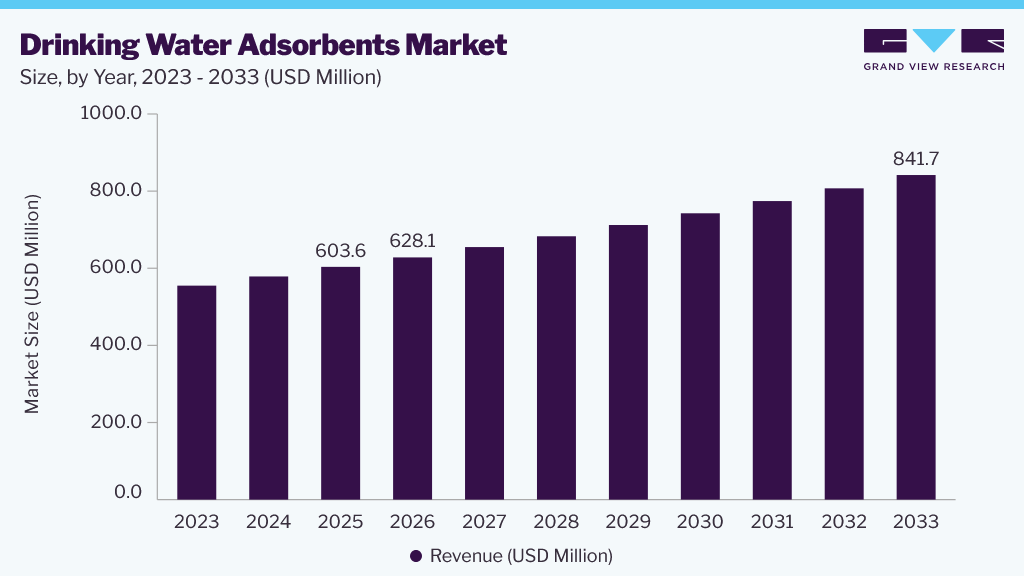
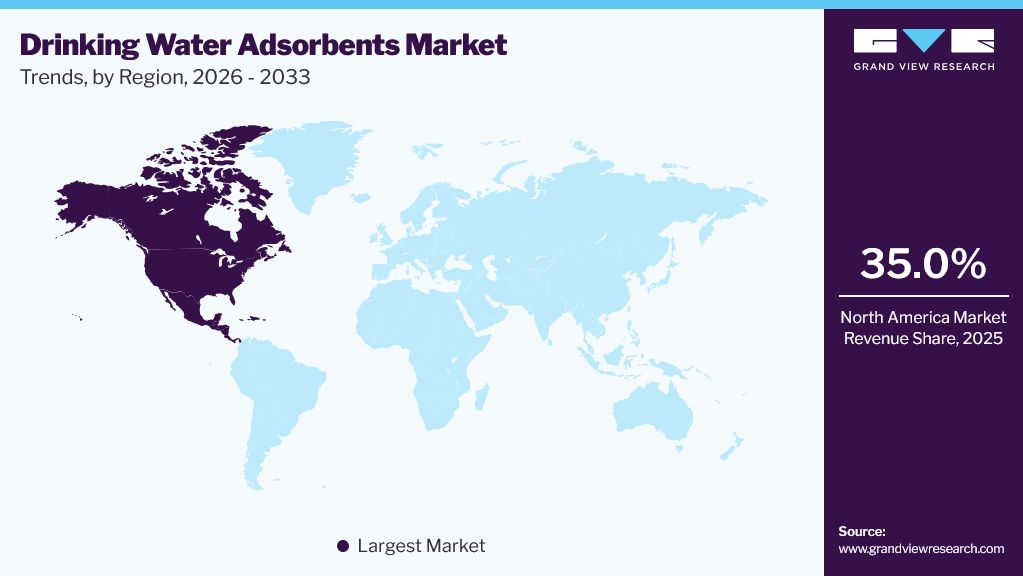
The global drinking water adsorbents market was valued at USD 603.9 million in 2025 and is projected to grow from USD 628.1 million in 2026 to USD 841.7 million by 2033, at a CAGR of 4.3% from 2026 to 2033. North America dominated the market, accounting for a revenue share of 35.0% in 2025. Rising pollution concerns and stricter environmental regulations, coupled with health risks associated with contaminated water, including cancer, brain damage, and organ failure, are expected to drive demand for adsorbents used in water treatment.
 Source: Grand View Research, IR Documents, Primary Interviews, Paid DatabasesTo learn more about this report,
 Download Free Sample Report
Key Market Trends & Insights
- By product: Activated carbon segment held the largest market share in 2025.
- By application: Municipal water treatment accounted for the largest share in 2025.
Regional Highlights
- Largest regional market: North America (35.0% revenue share, 2025)
- Fastest-growing regional market: Asia Pacific (highest CAGR, 2026-2033)
Market Size & Forecast
- Market size in 2025: USD 603.9 Million
- Estimated market size in 2026: USD 628.1 Million
- Projected market size by 2033: USD 841.7 Million
- CAGR (2026-2033): 4.3%
Prism AI by Grand View Research Free to tryAsk a question about the drinking water adsorbents marketTry asking✓Every figure cited from GVR research Prefer the report? Download free sample →The rising demand for activated carbon to remove turbidity and naturally occurring organic matter is projected to affect the market positively. The U.S. is a significant market for water treatment, attributed to its highly developed industrial sector and advanced processing capabilities. Favorable government initiatives to promote investment in the domestic water treatment industry are also expected to positively impact the market for drinking water adsorbents in the coming years.
However, the market may face considerable threats from substitutes, particularly alternative water purification techniques such as reverse osmosis. These methods offer advantages over adsorption, including the ability to remove dissolved impurities from water. Currently, there is a growing demand for organic adsorbents, such as coconut shells, coal, and wood. These materials are highly effective as adsorbents and play a valuable role in water quality control and purification. They can also be applied in various settings focused on environmental sustainability and recovery.
The increasing demand for adsorbents in drinking water filtration presents significant opportunities for new manufacturers entering the market. This surge in demand, along with growth potential in developing countries, is expected to allow local players to expand their business portfolios. Market participants are focusing on developing technologies to recycle spent adsorbents and extend their lifespan through regeneration. Furthermore, rising investment in the development of biochar as a bioadsorbent, a low-cost alternative to activated carbon, is anticipated to drive market growth in the foreseeable future.
Analyst Perspective
The drinking water adsorbents market is expanding amid growing global concerns about water quality and contamination. Adsorbents remove heavy metals, organic compounds, fluoride, arsenic, and other impurities from residential, industrial, and municipal water. Stricter regulations and greater investment in water treatment infrastructure are boosting demand. Manufacturers are focusing on developing high-capacity, affordable, sustainable adsorbent materials to improve filtration and lower operating costs. Companies with strong materials expertise, reliable production capabilities, and broad application knowledge are well positioned. Future growth will hinge on innovation, regulatory compliance, and effective solutions to evolving global water quality challenges.
Product Insights
The activated carbon segment held the largest market share in 2025, owing to its exceptional physical characteristics, which enable it to remove dissolved contaminants, including taste, odor, color, and toxic species. Activated carbon is the most efficient product for removing organic contaminants due to the presence of carbon and hydrogen in its structure. Water utilities are expanding the adoption of activated carbon to address emerging drinking water contaminants. For instance, in June 2026, Calgon Carbon launched Filtrasorb Rx for municipal drinking water systems, offering tailored activated carbon solutions with validated contaminant removal performance.
The zeolite segment is expected to expand at a significant CAGR over the forecast period, driven by rising preference for the product as a low-cost resource for separation and purification processes, particularly for removing ammonia and heavy metals from drinking water, owing to its high ion-exchange capacity and molecular-sieve properties. Water treatment stakeholders are increasingly adopting cost-effective adsorbents for contaminant removal. For instance, in May 2026, researchers validated conductive zeolite electrodes that achieved 97.2% ammonium removal from mining wastewater during pilot-scale treatment operations. This development highlights zeolite's strong ion-exchange performance, supporting its growing use for efficient water purification applications.
Application Insights
The municipal water treatment segment accounted for the largest share of the drinking water adsorbents market in 2025, owing to the critical need to provide safe drinking water to growing urban populations. Governments and utilities maintain significant investments in water infrastructure to keep pace with rising quality regulations. The growing concern about pollutants such as heavy metals, organic contaminants, and PFAS is fueling demand for adsorbents used at municipal facilities. Because large-scale treatment facilities’ capacities create steady demand, activated carbon, activated alumina, and other such sophisticated adsorbents are being used. Ongoing modernization of aging water infrastructure further supports market expansion. These factors collectively position municipal water treatment as the leading application segment within the global drinking water adsorbents market.
The residential point-of-use (POU) water treatment segment is projected to register the fastest growth during the forecast period. The growing public awareness of tap water quality is boosting sales of domestic filters. Aware of contaminants and aging infrastructure, customers are opting for further water filtration. Technological advancements have improved the affordability and effectiveness of residential filtration products. Consumer demand is further driven by population growth in urban centers and rising disposable income. Homeowners and consumers today are increasingly concerned about ensuring that clean water supplies are consistently and easily accessible in the home. Direct-to-consumer sales channels, coupled with a rising e-commerce penetration, are also making products more widely available.
Regional Insights
North America drinking water adsorbents marketdominated the global marketdue tothe demand for adsorbents in North America is projected to be driven by stringent environmental protection regulatory standards and is expected to expand at a notable CAGR during the forecast period. Besides, the implementation of the Safe Drinking Water Act (SDWA) by the U.S. Environmental Protection Agency (U.S. EPA) is projected to benefit the regional market growth.
 To learn more about this report, Download Free Sample Report
Asia Pacific Drinking Water Adsorbents Market Trends
Asia Pacific is expected to witness the fastest CAGR during the forecast period, driven by rising concerns about water pollution, which is leading to stricter regulations. Governmental bodies, such as municipal corporations, are encouraging the use of adsorbents for water treatment owing to their superior performance in removing heavy metal ions. Regional governments are strengthening water treatment initiatives to improve drinking water quality. For instance, in July 2025, Water Stewardship Asia Pacific launched a program to support wastewater quality regulations in Indonesia and Vietnam through policy development and improvements in water governance.
Rising groundwater contamination from pollutants such as arsenic, fluoride, sewage, and industrial effluents is leading to significant adverse health impacts across South Asia. This is expected to boost the prominence of water treatment processes for removing pollutants from groundwater resources, thereby driving the regional market.
Europe Drinking Water Adsorbents Market Trends
Drinking water adsorbents market in Europe is expected to remain the second-largest market for drinking water adsorbents in the forthcoming years. The region has stringent laws regarding water treatment. High awareness regarding pollution hazards, the presence of strict norms and regulations to promote sustainable growth, and high demand from manufacturing sectors for water filtration processes are the primary factors contributing to the demand for adsorbents in Europe.
Key Drinking Water Adsorbents Companies Insights
The market is fragmented due to numerous small- and medium-sized manufacturers. The regional players position themselves as regional experts and specialize in state- and national-level legislation. Also, these players know the regional environment and product demand, giving them a competitive edge over other players. Market participants focus on maintaining strategic relationships with suppliers and distributors to ensure a steady supply of products. They generally source raw materials from multiple suppliers to avoid disruptions in material supply.
Key Drinking Water Adsorbents Companies
The following key companies have been profiled for this study on the drinking water adsorbents market:
-
BASF SE
-
CycloPure, Inc.
-
Dow Inc.
-
DuPont de Nemours, Inc.
-
Evoqua Water Technologies LLC (Xylem Inc.)
-
KMI Zeolite, Inc.
-
Kuraray Co., Ltd.
-
Lenntech B.V.
-
Purolite Corporation (Ecolab)
-
TIGG LLC (Xylem Inc.)
Recent Developments
-
In June 2024, Kuraray Co., Ltd. published a report highlighting the growing demand for activated carbon following new PFAS drinking water regulations in the U.S. The company identified activated carbon as a key technology for removing PFAS contaminants from drinking water. The announcement underscores rising investment in advanced adsorbents and reflects stronger regulatory support for water treatment solutions
-
In April 2024, the U.S. Environmental Protection Agency (EPA) finalized national drinking water standards for PFAS. The regulation established enforceable limits for several PFAS compounds in drinking water. The decision is accelerating the adoption of granular activated carbon and other adsorbent technologies. It is also driving infrastructure investments across municipal water treatment systems.
Drinking Water Adsorbents Market Report Scope
Report Attribute
Details
Market size in 2025
USD 603.9 million
Estimated market size in 2026
USD 628.1 million
Projected market size by 2033
USD 841.7 million
Growth rate
CAGR of 4.3% from 2026 to 2033
Base year for estimation
2025
Historical data
2021 – 2024
Forecast period
2026 – 2033
Quantitative units
Revenue in USD million, and CAGR from 2026 to 2033
Report coverage
Revenue forecast, company ranking, competitive landscape, growth factors, and trends
Segments covered
Product, application, region
Regional scope
North America; Europe; Asia Pacific; Central & South America; Middle East & Africa
Country scope
U.S.; Canada; Mexico; UK; Germany; France; Italy; Spain; China; India; Japan; Australia; Brazil; Argentina; South Africa; UAE
Key companies profiled
BASF SE; CycloPure, Inc.; Dow Inc.; DuPont de Nemours, Inc.; Evoqua Water Technologies LLC (Xylem Inc.); KMI Zeolite, Inc.; Kuraray Co., Ltd.; Lenntech B.V.; Purolite Corporation (Ecolab); TIGG LLC (Xylem Inc.)
Customization scope
Free report customization (equivalent up to 8 analysts working days) with purchase. Addition or alteration to country, regional & segment scope.
Pricing and purchase options
Avail of customized purchase options to meet your exact research needs. Explore purchase options
Global Drinking Water Adsorbents Market Report Segmentation
This report forecasts revenue growth at global, regional, and country levels and provides an analysis of the latest industry trends and opportunities in each of the sub-segments from 2021 to 2033. For this study, Grand View Research has segmented the global drinking water adsorbents market report based on product, application, and region:
-
Product Outlook (Revenue, USD Million, 2021 - 2033)
-
Zeolite
-
Clay
-
Alumina
-
Activated Carbon
-
Manganese Oxide
-
Cellulose
-
Others
-
Application Outlook
- Municipal Water Treatment
- Residential POU Water Treatment
- Industrial Water Treatment
- Commercial Water Treatment
- Emergency and Portable Water Purification
-
Regional Outlook (Revenue, USD Million, 2021 - 2033)
-
North America
-
U.S.
-
Canada
-
Mexico
-
-
Europe
-
Germany
-
UK
-
France
-
Italy
-
Spain
-
-
Asia Pacific
-
China
-
Japan
-
India
-
Australia
-
-
Central & South America
-
Brazil
-
Argentina
-
-
MEA
-
South Africa
-
UAE
-
-
Frequently Asked Questions About This Report
The global drinking water adsorbents market size was estimated at USD 476.2 million in 2019 and is expected to reach USD 494.5 million in 2020.
The global drinking water adsorbents market is expected to grow at a compound annual growth rate of 4.0% from 2019 to 2025 to reach USD 603.8 million by 2025.
Activated carbon dominated the drinking water adsorbents market with a share of xx% in 2019. This is attributable to its exceptionally rare physical characteristics, which enable it to remove dissolved contaminants including taste, odor, color, and toxic species.
Some key players operating in the drinking water adsorbents market include Purolite, BASF SE, KMI Zeolite, and Kuraray Co. Ltd.
Key factors that are driving the drinking water adsorbents market growth include rising concerns regarding pollution, resulting in the formulation of strict regulations.
About the Author(s)
Water & Sludge Treatment Research Team
Bulk Chemicals · Water & Sludge TreatmentThis report was authored by the water & sludge treatment research team at Grand View Research - comprising two research analysts, one senior research analyst, and one industry expert - with specialized expertise in the water & sludge treatment segment of the bulk chemicals industry. All findings are based on proprietary bulk chemicals databases, executive interviews, and regulatory analysis, subject to internal peer review prior to publication.
Last Updated:
Speak to Analyst

Customize this report to your needs - add regions, segments, or data points, with 20% free customization.
Or view our licence options:


ISO 9001:2015 & 27001:2022 Certified
We are GDPR and CCPA compliant! Your transaction & personal information is safe and secure. For more details, please read our privacy policy.


