
- Home
- »
- Next Generation Technologies
- »
-
Drone-as-a-Service Market Size, Share, Trends Report, 2033GVR Report cover

Drone-as-a-Service Market (2026 - 2033)
Size, Share & Trends Analysis Report By Drone Type (Fixed-wing, Multi-rotor, Single-rotor, Hybrid), By Service (Surveying & Mapping, Inspection & Monitoring, Aerial Photography & Videography), By Application, By End-use, By Region, And Segment Forecasts
Market Size, 2025
$6.7BMarket Estimate, 2026
$8.0BMarket Forecast, 2033
$24.2BCAGR, 2026–2033
17.1%Drone-as-a-Service (DaaS) Market Summary
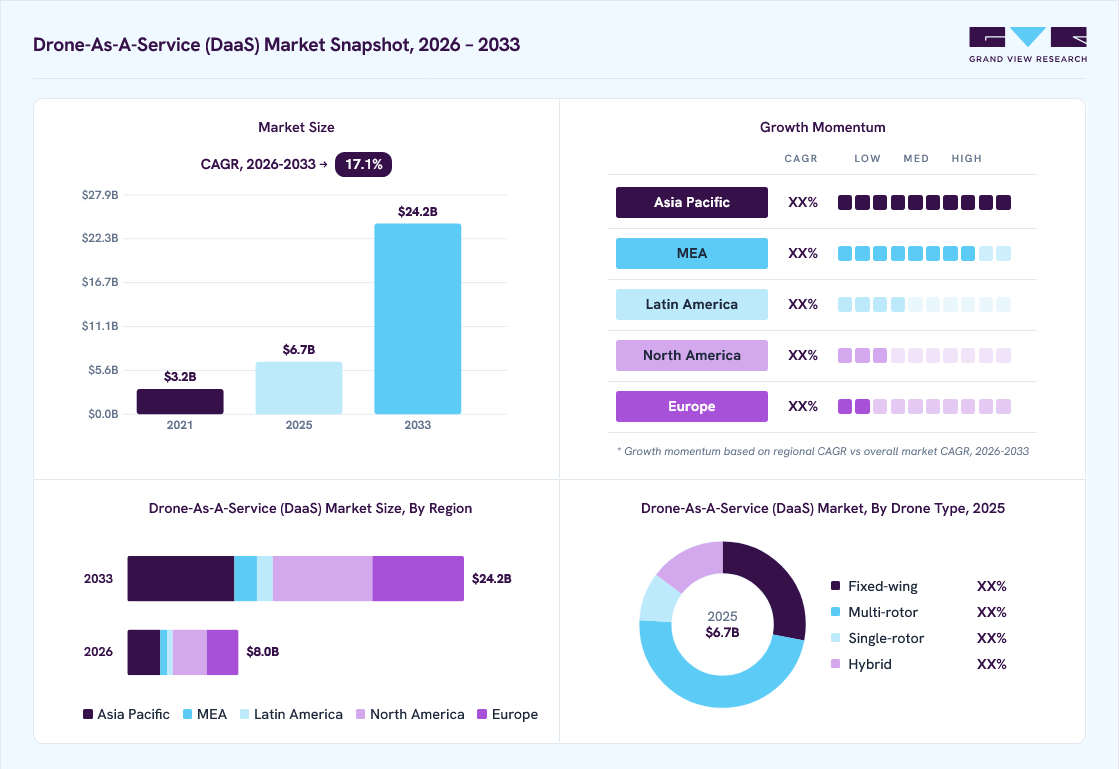
The global drone-as-a-service (DaaS) market size was valued at USD 6.7 billion in 2025 and is projected to grow from USD 8.0 billion in 2026 to USD 24.2 billion by 2033, at a CAGR of 17.1% from 2026 to 2033. North America dominated the market, accounting for the largest revenue share of 30.8% in 2025. Growth is primarily driven by increasing adoption of drone-based inspection, surveying, mapping, monitoring, and delivery services; rising investments in autonomous drone technologies; expanding commercial and industrial applications; and growing demand for cost-efficient aerial data collection and remote operations across industries.
 Source: Grand View Research, IR Documents, Primary Interviews, Paid DatabasesTo learn more about this report,
 Download Free Sample Report
 Key Market Trends & Insights
- By drone type: The multi-rotor segment accounted for the largest revenue share of over 47.0% in 2025.
- By service: The inspection & monitoring accounted for the largest overall market revenue share in 2025 worldwide.
- By application: The construction segment accounted for the largest market share in 2025.
- By end-use: The commercial segment held the largest market revenue share in 2025.
Regional Highlights
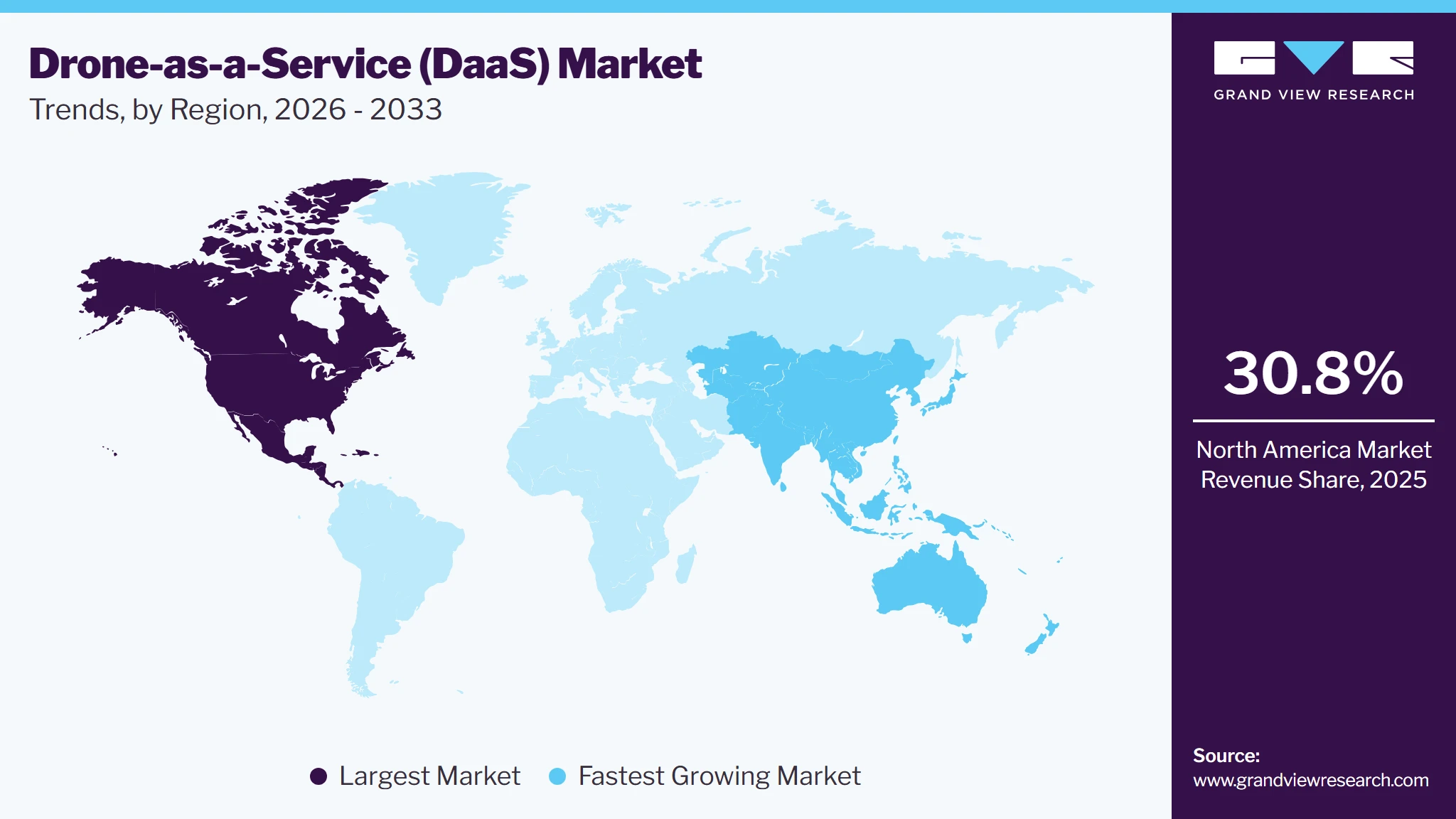
- Largest regional market: North America (30.8% revenue share in 2025)
- Fastest growing regional market: Asia Pacific (highest CAGR 18.3%, 2026-2033)
- By Country: The U.S. held the largest market share in 2025
Market Size & Forecast
- Market size in 2025: USD 6.7 Billion
- Estimated market size in 2026: USD 8.0 Billion
- Projected market size by 2033: USD 24.2 Billion
- CAGR (2026-2033): 17.1%
Three ways to get this report
Buy it, customize it, or ask a question.Ask an Analyst
A direct answer, usually in 1 working day
- AccessReport author, directly
- Reply timeWithin 1 working day
- No sales callDirect answer only
- FormatEmail reply
- CostFree, no cost
Get the Full Report
What the study covers
- FormatsPDF · Excel · Dashboard
- Timeline2026–2033 annual, 2025 base
- Coverage20+ countries, 5 regions
- Companies10+ key players profiled
Customize the Report
20% free customization
- IncludeCountries, segments, points
- TailorTo your product definition
- ExtendDeeper competitor detail
- OrA fully bespoke study
- Turnaround5–10 working days
The drone-as-a-service (DaaS) industry is advancing rapidly as commercial drone adoption, industrial aerial services, enterprise operations, logistics, public-safety activities, and government programs expand globally. Market participants are increasingly emphasizing autonomous flight, remote operations, AI-enabled data analytics, fleet management, real-time monitoring, and integrated drone-service platforms. These priorities are creating sustained demand for DaaS solutions across surveying, mapping, inspection, monitoring, agriculture, construction, logistics, mining, oil & gas, infrastructure, emergency response, and other specialized services.In addition, the expansion of commercial and industrial drone service programs and increasing investments in enterprise UAV platforms are accelerating demand for drone services that support surveying, mapping, inspection, monitoring, delivery, and aerial data collection. Service providers are also investing in autonomous flight technologies, fleet management platforms, remote operations, and regulatory-compliance capabilities to improve operational efficiency, expand service coverage, and meet evolving aviation requirements. These investments are expected to support the continued adoption of DaaS as commercial and industrial drone services scale.
 To learn more about this report, Download Free Sample Report
 Furthermore, industrial drone operations require highly integrated service capabilities that coordinate flight planning, remote piloting, payload management, data collection, real-time communication, and post-flight analytics. DaaS-enabled operations improve operational efficiency, data accuracy, asset visibility, and fleet coordination for customers, supporting safer and more scalable drone services across industries. This growing dependence on integrated drone operations is expected to strengthen DaaS adoption across the commercial and industrial drone ecosystem. These developments are expected to strengthen demand across the market throughout the forecast period.
Moreover, the integration of artificial intelligence, machine learning, cloud computing, digital mapping, and real-time data analytics is transforming drone service delivery and operations. AI-enabled systems can support autonomous flight, predictive maintenance, automated inspection, route optimization, asset monitoring, and operational decision-making. Fleet management platforms enable centralized control of drone operations, while simulation and testing tools improve mission planning and operational readiness. These technological advancements are expanding DaaS capabilities and encouraging stakeholders to invest in next-generation drone service infrastructure. These trends support continued adoption across the market.
Market Dynamics
The market is shaped by increasing drone adoption, evolving aviation regulations, advancements in autonomous operations, and the expansion of commercial and industrial drone-service infrastructure. Growth is supported by investments from drone service providers, technology developers, enterprise operators, logistics companies, and government agencies. However, complex regulatory requirements, airspace restrictions, cybersecurity risks, fragmented regional standards, high operational costs, and uncertain approval timelines remain key challenges. Ongoing innovation in autonomous flight, data analytics, fleet management, remote operations, and airspace coordination continues to shape the competitive landscape.
Commercial and industrial organizations increasingly require drone services to support inspection, surveying, mapping, monitoring, data collection, and asset-management activities. This has accelerated demand for DaaS solutions that can improve operational efficiency, reduce inspection time, enhance worker safety, and provide accurate aerial data across industrial and specialized applications. The shift toward outsourced and digitally managed drone operations is increasing demand for surveying, mapping, inspection, monitoring, and aerial imaging services.
Autonomous flight, real-time data collection, route planning, remote monitoring, and automated data processing can improve drone utilization and reduce operational complexity compared with conventional inspection and surveying workflows. Their ability to support efficient, scalable operations makes these capabilities important for commercial and industrial drone programs. Moreover, drone service providers and enterprise operators are increasing investments in DaaS capabilities, supporting sustained market growth.
The delivery of drone-as-a-service solutions requires regulatory approvals, qualified operators, airspace compliance, flight planning, insurance, maintenance, data security, and integration across multiple operational systems, making service deployment technically and operationally complex. High equipment, staffing, technology, and compliance expenditures, coupled with aviation requirements and integration across different operating environments, increase overall DaaS operating costs.
In addition, lengthy regulatory approval processes and evolving airspace, safety, and data privacy requirements can delay service deployment, particularly for emerging drone service providers. The need for continuous fleet maintenance, pilot training, software updates, cybersecurity management, and operational compliance further adds to lifecycle costs. These technical and financial challenges may slow adoption, especially among smaller operators and service providers with limited operational resources.
Increasing investments in commercial drone fleets, industrial inspection programs, logistics operations, and enterprise drone ecosystems are creating significant market opportunities. Agriculture, construction, mining, oil & gas, utilities, logistics operators, and government agencies are adopting DaaS solutions that enable efficient surveying, inspection, monitoring, mapping, delivery, and aerial data collection.
Emerging technologies such as autonomous flight systems, AI-enabled flight planning, digital mapping, fleet management, predictive maintenance, real-time aerial monitoring, remote operations, and digital airspace management are creating new opportunities for DaaS innovation. As drone programs progress toward broader regulatory approval and commercial deployment, the need for integrated services across drone operations, data collection, maintenance, fleet management, and infrastructure is expected to increase. These investments are expected to accelerate the adoption of specialized drone services and support sustained market growth over the forecast period.
Market Concentration & Characteristics
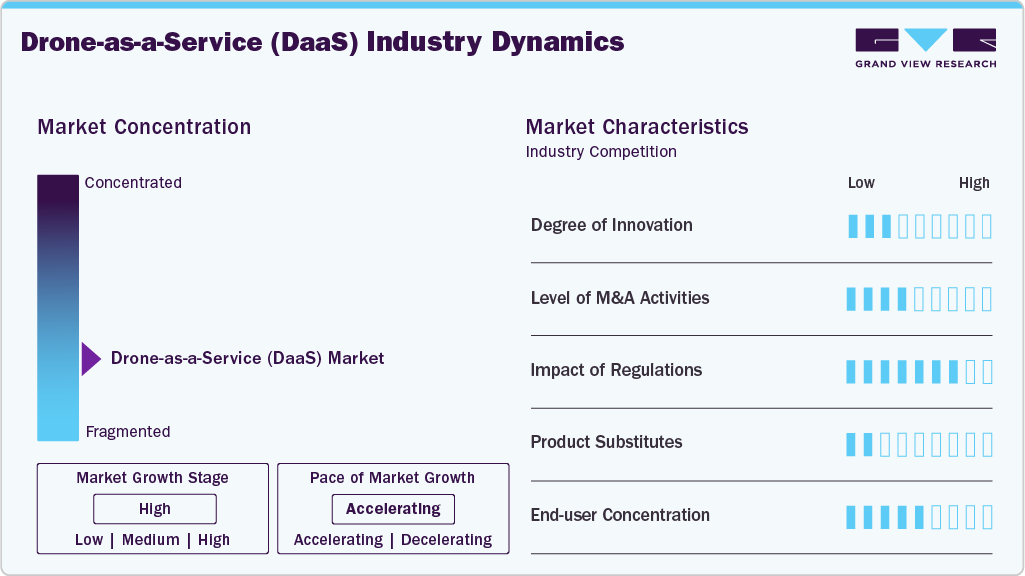
The global drone-as-a-service (DaaS) industry is moderately fragmented, with drone service providers, drone manufacturers, software providers, autonomous technology companies, and specialized operators competing across different DaaS service categories. The market demonstrates a high degree of innovation, driven by advancements in autonomous flight, AI-enabled data analytics, digital mapping, cloud platforms, fleet management, remote operations, and integrated drone systems. The market also witnesses partnerships and selective M&A activity as established service providers collaborate with specialized technology and software companies to strengthen capabilities across emerging commercial and industrial drone programs globally.
 To learn more about this report, Download Free Sample Report
 The drone-as-a-service (DaaS) industry is significantly affected by aviation regulations, airspace rules, cybersecurity requirements, data privacy governance, and government policies that support commercial and industrial drone operations. DaaS solutions have limited direct substitutes in applications requiring efficient aerial data collection, remote inspection, surveying, and monitoring, although conventional manned aircraft, ground-based inspection, and internally developed drone operations may serve selected applications. The competitive landscape is moderately concentrated, with drone service providers, industrial operators, logistics companies, infrastructure operators, government organizations, and other enterprise customers representing major demand centers. Expanding commercial and industrial drone programs are broadening adoption opportunities across emerging service applications and operations globally.
Analyst Perspective
The market is poised for steady expansion, driven by increasing adoption of drone-enabled services, growing demand for aerial data collection and analysis, advancements in autonomous flight and drone technologies, and the expanding use of drones across commercial, industrial, and government applications. Rising demand for surveying and mapping, inspection and monitoring, aerial photography and videography, and delivery services, coupled with improvements in flight automation, payload capabilities, data processing, and evolving drone regulations, is expected to drive the adoption of DaaS solutions across the expanding drone ecosystem in the coming years.
Drone Type Insights
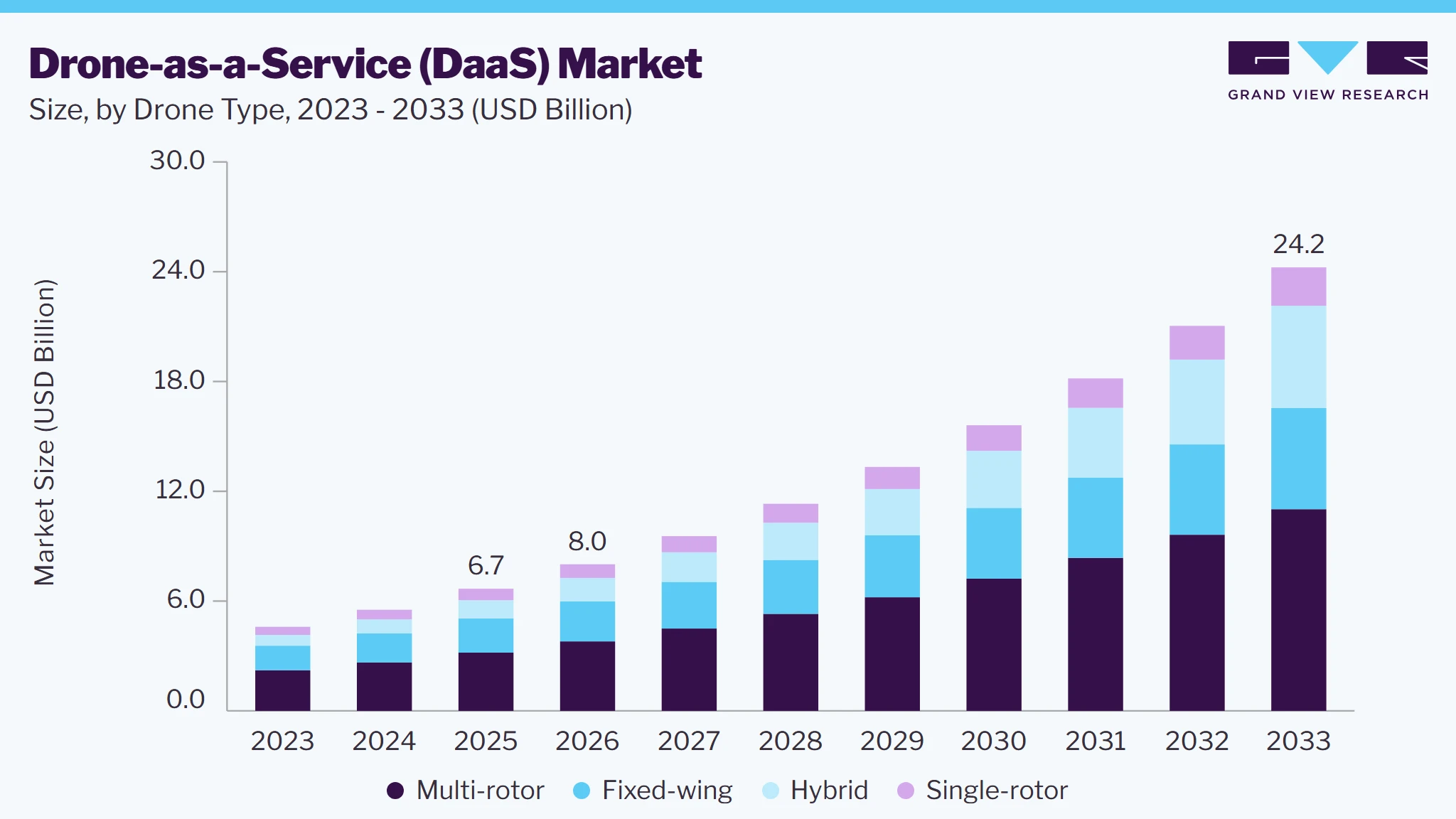
The multi-rotor segment accounted for the largest market share of over 47.0% in 2025, driven by increasing demand for surveying, mapping, inspection, monitoring, aerial photography, and videography services across commercial and industrial drone operations. The growing use of multi-rotor drones, driven by their maneuverability, hovering capabilities, operational flexibility, and suitability for diverse service applications, is further supporting the segment's dominance. These developments are expected to strengthen demand for multi-rotor-based DaaS solutions across commercial, industrial, and government applications throughout the forecast period.
The hybrid segment is expected to register strong, significant growth from 2026 to 2033, supported by rising demand for extended flight endurance, longer operational range, vertical takeoff and landing, autonomous operations, and flexible deployment capabilities. Increasing adoption of hybrid drones for surveying, mapping, inspection, monitoring, and delivery services is expected to accelerate segment growth. These developments are expected to strengthen demand for hybrid drone-based services across infrastructure, logistics, industrial operations, and other specialized DaaS applications.
Service Insights
The inspection & monitoring segment accounted for the largest market share in 2025, driven by increasing demand for drone-based inspection, asset monitoring, infrastructure assessment, and remote visual data collection across energy, utilities, construction, telecommunications, and industrial operations. The growing use of drones to improve inspection efficiency, reduce operational costs, enhance worker safety, and access difficult-to-reach assets is further supporting segment dominance. These developments are expected to strengthen demand for inspection and monitoring services across commercial, industrial, and government applications throughout the forecast period.
The delivery services segment is expected to register strong growth from 2026 to 2033, supported by rising demand for last-mile delivery, autonomous transportation, medical supply delivery, food delivery, and other time-sensitive logistics services. Increasing investments in autonomous drone fleets, navigation systems, delivery infrastructure, and regulatory frameworks are expected to accelerate service adoption. These developments are expected to strengthen demand for drone delivery services across logistics, healthcare, retail, and other commercial applications.
Application Insights
The construction segment accounted for the largest market share in 2025, driven by rising demand for drone-based surveying, mapping, progress monitoring, site inspections, stockpile measurements, and 3D modeling across construction projects. The growing integration of drone data into project management and site-monitoring workflows is further strengthening the segment's dominance. These developments are expected to strengthen demand for DaaS solutions across construction planning, monitoring, inspection, and project management throughout the forecast period.
The Logistics segment is expected to register strong growth from 2026 to 2033, supported by rising demand for last-mile delivery, autonomous transportation, route optimization, inventory monitoring, and time-sensitive shipment services. Increasing adoption of autonomous drone operations and investments in delivery infrastructure, fleet management, and regulatory compliance are expected to accelerate service adoption. These developments are expected to strengthen demand for drone-based logistics services across commercial and industrial applications.
End-use Insights
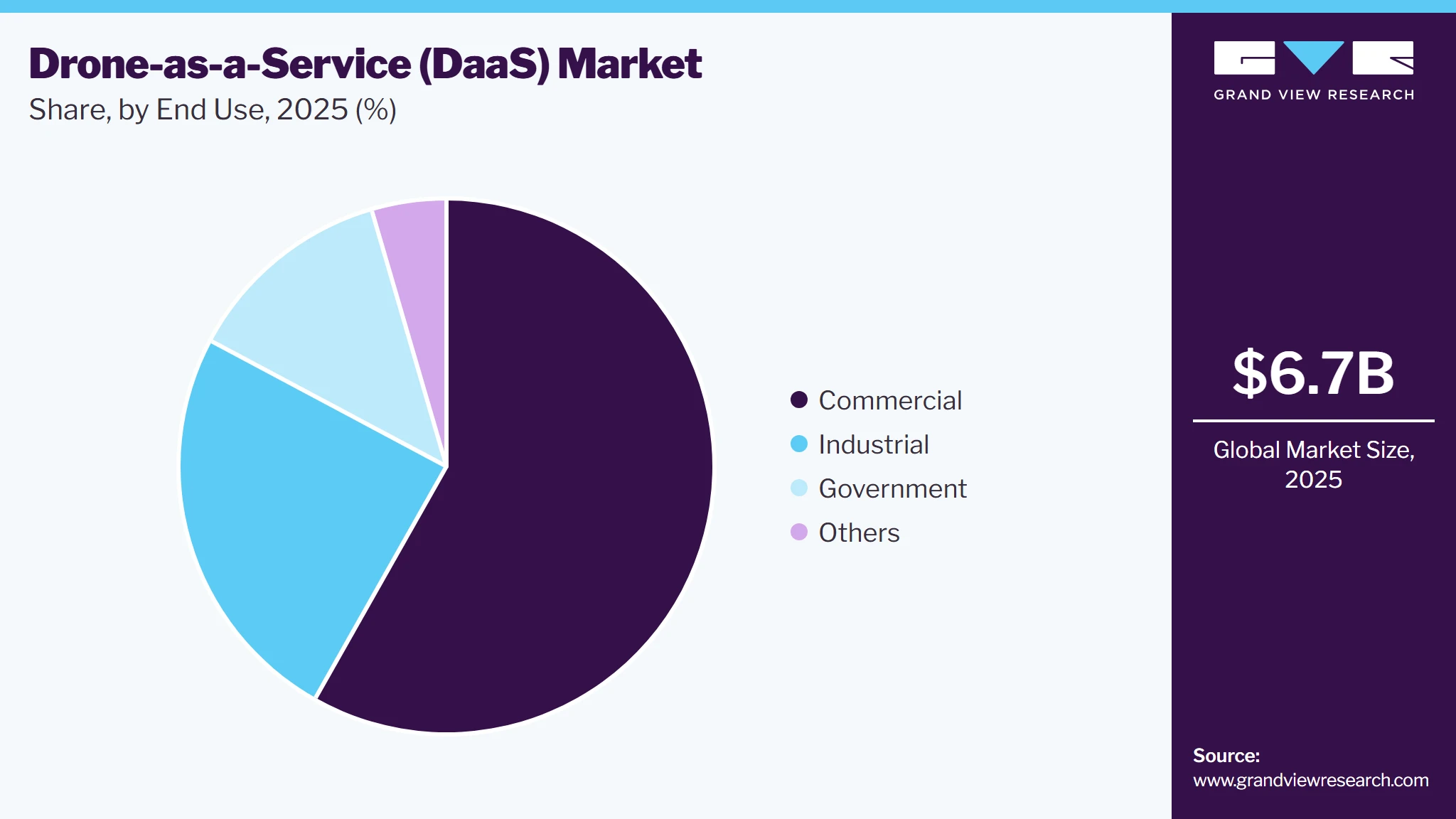
The commercial segment accounted for the largest market share in 2025, driven by increasing demand for outsourced drone services across aerial photography and videography, surveying, mapping, inspection, construction, agriculture, and other business applications. The growing preference for service-based drone operations that reduce upfront investment, operational complexity, and fleet management requirements is further strengthening the segment's dominance. These developments are expected to strengthen demand for DaaS solutions across commercial applications throughout the forecast period.
 To learn more about this report, Download Free Sample Report
 The government segment is expected to register strong, significant growth from 2026 to 2033, supported by rising demand for drone-based public infrastructure monitoring, emergency response, disaster assessment, public safety, environmental monitoring, and government surveying services. Increasing government investments in unmanned aerial systems, autonomous operations, and drone-enabled public services are expected to accelerate service adoption. These developments are expected to strengthen demand for DaaS solutions across public safety, infrastructure, environmental, and other government applications.
Regional Insights
North America accounted for the largest revenue share of the drone-as-a-service (DaaS) market, with over 30.8% in 2025, driven by growing adoption of drones across industrial, defense, public safety, infrastructure inspection, and aerial imaging services. The region’s established drone ecosystem, increasing investments in advanced drone technologies, and expanding use of unmanned aerial systems across various industries further supported market growth.
 To learn more about this report, Download Free Sample Report
 U.S. Drone-as-a-Service Market Trends
The drone-as-a-service (DaaS) market in the U.S. dominated North America in 2025, supported by substantial industrial drone deployment activity, advanced drone service capabilities, and early adoption of autonomous flight technologies. The country is investing heavily in drone operations, digital engineering, simulation, fleet management, and airspace integration to support the industrialization of enterprise drone services.
Europe Drone-as-a-Service Market Trends
The drone-as-a-service (DaaS) market in Europe is expected to grow at a CAGR of over 16.0% from 2026 to 2033, propelled by increasing industrial drone deployment, service innovation, sustainability targets, and investments in drone infrastructure. European companies are developing autonomous systems, simulation platforms, data analytics, and digital operational tools. Growing emphasis on regulatory readiness, interoperability, and sustainable inspection services is contributing to market growth across the region. These factors are expected to support continued market expansion across industrial drone programs.
Germany drone-as-a-service (DaaS) marketis expected to grow significantly in the coming years, fueled by drone-engineering capabilities, investments in industrial drone technology, and development of industrial inspection solutions. The country is focusing on autonomous flight, simulation, digital engineering, and aerial monitoring technologies. Growing collaboration among drone service providers, technology companies, and research institutions is further supporting adoption of DaaS solutions. These trends support continued adoption across the broader drone market globally.
The drone-as-a-service (DaaS) market in the UKis witnessing rapid expansion. Government initiatives supporting industrial drone operations, service innovation, and future flight technologies are driving demand for specialized drone services. The country is focusing on autonomous flight, simulation, airspace integration, and operational management solutions to improve the safety and scalability of emerging enterprise drone services.
Asia Pacific Drone-as-a-Service Market Trends
The drone-as-a-service (DaaS) market in the Asia Pacific is expected to grow at the fastest CAGR of 18.3% from 2026 to 2033, driven by increasing investments in industrial drone services, agricultural drone use, logistics, and autonomous systems. Countries across the region are developing drone infrastructure, digital platforms, and operational capabilities to support future industrial drone services globally.
China drone-as-a-service (DaaS) marketis being accelerated by strong investments in industrial drone services, autonomous technologies, and domestic manufacturing capabilities. The country is investing in flight control, navigation, aerial monitoring, simulation, and fleet management systems to support emerging drone operations. Government support and expanding domestic drone programs continue to accelerate DaaS development. These trends support continued adoption across the market.
The drone-as-a-service (DaaS) market in Japanis expanding steadily, driven by investments in industrial drone services, urban inspection services, aerospace innovation, and advanced operational technologies. Japan is focusing on autonomous flight, navigation, aerial monitoring, simulation, and airspace-management capabilities. Collaboration among technology companies, drone developers, and public agencies is further supporting adoption of DaaS solutions. These trends are expected to remain important for safe and scalable industrial drone operations.
Key Drone-as-a-Service Company Insights
Some of the key players operating in the market include Aerodyne Group, Terra Drone Corporation, Cyberhawk Innovations Limited, DroneDeploy, Inc., and SkySpecs, Inc.
-
Aerodyne Group is a major drone service provider with a strong presence in the market through drone-based inspection, surveying, mapping, monitoring, and data analytics solutions. The company provides integrated drone operations supporting energy, utilities, telecommunications, infrastructure, and mining applications. Its global operating capabilities and enterprise-focused drone services provide a significant competitive advantage in the market. These capabilities are expected to support continued adoption of outsourced drone services across commercial and industrial applications.
-
Terra Drone Corporation is a major drone technology and service provider with a strong presence in the market through surveying, mapping, inspection, monitoring, and delivery services. The company develops integrated drone operations and data solutions supporting construction, infrastructure, energy, logistics, and other industrial applications. Its global service network, drone technology capabilities, and diversified service portfolio provide a competitive advantage in the market. These developments are expected to support continued demand for drone-enabled services as commercial and industrial drone operations expand.
Zeitview, Inc. and DroneUp, LLC are among the emerging and specialized participants operating in the global market today.
-
Zeitview, Inc. is a prominent aerial inspection and visual data services provider specializing in drone-enabled inspection, monitoring, and asset intelligence solutions. The company provides services for renewable energy, telecommunications, infrastructure, and other industries requiring standardized aerial data. Its inspection network and data analytics capabilities support its role in the market across commercial and industrial applications.
-
DroneUp, LLC is an established drone services provider offering drone delivery, aerial operations, emergency response, and other drone-enabled services. The company provides integrated drone operations, fleet management, and delivery capabilities supporting commercial and government applications. Its focus on scalable drone operations and delivery services supports its market position. These trends support continued adoption across logistics and public-sector applications.
Key Drone-as-a-Service Companies
The following key companies have been profiled for this study on the drone-as-a-service (DaaS) market.
- Aerodyne Group
- Terra Drone Corporation
- Cyberhawk Innovations Limited
- DroneDeploy, Inc.
- SkySpecs, Inc.
- Zeitview, Inc.
- DroneUp, LLC
- Percepto Ltd.
- PrecisionHawk, Inc.
- Volatus Aerospace Corp.
- Sky-Futures
Competitive Benchmarking
Operating Strategies
Competitive Edge
Weaknesses
Established Players (Aerodyne Group, Terra Drone Corporation, Cyberhawk Innovations Limited, DroneDeploy, Inc., SkySpecs, Inc.)
- Focus on long-term contracts and partnerships with industrial, commercial, and government customers to provide surveying, mapping, inspection, monitoring, aerial imaging, and data analytics services.
- Invest in autonomous drone operations, AI-enabled analytics, cloud-based platforms, fleet management, remote operations, and integrated drone data solutions to expand service capabilities.
- Strong enterprise customer relationships, established drone operations, and experience across multiple commercial and industrial applications.
- Broad service capabilities, operational expertise, and established technology platforms support large-scale and recurring DaaS contracts.
- High operating, fleet management, and technology development costs associated with large-scale drone service operations.
- Regulatory requirements, airspace restrictions, and dependence on customer project cycles can limit the scalability of drone service operations.
Emerging & Specialized Players (Zeitview, Inc., DroneUp, LLC, Percepto Ltd., PrecisionHawk, Inc., Volatus Aerospace Corp., Sky-Futures)
- Focus on specialized DaaS capabilities, including autonomous inspection, drone delivery, aerial data collection, asset monitoring, surveying, and industrial inspection services.
- Expand service capabilities through technology partnerships, strategic collaborations, geographic expansion, and development of specialized drone service offerings.
- Faster innovation cycles and greater ability to develop specialized solutions for specific applications such as autonomous monitoring, infrastructure inspection, delivery, and industrial asset management.
- Strong expertise in targeted drone applications enables differentiated service offerings and flexible deployment models.
- Limited scale and geographic coverage compared with established DaaS providers.
- Smaller financial and operational resources, limited access to large enterprise contracts, and dependence on evolving drone regulations can constrain market expansion.
Recent Developments
-
In July 2026, Procore Technologies, Inc. announced a definitive agreement to acquire DroneDeploy, Inc. for approximately USD 845 million. The acquisition is expected to integrate DroneDeploy’s aerial and ground reality-capture and robotics capabilities with Procore’s construction management platform, strengthening the use of drone-based data, visual intelligence, and AI-powered insights across construction and asset-management workflows.
-
In July 2025, Terra Drone Corporation signed a memorandum of understanding with Saudi Arabia’s FAHSS to expand drone-based inspection services for plants and infrastructure. The partnership focuses on increasing the adoption of drone inspections across oil & gas, petrochemical, and energy applications and establishing drone-based inspection as a recognized industry practice in the Middle East.
-
In May 2025, Terra Drone Indonesia reported that its agriculture-focused drone service had conducted more than 200,000 hectares of drone-based operations, with up to 4,000 flights per day and more than 150 drones deployed in the field. The service includes pesticide spraying and mapping, demonstrating the expansion of DaaS models into large-scale agricultural operations.
Drone-as-a-Service Market Report Scope
Report Attribute
Details
Market size value in 2025
USD 6.7 billion
Market size value in 2026
USD 8.0 billion
Revenue forecast in 2033
USD 24.2 billion
Growth rate
CAGR of 17.1% from 2026 to 2033
Actual data
2021 - 2025
Forecast period
2026 - 2033
Quantitative units
Revenue in USD million/billion, and CAGR from 2026 to 2033
Report coverage
Report coverage, company ranking, competitive landscape, growth factors, and trends
Segments covered
Drone type, service, application, end-use, region
Regional scope
North America; Europe; Asia Pacific; Latin America; MEA
Country scope
U.S.; Canada; Mexico; Germany; UK; France; China; Japan; India; South Korea; Australia; Brazil; UAE; Saudi Arabia; South Africa
Key companies profiled
Aerodyne Group; Terra Drone Corporation; Cyberhawk Innovations Limited; DroneDeploy, Inc.; SkySpecs, Inc.; Zeitview, Inc.; DroneUp, LLC; Percepto Ltd.; PrecisionHawk, Inc.; Volatus Aerospace Corp.; Sky-Futures
Customization scope
Free report customization (equivalent up to 8 analysts working days) with purchase. Addition or alteration to country, regional & segment scope.
Global Drone-as-a-Service Market Report Segmentation
This report forecasts revenue growth at global, regional, and country levels and provides an analysis of the latest industry trends in each of the sub-segments from 2021 to 2033. For this study, Grand View Research has segmented the global drone-as-a-service (DaaS) market report based on drone type, service, application, end-use, and region.
-
Drone Type Outlook (Revenue, USD Billion, 2021 - 2033)
-
Fixed-wing
-
Multi-rotor
-
Single-rotor
-
Hybrid
-
-
Service Outlook (Revenue, USD Billion, 2021 - 2033)
-
Surveying & Mapping
-
Inspection & Monitoring
-
Aerial Photography & Videography
-
Delivery Services
-
Others
-
-
Application Outlook (Revenue, USD Billion, 2021 - 2033)
-
Agriculture
-
Construction
-
Logistics
-
Mining
-
Oil & Gas
-
Others
-
-
End-use Outlook (Revenue, USD Billion, 2021 - 2033)
-
Commercial
-
Industrial
-
Government
-
Others
-
-
Regional Outlook (Revenue, USD Billion, 2021 - 2033)
-
North America
-
U.S.
-
Canada
-
Mexico
-
-
Europe
-
Germany
-
UK
-
France
-
-
Asia Pacific
-
China
-
Japan
-
India
-
South Korea
-
Australia
-
-
Latin America
-
Brazil
-
-
Middle East and Africa (MEA)
-
UAE
-
Saudi Arabia
-
South Africa
-
-
Research Methodology
The drone-as-a-service (DaaS) market figures in this report are based on a proven research process that combines executive interviews with secondary research from proprietary databases, company filings, and recognized regulatory and institutional sources. Market size is built through value-chain sizing-reconciling supply-side and demand-side estimates-and triangulated with bottom-up and top-down approaches. Every estimate passes multiple levels of expert validation before publication, with each drone-as-a-service (DaaS) segment quantified using the revenue-capture definitions in the table below.
Segment Definition
Segment - Drone Type
Revenue capture definition
Fixed-wing
Revenue is generated from drone-as-a-service operations using fixed-wing drones for long-range and large-area applications, including surveying and mapping, infrastructure monitoring, agricultural monitoring, environmental assessment, and other services requiring extended flight endurance and coverage.
Multi-rotor
Revenue is generated from drone-as-a-service operations using multi-rotor drones for surveying, inspection, monitoring, aerial photography and videography, construction monitoring, agriculture, and other applications requiring vertical takeoff, hovering, and precise flight control.
Single-rotor
Revenue is generated from drone-as-a-service operations using single-rotor drones for applications requiring longer flight endurance and higher payload capacity, including industrial inspection, surveying, monitoring, agriculture, and specialized aerial data collection.
Hybrid
Revenue is generated from drone-as-a-service operations using hybrid drones that combine vertical takeoff and landing capabilities with fixed-wing flight characteristics for surveying, mapping, inspection, monitoring, delivery, and other services requiring extended range and operational flexibility.
Segment - Service
Revenue capture definition
Surveying & Mapping
Revenue is generated from drone-enabled surveying and mapping services, including land surveying, topographic mapping, photogrammetry, 3D modeling, cadastral mapping, construction site mapping, and geographic data collection.
Inspection & Monitoring
Revenue is generated from drone-enabled inspection and monitoring services for infrastructure, buildings, power lines, pipelines, telecommunications assets, industrial facilities, roads, bridges, and other assets requiring remote visual or sensor-based assessment.
Aerial Photography & Videography
Revenue is generated from drone-enabled photography and videography services for media production, film and television, advertising, real estate, tourism, events, sports, marketing content, and other applications requiring aerial imagery or video.
Delivery Services
Revenue is generated from drone-enabled delivery services involving the transportation and delivery of goods, packages, medical supplies, food, and other payloads to designated locations.
Others
Revenue is generated from other drone-enabled services, including emergency response, search and rescue, environmental monitoring, wildlife observation, disaster assessment, security and surveillance, and other specialized aerial services not covered under the defined services.
Segment - Application
Revenue capture definition
Agriculture
Revenue is generated from drone-as-a-service applications in agriculture, including crop monitoring, crop health assessment, field mapping, plant counting, irrigation monitoring, spraying, and other agricultural data collection and management services.
Construction
Revenue is generated from drone-as-a-service applications in construction, including site surveying, progress monitoring, land mapping, stockpile measurement, inspection, 3D modeling, and documentation of construction activities.
Logistics
Revenue is generated from drone-as-a-service applications in logistics, including last-mile delivery, parcel transportation, inventory monitoring, warehouse operations, route assessment, and other aerial logistics services.
Mining
Revenue is generated from drone-as-a-service applications in mining, including mine surveying, stockpile measurement, volumetric analysis, site mapping, pit monitoring, infrastructure inspection, and other aerial data collection services.
Oil & Gas
Revenue is generated from drone-as-a-service applications in oil and gas, including pipeline inspection, facility monitoring, flare inspection, storage tank inspection, offshore asset monitoring, and other remote inspection and surveillance services.
Others
Revenue is generated from drone-as-a-service applications across other industries, including utilities, telecommunications, real estate, media and entertainment, environmental monitoring, public safety, and other specialized applications.
Segment - End Use
Revenue capture definition
Commercial
Revenue is generated from drone-as-a-service solutions provided to commercial organizations for business activities such as aerial photography, real estate imaging, surveying, mapping, marketing, media production, agriculture, and other commercial applications.
Industrial
Revenue is generated from drone-as-a-service solutions used by industrial organizations for inspection, monitoring, surveying, mapping, asset management, construction, mining, oil and gas, utilities, and other industrial operations.
Government
Revenue is generated from drone-as-a-service solutions provided to government agencies for public infrastructure monitoring, emergency response, disaster assessment, public safety, environmental monitoring, surveying, mapping, and other government operations.
Others
Revenue is generated from drone-as-a-service solutions used by other end users, including research institutions, educational organizations, nonprofit organizations, and specialized users requiring drone-enabled aerial data collection or operational services.
Estimation Model
Layer Name
Key Question
Description
Drone Platform & Technology Layer
What drone platforms and technologies enable DaaS operations?
Represents the core drone platforms and technologies that enable drone-as-a-service operations. Includes fixed-wing, multi-rotor, single-rotor, and hybrid drones, along with flight control systems, navigation systems, payload capabilities, communication systems, sensors, autonomous flight capabilities, and other technologies that determine flight endurance, coverage, payload capacity, and operational performance.
Service & Application Layer
What services are delivered using drones and where are they applied?
Represents the services and applications that generate demand for DaaS. Key services include surveying & mapping, inspection & monitoring, aerial photography & videography, delivery services, and other specialized drone-enabled services. Primary applications include agriculture, construction, logistics, mining, oil & gas, and other industries requiring aerial data collection, monitoring, inspection, or delivery.
DaaS Operations & Service Delivery Layer
How are drone services planned, deployed, operated, and maintained?
Covers the operational activities required to deliver drone-as-a-service solutions throughout their service lifecycle. Includes mission planning, flight operations, drone deployment, remote piloting, autonomous operations, data collection, data processing, regulatory compliance, fleet management, maintenance, software updates, asset management, and post-flight analysis to ensure reliable and efficient service delivery.
DaaS Procurement & Market Monetization Layer
How is revenue generated in the Drone-as-a-Service (DaaS) Industry?
Revenue is generated through the provision of drone-enabled services to commercial, industrial, government, and other end users. Key revenue streams include surveying and mapping contracts, inspection and monitoring services, aerial photography and videography, drone delivery services, recurring service agreements, project-based contracts, subscription-based services, and other specialized drone operations.
Customization Table
Client Request
Customization Delivered
Value Adds
Market Sizing, Segmentation & Growth Opportunity Assessment
Assessed the global drone-as-a-service (DaaS) industry size, historical trends, forecast growth outlook, and detailed segmentation by Drone Type (Fixed-wing, Multi-rotor, Single-rotor, Hybrid), Service (Surveying & Mapping, Inspection & Monitoring, Aerial Photography & Videography, Delivery Services, Others), Application (Agriculture, Construction, Logistics, Mining, Oil & Gas, Others), and End Use (Commercial, Industrial, Government, Others). Evaluated demand patterns across drone-enabled surveying, mapping, inspection, monitoring, aerial photography and videography, delivery, and other specialized services.
Enables drone service providers, drone manufacturers, technology providers, industrial operators, government organizations, and investors to identify high-growth segments, prioritize investments, optimize service offerings, and capture revenue opportunities across commercial, industrial, and government DaaS applications.
Technology Landscape & Drone Service Innovation Analysis
Evaluated the adoption of next-generation technologies supporting DaaS operations, including autonomous flight, AI-enabled navigation and data processing, advanced sensors, real-time data transmission, flight management systems, fleet management platforms, obstacle detection and avoidance, precision positioning, and integrated drone-service technologies. Analyzed technological advancements improving operational efficiency, data accuracy, flight safety, scalability, and service delivery across different DaaS applications.
Helps drone service providers, technology companies, drone manufacturers, industrial operators, and other stakeholders identify emerging technology opportunities, improve operational efficiency, strengthen service differentiation, integrate advanced capabilities, and develop next-generation DaaS offerings aligned with evolving customer requirements.
Regional DaaS Demand & Adoption Analysis
Assessed regional demand across North America, Europe, Asia Pacific, Latin America, and the Middle East & Africa by evaluating drone adoption, regulatory developments, commercial and industrial activity, government applications, infrastructure development, logistics requirements, agricultural use, technology development, service-provider capabilities, and adoption of drone-enabled services across regional markets.
Provides actionable insights into regional growth opportunities, adoption priorities, competitive positioning, and investment hotspots, enabling DaaS providers, technology companies, investors, and other stakeholders to align market-entry strategies, prioritize regional resources, develop partnerships, and capitalize on increasing demand for drone-enabled services.
Frequently Asked Questions About This Report
The global Drone-as-a-Service (DaaS) Market is expected to reach USD 24.2 million by 2033, at a CAGR of 17.1% from 2026 to 2033.
North America accounted for the largest revenue share of 30.8% in 2025.
The increasing adoption of drone-based inspection, surveying, mapping, monitoring, and delivery services, rising investments in autonomous drone technologies, expanding commercial and industrial applications, and growing demand for cost-efficient aerial data collection and remote operations across industries are the key factors driving the market growth.
Aerodyne Group, Terra Drone Corporation, Cyberhawk Innovations Limited, DroneDeploy, Inc., SkySpecs, Inc., Zeitview, Inc., DroneUp, LLC, Percepto Ltd., PrecisionHawk, Inc., Volatus Aerospace Corp., Sky-Futures are the key players in drone as a service market.
By end-use, the commercial segment held the largest market revenue share in 2025.
In North America, The U.S. held the largest market share in 2025.
By service type, the inspection & monitoring accounted for the largest revenue share in 2025.
The global Drone-as-a-Service (DaaS) Market size was valued at USD 6.7 billion in 2025 and is estimated at USD 8.0 billion in 2026.
By drone type, the multi-rotor segment accounted for the largest revenue share of over 47.0% in 2025.
About the Author(s)
Next Generation Technologies Research Team
Technology · Next Generation TechnologiesThis report was authored by the next generation technologies research team at Grand View Research - comprising two research analysts, one senior research analyst, and one industry expert - with specialized expertise in the next generation technologies segment of the technology industry. All findings are based on proprietary technology databases, executive interviews, and regulatory analysis, subject to internal peer review prior to publication.
Last Updated:
Speak to Analyst

Customize this report to your needs - add regions, segments, or data points, with 20% free customization.
Or view our licence options:


ISO 9001:2015 & 27001:2022 Certified
We are GDPR and CCPA compliant! Your transaction & personal information is safe and secure. For more details, please read our privacy policy.


