
- Home
- »
- Next Generation Technologies
- »
-
Drone As First Responder Size & Share Report, 2026-2033GVR Report cover
![Drone As First Responder Market (2026 - 2033)Report]()
Drone As First Responder Market (2026 - 2033)
Size, Share & Trends Analysis Report By Component (Hardware, Software, Services), By Application (Law Enforcement, Firefighting), By Drone Type (Multirotor Drones, Fixed-Wing Drones), By Region, And Segment Forecasts
Market Size, 2025
$3.0BMarket Estimate, 2026
$3.5BMarket Forecast, 2033
$11.0BCAGR, 2026–2033
17.7%Drone As First Responder Market Summary
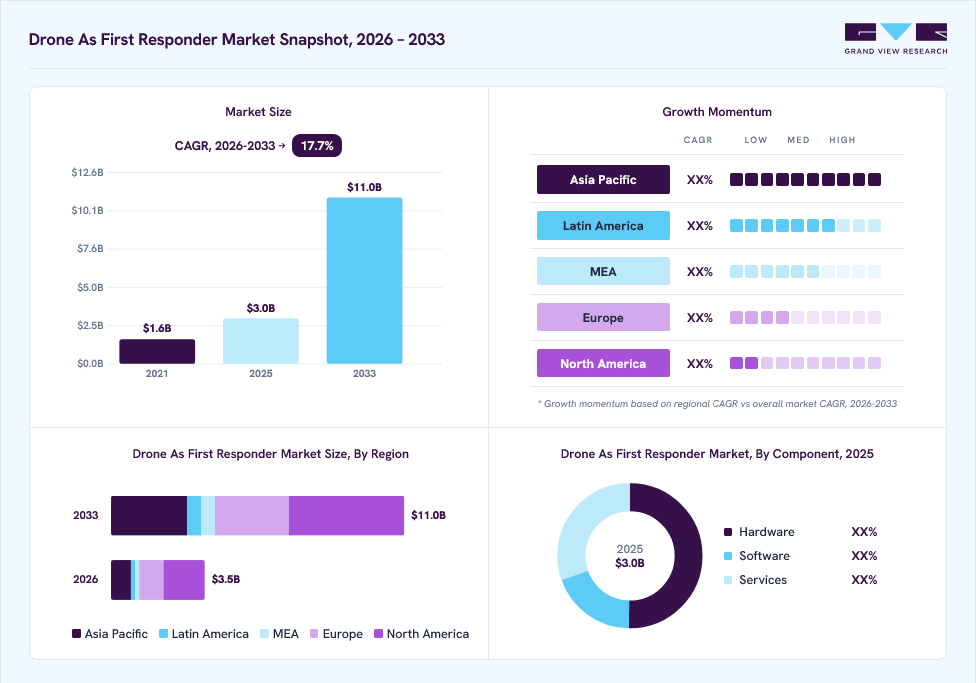
The global drone as first responder (DFR) market size was valued at USD 3.0 billion in 2025 and is projected to grow from USD 3.5 billion in 2026 to USD 11.0 billion by 2033, at a CAGR of 17.7% from 2026 to 2033. North America dominated the global market, accounting for the largest revenue share of 44.7% in 2025. The market growth is driven by increasing adoption of drones for rapid emergency response, rising demand for real-time aerial situational awareness, growing deployment of automated drone docking stations, expanding use of BVLOS operations, and increasing investments by law enforcement and public safety agencies to improve response times.
Key Market Trends & Insights
- By component: Hardware segment held the largest revenue share of 62.2% in 2025
- By application: Law enforcement segment held the largest revenue share of 35.3% in 2025
- By drone type: Multirotor drones segment held the largest revenue share in 2025
Regional Highlights
- Largest regional market: North America (44.7% revenue share in 2025)
- Fastest-growing regional market: Asia Pacific (fastest CAGR, 2026-2033)
- By country: The U.S. held the largest market share in 2025
Market Size & Forecast
- Market size in 2025: USD 3.0 Billion
- Estimated market size in 2026: USD 3.5 Billion
- Projected market size by 2033: USD 11.0 Billion
- CAGR (2026-2033): 17.7%
The growth of the drone as first responder (DFR) industry is driven by the increasing deployment of automated drone docking stations, expanding integration of drones with computer-aided dispatch and emergency communication systems, and growing adoption of real-time video and thermal imaging capabilities for incident assessment. Public safety agencies, law enforcement departments, and emergency response organizations are increasingly adopting remotely operated and connected drone systems to improve incident visibility, support informed decision-making, enhance operational coordination, reduce personnel risks, and strengthen emergency response capabilities.The increasing need for faster emergency response, growing demand for real-time aerial situational awareness, and rising adoption of remote monitoring capabilities are accelerating the deployment of Drone as First Responder (DFR) systems. Law enforcement agencies, fire departments, emergency medical services, and other public safety organizations are increasingly using drones to obtain immediate visual information during incidents before personnel reach the location. The ability to provide aerial intelligence, assess developing situations, monitor high-risk areas, and support emergency decision-making is strengthening the adoption of DFR programs across urban and suburban jurisdictions.

Additionally, the increasing deployment of automated drone-in-a-box systems, advancements in autonomous flight technologies, and growing integration with computer-aided dispatch platforms are driving innovation across the DFR market. DFR providers are integrating automated launch and landing systems, remote piloting capabilities, intelligent flight planning, high-resolution cameras, thermal imaging, and centralized command-and-control platforms to enable rapid and coordinated drone operations. These technological developments allow public safety agencies to reduce delays, improve incident visibility, enhance personnel safety, and provide continuous aerial intelligence during emergencies.
Moreover, the expansion of BVLOS operations, growing regulatory support for public-safety drone deployments, and rising investments in connected emergency-response infrastructure are creating new opportunities for the DFR market. Public safety organizations are increasingly establishing dedicated drone programs supported by remote operations centers and integrated data platforms to extend aerial coverage beyond conventional patrol operations. The growing use of DFR systems for crime monitoring, traffic incidents, missing-person searches, fires, hazardous situations, and disaster response is enabling agencies to broaden operational applications and strengthen the role of drones within modern emergency response frameworks.
Market Dynamics
The drone as first responder (DFR) market is experiencing growth, driven by the increasing adoption of automated drone deployment, rising demand for immediate incident intelligence, and growing integration of drones with public safety communication and dispatch systems. Expanding investments in remote operations centers, autonomous flight technologies, and advanced surveillance capabilities are accelerating market expansion. The integration of automated docking infrastructure, thermal imaging, secure communication networks, and centralized command platforms enhances situational awareness, operational coordination, personnel safety, and emergency response efficiency, creating substantial long-term growth opportunities for the global market.
The increasing need for rapid incident assessment is a major driver for the Drone as First Responder (DFR) market. Public safety agencies are deploying drones to provide immediate aerial visibility during emergencies, enabling remote operators to assess incidents before ground personnel arrive. Real-time video, thermal imaging, geolocation capabilities, and aerial surveillance allow responders to understand developing situations, prioritize resources, monitor threats, and improve decision-making during critical events.
The expanding use of DFR systems across emergency response scenarios is further supporting adoption. Drones can assist with crime investigations, missing-person searches, traffic incidents, fires, hazardous situations, and disaster response while reducing the need to immediately expose personnel to potentially dangerous environments. Their ability to provide persistent aerial intelligence from strategically positioned locations is encouraging agencies to incorporate drone-based response capabilities into routine emergency operations.
Complex regulatory requirements governing beyond-visual-line-of-sight (BVLOS) operations represent a key restraint on the Drone as First Responder (DFR) market. Regulatory authorities often require specific approvals, operational procedures, pilot qualifications, airspace coordination, and safety measures before agencies can conduct routine autonomous or remotely operated flights. These requirements can extend deployment timelines, increase administrative workloads, and create operational limitations for agencies seeking continuous drone coverage across wider geographic areas.
Compliance requirements can become particularly challenging when DFR programs involve automated launches, remote piloting, operations near populated areas, or flights across controlled airspace. Agencies may need to establish comprehensive procedures covering privacy, data security, evidence management, communication reliability, and emergency contingencies. The complexity of meeting these requirements can increase implementation costs while limiting the speed at which agencies expand automated drone operations across multiple response locations.
The expansion of automated remote drone operations presents a significant opportunity for the drone as first responder (DFR) market. Automated drone-in-a-box systems can enable remotely supervised launches from strategically located stations, allowing agencies to dispatch drones quickly without transporting equipment to incident locations. Integration with computer-aided dispatch platforms can further streamline deployment by linking emergency calls to predefined flight procedures, enabling faster aerial assessment and improving resource allocation across response operations.
Advancements in autonomous flight planning, docking infrastructure, secure communications, artificial intelligence, and centralized command platforms are creating additional opportunities for DFR deployments. Agencies can establish networks of remotely managed drones that cover multiple areas, reducing dependence on conventional manual deployment methods. Integration with thermal cameras, intelligent video analytics, mapping systems, and real-time data platforms can further strengthen remote operations, enabling agencies to coordinate aerial intelligence more efficiently during complex incidents.
Market Concentration & Characteristics
The drone as first responder (DFR) market is moderately fragmented, comprising drone manufacturers, autonomous drone-in-a-box providers, public safety technology companies, software developers, AI analytics providers, communication technology vendors, and specialized system integrators competing across law enforcement, emergency response, fire rescue, and municipal applications. The market is being shaped by increasing demand for rapid aerial situational awareness, expanding deployment of automated drone systems, and growing integration with emergency dispatch infrastructure. Strategic technology partnerships, platform integrations, and investments in autonomous operations are enabling companies to strengthen solution capabilities and expand deployments across jurisdictions.
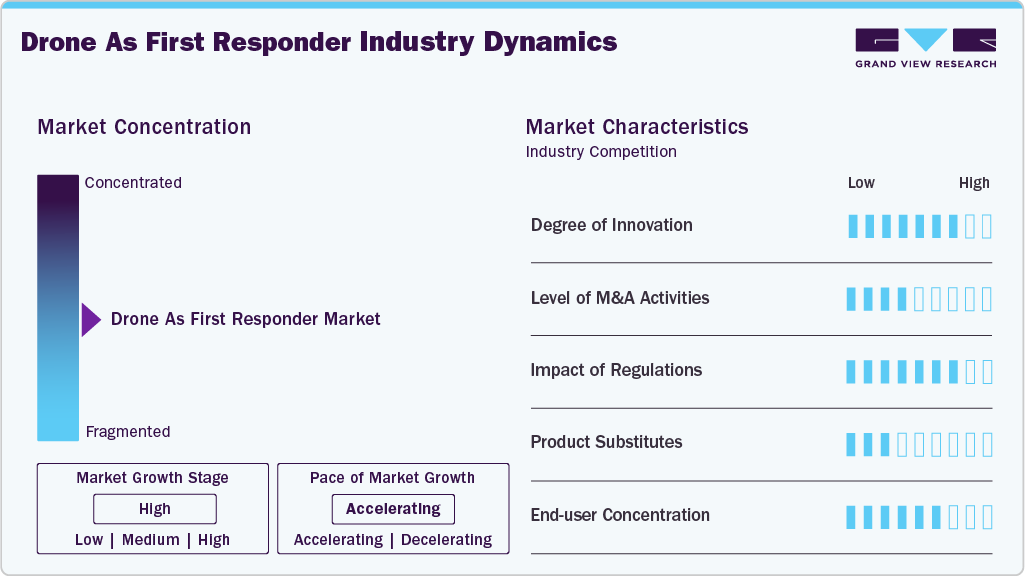
The market is characterized by a high degree of innovation, supported by continuous advancements in autonomous flight, automated docking stations, BVLOS operations, AI-powered video analytics, thermal imaging, remote piloting, and centralized command-and-control platforms. The market is witnessing relatively low merger and acquisition activity, as companies primarily rely on strategic partnerships, technology integrations, pilot programs, and government contracts to strengthen their market presence. Competition from helicopters, conventional patrol units, fixed surveillance cameras, and manually operated drones remains moderate, while increasing adoption of remote operations, real-time intelligence platforms, and connected public safety systems continues to strengthen solution differentiation and competitive positioning.
Analyst Perspective
The drone as first responder (DFR) market is experiencing strong momentum, driven by increasing adoption of rapid aerial response, growing demand for real-time situational awareness, and expanding investments in automated public safety technologies. Companies are introducing autonomous drones, automated docking stations, AI-enabled video analytics, thermal imaging, remote operations, and integrated command platforms. Rising deployment across law enforcement, firefighting, emergency medical services, search and rescue, and disaster management is encouraging solution diversification. These developments are helping organizations improve response efficiency, enhance personnel safety, strengthen operational visibility, and expand automated aerial coverage across diverse emergency applications.
Component Insights
The hardware segment dominated the drone as first responder (DFR) market, accounting for the largest revenue share of 62.2% in 2025, propelled by increasing deployment of autonomous drones, automated docking stations, high-resolution cameras, and reliable communication equipment across public safety applications. Law enforcement agencies, fire departments, and emergency response organizations are increasingly investing in dedicated DFR hardware to enable rapid aerial deployment, real-time incident monitoring, and remote situational assessment. Growing demand for aerial surveillance, improved sensor capabilities, and automated launch infrastructure continues to reinforce the segment’s leading position in the DFR market.
The services segment is expected to grow at the fastest CAGR of over 20% from 2026 to 2033. The segment growth is driven by increasing demand for remote drone operations, fleet management, maintenance, software integration, and regulatory compliance services. Public safety agencies are increasingly outsourcing specialized operational capabilities as DFR programs expand across multiple locations and require continuous system monitoring, data management, and technical support. Growing adoption of managed DFR operations, centralized command platforms, and recurring service models is expected to accelerate demand for specialized services throughout the forecast period.
Application Insights
The law enforcement segment dominated the drone as first responder (DFR) industry, accounting for the largest revenue share of 35.3% in 2025, driven by increasing adoption of drones for crime scene assessment, incident monitoring, suspect tracking, crowd management, and rapid aerial intelligence. Police departments are increasingly deploying DFR systems to obtain real-time visual information before officers arrive at incident locations, supporting faster situational assessment and resource allocation. Growing investments in automated drone stations, remote operations, thermal imaging, and integrated dispatch systems continue to strengthen DFR adoption across law enforcement applications.
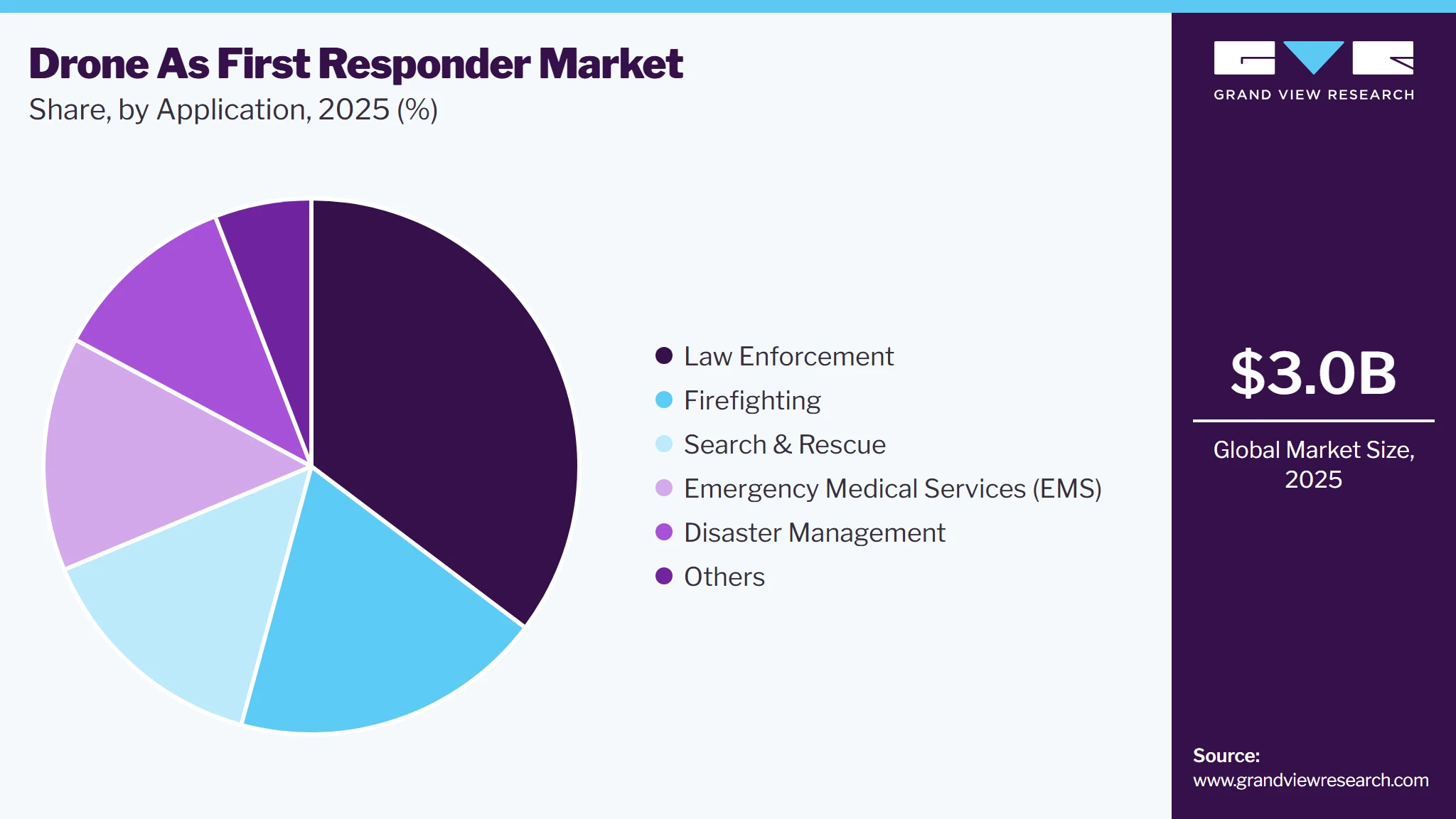
The emergency medical services (EMS) segment is expected to grow at the fastest CAGR from 2026 to 2033, driven by increasing demand for rapid aerial assessment during medical emergencies, accidents, disasters, and hard-to-access incidents. EMS organizations can utilize DFR systems to provide early visual information about accident scenes, assess accessibility, identify hazards, and coordinate incoming response teams. Advancements in autonomous flight, remote drone operations, real-time video transmission, and integration with emergency communication platforms are expected to accelerate DFR adoption.
Drone Type Insights
The multirotor drones segment dominated the drone as first responder (DFR) market, accounting for the largest revenue share of 74.0% in 2025, fueled by their vertical takeoff and landing capability, hovering performance, maneuverability, and suitability for rapid emergency deployment. Public safety agencies are increasingly adopting multirotor platforms for incident monitoring, suspect tracking, search-and-rescue operations, firefighting assessment, and real-time aerial intelligence. Their ability to operate from confined locations, carry advanced cameras and thermal sensors, and provide precise low-altitude surveillance continues to strengthen their position across DFR applications.
The hybrid VTOL drones segment is expected to grow at the fastest CAGR from 2026 to 2033, driven by growing demand for extended flight endurance, wider-area surveillance, and flexible deployment capabilities. These platforms combine vertical takeoff and landing with fixed-wing flight characteristics, enabling agencies to conduct longer-duration missions while maintaining operational flexibility. Increasing requirements for large-area disaster assessment, search and rescue, remote-area monitoring, and extended emergency surveillance are expected to accelerate the adoption of hybrid VTOL platforms.
Regional Insights
The North America drone as first responder (DFR) market held the largest revenue share of 44.7% in 2025, driven by the early adoption of public safety drone programs, increasing deployment of automated drone-in-a-box systems, and strong investment in advanced emergency response infrastructure. Law enforcement agencies, fire departments, and municipalities across the region are increasingly integrating DFR platforms with computer-aided dispatch systems, remote operations centers, and real-time video technologies. Favorable technology adoption, established drone ecosystems, and expanding BVLOS capabilities are further supporting DFR deployment across North America.

U.S. Drone as First Responder (DFR) Market Trends
The U.S. drone as first responder (DFR) industry dominated, with a revenue share of 88.6% in 2025, driven by the increasing adoption of drones by police departments for rapid incident assessment, crime scene monitoring, suspect tracking, and emergency surveillance. The expansion of automated drone stations across municipalities is enabling agencies to dispatch aircraft directly from strategic locations in response to emergency calls. Increasing investments in remote piloting infrastructure, AI-enabled video analytics, thermal imaging, and centralized command platforms are further strengthening the deployment of DFR systems.
Europe Drone as First Responder (DFR) Market Trends
The Europe drone as first responder (DFR) industry is expected to grow at a significant CAGR of 17.2% from 2026 to 2033. The market growth is supported by increasing adoption of unmanned aerial systems for emergency response, rising investments in digital public safety infrastructure, and growing interest in remote aerial surveillance. Police and emergency organizations are increasingly evaluating the deployment of automated drones for incident assessment, search-and-rescue operations, traffic monitoring, and disaster response. Advancements in drone autonomy, regulatory frameworks, secure communications, and integrated command platforms are strengthening the adoption of DFR solutions across Europe.
The UK drone as first responder (DFR) market is expected to grow significantly in the coming years, driven by developments as police forces increasingly explore drones for rapid response, missing-person searches, road incident monitoring, and high-risk situation assessment. The adoption of remotely operated systems is helping public safety organizations obtain aerial intelligence without immediately deploying personnel to potentially hazardous locations. Increasing integration of drones with emergency control rooms, improvements in remote operations capabilities, and growing interest in automated drone deployment are supporting the development of DFR programs across the country.
The drone as first responder (DFR) market in Germany is supported by the increasing adoption of unmanned aerial systems for emergency management, industrial-area incidents, search-and-rescue activities, and infrastructure monitoring. Public authorities are increasingly examining automated aerial platforms capable of providing rapid situational awareness while maintaining controlled, secure operations. Growing investments in autonomous navigation, high-resolution imaging, data security, and command-and-control technologies are strengthening the country's DFR ecosystem. Demand for reliable drone systems capable of operating in complex environments is also encouraging technology development.
Asia Pacific Drone as First Responder (DFR) Market Trends
The Asia Pacific drone as first responder (DFR) industry is expected to grow at the fastest CAGR of 21.1% from 2026 to 2033, by rapid urbanization, expanding smart-city programs, increasing public safety investments, and rising adoption of unmanned aerial technologies. Governments and municipalities are increasingly evaluating drones for emergency monitoring, disaster response, traffic management, and law enforcement applications. Growing domestic drone manufacturing capabilities, improvements in autonomous flight technologies, and the expanding deployment of connected command centers are creating favorable conditions for DFR adoption across the Asia-Pacific region.
The Japan drone as first responder (DFR) market is gaining traction owing to the country's increasing focus on disaster preparedness, emergency communications, and technologically advanced public safety systems. Drones are increasingly considered for earthquake response, infrastructure assessment, search-and-rescue operations, and monitoring of difficult-to-access areas. The development of autonomous flight systems, remote drone operations, and advanced communication technologies is supporting DFR deployment. Japan's emphasis on robotics and automation is also creating a strong technological foundation for remotely supervised emergency drone operations.
The drone as first responder (DFR) market in China is expanding rapidly, driven by strong domestic drone manufacturing capabilities, smart-city development, and increasing deployment of unmanned systems for public safety. Municipal authorities and emergency organizations are increasingly using drones for traffic monitoring, disaster assessment, fire response, and security surveillance. Investments in autonomous navigation, AI-based image recognition, high-performance sensors, and centralized command platforms are strengthening DFR capabilities. China's established drone technology ecosystem and expanding digital infrastructure are further supporting the integration of aerial systems into emergency response operations.
Key Drone as First Responder (DFR) Company Insights
Some of the key players operating in the market are Skydio, Inc. and Motorola Solutions, Inc.
-
Skydio, Inc. is a mature player in the drone as first responder (DFR) market, specializing in autonomous drones, dock-based deployment systems, DFR Command software, and remote operations solutions for public safety agencies. The company offers integrated DFR capabilities through its X10 and R10 platforms, enabling rapid aerial response, real-time situational awareness, indoor and outdoor operations, and centralized remote piloting. Its integration with CAD, emergency dispatch, and public-safety technology platforms is strengthening its position across law enforcement, campus safety, and fire-response applications.
-
Motorola Solutions, Inc. is a leading player in the drone as first responder (DFR) industry, leveraging its established public-safety communications, command-center, dispatch, and incident-management ecosystem to support drone-enabled emergency response. The company is expanding DFR capabilities by integrating purpose-built drone platforms to connect drone operations with emergency calls, dispatch workflows, and real-time incident information. Its broad public-safety technology portfolio, established agency relationships, and integrated response ecosystem strengthen its competitive position in DFR deployments.
BRINC Drones, Inc. and FlytBase, Inc. are some of the emerging participants in the drone as first responder (DFR) market.
-
BRINC Drones, Inc. is an emerging player in the drone as first responder (DFR) industry, specializing in purpose-built public safety drones, automated charging stations, remote operations software, and integrated emergency response solutions. Its Responder platform combines autonomous takeoff and landing, thermal imaging, two-way communications, obstacle avoidance, teleoperation, and CAD integration to support rapid response to 911 calls. The company's dedicated DFR ecosystem, including Responder Station and LiveOps, is strengthening its presence among law enforcement and other public safety agencies.
-
FlytBase, Inc. is an emerging player in the drone as first responder (DFR) industry, specializing in autonomous drone operations, dock management, fleet orchestration, AI-enabled aerial intelligence, and public-safety workflow integration. Its platform connects docked drones with CAD systems, video management platforms, GIS tools, emergency management systems, and command centers to automate aerial response. The company's hardware-agnostic approach, multi-site fleet management capabilities, and focus on unattended drone operations are strengthening its position in scalable DFR deployments.
Key Drone As First Responder (DFR) Companies
The following key companies have been profiled for this study of the drone as first responder (DFR) market.
-
Skydio, Inc.
-
DJI
-
Motorola Solutions, Inc.
-
BRINC Drones, Inc.
-
Axon Enterprise, Inc.
-
Flock Safety
-
DroneSense
-
FlytBase, Inc.
-
Airobotics Ltd.
-
Autel Robotics
Competitive Benchmarking
Category
Operating Strategies
Competitive Edge
Weakness
Established Players (Skydio, Inc., Motorola Solutions, Inc., DroneSense)
- Focus on integrated DFR ecosystems combining autonomous drones, docks, software, and command platforms.
- Invest heavily in R&D, public-safety partnerships, and regulatory capabilities to scale deployments.
- Strong public-safety relationships established drone portfolios, and advanced autonomous technologies support market leadership.
- Ability to deliver integrated DFR solutions covering rapid deployment, remote operations, surveillance, and incident management.
- Complex organizational structures can slow customization and deployment across the diverse requirements of public-safety agencies.
- Dependence on regulatory approvals and established technology ecosystems can constrain rapid market adaptation.
Emerging Players (FlytBase, Inc., Airobotics Ltd., BRINC Drones, Inc.)
- Emerging players are focusing on developing specialized DFR software, autonomous operations, and drone-in-a-box solutions.
- Invest in strategic partnerships, platform integrations, and public-safety pilots to expand deployment opportunities.
- Agile technology development enables rapid customization of DFR platforms for evolving public-safety requirements.
- Specialized autonomous capabilities provide differentiated solutions for remote operations, fleet management, and rapid response.
- A smaller operational scale can limit access to large public-sector contracts and extensive deployment networks.
- Limited brand recognition and established agency relationships can constrain adoption against mature competitors.
Recent Developments
-
In August 2026, DJI announced the upcoming launch of its Osmo 360 II camera, expanding its imaging portfolio with a new-generation 360-degree camera platform. Although the development is not directly focused on DFR, DJI continues to maintain professional drone platforms for public safety, emergency response, and aerial imaging. Its established drone portfolio, advanced imaging capabilities, and broad ecosystem continue to support its relevance in public safety-oriented unmanned aerial operations.
-
In May 2026, Axon Enterprise, Inc. partnered with Echodyne to strengthen low-altitude airspace awareness for public safety drone operations and DFR programs. The collaboration integrates Echodyne’s MESA radar technology with Axon’s growing drone ecosystem, supporting detection of unauthorized or potentially malicious aircraft while enabling safer scaling of remotely operated DFR deployments. The initiative strengthens Axon’s strategy of combining drones, counter-drone capabilities, airspace awareness, and public safety software within an integrated technology ecosystem.
-
In March 2026, BRINC launched Guardian, a next-generation 911 response drone designed specifically for drone as a first responder operations. Guardian incorporates advanced autonomy, an enhanced camera system, and satellite connectivity to support emergency response in locations where conventional communications infrastructure may be unavailable. The company also announced a new Seattle manufacturing facility, highlighting its focus on expanding domestic production capacity while advancing specialized drone technologies for law enforcement and emergency response applications.
Drone As First Responder (DFR) Market Report Scope
Report Attribute
Details
Market size value in 2025
USD 3.0 billion
Estimated market size in 2026
USD 3.5 billion
Projected market size by 2033
USD 11.0 billion
Growth Rate
CAGR of 17.7% from 2026 to 2033
Base year for estimation
2025
Historical data
2021-2024
Forecast period
2026- 2033
Quantitative units
Revenue in USD million/billion and CAGR from 2026 to 2033
Report Product
Revenue forecast, company ranking, competitive landscape, growth factors, and trends
Segments covered
Component, application, drone type, region
Region scope
North America; Europe; Asia Pacific; Latin America; Middle East & Africa
Country scope
U.S.; Canada; Mexico; UK; Germany; France; China; Japan; India; South Korea; Australia; Brazil; Saudi Arabia; UAE; South Africa
Key companies profiled
Skydio, Inc.; DJI; Motorola Solutions, Inc.; BRINC Drones, Inc.; Axon Enterprise, Inc.; Flock Safety; DroneSense; FlytBase, Inc.; Airobotics Ltd.; Autel Robotics.
Customization scope
Free report customization (equivalent to up to 8 analyst’s working days) with purchase. Addition or alteration to country, regional & segment scope.
Pricing and purchase options
Avail customized purchase options to meet you exact research needs. Explore purchase options
Global Drone As First Responder (DFR) Market Report Segmentation
This report forecasts revenue growth at the global, regional, and country levels and provides an analysis of the latest technological trends in each of the sub-segments from 2021 to 2033. For this study, Grand View Research has segmented the global drone as first responder (DFR) market report based on component, application, drone type, and region:

-
Component Outlook (Revenue, USD Million/Billion, 2021 - 2033)
-
Hardware
-
Software
-
Services
-
-
Application Outlook (Revenue, USD Million/Billion, 2021 - 2033)
-
Law Enforcement
-
Firefighting
-
Emergency Medical Services (EMS)
-
Search & Rescue
-
Disaster Management
-
Others
-
-
Drone Type Outlook (Revenue, USD Million/Billion, 2021 - 2033)
-
Multirotor Drones
-
Fixed-Wing Drones
-
Hybrid VTOL Drones
-
Others
-
-
Regional Outlook (Revenue, USD Million/Billion, 2021 - 2033)
-
North America
-
U.S.
-
Canada
-
Mexico
-
-
Europe
-
UK
-
Germany
-
France
-
-
Asia Pacific
-
China
-
Japan
-
India
-
South Korea
-
Australia
-
-
Latin America
-
Brazil
-
-
Middle East and Africa (MEA)
-
Saudi Arabia
-
UAE
-
South Africa
-
-
Research Methodology
The drone as first responder (DFR) market figures in this report are based on a proven research process that combines executive interviews with secondary research from proprietary databases, company filings, and recognized regulatory and institutional sources. Market size is built through value-chain sizing-reconciling supply-side and demand-side estimates-and triangulated with bottom-up and top-down approaches. Every estimate passes multiple levels of expert validation before publication, with each drone as first responder (DFR) segment quantified using the revenue-capture definitions in the table below.
Segment Definition
Segment - Component
Revenue capture definition
Hardware
Revenue is generated from physical DFR equipment, including drones, docking stations, cameras, thermal sensors, communication systems, batteries, payloads, and related infrastructure used for rapid aerial response and real-time situational awareness.
Software
Revenue is captured from software platforms supporting DFR operations, including drone fleet management, autonomous flight control, dispatch integration, video management, AI analytics, mission planning, remote operations, data management, and command-and-control capabilities.
Service
Revenue is generated from DFR-related services, including drone operations, maintenance, training, technical support, system integration, fleet management, regulatory assistance, remote piloting, and managed drone response programs provided to public safety organizations.
Segment - Application
Revenue capture definition
Law Enforcement
Revenue is generated from DFR systems deployed by police departments and law enforcement agencies for incident assessment, suspect tracking, crime scene monitoring, crowd management, traffic incidents, surveillance, and real-time aerial intelligence during emergency response.
Firefighting
Revenue is captured from DFR solutions used by fire departments for fire detection, thermal assessment, hazardous-area monitoring, incident visualization, perimeter surveillance, and real-time aerial intelligence to support firefighting decisions and improve responder safety.
Emergency Medical Services (EMS)
Revenue is generated from DFR systems supporting emergency medical response through rapid aerial assessment of accident locations, medical emergencies, hazardous environments, and difficult-to-access areas, enabling responders to evaluate conditions and coordinate resources before arrival.
Search & Rescue
Revenue is captured from drones deployed for locating missing persons, stranded individuals, accident victims, or people in difficult terrain. Solutions include thermal cameras, high-resolution imaging, autonomous flight, mapping, and real-time video transmission for search operations.
Disaster Management
Revenue is generated from DFR solutions used during natural or man-made disasters, including floods, wildfires, earthquakes, storms, and infrastructure emergencies. Drones provide aerial assessment, damage monitoring, hazard identification, mapping, and situational awareness for coordinated response activities.
Others
Revenue is generated from DFR applications across additional public safety and emergency use cases, including campus security, airport safety, municipal monitoring, critical infrastructure protection, event security, traffic management, and other specialized response operations.
Segment - Drone Type
Revenue capture definition
Multirotor Drones
Revenue is generated from multirotor DFR platforms, including quadcopters, hexacopters, and other vertical-takeoff drones capable of hovering, rapid deployment, and precise maneuvering. These drones are widely used for incident monitoring, surveillance, search operations, and real-time aerial intelligence.
Fixed-Wing Drones
Revenue is captured from fixed-wing drones designed for longer-duration flights, extended coverage, and efficient aerial surveillance. These platforms are used for large-area monitoring, disaster assessment, search operations, infrastructure surveillance, and other DFR applications requiring extended flight endurance.
Hybrid VTOL Drones
Revenue is generated from hybrid vertical takeoff and landing (VTOL) drones combining multirotor-style vertical takeoff capabilities with fixed-wing flight characteristics. These platforms provide extended range and endurance while maintaining flexible deployment for emergency monitoring, search operations, and large-area response.
Others
Revenue is captured from specialized DFR drone configurations that fall outside conventional multirotor, fixed-wing, or hybrid VTOL categories, including tethered drones, single-rotor systems, and other purpose-built aerial platforms used for specialized public safety and emergency response applications.
Estimation Model
Layer Name
Key Question
Description
Adoption Layer
Who are the potential adopters?
Identifies law enforcement agencies, fire departments, emergency medical services, search-and-rescue organizations, disaster management authorities, municipalities, airports, campus security teams, and other public safety organizations seeking rapid aerial response and real-time situational awareness.
Solution Enablement Layer
Who can provide DFR solutions?
Deployment depends on drone manufacturers, autonomous drone providers, docking-system developers, DFR software companies, AI analytics providers, communication technology vendors, system integrators, and specialized public safety technology companies supporting automated aerial response.
Response Deployment Layer
Where are DFR solutions currently being used?
DFR solutions are deployed across law enforcement, firefighting, emergency medical response, search and rescue, disaster management, traffic monitoring, public event security, critical infrastructure protection, campus safety, and other emergency response activities.
Revenue Generation Layer
How is revenue generated?
Revenue is generated through drone hardware sales, automated docking stations, software subscriptions, fleet management platforms, remote operations, maintenance contracts, system integration, training, technical support, managed DFR services, data analytics, and recurring platform-based service agreements.
Delivered Customizations
This report has been delivered with the following In-depth customizations
Client Request
Customization Delivered
Value Adds
DFR Deployment Optimization & Emergency Response Assessment
Evaluated DFR deployments across law enforcement, firefighting, EMS, search and rescue, and disaster management, integrating autonomous drones, docking stations, CAD systems, remote operations, and real-time aerial intelligence.
Improves response efficiency, enhances situational awareness, strengthens personnel safety, and optimizes drone deployment.
Autonomous Drone Infrastructure & Remote Operations Strategy
Assessed automated drone-in-a-box deployments, remote piloting, fleet management, BVLOS operations, secure communications, and centralized command platforms to improve continuous aerial coverage and emergency response coordination.
Enables faster deployment, expands coverage, reduces operational delays, and strengthens remote response capabilities.
AI-Powered Aerial Intelligence & Incident Monitoring Strategy
Evaluated AI-enabled video analytics, thermal imaging, object detection, automated flight planning, real-time video transmission, and incident intelligence capabilities to improve emergency assessment and operational decision-making.
Enhances incident visibility, accelerates decision-making, improves resource allocation, and supports safer emergency operations.
About the Author(s)
Next Generation Technologies Research Team
Technology · Next Generation TechnologiesThis report was authored by the next generation technologies research team at Grand View Research - comprising two research analysts, one senior research analyst, and one industry expert - with specialized expertise in the next generation technologies segment of the technology industry. All findings are based on proprietary technology databases, executive interviews, and regulatory analysis, subject to internal peer review prior to publication.
Last Updated:
Speak to Analyst


Customize this report to your needs — add regions, segments, or data points, with 20% free customization.
Or view our licence options:


ISO 9001:2015 & 27001:2022 Certified
We are GDPR and CCPA compliant! Your transaction & personal information is safe and secure. For more details, please read our privacy policy.


