
- Home
- »
- Paints, Coatings & Printing Inks
- »
-
Dyestuff Market Size, Share & Trends Report, 2026-2035GVR Report cover

Dyestuff Market (2026 - 2035)
Size, Share & Trends Analysis Report By Product Type (Reactive Dyes, Disperse Dyes, Acid Dyes, Direct Dyes, Vat Dyes), By Source (Synthetic Dyes, Natural Dyes), By Application, By Region, And Segment Forecasts
Market Size, 2025
$17.6BMarket Estimate, 2026
$18.4BMarket Forecast, 2035
$25.5BCAGR, 2026–2035
4.8%Dyestuff Market Summary
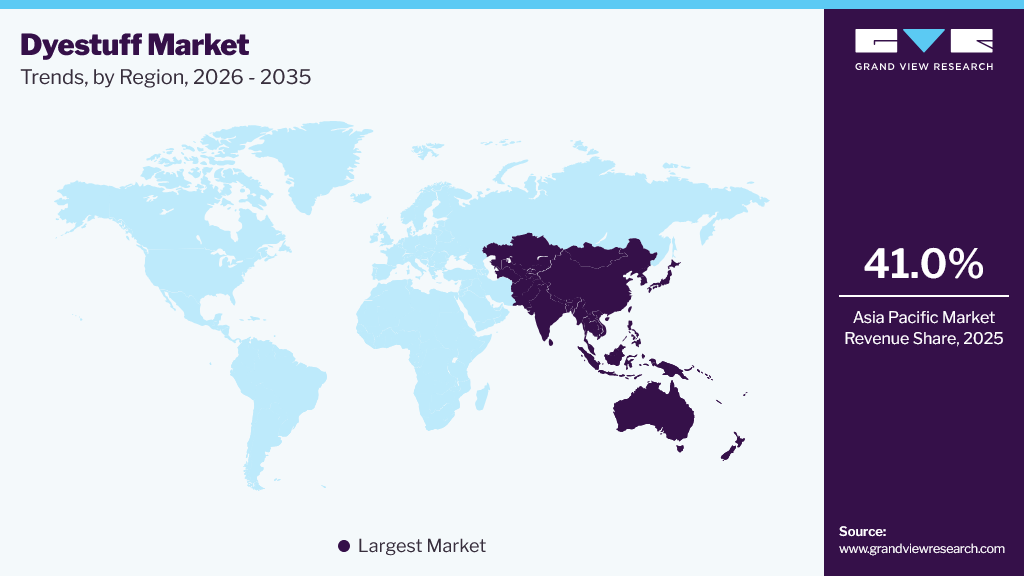
The global dyestuff market was valued at USD 17.6 billion in 2025 and is projected to grow from USD 18.4 billion in 2026 to USD 25.5 billion in 2035, at a CAGR of 4.8% from 2026 to 2035. Asia Pacific dominated the market, accounting for a revenue share of 41.0% in 2025. The market is supported by strong demand from the region’s large textile and apparel manufacturing base and expanding leather, plastics, paper, and printing industries.
Key Market Trends & Insights
- By product type: The reactive dyes segment held the largest market share of around 55.0% in 2025
- By source: The synthetic dyes segment held the largest revenue share of around 95.0% market in 2025
- By application: The textile segment held the largest market share of around 65.0% in 2025
Regional Highlights
- Largest regional market: Asia Pacific (41.0% revenue share, 2025)
Market Size & Forecast
- Market size in 2025: USD 17.6 Billion
- Estimated market size in 2026: USD 18.4 Billion
- Projected market size by 2035: USD 25.5 Billion
- CAGR (2026-2035): 4.8%
Prism AI by Grand View Research Free to tryAsk a question about the dyestuff marketTry asking✓Every figure cited from GVR research Prefer the report? Download free sample →
Advances in biotechnology and plant-based extraction methods are expanding the commercial availability of natural dyes as manufacturers respond to evolving environmental standards and consumer preferences. Continuous innovation in dye chemistry is also improving performance characteristics while reducing water consumption and processing costs across industrial dyeing operations.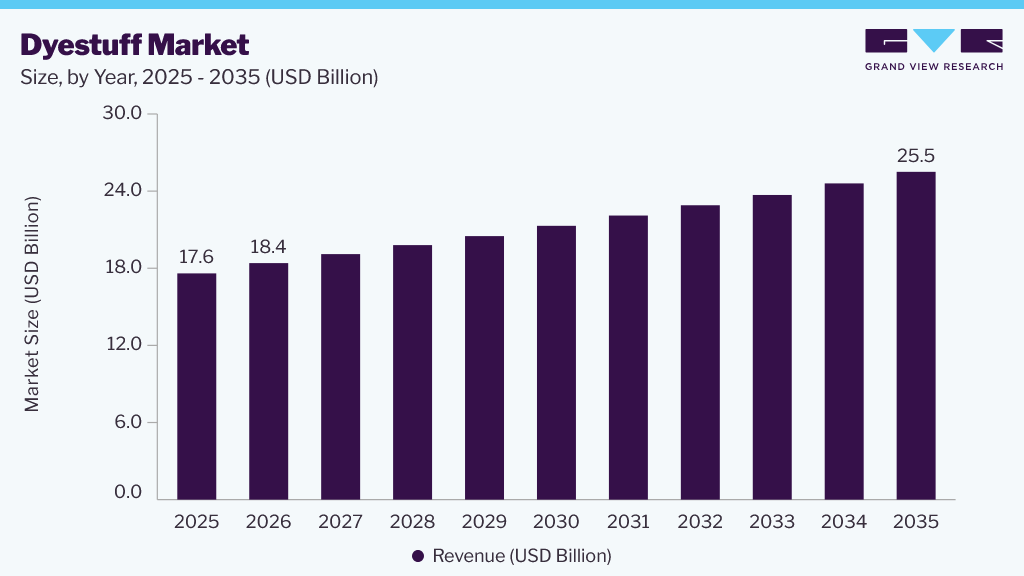 Source: Grand View Research, IR Documents, Primary Interviews, Paid DatabasesTo learn more about this report,
 Download Free Sample Report
The textile industry remains the largest consumer of dyestuffs, driven by growing apparel production, home furnishings, and technical textiles. Expanding manufacturing activities in the Asia Pacific, particularly in countries with integrated textile value chains, continue to support large-scale dye consumption. At the same time, increasing use of colored plastics in automotive, packaging, consumer goods, and electronics, together with demand for specialty inks and high-performance coatings, is broadening the market's application base. Manufacturers are investing in advanced formulations that deliver improved fixation rates, reduced effluent generation, and compliance with increasingly stringent environmental and chemical safety regulations across major global markets.
The market outlook remains positive as sustainable manufacturing practices, digital textile printing, and functional textile production reshape demand for advanced dye solutions. Regulatory pressure to minimize hazardous chemicals is encouraging the development of eco-friendly, low-impact, and bio-based dyestuffs without compromising product performance. At the same time, research into water-saving dyeing technologies, recyclable textile processing, and circular economy initiatives is creating new opportunities for innovation throughout the value chain. As end-use industries increasingly prioritize product quality, sustainability, and operational efficiency, the dyestuff market is expected to see steady long-term growth, supported by technological advances and expanding industrial applications.
Analyst Perspective
The dyestuff market is expected to evolve through a combination of technological advancements, shifting end-user requirements, and stricter environmental compliance, rather than through demand growth alone. Increasing adoption of specialty dyes for technical textiles, automotive materials, packaging, and high-quality printing applications is improving product differentiation and profitability. Manufacturers are also focusing on process optimization, energy-efficient production, and reduced wastewater generation to remain competitive. Over the forecast period, companies that successfully balance performance, sustainability, and cost efficiency while expanding their presence in emerging manufacturing hubs are expected to capture the strongest growth opportunities.
Product Type Insights
The reactive dyes segment held the largest market share of around 55.0% in 2025, owing to their extensive use in dyeing cotton and other cellulosic fibers. These dyes form strong covalent bonds with fibers, delivering excellent wash fastness, bright color shades, and superior color durability, making them the preferred choice for apparel, home textiles, and industrial fabrics. Their compatibility with modern continuous dyeing and printing processes further supports widespread adoption by textile manufacturers. Growing global demand for cotton-based garments, coupled with expanding textile exports from major manufacturing countries such as India, China, and Bangladesh, continues to reinforce the dominance of the reactive dyes segment.
The acid dyes segment is expected to register the fastest CAGR over the forecast period, supported by their increasing use in textiles, leather, and specialty applications. Acid dyes offer strong color intensity, excellent shade versatility, and good affinity for protein-based fibers such as wool, silk, and nylon, making them suitable for a wide range of high-value textile and leather products. Growing demand for premium apparel, technical textiles, carpets, and leather goods is expected to support consumption of acid dyes. In addition, ongoing development of dyes with improved color fastness, reduced environmental impact, and greater compatibility with modern textile-processing technologies is creating new opportunities for segment growth.
Source Insights
The synthetic dyes segment held the largest revenue share of around 95.0% market in 2025 due to their superior color consistency, extensive shade availability, high tinting strength, and cost-effective large-scale production. These dyes are extensively used across textiles, plastics, paper, leather, printing inks, and industrial applications where durability and process efficiency are critical. Continuous improvements in dye chemistry have enhanced color fastness, application versatility, and compatibility with modern manufacturing techniques. Despite growing sustainability concerns, synthetic dyes remain the preferred choice for high-volume industrial production because they deliver reliable performance, scalability, and competitive pricing across diverse end-use industries worldwide.
The natural dyes segment is expected to experience the fastest growth during the forecast period, driven by rising demand for environmentally friendly products and the increasing adoption of sustainable manufacturing practices. Derived from plant, mineral, and biological sources, these dyes are gaining popularity in premium textiles, cosmetics, food applications, and artisanal products where renewable ingredients and low environmental impact are valued. Advances in extraction technologies, biotechnology, and natural mordant systems are improving color stability and commercial viability, addressing historical performance limitations. Growing investment in circular textiles and bio-based materials is expected to further accelerate global demand for natural dyes.
Application Insights
The textile segment held the largest market share, at around 65.0% in 2025, driven by extensive dye consumption in apparel, home furnishings, industrial fabrics, and technical textiles. Dyestuffs are essential for imparting vibrant colors, excellent color fastness, and durability to natural and synthetic fibers while meeting stringent quality standards. Rising global apparel demand, expanding textile manufacturing in the Asia Pacific, and increasing exports of garments continue to drive dye consumption. The growing emphasis on reducing water, energy, and chemical consumption is also encouraging dye manufacturers to develop products that deliver high performance while improving the environmental profile of textile-processing operations. For instance, in June 2025, DYECOL launched its CARE ESN Series fourth-generation reactive dyes, designed to deliver high-performance, more environmentally conscious textile dyeing solutions. The launch reflects the industry's shift toward more efficient and sustainable reactive dye technologies, supporting demand for advanced dyestuffs as textile manufacturers seek to meet both performance requirements and evolving sustainability expectations.
The leather segment is anticipated to witness the fastest growth during the forecast period, driven by rising demand for premium footwear, automotive interiors, luxury goods, and fashion accessories. High-performance dyestuffs are increasingly adopted to achieve uniform coloration, enhanced light fastness, and long-lasting aesthetic appeal while complying with stringent environmental regulations governing leather processing. Growing consumer preference for premium and sustainably manufactured leather products is encouraging tanneries to adopt eco-friendly dye formulations with lower environmental impact. In addition, technological advancements in chrome-free and low-emission leather processing are creating new opportunities for specialty dyestuff manufacturers serving the global leather industry.
Regional Insights
Asia Pacific accounted for the largest share of around 41.0% in 2025, supported by its dominant textile manufacturing base and well-established chemical production infrastructure. Countries such as China, India, Bangladesh, Vietnam, and Indonesia are among the world's leading producers and exporters of textiles, garments, and dyed fabrics, resulting in substantial demand for reactive, disperse, and specialty dyes. The region also benefits from the presence of major dyestuff manufacturers, competitive production costs, and integrated supply chains. Rising industrialization, increasing domestic consumption, and continued investments in sustainable dyeing technologies are expected to reinforce Asia Pacific's leadership throughout the forecast period.
 To learn more about this report, Download Free Sample Report
North America Dyestuff Market Trends
North America is expected to register steady growth during the forecast period, driven by stable demand for sustainable dyes, specialty colorants, and high-value applications across textiles, automotive, packaging, and personal care industries. Stringent environmental regulations are accelerating the adoption of low-impact and bio-based dye technologies, while investments in advanced textile manufacturing and digital printing are supporting demand for innovative dye formulations. Growing research in biotechnology and circular textile processing is further encouraging product innovation. Additionally, rising consumer preference for environmentally responsible products is prompting manufacturers to develop safer and more resource-efficient dye solutions
Key Dyestuff Company Insights
The global dyestuff market is moderately consolidated, with leading manufacturers focusing on product innovation, sustainable dye chemistries, and capacity expansion to strengthen their market position. Companies are investing in low-impact dyes, digital textile coloration technologies, and bio-based alternatives while expanding their presence in high-growth textile manufacturing regions through strategic collaborations, R&D initiatives, and modernization of production facilities to meet evolving environmental and customer requirements.
Key Dyestuff Companies
The following key companies have been profiled for this study on the dyestuff market:
-
Zhejiang Longsheng Group Co., Ltd.
-
Archroma
-
DyStar Group
-
Huntsman Corporation
-
Kiri Industries Limited
-
Atul Ltd.
-
Bodal Chemicals Limited
-
Runtu Co., Ltd.
-
Everlight Chemical Industrial Corporation
-
Nippon Kayaku Co., Ltd.
-
Kyung-In Synthetic Corporation (KISCO)
-
Sudarshan Chemical Industries Limited
-
Jiangsu Yabang Dyestuff Co., Ltd.
-
Colourtex Industries Pvt. Ltd
Recent Developments
-
In June 2026, Archroma India inaugurated a renovated Sustainable Chemistry Laboratory and Centre of Excellence at The Maharaja Sayajirao University of Baroda. The initiative strengthens the company's focus on sustainable chemistry, research, and innovation and supports the development of more environmentally responsible solutions for the chemical and textile industries. The investment highlights the growing emphasis on sustainable chemistry and R&D in the dyestuff industry as manufacturers respond to increasing environmental and regulatory requirements.
-
In October 2025, DyStar India received the Innovision Award for its Eco Advanced Indigo Dyeing (EAID) process at Intexcon 2025. The process reduces the number of washing steps required during denim production, thereby lowering water and energy consumption and reducing the load on effluent treatment systems. The development highlights the growing focus on resource-efficient, sustainable dyeing technologies and is expected to drive demand for advanced dyestuffs and coloration solutions that enable textile manufacturers to improve production efficiency while reducing their environmental footprint.
Dyestuff Market Report Scope
Report Attribute
Details
Market size in 2025
USD 17.6 billion
Estimated market size in 2026
USD 18.4 billion
Projected market size by 2035
USD 25.5 billion
Growth rate
CAGR of 4.8% from 2026 to 2035
Base year for estimation
2025
Historical data
2021 – 2024
Forecast period
2026 – 2035
Quantitative units
Revenue in USD billion, and CAGR from 2026 to 2035
Report coverage
Revenue forecast, company ranking, competitive landscape, growth factors, and trends
Segments covered
Product type, source, application, region
Regional Scope
North America; Europe; Asia Pacific; Latin America; Middle East & Africa
Country Scope
U.S.; Canada; Mexico; UK; Germany; France; Italy; Spain; China; Japan; India; Australia; South Korea; Brazil; Argentina; South Africa; Saudi Arabia; UAE
Key companies profiled
Zhejiang Longsheng Group Co., Ltd.; Archroma; DyStar Group; Huntsman Corporation; Kiri Industries Limited.; Atul Ltd.; Bodal Chemicals Limited; Runtu Co., Ltd.; Everlight Chemical Industrial Corporation; Nippon Kayaku Co., Ltd.; Kyung-In Synthetic Corporation (KISCO); Sudarshan Chemical Industries Limited; Jiangsu Yabang Dyestuff Co., Ltd.; Colourtex Industries Pvt. Ltd.
Customization scope
Free report customization (equivalent to 8 analyst working days) with purchase. Addition or alteration to country, regional & segment scope.
Pricing and purchase options
Avail of customized purchase options to meet your exact research needs. Explore purchase options
Global Dyestuff Market Report Segmentation
This report forecasts revenue growth at the global, regional, and country levels and provides an analysis of the latest industry trends and opportunities across each sub-segment from 2021 to 2035. For this study, Grand View Research has segmented the global dyestuff market report based on product type, source, application & region:
-
Product Type Outlook (Revenue, USD Billion, 2021–2035)
-
Reactive Dyes
-
Disperse Dyes
-
Acid Dyes
-
Direct Dyes
-
Vat Dyes
-
Others
-
-
Source Outlook (Revenue, USD Billion, 2021–2035)
-
Synthetic Dyes
-
Natural Dyes
-
-
Application Outlook (Revenue, USD Billion, 2021–2035)
-
Textiles
-
Leather
-
Paper & Pulp
-
Plastics
-
Cosmetics
-
Food
-
Others
-
-
Regional Outlook (Revenue, USD Billion, 2021 - 2035)
-
North America
-
U.S.
-
Canada
-
Mexico
-
-
Europe
-
UK
-
Germany
-
France
-
Italy
-
Spain
-
-
Asia Pacific
-
China
-
Japan
-
India
-
Australia
-
South Korea
-
-
Central & South America
-
Brazil
-
Argentina
-
-
Middle East and Africa (MEA)
-
South Africa
-
Saudi Arabia
-
UAE
-
-
Frequently Asked Questions About This Report
The global dyestuff market size was valued at USD 17.6 billion in 2025 and is estimated at USD 18.4 billion in 2026.
The global dyestuff market is expected to grow at a CAGR of 4.8% from 2026 to 2035, reaching USD 25.5 billion by 2035.
Asia Pacific dominated with approximately 41.0% revenue share in 2025.
The reactive dyes segment accounted for the largest revenue share of approximately 55.0% in 2025.
Key players in the market include Zhejiang Longsheng Group Co., Ltd., Archroma, DyStar Group, Huntsman Corporation, Kiri Industries Limited., Atul Ltd., Bodal Chemicals Limited, Runtu Co., Ltd., Everlight Chemical Industrial Corporation, Nippon Kayaku Co., Ltd., Kyung-In Synthetic Corporation (KISCO), Sudarshan Chemical Industries Limited, Jiangsu Yabang Dyestuff Co., Ltd., Colourtex Industries Pvt. Ltd., and others.
About the Author(s)
Paints, Coatings & Printing Inks Research Team
Bulk Chemicals · Paints, Coatings & Printing InksThis report was authored by the paints, coatings & printing inks research team at Grand View Research - comprising two research analysts, one senior research analyst, and one industry expert - with specialized expertise in the paints, coatings & printing inks segment of the bulk chemicals industry. All findings are based on proprietary bulk chemicals databases, executive interviews, and regulatory analysis, subject to internal peer review prior to publication.
Last Updated:
Speak to Analyst

Customize this report to your needs - add regions, segments, or data points, with 20% free customization.
Or view our licence options:


ISO 9001:2015 & 27001:2022 Certified
We are GDPR and CCPA compliant! Your transaction & personal information is safe and secure. For more details, please read our privacy policy.


