
- Home
- »
- Advanced Interior Materials
- »
-
Dynamic Insulation Systems Market Size Report, 2026-2033GVR Report cover
![Dynamic Insulation Systems Market (2026 - 2033)Report]()
Dynamic Insulation Systems Market (2026 - 2033)
Size, Share & Trends Analysis Report By System Type (Airflow-Based Systems, Switchable Insulation Systems), By Application (Walls, Windows & Glazing), By End-use, By Region, And Segment Forecasts
Market Size, 2025
$942.5MMarket Estimate, 2026
$1,057.5MMarket Forecast, 2033
$2,367.1MCAGR, 2026–2033
12.2%Dynamic Insulation Systems Market Summary
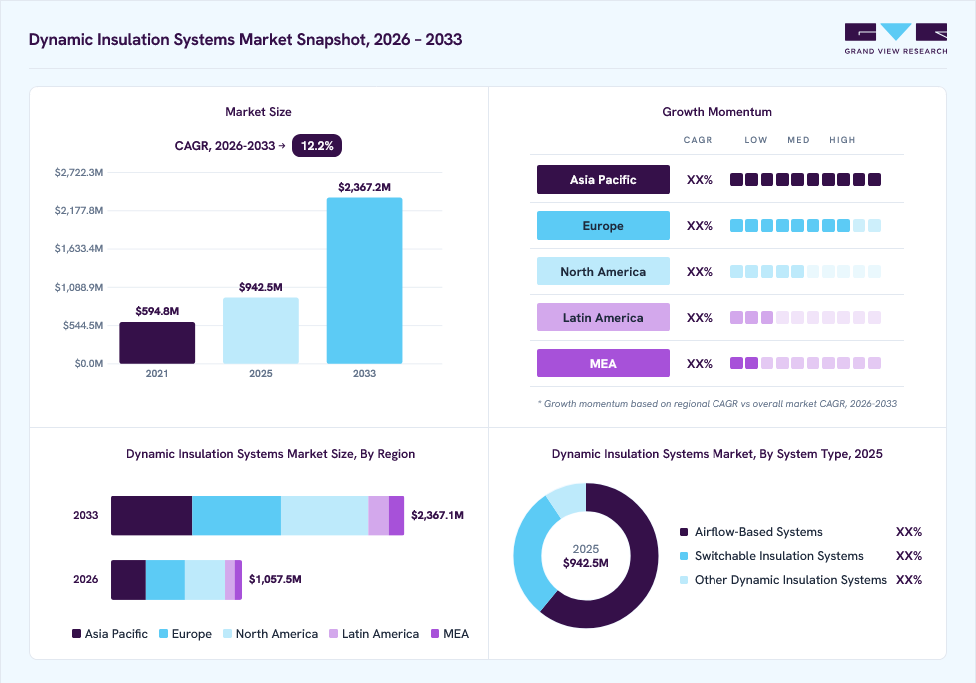
The global dynamic insulation systems market size was valued at USD 942.5 million in 2025 and is projected to grow from USD 1,057.5 million in 2026 to USD 2,367.1 million by 2033, at a CAGR of 12.2% from 2026 to 2033. North America dominated the market, accounting for the largest revenue share of 30.7% in 2025. The industry is primarily driven by increasing demand for energy-efficient buildings, advanced building envelope solutions, and insulation technologies that dynamically regulate heat transfer and reduce heating and cooling energy consumption.
Key Market Trends & Insights
- By system type: Airflow-Based segment held the largest revenue share of 60.9% in 2025.
- By application: Walls segment accounted for the largest revenue share of 40.7% in 2025.
- By end use: Residential segment held the largest revenue share of 46.7% in 2025.
Regional Highlights
- Largest regional market: North America (30.7% revenue share, 2025)
- Fastest growing Market: Asia-Pacific (highest CAGR, 2026-2033)
- By country: The U.S. held the largest share of North America in 2025.
Market Size & Forecast
- Market Size in 2025: USD 942.5 Million
- Estimated Market Size in 2026: USD 1,057.5 Million
- Projected Market Size in 2033: USD 2,367.1 Million
- CAGR (2026-2033): 12.2%
The industry is driven by the growing adoption of energy-efficient building envelopes and advanced thermal management solutions. As building owners, developers, and construction companies increasingly focus on reducing heating and cooling energy consumption, there is a growing demand for insulation systems capable of dynamically regulating heat transfer according to changing environmental conditions. Airflow-Based Systems are widely used to manage heat movement through building envelopes while supporting improved indoor thermal comfort. The expansion of sustainable construction, smart buildings, and energy-efficient residential and commercial infrastructure is further supporting demand for dynamic insulation solutions.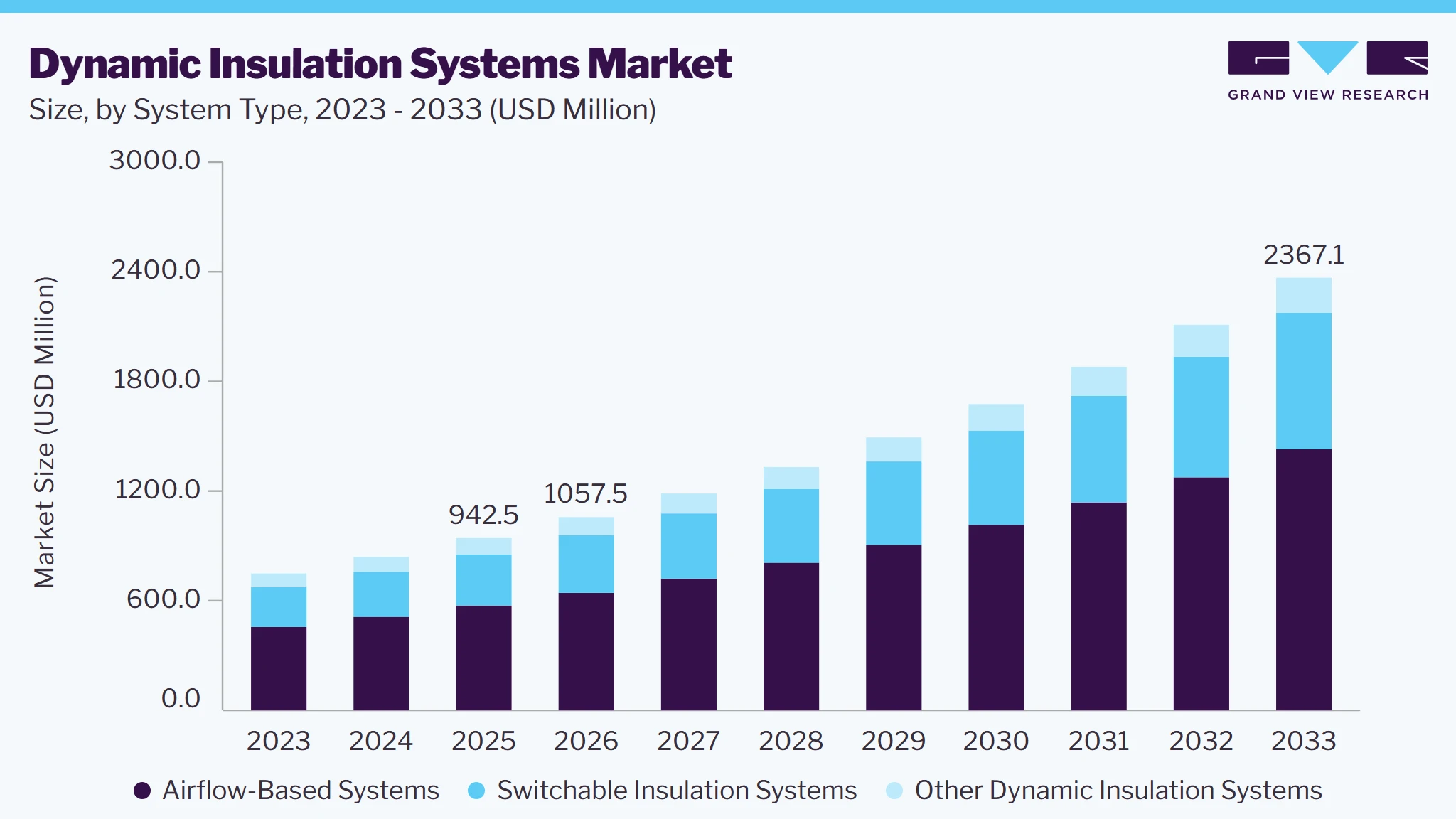
An increasing focus on building energy performance, indoor comfort, and the reduction of operational carbon emissions is expected to boost market growth in the coming years. Switchable Insulation Systems are gaining attention because they can adjust thermal resistance in response to external temperature and building conditions, helping optimize energy use across different seasons. Increasing adoption of smart building technologies, stricter energy-efficiency standards, and investments in advanced building-envelope solutions are encouraging the integration of dynamic insulation technologies across walls, roofs, floors, and windows & glazing.
Sustainability initiatives and the transition toward low-energy building systems are also significantly contributing to market growth. A defining trend in the industry is the accelerated shift toward adaptive and intelligent insulation technologies that can improve building energy performance while reducing reliance on conventional heating and cooling systems. This transition is being reinforced by investments in green buildings, energy-efficient construction, and building automation technologies. The growing integration of dynamic insulation with smart sensors and automated building management systems is expected to enhance real-time thermal regulation and improve overall building efficiency, supporting the long-term expansion of the industry.
Market Dynamics
The industry is experiencing strong growth, driven by increasing demand for energy-efficient buildings, advanced building envelope technologies, and solutions that dynamically regulate heat transfer. Growing investments in sustainable construction, smart buildings, and building energy management are encouraging the adoption of airflow-based and switchable insulation systems. However, high initial costs, technology complexity, and limited awareness of dynamic insulation solutions remain key challenges, while the increasing focus on low-carbon buildings and energy optimization creates significant opportunities for market expansion.
The growing emphasis on reducing building energy consumption is a key driver of the industry. Buildings account for a significant share of global energy use, increasing the need for advanced insulation technologies that can regulate heat transfer according to changing outdoor and indoor conditions. Dynamic insulation systems can help reduce heating and cooling requirements while improving indoor thermal comfort, making them increasingly attractive for residential, commercial, and industrial buildings.
The expansion of green building projects, rising energy costs, and stricter building energy-efficiency standards are further encouraging developers and building owners to adopt advanced envelope solutions. In addition, increasing investments in smart buildings and automated energy management systems are creating opportunities for dynamic insulation technologies to integrate with sensors and building controls, supporting more efficient real-time thermal management.
A significant restraint for the industry is the high initial investment and technical complexity associated with advanced insulation technologies. Dynamic systems may require specialized materials, sensors, control mechanisms, and skilled installation, increasing upfront costs compared with conventional insulation. In addition, limited awareness, lack of standardized installation practices, and challenges in integrating these systems with existing building structures can slow adoption, particularly in cost-sensitive markets and retrofit projects.
A major opportunity lies in the growing adoption of smart, energy-efficient, and sustainable buildings. Increasing investments in green construction, net-zero buildings, and energy-efficient retrofits are driving demand for adaptive building envelope technologies. Integration with IoT sensors, building automation systems, smart HVAC controls, and energy management platforms can enable real-time thermal regulation and improve overall building energy performance, creating significant opportunities for dynamic insulation manufacturers and technology developers.
Market Concentration & Characteristics
The market is characterized by its technology-intensive nature, driven by the increasing demand for energy-efficient buildings and advanced thermal management solutions. The industry relies on innovative insulation materials, airflow-control mechanisms, switchable technologies, sensors, and building automation systems to dynamically regulate heat transfer.
Manufacturers and technology providers prioritize thermal performance, energy savings, durability, system responsiveness, and compatibility with existing building envelopes. As energy-efficient construction becomes increasingly important, product development focuses on adaptive insulation solutions that can respond to changing indoor and outdoor conditions. Leading insulation and building-envelope companies are increasingly investing in advanced insulation technologies, smart building integration, and high-performance envelope solutions.
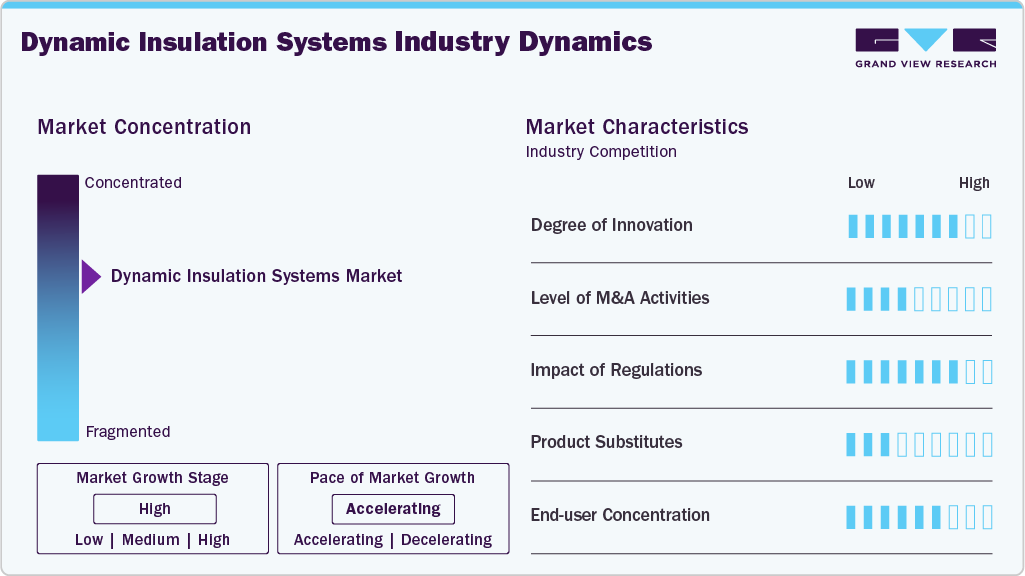
A defining feature of the industry is its transition from conventional passive insulation toward adaptive and intelligent insulation systems. Airflow-based systems currently represent the largest system type, while switchable insulation systems are gaining traction due to their ability to dynamically adjust thermal resistance based on environmental conditions. Increasing emphasis on green buildings, net-zero construction, and building energy-efficiency standards is accelerating this transition.
However, adoption varies by region due to differences in construction practices, technology awareness, installation expertise, and upfront costs. Integration with smart sensors, building management systems, and automated HVAC controls is further shaping product development and investment decisions across the industry.
Analyst Perspective
The industry has evolved from conventional static insulation toward adaptive solutions that actively manage heat transfer and improve building energy efficiency. Increasing focus on energy conservation, smart buildings, green construction, and stringent building-efficiency standards is driving adoption of airflow-based and switchable insulation systems. Going forward, demand is expected to strengthen as residential, commercial, and industrial buildings increasingly adopt advanced insulation technologies to reduce heating and cooling requirements and improve overall thermal performance.
System Type Insights
Based on system type, the airflow-based Systems segment led the market with the largest revenue share of 60.9% in 2025. Airflow-based systems are widely used in dynamic building envelopes because they facilitate controlled air movement within insulation layers, helping regulate heat transfer and improve overall thermal performance. Their ability to support energy efficiency, indoor comfort, and adaptable building-envelope performance makes them particularly suitable for residential, commercial, and other building applications. The segment's established technology base and broad applicability are expected to support its continued market leadership during the forecast period.
The Switchable Insulation Systems segment is expected to grow at the fastest CAGR of 13.1% from 2026 to 2033. These systems are gaining adoption due to their ability to dynamically adjust thermal resistance in response to changing environmental and building conditions. Increasing demand for smart and energy-efficient buildings, rising investments in adaptive building-envelope technologies, and the integration of insulation systems with sensors and building automation solutions are supporting segment growth. Their potential to optimize heating and cooling requirements and improve building energy performance is expected to further accelerate adoption over the forecast period.
Application Insights
Based on application, the walls segment led the market with the largest revenue share of 40.7% in 2025. Walls are the most widely adopted application because dynamic insulation technologies can be integrated into building wall assemblies to regulate heat transfer and improve thermal efficiency. Their broad use across residential, commercial, and other building structures, combined with growing demand for energy-efficient building envelopes, is expected to support continued growth of the segment during the forecast period.
The Roofs segment is expected to grow at the fastest CAGR of 12.6% from 2026 to 2033. Dynamic insulation systems in roofs are gaining adoption due to their ability to manage heat transfer and reduce heating and cooling requirements, particularly in buildings exposed to significant solar and outdoor temperature variations. Increasing investments in energy-efficient construction, green buildings, and advanced building-envelope technologies are supporting demand for dynamic roof insulation solutions. The growing focus on reducing building energy consumption is expected to further accelerate adoption of this segment over the forecast period.
End Use Insights
Based on end use, the residential segment led the market with the largest revenue share of 46.7% in 2025. Residential buildings represent a major application area for dynamic insulation systems due to increasing demand for energy-efficient homes, improved indoor thermal comfort, and reduced heating and cooling costs. Growing adoption of smart home technologies, energy-efficient building envelopes, and sustainable residential construction is expected to support continued demand for dynamic insulation solutions in residential applications.
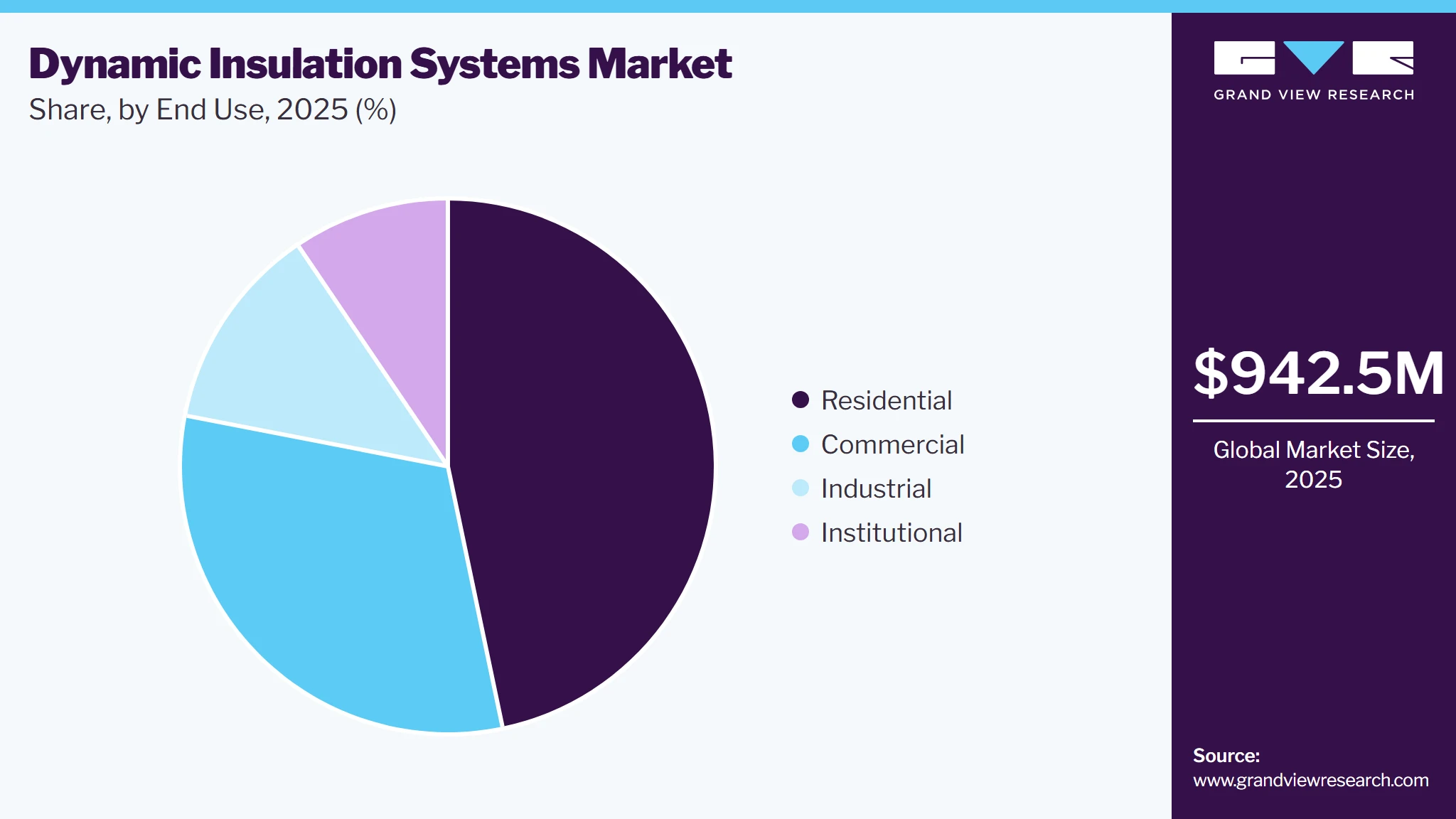
The commercial segment is expected to grow at the fastest CAGR of 12.6% from 2026 to 2033. Commercial buildings are increasingly adopting dynamic insulation systems to improve energy performance, optimize heating and cooling requirements, and meet evolving building efficiency standards. Rising investments in green buildings, smart commercial infrastructure, and energy-efficient retrofits are further supporting segment growth. The increasing focus among commercial property owners on reducing operating costs and carbon emissions is expected to accelerate adoption during the forecast period.
Regional Insights
The North America dynamic insulation systems market accounted for the largest revenue share of 30.7% in 2025. The region's strong position is supported by the widespread adoption of energy-efficient building technologies, increasing investments in smart buildings, and stringent requirements for improving building energy performance. Growing demand for advanced building envelope solutions across residential and commercial construction, along with increasing energy-efficiency retrofit activities, is expected to sustain regional market growth.

U.S. Dynamic Insulation Systems Market Trends
The dynamic insulation systems market in the U.S. represents a major portion of North America, supported by strong construction activity and increasing adoption of energy-efficient and smart building technologies. Growing emphasis on reducing building energy consumption, improving indoor thermal comfort, and lowering operational costs is encouraging the integration of advanced insulation solutions. Investments in sustainable construction, building automation, and energy-efficient renovations are expected to create further opportunities for dynamic insulation system providers.
Asia Pacific Dynamic Insulation Systems Market Trends
The dynamic insulation systems market in Asia Pacific is projected to register the fastest CAGR of 12.9% from 2026 to 2033. Rapid urbanization, expanding construction activity, rising energy consumption, and increasing investments in energy-efficient buildings are driving regional demand. The growing development of smart cities and sustainable infrastructure, particularly across emerging economies, is further supporting the adoption of advanced building-envelope technologies.
The China dynamic insulation systems market is supported by large-scale urban development, extensive construction activity, and increasing investment in energy-efficient buildings. Growing government and industry emphasis on reducing building energy consumption is encouraging the adoption of advanced insulation and smart building technologies. Expansion of commercial infrastructure and sustainable construction projects is expected to provide additional growth opportunities.
The dynamic insulation systems market in India is expected to witness strong growth during the forecast period, supported by rapid urbanization, expanding residential and commercial construction, and increasing awareness of energy-efficient building solutions. Rising temperatures and growing cooling requirements are encouraging building developers to improve thermal insulation and energy performance. Increasing investments in green buildings, smart infrastructure, and sustainable construction are expected to accelerate the adoption of dynamic insulation systems.
Europe Dynamic Insulation Systems Market Trends
The dynamic insulation systems market in Europe is projected to experience strong growth during the forecast period, registering a CAGR of 12.4% from 2026 to 2033. Demand is being supported by stringent building energy-efficiency requirements, decarbonization initiatives, and increasing adoption of sustainable construction technologies. The region's focus on improving building performance and reducing heating and cooling energy consumption is encouraging the use of adaptive insulation and advanced building-envelope solutions.
The Germany dynamic insulation systems market represents a significant market within Europe due to its strong focus on energy-efficient construction, building renovation, and sustainable infrastructure. Increasing adoption of smart building technologies and stringent energy-performance requirements are encouraging the deployment of advanced insulation solutions. Growing investments in energy-efficient residential and commercial buildings are expected to support continued demand for dynamic insulation systems.
Thedynamic insulation systems market in the UK is expected to grow steadily, supported by increasing efforts to improve building energy efficiency and reduce carbon emissions. Demand is being driven by energy-efficient residential construction, commercial building upgrades, and the modernization of existing building envelopes. Growing interest in smart building technologies and adaptive thermal management solutions is expected to strengthen market opportunities.
Latin America Dynamic Insulation Systems Market Trends
The dynamic insulation systems market in Latin America is projected to grow steadily, supported by increasing construction activity, urban development, and rising awareness of energy-efficient building solutions. Demand is gradually increasing across residential and commercial buildings as developers seek to improve thermal comfort and reduce energy consumption. Investments in sustainable infrastructure and building modernization are expected to create additional opportunities for dynamic insulation technologies.
The Brazil dynamic insulation systems market accounts for a significant portion of Latin America due to its large construction sector and expanding urban infrastructure. Increasing demand for energy-efficient residential and commercial buildings is encouraging the adoption of advanced insulation technologies. Growing investments in sustainable construction and improvements in building energy performance are expected to support future market development.
The dynamic insulation systems market in Argentina is expected to witness gradual growth, driven by increasing demand for improved building energy efficiency and thermal comfort. Residential and commercial construction projects are creating opportunities for advanced insulation technologies, while growing awareness of energy-saving solutions is encouraging building owners to consider improved building-envelope performance.
Middle East & Africa Dynamic Insulation Systems Market Trends
The dynamic insulation systems market in the Middle East & Africa is expected to grow steadily during the forecast period, supported by expanding construction activities, increasing investment in energy-efficient infrastructure, and the region's high cooling requirements. Demand for advanced insulation solutions is rising as building owners and developers seek to reduce cooling energy consumption and improve indoor thermal comfort. Growing investments in sustainable buildings, smart cities, and large-scale infrastructure projects are expected to support regional adoption.
Key Dynamic Insulation Systems Company Insights
Some key companies in the dynamic insulation systems market include Switchable Insulation Innovations, Active Insulation Systems B.V., Soleks, NECTES, and va-Q-tec Thermal Solutions GmbH. The market is characterized by adaptive thermal management, switchable insulation technologies, airflow control, energy-efficiency improvements, and integration with modern building systems. Key participants are focusing on improving thermal performance, reducing energy consumption, and developing responsive insulation solutions for residential, commercial, and industrial applications.
-
Switchable Insulation Innovations focuses on switchable insulation technologies designed to dynamically adjust thermal resistance according to changing environmental conditions. Its solutions support energy-efficient building envelopes by enabling greater control over heat transfer and indoor thermal conditions.
-
Active Insulation Systems B.V. develops active insulation solutions that combine insulation materials with controlled airflow and thermal management mechanisms. Its technology focus supports applications requiring improved energy efficiency and adaptive temperature regulation in buildings.
Key Dynamic Insulation Systems Companies
The following key companies have been profiled for this study on the dynamic insulation systems market.
-
Switchable Insulation Innovations
-
Active Insulation Systems B.V.
-
Soleks
-
NECTES
-
va-Q-tec Thermal Solutions GmbH
Competitive Benchmarking
Category
Operating Strategies
Competitive Edge
Weakness
Established Players (va-Q-tec Thermal Solutions GmbH; Active Insulation Systems B.V.)
Focus on advanced insulation technologies, thermal management solutions, R&D, and integration of switchable and adaptive insulation systems across building and industrial applications.
Strong technology expertise, established customer relationships, specialized product portfolios, and capabilities in high-performance thermal insulation.
High development costs, technology complexity, and dependence on specialized materials and installation expertise can limit adoption.
Emerging Players (Switchable Insulation Innovations; Soleks; NECTES)
Focus on developing switchable, adaptive, and energy-efficient insulation solutions, with emphasis on product innovation, customized systems, and applications requiring dynamic thermal control.
High flexibility, innovative technology approaches, customized solutions, and the ability to target emerging energy-efficiency applications.
Smaller production scale, limited geographic presence, lower brand recognition, and relatively limited resources for large-scale commercialization compared with established players.
Recent Development
-
In 2026, Switchable Insulation Innovations Ltd. received recognition as the Northern Ireland Construction and Building Services StartUp of the Year, highlighting its climate-responsive dynamic insulation technology for low-carbon buildings. The company is developing adaptive façade panels that can respond to changing conditions, helping buildings retain heat during colder periods and release excess heat during warmer conditions.
-
In May 2026, Soleks joined SPCleantech as the manufacturer and distributor of the TermaVIDA® active insulation technology. The solution combines insulation with heating and cooling functions, supporting improved indoor comfort, energy efficiency, and lower-energy building operation.
Dynamic Insulation Systems Market Report Scope
Report Attribute
Details
Market size value in 2025
USD 942.5 million
Estimated market size in 2026
USD 1,057.5 million
Revenue forecast in 2033
USD 2,367.1 million
Growth rate
CAGR of 12.2% from 2026 to 2033
Base year for estimation
2025
Historical data
2021 - 2024
Forecast period
2026 - 2033
Quantitative units
Revenue in USD million/billion and CAGR from 2026 to 2033
Report coverage
Revenue forecast, company ranking, competitive landscape, growth factors, and trends
Segments covered
System type, application, end-use, region
Regional scope
North America; Europe; Asia Pacific; Latin America; Middle East & Africa
Country scope
U.S.; Canada; Mexico; Germany; France; UK; Italy; Spain; China; India; Japan; South Korea; Brazil; Saudi Arabia
Key companies profiled
Switchable Insulation Innovations; Active Insulation Systems B.V.; Soleks; NECTES; va-Q-tec Thermal Solutions GmbH
Customization scope
Free report customization (equivalent up to 8 analysts working days) with purchase. Addition or alteration to country, regional & segment scope.
Pricing and purchase options
Avail of customized purchase options to meet your exact research needs. Explore purchase options
Global Dynamic Insulation Systems Market Report Segmentation
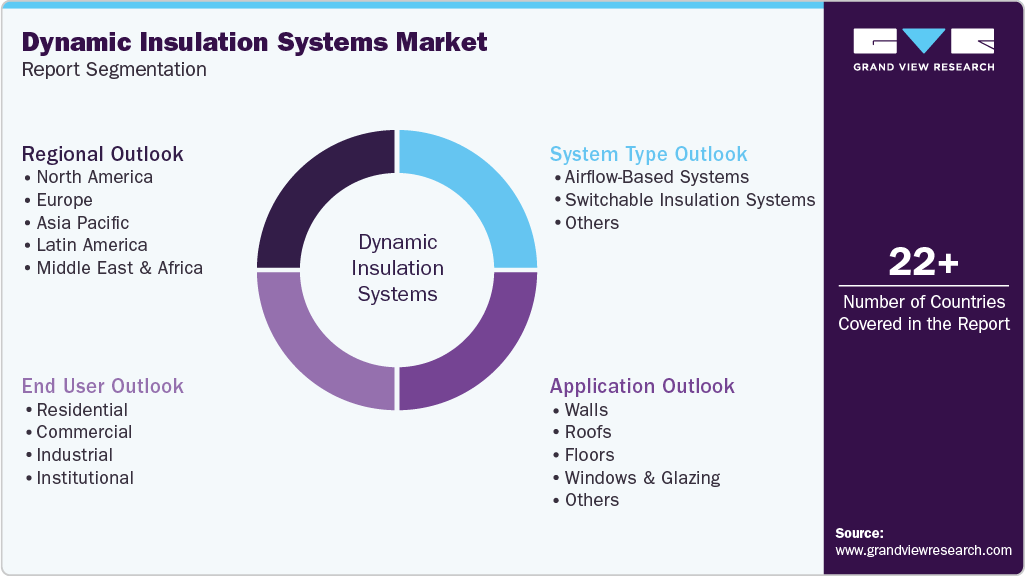
This report forecasts revenue growth at the global, regional, and country levels and provides an analysis of the latest industry trends and opportunities in each of the sub-segments from 2021 to 2033. For this study, Grand View Research has segmented the global dynamic insulation systems market report on the basis of system type, application, end-use, and region:
-
System Type Outlook (Revenue, USD Million, 2021 - 2033)
-
Airflow-Based Systems
-
Switchable Insulation Systems
-
Others
-
-
Application Outlook (Revenue, USD Million, 2021 - 2033)
-
Walls
-
Roofs
-
Floors
-
Windows & Glazing
-
Others
-
-
End-Use Outlook (Revenue, USD Million, 2021 - 2033)
-
Residential
-
Commercial
-
Industrial
-
Institutional
-
-
Regional Outlook (Revenue, USD Million, 2021 - 2033)
-
North America
-
U.S.
-
Canada
-
Mexico
-
-
Europe
-
Germany
-
France
-
UK
-
Italy
-
Spain
-
-
Asia Pacific
-
China
-
India
-
Japan
-
South Korea
-
-
Latin America
-
Brazil
-
-
Middle East & Africa
-
Saudi Arabia
-
-
Research Methodology
The dynamic insulation systems market figures in this report are based on a proven research process that combines executive interviews with secondary research from proprietary databases, company filings, and recognized regulatory and institutional sources. Market size is built through value-chain sizing-reconciling supply-side and demand-side estimates-and triangulated with bottom-up and top-down approaches. Every estimate passes multiple levels of expert validation before publication, with each dynamic insulation systems segment quantified using the revenue-capture definitions in the table below.
Segment Definition
Segment - System Type
Revenue capture definition
Airflow-Based Systems
Revenue generated from the sale of airflow-based dynamic insulation systems that regulate thermal performance by controlling air movement within insulation layers or building-envelope assemblies. Includes systems used in walls, roofs, floors, and other building components to improve energy efficiency, heat transfer management, and indoor thermal comfort.
Switchable Insulation Systems
Revenue generated from the sale of switchable insulation systems that dynamically alter their thermal resistance or heat-transfer characteristics in response to changing environmental or operating conditions. Includes adaptive insulation technologies used in residential, commercial, and industrial buildings for energy conservation, thermal regulation, and building-envelope optimization.
Other Dynamic Insulation Systems
Revenue generated from the sale of other dynamic insulation technologies that provide variable thermal performance through mechanisms such as responsive materials, adaptive barriers, phase-change technologies, or other active thermal-management approaches. Includes systems designed for specialized building-envelope and energy-efficiency applications across residential, commercial, industrial, and institutional settings.
Segment - Application
Revenue capture definition
Walls
Revenue generated from dynamic insulation systems installed within or integrated into wall assemblies to regulate heat transfer, improve thermal resistance, and enhance building energy efficiency. Includes systems used in exterior walls, cavity walls, and adaptive building-envelope applications.
Roofs
Revenue generated from dynamic insulation systems used in roof assemblies to manage heat gain and heat loss and improve overall building thermal performance. Includes solutions applied in residential, commercial, industrial, and institutional roofing systems.
Floors
Revenue generated from dynamic insulation systems incorporated into floors to control heat transfer between indoor spaces and surrounding environments. Includes systems designed to improve thermal comfort and energy efficiency in residential, commercial, and industrial buildings.
Windows & Glazing
Revenue generated from dynamic insulation solutions integrated with windows and glazing systems to regulate thermal transmission, reduce heat gain or loss, and improve building-envelope efficiency. Includes adaptive and responsive insulation technologies used in high-performance glazing applications.
Others
Revenue generated from dynamic insulation systems used in other building components and specialized applications, including doors, partitions, ceilings, HVAC-related thermal barriers, and specialized structures requiring adaptive thermal management and energy-efficiency performance.
Segment - End-Use
Revenue capture definition
Residential
Revenue generated from dynamic insulation systems installed in residential buildings, including single-family homes, apartments, and multifamily housing, to improve thermal comfort, reduce energy consumption, and enhance building-envelope efficiency.
Commercial
Revenue generated from dynamic insulation systems used in commercial buildings such as offices, retail centers, hotels, and mixed-use facilities to optimize heating and cooling performance, improve energy efficiency, and support sustainable building operations.
Industrial
Revenue generated from dynamic insulation systems deployed in industrial facilities, warehouses, manufacturing plants, and processing sites to manage thermal conditions, reduce heat transfer, and improve energy efficiency in demanding operating environments.
Institutional
Revenue generated from dynamic insulation systems used in institutional facilities such as schools, hospitals, universities, government buildings, and public facilities to enhance thermal comfort, energy conservation, and long-term building performance.
Estimation Model
Layer No.
Layer Name
Key Question
Description
01
End-use Industry Layer
What drives demand?
Estimate demand from key end-use sectors including residential, commercial, industrial, and institutional buildings that adopt dynamic insulation systems to improve energy efficiency and thermal comfort.
02
Application Adoption Layer
Where are dynamic insulation systems used?
Assess adoption across walls, roofs, floors, windows & glazing, and other building components based on thermal-management, energy-efficiency, and building-envelope requirements.
03
System Consumption Layer
Which systems generate demand?
Evaluate consumption of airflow-based systems, switchable insulation systems, and other dynamic insulation systems across major building applications and end-use sectors.
04
Revenue Layer
How is revenue generated?
Revenue is generated through the sale and installation of dynamic insulation systems for building-envelope applications, including thermal regulation, heat-transfer control, energy conservation, and indoor comfort improvement.
Delivered Customizations
This report has been delivered with the following In-depth customizations
Client Request
Customization Delivered
Value Adds
Cross-Segmentation Analysis
Comprehensive analysis of the Dynamic Insulation Systems market across System Type (Airflow-Based Systems, Switchable Insulation Systems, Other Dynamic Insulation Systems), Application (Walls, Roofs, Floors, Windows & Glazing, Others), End Use (Residential, Commercial, Industrial, Institutional), and regional markets.
Helps identify high-growth segment combinations, application-specific demand, target markets, and expansion opportunities across key building sectors.
Pricing Analysis
Detailed assessment of dynamic insulation system pricing based on system type, technology complexity, installation requirements, material costs, energy-efficiency performance, and regional market conditions.
Supports pricing strategy, cost benchmarking, margin optimization, procurement planning, and evaluation of price competitiveness across key markets.
Opportunity Assessment
Evaluation of emerging opportunities driven by energy-efficiency regulations, green building development, building retrofits, smart-building integration, and increasing demand for adaptive thermal-management solutions across residential, commercial, industrial, and institutional applications.
Enables clients to identify untapped markets, high-potential applications, emerging technology opportunities, and strategic areas for investment and market expansion.
About the Author(s)
Advanced Interior Materials Research Team
Advanced Materials · Advanced Interior MaterialsThis report was authored by the advanced interior materials research team at Grand View Research - comprising two research analysts, one senior research analyst, and one industry expert - with specialized expertise in the advanced interior materials segment of the advanced materials industry. All findings are based on proprietary advanced materials databases, executive interviews, and regulatory analysis, subject to internal peer review prior to publication.
Last Updated:
Speak to Analyst


Customize this report to your needs — add regions, segments, or data points, with 20% free customization.
Or view our licence options:


ISO 9001:2015 & 27001:2022 Certified
We are GDPR and CCPA compliant! Your transaction & personal information is safe and secure. For more details, please read our privacy policy.


