
- Home
- »
- Homecare & Decor
- »
-
Eco-friendly Furniture Market Size, Industry Report, 2033GVR Report cover
![Eco-friendly Furniture Market Size, Share & Trends Report]()
Eco-friendly Furniture Market (2026 - 2033) Size, Share & Trends Analysis Report By Application (Residential, Commercial), By Distribution Channel (Online, Offline), By Region (North America, Europe, Asia Pacific, Central & South America, Middle East & Africa), And Segment Forecasts
- Report ID: GVR-4-68038-405-5
- Number of Report Pages: 90
- Format: PDF
- Historical Range: 2021 - 2025
- Forecast Period: 2026 - 2033
- Industry: Consumer Goods
- Report Summary
- Table of Contents
- Segmentation
- Methodology
- Download FREE Sample
-
 Download Sample Report
Eco-friendly Furniture Market Summary
The global eco-friendly furniture market size was valued at USD 53.77 billion in 2025 and is projected to reach USD 113.94 billion by 2033, growing at a CAGR of 10.0% from 2026 to 2033. Growing environmental consciousness is one of the primary reasons the eco-friendly furniture market is expanding among consumers.
Key Market Trends & Insights
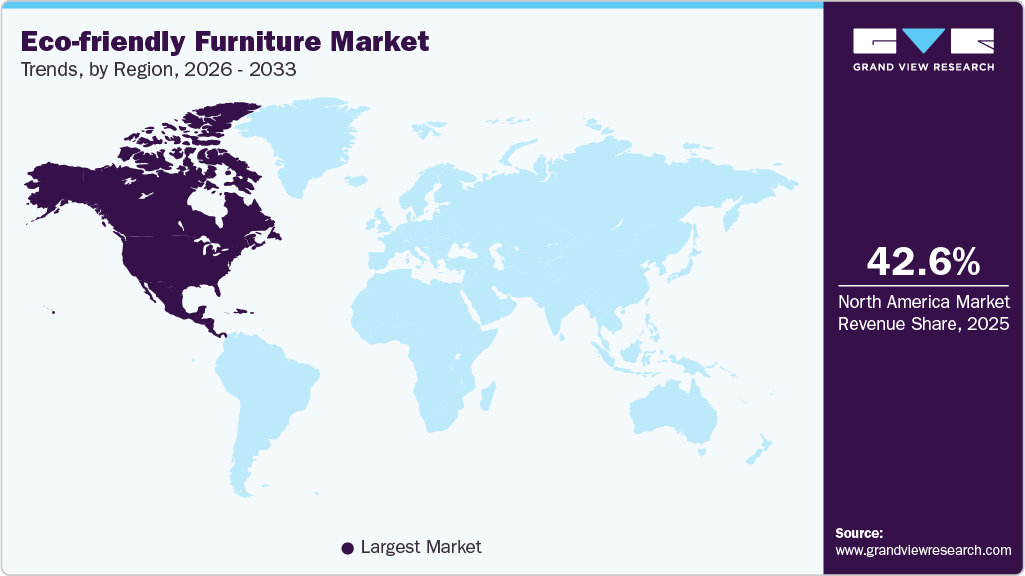
- North America led the market with a share of 42.6% in 2025.
- The eco-friendly furniture market in the Asia Pacific is anticipated to grow with a CAGR of 11.9% over the forecast period.
- By application, residential segment led the market and accounted for a share of 54.4% in 2025.
- By distribution channel, offline segment led the market and accounted for a share of 64.5% in 2025.
Market Size & Forecast
- 2025 Market Size: USD 53.77 Billion
- 2033 Projected Market Size: USD 113.94 Billion
- CAGR (2026-2033): 10.0%
- North America: Largest market in 2025
As awareness around issues such as deforestation, landfill waste, carbon emissions, and resource depletion increases, buyers are actively seeking furniture made from sustainable materials. Products crafted from FSC-certified wood, recycled components, biodegradable materials, and low-VOC or chemical-free finishes are viewed as responsible choices that help reduce environmental impact. This shift is particularly strong among younger consumers who prioritize sustainability as part of their lifestyle and purchasing decisions.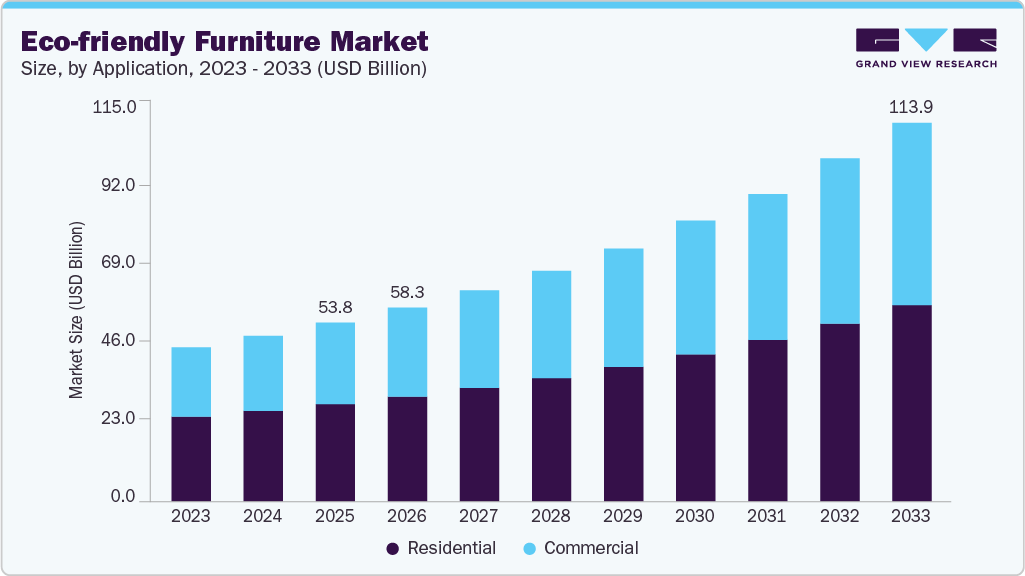
Health considerations are also contributing significantly to the rising demand for eco-friendly furniture. Conventional furniture often contains harmful chemicals, including formaldehyde, VOCs, and synthetic adhesives, which can negatively affect indoor air quality. Eco-friendly alternatives utilize natural materials, non-toxic finishes, and hypoallergenic textiles, appealing to families, health-conscious individuals, and consumers seeking safer home environments. As people become more aware of indoor pollution and the long-term effects of chemical exposure, sustainable furniture is increasingly perceived as a healthier option.
Another major trend driving growth is the rise of conscious consumerism and the broader circular economy movement. Many consumers now prefer durable, long-lasting, and ethically produced furniture over fast, disposable products. This has led to increasing interest in reclaimed wood furniture, upcycled pieces, modular designs that can be repaired or updated, and brands with transparent sourcing and manufacturing practices. The combination of sustainability, craftsmanship, and longevity makes eco-friendly furniture a compelling value proposition.
Manufacturers are responding to the growing demand for eco-friendly furniture by focusing on research and development, as well as introducing new products. For instance, in October 2024, Haworth and MiEN announced a new partnership. The collaboration aims to combine Haworth's expertise in workplace and educational furnishings with MiEN's innovative education solutions, enhancing offerings to the education market. This partnership is designed to support the evolving needs of modern learning environments.
Buyer Insights
The demand for eco-friendly furniture is steadily rising as consumers become increasingly environmentally conscious and prioritize sustainable living. A key driver behind this shift is the growing preference for products made from responsibly sourced, renewable, or recycled materials such as FSC-certified wood, bamboo, reclaimed timber, and recycled metals. Consumers are increasingly expecting brands to demonstrate transparency regarding sourcing, carbon footprint, and environmental certifications, reflecting a broader movement toward ethical and sustainable consumption.
Another major factor influencing demand is the increasing awareness of indoor air quality and its impact on personal health. Eco-friendly furniture typically avoids harmful chemicals, using low-VOC paints, non-toxic adhesives, and natural finishes, which is appealing to consumers-especially families-who wish to reduce exposure to allergens and synthetic chemicals. As people spend more time indoors due to hybrid work models, interest in health-safe furniture has accelerated even further.
Aesthetics also play an important role. Eco-friendly materials naturally align with popular minimalist, Scandinavian, and Japandi design styles that emphasize simplicity, natural textures, and earthy tones. Consumers are gravitating toward pieces that offer both sustainability and contemporary visual appeal. In addition, there is a noticeable shift toward functional, durable, and long-lasting furniture, with many consumers adopting a “buy better, buy once” mindset to avoid disposable, fast-furniture products. The availability of modular, repairable, and customizable designs further supports this trend.
Application Insights
Eco-friendly furniture for residential use accounted for a 54.4% share of the global market in 2025. Rising awareness of environmental impact, coupled with a preference for non-toxic, low-VOC materials, is driving homeowners to choose furniture made from responsibly sourced wood, recycled materials, and renewable alternatives. In addition, younger buyers, particularly Millennials and Gen Z, are willing to pay more for durable, ethically produced products that align with their lifestyle values. This shift, supported by strong social media influence and green-certification transparency, is accelerating the adoption of eco-friendly furniture in modern households.
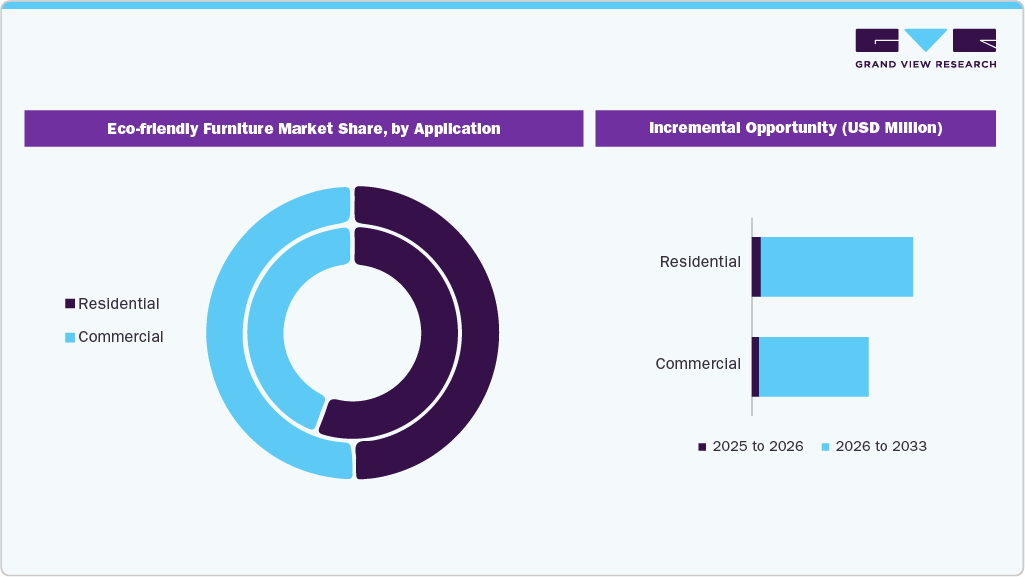
Eco-friendly furniture for commercial use is expected to grow at a CAGR of 10.8% from 2026 to 2033. Companies across various industries, including offices, hospitality, retail, and public institutions, are shifting toward green materials such as recycled wood, bamboo, responsibly sourced timber, and low-VOC finishes to reduce their environmental footprint and meet their ESG commitments. At the same time, consumers and employees now expect brands to demonstrate visible sustainability practices, making eco-friendly interiors a key part of brand image and workplace wellness. Additionally, energy-efficient manufacturing, durability, and circular-design models lower lifetime ownership costs, further accelerating adoption in commercial environments.
Distribution Channel Insights
The sales of eco-friendly furniture through offline channels accounted for a 64.5% share in 2025. The market for eco-friendly furniture is growing rapidly through offline channels, as consumers increasingly prefer to see, touch, and verify the sustainability and build quality of products before making a purchase. Physical stores enable buyers to assess materials, craftsmanship, certifications (such as FSC or recycled wood), and durability-factors that are more important in sustainable purchases than in conventional furniture. Additionally, offline retailers often highlight local, artisanal, or ethically sourced collections, building trust and helping customers feel confident about the authenticity of “eco-friendly” claims.
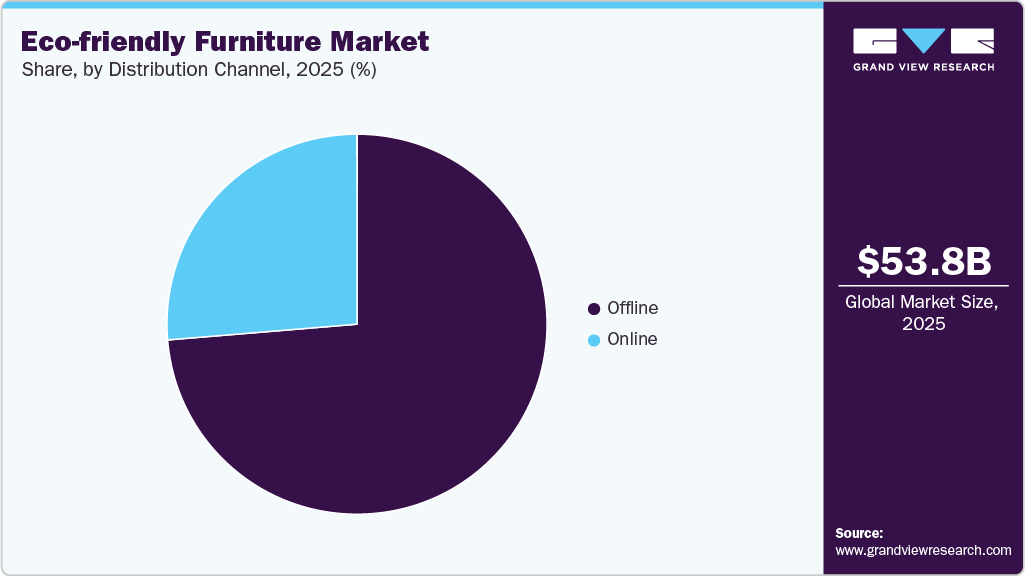
The online segment is expected to grow at a CAGR of 11.2% from 2026 to 2033. The market for eco-friendly furniture is growing rapidly through online channels as consumers become more environmentally conscious and increasingly seek sustainable, responsibly sourced products. E-commerce platforms offer greater transparency regarding materials, certifications, and manufacturing practices-information that is often not readily available in traditional retail settings. In addition, online marketplaces offer a wider variety of eco-friendly designs, competitive pricing, and the convenience of home delivery, making sustainable furniture more accessible. Rising awareness of carbon footprints and circular-economy lifestyles is further amplifying demand, encouraging shoppers to choose green furniture options online.
Regional Insights
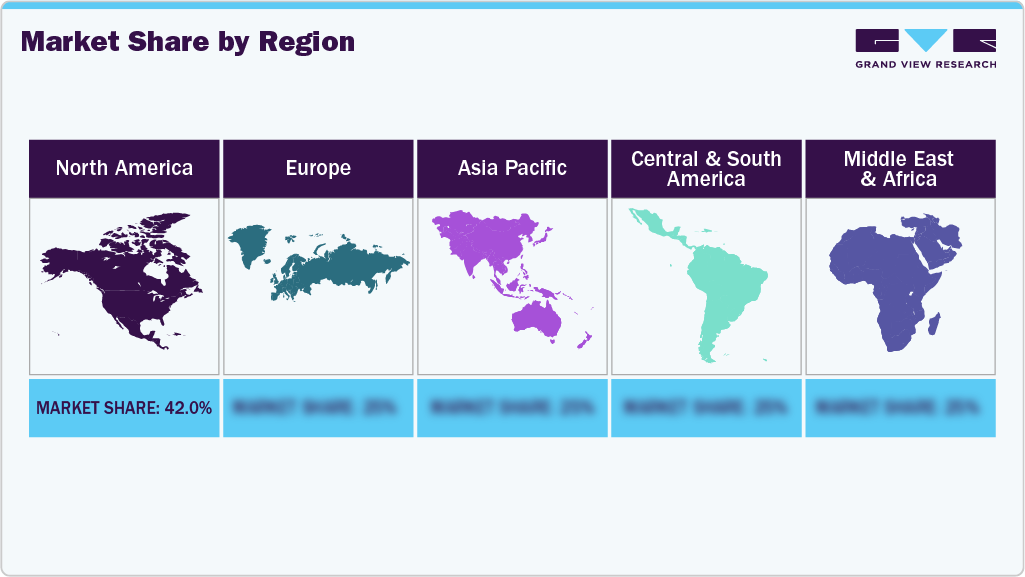
The North America eco-friendly furniture market held a major share of 42.6% in 2025. Rising environmental awareness, concerns over indoor air quality, and the preference for non-toxic, responsibly sourced materials are pushing buyers toward greener alternatives. In addition, major retailers and real-estate developers are integrating sustainability standards such as FSC-certified wood, recycled materials, and low-VOC finishes into their procurement policies. Government incentives, corporate ESG commitments, and the willingness of younger consumers to pay a premium for sustainable products further accelerate adoption, making eco-friendly furniture one of the fastest-expanding segments in the regional furniture market.
Europe Eco-friendly Furniture Market Trends
The eco-friendly furniture market in Europe is anticipated to grow with a CAGR of 9.7% from 2026 to 2033. The market for eco-friendly furniture in Europe is growing rapidly due to rising consumer awareness about sustainability, stricter environmental regulations, and a strong regional shift toward circular-economy practices. European consumers increasingly prefer furniture made from recycled, certified, or responsibly sourced materials, and brands are responding by adopting greener manufacturing processes and transparent supply chains. Additionally, corporate and public sector procurement policies now prioritize low-carbon, durable, and recyclable furniture, further accelerating demand across both residential and commercial segments.
Asia Pacific Eco-friendly Furniture Market Trends
The eco-friendly furniture market in the Asia Pacific is anticipated to grow with a CAGR of 11.9% over the forecast period. Governments across the region are tightening regulations on waste, emissions, and responsible sourcing, which is encouraging manufacturers to adopt greener materials such as bamboo, reclaimed wood, and recycled plastics. Younger consumers, particularly in China, Japan, South Korea, Australia, and Southeast Asia, are prioritizing products that are non-toxic, durable, ethically sourced, and aligned with wellness-focused home environments. Additionally, the expansion of green-certified buildings, premium real estate, and e-commerce platforms showcasing sustainable brands is accelerating the demand for eco-friendly furniture across the region.
Central & South America Eco-friendly Furniture Market Trends
The eco-friendly furniture market in Central & South America is anticipated to grow with a CAGR of 10.4% over the forecast period. The market for eco-friendly furniture in Central & South America is growing due to rising consumer awareness of sustainability, increasing preference for non-toxic and responsibly sourced materials, and stronger environmental regulations across the region. Urban middle-income households are gravitating toward durable, natural, and recycled furniture as part of a broader shift toward greener lifestyles. Additionally, hospitality, tourism, and real estate developers are adopting eco-certified furnishings to meet global ESG standards, which further accelerates demand for sustainable furniture solutions.
Middle East & Africa Eco-friendly Furniture Market Trends
In the Middle East and Africa, the eco-friendly furniture market is expected to grow at a CAGR of 9.6% from 2026 to 2033. Consumers, especially younger, urban demographics, are increasingly prioritizing furniture made from recycled, non-toxic, and sustainably sourced materials as part of healthier lifestyle choices. Additionally, large real estate developers and hotels in the UAE, Saudi Arabia, and South Africa are adopting eco-certified interior solutions to meet ESG commitments and green-building standards (LEED, Estidama), further accelerating demand for sustainable furniture products.
Key Eco-friendly Furniture Company Insights
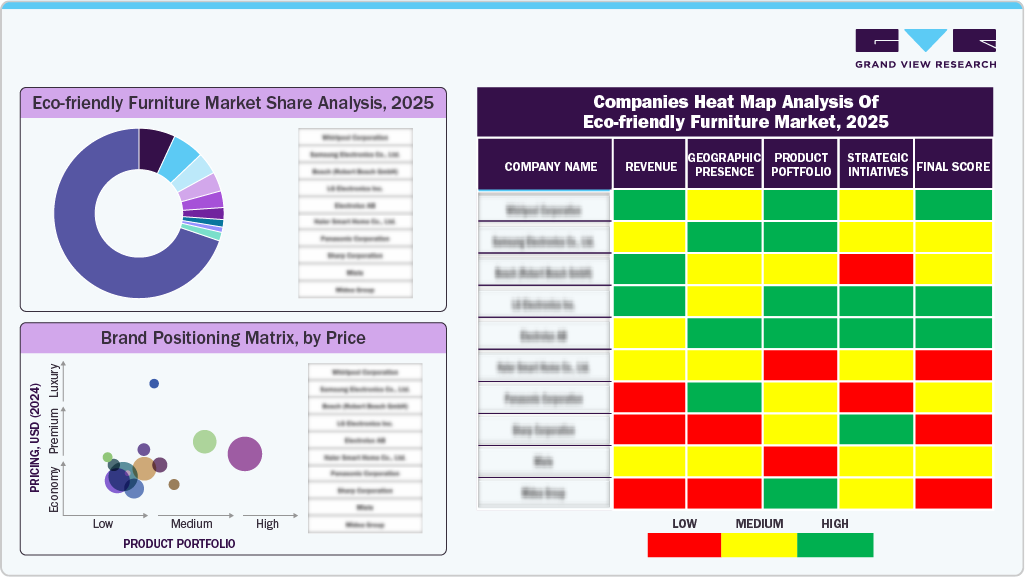
Manufacturers are adopting various strategies to maintain a competitive edge, with a primary focus on introducing a wide variety of eco-friendly furniture in terms of ingredients, applicationulations, and delivery methods to cater to different cognitive needs and consumer preferences. Manufacturers are also investing in educating consumers about the benefits and proper usage of eco-friendly furniture. Some of the initiatives include:
-
In September 2025,URBANICA Furniture launched a new collection of sustainable office furniture featuring ergonomic chairs (Muse, Onyx, Novo, and Seashell) and adjustable desks, including a compact mini Standing Desk. The products emphasize comfort, durability, and eco-friendly practices, such as tree planting with every purchase and minimal packaging. The collection supports both home and team workspaces, offers fast shipping, simple assembly, long warranties, and direct-to-consumer pricing for accessible quality upgrades.
-
In October 2025, Tradingzone AG, Switzerland's largest provider of new and pre-owned office furniture, has expanded its sustainable office furniture solutions and rental services to meet growing demand. The company focuses on circular economy practices by rescuing around 60-100 pieces of office furniture daily, refurbishing them into high-quality "second life" products, and offering flexible usage models like rental, leasing, and subscription. This approach reduces waste, lowers CO2 emissions, conserves resources, and provides economical, modular, and adaptable furniture options.
Key Eco-friendly Furniture Companies:
The following are the leading companies in the eco-friendly furniture market. These companies collectively hold the largest market share and dictate industry trends.
- Onnit Labs, Inc.
- Reckitt Benckiser Group PLC
- Mental Mojo, LLC
- NooCube
- Mind Lab Pro (Perapplicationance Lab Group Ltd)
- TruBrain
- Neu Mind, LLC
- Nooflux LLC
- Zhou Nutrition
- Kimera Koffee
Eco-friendly Furniture Market Report Scope
Report Attribute
Details
Market size value in 2026
USD 58.30 billion
Revenue forecast in 2033
USD 113.94 billion
Growth rate
CAGR of 10.0% from 2026 to 2033
Base year for estimation
2025
Historical data
2021 - 2025
Forecast period
2026 - 2033
Quantitative units
Revenue in USD million/billion and CAGR from 2026 to 2033
Report coverage
Revenue forecast, company ranking, competitive landscape, growth factors, and trends
Segments covered
Application, distribution channel, region
Regional scope
North America; Europe; Asia Pacific; Central & South America; Middle East & Africa
Country scope
U.S.; Canada; Mexico; Germany; UK; France; Italy; Spain; China; Japan; India; Australia & New Zealand; South Korea; Brazil; UAE
Key companies profiled
Onnit Labs, Inc.; Reckitt Benckiser Group PLC; Mental Mojo, LLC; NooCube; Mind Lab Pro (Perapplicationance Lab Group Ltd); TruBrain; Neu Mind, LLC; Nooflux LLC; Zhou Nutrition; Kimera Koffee
Customization scope
Free report customization (equivalent up to 8 analysts’ working days) with purchase. Addition or alteration to country, regional & segment scope.
Pricing and purchase options
Avail customized purchase options to meet your exact research needs. Explore purchase options.
Global Eco-friendly Furniture Market Report Segmentation
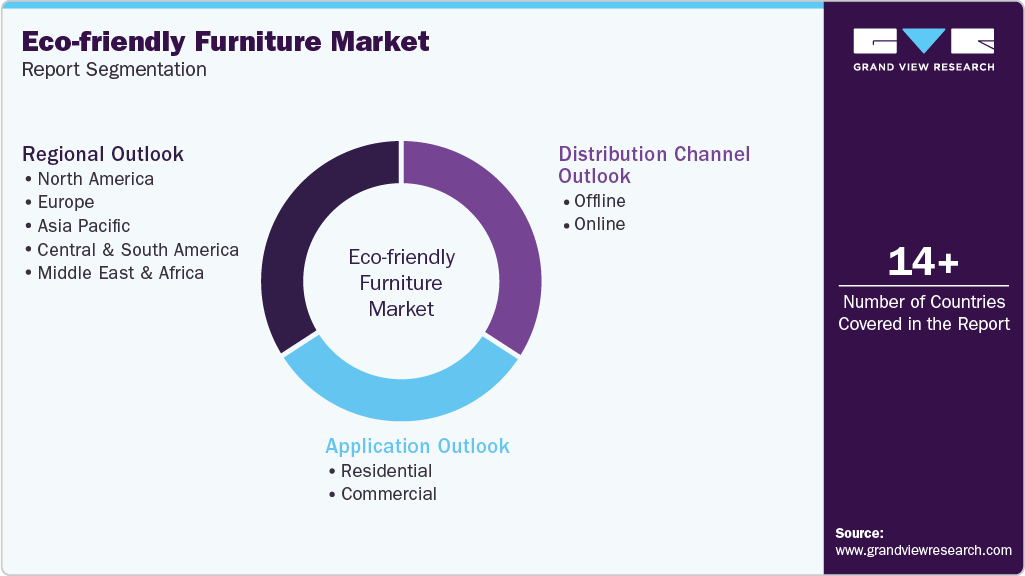
This report forecasts growth at global, regional, and country levels and provides an analysis of the latest industry trends in each of the sub-segments from 2021 to 2033. For this study, Grand View Research has segmented the global eco-friendly furniture market on the basis of application, distribution channel, and region:
-
Application Outlook (Revenue, USD Million, 2021 - 2033)
-
Residential
-
Commercial
-
-
Distribution Channel Outlook (Revenue, USD Million, 2021 - 2033)
-
Offline
-
Online
-
-
Regional Outlook (Revenue, USD Million, 2021 - 2033)
-
North America
-
U.S.
-
Canada
-
Mexico
-
-
Europe
-
Germany
-
UK
-
France
-
Italy
-
Spain
-
-
Asia Pacific
-
China
-
India
-
Japan
-
Australia & New Zealand
-
South Korea
-
-
Central & South America
-
Brazil
-
-
Middle East & Africa
-
UAE
-
-
Frequently Asked Questions About This Report
b. Some key players operating in the eco-friendly furniture market include Vermont Woods Studios, Cisco Brothers Corporation, Sabai, Greenington, Lee Industries, Inc., Williams-Sonoma, Inc., La-Z-Boy Inc., Vestre, KING Furniture Pty Ltd, Maiden Home, Ashley Furniture Industries, Inc., Ethan Allen Global, Inc., Roche Bobois, and Inter IKEA Systems B.V.
b. Key factors that are driving the market growth include the rising adoption of sustainable materials in furniture production to support the environment and also growing initiatives such as environmentally friendly housing projects across nations.
b. The global eco-friendly furniture market size was estimated at USD 53.77 billion in 2026 and is expected to reach USD 58.30 billion in 2033.
b. The global eco-friendly furniture market is expected to grow at a compound annual growth rate of 10.0% from 2026 to 2033 to reach USD 113.94 billion by 2033.
b. Eco-friendly furniture for residential use accounted for a share of 54.4% in the global market in 2025. Rising awareness of environmental impact, coupled with a preference for non-toxic, low-VOC materials, is driving homeowners to choose furniture made from responsibly sourced wood, recycled materials, and renewable alternatives.


Share this report with your colleague or friend.
Need a Tailored Report?
Customize this report to your needs — add regions, segments, or data points, with 20% free customization.


ISO 9001:2015 & 27001:2022 Certified
We are GDPR and CCPA compliant! Your transaction & personal information is safe and secure. For more details, please read our privacy policy.
Trusted market insights - try a free sample
See how our reports are structured and why industry leaders rely on Grand View Research. Get a free sample or ask us to tailor this report to your needs.













