
- Home
- »
- Medical Devices
- »
-
Education Microscope Market Size & Share Report, 2033GVR Report cover

Education Microscope Market (2026 - 2033)
Size, Share & Trends Analysis Report By Type (Optical Microscope (Upright Microscope, Inverted Microscope), Digital Microscope, Electron Microscope (Transmission Microscope)), By Region, And Segment Forecasts
Market Size, 2025
$442.8MMarket Estimate, 2026
$466.1MMarket Forecast, 2033
$659.1MCAGR, 2026–2033
5.1%Education Microscope Market Summary
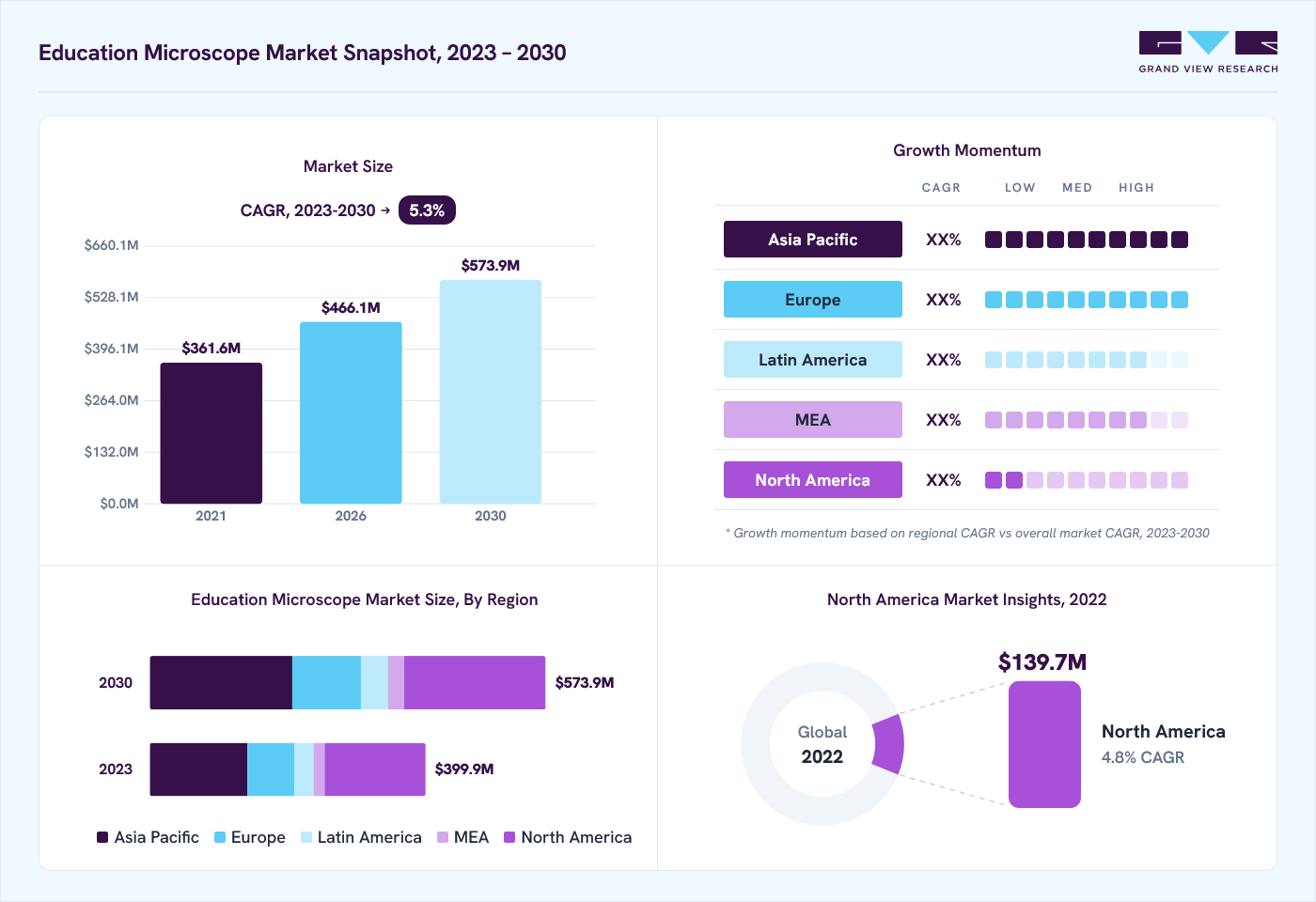
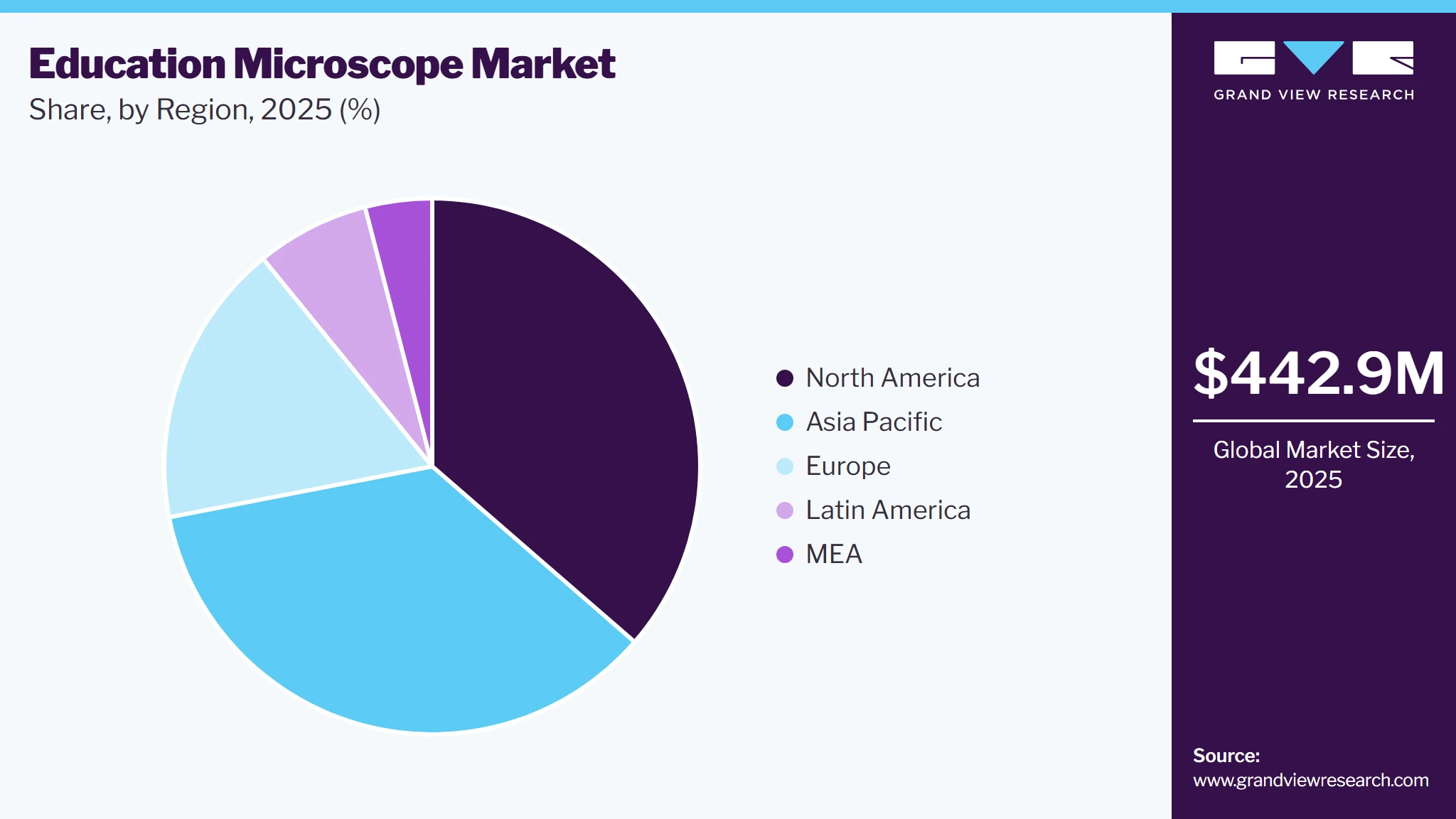
The global education microscope market size was valued at USD 442.8 million in 2025 and is projected to grow from USD 466.1 million in 2026 to USD 659.1 million by 2033, at a CAGR of 5.1% from 2026 to 2033. The market in North America dominated with a revenue share of 36.4% in 2025. The key factors driving the market growth are the growing emphasis on Science, Technology, Engineering, and Mathematics (STEM) education, the installation of advanced microscopes in academic facilities, and increasing funding by government & nongovernment organizations for installing scientific equipment in academic institutions. Moreover, the establishment of microscopy as of field of education to promote research activities contributes to the demand for microscopes.
 Source: Grand View Research, IR Documents, Primary Interviews, Paid DatabasesTo learn more about this report,
 Download Free Sample Report
Key Market Trends & Insights
- By type: Optical microscope segment held the largest market share of 91.0% in 2025.
- The digital microscope segment is expected to witness the fastest growth over the forecast period.
Regional Highlights
- Largest regional market: North America (36.4% revenue share, 2025)
- Fastest-growing regional market: Asia Pacific (highest CAGR, 2026-2033)
- By country: The U.S. held the largest market share in 2025
Market Size & Forecast
- Market size in 2025: USD 442.8 Million
- Estimated market size in 2026: USD 466.1 Million
- Projected market size by 2033: USD 659.1 Million
- CAGR (2026-2033): 5.1%
Prism AI by Grand View Research Free to tryAsk a question about the education microscope marketTry asking✓Every figure cited from GVR research Prefer the report? Download free sample →
Educators are turning to technology to boost learning outcomes. Hence, the government and other organizations are introducing various programs to offer advanced & quality education to students. For instance, the BioEYES science education program provides classroom-based learning opportunities to increase the adoption of STEM education globally. The program is currently benefitting more than 155,000 students from 13 diverse global locations. The program was started in Philadelphia, U.S., and microscopy was the core of the program. It deployed ZEISS Stemi 305 stereo microscope for analyzing and visualizing zebrafish embryos and larvae.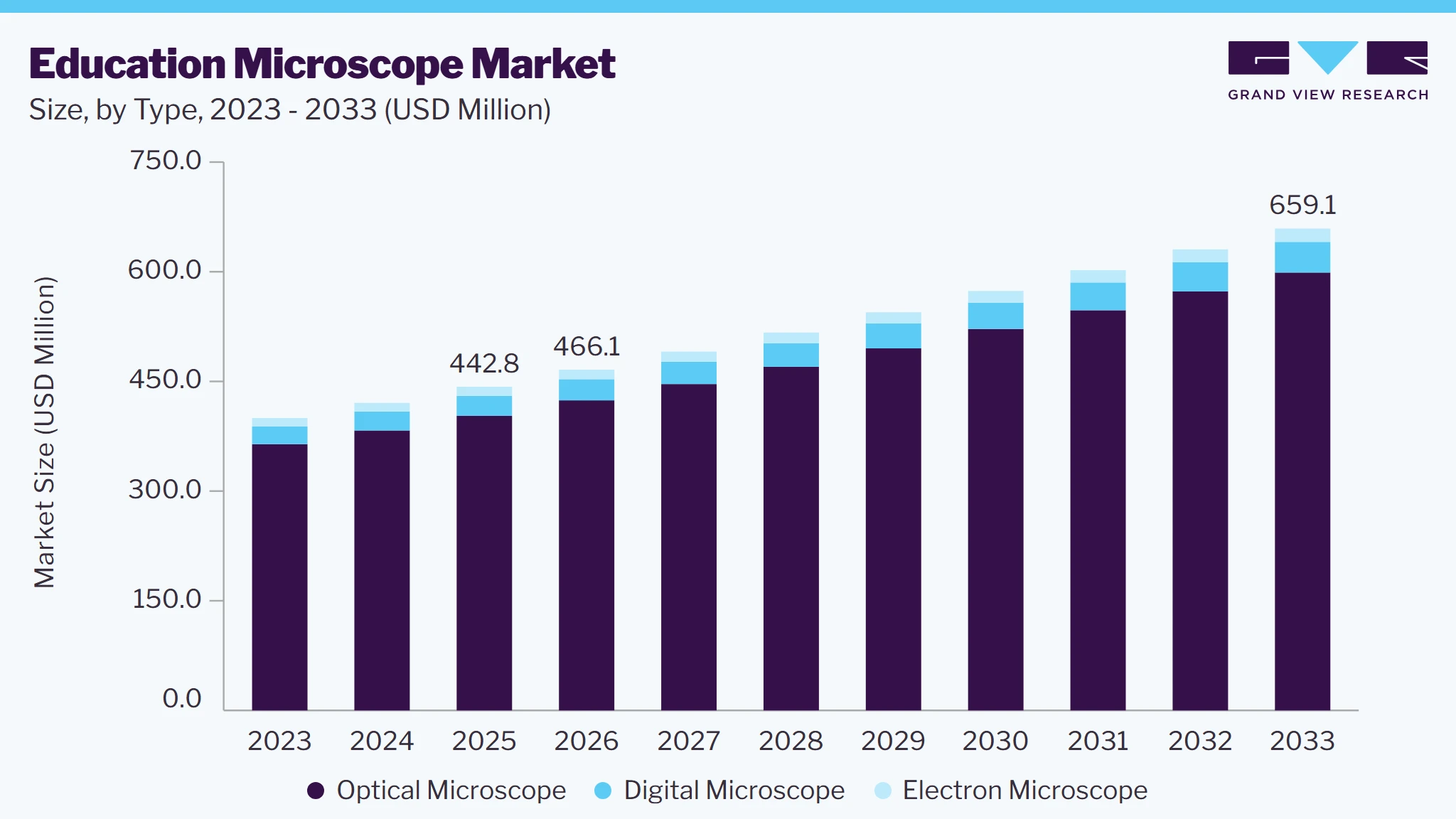 To learn more about this report, Download Free Sample Report
Moreover, many organizations are shifting toward advanced microscopes to augment education delivery and enable students to work on high-level research. For instance, in November 2020, the College of Engineering at the University of Miami installed a new Scanning Electron Microscope (SEM) and testing tools to accelerate the studies for materials characterization and application of advanced materials in various industries.
Government and nongovernment funding for educational institutions is constantly growing globally. Hence, these institutions are shifting toward advanced technologies to offer high-level instruments and resources to their students to gain a competitive advantage in the education industry. For instance, in February 2022, the Massachusetts Institute of Technology (MIT)-Nano received a grant from the U.S. National Science Foundation (NSF) to install VELION FIB-SEM, focused ion beam SEM.
Due to the COVID-19 pandemic, most countries closed academic institutions to curb the spread of the virus. This negatively impacted the installation of new educational microscopes. According to UNICEF data released in March 2021, schools for more than 168 million children were completely closed during the pandemic. Moreover, with the pandemic, academic institutions shifted toward virtual microscopes to provide quality education to the students who were attending online classes. Virtual microscopes are available online and can be simultaneously accessed by many students. This has decreased the adoption of conventional microscopes at academic institutions globally, specifically in developed countries.
Market Dynamics
The educational microscopes market comprises microscopes specifically designed for teaching, training, and academic research across schools, colleges, universities, vocational institutes, and training laboratories. These microscopes facilitate hands-on learning in biology, microbiology, life sciences, pathology, environmental science, and other scientific disciplines by enabling students to observe and analyze microscopic specimens. The market includes compound microscopes, stereo microscopes, digital microscopes, and portable microscopes, along with associated imaging software and accessories.
Market growth is primarily driven by increasing investments in STEM (Science, Technology, Engineering, and Mathematics) education, rising government funding for laboratory infrastructure, and growing emphasis on experiential and inquiry-based learning. The rapid adoption of digital microscopy solutions, which support image capture, real-time collaboration, and hybrid learning environments, is further transforming science education. Educational institutions are increasingly replacing conventional optical microscopes with digital and connected systems that enhance classroom engagement and improve learning outcomes.
Governments globally are increasing investments in STEM education and laboratory modernization to strengthen practical science education and workforce development. The expansion of science laboratories in schools, colleges, and universities is driving the procurement of advanced optical and digital microscopes for biology, microbiology, and life science education. Furthermore, funding initiatives aimed at improving laboratory infrastructure are expected to accelerate the adoption of educational microscopy systems.
• In April 2026, the UK Department for Education, in collaboration with the Department for Science, Innovation and Technology (DSIT), Department for Business and Trade (DBT), and the Ministry of Defence (MoD), announced approximately USD 232 million investment to establish Technical Excellence Colleges across the UK. The funding is intended to support high-quality teaching, enhance technical courses, and provide access to specialist laboratory equipment and advanced learning resources. This initiative is expected to strengthen STEM education and increase the procurement of laboratory instruments, including educational microscopes, across technical and higher education institutions.
• The U.S. National Science Foundation (NSF) announced that approximately USD 74.0 million was available for new and continuing awards under the Advanced Technological Education (ATE) Program in FY2025. Of this, approximately USD 69.0 million was allocated to fund new awards aimed at strengthening STEM technician education, enhancing laboratory infrastructure, and advancing scientific training across U.S. academic institutions, thereby supporting the procurement of modern laboratory equipment, including educational microscopes.
• The UK Research and Innovation (UKRI) World Class Laboratories Funding program allocated approximately USD 2.1 billion over the financial years 2022–2023, 2023–2024, and 2024–2025 to help universities and research institutes maintain and upgrade world-class laboratories, scientific equipment, and digital research infrastructure. The funding supported the modernization of laboratory facilities, creating significant opportunities for the adoption of advanced educational microscopy systems across higher education institutions.
• In January 2023, the NOVA School of Science and Technology (FCT NOVA) received approximately USD 2.7 million in funding from the European Union under the ERA Chairs Actions initiative to establish Portugal's first research group in Electron Cryo-Microscopy (cryoEM) for Structural Biology. The investment supports the development of advanced microscopy infrastructure, strengthens scientific education and research capabilities, and is expected to drive the adoption of high-end microscopy systems in academic and research institutions.
The high costs of advanced educational microscopes, particularly digital, fluorescence, and AI-enabled imaging systems, remain a significant challenge for the market. Budget constraints among public schools, community colleges, and educational institutions in developing countries often delay laboratory modernization and limit the replacement of conventional microscopes with technologically advanced systems. In addition to procurement costs, expenses for software licensing, maintenance, accessories, and faculty training further limit widespread adoption.
For instance, according to the UNESCO Global Education Monitoring (GEM) Report 2024, low-income countries spend only about USD 55 per primary school student annually, compared with approximately USD 8,543 per student in high-income countries. This substantial disparity in education funding limits investments in laboratory infrastructure and scientific equipment, constraining the adoption of advanced educational microscopes in resource-constrained educational institutions.
Unlike conventional microscopes, digital microscopes enable real-time image capture, video recording, image sharing, and integration with computers, tablets, and interactive classroom displays, making science education more engaging and collaborative. The growing emphasis on STEM education, virtual laboratories, hybrid learning environments, and inquiry-based teaching is encouraging educational institutions to invest in digital microscopy solutions that improve student participation and learning outcomes. Furthermore, manufacturers are introducing user-friendly digital microscopes with wireless connectivity, integrated cameras, and educational software, further accelerating their adoption across K–12 schools and higher education institutions.
Digital Educational Microscopes and Their Applications
Company
Digital Microscope
Key Application
Leica Microsystems
Leica EZ4, Leica EZ4 E, Leica EZ4 W, Leica DM100, Leica DM300, Leica DM500, Leica DM750, Leica DM750 P, Leica DM750 M, Leica ICC50 W (Digital Camera System)
K-12 education, undergraduate teaching, life sciences, biology, microbiology, geology, materials science, STEM laboratories, digital classroom learning, and university teaching laboratories.
Olympus (Evident)
CX23 with EP50 Digital Camera, CX33 Digital, BX43 Digital Imaging System
School laboratories, university teaching, life sciences
ZEISS
Primostar 3, Axiolab 5 Digital, Primo Star iLED
Biology, pathology, microbiology, higher education
Nikon Instruments
Eclipse Ei, Eclipse Si, SMZ445 Digital Stereo Microscope
Undergraduate teaching, biology, material sciences
Motic
Motic BA210 Digital, BA310 Digital, Panthera C2 Digital, Moticam Series
Schools, colleges, teaching laboratories
Bresser
Bresser LCD Digital Microscope, Erudit DLX Digital, Biolux NV Digital
K-12 education, STEM learning, home education
Analyst Perspective
The global education microscopes market is expected to grow steadily, driven by increasing investments in STEM education, laboratory modernization, and the adoption of digital learning technologies across educational institutions. Governments and universities are allocating more funding to upgrade science laboratories, thereby creating sustained demand for advanced optical and digital microscopes. The growing integration of digital imaging is transforming traditional microscopy into a more interactive and collaborative learning tool. While budget constraints in public educational institutions may limit the adoption of premium microscopy systems, manufacturers are responding by introducing cost-effective and user-friendly solutions tailored for schools and colleges.
Type Insights
The optical microscope segment led the market with the largest revenue share of 91.0% in 2025. The optical microscope segment dominated the market and accounted for the largest revenue share of 91.06% in 2022. The high share of the segment can be attributed to the lower cost and high device preference among schools. Optical microscopes have lower maintenance costs and are easy to handle. Hence, many institutions prefer installing optical microscopes, mainly in developing countries.
Hence, businesses are introducing cutting-edge products to gain an advantage in the highly competitive market. For instance, in January 2021, ZEISS launched ZEISS Primostar 3, a new compact upright optical microscope for routine lab work and digital teaching. The microscope is designed for daily work in laboratories & classrooms for sample and tissue examination in microscopy, food, cell biology, and histology.
The digital microscope segment is expected to witness the fastest growth over the forecast period. Many institutions prefer a digital microscope as it eliminates the need for a handler. Hence, manufacturers are launching products specifically designed to cater to the growing demand from the end user. For instance, in June 2020, Nikon Corporation launched Digital Sight 1000, a microscope camera that offers digital solutions to educational/clinical institutions.
Regional Insights
North America dominated the education microscope market with the largest revenue share of 36.4% in 2025. The high share of the region can be attributed to the demand for high-quality scientific education and the need to equip educational institutions with suitable laboratory tools like high-level microscopes. For instance, in September 2021, the University of Arkansas’ Dale Bumpers College of Agricultural, Food and Life Sciences received USD 481,121 grant from the U.S. Department of Agriculture- National Institute of Food and Agriculture and purchased a confocal microscope for research & teaching purposes in the campus.
 To learn more about this report, Download Free Sample Report
The U.S. market held the largest share in North America in 2025. This is driven by the growing adoption of hands-on STEM learning, laboratory-based science education, and digital classroom technologies. Educational institutions are increasingly shifting toward digital, USB, and imaging microscopes that enable students and teachers to view, capture, and share microscopic images on computers or displays. For instance, Leica Microsystems offers educational microscope solutions designed for teaching and laboratory applications, reflecting the industry's move toward more interactive and digitally enabled microscopy.
Asia Pacific region is expected to witness the fastest growth over the forecast period owing to increasing research in the field of nanotechnology, the growing interest of international players in investing in this region, and various government initiatives being undertaken to support STEM education. For instance, in October 2021, teachers from Ban Din Dam Laosentai School in Thailand raised funds to purchase five sets of optical microscopes to provide hands-on learning experiences to more than 400 students in the school.
Europe is expected to grow at a significant CAGR over the forecast period. Dynamic activity among research institutes resulted in the rise in the growth potential of the market in this region. The funding to provide access to advanced technologies and microscopes to research & academic facilities is growing in Europe, contributing to the growth of the market. For instance, in January 2023, NOVA School of Science and Technology received USD 2.74 million (Euro 2.5 million) funding under the ERA Chairs Actions program by the EU for the establishment of an Electronic Cryo-Microscopy (cryoEM) research group in Portugal.
Key Companies & Market Share Insights
The market is fragmented with the presence of various multinational and regional players. Integrating advanced technology in the products helps improve efficiency and reduce the time required for microscopic analysis. Product manufacturers are collaborating with academic organizations to adopt such technologies. The market has witnessed the adoption of strategies for product launches, mergers & acquisitions, and collaborations. For instance, in May 2023, Nikon Corporation launched ECLIPSE Ni-L, an upright optical microscope enabled with LED illumination for effective observation of cells and pathological specimens. Some prominent players in the global education microscope market include:
-
Thermo Fisher Scientific, Inc
-
JEOL Ltd
-
Bruker Corporation
-
ZEISS Group
-
Nikon Corporation
-
Olympus Corporation
-
Leica Microsystem (Danaher Corporation)
-
OPTIKA
-
AmScope
-
Dino-Lite
-
Jenoptik
-
Meiji Techno
-
Motic Microscope
-
National Optical
Competitive Benchmarking
Category
Operating Strategies
Competitive Edge
Weakness
Established Players (e.g., Thermo Fisher Scientific, JEOL Ltd., Bruker Corporation, ZEISS Group, Nikon Corporation, Olympus Corporation (Evident), Leica Microsystems (Danaher Corporation))
- Focus on continuous product innovation and digital microscopy technologies.
- Expand global distribution networks through partnerships, academic collaborations, and investments in R&D.
- Strong global brand recognition with extensive product portfolios and well-established after-sales support.
- Advanced optical imaging technologies and broad presence across schools, universities, and research institutions.
- High pricing limits adoption in budget-constrained educational institutions.
- Longer procurement cycles due to high equipment costs and complex purchasing processes.
Specialized Players (e.g., OPTIKA, AmScope, Dino-Lite, Jenoptik, Meiji Techno, Motic Microscopes, National Optical)
- Focus on affordable educational microscopy solutions and expansion through distributors and online sales channels.
- Introduce user-friendly digital microscopes targeting schools, colleges, and STEM education programs.
- Cost-effective products with competitive pricing and increasing adoption in educational institutions.
- Greater flexibility in addressing niche educational requirements and regional markets.
- Limited global distribution and brand recognition compared to established companies.
- Smaller R&D budgets and narrower product portfolios, particularly in advanced digital and electron microscopy.
Education Microscope Market Report Scope
Report Attribute
Details
Market size in 2025
USD 442.8 million
Estimated market size in 2026
USD 466.1 million
Projected market size by 2033
USD 659.1 million
Growth rate
CAGR of 5.1% from 2026 to 2033
Historical data
2021 - 2025
Forecast period
2026 - 2033
Quantitative units
Revenue in USD billion and CAGR from 2026 to 2033
Report coverage
Revenue forecast, company ranking, competitive landscape, growth factors, and trends
Segments covered
Type, region
Regional scope
North America; Europe; Asia Pacific; Latin America; Middle East & Africa
Country scope
U.S.; Canada; UK; Germany; France; Italy; Spain; Norway; Denmark; Sweden; Japan; China; India; Australia; South Korea; Thailand; Mexico; Brazil; Argentina; Colombia; South Africa; Saudi Arabia; UAE; Kuwait
Key companies profiled
Thermo Fisher Scientific, Inc; JEOL Ltd; Bruker Corporation; ZEISS Group; Nikon Corporation; Olympus Corporation; Leica Microsystem (Danaher Corporation); OPTIKA; AmScope; Dino-Lite; Jenoptik; Meiji Techno; Motic Microscope; National Optical
Customization scope
Free report customization (equivalent up to 8 analysts' working days) with purchasse. Addition or alteration to country, regional & segment scope.
Pricing and purchase options
Avail customized purchase options to meet your exact research needs. Explore purchase options
Global Education Microscope Market Report Segmentation
This report forecasts revenue growth at global, regional, and country levels and provides an analysis of the latest trends in each of the sub-segments from 2021 to 2033. For this study, Grand View Research has segmented the global education microscope market report based on type, and region:
 To learn more about this report, Download Free Sample Report
-
Type Outlook (Revenue, USD Million, 2021 - 2033)
-
Optical Microscope
-
Upright Microscope
-
Inverted Microscope
-
Stereo Microscope
-
Other Optical Microscope
-
-
Digital Microscope
-
Electron Microscope
-
Transmission Microscope
-
Scanning Electron Microscope
-
-
-
Regional Outlook (Revenue, USD Million, 2021 - 2033)
-
North America
-
U.S.
-
Canada
-
-
Europe
-
UK
-
Germany
-
France
-
Italy
-
Spain
-
Norway
-
Denmark
-
Sweden
-
-
Asia Pacific
-
Japan
-
China
-
India
-
Australia
-
South Korea
-
Thailand
-
-
Latin America
-
Mexico
-
Brazil
-
Argentina
-
Colombia
-
-
Middle East & Africa (MEA)
-
South Africa
-
Saudi Arabia
-
UAE
-
Kuwait
-
-
Research Methodology
The education microscope market figures in this report are based on a proven research process that combines executive interviews with secondary research from proprietary databases, company filings, and recognized regulatory and institutional sources. Market size is built through value-chain sizing - reconciling supply-side and demand-side estimates - and triangulated with bottom-up and top-down approaches. Every estimate passes multiple levels of expert validation before publication, with each education microscope segment quantified using the revenue-capture definitions in the table below.
Segment Definition
Type
Revenue capture definition
Optical Microscope
Optical microscopes use visible light and a system of lenses to magnify specimens for observation. They are the most widely used microscopes in schools, colleges, and universities for teaching biology, microbiology, and general life sciences due to their affordability and ease of use.
Digital Microscope
Digital microscopes integrate high-resolution cameras with digital imaging technology to display magnified images on computers, tablets, or monitors. They support interactive learning, image sharing, and virtual classroom demonstrations, making them increasingly popular in modern educational environments.
Electron Microscope
Electron microscopes use a beam of electrons instead of visible light to produce ultra-high-resolution images of specimens at the nanoscale. They are primarily used in universities and advanced research institutions for materials science, nanotechnology, and life science education requiring detailed structural analysis.
Estimation Model
Model Details
This research methodology outlines the process for estimating the size of the global education microscope market for the period from 2021 to 2033. The study covers key product types, including optical microscopes, digital microscopes, and electron microscopes, across educational institutions such as schools, colleges, universities, technical institutes, and research laboratories in North America, Europe, Asia Pacific, Latin America, and the Middle East & Africa. The objective is to develop a robust and defensible market estimate, supported by extensive primary industry validation.
Step-by-Step Market Estimation Process
Educational Institution-Based Procurement Model
-
Step 1: Country-level data on the number of schools, colleges, universities, technical institutes, and research laboratories were collected from UNESCO, OECD, national education ministries, and statistical agencies.
-
Step 2: Science laboratory penetration and microscope adoption rates were estimated by institution type through government education programs, procurement records, and primary interviews.
-
Step 3: Average microscope procurement volumes, replacement cycles, and laboratory expansion rates were established for each educational segment.
-
Step 4: Market size was calculated using the number of educational institutions × microscope adoption rate × average procurement volume × replacement demand.
-
Step 5: Country-level estimates were aggregated to regional and global market values.
-
Step 6: Historical and forecast growth incorporated increasing STEM education investments, laboratory modernization initiatives, digital learning adoption, and higher education expansion.
Installed Base and Revenue Extrapolation Model
-
Step 1: The installed base of microscopes across educational institutions was estimated using school directories, university databases, procurement records, distributor information, manufacturer disclosures, and proprietary databases.
-
Step 2: Average annual revenue per installed microscope was estimated using equipment prices, digital imaging accessories, maintenance contracts, software licenses, and replacement purchases.
-
Step 3: Revenue estimates were adjusted for regional pricing variations, purchasing power parity, education expenditure, and procurement practices.
-
Step 4: Country-level market size was calculated by combining installed microscope base, replacement demand, and average annual revenue per system.
-
Step 5: Regional and global market values were generated through aggregation of country-level estimates.
-
Step 6: Annual adjustments accounted for laboratory modernization projects, new educational institutions, digital microscope adoption, and replacement of aging optical microscopes.
Equipment Sales and Education Spending Model
-
Step 1: Annual sales volume data were collected from manufacturer annual reports, distributor networks, educational procurement databases, import-export statistics, and industry publications.
-
Step 2: Equipment sales were categorized by product type (optical, digital, and electron microscopes) and educational level (K-12 schools, colleges, universities, and research institutions).
-
Step 3: Average selling prices (ASP) were established by region using public tenders, procurement contracts, manufacturer pricing, and expert interviews.
-
Step 4: Revenue generated by each product segment was calculated by multiplying annual unit sales by regional ASP.
-
Step 5: Segment revenues were aggregated to estimate country, regional, and global market sizes.
-
Step 6: Forecast assumptions incorporated increasing investments in STEM education, government laboratory funding, digital classroom adoption, AI-enabled microscopy technologies, and expanding science education infrastructure.
Geographic Education Infrastructure Index (GEII) Validation Model
This model applied four macro-level indicators:
-
Number of educational institutions (schools, colleges & universities)
-
Government expenditure on education and STEM programs
-
Science laboratory infrastructure & modernization initiatives
-
Adoption of digital learning technologies and advanced laboratory equipment
Each country's GEII score was calculated and normalized to estimate its relative share of global education microscope demand. The resulting scores were used as a validation framework for the market estimates generated through Models 1–3, ensuring alignment with educational infrastructure, laboratory investment, technology adoption, and regional funding trends.
Final Market Triangulation
The final global education microscope market size was derived through triangulation of:
-
Educational institution-based procurement model
-
Installed base and revenue extrapolation model
-
Equipment sales and education spending model
-
GEII validation model
The weighted average of these models, validated through primary interviews and secondary industry sources, was used to generate the final historical market estimates (2021–2025) and forecast projections (2026–2033) for the global education microscopes market.
Delivered Customizations
This report has been delivered with the following In-depth customizations
Client Request
Customization Delivered
Value Adds
Volume-Based Market Analysis
Market estimates and forecasts in Units by microscope type (optical, digital, and electron), educational institution (schools, colleges, universities, and research institutes), region, and country, along with installed base and annual shipments.
Provides visibility into product demand across educational institutions, supports production and inventory planning, identifies high-growth regions, and strengthens long-term sales forecasting and distribution strategies.
Pricing Analysis
Regional and country-level ASP analysis by microscope type, educational institution, procurement channel, and purchasing model (public vs. private institutions).
Supports pricing optimization, evaluates regional pricing trends, identifies procurement opportunities, improves revenue forecasting, and strengthens competitive pricing strategies across education markets.
Government Funding & Procurement Analysis
Detailed assessment of government funding programs, STEM education investments, laboratory modernization initiatives, public procurement projects, and institutional purchasing trends by country.
Helps identify upcoming procurement opportunities, supports business development and tender participation, enables market prioritization, and aligns sales strategies with government education spending.
Frequently Asked Questions About This Report
Asia Pacific is the fastest-growing region over the forecast period.
The optical microscope segment led with a 91.0% revenue share in 2025, while digital microscope is the fastest-growing segment.
Some key players operating in the education microscope market include Thermo Fisher Scientific, Inc; JEOL Ltd; Bruker Corporation; ZEISS Group; Nikon Corporation; Olympus Corporation; Leica Microsystem (Danaher Corporation); OPTIKA; AmScope; Dino-Lite; Jenoptik; Meiji Techno; Motic Microscopes; National Optical.
Key factors that are driving the education microscope market growth include increasing emphasis on STEM learning, enhanced funding for education by various government and other organizations, and adoption of advanced microscopes by the academic institutions.
North America dominated with a 36.4% revenue share in 2025.
The global education microscope market size was valued at USD 442.8 million in 2025 and is estimated at USD 466.1 million for 2026.
The global education microscope market is expected to grow at a CAGR of 5.1% from 2026 to 2033, reaching USD 659.1 million by 2033.
About the Author(s)
Medical Devices Research Team
Healthcare · Medical DevicesThis report was authored by the medical devices research team at Grand View Research - comprising two research analysts, one senior research analyst, and one industry expert - with specialized expertise in the medical devices segment of the healthcare industry. All findings are based on proprietary healthcare databases, executive interviews, and regulatory analysis, subject to internal peer review prior to publication.
Last Updated:
Speak to Analyst

Customize this report to your needs - add regions, segments, or data points, with 20% free customization.
Or view our licence options:


ISO 9001:2015 & 27001:2022 Certified
We are GDPR and CCPA compliant! Your transaction & personal information is safe and secure. For more details, please read our privacy policy.


