
- Home
- »
- Medical Devices
- »
-
Electron Microscopes Market Size Report, 2026-2033GVR Report cover

Electron Microscopes Market (2026 - 2033)
Size, Share & Trends Analysis Report By Offering (Equipment, Maintenance Service, Spare Parts & Consumables), By Application (Material Science, Life Science, Nanotechnology, Semiconductors), By Region, And Segment Forecasts
Market Size, 2025
$5.0BMarket Estimate, 2026
$5.4BMarket Forecast, 2033
$9.4BCAGR, 2026–2033
8.2%Electron Microscopes Market Summary
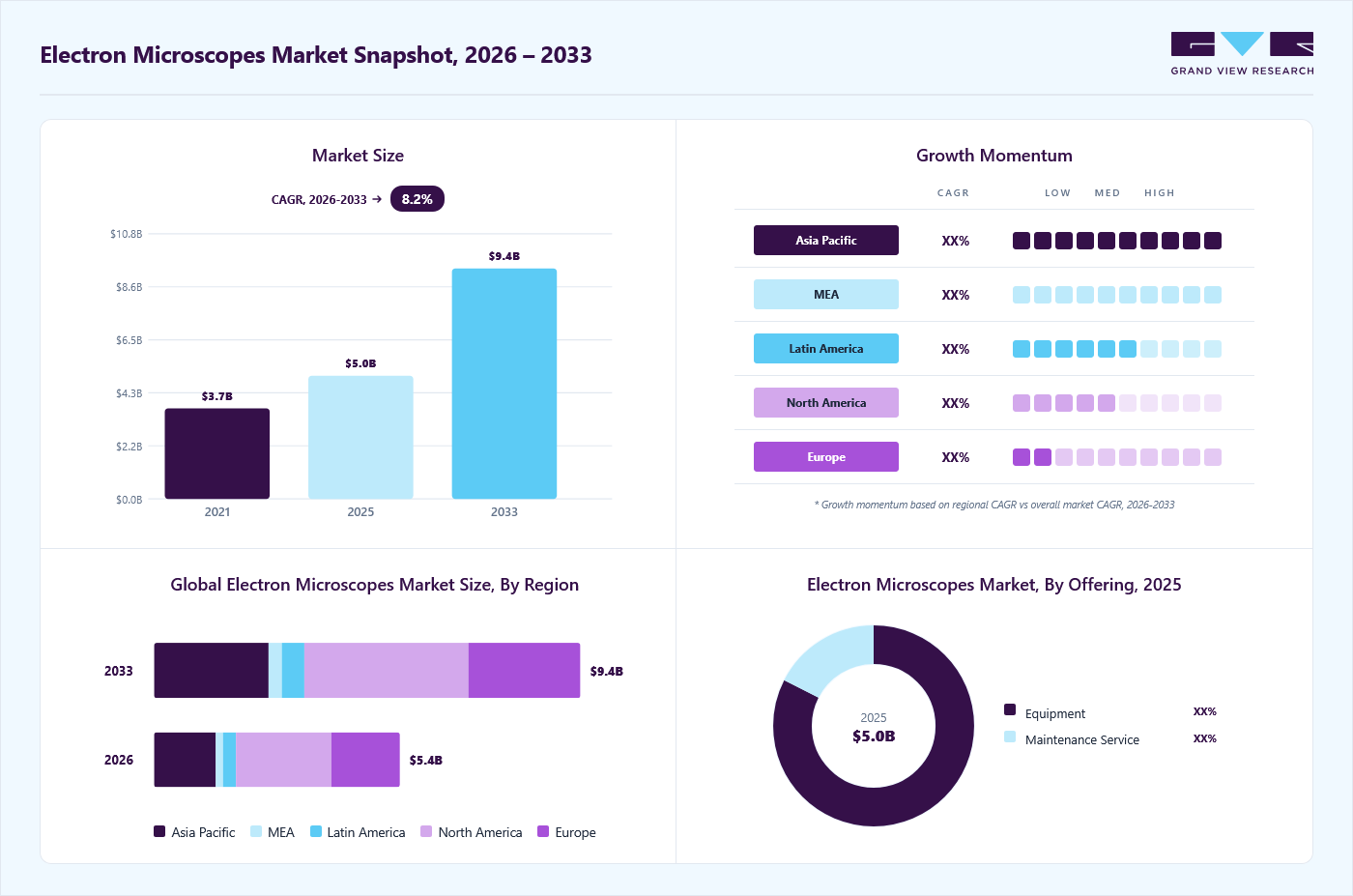
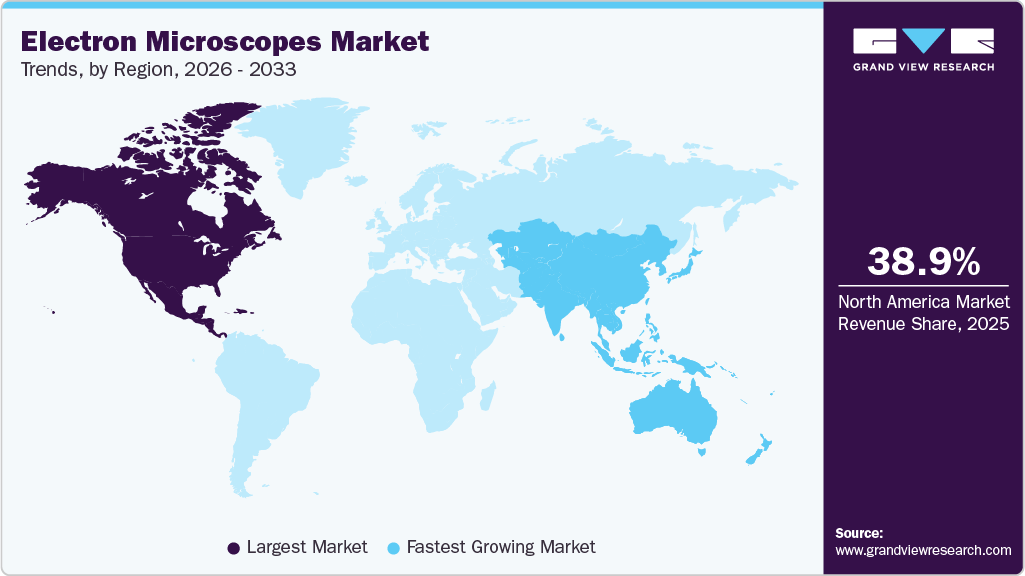
The global electron microscopes market size was valued at USD 5.0 billion in 2025 and is projected to grow from USD 5.4 billion in 2026 to USD 9.4 billion by 2033, at a CAGR of 8.2% from 2026 to 2033. The market in North America dominated with a revenue share of 38.9% in 2025. Rising demand for advanced high-resolution imaging and increasing R&D activities in the field of nanotechnology and materials science are factors contributing to market growth.
 Source: Grand View Research, IR Documents, Primary Interviews, Paid DatabasesTo learn more about this report,
 Download Free Sample Report
 Key Market Trends & Insights
- By offering: Equipment segment held the largest market share of 80.1% in 2025.
- By application: Life science segment held the largest market share of 34.7% in 2025.
Regional Highlights
- Largest regional market: North America (38.9% revenue share, 2025)
- Fastest-growing regional market: Asia Pacific (highest CAGR, 2026-2033)
- By country: The U.S. held the largest market share in 2025
Market Size & Forecast
- Market size in 2025: USD 5.0 Billion
- Estimated market size in 2026: USD 5.4 Billion
- Projected market size by 2033: USD 9.4 Billion
- CAGR (2026-2033): 8.2%
Three ways to get this report
Buy it, customize it, or ask a question.Ask an Analyst
Analyst response in 1 business day
- AccessReport author, directly
- Reply timeWithin 1 working day
- No sales callDirect answer only
- FormatEmail reply
- CostFree, no cost
Get the Full Report
What the study covers
- FormatsPDF · Excel · Dashboard
- Timeline2026–2033 annual, 2025 base
- Coverage20+ countries, 5 regions
- Companies10+ key players profiled
Customize the Report
20% free customization
- IncludeCountries, segments, points
- TailorTo your product definition
- ExtendDeeper competitor detail
- OrA fully bespoke study
- Turnaround5–10 working days
Moreover, growth in the semiconductor and electronics industry and the availability of customized microscopy solutions further drive market growth. The section below outlines the key factors driving market growth, highlighting rising demand for advanced high-resolution imaging and increasing R&D activities in the field of nanotechnology and materials science. Moreover, growth in the semiconductor and electronics industry and the availability of customized microscopy solutions propel market growth further.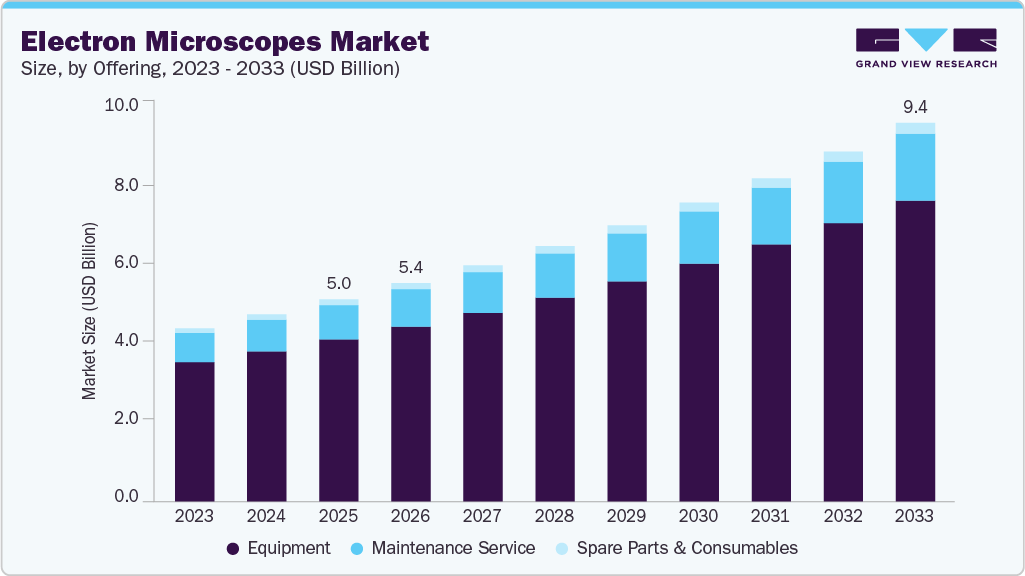 To learn more about this report, Download Free Sample Report
 Rising Demand for Advanced High-Resolution Imaging
The growing demand for advanced high-resolution imaging is a key driver for the market. Electron microscopes provide sub-nanometer and near-atomic resolution, enabling researchers to visualize structures that are far smaller than what conventional optical microscopes can detect. This capability is essential for studying nanomaterials, biological macromolecules, viruses, and advanced materials used in next-generation technologies. Industries such as semiconductors, life sciences, and materials engineering increasingly rely on precise structural characterization to improve product performance, ensure quality control, and accelerate research breakthroughs.
Several developments and industry initiatives highlight this growing demand. For instance, companies such as Thermo Fisher Scientific and JEOL Ltd. have introduced next-generation cryo-electron microscopy (cryo-EM) systems capable of achieving near-atomic resolution for structural biology research, enabling scientists to study protein structures critical for drug discovery. Similarly, Carl Zeiss AG and Hitachi High‑Tech Corporation have launched advanced scanning electron microscope (SEM) platforms with improved detectors and automated imaging for semiconductor inspection and materials analysis. In the semiconductor industry, electron microscopy is widely used for defect analysis and nanoscale inspection of chips below 5 nm, supporting advanced manufacturing processes.
Increasing R&D Activities In The Field of Nanotechnology And Materials Science
Furthermore, electron microscopes, including SEM and TEM, enable researchers to analyze the morphology, structure, and composition of nanomaterials with extremely high precision. As research institutions and industries increasingly develop advanced materials for applications such as semiconductors, batteries, energy storage systems, and biomedical devices, the need for nanoscale imaging and characterization tools continues to rise, thereby increasing the adoption of electron microscopes in academic laboratories and industrial R&D facilities. For instance, in October 2025, Temple University received a USD 3.3 million grant from the National Science Foundation to acquire an advanced electron microscopy platform to support regional research in energy, biological, and materials science applications. The system enables researchers to visualize and map elements and molecules at the nanoscale, highlighting the importance of electron microscopy in materials innovation.
“This is some of the most advanced technology in the field, and these skills are very in demand right now. Not many people know that this technology is used in forensic departments. It is used by most oil companies. It is used by high-end cosmetic companies, like L’Oréal. Hands-on users of this instrument will gain experience that will set them apart in their future research and industry careers.”
-said Dikin, who has used SEMs to conduct research out of the Nano Instrumentation Center for over a decade.
Growth In Semiconductor and Electronics Industry
As semiconductor manufacturers continue to reduce chip sizes and increase transistor density, the complexity of integrated circuits has increased significantly. With the growing demand for technologies such as artificial intelligence (AI), 5G networks, high-performance computing, and consumer electronics, global semiconductor production is expanding, thereby increasing the adoption of electron microscopes in both industrial manufacturing and R&D environments.
Market Concentration & Characteristics
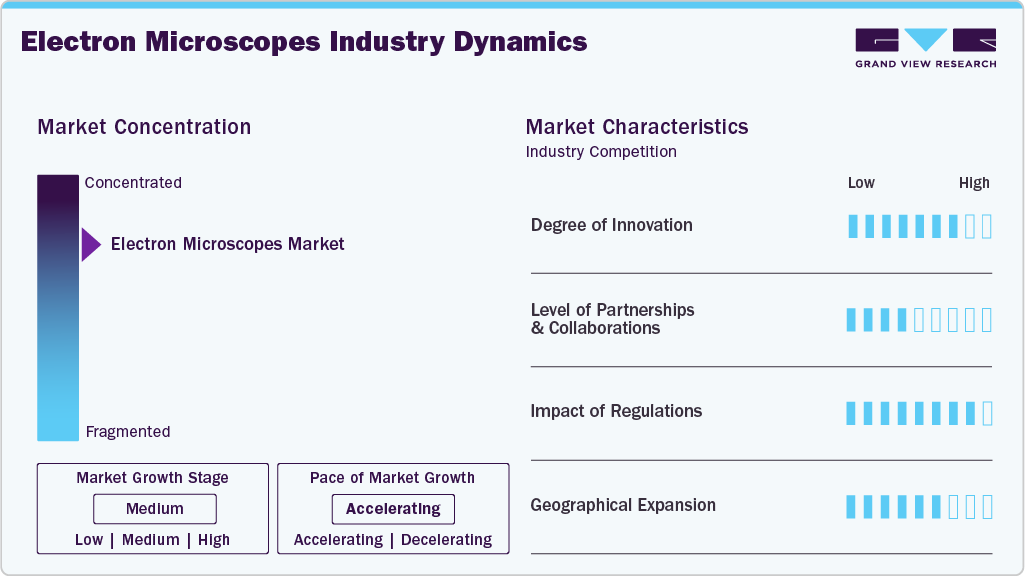
The chart below illustrates the relationship between industry concentration, characteristics, and participants. The x-axis represents the level of industry concentration, ranging from low to high. The y-axis represents various industry characteristics, including industry competition, level of partnerships & collaboration activities, degree of innovation, impact of regulations, and regional expansion. The electron microscopes industry is consolidated, with the major global players dominating the market. The degree of innovation is high, and the level of partnerships & collaboration activities is moderate. Moreover, the impact of regulations on the industry is high, while the regional expansion of the industry is moderate.
The electron microscopes industry experiences a high degree of innovation driven by technological advancements. For instance, in October 2025, Hitachi High-Tech Corporation announced the launch of the SU9600 Ultrahigh-Resolution Scanning Electron Microscope, a next-generation SEM designed for sub-nanometer imaging, integrating automated workflows and high-throughput data acquisition to support advanced semiconductor and materials research.
 To learn more about this report, Download Free Sample Report
 The industry is experiencing a moderate level of partnership & collaboration activities undertaken by several key players. This is due to the desire to gain a competitive advantage in the industry, enhance technological capabilities, and consolidate in a rapidly growing market.
The regulatory framework governing electron microscopes in the U.S. is primarily overseen by the U.S. Food and Drug Administration (FDA) when the systems are used for clinical or diagnostic applications. Manufacturers producing electron microscopy systems for medical or diagnostic use must register their establishments with the regulatory authority and comply with quality system regulations outlined in 21 CFR Part 820. Similarly, the regulatory framework for electron microscopes in the UK is primarily governed by the Medicines and Healthcare Products Regulatory Agency (MHRA).
Companies within the electron microscopes sector seek geographic expansion strategies to maintain their foothold in emerging markets and attract customers from these regions.Moreover, the industry is witnessing moderate geographical expansion, driven by an increasing customer base for electron microscopes. For instance, in July 2024, Thermo Fisher Scientific opened its first electron microscopy NanoPort demonstration center in Taiwan to support semiconductor innovation and materials research, providing customers access to advanced analytical technologies, expert training, and application support to accelerate research and reduce product development timelines.
“Thermo Fisher’s new NanoPort in Taiwan underscores our continuous commitment to the advancement of science and technology worldwide.”
-Sho-Wen Yeo, vice president and general manager, Southeast Asia and Taiwan, Thermo Fisher Scientific.
Offering Insights
Based on offering, the equipment segment dominated the market with a revenue share of 80.1% in 2025. The growing demand for high-resolution imaging across scientific, industrial, and medical fields is a major driver for equipment in the market. The rapid expansion of life sciences research, particularly in structural biology and virology, has driven demand for high-performance imaging equipment used to analyze viruses, proteins, and cellular structures. The widespread use of advanced imaging techniques such as Cryogenic Electron Microscopy has further accelerated equipment adoption in pharmaceutical research and drug discovery.
The maintenance service segment is expected to grow at the fastest CAGR during the forecast period. The maintenance service in the market is highly in demand as these instruments are highly complex, high-value systems that require continuous service to maintain performance, accuracy, and uptime. As these instruments are often used in critical research and industrial environments such as semiconductor manufacturing, nanotechnology research, and biomedical laboratories, any equipment downtime can significantly disrupt operations. Therefore, laboratories and industrial facilities increasingly rely on annual maintenance contracts, preventive maintenance programs, and OEM service agreements to ensure reliable performance and minimize unexpected breakdowns.
Application Insights
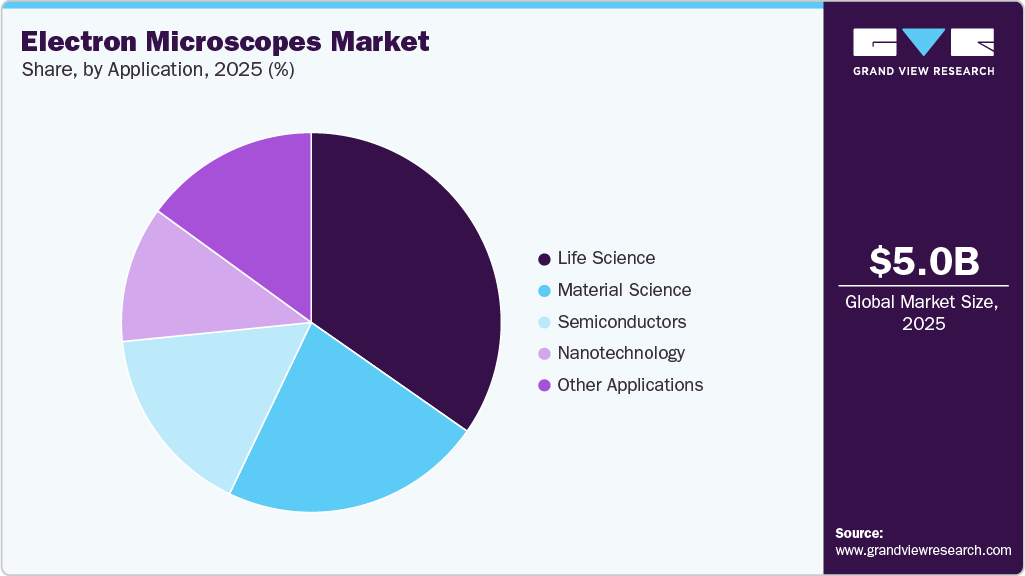
Based on application, the life science segment dominated the market, with the largest revenue share of 34.7% in 2025. The life sciences sector is majorly driven by the growing need for ultra-high-resolution imaging to study complex biological structures at the cellular and molecular levels. As biomedical research intensifies globally, research institutions, pharmaceutical companies, and biotechnology firms increasingly rely on advanced microscopy techniques, particularly cryo-electron microscopy (cryo-EM), to understand disease mechanisms and accelerate therapeutic development. The ability to observe biological samples in near-native states without extensive staining or crystallization has significantly improved the accuracy and efficiency of life-science research.
 To learn more about this report, Download Free Sample Report
 The semiconductors segment is projected to grow at the fastest CAGR from 2026 to 2033. The growing demand for semiconductors is a major driver for the market, as these microscopes are essential tools for inspecting, analyzing, and developing semiconductor components at the nanoscale. As semiconductor devices continue to shrink in size and increase in complexity, manufacturers rely heavily on advanced electron microscopy techniques such as SEM and TEM for defect analysis, failure analysis, and precise material characterization. In addition, the rapid advancement of technologies such as artificial intelligence, 5G, and high-performance computing has accelerated semiconductor innovation, further increasing the need for high-resolution imaging solutions.
Regional Insights
North America dominated the electron microscopes market with a revenue share of 38.9% in 2025. This growth is due to the strong research infrastructure, advanced semiconductor manufacturing activity, and increasing investment in life science research. Electron microscopy systems are widely used across academic laboratories, semiconductor fabrication facilities, and biotechnology research centers for nanoscale imaging and materials characterization. Growing demand for high-resolution analytical tools in nanotechnology, structural biology, and advanced materials research continues to support market expansion in the region.
 To learn more about this report, Download Free Sample Report
 Moreover, major players are expanding their product portfolios to strengthen their presence in the market. For instance, in July 2025, Thermo Fisher Scientific introduced advanced transmission electron microscopy Scios FIB- SEM and Talos 12 TEM, the technologies designed for high-resolution materials characterization and semiconductor research applications.
U.S. Electron Microscopes Market Trends
The electron microscopes market in the U.S. is expected to grow significantly over the forecast period. Government funding and academic research initiatives continue to contribute to the growth of advanced imaging technologies. In addition, manufacturers are introducing new technologies to enhance imaging capabilities for research and semiconductor analysis. For instance, in May 2024, JEOL Ltd. introduced the JEM-120i transmission electron microscope, developed with a compact design and improved usability to support applications across biotechnology, nanotechnology, and advanced materials research. Technological advancements in cryogenic electron microscopy are supporting detailed visualization of biological molecules and complex materials structures across scientific laboratories in the U.S.
Europe Electron Microscopes Market Trends
The electron microscopes market in Europe is driven by the strong research infrastructure, increasing focus on nanotechnology development, and the presence of advanced materials science laboratories in the region. In the region, the Industrial laboratories, universities, and research institutes utilize electron microscopy systems for nanoscale imaging, semiconductor inspection, and pharmaceutical research. The rising innovation in biotechnology, nanotechnology, and semiconductor technologies is contributing to the demand for high-resolution analytical instruments across laboratories in the region.
The UK electron microscopes market is expected to grow significantly over the forecast period. The growth is supported by academic research capabilities, advanced life science programs, and increasing activity in nanotechnology and materials engineering studies. Universities and research institutes in the UK utilize electron microscopy systems for nanoscale imaging, structural biology analysis, and advanced materials characterization. Increasing research activity in biotechnology, pharmaceutical development, and semiconductor-related technologies continues to support demand for high-resolution analytical instruments across laboratories in the country.
The electron microscopes market in Germany is expected to grow substantially from 2026 to 2033. Germany is recognized for its strong innovation ecosystem and advanced industrial research capabilities, which support the development and adoption of electron microscopy technologies across academia and industrial laboratories. The market is supported by innovation capabilities, advanced materials science programs, and increasing semiconductor research activities. In Germany, the industrial laboratories use microscopy for nanotechnology research, semiconductor inspection, and pharmaceutical research, among others. Rising innovation in biotechnology, automotive materials engineering, and advanced manufacturing technologies is contributing to the demand for high-resolution analytical instruments across laboratories in the country.
Asia Pacific Electron Microscopes Market Trends
The electron microscopes market in the Asia Pacific is expected to grow at the fastest CAGR from 2026 to 2033 due to strong industrial and academic research activities in semiconductor manufacturing, nanotechnology, materials science, and biotechnology. High-resolution electron microscopes are extensively used across universities, research institutes, and industrial laboratories for nanoscale imaging, structural characterization, and advanced materials analysis. Countries such as China, Japan, South Korea, India, and Australia are increasingly adopting these microscopes for semiconductor inspection, battery materials research, nanomaterial characterization, and life sciences applications.
China electron microscopes market is expanding rapidly due to increasing investment in research and development across semiconductor manufacturing, nanotechnology, materials science, and biotechnology sectors. Universities, government research institutes, industrial laboratories, and independent research centers in the country utilize electron microscopes for nanoscale imaging, structural characterization, and compositional analysis. Growing demand for advanced analytical instruments in semiconductor fabrication, materials engineering, and life sciences research continues to support the adoption of electron microscopy technologies across laboratories in China.
The electron microscopes market in India is driven by the increasing investments in scientific research, nanotechnology development, and pharmaceutical innovation. Electron microscopy systems are widely used across academic institutions, government laboratories, and industrial research centers for nanoscale imaging, semiconductor inspection, materials characterization, and biological structure analysis. Growing research activity in structural biology, drug discovery, advanced materials engineering, and microelectronics manufacturing is contributing to the rising demand for high-resolution analytical instruments across laboratories in the country.
Latin America Electron Microscopes Market Trends
The electron microscopes market in Latin America is influenced by the expansion of scientific research infrastructure and increasing investments in life sciences, materials science, and nanotechnology across the region. Research institutions, national laboratories, and universities in countries such as Brazil and Argentina utilize electron microscopy technologies for nanoscale imaging, structural characterization, and advanced materials analysis.
Middle East & Africa Electron Microscopes Market Trends
The electron microscopes market in the MEA is supported by the rising investment in innovation, nanotechnology, chemical science, and healthcare in the region. Research centers and industrial laboratories in countries such as Saudi Arabia, South Africa, and the UAE utilize electron microscopes for nanoscale imaging, structural characterization, and compositional analysis of materials and biological samples. Growing research initiatives in pharmaceuticals, renewable energy materials, semiconductor development, and advanced manufacturing are contributing to the demand for high-resolution analytical instruments across laboratories in the region.
Key Electron Microscopes Company Insights
The market is characterized by strong competition, with a few major worldwide competitors owning a significant market share. The major focus is on developing new products and collaborating among the key players.
Key Electron Microscopes Companies:
The following key companies have been profiled for this study on the electron microscopes market.
- Thermo Fisher Scientific Inc
- Oxford Instruments
- Carl Zeiss AG
- Hitachi High-Tech Corporation
- JEOL Ltd.
- Angstrom Advanced Inc
- Hirox Europe
- ADVANTEST CORPORATION
- Bruker
- Delong Instruments
Recent Developments
-
In July 2025, Thermo Fisher Scientific announced the launch of the Thermo Scientific Scios 3 FIB-SEM and Talos 12 TEM at the Microscopy & Microanalysis Conference 2025, introducing automation, improved usability, and enhanced imaging capabilities to expand access to advanced electron microscopy for research and industrial applications.
-
In April 2025, Carl Zeiss AG introduced ZEN core, a universal software suited for all ZEISS scanning electron microscopes, providing intuitive SEM control, streamlined imaging, integrated EDS analysis, and enhanced workflow efficiency across research and industrial applications.
-
In June 2024, Oxford Instruments plc announced an agreement to acquire FemtoTools AG, a Zurich-based developer of high-speed precision nanoindenters, for CHF 17 million, integrating its products into Oxford Instruments’ Imaging & Analysis division to enhance materials research and semiconductor applications.
-
In May 2024, Hitachi High-Tech Europe launched the SU3800SE Field Emission Scanning Electron Microscope and SU3900SE Field Emission Scanning Electron Microscope, introducing high-resolution Schottky field emission SEM systems with automated alignment, large sample handling, and workflow automation for efficient high-throughput imaging and analysis.
“The new SEMs in our portfolio provide an innovative solution for both industrial and academic applications. The ability to accommodate large or heavy specimens in the SU3900SE makes this SEM ideal for quality control in industries like automotive, aerospace, and materials science, or in environments where precious specimens cannot be cut down. High resolution imaging and powerful chemical analysis are performed for a wide variety of samples, with lower user training requirements.”
-Kazuyoshi Matsukaze, President of Hitachi High-Tech Europe GmbH.
Electron Microscopes Market Report Scope
Report Attribute
Details
Market size in 2025
USD 5.0 billion
Estimated Market size in 2026
USD 5.4 billion
Projected Market size by 2033
USD 9.4 billion
Growth rate
CAGR of 8.2% from 2026 to 2033
Actual data
2021 - 2025
Forecast period
2026 - 2033
Quantitative units
Revenue in USD million/billion and CAGR from 2026 to 2033
Report coverage
Revenue forecast, company ranking, competitive landscape, growth factors, and trends
Segments covered
Offering, application, region
Regional scope
North America; Europe; Asia Pacific; Latin America; MEA
Country scope
U.S.; Canada; Mexico; Germany; UK; France; Italy; Spain; Norway; Denmark; Sweden; China; Japan; India; South Korea; Australia; Thailand; Brazil; Argentina; Saudi Arabia; South Africa; UAE; Kuwait
Key companies profiled
Thermo Fisher Scientific Inc; Oxford Instruments; Carl Zeiss AG; Hitachi High-Tech Corporation; JEOL Ltd.; Angstrom Advanced Inc; Hirox Europe; ADVANTEST CORPORATION; Bruker; Delong Instruments
Customization scope
Free report customization (equivalent up to 8 analysts working days) with purchase. Addition or alteration to country, regional & segment scope.
Pricing and purchase options
Avail customized purchase options to meet your exact research needs. Explore purchase options
Global Electron Microscopes Market Report Segmentation
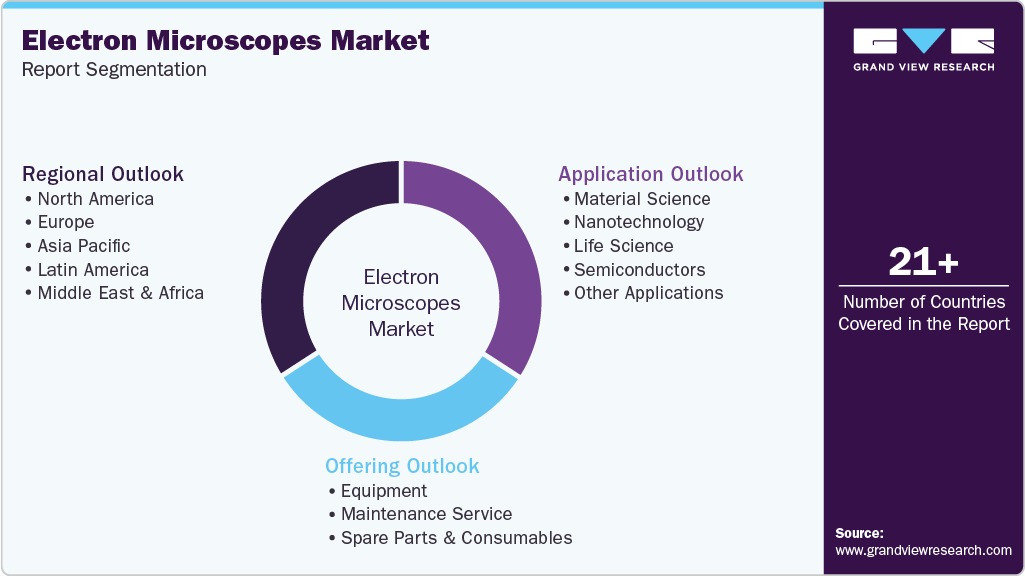
This report forecasts revenue growth at the global, regional, and country levels and provides an analysis of the industry trends in each of the sub-segments from 2021 to 2033. For this study, Grand View Research has segmented the global electron microscopes market report based on offering, application, and region:
 To learn more about this report, Download Free Sample Report
 -
Offering Outlook (Revenue, USD Million, 2021 - 2033)
-
Equipment
-
Transmission Microscopes
-
Scanning Electron Microscopes
-
-
Maintenance Service
-
Preventive Maintenance Services
-
Annual Maintenance Contracts (AMCs) / Service Agreements
-
Others
-
-
Spare Parts & Consumables
-
-
Application Outlook (Revenue, USD Million, 2021 - 2033)
-
Material Science
-
Nanotechnology
-
Life Science
-
Semiconductors
-
Other Applications
-
-
Regional Outlook (Revenue, USD Million, 2021 - 2033)
-
North America
-
U.S.
-
Canada
-
Mexico
-
-
Europe
-
Germany
-
UK
-
France
-
Italy
-
Spain
-
Denmark
-
Sweden
-
Norway
-
-
Asia Pacific
-
China
-
Japan
-
India
-
South Korea
-
Australia
-
Thailand
-
-
Latin America
-
Brazil
-
Argentina
-
-
Middle East and Africa
-
Saudi Arabia
-
UAE
-
South Africa
-
Kuwait
-
-
Frequently Asked Questions About This Report
The global electron microscopes market is expected to grow at a compound annual growth rate of 8.2% from 2026 to 2033 to reach USD 9.4 billion by 2033.
Asia Pacific is the fastest-growing region over the forecast period.
The equipment segment led with a 80.1% revenue share in 2025, while the maintenance service segment is the fastest-growing.
The life science segment led with a 34.7% revenue share in 2025, while the semiconductors segment is the fastest-growing.
North America dominated the electron microscopes market with a share of 38.9% in 2025. This growth is due to the strong research infrastructure, advanced semiconductor manufacturing activity, and increasing investment in life science research.
Rising demand for advanced high-resolution imaging and increasing R&D activities in the field nanotechnology and materials science are factors contributing to market growth.
The global electron microscopes market size was estimated at USD 5.0 billion in 2025 and is expected to reach USD 5.4 billion in 2026.
Some key players operating in the electron microscopes market include Thermo Fisher Scientific Inc; Oxford Instruments; Carl Zeiss AG; Hitachi High-Tech Corporation; JEOL Ltd.; Angstrom Advanced Inc; Hirox Europe; ADVANTEST CORPORATION; Bruker; Delong Instruments
About the Author(s)
Medical Devices Research Team
Healthcare · Medical DevicesThis report was authored by the medical devices research team at Grand View Research - comprising two research analysts, one senior research analyst, and one industry expert - with specialized expertise in the medical devices segment of the healthcare industry. All findings are based on proprietary healthcare databases, executive interviews, and regulatory analysis, subject to internal peer review prior to publication.
Last Updated:
Speak to Analyst

Customize this report to your needs - add regions, segments, or data points, with 20% free customization.
Or view our licence options:


ISO 9001:2015 & 27001:2022 Certified
We are GDPR and CCPA compliant! Your transaction & personal information is safe and secure. For more details, please read our privacy policy.


