
- Home
- »
- Medical Devices
- »
-
Egg Freezing & Embryo Banking Market Size & Share Report, 2023-2030GVR Report cover

Egg Freezing And Embryo Banking Market (2023 - 2030)
Size, Share & Trends Analysis Report By Type (Donor, Nondonor), By Preservation (Egg Freezing, Embryo Freezing), By Age Of Patient, By Region, And Segment Forecasts
Market Size, 2022
$3.9BMarket Estimate, 2026
$7.4BMarket Forecast, 2030
$13.7BCAGR, 2023–2030
16.8%Egg Freezing And Embryo Banking Market Summary
The global egg freezing and embryo banking market size was valued at USD 3.9 billion in 2022 and is projected to grow from USD 7.4 billion in 2026 to USD 13.8 billion by 2030, at a CAGR of 16.8% from 2023 to 2030. Europe dominated the market, accounting for a revenue share of 36% in 2022. Europe dominated the market, accounting for a revenue share of 36% in 2022. The market is expected to expand due to societal shifts and advancements in reproductive technologies.
 Source: Grand View Research, IR Documents, Primary Interviews, Paid DatabasesTo learn more about this report,
 Download Free Sample Report
 Key Market Trends & Insights
- By age of patients, the under-35-year women segment held the largest revenue share of more than 31% in 2022.
- By type, the nondonor segment dominated the market and accounted for the largest revenue share of over 53% in 2022.
- By preservation, the embryo banking segment dominated the market and accounted for the largest revenue share of 71.8% in 2022.
Market Size & Forecast
- 2022 Market Size: USD 3.9 Billion
- 2030 Projected Market Size: USD 13.8 Billion
- CAGR (2023-2030): 16.80%
- Europe: Largest market in 2022
Three ways to get this report
Buy it, customize it, or ask a question.Ask an Analyst
Analyst response in 1 business day
- AccessReport author, directly
- Reply timeWithin 1 working day
- No sales callDirect answer only
- FormatEmail reply
- CostFree, no cost
Get the Full Report
What the study covers
- FormatsPDF · Excel · Dashboard
- Timeline2023–2030 annual, 2022 base
- Coverage20+ countries, 5 regions
- Companies10+ key players profiled
Customize the Report
20% free customization
- IncludeCountries, segments, points
- TailorTo your product definition
- ExtendDeeper competitor detail
- OrA fully bespoke study
- Turnaround5–10 working days
People opt for fertility preservation through assisted reproductive technology for reasons such as postponed parenting, health concerns, or career aspirations. Growing awareness and improved success rates are driving the demand for these services, ensuring market growth.
 To learn more about this report, Download Free Sample Report
 Furthermore, delayed childbearing due to sociodemographic factors is expected to contribute to market growth. For instance, according to the Centers for Disease Control and Prevention (CDC), in 2021, 167,689 of the 413,776 ART cycles were egg or embryo banking cycles, in which all the resultant eggs & embryos were stored for future use. Therefore, delayed parenthood has resulted in an inclination towards egg freezing and embryo banking, which is expected to boost market growth.
In addition, the World Health Organization's 2023 report indicates that approximately 1 in 6 adults, or around 17.5% of the global population, face issues of infertility. This statistic highlights the growing demand for accessible and affordable fertility care. To address this issue and allow for delayed parenthood, individuals are increasingly turning to the option of egg and embryo banking. This trend towards fertility preservation is expected to drive the growth of the market.
The market for egg freezing and embryo banking experienced a positive shift during the COVID-19 pandemic. As per the Human Fertilisation & Embryology Authority's report published in June 2023, the UK has witnessed significant growth in this space. In 2020, embryo storage cycles saw a 7% rise from 2019, reaching 8,878. This number further increased in 2021 with a 30% growth compared to 2019, totaling 10,719 cycles. Additionally, egg storage cycles surged by an impressive number from 2,576 in 2019 to 4,215 in 2021. The post-pandemic period has thus witnessed a spike in fertility preservation cases, fueling the expansion of the market.
The egg freezing and embryo banking industry is anticipated to witness substantial growth, propelled by government initiatives. For instance, in Australia, the re-election of the Liberal and Nationals Government has brought a broader scope of fertility treatment rebates, encompassing egg freezing procedures and increasing cycle numbers. Owing to this, an Australian woman opting for egg freezing can claim a USD 2,000 rebate, following a USD 4 million expansion within the NSW Government's USD 80 million Affordable IVF Initiative. Such proactive approaches are expected to drive market growth by enhancing the accessibility of fertility preservation.
Age of Patient Insights
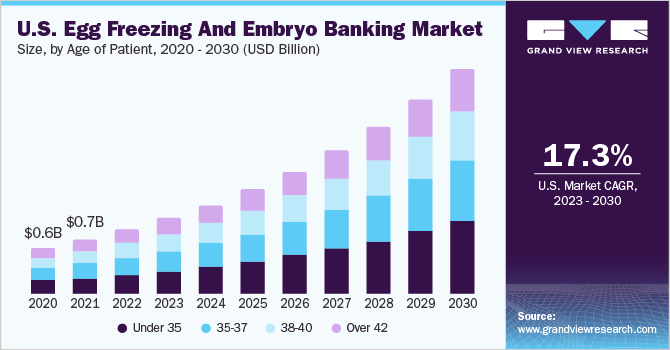
The under-35-year women segment held the largest revenue share of more than 31% in 2022. This share can be attributed to the increasing prevalence of women under 35 opting for egg freezing and embryo banking procedures. The high success rate of fertilization after embryo transfer further fuels this trend. The SART Preliminary National Summary Report 2021 underscores the importance of this age group, with around 42.0% of singleton births originating from women under 35 and 87.1% being the cryopreservation rate, which is higher in comparison to other age groups.
In terms of the age of patients, the market has been categorized into under 35, 35-37, 38-40, and over 42. Women in the age group of 35-37 years contribute significantly, holding the second-largest revenue share in the market in 2022. With a singleton birth rate of approximately 30.8% and a cryopreservation rate of 81.2%, this age group contributes substantially to the market growth.
Type Insights
The nondonor segment dominated the egg freezing and embryo banking market and accounted for the largest revenue share of over 53% in 2022. According to the CDC’s preliminary National Summary 2021, the data highlights a prevailing preference for utilizing one's own eggs among women.
Women under 35 years of age comprised a substantial majority of cycles involving their own eggs/embryos, while the 35-37 age group also exhibited significant usage at a slightly lower rate. In contrast, the utilization of donor eggs/embryos was notably less, with women under 35 and those aged 35-37 years representing a relatively small portion of cycles. For women younger than 35 years old, there were a total of 45,576 embryo transfer procedures conducted.
The mean number of embryos transferred during each procedure was 1.1, and the implantation rate (percentage of transferred embryos that were successfully implanted) was 52.3% in this age group. This data shows that many women prefer using their own eggs instead of donated ones when it comes to freezing eggs and storing embryos.
Preservation Insights
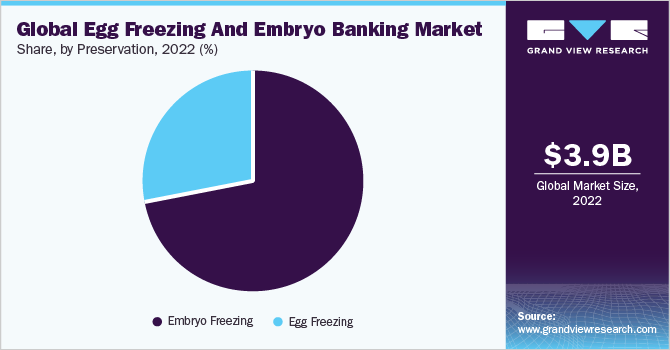
The embryo banking segment dominated the market and accounted for the largest revenue share of 71.8% in 2022. This innovative concept offers individuals the opportunity to preserve their fertility potential, aligning with changing lifestyles and delayed parenthood. As awareness spreads and societal acceptance increases, the demand for these services is expected to increase. For instance, according to the Human Fertilisation & Embryology Authority's 2023 report, in the U.K., the number of embryo storage cycles increased from 2019, with a 6.87% rise in 2020 and 17.18% rise in 2021.
 To learn more about this report, Download Free Sample Report
 The preservation segment has been categorized into egg freezing and embryo banking. According to the HFEA’s 2023 report, in the U.K., the number of egg storage cycles increased by 64% from 2019 to 2021. Modern lifestyles and delayed family planning fuel the demand for preserving fertility options. Advancements in egg storage technology have ensured a higher post-thaw viability, thus increasing confidence in future successful pregnancies. This trend empowers women to take control of their reproductive choices, propelling segment expansion.
Regional Insights
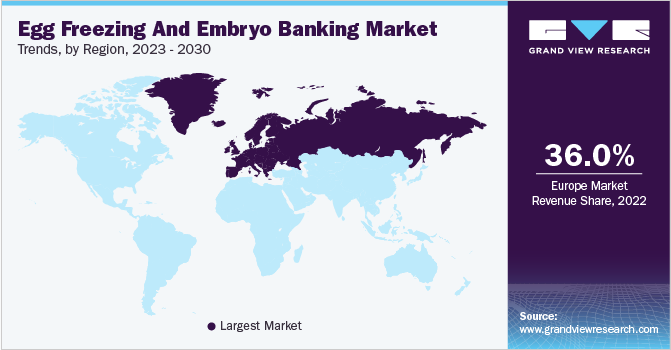
Europe dominated the market and accounted for the maximum revenue share of over 36% in 2022. This is primarily due to the region’s well-established presence in the field of assisted reproduction technology (ART). According to a report published by the European Society of Human Reproduction and Embryology (ESHRE) in 2019, Spain emerged as the most active country in Europe in terms of assisted reproduction, conducting a total of 140,909 treatment cycles. Spain maintained its leading position over countries such as Germany (969,226 cycles), France (104,733 cycles), and Russia (121,235 cycles). Treatments encompassing IVF, ICSI, intrauterine insemination, and egg donation are all closely monitored by the ESHRE.
 To learn more about this report, Download Free Sample Report
 The Asia Pacific region is projected to experience the highest CAGR during the forecast period. Supportive regulations and Asia Pacific's emergence as a medical tourism hub, offering quality treatments at lower costs, are the primary factors driving market expansion. For instance, the Tokyo metropolitan government plans to introduce a subsidy covering the costs of egg freezing. In the fiscal 2023 budget proposal, USD 733,000 (approximately 100 million yen) has been allocated for the program's startup. This pioneering initiative aims to offer up to USD 2,199 (about 300,000 yen) per person annually to 200-300 Tokyo residents, regardless of marital status. The move addresses fertility concerns, allowing women to plan their reproductive futures amid career priorities.
Key Companies & Market Share Insights
Major players are undertaking various strategic initiatives such as collaborations, mergers & acquisitions, and geographical expansions, as well as service expansions to drive market growth. For instance, in June 2023, Pinnacle Fertility partnered with TMRW Life Sciences to adopt an automated platform for the safe storage of patients' frozen eggs and embryos. This technology-driven move would enhance the accuracy and efficiency of storage, and improve patient care. Pinnacle's commitment to innovation aligns with TMRW's novel solution, setting a new standard in fertility care through digital advancements. Some of the prominent players in the global egg freezing and embryo banking market include:
-
ReproTech LLC
-
Cryos International
-
CCRM Fertility
-
RMA Network
-
Carrot Fertility
-
WINFertility
-
Columbia University
-
Shady Grove Fertility
-
Kindbody
Egg Freezing And Embryo Banking Market Report Scope
Report Attribute
Details
Market size in 2022
USD 3.9 billion
Estimated Market size in 2026
USD 7.4 billion
Projected Market size by 2030
USD 13.8 billion
Growth rate
CAGR of 16.80% from 2023 to 2030
Base year for estimation
2022
Historical data
2018 - 2021
Forecast period
2023 - 2030
Quantitative units
Revenue in USD million and CAGR from 2023 to 2030
Report coverage
Revenue forecast, company ranking, competitive landscape, growth factors, and trends
Segments covered
Type, preservation, age of patient, region
Regional scope
North America; Europe; Asia Pacific; Latin America; MEA
Country scope
U.S.; Canada; U.K.; Germany; France; Italy; Spain; Sweden; Norway; Denmark; Japan; China; India; Australia; South Korea; Thailand; Brazil; Mexico; Argentina; South Africa; Saudi Arabia; UAE; Kuwait
Key companies profiled
ReproTech LLC; Cryos International; CCRM Fertility; RMA Network; Carrot Fertility; WINFertility; Columbia University; Shady Grove Fertility; Kindbody
Customization scope
Free report customization (equivalent up to 8 analysts working days) with purchase. Addition or alteration to country, regional & segment scope.
Pricing and purchase options
Avail customized purchase options to meet your exact research needs. Explore purchase options
Global Egg Freezing and Embryo Banking Market Report Segmentation
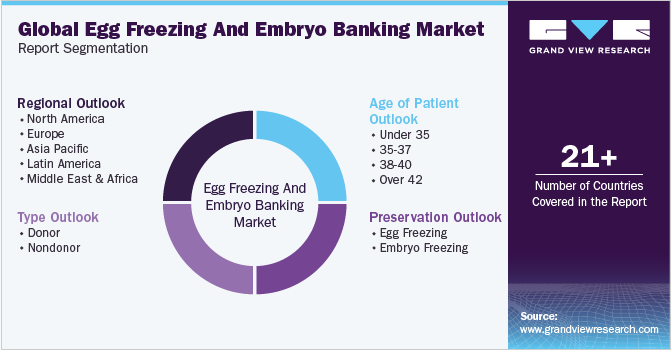
This report forecasts revenue growth at the global, regional, and country levels and provides an analysis of the latest industry trends and opportunities in each of the sub-segments from 2018 to 2030. For the purpose of this study, Grand View Research has segmented the global egg freezing and embryo banking market report on the basis of type, preservation, age of patient, and region:
 To learn more about this report, Download Free Sample Report
 -
Type Outlook (Revenue, USD Million, 2018 - 2030)
-
Donor
-
Nondonor
-
-
Preservation Outlook (Revenue, USD Million, 2018 - 2030)
-
Egg Freezing
-
Embryo Freezing
-
-
Age of Patient Outlook (Revenue, USD Million, 2018 - 2030)
-
Under 35
-
35-37
-
38-40
-
Over 42
-
-
Regional Outlook (Revenue, USD Million, 2018 - 2030)
-
North America
-
U.S.
-
Canada
-
-
Europe
-
U.K.
-
Germany
-
France
-
Italy
-
Spain
-
Sweden
-
Norway
-
Denmark
-
-
Asia Pacific
-
China
-
Japan
-
India
-
South Korea
-
Australia
-
Thailand
-
-
Latin America
-
Brazil
-
Mexico
-
Argentina
-
-
Middle East & Africa (MEA)
-
South Africa
-
Saudi Arabia
-
UAE
-
Kuwait
-
-
Frequently Asked Questions About This Report
The global egg freezing and embryo banking market size was valued at USD 3.9 billion in 2022 and is estimated at USD 7.4 billion for 2026.
The global egg freezing and embryo banking market is expected to grow at a CAGR of 16.8% from 2023 to 2030, reaching USD 13.8 billion by 2030.
Europe dominated with a revenue share of 36% in 2022.
Some key players operating in the egg freezing and embryo banking market include ReproTech LLC, Cryos International, CCRM Fertility, RMA Network, Carrot Fertility, WINFertility, Columbia University, Shady Grove Fertility, and KindBody.
Key factors that are driving the egg freezing and embryo banking market growth include delayed childbearing due to sociodemographic factors, increasing rate of infertilities and others.
About the Author(s)
Medical Devices Research Team
Healthcare · Medical DevicesThis report was authored by the medical devices research team at Grand View Research - comprising two research analysts, one senior research analyst, and one industry expert - with specialized expertise in the medical devices segment of the healthcare industry. All findings are based on proprietary healthcare databases, executive interviews, and regulatory analysis, subject to internal peer review prior to publication.
Last Updated:
Speak to Analyst

Customize this report to your needs - add regions, segments, or data points, with 20% free customization.
Or view our licence options:


ISO 9001:2015 & 27001:2022 Certified
We are GDPR and CCPA compliant! Your transaction & personal information is safe and secure. For more details, please read our privacy policy.


