
- Home
- »
- Plastics, Polymers & Resins
- »
-
Elastomers Market Size, Share & Growth Report, 2026-2033GVR Report cover

Elastomers Market (2026 - 2033)
Size, Share & Trends Analysis Report By Type (Thermoplastics, Thermosets), By End-use (Automotive, Medical, Consumer Goods, Industrial), By Region (North America, Europe, Asia Pacific, Latin America, MEA), And Segment Forecasts
Market Size, 2025
$109.2BMarket Estimate, 2026
$114.8BMarket Forecast, 2033
$166.9BCAGR, 2026–2033
5.5%Elastomers Market Summary
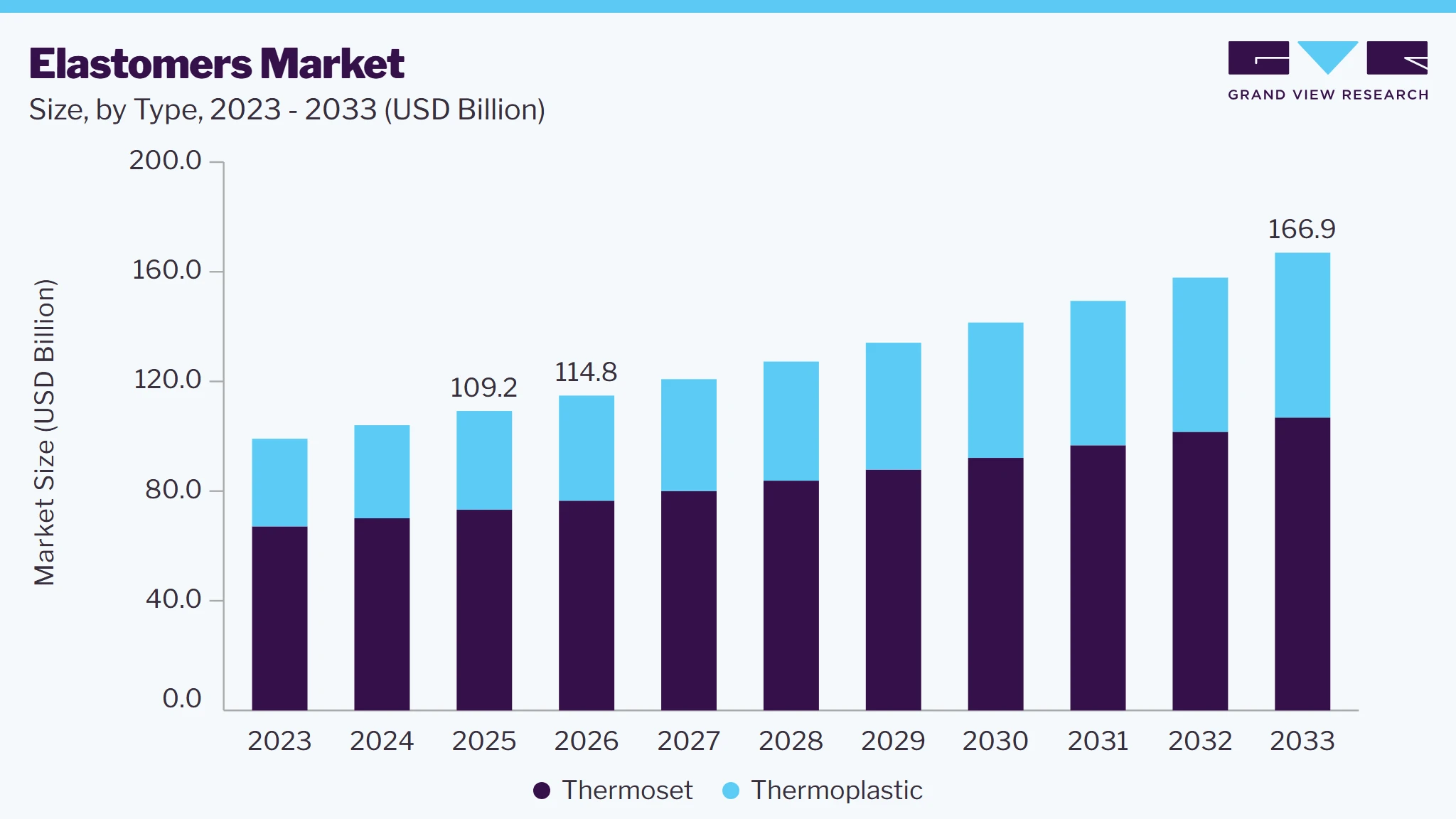
The global elastomers market size was valued at USD 109.2 billion in 2025 and is projected to grow from USD 114.8 billion in 2026 to USD 166.9 billion by 2033, at a CAGR of 5.5% from 2026 to 2033. Asia Pacific dominated the elastomers market with the largest revenue share of 43.5% in 2025. Rising demand from the automotive industry for lightweight, high-performance materials and expanding adoption across construction, medical, and consumer goods applications are driving the growth of the market.
 Source: Grand View Research, IR Documents, Primary Interviews, Paid DatabasesTo learn more about this report,
 Download Free Sample Report
Key Market Trends & Insights
- By type: Thermoset segment led the market with the largest revenue share of 67.0% in 2025.
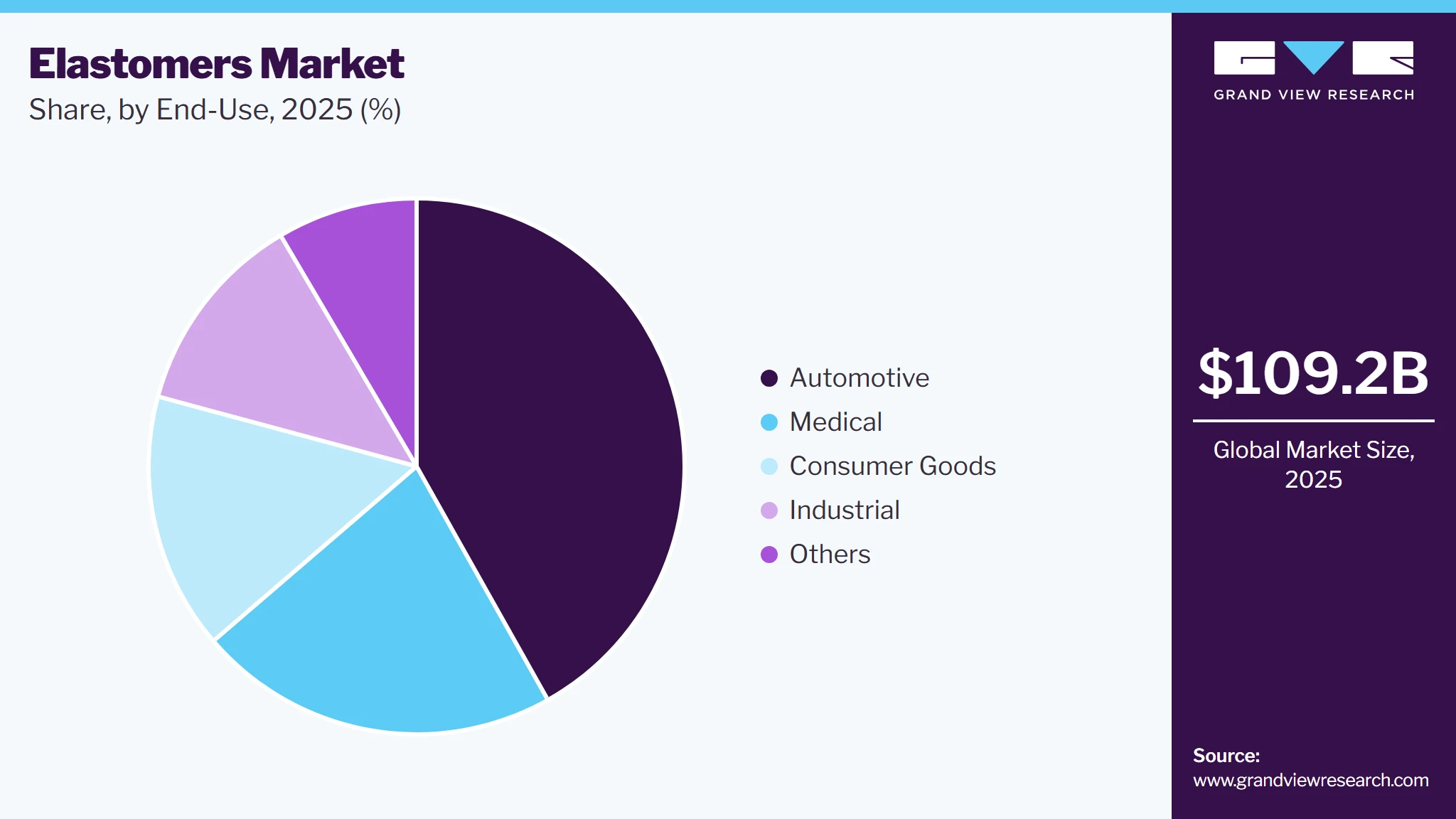
- By end use: Automotive segment led the market with the largest revenue share of 41.9% in 2025.
Regional Highlights
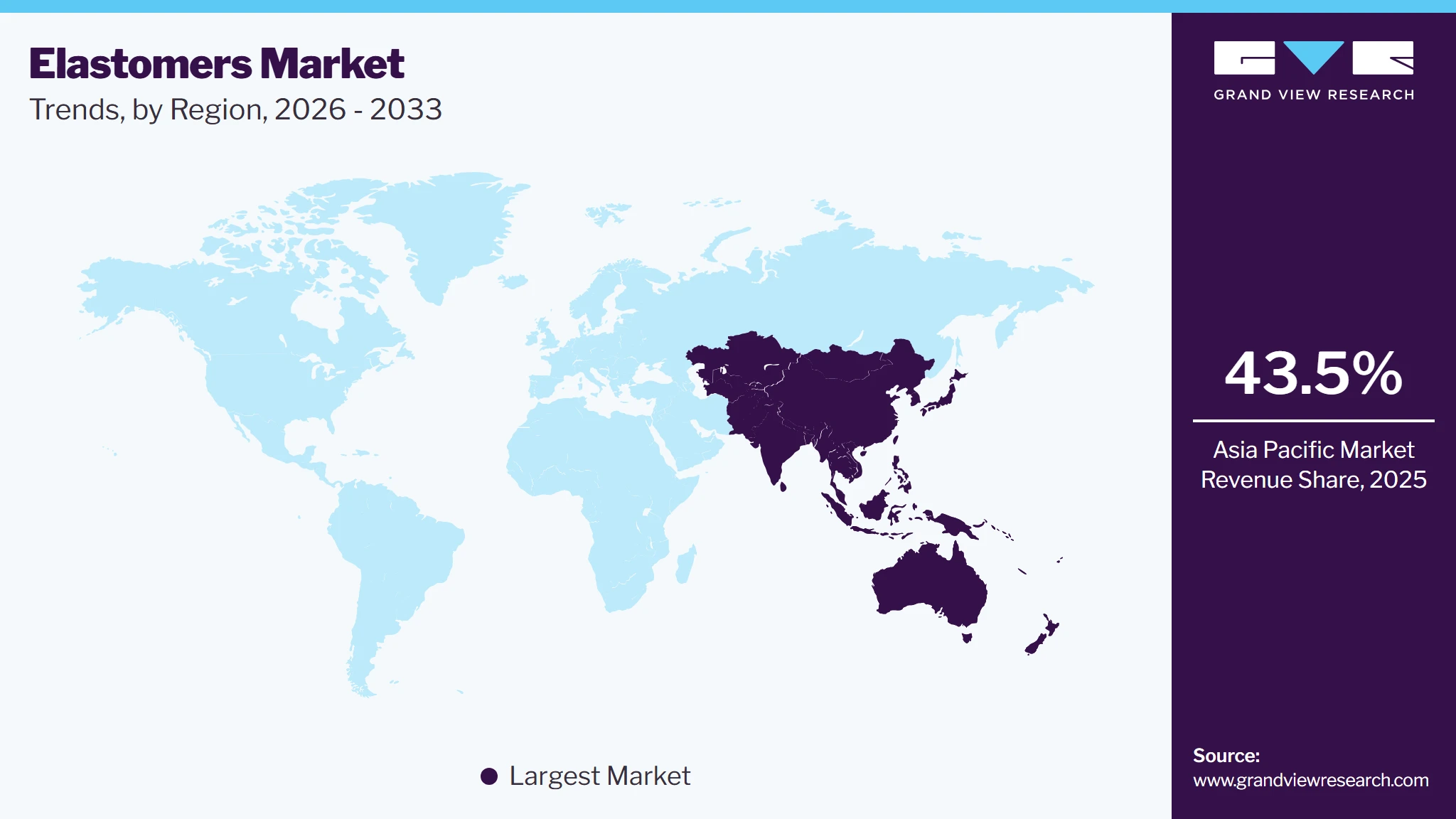
- Largest regional market: Asia Pacific 43.5% revenue share, 2025)
- By country: China held the largest share in 2025.
Market Size & Forecasts
- Market size in 2025: USD 109.2 Billion
- Estimated market size in 2026: USD 114.8 Billion
- Projected market size by 2033: USD 166.9 Billion
- CAGR (2026-2033): 5.5%
Three ways to get this report
Buy it, customize it, or ask a question.Ask an Analyst
Analyst response in 1 business day
- AccessReport author, directly
- Reply timeWithin 1 working day
- No sales callDirect answer only
- FormatEmail reply
- CostFree, no cost
Get the Full Report
What the study covers
- FormatsPDF · Excel · Dashboard
- Timeline2026–2033 annual, 2025 base
- Coverage20+ countries, 5 regions
- Companies10+ key players profiled
Customize the Report
20% free customization
- IncludeCountries, segments, points
- TailorTo your product definition
- ExtendDeeper competitor detail
- OrA fully bespoke study
- Turnaround5–10 working days
Their superior durability, chemical resistance, and design flexibility are accelerating product utilization. At the same time, advancements in processing technologies and the increasing shift toward sustainable bio-based elastomers continue to strengthen long-term market growth during the forecast period.Elastomers are rubber-like materials known for their elasticity and durability, making them essential in various industries. The construction sector's increasing demand significantly influences the growth of the elastomers market. As urbanization accelerates and infrastructure projects expand globally, the need for high-performance materials that offer flexibility, durability, and weather resistance becomes critical. Elastomers are widely used in sealants, adhesives, and waterproofing applications, effectively fulfilling these requirements.
 To learn more about this report, Download Free Sample Report
Furthermore, the rising emphasis on sustainability within the construction industry has led to an increased preference for eco-friendly elastomeric materials derived from renewable sources. This shift addresses environmental concerns and aligns with the industry's goal of reducing reliance on fossil fuels. Innovations in renewable elastomers have emerged, providing properties comparable to traditional synthetic options while promoting biodegradability and a lower carbon footprint.
Moreover, technological advancements play a vital role in this market's expansion as ongoing research and development efforts yield innovative elastomer products with enhanced performance characteristics. These developments cater to diverse applications across various sectors, including automotive and consumer goods. As the demand for sustainable construction materials continues to grow, elastomers are poised to capture a significant share of this evolving market landscape.
Market Dynamics
The elastomers market is driven by rising demand for durable, high-performance materials across the construction, automotive, and consumer goods industries, as well as the rapid expansion of urban infrastructure and sustainable building practices. The superior flexibility, weather resistance, sealing performance, and durability of elastomers are accelerating adoption in sealants, adhesives, waterproofing systems, and engineered components. Additionally, ongoing advancements in elastomer technologies, a growing preference for renewable and bio-based materials, and continued investments in sustainable construction and product innovation are enhancing performance, reducing environmental impact, and supporting long-term market growth over the forecast period.
The elastomers market is experiencing steady growth, driven by rising automotive production, increasing vehicle electrification, and growing demand for high-performance components that enhance safety, durability, and operational efficiency. Elastomers are increasingly adopted across conventional and electric vehicles owing to their superior elasticity, vibration damping, heat resistance, chemical stability, and sealing performance, enabling reliable operation in tires, hoses, gaskets, seals, suspension systems, and battery packs. Their ability to withstand demanding mechanical and environmental conditions while extending component lifespan continues to strengthen their importance in modern vehicle manufacturing.
Market growth is further supported by expanding electric vehicle production, stringent fuel efficiency and emission regulations, and increasing investments in advanced automotive technologies. Rising demand for lightweight materials, improved thermal management, and enhanced passenger comfort has significantly accelerated elastomer adoption across critical vehicle systems. Continuous innovations in specialty elastomer formulations, along with advancements in manufacturing processes and component design, are improving product performance and reliability. As global automotive manufacturers continue to prioritize electrification, efficiency, and long-term durability, the elastomers market is expected to witness sustained growth during the forecast period.
Raw material price volatility remains a significant restraint for the elastomers market. Most synthetic elastomers are manufactured using petrochemical feedstocks such as crude oil, butadiene, benzene, and other hydrocarbon derivatives, making production costs highly sensitive to fluctuations in global energy and commodity markets. Supply chain disruptions, geopolitical uncertainties, and feedstock price instability increase procurement costs, reduce pricing predictability, and compress manufacturer profit margins. These factors can disrupt production planning, weaken cost competitiveness, and limit investment in capacity expansion, thereby restraining the long-term growth of the elastomers market.
The expanding healthcare and medical device industry is creating significant growth opportunities for the elastomers market. Rising demand for biocompatible, PVC-free elastomers and medical-grade silicone materials is accelerating their adoption in infusion systems, drug delivery devices, wearable patient monitoring equipment, and other advanced medical applications. Growing emphasis on patient safety, regulatory compliance, and high-performance healthcare materials is further supporting market expansion. At the same time, continuous innovations in sterilization-resistant elastomers capable of withstanding repeated heat and chemical exposure are expected to drive sustained demand and premium product adoption during the forecast period.
Analyst Perspective
The global market for elastomers is anticipated to experience consistent expansion, driven by growing requirements from significant end-use sectors including automotive, construction, healthcare, consumer products, and industrial manufacturing. The automotive industry continues to be a primary factor boosting growth, fueled by higher vehicle production, greater acceptance of electric vehicles (EVs), and the need for high-quality elastomer components for applications in sealing, vibration control, tires, and thermal management. Furthermore, the increasing infrastructure development, urbanization, and investments in construction projects are boosting the demand for elastomers utilized in sealants, waterproofing applications, insulation, and protective coatings. Innovations in specialty elastomers, eco-friendly elastomer solutions, and high-performance materials are broadening the range of application possibilities. A growing emphasis on durability, chemical resistance, lightweight materials, and improved product performance is anticipated to promote sustained market growth.
Type Insights
Based on type, the thermoset segment led the market with the largest revenue share of 67.0% in 2025. This growth can be attributed to their exceptional properties, including high-temperature resistance, chemical stability, and durability. These characteristics make thermosets ideal for demanding automotive, aerospace, and construction applications. In addition, their ability to maintain structural integrity under extreme conditions enhances their appeal for products such as tires and seals. Furthermore, the increasing focus on sustainability and the development of advanced formulations are further propelling the demand for thermoset elastomers in various applications.
The thermoplastic elastomers (TPE) segment is expected to grow at a CAGR of 6.5% in 2024, owing to their versatility and ease of processing. TPEs are increasingly favored in automotive applications for their lightweight and flexible nature, which contributes to fuel efficiency and performance. In addition, the rise of electric vehicles also boosts TPE demand, as these materials are essential for components requiring durability and impact resistance. Furthermore, the growing consumer electronics sector seeks TPEs for their aesthetic appeal and functional properties, driving further growth in this segment of the elastomers market.
End Use Insights
Based on end use, the automotive segment led the market with the largest revenue share of 41.9% in 2025, primarily driven by the increasing demand for lightweight and durable materials that enhance vehicle efficiency and performance. In addition, as automakers focus on reducing emissions and improving fuel economy, elastomers provide essential properties such as flexibility, heat resistance, and chemical stability. Furthermore, stringent government regulations to ensure passenger safety and reduce environmental impact further boost the adoption of elastomers in various automotive applications.
 To learn more about this report, Download Free Sample Report
The medical segment is expected to grow at a CAGR of 6.3% from 2025 to 2030, owing to the rising demand for high-quality, biocompatible materials propelling elastomers' growth. These materials are crucial for manufacturing medical devices, seals, and gaskets that require excellent durability and flexibility. In addition, the ongoing advancements in healthcare technology and the increasing emphasis on patient safety drive the need for innovative elastomer solutions. Furthermore, the trend towards minimally invasive procedures and personalized medicine necessitates the development of specialized elastomers that meet stringent regulatory standards, fostering market expansion in this sector.
Regional Insights
Asia Pacific dominated the elastomers market with the largest revenue share of 43.5% in 2025, primarily driven by rapid industrialization and urbanization, leading to increased demand for lightweight and durable materials across various sectors, including automotive and construction. In addition, the region's expanding infrastructure projects further enhance the need for elastomers in applications such as sealants and adhesives. Furthermore, advancements in manufacturing technologies and a growing focus on sustainability are propelling the adoption of eco-friendly elastomers, catering to both environmental regulations and consumer preferences.
 To learn more about this report, Download Free Sample Report
China Elastomers Market Trends
The elastomers market in China accounted for the largest market revenue share in the Asia Pacific in 2025, owing to its robust manufacturing sector and significant investments in the automotive and construction industries. In addition, the government's stringent environmental policies promote the use of eco-friendly elastomers, which are increasingly favored for their recyclability and lower environmental impact. Furthermore, China's booming electronics industry demands high-performance elastomers for applications requiring flexibility and heat resistance.
Middle East & Africa Elastomers Market Trends
Middle East & Africa elastomers market is expected to grow at a CAGR of 6.6% over the forecast period, driven by increasing infrastructure development and urbanization initiatives. Countries in this region are investing in construction projects that require durable and weather-resistant materials, driving demand for elastomers. Furthermore, expanding the oil and gas sector necessitates specialized elastomer products for applications such as seals and gaskets. Moreover, the region's focus on diversifying economies beyond oil dependency further encourages investment in various industries that utilize elastomers.
North America Elastomers Market Trends
The elastomers market in North America held a significant revenue share of 24.8% in 2024, owing to the advancements in automotive technology, particularly with the rise of electric vehicles that require lightweight materials for improved efficiency. In addition, the region's strong emphasis on innovation drives demand for high-performance elastomers in various applications, including medical devices and consumer goods. Furthermore, stringent emissions and safety standards regulations propel manufacturers to adopt advanced elastomer solutions that meet these requirements.
U.S. elastomers market led the North American market and accounted for the largest revenue share in 2024, primarily driven by a strong automotive sector that increasingly seeks lightweight materials to enhance fuel efficiency and performance. In addition, the growing healthcare industry demands biocompatible elastomers for medical devices, further driving market expansion. Moreover, innovations in manufacturing processes also contribute to improved product quality and cost-effectiveness, making U.S.-based manufacturers competitive on a global scale. As sustainability becomes a priority, the shift towards eco-friendly elastomer solutions is expected to shape future growth.
Europe Elastomers Market Trends
The elastomers market in Europe is expected to grow significantly over the forecast period, driven by stringent environmental regulations that encourage the use of sustainable materials across industries. In addition, the automotive sector's transition towards electric vehicles significantly boosts demand for lightweight and high-performance elastomers. Moreover, advancements in technology facilitate the development of innovative elastomer products that meet diverse application needs, from construction to medical devices.
Key Elastomers Company Insights
Key players in the global elastomers industry include DuPont de Nemours, Inc., ASF SE, INEOS, and others. These companies are adopting various strategies to enhance their competitive edge. Partnerships and agreements are being formed to leverage technological advancements and expand product portfolios. In addition, companies are focusing on new product developments to meet evolving consumer demands and regulatory standards. Furthermore, market expansions into emerging regions are also a priority, enabling players to tap into growing markets.
-
LANXESS AG specializes in producing polyurethane elastomers, which are utilized in various applications, including automotive components, industrial machinery, and consumer goods. The company operates primarily in the Advanced Intermediates, Specialty Additives, and Consumer Protection segments, offering a diverse range of products designed to meet the specific needs of different industries while ensuring high quality and performance standards.
-
LG Chem manufactures thermoplastic elastomers (TPEs) and other specialty elastomers used across multiple sectors, including automotive, electronics, and consumer goods. Operating within the advanced materials segment, the company focuses on innovation and sustainability, developing high-quality elastomers that cater to industries' evolving demands while enhancing performance and environmental responsibility.
Key Elastomers Companies
The following key companies have been profiled for this study on the elastomers market.
-
DuPont de Nemours, Inc.
-
BASF SE
-
INEOS
-
Asahi Kasei Corporation
-
LANXESS AG
-
Huntsman Corporation
-
LG Chem. Ltd
-
Chemtura Corporation
-
Mitsui Chemicals, Inc.
-
JSR BST Elastomer Co., Ltd
-
Zeon Chemicals L.P.
-
Kuraray Co., Ltd.
-
Wacker Chemie AG
-
ExxonMobil
-
Arkema
Competitive Benchmarking
Category
Operating Strategies
Competitive Edge
Weakness
Established Players (DuPont de Nemours, Inc.; BASF SE; INEOS; Asahi Kasei Corporation; LANXESS AG; Huntsman Corporation; Mitsui Chemicals, Inc.; ExxonMobil; Arkema; Chemtura Corporation)
- Focus on strengthening their position in the elastomers market through the development and commercialization of high-performance synthetic elastomers, thermoplastic elastomers, specialty elastomers, and advanced polymer solutions for automotive, industrial, medical, consumer goods, and infrastructure applications.
- Strong emphasis is placed on expanding specialty product portfolios with enhanced durability, chemical resistance, thermal stability, and lightweight performance.
- Continuous investments in R&D, manufacturing capacity expansion, process optimization, sustainable material development, and strategic collaborations with OEMs and industrial manufacturers support global market penetration and long-term commercial growth.
- Extensive expertise in polymer science, elastomer chemistry, and integrated manufacturing enables the commercialization of high-performance elastomer solutions with superior mechanical properties, heat resistance, elasticity, and long-term durability.
- Strong research and development capabilities, globally recognized brands, vertically integrated production facilities, diversified product portfolios, established relationships with automotive OEMs and industrial customers, and extensive global distribution networks provide sustainable competitive differentiation and recurring revenue opportunities across multiple end-use industries.
- High capital investment requirements for specialty elastomer production, advanced manufacturing technologies, capacity expansion, and continuous product innovation increase operational complexity and production costs.
- Volatility in petrochemical feedstock prices, stringent environmental regulations, increasing sustainability requirements, and intense competition from regional manufacturers influence profitability.
- Additionally, substantial investments in bio-based elastomers, recycling technologies, carbon reduction initiatives, and regulatory compliance may affect operating margins and long-term market share.
Emerging Players (JSR BST Elastomer Co., Ltd.; LG Chem; Zeon Chemicals L.P.; Kuraray Co., Ltd.; Wacker Chemie AG)
- Focus on expanding their presence in the elastomers market through the development of innovative, application-specific, and sustainable elastomer materials for automotive, healthcare, industrial, electronics, and consumer goods applications.
- Emphasis is placed on improving material performance, advancing specialty elastomer technologies, enhancing manufacturing efficiency, and strengthening collaborations with OEMs, component manufacturers, and material distributors.
- Strategic partnerships, regional capacity expansion, and targeted commercialization initiatives support product innovation, business growth, and expansion into high-growth domestic and international markets.
- Strong flexibility in product innovation, advanced material technologies, customized elastomer formulations, and responsive technical support enable these companies to address evolving application requirements effectively.
- Their ability to rapidly commercialize specialty elastomers, thermoplastic elastomers, silicone elastomers, and high-performance compounds while optimizing production efficiency and offering application-specific solutions strengthens customer adoption.
- Agile business models, niche market expertise, and customer-focused product development further enhance their competitive positioning in the elastomers market.
- Comparatively smaller manufacturing scale across the broader elastomers value chain, limited product diversification relative to leading multinational competitors, and lower market penetration in certain regions may restrict participation in large-volume global supply programs.
- Dependence on specialty application segments, increasing raw material price volatility, evolving environmental compliance requirements, and pricing pressure from established global suppliers can constrain market expansion.
- Additionally, substantial investments in production capacity, advanced processing technologies, sustainable material innovation, regulatory certifications, and global customer acquisition are required to compete effectively in the elastomers market.
Recent Developments
-
In March 2024, Dow introduced a new polyolefin elastomer (POE)--based alternative to leather, targeting the automotive industry’s shift toward animal-free products. This innovation, developed in partnership with HIUV Materials Technology, offers advantages such as enhanced softness, color stability, and resistance to aging and low temperatures. Furthermore, it is lighter than PVC leather and free from hazardous chemicals. Dow anticipates expanding this elastomer-based solution into various consumer sectors, including fashion and furniture.
-
In March 2023, Borealis announced the launch of its new line of circular plastomers and elastomers, named Renewable. Produced at its Geleen facility in the Netherlands using renewable feedstock, these products aimed to meet the increasing demand for sustainable materials without compromising performance. The Bornewables line is ISCC PLUS certified and utilizes waste-derived feedstock, including used cooking oil.
-
In February 2023, Kuraray Co., Ltd. announced the completion of a new plant for isoprene-related businesses. Located in the WHA Eastern Industrial Park in Rayong Province, Thailand, this facility was expected to enhance the global supply chain for products such as 3-Methyl-1.5-Pentanediol (MPD) and SEPTON hydrogenated styrenic block copolymers (HSBC), both of which are key elastomers. The investment aimed to meet rising global demand and supports Kuraray's medium-term management plan, "PASSION 2026," focusing on sustainable growth and innovation in specialty chemicals.
Elastomers Market Report Scope
Report Attribute
Details
Market size in 2025
USD 109.2 billion
Estimated market size in 2026
USD 114.8 billion
Projected market size by 2033
USD 166.9 billion
Growth rate
CAGR of 5.5% from 2026 to 2033
Base year for estimation
2025
Historical data
2021 - 2024
Forecast period
2026 - 2033
Quantitative units
Revenue in USD million/billion, volume in kilotons, and CAGR from 2026 to 2033
Report coverage
Revenue forecast, company ranking, competitive landscape, growth factors, and trends
Segments covered
Type, end use, region
Regional scope
North America, Asia Pacific, Europe, Latin America, the Middle East, and Africa
Country scope
U.S., Canada, Mexico, China, India, Japan, South Korea, Thailand, Germany, France, UK, Italy, Brazil, and Saudi Arabia
Key companies profiled
DuPont de Nemours, Inc.; BASF SE; INEOS; Asahi Kasei Corporation; LANXESS AG; Huntsman Corporation; LG Chem. Ltd; Chemtura Corporation; Mitsui Chemicals, Inc.; JSR BST Elastomer Co., Ltd; Zeon Chemicals L.P.; Kuraray Co., Ltd; Wacker Chemie AG; ExxonMobil; Arkema.
Customization scope
Free report customization (equivalent to up to 8 analysts' working days) with purchase-addition or alteration to country, regional & segment scope.
Pricing and purchase options
Avail customized purchase options to meet your exact research needs. Explore purchase options
Global Elastomers Market Report Segmentation
This report forecasts revenue growth at global, regional, and country levels and analyzes the latest industry trends in each sub-segment from 2018 to 2030. For this study, Grand View Research has segmented the elastomers market report based on type, end use, and region.
 To learn more about this report, Download Free Sample Report
-
Type Outlook (Volume, Kilotons; Revenue, USD Million, 2021 - 2033)
-
Thermoset
-
Thermoplastic
-
-
End Use Outlook (Volume, Kilotons; Revenue, USD Million, 2021 - 2033)
-
Automotive
-
Medical
-
Consumer Goods
-
Industrial
-
Others
-
-
Regional Outlook (Volume, Kilotons; Revenue, USD Million, 2021 - 2033)
-
North America
-
U.S.
-
Canada
-
Mexico
-
-
Europe
-
Germany
-
France
-
UK
-
Italy
-
-
Asia Pacific
-
China
-
India
-
Japan
-
South Korea
-
Thailand
-
-
Latin America
-
Brazil
-
-
Middle East and Africa
-
Saudi Arabia
-
-
Research Methodology
The elastomers market figures in this report are based on a proven research process that combines executive interviews with secondary research from proprietary databases, company filings, and recognized regulatory and institutional sources. Market size is built through value-chain sizing - reconciling supply-side and demand-side estimates - and triangulated with bottom-up and top-down approaches. Every estimate passes multiple levels of expert validation before publication, with each elastomers segment quantified using the revenue-capture definitions in the table below.
Segment Definition
Segment - Type
Revenue capture definition
Thermoset Elastomers
Revenue is captured through the production and sale of thermoset elastomers used in high-performance sealing, insulation, vibration damping, and molded component applications across automotive, industrial, construction, and electrical sectors. Demand is driven by superior heat resistance, chemical stability, mechanical strength, dimensional stability, long service life, and increasing adoption in applications requiring permanent cross-linked performance under demanding operating conditions.
Thermoplastic Elastomers (TPEs)
Revenue is captured through the production and sale of thermoplastic elastomers used in automotive components, medical devices, consumer products, electrical equipment, and industrial applications. Growth is supported by excellent flexibility, lightweight properties, recyclability, ease of processing, design versatility, reduced manufacturing costs, and increasing demand for sustainable, high-performance materials that combine the characteristics of rubber and thermoplastics.
Segment - End-Use
Revenue capture definition
Automotive
Revenue is captured through the production and sale of elastomer materials used in tires, seals, gaskets, hoses, weatherstrips, bushings, vibration dampers, interior components, and electric vehicle battery systems. Demand is driven by increasing vehicle production, rising electric vehicle adoption, lightweight material requirements, superior durability, heat and chemical resistance, vibration control, and stringent performance and safety standards.
Medical
Revenue is captured through the commercialization of elastomers used in medical tubing, catheters, seals, syringes, infusion systems, wearable medical devices, surgical instruments, and pharmaceutical packaging components. Growth is supported by superior biocompatibility, sterilization resistance, flexibility, chemical stability, regulatory compliance, and increasing demand for advanced healthcare and medical device technologies.
Consumer Goods
Revenue is captured through the production and sale of elastomers used in footwear, sporting goods, personal care products, household appliances, electronic accessories, toys, and flexible consumer products. Demand is driven by superior comfort, durability, design flexibility, impact resistance, aesthetic appeal, and growing consumer preference for lightweight, high-performance, and long-lasting products.
Industrial
Revenue is captured through the production and sale of elastomers used in industrial hoses, conveyor belts, seals, gaskets, rollers, vibration isolators, hydraulic systems, machinery components, and fluid handling equipment. Growth is supported by excellent abrasion resistance, chemical resistance, mechanical durability, operational reliability, and increasing investments in manufacturing, automation, mining, oil & gas, and process industries.
Others
Revenue is captured through the commercialization of elastomers used across construction, aerospace, electrical and electronics, agriculture, marine, energy, and other specialized applications. Demand is driven by expanding infrastructure development, renewable energy projects, electrical insulation requirements, environmental durability, weather resistance, and increasing adoption of high-performance elastomer solutions in diverse end-use industries.
Estimation Model
Layer Name
Key Question
Description
Bottom-Up Elastomers Demand Assessment Layer
What defines market boundaries?
This layer begins with global demand for elastomers across automotive, medical, consumer goods, industrial, construction, electrical, and other engineering applications. Demand is filtered based on vehicle production, industrial output, healthcare expenditure, consumer goods manufacturing, infrastructure development, electrification trends, and increasing adoption of high-performance, lightweight, and durable materials across global end-use industries.
Type and End-Use Validation Layer
Where is demand generated?
This layer evaluates demand distribution across thermoset elastomers and thermoplastic elastomers (TPEs) used in automotive, medical, consumer goods, industrial, and other end-use sectors. Market revenue is aligned with critical performance requirements, including elasticity, chemical resistance, heat resistance, abrasion resistance, sealing performance, vibration damping, flexibility, durability, recyclability, and regulatory compliance across diverse application environments.
Technology and Revenue Conversion Layer
Who captures market revenue?
This layer converts application-level demand into the elastomers market revenue by applying product mix ratios across thermoset and thermoplastic elastomer categories. Revenue allocation considers polymer type, material formulation, manufacturing technology, product specifications, processing methods, regulatory compliance, production costs, application-specific performance requirements, product pricing, and supplier positioning across the global elastomers value chain.
Regional Commercial Cross-Check Layer
How are assumptions validated?
This layer validates demand concentration by comparing North America's growth, supported by automotive innovation, industrial automation, and healthcare investments; Europe's demand, driven by sustainability initiatives, stringent environmental regulations, and advanced manufacturing; and Asia Pacific's rapid expansion, fueled by industrialization, automotive production, infrastructure development, expanding healthcare capacity, and increasing consumer goods manufacturing across emerging economies.
Delivered Customizations
This report has been delivered with the following In-depth customizations
Client Request
Customization Delivered
Value Adds
Regional Segmentation
Delivered an in-depth regional assessment of the Elastomers Market covering North America, Europe, Asia Pacific, Latin America, and the Middle East & Africa, with analysis of demand drivers, manufacturing hubs, regulatory landscape, end-use industry concentration, supply dynamics, and regional growth prospects.
Enables identification of high-growth regions, supports regional investment prioritization, production planning, market entry strategies, and geographic expansion decisions.
Trade Assessment
Analyzed global trade flows, major exporting and importing countries, production hubs, supply chain dependencies, feedstock availability, trade policies, tariff impacts, and regional sourcing patterns influencing the elastomers value chain.
Supports supply chain optimization, sourcing diversification, trade risk mitigation, localization strategies, and informed manufacturing and procurement decisions.
Opportunity Assessment
Identified high-growth opportunities across electric vehicles, advanced medical devices, industrial automation, renewable energy, sustainable construction, bio-based elastomers, recyclable thermoplastic elastomers, and specialty high-performance elastomer applications, supported by technology and regulatory trend analysis.
Enables strategic investment prioritization, product innovation planning, new application development, long-term growth strategy formulation, and expansion into emerging high-value market segments.
Frequently Asked Questions About This Report
The elastomers market was estimated at around USD 109.2 billion in the year 2025 and is expected to reach around USD 114.8 billion in 2026.
The elastomers market is expected to grow at a compound annual growth rate of 5.5% from 2026 to 2033 to reach around USD 166.9 billion by 2033.
Some key players operating in the elastomers market include LG Chem. Ltd.; Arkema, Inc.; PolyOne Corporation; Covestro AG; E. I. du Pont de Nemours and Company; The Dow Chemical Company; and Huntsman International LLC.
Key factors that are driving the market growth include rising demand from key application areas coupled with advancements in the processing technologies.
The Asia Pacific Elastomers market accounted for the largest share of 43.5% market size in 2025.
China was the leading Elastomers market and is expected to grow at a compound annual growth rate of 7.6%.
The Medical segment, based on technique, is expected to grow at a CAGR of 6.3% for the forecast period.
Based on end use, the automotive segment accounted for the largest share of 41.9% market size in 2025. Rising vehicle production and increasing electric vehicle adoption. Growing demand for lightweight, high-performance automotive components is accelerating automotive adoption of elastomers due to their superior elasticity, vibration damping, heat resistance, chemical resistance, and long-term durability across tires, seals, gaskets, hoses, weatherstrips, suspension systems, and electric vehicle battery components.
The thermoset led the elastomers market in 2025 with a 67.0% share. Rising demand for high-performance materials across automotive, industrial, electrical, and infrastructure applications is accelerating thermoset elastomer adoption due to their superior heat resistance, chemical resistance, mechanical strength, dimensional stability, and long-term durability across seals, gaskets, hoses, vibration dampers, insulation components, and other critical engineering applications.
About the Author(s)
Plastics, Polymers & Resins Research Team
Bulk Chemicals · Plastics, Polymers & ResinsThis report was authored by the plastics, polymers & resins research team at Grand View Research - comprising two research analysts, one senior research analyst, and one industry expert - with specialized expertise in the plastics, polymers & resins segment of the bulk chemicals industry. All findings are based on proprietary bulk chemicals databases, executive interviews, and regulatory analysis, subject to internal peer review prior to publication.
Last Updated:
Speak to Analyst

Customize this report to your needs - add regions, segments, or data points, with 20% free customization.
Or view our licence options:


ISO 9001:2015 & 27001:2022 Certified
We are GDPR and CCPA compliant! Your transaction & personal information is safe and secure. For more details, please read our privacy policy.


