
- Home
- »
- Medical Devices
- »
-
Electric Breast Pumps Market Size, Share Report, 2026-2033GVR Report cover

Electric Breast Pumps Market (2026 - 2033)
Size, Share & Trends Analysis Report By Type (Single, Double), By Application (Personal-use, Hospital Grade), By Distribution Channel (Hospital Pharmacy (Inpatient), Retail Store, E-commerce), By Region, And Segment Forecasts
Market Size, 2025
$1.0BMarket Estimate, 2026
$1.1BMarket Forecast, 2033
$1.8BCAGR, 2026–2033
7.3%Electric Breast Pumps Market Size & Trends
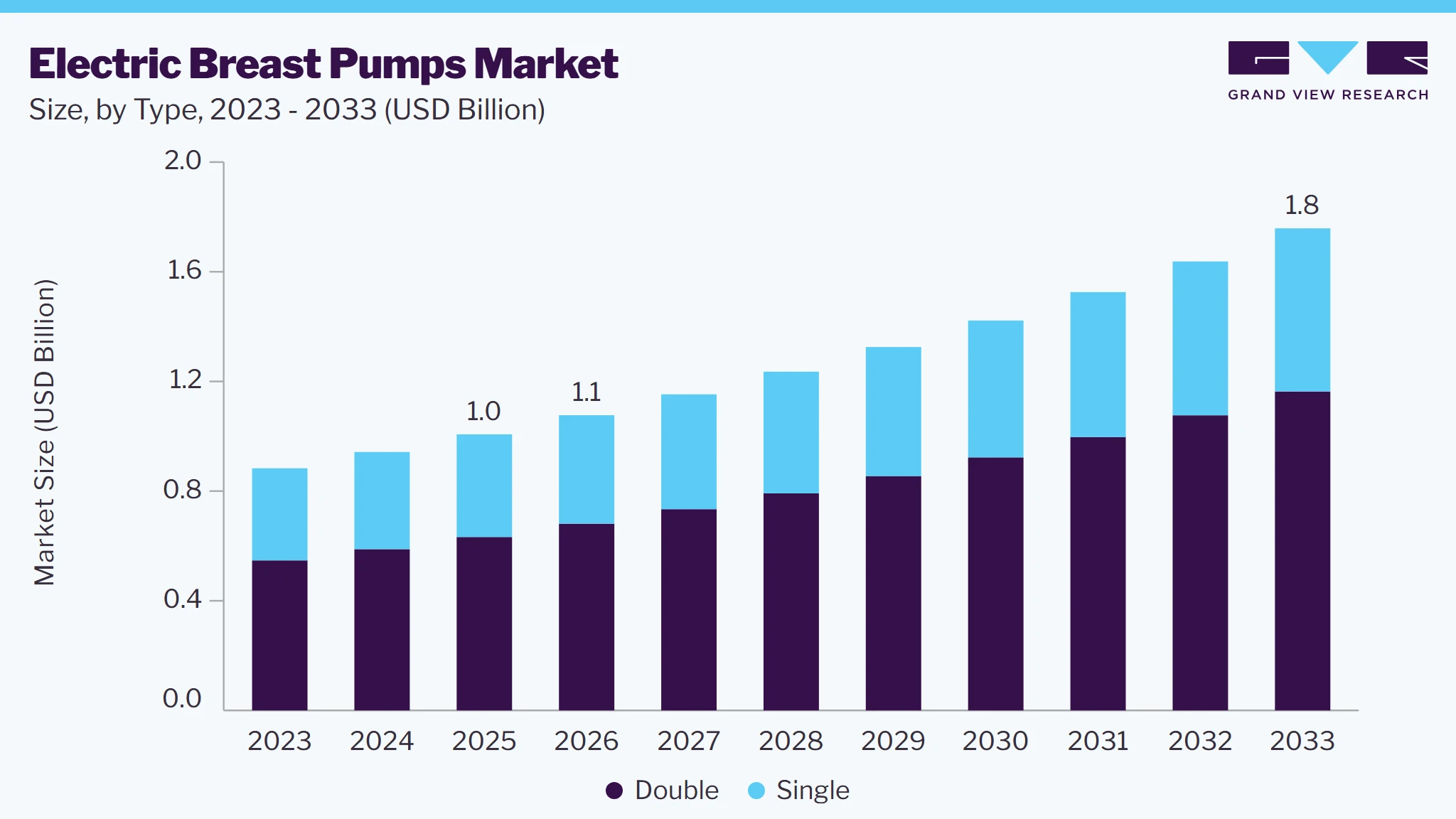
The global electric breast pumps market size was valued at USD 1.0 billion in 2025 and is projected to grow from USD 1.1 billion in 2026 to USD 1.8 billion by 2033, growing at a CAGR of 7.3% from 2026 to 2033. North America dominated the electric breast pumps market with the largest revenue share of 52.3% in 2025. Increasing employment rates for women worldwide, improving healthcare systems in developing nations, and government initiatives to support working mothers are the major factors propelling the market growth.
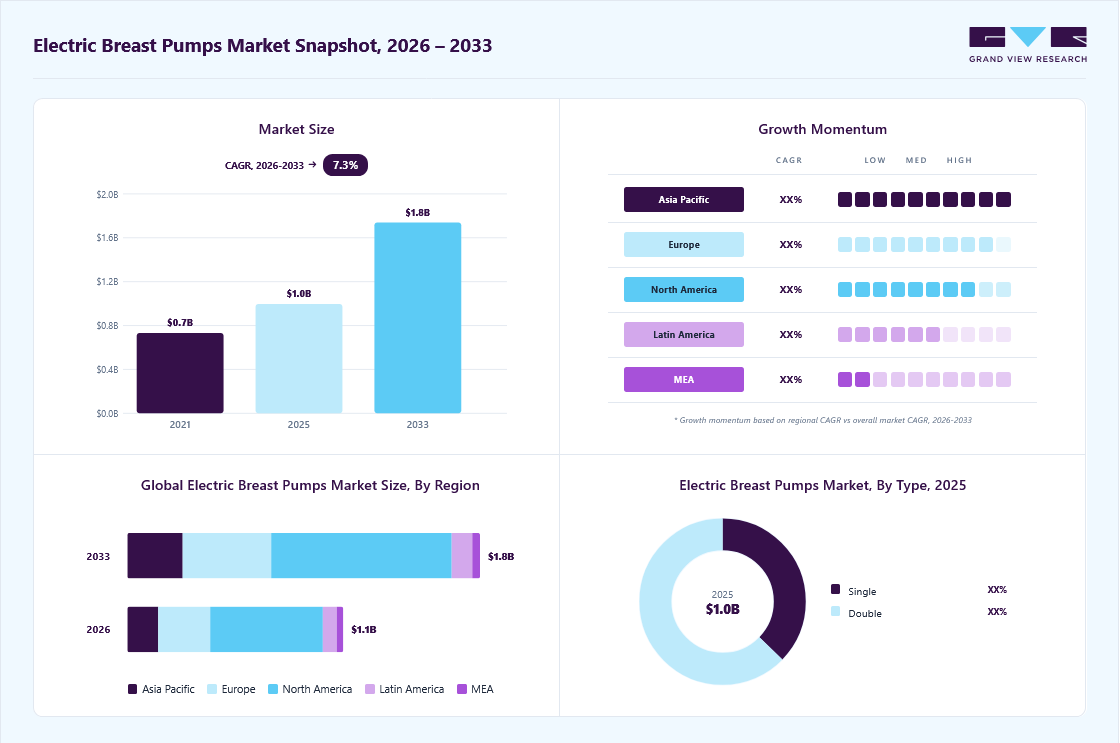 Source: Grand View Research, IR Documents, Primary Interviews, Paid DatabasesTo learn more about this report,
 Download Free Sample Report
Key Market Trends & Insights
- By type: Double electric pumps segment led the market with the largest revenue share of 62.8% in 2025, and single electric pumps are expected to grow at a significant CAGR over the forecast period.
- By applications: Hospital grade segment led the market with the largest revenue share of 61.5% in 2025.
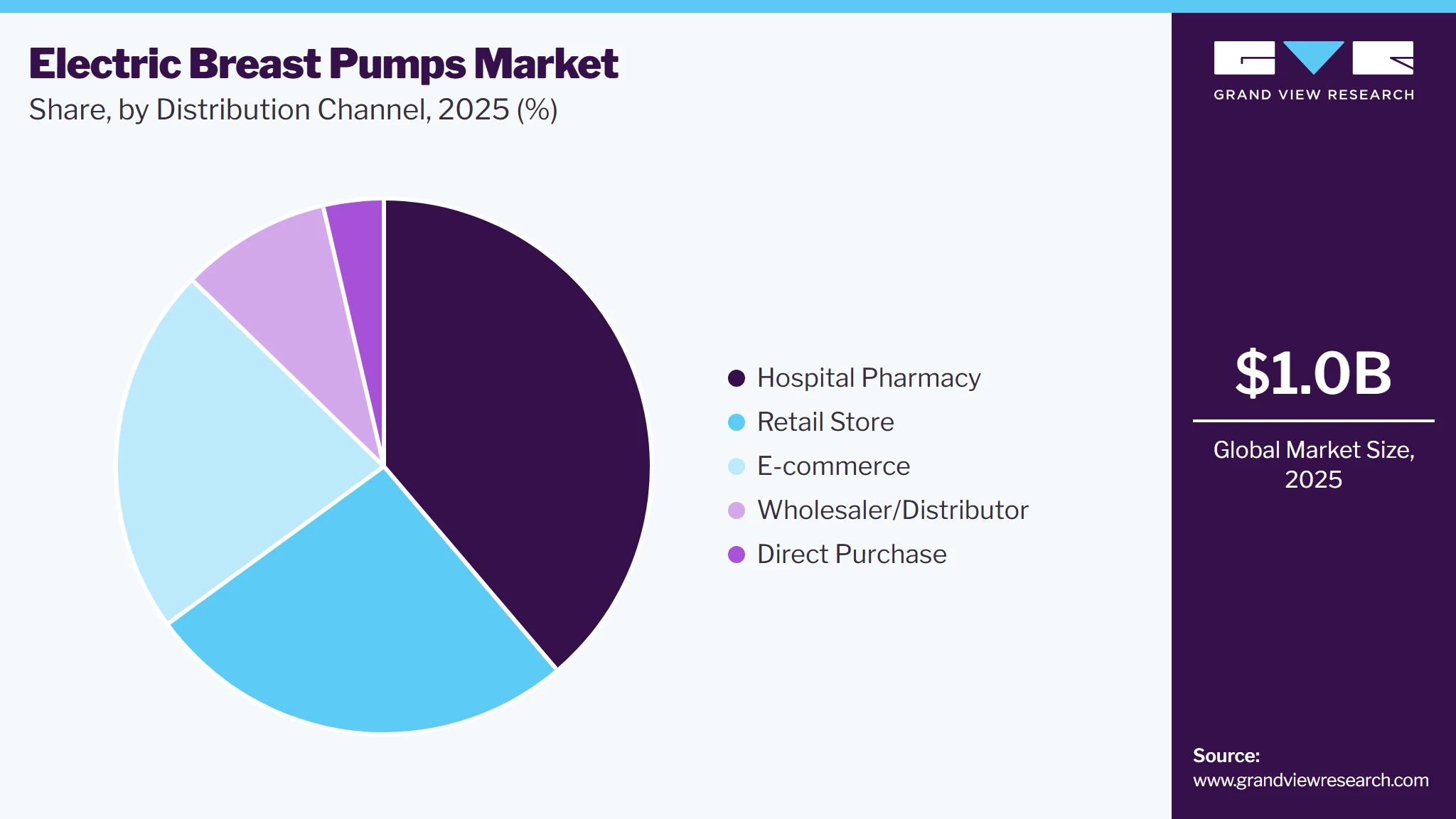
- By distribution channel: Hospital pharmacy segment led the market with the largest revenue share of 38.8% in 2025.
Regional Highlights
- Largest regional market: North America (52.3% revenue share, 2025)
- By country: The U.S. the largest market share in 2025.
Market Size & Forecast
- Market size in 2025: USD 1.0 Billion
- Estimated market size in 2026: USD 1.1 Billion
- Projected market size by 2033: USD 1.8 Billion
- CAGR (2026-2033): 7.3%
Three ways to get this report
Buy it, customize it, or ask a question.Ask an Analyst
Analyst response in 1 business day
- AccessReport author, directly
- Reply timeWithin 1 working day
- No sales callDirect answer only
- FormatEmail reply
- CostFree, no cost
Get the Full Report
What the study covers
- FormatsPDF · Excel · Dashboard
- Timeline2026–2033 annual, 2025 base
- Coverage20+ countries, 5 regions
- Companies10+ key players profiled
Customize the Report
20% free customization
- IncludeCountries, segments, points
- TailorTo your product definition
- ExtendDeeper competitor detail
- OrA fully bespoke study
- Turnaround5–10 working days
According to the International Labor Organization (ILO), throughout the past 20 years, there has been notable progress in terms of employment prospects and gender equality. The ILO spearheaded the 2030 United Nations Agenda, which states that all women and girls must be empowered to achieve gender equality, productive work, economic development, and equal wage opportunity for the young and disabled population.Electric breast pumps are a suitable choice for working mothers who intend to feed their infants while they are away from home for work. As per the World Bank Group, globally, women's labor force participation rate was around 50% in 2022, which is 30% less than men's employment rate. According to the International Labour Organization, in 2023, the global unemployment rate among women is 5.3%, slightly higher than the 5 per cent rate among men.
 To learn more about this report, Download Free Sample Report
Motor-powered electric breast pumps deliver suction through plastic tubing to a horn that fits over the nipple. It offers much more suction, speeds up pumping considerably, and enables simultaneous pumping of both breasts. Electric breast pumps have a lot of power, are expensive, and are power-driven. When compared to alternatives like manual and battery-powered pumps, they are quicker in pumping milk. In addition, they enable double pumping, which greatly reduces pumping time. They are therefore ideal for working women who need quick pumping sessions and must freeze milk before leaving for work.
Electric pumps are typically heavy and noisy, but manufacturers continue to apply modern technologies to make lighter and quieter pumps. Electric pumps are also available for rent for moms who cannot afford to purchase a new pump and only need it for a short period. Ameda AG's Purely Yours Ultra Electric Breast Pumps and Philips AVENT's Isis iQ Duo Electric Breast Pumps are two key brands in this segment. Technological advances, such as the advent of portable instruments such as Ameda's Platinum electric breast pumps and Medela's Electric swing electric breast pumps, are projected to boost market growth in the coming years.
Furthermore, factors such as rising consumer awareness and government backing are expected to drive global demand for electric breast pumps. For example, the United Nations Children's Fund (UNICEF) and the World Health Organization (WHO) established the Baby Friendly Hospital Initiative (BFHI), which promotes evidence-based practices for breastfeeding success, to increase breastfeeding rates and enable families to attain their breastfeeding goals. As part of the Affordable Care Act, most insurance plans must now cover certain breastfeeding assistance and supplies, such as breast pumps.
Moreover, in 2021, the American Society for Biochemistry and Molecular Biology held a nursing awareness campaign. Breastfeeding may provide psychological or emotional benefits for both the mother and the child. As a result, such programs are likely to enhance product utilization. As a result, end consumers find it easier to purchase these devices, resulting in increased demand for electric breast pumps.
Governments across the globe are urging mothers to breastfeed their babies until they are six months old. Furthermore, numerous worldwide organizations are planning breastfeeding awareness campaigns. Various industry participants, including Medela LLC, Laura & Co., Newell Brands, and Ameda, as well as universities, like Washington University and Fudan University, are boosting awareness among women about breastfeeding and its benefits through campaigns and educational periodicals.
Similarly, awareness initiatives by the CDC, WHO, and the Academy of Breastfeeding Medicine (ABM) to feed babies with expressed breastmilk using electric breast pumps are expected to have a positive impact on the market growth. Thus, increased usage of electric breast pumps in the wake of rising precautionary measures is anticipated to drive market growth during the forecast period.
Furthermore, rising breastfeeding issues among women will drive demand for electric breast pumps in the near future. Breastfeeding difficulties in women include nipple pain, breast engorgement, and poor attachment. As a result of these concerns among women, nursing becomes more challenging. According to Nemours, a non-profit children's health organization, most women stop breastfeeding their newborn babies too soon, increasing the requirement for electric pumps.
In addition, engorgement is likely to be one of the primary reasons driving demand for electric breast pumps over the forecast period. Excess milk must be eliminated to avoid engorgement. Hand expression and electric breast pumps are the only two methods for evoking excess milk from the breasts in a healthy manner. As a result of insufficient bonding, mothers may experience significant nipple pain when the infant is sucking. As a result, poor attachment is another factor driving product demand.
Furthermore, social media sites such as YouTube, Facebook, and Instagram have made it possible for users to learn more about electric breast pumps and related accessories. Numerous companies provide information on these platforms. For instance, Spectra Baby USA has a page named Spectra Baby USA - Pumping for Mom Support that promotes and provides information about electric breast pumps. As a result, such factors are likely to enhance the product demand over the projected timeframe.
Market Dynamics
The electric breast pumps market is driven by the increasing number of working women seeking efficient, convenient solutions that support milk expression while balancing professional responsibilities. Growing awareness of the health benefits of breastfeeding is encouraging mothers to use electric breast pumps for regular and effective milk collection. In addition, the rising demand for user-friendly, time-saving pumping devices is driving market adoption. Continuous technological advancements, such as adjustable suction settings, improved comfort features, quieter operation, and portable designs, are further enhancing product performance and driving market growth.
The rising participation of women in the workforce is a significant driver of the electric breast pumps market. As more women return to work shortly after childbirth, the need for convenient solutions that support breastfeeding while balancing professional responsibilities has increased. Electric breast pumps enable mothers to express milk more efficiently in less time than manual alternatives, making them particularly suitable for working women with demanding schedules.
For instance, according to the World Bank Group, the global female labor force participation rate among women aged 15–64 reached approximately 55.1% in 2025, indicating that more than half of working-age women are actively engaged in the labor market. In addition, the ratio of female-to-male labor force participation globally increased to 69.6% in 2025, reflecting the continued integration of women into the workforce.
Limited awareness about the benefits and proper use of electric breast pumps remains a key restraint for market growth, particularly in low- and middle-income countries. Many mothers in these regions continue to rely on traditional breastfeeding practices. They may have limited knowledge about breast milk expression, storage, and the role of electric breast pumps in supporting breastfeeding. In addition, inadequate access to lactation counseling and maternal health education reduces awareness of available breast pumping solutions. The market is also constrained by low product penetration in many developing countries, where electric breast pumps are not widely available through hospitals, pharmacies, or retail channels. Higher product costs relative to household incomes further limit consumer adoption.
The increasing demand for portable, rechargeable, and technologically advanced breastfeeding products presents a significant growth opportunity for the electric breast pumps market. Modern mothers are seeking convenient solutions that allow them to express milk efficiently while managing work, travel, and daily activities. This is driving interest in electric breast pumps with features such as adjustable suction levels, quieter operation, app connectivity, milk tracking, and improved comfort. In addition, rising smartphone adoption and growing awareness of maternal health are driving the adoption of smart breast pumps that offer personalized pumping experiences and improved breastfeeding management. Manufacturers that introduce innovative, user-friendly, and affordable electric breast pumps are well-positioned to expand their customer base and capitalize on the evolving needs of breastfeeding mothers globally.
Market Concentration & Characteristics
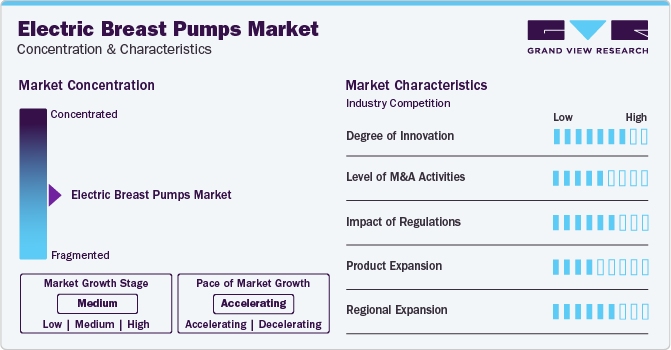
The market growth stage is high, and the pace is accelerating. The market is characterized by a high degree of innovation owing to the advancements in technologies that have been developed to improve the effectiveness and comfort of electric breast pumps. For instance, the Avent Electric Single Breast Pump incorporates natural motion technology, mimicking baby's nursing action to facilitate milk expression from the breast.
 To learn more about this report, Download Free Sample Report
The market is also characterized by a high level of merger and acquisition (M&A) activity by the leading players. Key players in market are acquiring small- and medium-sized manufacturers of electric breast pumps to expand their product portfolios and increase their market share.
The market has been experiencing growing regulatory scrutiny. Government bodies such as the FDA and the European Medicines Agency have set up strict regulations to ensure the safety and effectiveness of medical devices, and electric breast pumps. Governments globally are actively formulating regulations to oversee the development and utilization of electric breast pumps. The implementation of such regulations has the potential to exert a substantial influence on the breastfeeding accessories market.
There are various substitutes for in the market. Some of the commonly used alternatives include manual options, battery-operated models, and wearable variants. These products may provide similar benefits to electric breast pumps.
The market is significantly affected by the concentration of end users. Depending on the preferences of the target consumers, these products may be available in speciality stores, pharmacies, online platforms, or through healthcare providers.
Analyst Perspective
The electric breast pump market is supported by demand generated from childbirth volumes, breastfeeding practices, and female workforce participation. Market expansion is driven by increasing utilization of electric breast pumps, growth in wearable pump adoption, broader product availability through retail and e-commerce channels, and healthcare initiatives supporting breastfeeding. Demand is generated by recurring additions to the population of nursing mothers rather than equipment replacement cycles. Manufacturers with portfolios spanning hospital-grade, personal-use, double electric, single electric, and wearable breast pumps are positioned to address multiple user requirements. Market position is influenced by product availability, distribution coverage, reimbursement access, technology integration, and relationships with healthcare providers and consumers. As adoption expands across regions, competition is expected to center on portfolio coverage, supply chain execution, distribution networks, and user retention.
Type Insights
Based on type, the double electric pumps segment led the market with the largest revenue share of 62.8% in 2025, and single electric pumps are expected to grow at a significant CAGR over the forecast period. Double electric breast pumps have several advantages over single electric breast pumps. These breast pumps extract milk from both breasts at the same time, making them more convenient for regular expression. It produces around 18% more milk than pumping from each breast separately. As a result, it is an excellent option for working mothers. Furthermore, milk derived from twice pumping has a larger fat and calorie content. These pumps can be used in a variety of positions without tiring out mothers. Some of the more modern twin electric breast pumps include a 'memory' function. Nonetheless, these types of pumps are widely available and are offered by most of the major competitors.
The single electric pumps segment is expected to grow at a moderate CAGR over the forecast period. Single electric breast pumps are both quick and efficient. Furthermore, as compared to double electric pumps, these types of pumps are very cost-effective. Milk can, however, be expressed only from a single breast at a time. These pumps are specifically developed for moms who desire to express milk on a limited basis. Aside from price, a single breast pump allows a mother to breastfeed her infant while expressing from the other breast, which is a very efficient use of time.
However, some women find it messy and a waste of precious milk when they express milk from one breast and the other breast leaks milk. As a result, such situations are anticipated to promote the adoption of double electric breast pumps in the short term, consequently limiting the market growth of single breast pumps.
Application Insights
Based on applications, the hospital grade segment led the market with the largest revenue share of 61.5% in 2025. Hospital-grade electric breast pumps feature powerful motors and are commonly used in hospitals, although they can also be rented on a monthly basis for personal use. These electric breast pumps operate on a "closed system," which means that barriers are in place to prevent milk and other fluids from entering the motor. This reduces contamination and guarantees that they are safe for several users.
These electric breast pumps have various advantages, including being more powerful and effective than typical personal-use pumps. They are useful for mothers who have medical conditions that need the use of a high-powered pump or whose newborns have trouble latching and nursing. As a result of the aforementioned benefits provided by hospital-grade pumps, the segment is likely to develop significantly throughout the forecast period.
Distribution Channel Insights
Based on distribution channel, the hospital pharmacy segment led the market with the largest revenue share of 38.8% in 2025. The segment is predicted to grow as a result of increased pregnancy rates worldwide and an increase in new moms' desire for postpartum items. Furthermore, due to safety concerns, customers trust hospital pharmacies while purchasing baby and mother products. As a result, parents have a high level of trust in doctors and specialists, which encourages the growth of the hospital pharmacy business. The high growth of this industry has also been ascribed to the rise of hospitals in both developed and developing countries.
 To learn more about this report, Download Free Sample Report
The e-commerce segment is anticipated to grow at the fastest CAGR during the forecast period. The increased availability of electric breast pumps through e-commerce is projected to contribute to market expansion. End-users can compare and select appropriate products based on their type, brand, price, and point of sale through the e-commerce channel. Amazon, Belly Bandit Walmart, Motherhood Maternity, and The Moms Co. are just a few of the top online retailers that offer products to customers.
In addition, major companies such as Koninklijke Philips N.V., Medela LLC, Newell Brands, and Ameda have started offering a broad range of postpartum products through online channels. More consumers are drawn in by sales methods such as buy one, get one free, discounts, and complimentary products. This is anticipated to promote sales of electric breast pumps through this channel, as they are usually in high demand among consumers.
Regional Insights
North America dominated the electric breast pumps market with the largest revenue share of 52.3% in 2025, owing to the existence of high women employment rates, healthcare expenditure, advanced healthcare infrastructure, and patient awareness levels in this area. Furthermore, industry leaders are creating technologically advanced electric breast pumps, which will boost overall market growth throughout the forecast period.
 To learn more about this report, Download Free Sample Report
U.S. Electric Breast Pumps Market Trends
The electric breast pumps market in the U.S. held the largest share in the North America region in 2025. Some of the main reasons driving the market are the rising percentage of women in the workforce and the existence of significant market players in the nation. The market for electric breast pumps is anticipated to be driven by these factors. These factors are expected to drive the market growth.
Europe Electric Breast Pumps Market Trends
The electric breast pumps market in Europe is driven by factors such as the growing birth rate coupled with rising women’s employment in the region and presence of well-established healthcare infrastructure. For instance, as per a European Commission in 2022 around 3.88 million babies were born in Europe.
The UK electric breast pumps market is driven by the advancements in technology, increasing awareness about the benefits of breastfeeding, and the growing number of working mothers who require convenient and efficient pumping solutions. These factors are driving the market growth over the forecast period.
The electric breast pumps market in France is anticipated to witness at a significant CAGR over the forecast period, owing to several key factors, such as presence of several key players in the market, increasing awareness of the importance of breastfeeding and the rising number of working mothers contribute to the demand for electric breast pumps.
The Germany electric breast pumps market is driven by the factors, such as many companies are forming strategic partnerships, launching new products, and engaging in mergers and agreements. Such factors are expected to boost the market growth in Germany and intensify the competition over the forecast period.
Asia Pacific Electric Breast Pumps Market Trends
The electric breast pumps market in Asia Pacific is anticipated to witness at a significant CAGR over the forecast period. This is due to the changing lifestyles and increasing urbanization have led to a rise in the number of working mothers who require convenient and efficient breast pumping solutions are expected to present significant regional growth opportunities in the market.
The China electric breast pumps market accounted for the largest share of the Asia Pacific region in 2025. The primary drivers of market growth are the government's breastfeeding promotion programs and the increasing knowledge of the benefits of breastfeeding among Chinese moms. These factors are anticipated to drive demand for electric breast pumps in China in the next years.
The electric breast pumps market in Japan is moderately competitive, with the presence of some major companies offering wound care products. Major players in the market are adopting several strategies such as mergers & acquisitions and partnerships & collaborations to stay competitive in the market.
Latin America Electric Breast Pumps Market Trends
The electric breast pumps market in Latin America is driven due to the rising female workforce participation rates and the need for mothers to balance work and breastfeeding contribute to the adoption of electric breast pumps as convenient solutions for expressing milk, which is expected to drive market growth over the forecast period.
Middle East & Africa Electric Breast Pumps Market Trends
The electric breast pumps market in the Middle East & Africa region is expected to witness at a significant CAGR over the forecast period, due to various factors, such as the collaborations between manufacturers and healthcare professionals, as well as the expansion of distribution channels and online retail platforms, play significant roles in driving market growth in the Middle East and Africa.
Key Electric Breast Pumps Company Insights
Top players are adapting the shift towards user comfort through technological advancements, and innovative products. These innovative products are driving the market growth positively over the forecast period.
Key Electric Breast Pumps Companies:
The following key companies have been profiled for this study on the electric breast pumps market.
-
Medela AG
-
Koninklijke Philips N.V.
-
Ameda AG
-
Hygeia Health
-
Lansinoh Laboratories, Inc.
-
Spectra Baby USA
-
Pigeon Corporation
-
Evenflo
-
Willow
-
Ardo
-
Motif Medical
-
Elvie
Competitive Benchmarking
Category
Operating Strategies
Competitive Edge
Weakness
Established Players (Medela AG, Koninklijke Philips N.V., Lansinoh Laboratories, Inc., Pigeon Corporation, Elvie)
- Strengthen electric breast pump portfolios through continuous innovation in single and double electric pumps, wearable integration, smart app connectivity, customizable suction settings, quieter motors, and enhanced comfort features.
- Expand global market presence through partnerships with hospitals, maternity clinics, healthcare providers, pharmacies, distributors, and e-commerce platforms while strengthening omnichannel sales networks.
- Strong brand recognition, extensive global distribution networks, and established relationships with healthcare professionals and maternal care institutions.
- Significant R&D capabilities, broad maternal and infant care product portfolios, strong regulatory expertise, and financial resources that support product innovation and large-scale commercialization.
- Intense competition among leading manufacturers creates pricing pressure and challenges in maintaining product differentiation.
- High costs associated with product development, regulatory compliance, clinical validation, marketing, and continuous technological innovation.
Emerging Players (Ameda AG, Hygeia Health, Spectra Baby USA, Willow, Ardo, Motif Medical)
- Focus on developing efficient, portable, and user-friendly electric breast pumps with improved suction technology, portability, rechargeable batteries, and breastfeeding support features.
- Strengthening collaborations with maternity hospitals, lactation consultants, insurance providers, parenting communities, and online retail platforms to increase market penetration and brand visibility.
- Strong focus on specific customer needs, breastfeeding support solutions, and product innovation tailored to working mothers and frequent pump users.
- Greater agility in product development enables faster adoption of new technologies and quicker response to changing consumer preferences.
- Limited global reach and smaller distribution networks compared with multinational market leaders.
- Greater dependence on regional markets and online sales channels, creating challenges in scaling operations, expanding brand awareness, and competing with well-established global brands.
Recent Developments
-
In November 2023, Pigeon launched its latest iteration, the GoMini Plus Electric Breast Pump, marking the second generation of its GoMini line. Designed with today's active mothers in mind, this pioneering advancement assures a pumping journey unlike any other, perfectly suited for the modern lifestyle
-
In March 2022, TensCare introduced the new TensCare Nouri Breast Pump line, which comprises an electric breast pump. This breast pump has novel features that make breast pumping quick and easy
-
In January 2022, Medela introduced the "Solo" electric breast pump in Canada for breastfeeding mothers and working women at an affordable price
-
In March 2021, Philips introduced the "Philips Avent Double Electric Breast Pump," which has 16 expression levels and 8 simulation levels to improve user comfort while pumping
Electric Breast Pumps Market Report Scope
Report Attribute
Details
Market size in 2025
USD 1.0 billion
Estimated market size in 2026
USD 1.1 billion
Projected market size by 2033
USD 1.8 billion
Growth rate
CAGR of 7.3% from 2026 to 2033
Base year for estimation
2025
Historical data
2021 - 2024
Forecast period
2026 - 2033
Quantitative units
Revenue in USD million/billion and CAGR from 2026 to 2033
Report coverage
Revenue forecast, company ranking, competitive landscape, growth factors, and trends
Segments covered
Type, application, distribution channel, region
Regional scope
North America; Europe; Asia Pacific; Latin America; MEA
Country scope
U.S.; Canada; Mexico; Germany; UK; France; Italy; Spain; Denmark, Sweden, Norway, China; Japan; India; Australia; Thailand; South Korea, Brazil; Argentina; South Africa; Saudi Arabia; UAE; Kuwait
Key companies profiled
Medela AG; Koninklijke Philips N.V.; Ameda AG; Hygeia Health; Lansinoh Laboratories, Inc.; Spectra Baby USA; Pigeon Corporation; Evenflo; Willow; Ardo; Motif Medical; Elvie
Customization scope
Free report customization (equivalent up to 8 analysts' working days) with purchase. Addition or alteration to country, regional & segment scope.
Pricing and purchase options
Avail customized purchase options to meet your exact research needs. Explore purchase options
Global Electric Breast Pumps Market Report Segmentation
This report forecasts revenue growth at regional and country levels and provides an analysis of the latest industry trends in each of the sub-segments from 2021 to 2033. For this study, Grand View Research has segmented the global electric breast pumps market report based on type, application, distribution channel, and region:
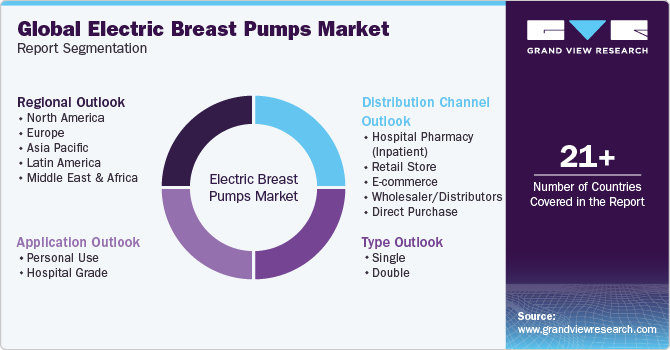 To learn more about this report, Download Free Sample Report
-
Type Outlook (Revenue, USD Million, 2021 - 2033)
-
Single
-
Double
-
-
Application Outlook (Revenue, USD Million, 2021 - 2033)
-
Personal Use
-
Hospital Grade
-
-
Distribution Channel Outlook (Revenue, USD Million, 2021 - 2033)
-
Hospital Pharmacy (Inpatient)
-
Retail Store
-
E-commerce
-
Wholesaler/Distributors
-
Direct Purchase
-
-
Regional Outlook (Revenue, USD Million, 2021 - 2033)
-
North America
-
U.S.
-
Canada
-
-
Europe
-
UK
-
Germany
-
Italy
-
France
-
-
Asia Pacific
-
China
-
India
-
Japan
-
South Korea
-
Australia
-
-
Latin America
-
Brazil
-
Mexico
-
-
Middle East & Africa
-
UAE
-
Saudi Arabia
-
South Africa
-
-
Research Methodology
The electric breast pumps market figures in this report are based on a proven research process that combines executive interviews with secondary research from proprietary databases, company filings, and recognized regulatory and institutional sources. Market size is built through value-chain sizing - reconciling supply-side and demand-side estimates - and triangulated with bottom-up and top-down approaches. Every estimate passes multiple levels of expert validation before publication, with each electric breast pumps segment quantified using the revenue-capture definitions in the table below.
Segment Definition
Segment - Type
Revenue capture definition
Single
Revenue generated from the sale of electric breast pumps designed to express milk from one breast at a time. This segment includes portable, rechargeable, and corded single-pump devices used by mothers seeking a cost-effective and convenient milk expression solution.
Double
Revenue generated from the sale of electric breast pumps designed to express milk from both breasts simultaneously. This segment includes hospital-grade and personal-use double pumps that offer greater efficiency, reduced pumping time, and higher milk output, making them particularly popular among working mothers and frequent pump users.
Estimation Model
Bottom-Up Estimation
Top-Down Approach
Supply-Side Analysis
Revenue is calculated by aggregating electric breast pump sales across countries and regions. Unit volumes are assessed for hospital-grade, personal-use, double electric, single electric, and wearable pumps. Birth rates, breastfeeding rates, adoption levels, replacement cycles, and average selling prices (ASPs) are analyzed to estimate overall market value.
The maternal and infant care market is evaluated first, followed by estimating the share attributable to electric breast pumps. Factors such as annual births, breastfeeding practices, female workforce participation, healthcare spending, insurance coverage, and consumer expenditure patterns are analyzed to determine market contribution and overall revenue.
Market size is assessed through manufacturer revenues, production volumes, shipment data, distribution networks, and import-export statistics. Analysis includes leading manufacturers, regional suppliers, and private-label brands. Company reports, industry databases, distributor insights, and average selling prices (ASPs) are evaluated to estimate market size and competitive positioning.
Delivered Customizations
This report has been delivered with the following In-depth customizations
Client Request
Customization Delivered
Value Adds
Electric Breast Pump Product Category Analysis
Conducted a detailed assessment of key electric breast pump product categories, including single electric pumps, double electric pumps, wearable pumps, hospital-grade pumps, and battery-operated systems. Evaluated market size, adoption trends, pricing dynamics, distribution channels, and category-specific growth drivers across developed and emerging markets.
Helps stakeholders identify high-growth product segments, understand category-level demand patterns, evaluate technology adoption trends, and prioritize investment opportunities across the electric breast pump market.
Frequently Asked Questions About This Report
The global electric breast pumps market size was valued at USD 1.0 billion in 2025 and is estimated at USD 1.1 billion for 2026.
Key factors include the increasing participation of women in the workforce, rising awareness about the benefits of breastfeeding, growing preference for hands-free and discreet pumping solutions, and continuous technological advancements in electric breast pump design, including quieter motors, improved suction efficiency, and smart connectivity features.
North America dominated with a 52.3% revenue share in 2025.
Asia Pacific is the fastest-growing region over the forecast period.
The global electric breast pumps market is expected to grow at a CAGR of 7.3% from 2026 to 2033, reaching USD 1.8 billion.
The double electric pumps segment led with a 62.8% revenue share in 2025, while the single electric pumps segment is growing moderately over the forecast period.
The hospital grade segment held the largest share of 61.5% in 2025 and is the fastest-growing segment over the forecast period.
The hospital pharmacy held the largest share of 38.8% in 2025, while e-commerce is the fastest-growing segment over the forecast period.
Key players include Medela AG; Koninklijke Philips N.V.; Ameda AG; Hygeia Health; Lansinoh Laboratories, Inc.; Spectra Baby USA; Pigeon Corporation; Evenflo; Willow; Ardo; Motif Medical; and Elvie.
About the Author(s)
Medical Devices Research Team
Healthcare · Medical DevicesThis report was authored by the medical devices research team at Grand View Research - comprising two research analysts, one senior research analyst, and one industry expert - with specialized expertise in the medical devices segment of the healthcare industry. All findings are based on proprietary healthcare databases, executive interviews, and regulatory analysis, subject to internal peer review prior to publication.
Last Updated:
Speak to Analyst

Customize this report to your needs - add regions, segments, or data points, with 20% free customization.
Or view our licence options:


ISO 9001:2015 & 27001:2022 Certified
We are GDPR and CCPA compliant! Your transaction & personal information is safe and secure. For more details, please read our privacy policy.


