
- Home
- »
- Clothing, Footwear & Accessories
- »
-
Electric Guitars Market Size & Share Report, 2026-2033GVR Report cover

Electric Guitars Market (2026 - 2033)
Size, Share & Trends Analysis Report By Product (Solid-Body, Semi-Hollow Body, Hollow Body), By Distribution Channel (Offline, Online), By Region, And Segment Forecasts
Market Size, 2025
$2.5BMarket Estimate, 2026
$2.6BMarket Forecast, 2033
$3.8BCAGR, 2026–2033
5.4%Electric Guitars Market Summary
The global electric guitars market size was valued at USD 2.5 billion in 2025 and is projected to grow from USD 2.6 billion in 2026 to USD 3.8 billion by 2033, at a CAGR of 5.4% from 2026 to 2033. North America dominated the market, accounting for a revenue share of 34.4% in 2025.Market growth is driven by the rising popularity of music creation, increasing participation in live performances, and growing interest in learning musical instruments across all age groups. The expanding influence of streaming platforms, social media, and online music education has encouraged consumers to invest in electric guitars, amplifiers, accessories, and related equipment, supporting sustained market demand.
 Source: Grand View Research, IR Documents, Primary Interviews, Paid DatabasesTo learn more about this report,
 Download Free Sample Report
 Key Market Trends & Insights
- By product: The solid body accounted for a market share of 71.0% in 2025.
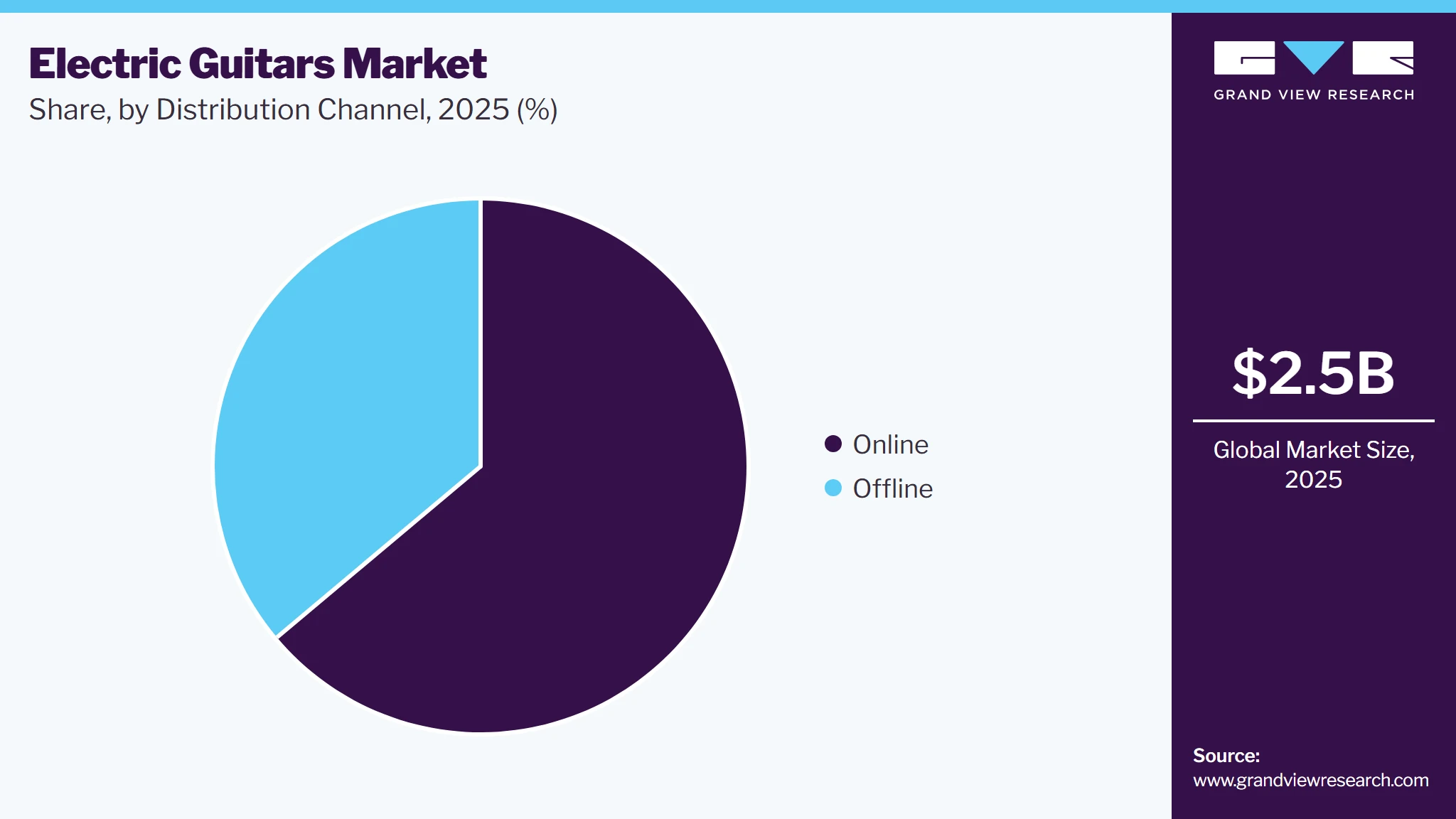
- By distribution channel: Sales through online accounted for a market share of 63.8% in 2025.
Regional Highlights
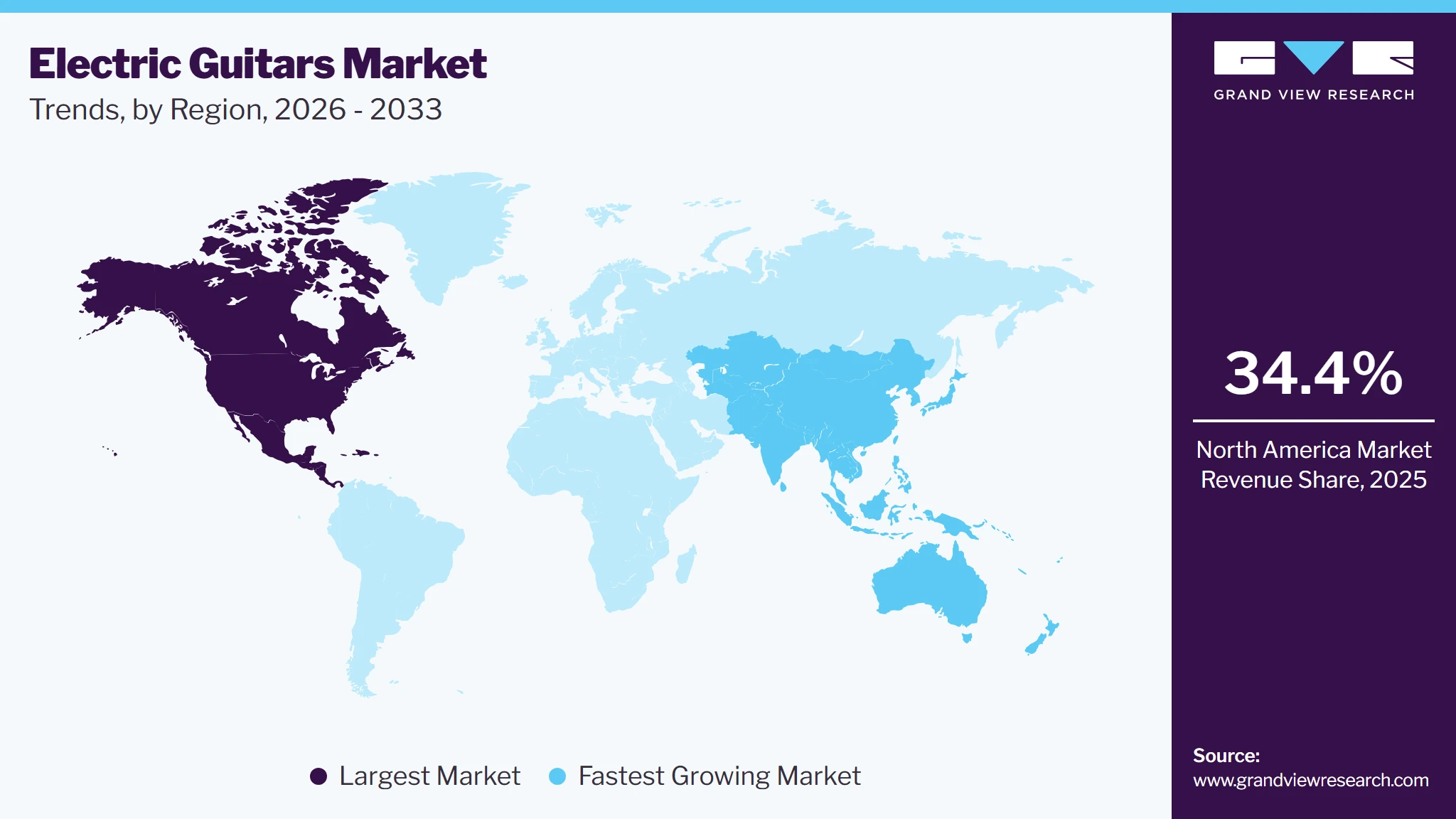
- Largest regional market: North America (34.4% revenue share, 2025)
- Fastest-growing regional market: Asia Pacific (highest CAGR, 2026-2033)
- By country: The U.S. held the largest market share in 2025.
Market Size & Forecast
- Market Size in 2025: USD 2.5 Billion
- Estimated Market Size in 2026: USD 2.6 Billion
- Projected Market Size by 2033: USD 3.8 Billion
- CAGR (2026-2033): 5.4%
Three ways to get this report
Buy it, customize it, or ask a question.Ask an Analyst
Analyst response in 1 business day
- AccessReport author, directly
- Reply timeWithin 1 working day
- No sales callDirect answer only
- FormatEmail reply
- CostFree, no cost
Get the Full Report
What the study covers
- FormatsPDF · Excel · Dashboard
- Timeline2026–2033 annual, 2025 base
- Coverage20+ countries, 5 regions
- Companies10+ key players profiled
Customize the Report
20% free customization
- IncludeCountries, segments, points
- TailorTo your product definition
- ExtendDeeper competitor detail
- OrA fully bespoke study
- Turnaround5–10 working days
The market is also witnessing a strong shift toward technologically advanced and performance-oriented electric guitars. Demand is increasing for models featuring advanced pickups, digital connectivity, lightweight materials, ergonomic designs, and integrated sound customization technologies. Manufacturers are introducing innovative products with enhanced tonal versatility, improved playability, and smart electronic features to meet the evolving needs of both professional musicians and beginners. This reflects the industry's broader transition toward technology-driven instrument innovation, where superior sound quality, customization, and modern design increasingly influence consumer-purchasing decisions.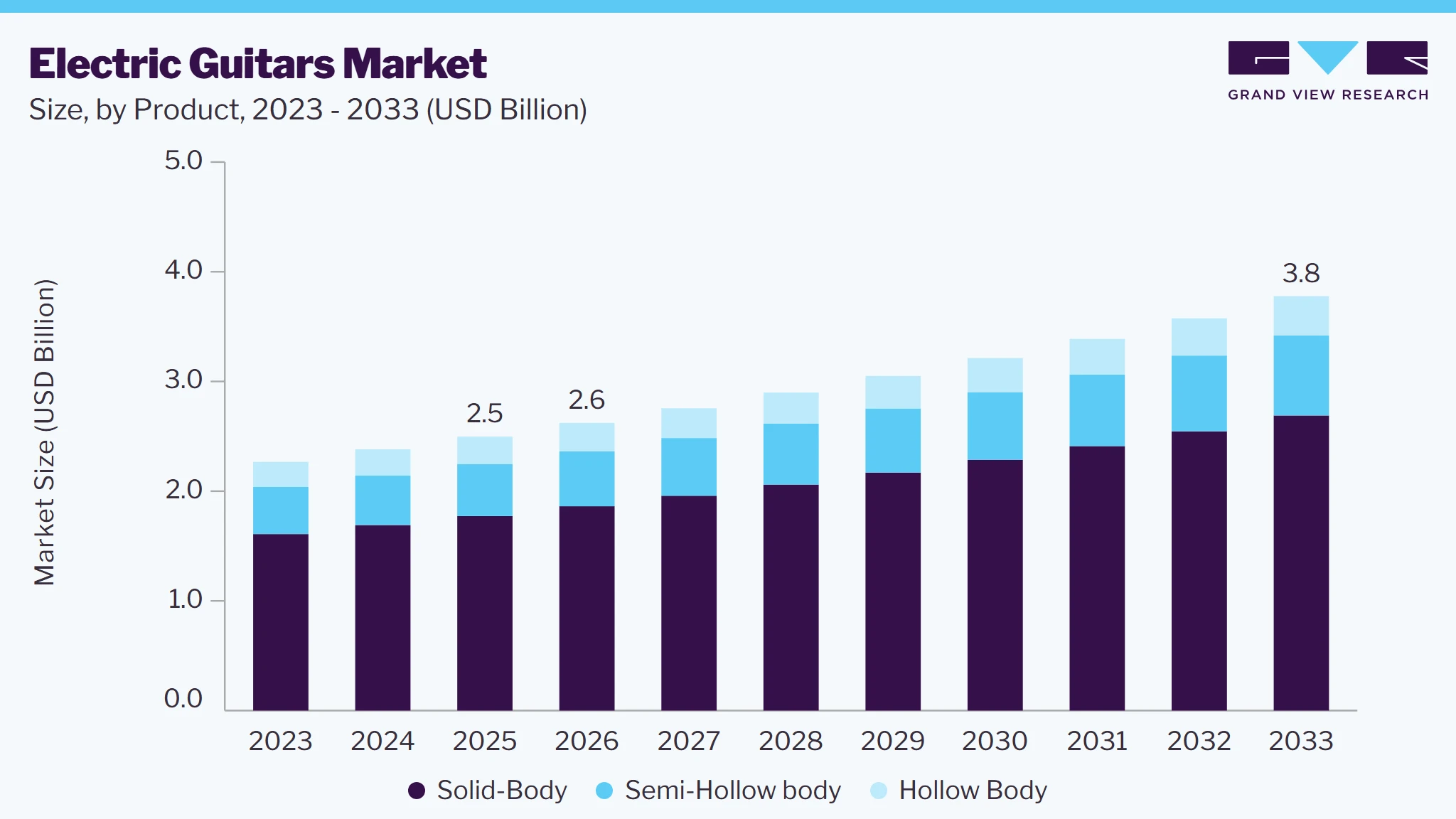 To learn more about this report, Download Free Sample Report
 Growing consumer interest in music creation, live performances, home recording, and recreational music learning is significantly driving demand in the global electric guitars industry. Consumers increasingly view electric guitars as instruments for creative expression, entertainment, and professional development, leading to higher participation among beginners, hobbyists, and professional musicians. This trend is influencing purchasing behavior across multiple product categories, including solid-body, semi-hollow, and hollow-body electric guitars, amplifiers, effects pedals, strings, and accessories. Consumers are also showing a strong preference for products that offer superior sound quality, ergonomic designs, durability, and enhanced playability for both stage performances and home practice. In addition, the growing popularity of online music education and regular practice routines is increasing demand for beginner-friendly electric guitars, practice amplifiers, and digital learning accessories, supporting recurring purchases and product upgrades.
The global electric guitars market is also witnessing a strong shift toward technologically advanced, lightweight, and high-performance instruments as consumers increasingly prioritize tonal versatility, customization, and enhanced playing experiences. Guitarists are showing growing preference for products featuring noiseless and active pickups, multi-scale necks, lightweight tonewoods, ergonomic body designs, digital modeling technology, MIDI compatibility, and wireless connectivity. Demand for customizable guitars with advanced electronics and integrated software is increasing as musicians seek greater sound flexibility for studio recording and live performances. At the same time, manufacturers are focusing on innovative designs, improved comfort, and premium craftsmanship to align with evolving consumer expectations for performance, reliability, and technology integration.
Furthermore, changing consumer demographics and evolving music consumption trends are expanding the customer base within the global electric guitars industry. Younger consumers, independent artists, content creators, and female musicians are increasingly adopting electric guitars through online tutorials, music schools, home studios, and social media platforms. This trend is driving demand for beginner-friendly models, compact electric guitars, signature artist editions, and aesthetically distinctive designs. Consumers are also increasingly influenced by artist endorsements, live concerts, music streaming platforms, and social media content, encouraging manufacturers to focus on innovative product styling, inclusive marketing strategies, and personalized product offerings.
In addition, the rapid expansion of e-commerce platforms, direct-to-consumer sales channels, and digital retail ecosystems is significantly reshaping consumer-purchasing behavior in the global electric guitars industry. Consumers increasingly prefer online platforms for product comparisons, virtual demonstrations, expert reviews, customization options, and access to a broader portfolio of electric guitars and accessories at competitive prices. Digital engagement through artist collaborations, influencer marketing, live product launches, and social media campaigns is accelerating product discovery and influencing purchasing decisions. As a result, manufacturers are strengthening their digital presence, investing in personalized online shopping experiences, and expanding direct-to-consumer offerings to improve customer engagement and global market reach.
Market Dynamics
The increasing popularity of music creation, home recording, and live performances is a major driver of the global market. Consumers are increasingly adopting electric guitars for recreational learning, professional music production, live concerts, and content creation, leading to rising demand for electric guitars, amplifiers, effects pedals, audio interfaces, and related accessories. The expansion of online music education platforms, home studios, independent music production, and live entertainment events is further strengthening consumer engagement, particularly among younger audiences, aspiring musicians, and hobbyists.
In addition, advancements in guitars technology, including digital modeling, smart amplifiers, wireless connectivity, and customizable electronics, are enhancing the playing experience and improving accessibility for musicians of all skill levels. Consumers are increasingly investing in high-performance instruments that offer superior sound quality, tonal versatility, and personalized configurations for both studio recording and live performances. Social media platforms, artist endorsements, online tutorials, and digital music communities are also encouraging consumers to learn, perform, and upgrade their equipment. This growing culture of music creation, performance, and continuous skill development is supporting recurring purchases of electric guitars and accessories, thereby contributing significantly to the growth of the global electric guitars market.
The high cost associated with premium electric guitars and professional music equipment remains a key factor restraining the growth of the market. Consumers often face significant expenses related to electric guitars, amplifiers, effects pedals, recording equipment, accessories, maintenance, and replacement components, which can discourage purchases among price-sensitive buyers and beginners. Premium instruments featuring high-quality tonewoods, advanced pickups, signature artist specifications, and custom craftsmanship further increase ownership costs, making them less affordable for many consumers.
In addition, many first-time buyers have limited knowledge regarding guitars specifications, body styles, pickup configurations, and equipment compatibility, creating uncertainty during the purchasing process. The combination of high initial investment, ongoing maintenance costs, premium product pricing, and affordability constraints in developing markets continues to limit wider consumer adoption and poses a significant challenge to the expansion of the global electric guitars market.
Analyst Perspective
The global electric guitars market is evolving through continuous product innovation, digital integration, and expanding participation in music creation across both professional and recreational segments. Consumer demand is increasingly driven by technologically advanced instruments featuring versatile pickup configurations, lightweight materials, ergonomic designs, and digital connectivity, enabling enhanced performance and personalized playing experiences. Growing interest in home recording, online music education, and independent content creation is further supporting demand among beginners and experienced musicians alike. Meanwhile, manufacturers are strengthening their direct-to-consumer and online retail strategies by offering product customization, virtual demonstrations, and artist collaborations. As younger consumers increasingly embrace music as a creative outlet and lifestyle choice, the market is expected to benefit from sustained demand for premium, beginner-friendly, and performance-oriented electric guitars.
Brand Market Share Insights
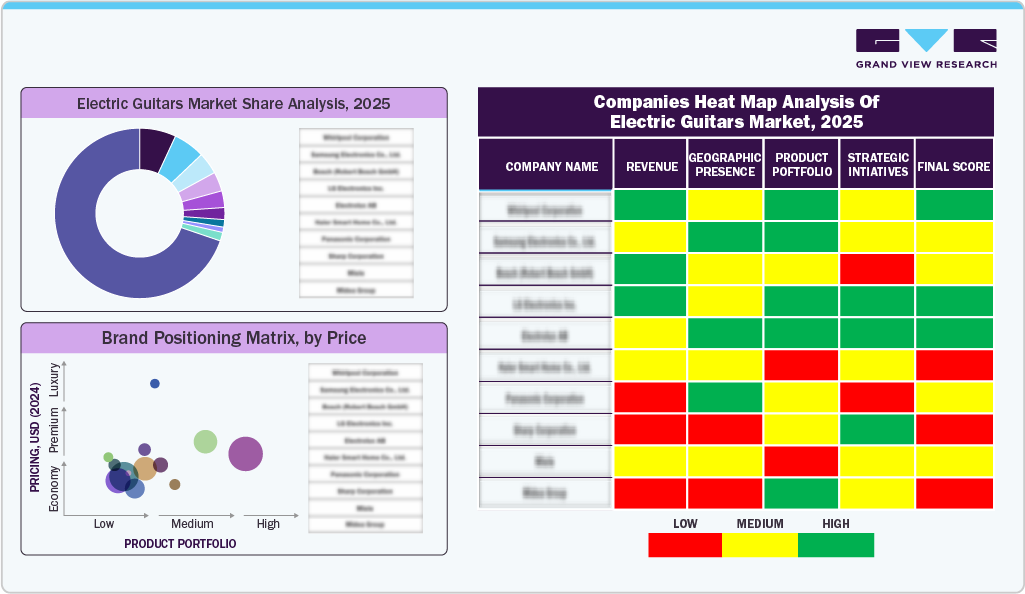
The global electric guitars market is highly competitive, driven by continuous innovation in instrument design, sound technology, and player-focused features. Major companies such as Gibson Brands, Inc., Fender Musical Instruments Corporation, Yamaha Corporation, Ibanez Guitars, and The ESP Guitar Company compete through the introduction of premium electric guitars, signature artist models, advanced pickup systems, and performance-oriented instruments. Competition is increasingly centered on superior tonal versatility, ergonomic body designs, lightweight construction, and integrated electronics that enhance playability for both professional musicians and beginners.
 To learn more about this report, Download Free Sample Report
 The market is also witnessing growing demand for beginner-friendly, mid-range, and premium electric guitars designed for diverse playing styles and musical genres. Companies including Epiphone, Cort Guitars, Michael Kelly Guitar Co., DEAN GUITARS, and Karl Höfner GmbH & Co. KG are strengthening their market presence by expanding product portfolios with affordable entry-level models, vintage-inspired designs, and high-performance instruments featuring modern electronics and premium craftsmanship. In addition, manufacturers are leveraging artist endorsements, limited-edition collections, direct-to-consumer sales channels, and digital marketing initiatives to expand brand visibility and capture a broader global customer base.
Consumer Insights
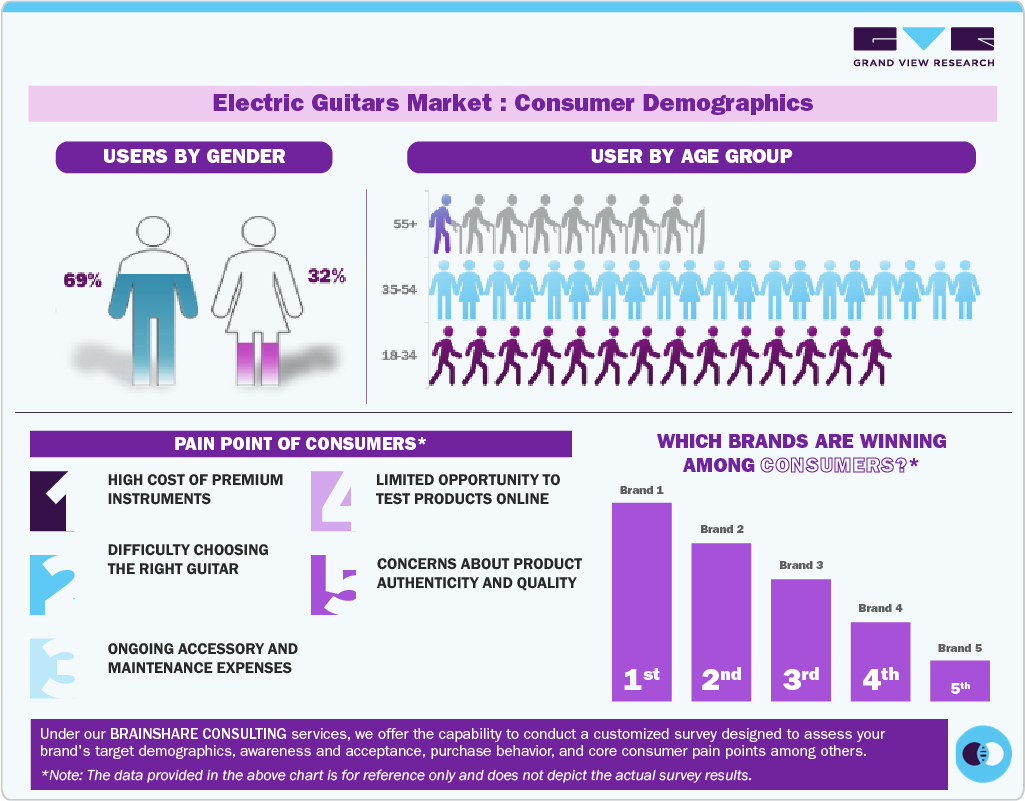
Consumer behavior in the global electric guitars industry is increasingly centered on performance-driven purchasing decisions, with buyers prioritizing instruments that deliver superior sound quality, tonal versatility, playability, and long-term reliability rather than simply aesthetic appeal. Consumers are actively seeking electric guitars equipped with advanced pickup systems, ergonomic body designs, lightweight construction, and versatile electronics that cater to different playing styles and musical genres. This trend is reinforcing electric guitars as performance-oriented instruments where craftsmanship, component quality, and technological innovation directly influence purchasing decisions.
 To learn more about this report, Download Free Sample Report
 At the same time, purchasing behavior in the global market is strongly influenced by accessory bundling and frequent equipment upgrades. Consumers are increasingly investing in complementary products such as amplifiers, effects pedals, strings, gig bags, audio interfaces, and wireless systems to enhance their playing and recording experiences. The growing popularity of home studios, online music education, live performances, and digital content creation is encouraging musicians to upgrade instruments and accessories as their skills progress. This behavior supports higher average spending per customer, recurring purchases of consumables and accessories, and increased demand across beginner, intermediate, and professional product categories, contributing to sustained growth in the global market.
Product Insights
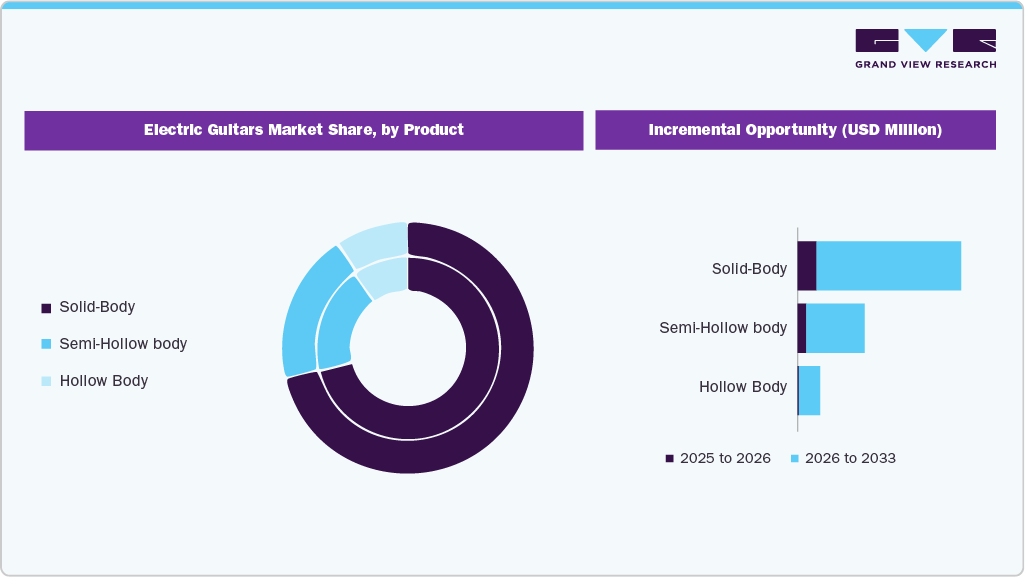
Solid-body electric guitars accounted for the largest market share of 71.0% in 2025, supported by their versatility, durability, and widespread adoption across musical genres such as rock, pop, blues, metal, and country. Strong demand is driven by both professional musicians and beginners who prefer solid-body models for their sustain, reduced feedback, and compatibility with a wide range of amplifiers and effects pedals. Continuous product innovation, including advanced pickup systems, lightweight body materials, ergonomic designs, and signature artist editions, is further strengthening the segment. The availability of models across entry-level, mid-range, and premium price points also supports broad consumer adoption.
 To learn more about this report, Download Free Sample Report
 Semi-hollow electric guitars are anticipated to grow at a CAGR of 5.6% from 2026 to 2033, driven by increasing demand for versatile instruments that offer a balance between the sustain of solid-body guitars and the warm, resonant tones of hollow-body models. Consumers are increasingly adopting semi-hollow guitars for genres such as blues, jazz, rock, indie, and fusion, owing to their tonal flexibility and suitability for both studio recording and live performances. At the same time, growing interest in vintage-inspired designs, premium craftsmanship, and signature artist models is supporting segment growth. Manufacturers are also introducing semi-hollow guitars with advanced pickups, lightweight construction, and enhanced electronics to improve playability and sound versatility, further driving consumer adoption across both professional and enthusiast musician segments.
Distribution Channel Insights
The sales of electric guitars through online channel accounted for 63.8% in 2025, driven by expanding e-commerce infrastructure, broader product selection, competitive pricing, and the increasing comfort of consumers making considered, high-value purchases without in-person trial. This channel encompasses two distinct sub-segments: e-commerce websites operated by third-party retailers and marketplaces, and brand-owned websites through which manufacturers sell directly to consumers. With online penetration accelerating across the broader musical instruments category, buyers are increasingly researching, comparing, and purchasing guitars digitally rather than exclusively through physical retail visits.
 To learn more about this report, Download Free Sample Report
 Demand growth in the online channel is supported by several structural factors: the availability of detailed product content, including high-resolution imagery, video demonstrations, and sound samples that help bridge the sensory gap of a traditionally hands-on purchase category, free shipping, and flexible return policies that reduce purchase risk. The convenience, broader selection, competitive pricing, and improved online shopping experiences have continued to drive e-commerce growth in the guitars category in the years following.
The sales of electric guitars through offline channels is expected to grow at a CAGR of 5.9% from 2026 to 2033.The offline distribution channel encompasses the full range of physical, in-person retail formats through which electric guitars reach end consumers, including dedicated specialty music retailers, brand-owned flagship stores, general department and mass-market retailers, and other physical retail formats. Despite the accelerating growth of online and e-commerce channels, the offline channel continues to play a critical role in the market due to the inherently experiential nature of the purchase: guitars are a high-consideration, tactile product where consumers often prefer to physically handle, play, and compare instruments before committing to purchase, particularly for higher-value or premium-tier models.
The offline channel is segmented into four sub-categories, each serving a distinct consumer need and price tier. Specialty music stores offer the deepest product selection and most knowledgeable service, catering to serious hobbyists and professional musicians. Brand-owned stores function as immersive, experience-led retail concepts designed to deepen brand engagement rather than serve as primary high-volume sales points. Department and mass-market stores extend guitars availability to a broader, more casual, often entry-level consumer base through high-footfall general retail environments. The other category captures additional physical retail formats, including independent local music shops, pawn and vintage shops, and pop-up or event-based retail.
Regional Insights
North America Electric Guitars Market Trends
The North American electric guitars industry accounted for the largest share of 34.4% in 2025. The North American market is driven by a strong music culture, high participation in live performances, and increasing consumer interest in home recording, music education, and content creation across the U.S. and Canada. Consumers in the region are increasingly prioritizing high-performance electric guitars that offer superior sound quality, tonal versatility, and enhanced playability. Demand is particularly strong for premium solid-body and semi-hollow guitars, signature artist models, advanced pickup systems, digital amplifiers, and performance accessories designed for both professional musicians and recreational players.
 To learn more about this report, Download Free Sample Report
 The market is also witnessing growing consumer preference for customizable electric guitars, lightweight ergonomic designs, and technologically advanced instruments featuring active pickups, wireless connectivity, and digital modeling capabilities. In addition, younger musicians, independent artists, and social media content creators are influencing purchasing trends, driving demand for beginner-friendly models, affordable mid-range guitars, and aesthetically distinctive designs. The market further benefits from the strong presence of leading manufacturers such as Fender, Gibson, and PRS, a well-established network of specialty music retailers, widespread music education programs, and rapidly expanding e-commerce platforms that enable consumers to compare, customize, and purchase electric guitars and accessories across both premium and entry-level segments.
U.S. Electric Guitars Market Trends
The electric guitars industry in the U.S. accounted for a revenue share of around 84.7% of the North America market in 2025. The U.S. market is supported by the country's well-established music industry, large community of professional and amateur musicians, and growing participation in music education, home recording, and live performances. Consumers in the U.S. increasingly prioritize sound quality, tonal versatility, and playing comfort, driving strong demand for premium electric guitars, signature artist models, high-performance pickups, digital amplifiers, and professional accessories. The market also benefits from rising consumer interest in customized instruments, including personalized finishes, pickup configurations, neck profiles, and hardware upgrades tailored to individual playing styles.
In addition, evolving consumer preferences toward independent music production, online content creation, and digital music learning are driving demand for beginner-friendly electric guitars, compact practice amplifiers, multi-effects processors, and home studio equipment. Consumers are also showing increasing preference for technologically advanced guitars featuring active electronics, wireless connectivity, and digital modeling capabilities that enhance both recording and live performance experiences. Artist endorsements, music festivals, streaming platforms, and social media content continue to influence purchasing decisions, particularly among younger musicians and first-time buyers. Furthermore, the strong presence of leading manufacturers, specialty music retailers, and expanding e-commerce platforms is improving product accessibility and accelerating the adoption of newly launched electric guitars and related accessories across the U.S. market.
The Canada electric guitars industry is expected to grow at a CAGR of 5.6% from 2026 to 2033. The Canada market is driven by increasing participation in music education, growing interest in home recording, and rising consumer engagement in live performances and independent music production. Canadian consumers are increasingly favoring high-quality, durable, and performance-oriented electric guitars that deliver excellent sound quality and versatility across a wide range of musical genres. Demand is particularly strong for solid-body and semi-hollow electric guitars, digital amplifiers, effects pedals, and premium accessories that enhance both studio recording and live performance experiences.
Consumers in Canada are also showing growing interest in beginner-friendly electric guitars, compact practice amplifiers, and online music learning solutions, reflecting the increasing adoption of home-based music creation and digital education platforms. In addition, there is rising preference for customizable guitars, signature artist models, and lightweight ergonomic designs that improve playing comfort and performance. Sustainability is also becoming an emerging purchasing factor, with consumers gradually favoring instruments manufactured using responsibly sourced tonewoods, environmentally conscious production processes, and recyclable packaging materials.
Europe Electric Guitars Market Trends
The Europe electric guitars industry accounted for a revenue share of 29.1% of the global market in 2025. The Europe electric guitars market is driven by a strong musical heritage, growing participation in live music events, and increasing consumer interest in home recording and music education across countries such as the UK, Germany, France, Italy, and Spain. Consumers in the region increasingly prefer premium and performance-oriented electric guitars that offer superior sound quality, tonal versatility, and craftsmanship. Demand remains strong for solid-body and semi-hollow electric guitars, signature artist models, high-performance pickups, digital amplifiers, and professional accessories designed for both studio recording and live performances.
The market is also witnessing rising preference for sustainably manufactured and high-quality instruments, with consumers increasingly favoring guitars made from responsibly sourced tonewoods, environmentally conscious production processes, and durable components that extend product life. In addition, the growing popularity of independent musicians, music festivals, home studios, and digital music learning platforms is supporting demand for beginner-friendly guitars, compact amplifiers, and recording equipment. The presence of established musical instrument manufacturers, specialty music retailers, and expanding e-commerce penetration is further improving product accessibility and supporting growth across both premium and mid-range electric guitars segments.
The electric guitars industry in France accounted for a revenue share of around 13.5% of the Europe market in 2025. The France market is driven by growing consumer interest in music creation, live performances, and premium musical instruments. French consumers increasingly prefer electric guitars that combine exceptional sound quality, craftsmanship, and aesthetic appeal, reflecting a strong inclination toward high-quality construction and distinctive instrument design. Demand is particularly strong for premium solid-body and semi-hollow electric guitars, signature artist models, professional amplifiers, and high-quality accessories that deliver both performance and visual appeal for stage and studio use.
The market is also supported by rising preference for technologically advanced and ergonomically designed instruments that enhance playability, tonal flexibility, and recording capabilities. Consumers in France are increasingly adopting electric guitars featuring advanced pickup systems, lightweight body designs, digital modeling technology, and customizable electronics to support diverse musical styles and skill development. In addition, growing interest in music education, independent artists, and live music festivals is encouraging higher spending on branded electric guitars, amplifiers, and performance accessories across the France market.
The UK electric guitars industry is expected to grow at a CAGR of 4.3% from 2026 to 2033. The UK market is driven by increasing consumer participation in music education, a vibrant live music culture, and growing interest in independent music production and home recording. Consumers in the UK are increasingly preferring lightweight, versatile, and high-performance electric guitars that offer superior playability, tonal flexibility, and comfort for both practice and live performances. Demand is particularly increasing for solid-body and semi-hollow electric guitars, compact digital amplifiers, multi-effects processors, and portable accessories suited for musicians performing across diverse venues and recording environments.
In addition, consumers are showing growing preference for technologically advanced instruments featuring active pickups, digital modeling capabilities, and customizable electronics that support a wide range of musical styles and performance needs. Sustainability trends are also influencing purchasing behavior, with rising interest in guitars manufactured using responsibly sourced tonewoods, environmentally conscious production methods, and durable components that extend instrument lifespan.
Asia Pacific Electric Guitars Market Trends
The Asia Pacific electric guitars industry is expected to grow at a CAGR of 6.4% from 2026 to 2033. The Asia Pacific market is driven by increasing participation in music education, rising disposable incomes, and growing consumer interest in live performances, home recording, and digital content creation across countries such as Japan, South Korea, China, India, and Australia. Consumers in the region increasingly prefer lightweight, versatile, and technologically advanced electric guitars that offer excellent playability, tonal flexibility, and value for money. Demand is particularly strong for beginner-friendly models, compact practice amplifiers, multi-effects processors, and affordable accessories that support home practice and independent music production in urban environments.
The market is also benefiting from the growing popularity of online music learning platforms, independent artists, music festivals, and digital recording studios, particularly among younger consumers and first-time musicians. In addition, consumers across the region are showing increasing preference for signature artist models, aesthetically distinctive guitars designs, and technologically advanced instruments featuring digital modeling and enhanced electronics. Expanding e-commerce platforms, social media influence, and growing investments in music education are further supporting the adoption of electric guitars and related accessories across the Asia Pacific market.
The electric guitars industry in China accounted for a revenue share of around 32.1% of the Asia Pacific market in 2025.The China electric guitars industry is driven by rising participation in music education, increasing consumer spending on musical instruments, and growing interest in home recording, live performances, and digital content creation across major urban centers. Chinese consumers are increasingly viewing electric guitars as instruments for creative expression and entertainment, driving demand for premium electric guitars, digital amplifiers, effects pedals, and performance-oriented accessories. Consumers also show a strong preference for technologically advanced products that offer versatile sound customization, enhanced playability, and seamless integration with digital recording and music production systems.
The market is further supported by growing interest in compact and digitally connected music equipment, including portable amplifiers, multi-effects processors, and smart practice solutions suited to urban lifestyles. In addition, younger consumers in China are increasingly influenced by social media platforms, online music tutorials, artist endorsements, and live streaming content, encouraging higher adoption of signature electric guitars, stylish instrument designs, and premium accessories across both online and offline retail channels.
The India electric guitars industry is expected to grow at a CAGR of 7.0% from 2026 to 2033.The India electric guitars industry is increasingly being shaped by evolving music preferences, rising participation in music education, and growing consumer exposure to digital music creation and live performances. Consumers are showing a rising preference for affordable yet performance-oriented electric guitars, particularly among beginners, students, and hobbyists learning through music academies and online platforms. Demand is steadily increasing for entry-level and mid-range electric guitars, compact practice amplifiers, multi-effects processors, and essential accessories that offer versatility, durability, and ease of use.
The market is also witnessing strong traction for home recording equipment and digital practice solutions, supported by increasing interest in independent music production, online tutorials, and content creation. Young consumers are increasingly influenced by social media platforms, artist endorsements, music festivals, and streaming services, encouraging higher adoption of stylish electric guitars, signature artist models, and performance accessories. In addition, rising preference for online purchasing, product customization, and digitally connected instruments is reshaping consumer buying behavior across the India electric guitars market.
Central & South America Electric Guitars Market Trends
The Central & South America electric guitars industry is expected to grow at a CAGR of 5.7% from 2026 to 2033. The Central & South America market is primarily driven by increasing participation in music education, growing interest in live performances, and rising consumer demand for affordable musical instruments across countries such as Brazil, Argentina, Chile, and Colombia. Consumers in the region are increasingly preferring cost-effective and durable electric guitars that deliver reliable sound quality and performance at accessible price points, particularly among beginners, students, and independent musicians. Demand is rising for entry-level and mid-range electric guitars, compact amplifiers, effects pedals, and essential accessories suited for home practice, studio recording, and live performances.
The market is also witnessing growing adoption of home recording and digital music production, encouraging demand for beginner-friendly instruments and recording accessories. In addition, increasing availability of electric guitars through specialty music retailers, local distributors, and expanding e-commerce platforms is improving product accessibility across both urban and semi-urban areas. Social media influence, growing music festivals, international artist exposure, and rising disposable incomes among middle-class consumers are further supporting the gradual development of the Central & South America electric guitars market.
Middle East & Africa Electric Guitars Market Trends
The Middle East & Africa electric guitars industry is expected to grow at a CAGR of 4.2% from 2026 to 2033. The Middle East & Africa market is driven by increasing investment in music education, rising participation in live entertainment, and growing consumer interest in modern musical instruments across countries such as the UAE, Saudi Arabia, South Africa, and Qatar. Consumers in the region are increasingly showing preference for high-quality, durable, and performance-oriented electric guitars, along with premium amplifiers, effects pedals, and accessories that support both live performances and home recording. Demand is particularly strong for versatile instruments that cater to a wide range of musical genres while offering superior sound quality and reliability.
The market is also witnessing growing demand for technologically advanced music equipment, including digital amplifiers, multi-effects processors, wireless guitars systems, and smart recording solutions that enhance performance and convenience. In addition, affluent consumers and aspiring musicians are increasingly influenced by international artists, music festivals, social media platforms, and digital music learning, leading to higher demand for premium electric guitars, signature artist models, and branded accessories. Expanding specialty music retailers, improving e-commerce penetration, and increasing investments in entertainment and cultural events are further supporting market penetration and long-term growth in the Middle East & Africa electric guitars market.
Key Electric Guitars Companies
The following key companies have been profiled for this study on the electric guitars market
-
Gibson Brands, Inc.
-
Fender Musical Instruments Corporation
-
Karl Höfner GmbH & Co. KG
-
Ibanez Guitars
-
Yamaha Corporation
-
The ESP Guitar Company
-
Cort Guitars
-
Michael Kelly Guitar Co.
-
DEAN GUITARS
-
Epiphone
Recent Developments
-
In October 2024, Fender Musical Instruments Corporation launched the American Ultra II series, positioning it as the brand's most advanced line of electric guitars to date. The series builds on the prior American Ultra range with a host of new features and upgrades aimed at enhancing playability and performance, including the Stratocaster, HSS Stratocaster, Telecaster, and Meteora models. The lineup introduced hyper-modern electronics that blend Fender's traditional aesthetics with high-performance engineering, featuring new Haymaker humbuckers and Ultra II Noiseless alongside updated body contours. Renowned artists, including Isaiah Sharkey, John 5, and Joe Lally, were associated with the launch. The series underscores the segment's ongoing trajectory toward combining heritage design with contemporary performance specifications to attract both legacy and new consumers.
-
In September 2025, PRS Guitars announced the launch of the S2 Special Semi-Hollow Reclaimed Limited Edition, a model built around reclaimed and salvaged tonewoods applied to one of the company's most versatile semi-hollow platforms. Each instrument features a unique top, left as natural as possible, rendering every guitars individually distinct. Production was limited to 700 units for 2025. The Cuban mahogany used for the necks was sourced from Puerto Rico, with some wood salvaged from trees brought down by Hurricane Maria in 2017, while the Guaribu Preto fretboards were obtained from Brazil, where the timber had historically served as structural support beams for houses. The release reflects a broader industry trend towards responsibly sourced materials and sustainability-led product narratives within the premium semi-hollow segment.
Electric Guitars Market Report Scope
Report Attribute
Details
Market size value in 2025
USD 2.5 billion
Market size value in 2026
USD 2.6 billion
Revenue forecast in 2033
USD 3.8 billion
Growth rate
CAGR of 5.4% from 2026 to 2033
Base year for estimation
2025
Historical data
2021 - 2025
Forecast period
2026 - 2033
Quantitative units
Revenue in USD billion and CAGR from 2026 to 2033
Report coverage
Revenue forecast, company ranking, competitive landscape, growth factors, and trends
Segments covered
Product, distribution channel, and region
Regional scope
North America; Europe; Asia Pacific; Central & South America; and Middle East & Africa
Country scope
U.S.; Canada; Mexico; UK; Germany; France; Italy; Spain; China; Japan; India; Australia & New Zealand; South Korea; Brazil; South Africa
Key companies profiled
Gibson Brands, Inc.; Fender Musical Instruments Corporation; Karl Höfner GmbH & Co. KG; Ibanez Guitars; Yamaha Corporation; The ESP Guitar Company; Cort Guitars; Michael Kelly Guitar Co.; DEAN GUITARS; Epiphone
Customization scope
Free report customization (equivalent up to 8 analysts working days) with purchase. Addition or alteration to country, regional & segment scope.
Pricing and purchase options
Avail customized purchase options to meet your exact research needs. Explore purchase options
Global Electric Guitars Market Report Segmentation
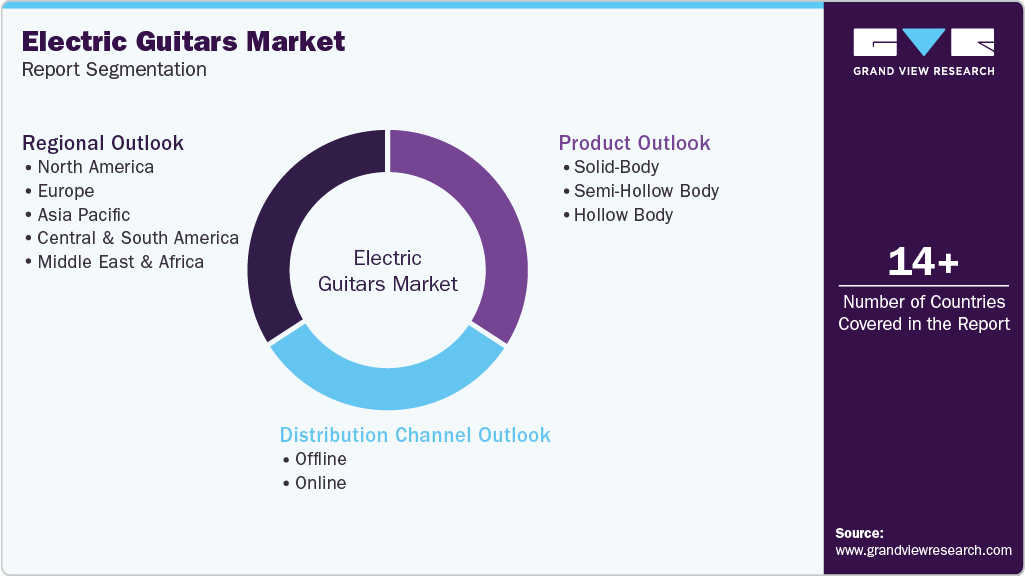
This report forecasts revenue growth at global, regional & country levels and provides an analysis of the latest trends and opportunities in each of the sub-segments from 2021 to 2033. For this study, Grand View Research has segmented the electric guitars market based on product, distribution channel, and region.
 To learn more about this report, Download Free Sample Report
 -
Product Outlook (Volume, Thousand Units; Revenue, USD Million, 2021 - 2033)
-
Solid-Body
-
Semi-Hollow Body
-
Hollow Body
-
-
Distribution Channel Outlook (Volume, Thousand Units; Revenue, USD Million, 2021 - 2033)
-
Offline
-
E-commerce Websites
-
Brand Owned Websites
-
-
Online
-
Specialty Music Stores
-
Brand Owned Stores
-
Department Stores
-
Others
-
-
-
Regional Outlook (Volume, Thousand Units; Revenue, USD Million, 2021 - 2033)
-
North America
-
U.S.
-
Canada
-
Mexico
-
-
Europe
-
UK
-
Germany
-
France
-
Italy
-
Spain
-
-
Asia Pacific
-
China
-
India
-
Japan
-
South Korea
-
Australia & New Zealand
-
-
Central & South America
-
Brazil
-
-
Middle East & Africa
-
South Africa
-
-
Research Methodology
The electric guitars market figures in this report are based on a proven research process that combines executive interviews with secondary research from proprietary databases, company filings, and recognized regulatory and institutional sources. Market size is built through value-chain sizing—reconciling supply-side and demand-side estimates—and triangulated with bottom-up and top-down approaches. Every estimate passes multiple levels of expert validation before publication, with each electric guitars segment quantified using the revenue-capture definitions in the table below.
Segment Definition
Segment - Product
Revenue capture definition
Solid-Body
This segment covers the revenues generated through the sales of solid-body electric guitars, which feature a completely solid wooden body designed to minimize feedback and deliver enhanced sustain, making them suitable for a wide range of music genres including rock, metal, pop, blues, and country. These guitars are widely used by professional musicians, recording artists, hobbyists, and music students. Examples include the Fender Stratocaster, Gibson Les Paul, Ibanez RG Series, Yamaha Pacifica, and ESP LTD EC Series.
Semi-Hollow body
This segment covers the revenues generated through the sales of semi-hollow body electric guitars, which incorporate a solid center block with hollow side chambers to provide a balance between the sustain of solid-body guitars and the warm, resonant tones of hollow-body instruments. These guitars are commonly preferred for jazz, blues, classic rock, indie, and fusion music. Examples include the Gibson ES-335, Epiphone ES-335, Ibanez Artcore AS Series, Yamaha SA Series, and D'Angelico Premier SS.
Hollow Body
This segment covers the revenues generated through the sales of hollow body electric guitars, which feature a fully hollow construction that produces rich, warm, and naturally resonant tones, making them well suited for jazz, blues, rockabilly, and traditional music styles. These guitars are widely used by professional performers and studio musicians seeking enhanced acoustic resonance with electric amplification. Examples include the Gibson ES-175, Gretsch G6120 Chet Atkins, Epiphone Casino, Höfner Verythin, and Ibanez Artcore AF Series.
Estimation Model
Each layer progressively narrows the population pool and applies a conversion rate to arrive at addressable revenue.
Electric Guitar User Base Layer
Access & Availability Layer
Electric Guitar Purchase & Usage Layer
Revenue Generation Layer
Who uses electric guitars?
Who can be reached?
Who is likely to buy?
How much revenue is generated?
Identify aspiring musicians, professional artists, music students, hobbyists, live performers, and bands across key regions using electric guitars for learning, recording, and performances.
Estimate the addressable market based on music store presence, e-commerce penetration, income levels, and consumer access to electric guitars and related accessories.
Estimate active buyers based on music education, home recording, live performances, replacement demand, product upgrades, and preference for premium electric guitars.
Calculate market revenue by multiplying active buyers with average selling prices (ASP), replacement purchases, accessory sales, and revenue generated across product categories and distribution channels.
Delivered Customizations
This report has been delivered with the following In-depth customizations
Client Request
Customization Delivered
Value Adds
Brand & Product-Level Analysis Across Price Segments and Regions
Comprehensive analysis of electric guitars brands by product type, price range, distribution channel, and regional demand across North America, Europe, Asia Pacific, Latin America, and MEA.
Helps identify leading brands, pricing strategies, consumer preferences, and regional demand trends across entry-level, mid-range, and premium electric guitars.
Sales Performance & Consumer Demand Assessment
Detailed evaluation of electric guitars sales, consumer buying behavior, product launches, pricing trends, and demand across key end-user segments.
Enables businesses to understand growth drivers, optimize product portfolios, and identify high-potential market opportunities.
Distribution Channel & Retail Landscape Analysis
Assessment of online and offline sales channels, including e-commerce platforms, music retailers, specialty stores, brand outlets, and distributors.
Identifies the most effective sales channels, retail strategies, and emerging distribution trends to strengthen market reach and sales performance.
Frequently Asked Questions About This Report
Some key players operating in the electric guitars market include Gibson Brands, Inc.; Fender Musical Instruments; Karl Höfner GmbH & Co. KG; Ibanez guitars; Yamaha Corporation; and Michael Kelly Guitar Co.
Key factors that are driving the electric guitars market growth include the increasing number of music enthusiasts and the rising number of live concerts and music festivals around the world.
The global electric guitars market size was valued at USD 4.5 billion in 2022 and is estimated at USD 6.0 billion for 2026.
The global electric guitars market is expected to grow at a CAGR of 6.8% from 2023 to 2030, reaching USD 7.6 billion by 2030.
Asia Pacific dominated with a revenue share of 35.0% in 2022.
About the Author(s)
Clothing, Footwear & Accessories Research Team
Consumer Goods · Clothing, Footwear & AccessoriesThis report was authored by the clothing, footwear & accessories research team at Grand View Research - comprising two research analysts, one senior research analyst, and one industry expert - with specialized expertise in the clothing, footwear & accessories segment of the consumer goods industry. All findings are based on proprietary consumer goods databases, executive interviews, and regulatory analysis, subject to internal peer review prior to publication.
Last Updated:
Speak to Analyst

Customize this report to your needs - add regions, segments, or data points, with 20% free customization.
Or view our licence options:


ISO 9001:2015 & 27001:2022 Certified
We are GDPR and CCPA compliant! Your transaction & personal information is safe and secure. For more details, please read our privacy policy.


