
- Home
- »
- Sensors & Controls
- »
-
Electric Linear Actuator Market Size & Share Report, 2033GVR Report cover

Electric Linear Actuator Market (2026 - 2033)
Size, Share & Trends Analysis Report By Type (DC Electric Linear Actuator, AC Electric Linear Actuator), By Control type (Open Loop, Closed Loop), By Application (Industrial, Automotive, Medical), By Region, And Segment Forecasts
Market Size, 2025
$27.2BMarket Estimate, 2026
$29.0BMarket Forecast, 2033
$46.5BCAGR, 2026–2033
7.0%Electric Linear Actuator Market Summary
The global electric linear actuator market size was valued at USD 27.2 billion in 2025 and is projected to grow from USD 29.0 billion in 2026 to USD 46.5 billion by 2033, at a CAGR of 7.0% from 2026 to 2033. Asia Pacific dominated the global market, accounting for the largest revenue share of 38.7% in 2025. The industry is driven by increasing industrial automation and the shift toward precise, energy-efficient motion-control systems.
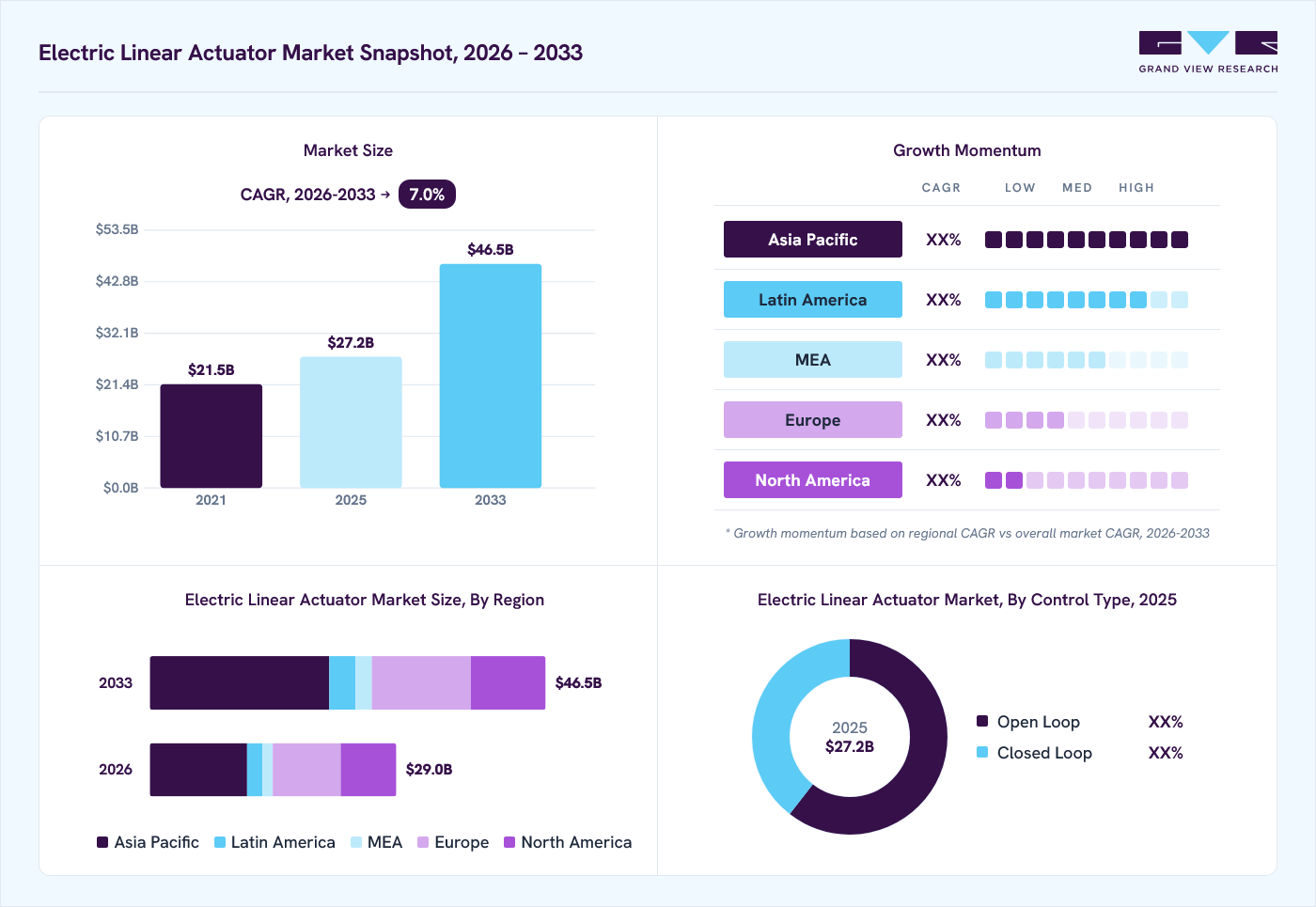 Source: Grand View Research, IR Documents, Primary Interviews, Paid DatabasesTo learn more about this report,
 Download Free Sample Report
 Key Market Trends & Insights
- Based on type: the DC electric linear actuators segment led the market and accounted for 66.8% of the global revenue in 2025.
- Based on control type: the open-loop segment led the market and accounted for 60.5% of the global revenue in 2025.
- Based on application: the industrial segment accounted for the largest share of global revenue in 2025.
Regional Highlights
- Largest regional market: Asia Pacific (38.7% revenue share, 2025)
- Fastest growing regional market: Asia Pacific (highest CAGR, 2026-2033)
- By country: China held the largest market share in 2025.
Market Size & Forecast
- Market Size in 2025: USD 27.2 Billion
- Estimated Market Size in 2026: USD 29.0 Billion
- Projected Market Size in 2033: USD 46.5 Billion
- CAGR (2026-2033): 7.0%
Three ways to get this report
Buy it, customize it, or ask a question.Ask an Analyst
Analyst response in 1 business day
- AccessReport author, directly
- Reply timeWithin 1 working day
- No sales callDirect answer only
- FormatEmail reply
- CostFree, no cost
Get the Full Report
What the study covers
- FormatsPDF · Excel · Dashboard
- Timeline2026–2033 annual, 2025 base
- Coverage20+ countries, 5 regions
- Companies10+ key players profiled
Customize the Report
20% free customization
- IncludeCountries, segments, points
- TailorTo your product definition
- ExtendDeeper competitor detail
- OrA fully bespoke study
- Turnaround5–10 working days
Industrial automation is increasing the need for precise, repeatable, and electronically controlled linear movement across manufacturing and processing equipment. Electric linear actuators provide accurate positioning, speed control, and programmable movement, making them suitable for automated machinery and production systems. Unlike conventional hydraulic or pneumatic systems, electric actuators can be directly integrated with electronic control systems, sensors, and communication interfaces. This enables manufacturers to implement automated positioning, feedback-based control, and condition monitoring. The growing adoption of robotics, automated material handling, packaging machinery, and flexible manufacturing systems is therefore expanding the addressable application base. To learn more about this report, Download Free Sample Report
 Electric actuators can also reduce the complexity associated with hydraulic pumps, hoses, valves, and fluid management. Their compact architecture and relatively straightforward installation support integration into space-constrained automated equipment. Increasing requirements for machine flexibility and rapid changeovers further favor programmable electric actuation. The availability of intelligent actuators with integrated controllers and communication protocols is strengthening their role in connected industrial equipment. Consequently, continued investment in automation and smart manufacturing is expected to remain a major structural driver.
Market Dynamics
The replacement of hydraulic and pneumatic actuation with electric alternatives is a major growth driver for electric linear actuators. Manufacturers are increasingly evaluating electric actuation where applications require controlled movement, lower maintenance, and simplified system architecture. Electric actuators eliminate hydraulic hoses, pumps, and oil circuits, reducing potential leakage points and maintenance requirements. They can also provide direct electronic control and position feedback, which is particularly valuable in increasingly automated equipment. In agricultural machinery, for example, electric actuators are being used for the precise adjustment of components where hydraulic systems were historically dominant.
Electric systems can also operate efficiently in applications where movement is intermittent because power consumption can be minimized when the actuator is stationary. The absence of hydraulic fluids additionally supports cleaner equipment designs and reduces the risk of oil leakage. Improvements in actuator force capacity, durability, environmental protection, and control capabilities are expanding the range of applications that can transition from hydraulics. This trend is particularly relevant to agriculture, construction equipment, industrial machinery, material handling, and mobile equipment. As equipment manufacturers pursue simpler, cleaner, and more electronically controlled architectures, substitution from hydraulic and pneumatic systems should continue to support market growth.
The higher upfront cost of electric linear actuators compared with conventional pneumatic and hydraulic alternatives remains a key restraint to market adoption. Electric solutions generally require an actuator, motor, drive/controller, and potentially sensors or feedback systems, increasing the initial system cost. This is particularly challenging in price-sensitive applications where pneumatic cylinders can provide simple linear motion at relatively low acquisition cost. In addition, hydraulic systems continue to offer advantages in applications requiring very high force within a compact installation envelope. Electric actuators can also face limitations in very high-speed or high-duty-cycle applications because motor, screw, thermal, and mechanical components must be appropriately sized to manage heat and continuous loads. Consequently, replacing an existing hydraulic or pneumatic system may require broader equipment redesign rather than a simple actuator substitution. This increases engineering, integration, and commissioning costs for OEMs. Existing hydraulic and compressed-air infrastructure can further reduce the economic incentive to switch because the infrastructure is already installed and operational. Therefore, despite advantages in precision, controllability, and energy efficiency, initial investment and application-specific force, speed, and duty-cycle limitations can slow electric linear actuator penetration, particularly in heavy-duty and cost-sensitive applications.
The increasing integration of electronics, sensors, communication interfaces, and software into electric linear actuators presents a significant opportunity for market participants. Smart actuators can incorporate position feedback, diagnostics, current sensing, and onboard control electronics, reducing the need for separate control components. This enables actuators to communicate directly with machine-control systems and industrial networks. Technologies such as CAN bus, IO-Link, Modbus, Ethernet-based protocols, and other fieldbus interfaces are expanding their applicability in connected machinery. Real-time feedback and synchronization also allow multiple actuators to operate together with improved positioning accuracy and load management. This creates opportunities to replace conventional actuators with higher-value intelligent solutions rather than competing solely on actuator hardware price. Smart actuators can also support diagnostics and usage data collection, enabling predictive maintenance and reducing equipment downtime. The opportunity is particularly strong in industrial automation, material handling, agriculture, off-highway equipment, and advanced medical equipment. As OEMs increasingly develop connected and software-enabled machines, smart electric linear actuators are expected to capture a growing share of the overall actuator value pool.
Market Concentration & Characteristics
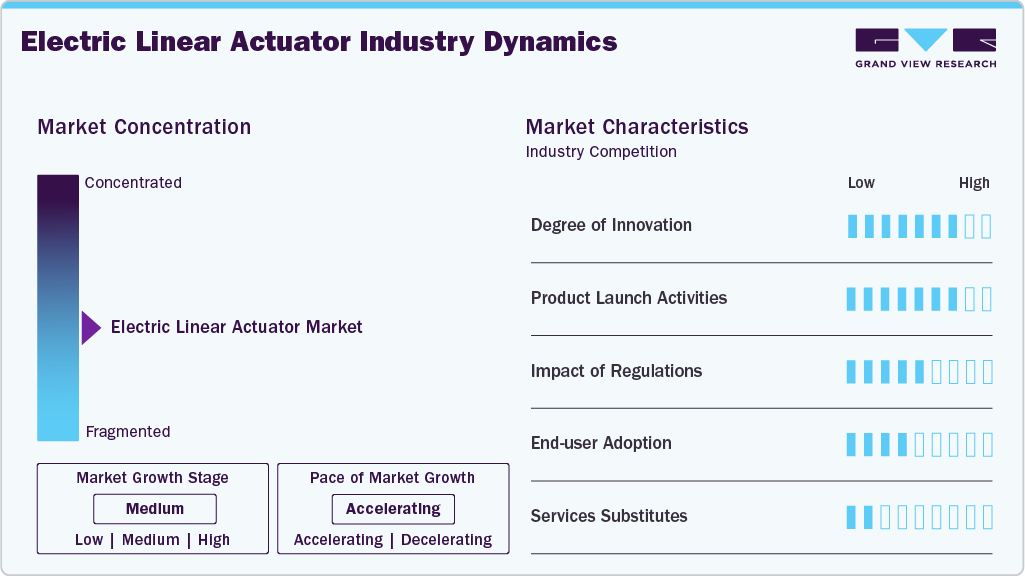
The industry is moderately fragmented in nature due to the presence of established motion-control and automation companies, specialized actuator manufacturers, industrial equipment suppliers, and regional players competing across diverse end-use applications. Companies are actively focusing on the development of high-performance electric linear actuators, compact actuator designs, higher force and speed capabilities, integrated motor and controller systems, and application-specific solutions. The market is benefiting from the gradual transition from hydraulic and pneumatic actuation toward electrically driven motion systems, particularly in industrial automation, material handling, medical equipment, agriculture, furniture, and mobile equipment applications. Continuous advancements in servo motors, ball screws, lead screws, sensors, feedback systems, integrated controllers, and communication technologies are further intensifying competition among manufacturers. Growing demand for precise positioning, energy efficiency, low maintenance, and programmable motion control is also encouraging manufacturers to expand their electric actuation portfolios.
 To learn more about this report, Download Free Sample Report
 Fragmentation in the market is also driven by the presence of specialized linear motion and actuator manufacturers, including LINAK, Thomson Industries, Tolomatic, and TiMOTION, which offer linear actuators, lifting columns, integrated control systems, and customized electric motion solutions. At the same time, diversified automation and motion-control companies such as Bosch Rexroth, SKF, Parker Hannifin, and Festo are strengthening their electric motion portfolios and integrated automation capabilities. Market participants primarily compete through force and stroke range, speed, positioning accuracy, actuator efficiency, product durability, customization capabilities, smart connectivity, application expertise, pricing, and global distribution and after-sales networks, rather than through dominance by a single manufacturer. This broad competitive landscape across industrial, medical, agricultural, automotive, furniture, and material-handling applications supports the moderately fragmented structure of the industry.
Analyst Perspective
The electric linear actuator market is witnessing steady growth due to rising investments in industrial automation, smart manufacturing, medical equipment, agriculture, and material handling. Demand is driven by the need for high precision, energy efficiency, compact designs, low maintenance, and better controllability. Manufacturers are increasingly integrating motors, sensors, controllers, and communication interfaces to develop smart actuators. Future growth is expected to focus on higher force and speed, improved durability, advanced sensing, and connectivity with industrial control systems.
Type Insights
Based on type, the DC electric linear actuators segment accounted for the largest share of 66.8% in 2025. Growing demand for battery-powered and mobile equipment is the key segment driver for DC electric linear actuators. DC actuators can operate directly from low-voltage battery systems, making them well-suited for equipment where grid-connected AC power is unavailable. Their compatibility with 12 V, 24 V, and other DC electrical architectures supports adoption across agricultural machinery, medical equipment, automotive systems, material-handling equipment, mobility devices, and recreational vehicles. The increasing electrification of off-highway and mobile equipment is creating additional opportunities for DC actuation in applications that traditionally relied on hydraulic or manual mechanisms.
The AC electric linear actuators segment is projected to grow at the fastest CAGR over the forecast period. AC-powered actuators are well-suited to fixed industrial installations where continuous access to mains electricity is available. Their ability to support relatively high power output and continuous-duty operation makes them attractive for heavy industrial machinery, production lines, automated material-handling systems, and process equipment. As manufacturers increase automation levels, demand is rising for electrically controlled linear movement with repeatable positioning and programmable operation.
Control Type Insights
Based on control type, the open loop segment accounted for the largest share of 60.5% in 2025. Open-loop actuators do not require external position feedback systems, making their architecture simpler than closed-loop solutions. This reduces the number of components, wiring requirements, controller complexity, and overall system cost. The lower cost makes open-loop actuators particularly attractive for applications where precise real-time position feedback is not critical. These include adjustable furniture, medical beds, access systems, lifting mechanisms, basic material-handling equipment, and general industrial machinery.
The closed loop segment is projected to grow at the fastest CAGR over the forecast period. Closed-loop actuators incorporate position, force, or other feedback mechanisms that enable the control system to continuously monitor actuator performance and correct deviations. This makes them suitable for applications requiring high positioning accuracy, repeatability, synchronization, and reliable movement under variable loads. Increasing adoption of industrial automation, robotics, CNC machinery, automated material handling, and advanced medical equipment is expanding demand for feedback-enabled actuation.
Application Insights
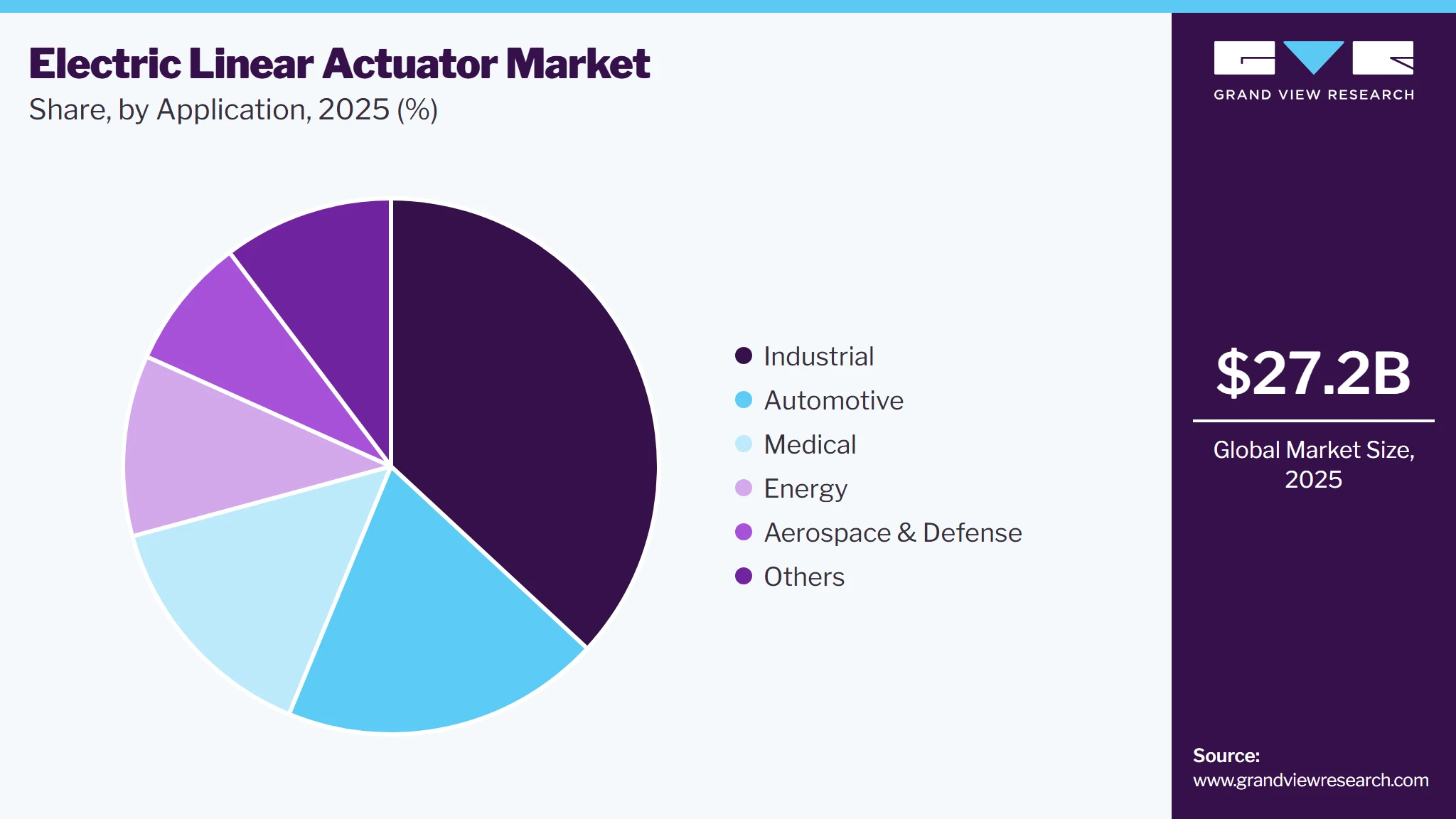
Based on application, the industrial segment led the market and accounted for the largest share in 2025. Increasing adoption of industrial automation and smart manufacturing is the primary driver for electric linear actuator demand in industrial applications. Manufacturers are increasingly replacing manual and hydraulic/pneumatic mechanisms with electrically controlled motion systems to improve positioning accuracy, repeatability, and operational efficiency. Electric linear actuators are widely used for lifting, positioning, clamping, indexing, material handling, and automated adjustment functions across manufacturing equipment. The expansion of robotics, automated assembly lines, packaging machinery, CNC equipment, and warehouse automation is creating additional demand for precise linear motion. Their ability to integrate with PLCs, servo drives, sensors, and industrial communication networks also supports deployment in connected production environments.
 To learn more about this report, Download Free Sample Report
 The energy segment is expected to grow at the fastest CAGR over the forecast period. Increasing investment in renewable energy and power-generation infrastructure is expected to drive demand for electric linear actuators in energy applications. Electric linear actuators are used for controlled positioning, adjustment, opening, closing, and tracking functions across energy equipment. In solar power systems, actuators can support the movement and positioning of solar panels and tracking mechanisms to optimize exposure to sunlight. The expansion of utility-scale and distributed solar installations is therefore creating additional demand for reliable electromechanical positioning systems. Electric actuators are also applicable in wind turbines and other energy equipment for functions requiring controlled mechanical adjustment.
Regional Insights
The Asia Pacific electric linear actuator market led the global industry and accounted for 38.7% share in 2025. Rapid industrialization, manufacturing automation, and expansion of smart-factory investments are expected to be the primary drivers of the Asia Pacific electric linear actuator market. China, Japan, South Korea, and India are increasingly investing in factory automation, robotics, automated material handling, and digitally connected production systems. This is increasing demand for precise and programmable linear motion components across manufacturing equipment and industrial machinery.
 To learn more about this report, Download Free Sample Report
 China Electric Linear Actuator Market Trends
The China electric linear actuator market held a significant share in Asia Pacific. Rapid expansion of industrial automation and advanced manufacturing is the primary driver of the electric linear actuator market in China. China has a large manufacturing base spanning automotive, electronics, semiconductor, machinery, packaging, and consumer goods industries, creating a substantial application base for linear motion systems. The continued modernization of factories is increasing demand for automated positioning, lifting, clamping, assembly, and material-handling functions.
The electric linear actuator market in Japan is expected to grow at a high CAGR over the forecast period. Japan has a highly automated manufacturing sector with extensive use of robotics, CNC machinery, automated production lines, and precision equipment. This creates sustained demand for high-precision linear motion systems capable of delivering repeatable positioning and reliable operation. An aging workforce and persistent labor shortages are encouraging manufacturers to further automate repetitive and labor-intensive processes.
North America Electric Linear Actuator Market Trends
The electric linear actuator market in North America accounted for a significant share of the global revenue in 2025. Increasing investment in industrial automation, reshoring of manufacturing, and smart-factory infrastructure is expected to be the primary driver of the North American electric linear actuator market. The U.S. and Canada are witnessing increased investments in automotive, semiconductor, electronics, food & beverage, pharmaceuticals, and advanced manufacturing facilities, creating demand for automated motion-control equipment.
The U.S. electric linear actuator market is anticipated to register significant growth from 2026 to 2033. The expansion of semiconductor, electronics, automotive, EV, battery, aerospace, and pharmaceutical manufacturing is increasing demand for automated equipment with precise and repeatable linear motion. U.S. manufacturers are also investing in reshoring and domestic production capacity, which is driving the installation of new automated production lines and material-handling systems.
Europe Electric Linear Actuator Market Trends
The electric linear actuator market in Europe is poised for significant growth from 2026 to 2033. Europe has a highly developed manufacturing base across automotive, machinery, aerospace, pharmaceuticals, food processing, and industrial equipment, providing a large installed base for linear motion applications. Manufacturers are increasingly investing in robotics, automated production lines, flexible manufacturing, and smart-factory technologies to improve productivity and reduce dependence on manual labor.
The UK electric linear actuator market is driven by the increasing automation across advanced manufacturing and the need to address labor shortages. The UK is investing in automation across automotive, aerospace, food & beverage, pharmaceuticals, logistics, and general manufacturing, creating demand for precise electric motion systems. Electric linear actuators support automated positioning, lifting, adjustment, clamping, and material-handling functions across these industries. The growing adoption of robotics and smart manufacturing is increasing the requirement for actuators that can integrate with PLCs, sensors, servo drives, and digital control systems.
The electric linear actuator market in Germany held a substantial share in Europe. Germany has a large manufacturing base across automotive, machinery, industrial equipment, electronics, pharmaceuticals, and material handling, providing extensive applications for electric linear motion. The country's high adoption of robotics, automated production lines, CNC machinery, and smart-factory technologies supports sustained demand for precision actuators.
Key Electric Linear Actuator Company Insights
Key players operating in the electric linear actuator market are heavily investing in the development of high-force and high-speed actuators, servo-integrated systems, smart actuators, precision positioning technologies, and application-specific solutions for industrial automation, medical equipment, agriculture, material handling, furniture, and other end-use applications. Companies are focusing on product launches, actuator customization, integrated motor and controller solutions, connectivity, and expansion of global manufacturing and distribution networks to strengthen their market presence.
-
LINAK is a global manufacturer of electric linear actuators and electric motion systems, with a strong presence across medical, industrial, agriculture, office, and furniture applications. The company offers a broad portfolio of linear actuators, lifting columns, control boxes, controls, and accessories designed for applications requiring precise, reliable, and programmable linear movement. Its solutions support applications such as hospital beds, patient lifts, dental equipment, industrial machinery, agricultural equipment, and height-adjustable desks. LINAK focuses on integrated motion systems combining actuators with control electronics, sensors, and connectivity features to improve equipment functionality and user control.
-
TiMOTION Technology Co., Ltd. is a Taiwan-based manufacturer specializing in electric linear actuator systems and related motion-control solutions for industrial, medical, furniture, and ergonomic applications. The company offers electric linear actuators, lifting columns, control systems, and accessories designed for applications requiring controlled lifting, positioning, tilting, and adjustment. Its product portfolio covers applications including medical beds, patient lifts, dental equipment, industrial machinery, agricultural equipment, and adjustable furniture. TiMOTION emphasizes customized actuator solutions, allowing OEM customers to specify parameters such as load capacity, stroke length, speed, dimensions, protection rating, and control configuration.
Key Electric Linear Actuator Companies
The following key companies have been profiled for this study on the electric linear actuator market.
-
LINAK
-
TiMOTION Technology Co. Ltd
-
Parker Hannifin
-
Thomson Industries, Inc.
-
Festo India Private Limited
-
SKF
-
SMC Corporation
-
Tolomatic USA
-
Bosch Rexroth (India) Private Limited
-
Actuonix Motion Devices
Company Categorization
Operating Strategies
Competitive Edge
Weaknesses
Mature Players: LINAK, Thomson Industries, Tolomatic, TiMOTION Technology Co., Ltd.,
- Mature players in the electric linear actuator market are focusing on expanding actuator portfolios, developing high-force and high-speed solutions, integrating motors, controllers, sensors, and feedback systems, and providing customized solutions across industrial automation, medical equipment, agriculture, material handling, and furniture applications.
- Mature players gain a competitive advantage through strong brand recognition, broad product portfolios, extensive global distribution networks, established OEM relationships, advanced motion-control capabilities, application engineering expertise, and comprehensive after-sales support.
- These companies face challenges related to higher product and integration costs, large organizational structures, longer development cycles for customized solutions, and lower flexibility in highly customized low-volume applications, which can make them less competitive against specialized regional actuator manufacturers and niche players.
Emerging Players: Bosch Rexroth Private Limited, Actuonix Motion Devices
- Emerging players in the electric linear actuator market are focusing on application-specific actuator solutions, compact and cost-effective designs, product customization, direct distribution, smart actuator capabilities, and targeted expansion across industrial automation, medical equipment, furniture, agriculture, and other specialized applications.
- Emerging players gain market traction through flexible product configurations, competitive pricing, shorter response times, application-specific engineering, faster product adaptation, and the ability to address niche customer requirements that may not be efficiently served by larger manufacturers.
- Emerging players face limitations due to smaller global manufacturing footprints, narrower product portfolios, lower brand recognition, limited penetration among large OEMs, and comparatively smaller distribution and after-sales networks, which can limit their ability to compete for large multinational automation programs and complex integrated motion-control projects.
Recent Developments
-
In March 2026, Tolomatic announced the launch of a new product RSX50 electric linear actuator. The actuator delivers up to 50 tons of force in a frame footprint nearly the same size as the RSX25, providing higher force output in a similar form factor for high-force electric linear motion applications. The product launch is expected to help the company strengthen its position in the market.
-
In February 2026, Schaeffler announced the expansion of its platform of EWELLIX EMA-series linear actuators with a new variant for medical technology. This expansion of the product is expected to help the company open new opportunities in medical imaging and operating room applications.
Electric Linear Actuator Market Report Scope
Report Attribute
Details
Market size value in 2025
USD 27.2 billion
Estimated market size in 2026
USD 29.0 billion
Revenue forecast in 2033
USD 46.5 billion
Growth rate
CAGR of 7.0% from 2026 to 2033
Base year for estimation
2025
Historical data
2021 - 2024
Forecast period
2026 - 2033
Quantitative units
Revenue in USD billion and CAGR from 2026 to 2033
Report coverage
Revenue forecast, company ranking, competitive landscape, growth factors, and trends
Segments covered
Type, control type, application, region
Regional scope
North America; Europe; Asia Pacific; Latin America; MEA
Country scope
U.S.; Canada; Mexico; Germany; U.K.; France; China; Japan; India; South Korea; Australia; Brazil; Kingdom of Saudi Arabia (KSA); UAE; South Africa
Key companies profiled
LINAK; TiMOTION Technology Co. Ltd.; Parker Hannifin; Thomson Industries, Inc.; Festo India Private Limited; SKF; SMC Corporation; Tolomatic USA; Bosch Rexroth (India) Private Limited; Actuonix Motion Devices.
Customization scope
Free report customization (equivalent up to 8 analysts working days) with purchase. Addition or alteration to country, regional & segment scope.
Pricing and purchase options
Avail customized purchase options to meet your exact research needs. Explore purchase options
Global Electric Linear Actuator Market Report Segmentation
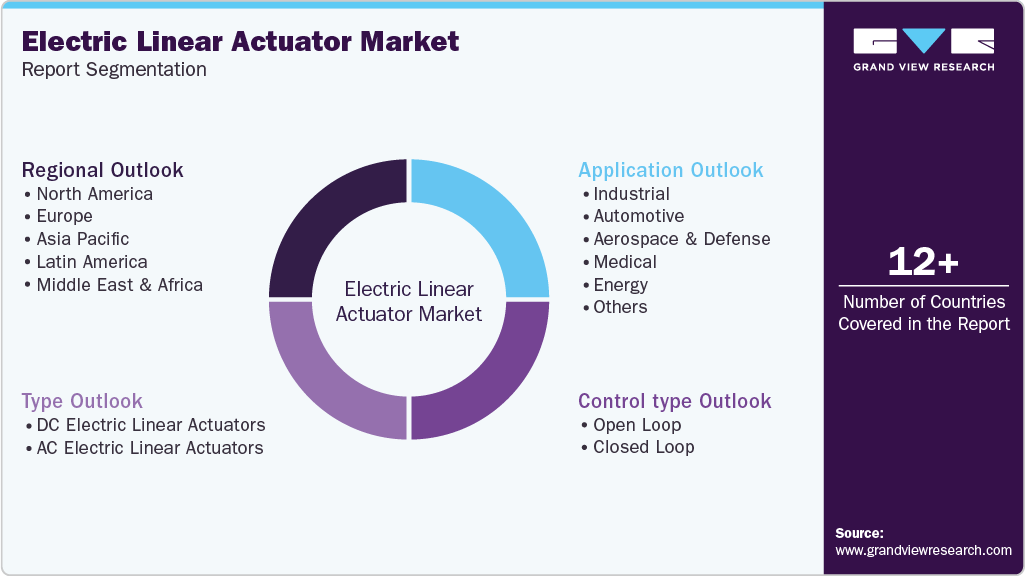
The report forecasts revenue growth at global, regional, and country levels and provides an analysis of the latest industry trends in each of the sub-segments from 2021 to 2033. For this study, Grand View Research has segmented the global electric linear actuator market report based on type, control type, application, and region.
 To learn more about this report, Download Free Sample Report
 -
Type Outlook (Revenue, USD Billion, 2021 - 2033)
-
DC Electric Linear Actuators
-
AC Electric Linear Actuators
-
-
Control type Outlook (Revenue, USD Billion, 2021 - 2033)
-
Open Loop
-
Closed Loop
-
-
Application Outlook (Revenue, USD Billion, 2021 - 2033)
-
Industrial
-
Automotive
-
Aerospace & Defense
-
Medical
-
Energy
-
Others
-
-
Regional Outlook (Revenue, USD Billion, 2021 - 2033)
-
North America
-
U.S.
-
Canada
-
Mexico
-
-
Europe
-
Germany
-
UK
-
France
-
-
Asia Pacific
-
China
-
India
-
Japan
-
South Korea
-
Australia
-
-
Latin America
-
Brazil
-
-
Middle East & Africa (MEA)
-
UAE
-
Kingdom of Saudi Arabia (KSA)
-
South Africa
-
-
Research Methodology
The electric linear actuator market figures in this report are based on a proven research process that combines executive interviews with secondary research from proprietary databases, company filings, and recognized regulatory and institutional sources. Market size is built through value-chain sizing-reconciling supply-side and demand-side estimates-and triangulated with bottom-up and top-down approaches. Every estimate passes multiple levels of expert validation before publication, with each electric linear actuator segment quantified using the revenue-capture definitions in the table below.
Segment Definition
Segment -Type
Revenue capture definition
DC Electric Linear Actuators
Revenue generated from DC-powered electric linear actuators, including 12V, 24V, and other low-voltage DC actuator systems used for lifting, positioning, tilting, opening, closing, and adjustment functions across industrial, automotive, medical, agricultural, furniture, and mobile equipment applications.
AC Electric Linear Actuators
Revenue generated from AC-powered electric linear actuators designed for fixed or stationary applications requiring continuous or high-duty-cycle operation, including industrial machinery, factory automation, material handling, process equipment, and other mains-powered applications.
Segment - Control Type
Revenue capture definition
Open Loop
Revenue generated from open-loop electric linear actuators that operate without continuous position or force feedback, including actuator systems using predefined commands, limit switches, or basic control mechanisms for lifting, positioning, adjustment, and movement applications.
Closed Loop
Revenue generated from closed-loop electric linear actuators incorporating position, force, speed, or other feedback mechanisms to continuously monitor and control actuator movement, including precision positioning, synchronization, robotics, automation, medical equipment, and other feedback-critical applications.
Segment - Application
Revenue capture definition
Industrial
Revenue generated from electric linear actuators used in industrial machinery and automation, including manufacturing equipment, assembly systems, packaging machinery, material handling, CNC equipment, robotics, lifting systems, and automated production lines.
Automotive
Revenue generated from electric linear actuators used in automotive and commercial vehicle applications, including seat adjustment, door and hatch mechanisms, aerodynamic systems, hood and trunk systems, charging interfaces, vehicle positioning systems, and other electronically controlled vehicle functions.
Aerospace & Defense
Revenue generated from electric linear actuators used in aerospace and defense equipment, including aircraft seating, flight-control mechanisms, landing systems, weapon systems, unmanned systems, military vehicles, and other applications requiring precise and reliable linear movement.
Medical
Revenue generated from electric linear actuators used in medical and healthcare equipment, including hospital beds, patient lifts, dental equipment, examination tables, surgical equipment, rehabilitation systems, and other patient-positioning applications.
Energy
Revenue generated from electric linear actuators used in energy-generation and energy-infrastructure applications, including solar tracking systems, wind-energy equipment, power-generation equipment, energy-storage systems, and other applications requiring automated positioning and adjustment.
Others
Revenue generated from electric linear actuators used in other applications, including agriculture and forestry equipment, furniture, home automation, accessibility equipment, marine equipment, construction machinery, recreational vehicles, and other specialized applications.
Estimation Model
Layer Name
Key Question
Description
Application & End-use Demand Assessment
Which applications and industries require electric linear actuators?
Assesses demand across industrial automation, medical equipment, automotive, agriculture, material handling, furniture, and other end-use applications.
Actuator Configuration & Technology Adoption Analysis
Which actuator configurations and technologies are being adopted?
Evaluates actuator types, drive mechanisms, motor technologies, force capacity, stroke length, speed, precision, and smart/connected features.
Revenue Opportunity & Pricing Assessment
Where is commercial value generated?
Assesses revenue from actuators, installation, maintenance, and aftermarket services, including ASP variations by technology and application.
Competitive Intelligence & Market Validation
Which manufacturers are best positioned to capture market growth?
Evaluates manufacturers based on product portfolio, technology, application coverage, geographic presence, customization, distribution, and OEM relationships.
Delivered Customization
We have successfully delivered the following deep-dive customizations
Client Request
Customization Delivered
Value Adds
Regional Electric Linear Actuator Market Opportunity Assessment
Country/region-wise market sizing and forecasts·
Analysis of demand, adoption trends, and regulatory landscape.
Identification of high-growth regions and investment hotspots
Identified region-specific growth opportunities.
Supported expansion and go-to-market strategy.
Enabled informed regional investment decisions
Cross-Segmentation Analysis for the Electric Linear Actuator Market
Cross-segment market analysis by propulsion type, seating capacity, and application·
Demand and adoption assessment across key segments·
Segment attractiveness and growth potential benchmarking
Identified high-potential market segments.
Supported targeted product and application positioning.
Improved customer and segment prioritization
Competitive Benchmarking and Strategic Positioning in the Electric Linear Actuator Market
Benchmarking of key competitors across vehicle portfolios, propulsion, seating capacity, pricing, partnerships, and innovation.
Comparative assessment of market share, capabilities, and strategies.
Analysis of competitive strengths, gaps, and differentiation areas.
Identified competitive white spaces and growth gaps.
Supported strategic positioning and differentiation.
Enabled data-driven competitive strategy development
Frequently Asked Questions About This Report
Asia Pacific dominated the electric linear actuator market with a share of 38.7% in 2025. Rapid industrialization, manufacturing automation, and expansion of smart-factory investments are expected to be the primary drivers of the Asia Pacific electric linear actuator market
The open loop segment dominated the global electric linear actuator market with share of 60.5% in 2025
The industrial segment dominated the global electric linear actuator market with share of 36.9% in 2025
The global electric linear actuator market size was valued at USD 27.2 billion in 2025 and is estimated at USD 29.0 billion for 2026.
The global electric linear actuator market is expected to grow at a CAGR of 7.0% from 2026 to 2033, reaching USD 46.5 billion by 2033.
Some key players operating in the electric linear actuator market include LINAK, TiMOTION Technology Co. Ltd., Parker Hannifin, Thomson Industries, Inc., Festo India Private Limited, SKF, SMC Corporation, Tolomatic USA, Bosch Rexroth (India) Private Limited, and Actuonix Motion Devices.
Key factors that are driving the market growth include rapid urbanization and the development of large business and industrial parks are also supporting demand for corporate employee shuttle services.
The U.S. electric linear actuator market size was valued at USD 4.9 billion in 2025.
The DC electric linear actuators segment dominated the global electric linear actuator market with share of 66.8% in 2025
About the Author(s)
Sensors & Controls Research Team
Semiconductors & Electronics · Sensors & ControlsThis report was authored by the sensors & controls research team at Grand View Research - comprising two research analysts, one senior research analyst, and one industry expert - with specialized expertise in the sensors & controls segment of the semiconductors & electronics industry. All findings are based on proprietary semiconductors & electronics databases, executive interviews, and regulatory analysis, subject to internal peer review prior to publication.
Last Updated:
Speak to Analyst

Customize this report to your needs - add regions, segments, or data points, with 20% free customization.
Or view our licence options:


ISO 9001:2015 & 27001:2022 Certified
We are GDPR and CCPA compliant! Your transaction & personal information is safe and secure. For more details, please read our privacy policy.


