
- Home
- »
- Advanced Interior Materials
- »
-
Electric Submersible Pumps Market Size, Share Report, 2033GVR Report cover

Electric Submersible Pumps Market (2026 - 2033)
Size, Share & Trends Analysis Report By Product (Borewell, Openwell, Non-clog), By End-use (Agriculture, Construction & Building Services, Water & Wastewater, Power Generation), By Region, And Segment Forecasts
Market Size, 2025
$9.6BMarket Estimate, 2026
$9.9BMarket Forecast, 2033
$14.4BCAGR, 2026–2033
5.5%Electric Submersible Pumps Market Summary
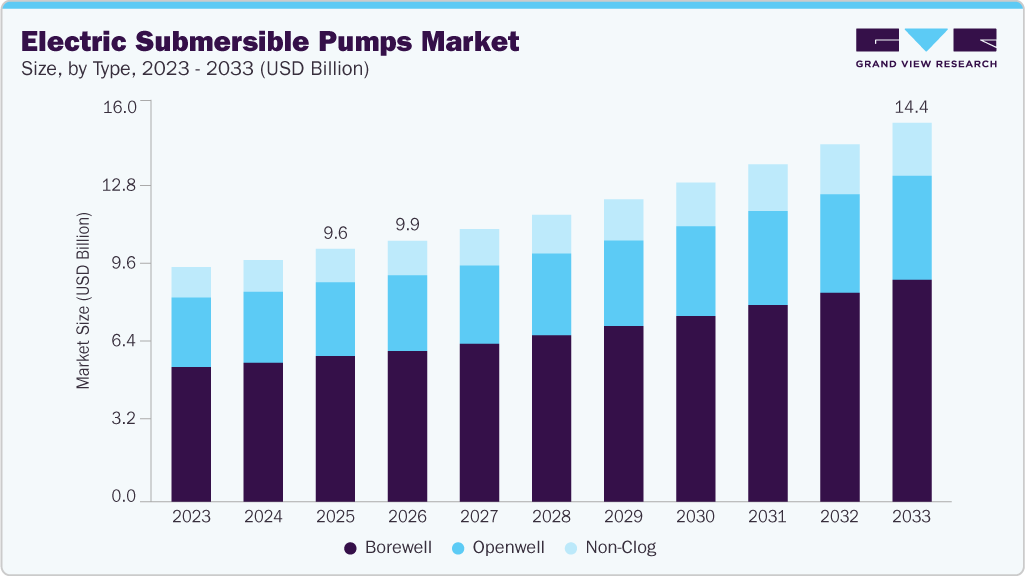
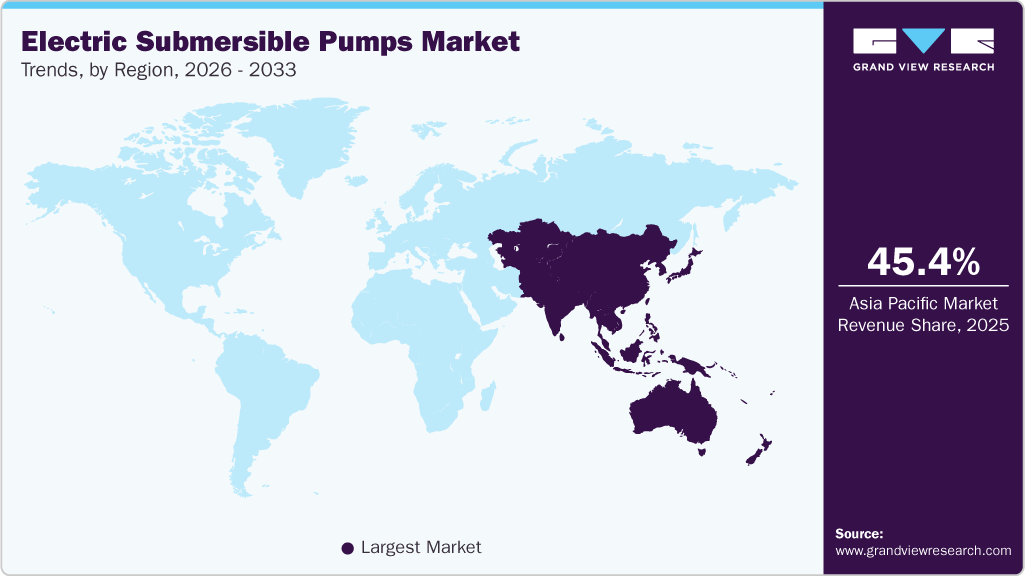
The global electric submersible pumps market size was valued at USD 9.6 billion in 2025 and is projected to grow from USD 9.9 billion in 2026 to USD 14.4 billion by 2033, at a CAGR of 5.5% from 2026 to 2033. Asia Pacific dominated the global electric submersible pumps market with the largest revenue share of 45.4% in 2025. The market is primarily driven by growing global energy needs, rising water management concerns, and the ongoing efforts towards improving agricultural yields.
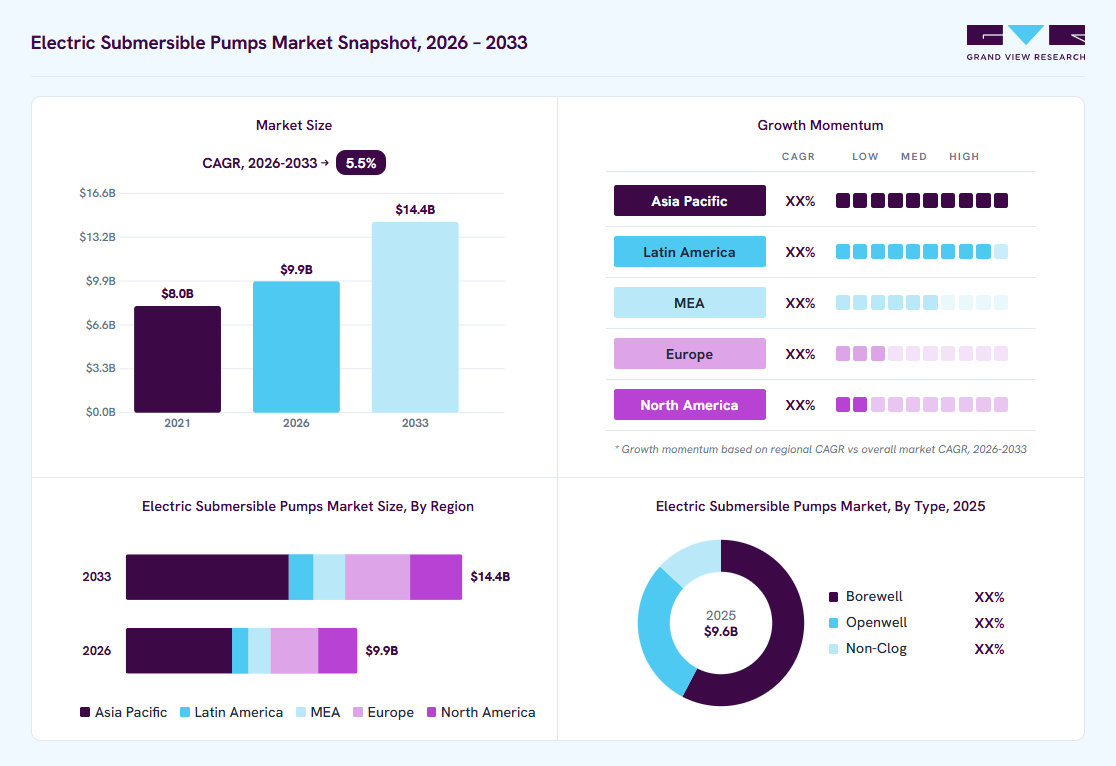 Source: Grand View Research, IR Documents, Primary Interviews, Paid DatabasesTo learn more about this report,
 Download Free Sample Report
 Key Market Trends & Insights
- By product: Borewell segment represented a critical type of electric submersible pump in 2025, accounting for a share of 57.7% of the revenue.
- By end use: Chemical segment is expected to grow at the fastest CAGR of 6.9% from 2026 to 2033.
Regional Highlights
- Largest regional market: Asia Pacific (45.4% revenue share, 2025)
- By country: The China held the largest market share in 2025.
Market Size & Forecast
- Market size in 2025: USD 9.6 Billion
- Estimated market size in 2026: USD 9.9 Billion
- Projected market size by 2033: USD 14.4 Billion
- CAGR (2026-2033): 5.5%
Three ways to get this report
Buy it, customize it, or ask a question.Ask an Analyst
Analyst response in 1 business day
- AccessReport author, directly
- Reply timeWithin 1 working day
- No sales callDirect answer only
- FormatEmail reply
- CostFree, no cost
Get the Full Report
What the study covers
- FormatsPDF · Excel · Dashboard
- Timeline2026–2033 annual, 2025 base
- Coverage20+ countries, 5 regions
- Companies10+ key players profiled
Customize the Report
20% free customization
- IncludeCountries, segments, points
- TailorTo your product definition
- ExtendDeeper competitor detail
- OrA fully bespoke study
- Turnaround5–10 working days
 To learn more about this report, Download Free Sample Report
The shift toward decarbonization has encouraged the oil and gas industry to adopt more energy-efficient and lower-emission technologies. Electric submersible pumps, being electrically driven and highly efficient, support this transition by optimizing production while reducing operational energy intensity. This alignment with efficiency and sustainability objectives, alongside core performance benefits, is contributing to the growing adoption of electric submersible pumps.Market Concentration & Characteristics
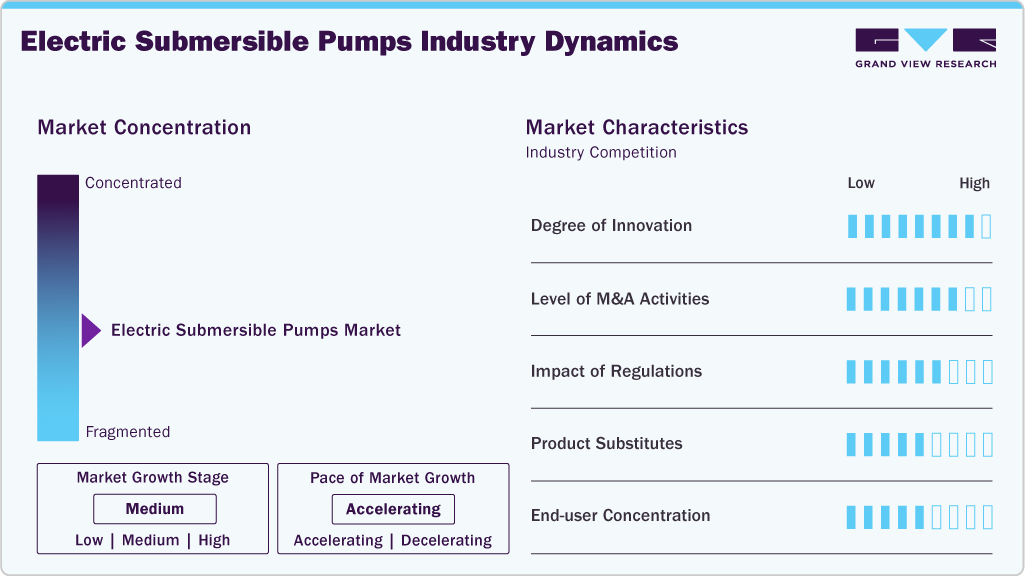
The electric submersible pump (ESP) market is relatively fragmented, with a few global players dominating high-end oil & gas applications, while regional and local manufacturers serve water, agriculture, and construction segments. Established companies compete on technological capabilities, reliability, and service networks, particularly in oilfield applications where performance and uptime are critical. High entry barriers, including capital intensity and technical expertise, limit new entrants in advanced segments, while lower barriers exist in commoditized water and agriculture applications.
The threat of alternatives varies by the application involved. In oil & gas, ESPs (Electric Submersible Pumps) compete with artificial lift methods such as gas lift, rod lift, and progressing cavity pumps, with selection dependent on well conditions, depth, and fluid characteristics. While alternatives remain viable, ESPs are preferred in high-volume and deep-well operations due to their efficiency and scalability. Regulatory frameworks, particularly those related to environmental compliance, water management, and energy efficiency, are influencing adoption patterns by encouraging the use of efficient pumping systems in both industrial and municipal applications.
 To learn more about this report, Download Free Sample Report
 Technological advancements are a key differentiator in the market, with innovations focused on improving energy efficiency, reliability, and operational monitoring. Integration of digital technologies such as remote monitoring, automation, and predictive maintenance is enhancing performance and reducing downtime. Top players are increasingly adopting strategies centered on product innovation, expansion of service capabilities, and partnerships with oilfield operators and infrastructure developers. Moreover, companies are focusing on developing corrosion-resistant materials and high-temperature-resistant systems to expand applicability across challenging operating environments, thereby strengthening their competitive positioning.
Drivers, Opportunities & Restraints
The global electric submersible pump market is driven by the need to sustain production in mature oilfields through Enhanced Oil Recovery (EOR), alongside rising demand for efficient water and wastewater management due to rapid urbanization and population growth. In parallel, growing applications across agriculture for irrigation and across industries for fluid handling are further strengthening market demand. At the same time, technological advancements such as digital monitoring, predictive maintenance, and energy-efficient systems are improving operational performance and reducing costs.
Significant market opportunities for electric submersible pumps lie in the digital transformation of oilfield and water management operations through the integration of AI-driven predictive maintenance and IoT sensors. The escalating global focus on sustainability also presents a major opening for solar-powered ESPs in off-grid agricultural regions and high-efficiency units designed to reduce carbon footprints in industrial processes.
The growth of the electric submersible pumps market is considerably restrained by high initial capital expenditures and substantial long-term maintenance costs, which can deter adoption among smaller operators and budget-constrained municipal sectors. Moreover, operating in abrasive or corrosive environments frequently leads to performance degradation, necessitating specialized repairs and causing unplanned downtime that impacts overall operational efficiency. Furthermore, the market faces challenges from the volatility of raw material prices, specifically for copper and high-grade steel, along with the technical complexity involved in installing systems in deep or remote locations. Additionally, the availability of alternative pumping technologies and the ongoing need for strict compliance with evolving environmental and energy-efficiency regulations can further restrict aggressive market expansion.
Product Insights
The borewell segment led the market in 2025 in terms of revenue share, driven by its widespread use across agriculture, municipal water supply, and oil & gas applications. In agriculture, borewell ESPs are extensively used for deep-well irrigation, particularly in water-stressed regions. Growing urbanization has also increased their adoption in municipal systems to ensure reliable water supply from deep aquifers. In addition, their use in artificial lift applications in mature oilfields supports production at greater depths. This versatility and ability to operate efficiently in deep-well conditions underpin the segment’s leading revenue share.
This non-clog segment is expected to grow at a CAGR of 6.3% over the forecast period, driven by its critical role in handling wastewater, sewage, and fluids containing solid particles across municipal and industrial applications. These pumps are specifically designed to prevent blockages, ensuring reliable operation in environments with high debris content, such as wastewater treatment plants, drainage systems, and industrial effluent management. Increasing investments in water and wastewater infrastructure, along with rising urbanization and stricter environmental regulations, are supporting steady demand for non-clog submersible pumps.
End-use Insights
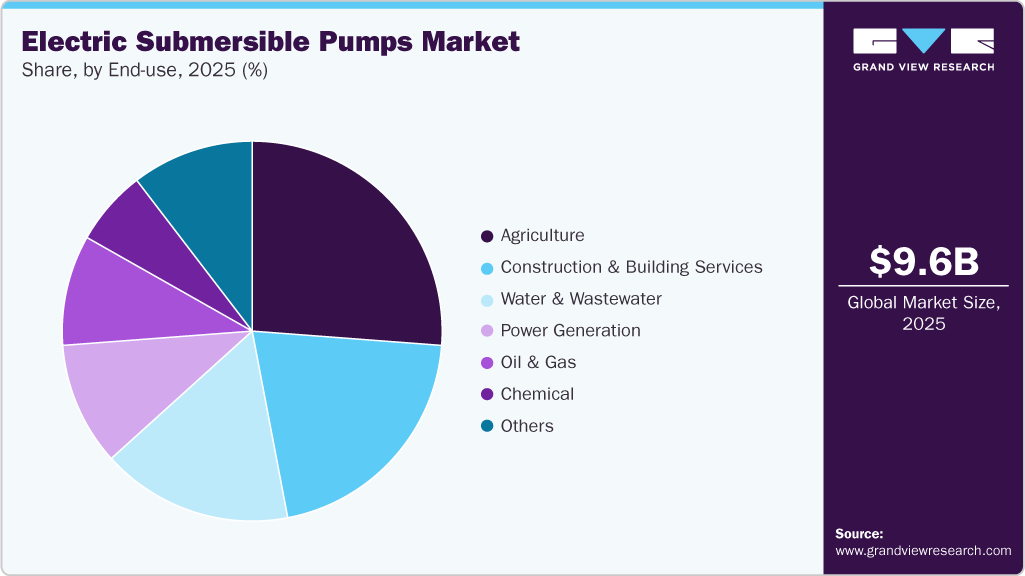
The agriculture segment accounted for a revenue share of 26.2% in 2025, due to the increasing global demand for food security and the subsequent expansion of modern irrigation networks. In water-stressed regions, farmers increasingly rely on borewell ESPs for efficient groundwater extraction from deep aquifers, where surface water is insufficient. Additionally, government support for irrigation infrastructure and the expansion of mechanized farming practices further contribute to sustained demand in this segment.
 To learn more about this report, Download Free Sample Report
 The chemical segment is projected to witness substantial growth over the forecast period, due to the expansion of chemical and petrochemical manufacturing activities, particularly in key industrial regions. These facilities require reliable pumping systems for handling aggressive, corrosive, and hazardous fluids, leading to the adoption of ESPs designed with high-grade, corrosion-resistant materials and explosion-proof features. Such capabilities ensure operational safety and process integrity in demanding environments. Growth in this segment is especially evident in industrial hubs across Asia Pacific and the Middle East, where investments in petrochemical and specialty chemical production are increasing.
Regional Insights
North America remains a strong force in the electric submersible pumps (ESP) market, largely driven by the U.S. shale revolution and advanced deepwater projects in the Gulf of Mexico. The market is characterized by a high demand for sophisticated artificial lift systems that can handle high-volume fluid production, which has also accelerated the adoption of digital technologies to enhance performance and reliability. Operators are increasingly integrating real-time analytics to minimize downtime and optimize production, particularly in remote oilfields. Additionally, rising focus on water conservation and infrastructure upgrades is also supporting steady demand for ESPs in municipal and water-related applications.
 To learn more about this report, Download Free Sample Report
 U.S. Electric Submersible Pumps Market Trends
The U.S. market is primarily driven by the resurgence of shale oil and gas production and the increasing need for artificial lift systems in maturing onshore wells. Additionally, the federal focus on modernizing aging water infrastructure and expanding smart municipal utilities is fueling demand for high-efficiency, IoT-enabled pumps. On the other hand, the market faces challenges from volatile raw material prices, such as copper and steel, and a shortage of skilled labor capable of managing complex down-hole installations in remote oilfield locations.
Europe Electric Submersible Pumps Market Trends
The electric submersible pumps market in Europe is driven by steady demand from water & wastewater management, industrial applications, and infrastructure upgrades, supported by stringent environmental regulations promoting energy-efficient systems. Aging water networks and increasing focus on sustainability are driving replacement and modernization demand. However, the market faces challenges such as high energy costs and is relatively mature, which limits growth to largely replacement-driven demand. Despite this, ongoing technological advancements, including smart monitoring and efficient designs, continue to support gradual market growth.
The electric submersible pumps market in Germany is heavily dictated by stringent environmental regulations and the European Union’s energy efficiency mandates, pushing industries toward green pumping solutions. The country’s leadership in industrial automation means there is a high adoption rate for pumps integrated with sensors for predictive maintenance.
The electric submersible pumps market in France is supported by strong demand from the water & wastewater and agriculture sectors, driven by the country’s emphasis on efficient water management and irrigation practices. Municipal authorities are increasingly investing in groundwater extraction, drainage, and wastewater handling systems to address aging infrastructure and environmental compliance requirements.
Asia Pacific Electric Submersible Pumps Market Trends
The Asia Pacific region holds a significant share in the global electric submersible pumps market, primarily due to its vast agricultural sector, rapid industrialization, and increasing infrastructural development initiatives. The region's extensive agricultural activities necessitate efficient irrigation systems, wherein electric submersible pumps play a critical role in water extraction from wells to ensure sustainable crop production. Furthermore, the fast-paced urbanization and industrial growth across Asia Pacific countries have spurred the demand for these pumps in water and wastewater management, mining, and construction projects. This will drive the demand for electric submersible pumps over the forecast period.
The electric submersible pumps market in China is expanding rapidly, driven by the country's continuous emphasis on infrastructural development, agricultural modernization, and environmental sustainability initiatives. The government's push for water conservation and pollution control measures has also led to heightened investments in water treatment and recycling facilities, further propelling the demand for electric submersible pump.
The electric submersible pumps market in India is driven by strong demand from agriculture, water infrastructure, and industrial applications, supported by increasing reliance on groundwater irrigation and government investments in water supply and sanitation. Rapid urbanization and expanding construction activities further contribute to the demand for dewatering and fluid handling solutions.
Latin America Electric Submersible Pumps Market Trends
The electric submersible pumps market in Latin America is driven by strong demand from mining, agriculture, and water management applications across countries such as Brazil, Chile, Peru, and Argentina. Extensive mining operations and expanding irrigation needs are supporting consistent deployment of ESPs in fluid extraction and handling applications. Additionally, investments in water infrastructure and sanitation are contributing to demand across municipal and industrial sectors. However, the market faces challenges such as economic volatility, limited infrastructure in remote regions, and high dependence on commodity cycles, which can impact investment continuity.
The electric submersible pumps market in Brazil is driven by the expansion of offshore oil & gas activity in pre-salt reserves and increasing irrigation needs in its large agribusiness sector. Government initiatives such as the National Basic Sanitation Plan are further supporting demand for municipal pumping systems. However, logistical challenges in remote regions, particularly in areas like the Amazon basin, along with limited service accessibility, can increase the complexity and cost of maintaining advanced pumping systems.
Middle East & Africa Electric Submersible Pumps Market Trends
The Middle East & Africa electric submersible pumps market is primarily driven by hydrocarbon activity and water scarcity. Saudi Arabia and the UAE are leading demand in high-end applications through Enhanced Oil Recovery (EOR) and expanding water infrastructure. In Africa, the market is more segmented, with countries like South Africa witnessing growth in borewell applications for water access. The region also serves as a key environment for deploying and testing pumps designed to operate under extreme temperatures and abrasive conditions.
The electric submersible pumps market in Saudi Arabia dominates the Middle East market, with growth driven by Enhanced Oil Recovery (EOR) projects and the development of deep, high-temperature wells. As the Kingdom diversifies its economy under Vision 2030, expanding water infrastructure is also supporting demand for pumping systems, particularly in groundwater and water transfer applications. However, harsh operating conditions, such as extreme temperatures, high salinity, and abrasive sand, pose ongoing challenges, requiring specialized materials and increasing maintenance and replacement costs.
Key Electric Submersible Pumps Companies Insights
Some of the key players operating in the market include Xylem Inc. and Flowserve Corporation, among others.
-
Xylem Inc. specializes in the design and production of highly engineered products and solutions tailored for critical applications, primarily within the water industry. It has a wide customer base in roughly 150 countries, catered by the distinct global distribution network consisting of independent channel partners and direct sales forces.
-
Flowserve Corporation company manufactures comprehensive flow control systems and provides aftermarket services. The company has a strong operational presence in more than 50 countries. Currently, it operates 206 facilities, including manufacturing and quick response centers (QRS), around the globe and provides an array of aftermarket services such as installation, advanced diagnostics, retrofitting, and repair.
Key Electric Submersible Pumps Companies:
The following key companies have been profiled for this study on the electric submersible pumps market.
- Xylem, Inc.
- Sulzer Ltd.
- KSB SE & Co. KGaA
- Grundfos Holding A/S
- Atlas Copco
- Flowserve
- Wilo SE
- Homa Pump Technology
- HCP PUMP MANUFACTURER CO., LTD.
- EBARA International Corporation
- Schlumberger Limited
- ITT INC
- Baker Hughes Company
- Novomet
- Zenit Italia Srl
Recent Developments
-
In May 2025, ITT Inc. completed its acquisition of SPX FLOW in a deal valued at approximately USD 4.8 billion, strengthening its position in engineered components and flow technologies. The acquisition adds SPX FLOW’s portfolio of industrial equipment and process technologies across sectors such as industrial, chemical, energy, and food & health, significantly expanding ITT’s capabilities and market reach. It also brings a sizable installed base, strong aftermarket services, and established customer relationships, enhancing recurring revenue streams. The deal supports ITT’s long-term strategy to shift toward higher-growth, higher-margin businesses and accelerate its portfolio transformation.
-
In July 2024, Zenit Group was fully acquired by Tsurumi Manufacturing, formalizing a process that began with a strategic partnership in 2018. The acquisition allows Zenit to retain its brand identity and operational structure while benefiting from Tsurumi’s global presence and resources. This integration is expected to support further investments in research & development, infrastructure upgrades, and market expansion. The move strengthens both companies’ positions in the global electric pump market by combining Zenit’s wastewater expertise with Tsurumi’s scale and distribution network.
Electric Submersible Pumps Market Report Scope
Report Attribute
Details
Market size in 2025
USD 9.6 billion
Estimated market size in 2026
USD 9.9 billion
Projected market size by 2033
USD 14.4 billion
Growth rate
CAGR of 5.5% from 2026 to 2033
Base year for estimation
2025
Historical data
2021 - 2024
Forecast period
2026 - 2033
Quantitative units
Revenue in USD million/billion, and CAGR from 2026 to 2033
Report coverage
Revenue forecast, company market position analysis, competitive landscape, growth factors, and trends
Segments covered
Type, end-use, region
Regional scope
North America; Europe; Asia Pacific; Latin America; Middle East & Africa
Country Scope
U.S.; Canada; Mexico; UK; Germany; France; Italy; Spain; China; India; Japan; South Korea; Australia; Brazil; Argentina; South Africa; Saudi Arabia; UAE
Key companies profiled
Xylem, Inc.; Sulzer Ltd.; KSB SE & Co. KGaA; Grundfos Holding A/S; Atlas Copco; Flowserve; Wilo SE; Homa Pump Technology; HCP Pump Manufacturer Co., Ltd.; EBARA International Corporation; Schlumberger Limited; ITT Inc.; Baker Hughes Company; Novomet; Zenit Italia Srl.
Customization scope
Free report customization (equivalent up to 8 analysts working days) with purchase. Addition or alteration to country, regional & segment scope.
Pricing and purchase options
Avail customized purchase options to meet your exact research needs. Explore purchase options
Global Electric Submersible Pumps Market Report Segmentation
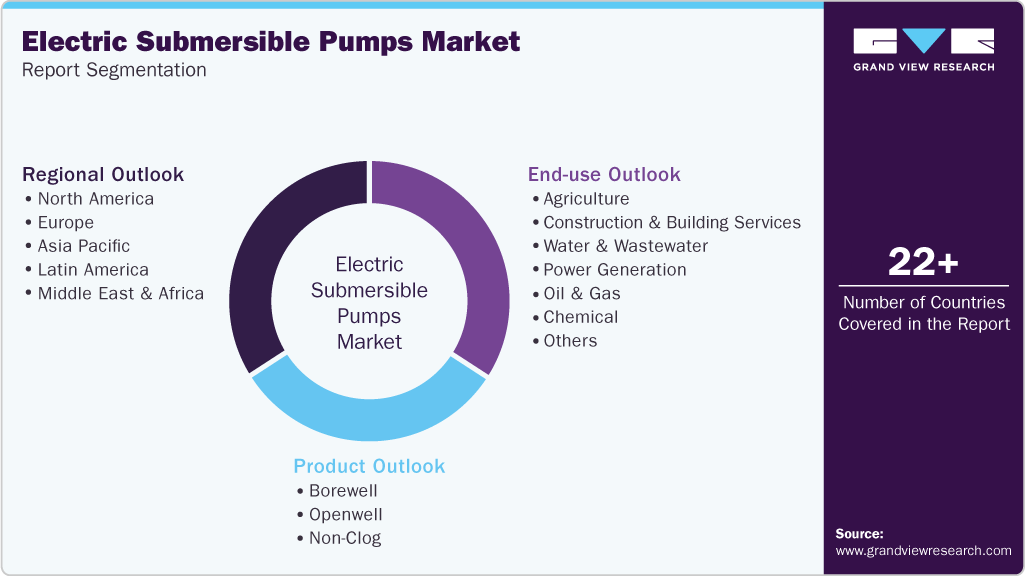
This report forecasts revenue growth at global, regional & country levels and provides an analysis on the industry trends in each of the sub-segments from 2021 to 2033. For this study, Grand View Research has segmented the global electric submersible pumps market report based on type, end-use, and region:
 To learn more about this report, Download Free Sample Report
 -
Product Outlook (Revenue, USD Million, 2021 - 2033)
-
Borewell
-
Openwell
-
Non-Clog
-
-
End-use Outlook (Revenue, USD Million, 2021 - 2033)
-
Agriculture
-
Construction & Building Services
-
Water & Wastewater
-
Power Generation
-
Oil & Gas
-
Chemical
-
Others
-
-
Regional Outlook (Revenue, USD Million, 2021 - 2033)
-
North America
-
U.S.
-
Canada
-
Mexico
-
-
Europe
-
UK
-
Germany
-
France
-
Italy
-
Spain
-
-
Asia Pacific
-
Japan
-
China
-
India
-
Australia
-
South Korea
-
-
Latin America
-
Brazil
-
Argentina
-
-
Middle East & Africa
-
South Africa
-
Saudi Arabia
-
UAE
-
-
Frequently Asked Questions About This Report
The borewell segment held the largest revenue share in 2025.
Agriculture held the largest revenue share 26.2% in 2025.
The global electric submersible pumps market size was estimated at USD 9.6 billion in 2025 and is expected to reach USD 9.9 billion in 2026.
The global electric submersible pumps market, in terms of revenue, is expected to grow at a compound annual growth rate of 5.5% from 2026 to 2033 to reach USD 14.4 billion by 2033.
Some of the key players operating in the electric submersible pumps market Xylem, Inc., Sulzer Ltd., KSB SE & Co. KGaA, Grundfos Holding A/S, Atlas Copco, Flowserve, Wilo SE, Homa Pump Technology, HCP Pump Manufacturer Co., Ltd., EBARA International Corporation, Schlumberger Limited, ITT Inc., Baker Hughes Company, Novomet, and Zenit Italia Srl.
The electric submersible pumps market is primarily driven by increasing demand for efficient fluid extraction across oil & gas, water management, agriculture, and industrial applications is driving the electric submersible pumps market.
The Asia Pacific electric submersible pumps market dominated the global revenue share in 2025 accounting for 45.4% of the share, driven by rapid industrialization, expanding infrastructure development, and increasing demand for water management and energy production.
About the Author(s)
Advanced Interior Materials Research Team
Advanced Materials · Advanced Interior MaterialsThis report was authored by the advanced interior materials research team at Grand View Research - comprising two research analysts, one senior research analyst, and one industry expert - with specialized expertise in the advanced interior materials segment of the advanced materials industry. All findings are based on proprietary advanced materials databases, executive interviews, and regulatory analysis, subject to internal peer review prior to publication.
Last Updated:
Speak to Analyst

Customize this report to your needs - add regions, segments, or data points, with 20% free customization.
Or view our licence options:


ISO 9001:2015 & 27001:2022 Certified
We are GDPR and CCPA compliant! Your transaction & personal information is safe and secure. For more details, please read our privacy policy.


