
- Home
- »
- IT Services & Applications
- »
-
Electric Vehicle Testing, Inspection, And Certification Market Report, 2033GVR Report cover

Electric Vehicle Testing, Inspection, And Certification Market (2026 - 2033)
Size, Share & Trends Analysis Report By Service Type (Testing, Inspection), By Sourcing Type, By Application, By Vehicle Type, By Industry, By Region, and Segment Forecasts
Market Size, 2025
$1.6BMarket Estimate, 2026
$1.8BMarket Forecast, 2033
$4.6BCAGR, 2026–2033
14.1%Electric Vehicle Testing, Inspection, And Certification Market Summary
The global electric vehicle testing, Inspection, and certification market size was valued at USD 1.6 billion in 2025 and is projected to grow from USD 1.8 billion in 2026 to USD 4.6 billion by 2033, at a CAGR of 14.1% from 2026 to 2033. Asia Pacific dominated the market, accounting for a largest revenue share of 33.5% in 2025. The market growth is driven by rapid advancements in electric vehicle technologies, increasing production of battery electric and hybrid vehicles, and the growing complexity of vehicle systems that require independent verification before commercialization.
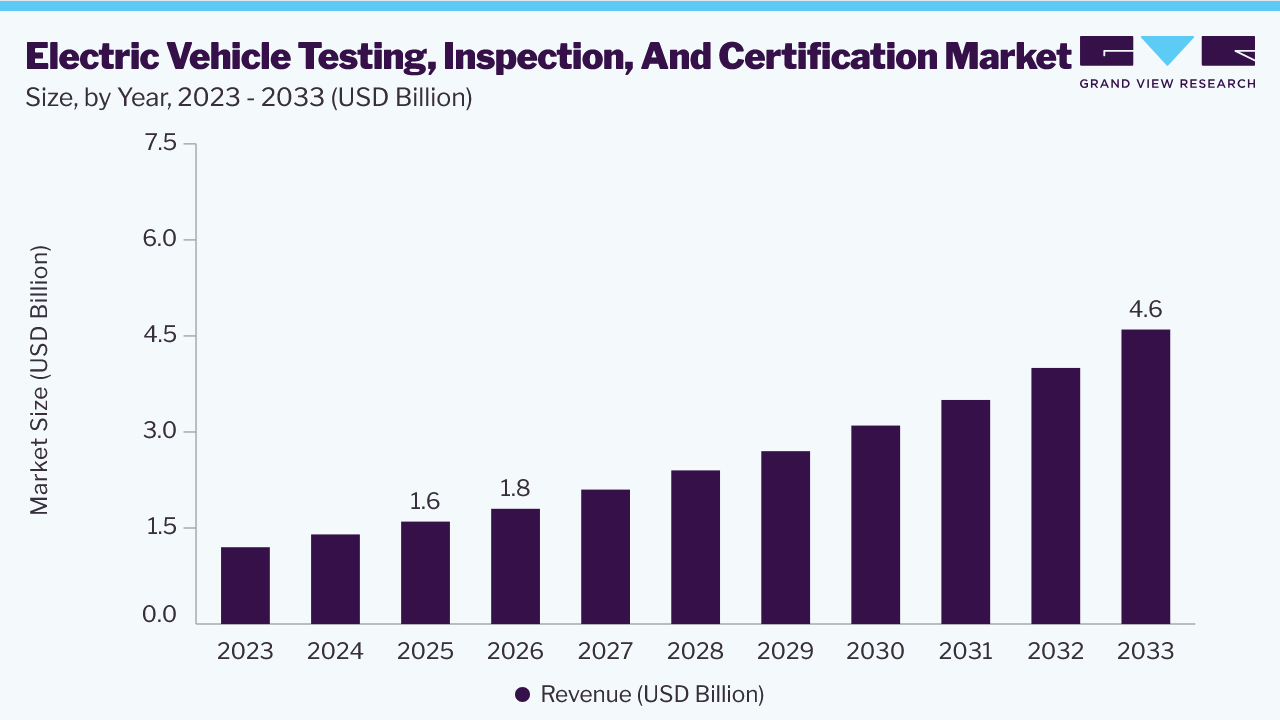 Source: Grand View Research, IR Documents, Primary Interviews, Paid DatabasesTo learn more about this report,
 Download Free Sample Report
Key Market Trends & Insights
- By service type: The testing segment held the largest market share of over 72.0% in 2025.
- By sourcing type: The in-house segment dominated the market and accounted for a share of over 58.0% in 2025.
- By application: The safety and security segment dominated the market and accounted for a share of around 52.0% in 2025.
- By vehicle type: The BEV segment accounted for the largest market revenue share of over 30.0% in 2025.
- By industry: The automotive segment held the largest market revenue share of more than 53.0% in 2025.
Regional Highlights
- Largest regional market: Asia Pacific (33.5% revenue share, 2025)
- Fastest-growing regional market: Europe (highest CAGR, 2026-2033)
Market Size & Forecast
- Market size in 2025: USD 1.6 Billion
- Estimated market size in 2026: USD 1.8 Billion
- Projected market size by 2033: USD 4.6 Billion
- CAGR (2026-2033): 14.1%
GVR research-powered AIAsk Prism AI about the electric vehicle Testing, Inspection, and certification marketGet cited answers from GVR research on market growth, segments, regulations and forecasts.Start with✓ Source-linked answers ✓ Market-specific context ✓ Traceable figuresExplore Prism AI ↗The implementation of increasingly stringent safety, quality, and regulatory requirements across global automotive markets is accelerating demand for testing, inspection, and certification services. Manufacturers are required to validate battery systems, electric powertrains, functional safety, electromagnetic compatibility, and other critical vehicle components before market approval. For instance, in June 2024, the Government of India's Bureau of Indian Standards (BIS) introduced IS 18590:2024 and IS 18606:2024, establishing mandatory safety standards for electric vehicle powertrains and battery systems. The standards require manufacturers to comply with defined testing and certification requirements before vehicle commercialization.
The continued expansion of ultra-fast charging infrastructure and next-generation battery technologies is further increasing the need for specialized testing and certification services. High-voltage charging systems, advanced battery chemistries, and connected vehicle technologies require rigorous validation to ensure operational safety, interoperability, and compliance with evolving international standards. Meanwhile, ongoing investments in research, laboratory capabilities, and advanced testing methodologies are enabling TIC providers to address the growing technical complexity of modern electric vehicles.
Analyst Perspective
The electric vehicle testing, inspection, and certification (TIC) market is becoming an essential part of the global electric mobility value chain as EV technologies grow more complex. The adoption of high-voltage batteries, advanced driver assistance systems, software-defined vehicles, and connected technologies is expanding testing requirements beyond conventional vehicle validation. At the same time, stricter safety, quality, and performance regulations are increasing the need for independent certification before commercialization. As EV platforms continue to evolve, demand for specialized testing facilities, accredited laboratories, digital validation, cybersecurity assessment, and global regulatory expertise is expected to rise, strengthening the position of advanced TIC providers.
Service Type Insights
The testing segment held the largest market share, over 72.0%, in 2025. The dominance of this segment is driven by the increasing technical complexity of electric vehicles, requiring comprehensive validation of battery systems, electric powertrains, charging systems, electromagnetic compatibility, and vehicle durability before commercialization. Automakers are expanding testing activities to evaluate the performance and reliability of next-generation technologies, including high-voltage batteries and advanced vehicle electronics. For instance, in September 2025, DEKRA expanded its Battery Test Center at the Lausitzring in Germany. According to the company, the expansion enhances testing capabilities for battery safety, performance, lifecycle, transport, and regulatory compliance. Growing investments in advanced testing infrastructure and laboratory capabilities are expected to further strengthen the testing segment.
The certification segment is expected to grow at the fastest CAGR during the forecast period, driven by the increasing number of regulatory requirements governing electric vehicle safety, battery performance, charging interoperability, and software-enabled vehicle functions across global markets. As manufacturers introduce connected, software-defined, and highly automated electric vehicles, certification processes are expanding to include cybersecurity, functional safety, and software validation alongside conventional vehicle compliance. The growing frequency of over-the-air software updates and continuous product enhancements is further encouraging the development of updated certification frameworks, creating sustained demand for independent certification services throughout the forecast period.
Sourcing Type Insights
The in-house segment dominated the market, accounting for a share of over 58.0% in 2025. The segment is driven by major automotive manufacturers increasingly establishing dedicated testing facilities to accelerate product development, protect proprietary technologies, and streamline vehicle validation before commercialization. Conducting testing and validation internally enables manufacturers to coordinate engineering, product development, and compliance activities more efficiently while reducing development timelines for next-generation electric vehicles. For instance, in July 2024, Mercedes-Benz opened the eCampus battery research and testing center in Stuttgart-Untertürkheim, Germany. The facility supports research, development, and testing of next-generation battery cells as part of its battery technology strategy. The expansion reflects increasing investments in in-house battery testing capabilities.
The outsourced segment is projected to grow significantly over the forecast period, driven by increasing demand for independent testing expertise, accredited laboratories, and specialized certification services that support evolving global regulatory requirements. Small and mid-sized vehicle manufacturers, battery developers, and component suppliers increasingly rely on third-party TIC providers to access advanced testing infrastructure without making substantial capital investments. The expanding complexity of battery technologies, charging systems, and vehicle electronics is expected to further strengthen demand for outsourced testing, inspection, and certification services.
Application Insights
The safety and security segment dominated the market, accounting for around 52.0% in 2025, owing to increasingly stringent regulatory requirements governing electric vehicle safety, battery reliability, crash performance, and functional safety. Manufacturers conduct extensive testing and validation of battery systems, electrical components, and high-voltage architectures before commercial deployment to comply with national and international standards. Growing emphasis on vehicle reliability, passenger protection, and regulatory compliance continues to increase demand for testing, inspection, and certification services across the electric vehicle industry.
The outsourced segment is projected to grow significantly over the forecast period. Growth of this segment is driven by the rapid adoption of connected vehicle technologies, software-defined vehicle architecture, and over-the-air software update capabilities. Increasing integration of telematics, cloud connectivity, and vehicle-to-everything (V2X) communication is expanding the scope of TIC services to include cybersecurity validation, software verification, and communication protocol testing. As connected electric vehicles become more digitally integrated, manufacturers are increasingly seeking independent assessment services to ensure compliance with evolving cybersecurity and data protection standards.
Vehicle Type Insights
The BEV (battery electric vehicle) segment accounted for the largest market revenue share of over 30.0% in 2025. The escalating global shift towards sustainable, environmentally friendly transportation has fueled demand for BEVs, necessitating comprehensive testing and certification services. In addition, technological advancements in battery technology and the growing complexity of electric propulsion systems necessitate specialized TIC services tailored to the unique challenges posed by battery-electric vehicles. Governments worldwide are implementing stringent regulations and standards for BEVs, driving the need for rigorous testing to ensure compliance.
The FCEV (fuel cell electric vehicle) segment is projected to grow significantly over the forecast period. The growing emphasis on sustainable and zero-emission transportation solutions has heightened the importance of FCEVs in the global automotive market. Rigorous testing and certification are imperative to ensure the secure integration of hydrogen fuel cells and to address concerns related to storage, transportation, and utilization. In addition, ongoing advancements in hydrogen fuel cell technology are propelling the segment's growth.
Industry Insights
The automotive segment held the largest market revenue share at more than 53.0% in 2025. The automotive segment in the electric vehicle TIC market is emerging, driven by rising sales of battery electric vehicles (BEVs) and plug-in hybrid electric vehicles (PHEVs). BEVs are gaining popularity, driven by factors such as extended range, improved performance, cost reductions, and expanded charging infrastructure. PHEVs continue to be in demand, offering a blend of electric power for short trips and conventional engine range for longer journeys. Premium EV brands such as BMW AG, Tesla, and Mercedes-Benz AG are increasing their market share by offering high-quality, high-performance EV models.
The defense segment is projected to grow significantly over the forecast period. Governments worldwide are actively pursuing the integration of electric and hybrid-electric vehicles into military operations to enhance sustainability. This initiative involves developing various military vehicles, such as armored carriers and logistics vehicles, with a focus on reducing fuel consumption, maintenance costs, and environmental impact. Collaborations between defense contractors and government agencies promote innovation in electric vehicle technologies, energy efficiency, and autonomy. Regulatory standards and certifications are being established to ensure the safety and compliance of electric defense vehicles.
Regional Insights
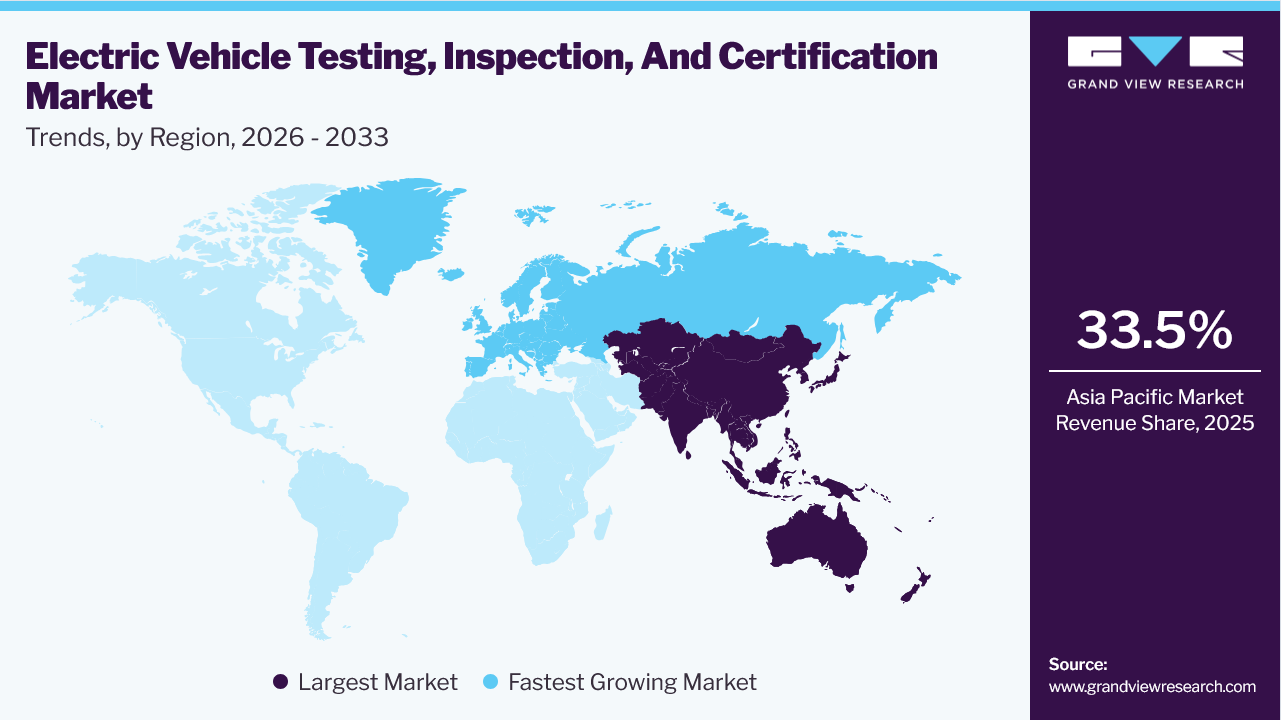
Asia Pacific dominated the market, accounting for approximately 33.5% of the market share in 2025. The region serves as the global manufacturing hub for electric vehicles and battery components, resulting in a substantial need for testing, inspection, and certification services throughout product development and production. Rapid expansion of domestic battery manufacturing, rising electric-vehicle exports, and the establishment of dedicated testing infrastructure are strengthening the region's compliance ecosystem. Governments across the region are also investing in advanced testing capabilities to support evolving safety and quality requirements. In 2025, the Government of India inaugurated a state-of-the-art Electric Vehicle Testing Facility at the Regional Testing Laboratory in Alipore, Kolkata. The facility conducts electrical, climatic, mechanical, and material safety testing for EV batteries in accordance with national and international standards. The continuous expansion of testing infrastructure and manufacturing capacity is expected to sustain long-term demand for EV TIC services across Asia Pacific.
 To learn more about this report, Download Free Sample Report
Europe Electric Vehicle Testing, Inspection, And Certification Market Trends
Europe is expected to grow at a significant CAGR during the forecast period. The region is characterized by a mature automotive industry and one of the world's most comprehensive regulatory frameworks governing vehicle safety, battery performance, and homologation. As electric vehicle technologies continue to evolve, manufacturers are increasing investments in independent testing and validation to comply with stringent European technical standards before commercial deployment. Growing development of battery systems, e-powertrains, charging technologies, and software-defined vehicle platforms is further expanding the scope of TIC services. For instance, in October 2024, Applus+ IDIADA inaugurated its EV and Battery Innovation Center in Santa Oliva, Spain. The facility expands testing capabilities for electric vehicles, battery packs, e-powertrains, charging systems, and vehicle validation. These developments are expected to strengthen Europe's position as a key market for advanced EV testing and certification services.
Key Electric Vehicle Testing, Inspection, And Certification Company Insights
To address rapidly growing market competition, key industry participants are adopting strategies such as enhanced R&D efforts, service differentiation, and collaborations to gain greater technological expertise and other capabilities.
Key Electric Vehicle Testing, Inspection, And Certification Companies
The following key companies have been profiled for this study on the electric vehicle testing, Inspection, and certification market:
-
Bureau Veritas SA
-
DEKRA SE
-
Element Materials Technology Group Limited
-
Intertek Group plc
-
SGS Société Générale de Surveillance SA
-
TÜV SÜD AG
-
TÜV Rheinland AG
-
BSI Group
-
UL LLC
Recent Developments
- In June 2025, TÜV Rheinland and Seres Group signed a Memorandum of Understanding (MoU) to expand their collaboration in vehicle testing, inspection, and certification. Under the agreement, TÜV Rheinland is expected to provide testing, certification, inspection, and technical training services to support Seres' international expansion and vehicle compliance activities.
- In August 2024, UL Solutions expanded its Advanced Battery Testing Laboratory in Auburn Hills, Michigan, adding capabilities for electric vehicle battery performance testing, abuse testing, safety evaluation, and certification services.
Electric Vehicle Testing, Inspection, And Certification Market Report Scope
Report Attribute
Details
Market size in 2025
USD 1.6 billion
Estimated Market size in 2026
USD 1.8 billion
Projected Market size by 2033
USD 4.6 billion
Growth rate
CAGR of 14.1% from 2026 to 2033
Base year for estimation
2025
Historical data
2021 – 2024
Forecast period
2026 – 2033
Quantitative units
Revenue in USD billion, and CAGR from 2026 to 2033
Report coverage
Revenue forecast, company ranking, competitive landscape, growth factors, and trends
Segments covered
Service type, sourcing type, application, vehicle type, industry, region
Regional Scope
North America; Europe; Asia Pacific; Latin America; Middle East & Africa
Country scope
U.S.; Canada; Mexico; UK; Germany; France; China; India; Japan; Australia; South Korea; Brazil; KSA; South Africa; UAE
Key companies profiled
Bureau Veritas SA; DEKRA SE; Element Materials Technology Group Limited; Intertek Group plc; SGS Société Générale de Surveillance SA; TÜV SÜD AG; TÜV Rheinland AG; BSI Group; UL LLC.
Customization scope
Free report customization (equivalent up to 8 analysts working days) with purchase. Addition or alteration to country, regional & segment scope.
Pricing and purchase options
Avail of customized purchase options to meet your exact research needs. Explore purchase options
Global Electric Vehicle Testing, Inspection, and Certification Market Report Segmentation
This report forecasts revenue growth at the regional and country levels and provides an analysis of the latest industry trends and opportunities in each sub-segment from 2021 to 2033. For this study, Grand View Research has segmented global electric vehicle testing, inspection, and certification market report based on service type, sourcing type, application, vehicle type, industry, and region.
-
Service Type Outlook (Revenue, USD Billion, 2021 - 2033)
-
Testing
-
Battery Testing
-
Electric E-Motor Testing
-
Electromagnetic Compatibility (EMC) Testing
-
Component Testing
-
-
Inspection
-
Certification
-
-
Sourcing Type Outlook (Revenue, USD Billion, 2021 - 2033)
-
In-House
-
Outsourced
-
-
Application Outlook (Revenue, USD Billion, 2021 - 2033)
-
Safety & Security
-
Connectors
-
Communication
-
EV Charging
-
-
Vehicle Type Outlook (Revenue, USD Billion, 2021 - 2033)
-
BEV
-
PHEV
-
FCEV
-
Others
-
-
Industry Outlook (Revenue, USD Billion, 2021 - 2033)
-
Automotive
-
Aerospace
-
Defense
-
Others
-
-
Regional Outlook (Revenue, USD Billion, 2021 - 2033)
-
North America
-
U.S.
-
Canada
-
Mexico
-
-
Europe
-
Germany
-
UK
-
France
-
-
Asia Pacific
-
China
-
Japan
-
India
-
South Korea
-
Australia
-
-
Latin America
-
Brazil
-
-
Middle East & Africa (MEA)
-
KSA
-
UAE
-
South Africa
-
-
Frequently Asked Questions About This Report
Asia Pacific dominated with an approximately 33.5% revenue share in 2025.
Key players in the market include Bureau Veritas SA, DEKRA SE, Element Materials Technology Group Limited, Intertek Group plc, SGS Société Générale de Surveillance SA, TÜV SÜD AG, TÜV Rheinland AG, BSI Group, and UL LLC. and others.
The global electric vehicle testing, Inspection, and certification market is expected to grow at a CAGR of 14.1% from 2026 to 2033, reaching USD 4.6 billion.
The global electric vehicle testing, Inspection, and certification market size was valued at USD 1.6 billion in 2025 and is estimated at USD 1.8 billion for 2026.
The testing segment accounted for the largest revenue share of over 72.0% in 2025.
About the Author(s)
IT Services & Applications Research Team
Technology · IT Services & ApplicationsThis report was authored by the it services & applications research team at Grand View Research - comprising two research analysts, one senior research analyst, and one industry expert - with specialized expertise in the it services & applications segment of the technology industry. All findings are based on proprietary technology databases, executive interviews, and regulatory analysis, subject to internal peer review prior to publication.
Last Updated:
Speak to Analyst

Customize this report to your needs - add regions, segments, or data points, with 20% free customization.
Or view our licence options:


ISO 9001:2015 & 27001:2022 Certified
We are GDPR and CCPA compliant! Your transaction & personal information is safe and secure. For more details, please read our privacy policy.


