
- Home
- »
- Power Distribution
- »
-
Electrical Bushing Market Size & Share Report, 2026-2033GVR Report cover

Electrical Bushing Market (2026 - 2033)
Size, Share & Trends Analysis Report By Type (Oil Impregnated Paper, Resin Impregnated Paper), By Insulation (Porcelain, Polymeric), By Voltage (Medium, High, Extra-High), By Application (Transformer, Switchgear), By Region, And Segment Forecasts
Market Size, 2025
$4.1BMarket Estimate, 2026
$4.3BMarket Forecast, 2033
$5.9BCAGR, 2026–2033
4.6%Electrical Bushing Market Summary
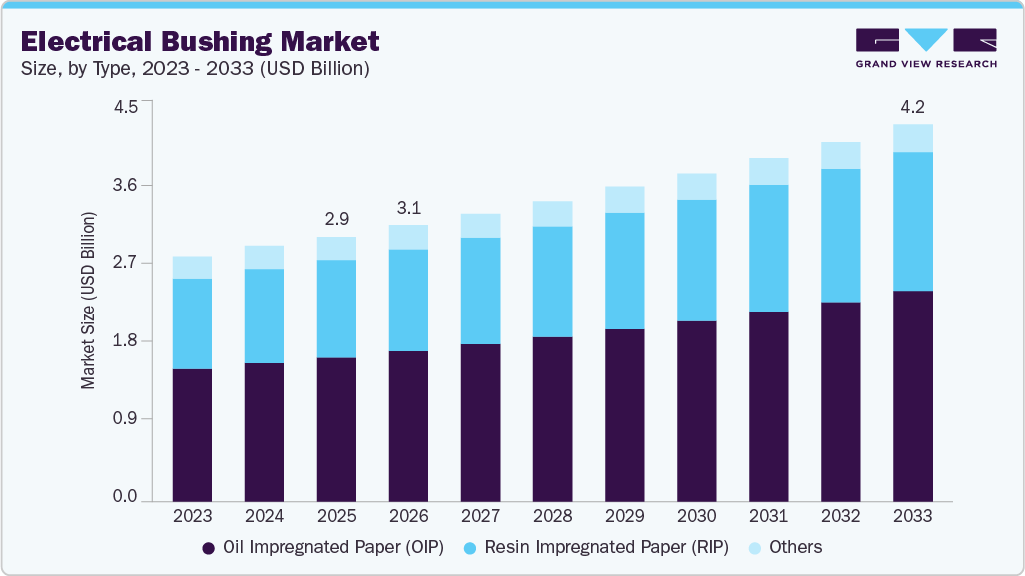
The global electrical bushing market size was valued at USD 4.1 billion in 2025 and is projected to grow from USD 4.3 billion in 2026 to USD 5.9 billion by 2033, at a CAGR of 4.6% from 2026 to 2033. Asia Pacific dominated the market, accounting for a revenue share of 38.9% in 2025. The rising demand for electricity across applications such as electric vehicles (EVs), consumer electronics, data centers, and industrial equipment is driving investments in power generation, transmission, and distribution infrastructure.
 Source: Grand View Research, IR Documents, Primary Interviews, Paid DatabasesTo learn more about this report,
 Download Free Sample Report
Key Market Trends & Insights
- By type: Oil impregnated paper segment dominated the market with a share of 54.1% in 2025.
- By insulation: Porcelain segment dominated the market with a share of 57.5% in 2025.
- By voltage: Medium voltage segment dominated the market with a share of over 50.7% in 2025.
Regional Highlights
- Largest regional market: Asia Pacific (38.9% revenue share, 2025)
- By country: China held the largest market share in 2025.
Market Size & Forecast
- Market size in 2025: USD 4.1 Billion
- Estimated market size in 2026: USD 4.3 Billion
- Projected market size by 2033: USD 5.9 Billion
- CAGR (2026-2033): 4.6%
Three ways to get this report
Buy it, customize it, or ask a question.Ask an Analyst
Analyst response in 1 business day
- AccessReport author, directly
- Reply timeWithin 1 working day
- No sales callDirect answer only
- FormatEmail reply
- CostFree, no cost
Get the Full Report
What the study covers
- FormatsPDF · Excel · Dashboard
- Timeline2026–2033 annual, 2025 base
- Coverage20+ countries, 5 regions
- Companies10+ key players profiled
Customize the Report
20% free customization
- IncludeCountries, segments, points
- TailorTo your product definition
- ExtendDeeper competitor detail
- OrA fully bespoke study
- Turnaround5–10 working days
 To learn more about this report, Download Free Sample Report
Market Dynamics
The market is being shaped by the combined impact of grid modernization, reliability requirements, technological advancements, and changing procurement priorities. Utilities and industrial buyers are increasingly demanding high-performance bushings with improved insulation, longer service life, digital monitoring, and condition-monitoring capabilities, supporting adoption of RIP, RIS, composite, and advanced bushing technologies. At the same time, stricter testing standards and evolving IEC and IEEE requirements are raising qualification requirements for manufacturers and suppliers. Raw material price fluctuations, supplier localization, and supply chain considerations are influencing manufacturing costs and sourcing strategies, while retrofit and replacement demand is driven by the need to extend the operating life of aging transformers and upgrade existing grid infrastructure.
Expansion and modernization of transmission and distribution (T&D) networks are key demand drivers for the market, as new substations, transformers, reactors, and switchgear require bushings for insulation and current transmission. Rising electricity demand, higher peak loads, grid interconnections, and aging infrastructure are encouraging utilities to expand network capacity. At the same time, aging transformer fleets are driving demand for replacements and retrofits, as utilities refurbish existing assets and replace individual components to avoid the higher costs and longer procurement timelines associated with new equipment.
Growing T&D investment is also raising performance requirements for electrical bushings, particularly in higher-voltage applications. New projects increasingly require improved dielectric performance, thermal capability, mechanical strength, environmental resistance, and condition monitoring. As a result, grid expansion is supporting demand for conventional bushings while also increasing adoption of high-voltage, dry-type, composite, and digitally monitored solutions. Overall, new network development, transformer installations, asset replacement, and reliability upgrades are expected to sustain demand across both new-build and aftermarket applications.
High initial and installation costs can restrain the adoption of electrical bushings, particularly HV, EHV, and advanced RIP technologies, where specialized insulation materials, precision manufacturing, testing, installation equipment, and skilled technicians increase total project costs. The cost burden is higher for advanced and customized solutions with higher voltage ratings or integrated monitoring capabilities, which can lead buyers to prioritize established lower-cost options or defer replacements when budgets are constrained. Although advanced bushings can improve reliability and reduce maintenance needs over their service life, higher upfront investment remains a key barrier, especially in cost-sensitive projects and emerging markets.
The shift toward RIP and dry-type bushing technologies presents an emerging business opportunity in the market, driven by demand for safer, lower-maintenance, and environmentally preferable alternatives to oil-impregnated designs. RIP and composite bushings eliminate the risk of oil leakage and reduce fire-related concerns while offering improved insulation performance, mechanical strength, and suitability for modern transformer and grid applications. Their adoption is particularly relevant in new high-voltage installations and refurbishment projects, where utilities and equipment manufacturers seek higher reliability and reduced lifecycle maintenance. In 2025, Hitachi Energy expanded its dry-type bushing portfolio with the introduction of the GOE dry bushing, targeting high-voltage transformer applications.
Analyst Perspective
The market is being shaped by grid expansion, transformer replacement, and the growing need for higher reliability across aging power infrastructure. A key trend is the shift from conventional oil-impregnated porcelain bushings toward RIP, dry-type, and composite designs, supported by safety, maintenance, and environmental considerations. Digital condition monitoring is also emerging as a differentiator, enabling utilities to identify insulation deterioration and reduce unplanned transformer outages. Demand is therefore shifting from basic replacement volumes toward higher-performance, application-specific bushing solutions, particularly in HV and EHV networks.
Type Insights
The oil impregnated paper segment dominated the market and accounted for a share of 54.1% in 2025. OIP electrical bushings are highly regarded for their exceptional reliability and performance in high-voltage applications, making these characteristics key drivers of demand. In power transmission and distribution networks, ensuring the uninterrupted flow of electricity over long distances and under varying environmental conditions is critical. OIP bushings are designed to provide superior insulation strength and thermal stability, which are essential for managing high-voltage levels without compromising operational safety or efficiency. Their robust construction and ability to withstand high electrical stress make them a preferred choice for transformers, circuit breakers, and other critical electrical equipment.
Resin-impregnated paper (RIP) electrical bushing segment is expected to register the fastest CAGR of 5.9% during the forecast period. This is driven by the growing demand for enhanced safety and environmental sustainability in modern electrical infrastructure. Unlike traditional OIP bushings, RIP bushings are dry and oil-free, significantly reducing the risk of fire hazards and environmental contamination in the event of failure. This makes them particularly attractive for deployment in high-risk environments, indoor substations, and densely populated urban areas, where safety, reliability, and environmental compliance are critical concerns. As utilities increasingly prioritize low-maintenance and eco-friendly solutions, the adoption of RIP bushings continues to gain momentum.
Insulation Insights
The porcelain segment led the market, accounting for 57.5% of total revenue in 2025. Porcelain-insulated bushings are widely preferred due to their high durability, long service life, and strong resistance to mechanical, thermal, and electrical stresses. As a ceramic-based material, porcelain provides excellent protection against weather, pollution, moisture, and extreme temperatures, enabling reliable long-term performance in outdoor and high-voltage installations. These characteristics make porcelain bushings particularly suitable for substations and transmission networks operating in harsh environmental conditions, supporting their continued dominance in the market.
Polymeric-insulated electrical bushings are anticipated to grow at the fastest CAGR, 6.2%, from 2026 to 2033. This segment is witnessing increasing adoption due to its lightweight construction, design flexibility, and ease of installation. Manufactured from materials such as silicone rubber and epoxy resin, polymeric bushings offer significantly lower weight than traditional porcelain designs, reducing transportation, handling, and installation costs. Their compact, versatile design makes them well-suited for mobile substations, urban power networks, and space-constrained installations. In addition, improved resistance to seismic activity and mechanical impact further strengthens their appeal in modern grid infrastructure.
Glass-insulated electrical bushings are driven by their superior dielectric performance and inherent transparency, which enhances operational reliability and maintenance efficiency. Glass offers high electrical insulation strength and stable performance under high-voltage conditions, making it suitable for critical transmission and distribution applications. The transparent structure enables easy visual inspection for cracks, contamination, or internal defects without dismantling equipment, reducing downtime and maintenance costs.
Voltage Insights
The medium-voltage segment dominated the market, accounting for a share of 50.7% of total revenue in 2025. The strong demand for medium-voltage bushings is primarily driven by the ongoing expansion of urban infrastructure, industrial facilities, and commercial developments. As cities grow and industrial activities increase, the need for efficient and reliable power distribution networks operating within the 1 kV to 36 kV range continues to rise. Medium voltage bushings play a critical role in transformers, switchgear, and distribution equipment that supply electricity to residential, commercial, and industrial consumers.
The extra-high-voltage (EHV) segment is anticipated to register the fastest CAGR of 5.8% over the forecast period, driven by growing investments in long-distance power transmission, ultra-high-voltage (UHV) networks, and HVDC infrastructure. EHV bushings are essential components in large transmission transformers, reactors, GIS, and converter stations, where higher electrical stresses require advanced insulation and performance capabilities. Increasing integration of renewable energy, cross-border grid interconnections, and grid modernization projects are further supporting demand for high-value EHV bushings. The development of technologies such as 800 kV DC RIP bushings for UHVDC projects and transformer bushings rated up to 1,200 kV highlights the industry's focus on supporting next-generation transmission systems and expanding high-voltage network capacity.
Application Insights
The transformer segment dominated the market, accounting for 56.4% of total revenue in 2025. The strong demand for transformer-mounted bushings is driven by the growing need for a reliable, uninterrupted power supply across the residential, commercial, and industrial sectors. Transformers play a critical role in stepping up and stepping down voltage levels for efficient power transmission and distribution, making bushing performance essential for overall system reliability. Rising global electricity consumption, supported by population growth, rapid urbanization, and industrial expansion is increasing investments in new transformer installations and the replacement of aging units.
 To learn more about this report, Download Free Sample Report
The switchgear segment is expected to grow at a CAGR of 5.2% over the forecast period. This is supported by the continuous expansion of electrical networks and rising investments in power system protection and automation. Switchgear systems, including circuit breakers, isolators, and protective devices are essential for controlling, monitoring, and safeguarding electrical equipment across transmission and distribution networks. Increasing electricity demand from industrial facilities, data centers, and electrified transportation systems is driving the adoption of advanced and compact switchgear solutions. Electrical bushings in switchgear enable the safe passage of conductors through grounded enclosures, ensuring operational safety and system stability.
Regional Insights
Asia Pacific Electrical Bushing Market Trends
The electrical bushing industry in Asia Pacific held the largest share of 38.9% of the global market in 2025. The Asia Pacific market is also expected to grow at the fastest CAGR of 4.9% over the forecast period. The market is experiencing robust growth due to rapid urbanization, industrial expansion, and large-scale investments in power generation and transmission infrastructure. Major economies such as China, India, Japan, and Southeast Asian countries are expanding high-voltage and ultra-high-voltage networks to support rising electricity demand and the integration of renewable energy.
 To learn more about this report, Download Free Sample Report
China’s electrical bushing industry is supported by continued investment in ultra-high-voltage (UHV) transmission, distribution network upgrades, and transformer capacity expansion. State Grid’s annual grid investment exceeded USD 80 billion in 2024 and was expected to surpass USD 90 billion in 2025, reflecting the country’s strong focus on grid expansion and modernization. The development of UHV transmission projects, renewable energy integration, and replacement of aging power equipment is sustaining demand for high-voltage and EHV bushings. At the same time, grid modernization is creating opportunities for RIP, dry-type, composite, and condition-monitoring-enabled bushing technologies.
North America Electrical Bushing Market Trends
The electrical bushing industry in North America is expected to grow at the second-fastest CAGR of 4.7% from 2026 to 2033. The market is driven by ongoing investments in grid modernization, replacement of aging transmission infrastructure, and the expansion of renewable energy capacity across the region. Utilities in the U.S. and Canada are increasingly upgrading power transformers and substations to improve reliability and resilience against extreme weather events, supporting steady demand for high-voltage and medium-voltage bushings.
U.S. Electrical Bushing Market Trends
The U.S. electrical bushing industry is driven by extensive programs to upgrade aging power infrastructure, strengthen grid resilience, and support the integration of renewable and distributed energy resources. Federal and state-level investments in transmission expansion, wildfire mitigation, and substation modernization are increasing demand for advanced bushings with enhanced insulation performance and digital monitoring capabilities. In addition, the growing adoption of electric vehicles, data centers, and energy storage systems is contributing to higher electricity loads, further supporting replacement and new installation demand.
Latin America Electrical Bushing Market Trends
The electrical bushing industry in Latin America is primarily driven by power transmission expansion, renewable energy projects, and grid reliability improvement initiatives in countries such as Brazil, Mexico, and Chile. Growing investments in wind, solar, and hydropower facilities are driving demand for new transformers and substation equipment, in turn supporting demand for high-voltage bushings. In addition, efforts to reduce transmission losses and improve network stability are encouraging utilities to replace aging infrastructure with modern, high-performance insulation systems.
Europe Electrical Bushing Market Trends
The electrical bushing industry in Europe is supported by a strong regulatory focus on energy efficiency, decarbonization, and cross-border power transmission projects. Countries such as Germany, France, and the UK are investing in high-voltage direct current (HVDC) corridors, offshore wind connections, and grid reinforcement programs, which require high-performance bushings for transformers and gas-insulated substations. The region is also witnessing growing demand for environmentally friendly, dry-type bushings that align with strict environmental and safety standards.
Middle East & Africa Electrical Bushing Market Trends
The electrical bushing industry in the Middle East & Africa is supported by large-scale investments in power generation, transmission, and urban infrastructure development. Gulf countries are expanding grid capacity to support industrial zones, smart cities, and renewable energy projects, while several African nations are focusing on rural electrification and cross-border transmission lines. Harsh climatic conditions, including high temperatures and dust exposure, are also driving demand for durable, high-reliability bushings designed for extreme operating environments.
Key Electrical Bushing Company Insights
Some of the key players operating in the global market include ABB Group and Siemens Energy, among others.
-
ABB Group is a major participant in the market, supplying bushing technologies for transformers, switchgear, and high-voltage substations. Its portfolio includes oil-impregnated paper (OIP), resin-impregnated paper (RIP), and dry-type bushings designed for high-voltage applications. The company’s capabilities in insulation technology, grid modernization, and digital asset monitoring support the development of reliable and advanced bushing solutions. ABB’s broad power transmission portfolio and focus on grid reliability support its participation in the market.
-
Siemens Energy is a prominent participant in the market, supplying high-voltage and ultra-high-voltage bushing solutions for transformers, gas-insulated switchgear, and substations. Its portfolio supports power transmission applications requiring high electrical insulation performance, reliability, and operational safety. The company combines insulation technology, high-voltage engineering, and digital grid solutions to support modern transmission infrastructure. Siemens Energy’s strong presence in power transmission and grid modernization supports its participation in the market.
Key Electrical Bushing Companies:
The following key companies have been profiled for this study on the electrical bushing market
-
ABB Group
-
TRENCH Group
-
GE Vernova
-
Eaton
-
Elliot Industries
-
Gipro GMBH
-
RHM International
-
Toshiba
-
Webster-Wilkinson
-
Siemens Energy
-
Nexans
Competitive Benchmarking
Category
Operating Strategies
Competitive Edge
Weakness
Established Players (ABB Group, TRENCH Group, GE Vernova, Eaton, Toshiba, Siemens Energy, Nexans)
- Expanding high-voltage and transformer-bushing capabilities across major grid markets.
- Investing in dry-type, RIP/RIS, composite, and advanced insulation technologies.
- Leveraging global manufacturing, testing, engineering, and customer networks.
- Strong brands and established relationships with utilities and transformer manufacturers.
- Broad coverage of high-voltage, HVDC, transformer, GIS, and specialized applications.
- Strong engineering and R&D capabilities support customized and high-voltage solutions.
- High manufacturing complexity for high- and ultra-high-voltage bushings.
- Significant investment required for specialized production and testing.
- Large organizational structures can result in longer development cycles.
Emerging Players (Elliot Industries, GIPRO GmbH, RHM International, Webster-Wilkinson)
- Focusing on specialized bushing, insulation, epoxy, and dry-type solutions.
- Developing customized products for transformer, switchgear, measurement, and high-voltage applications.
- Strengthening focused manufacturing and engineering capabilities.
- Flexible designs for specialized customer requirements.
- Strong technical expertise in targeted voltage classes and insulation systems.
- Specialized capabilities enable participation in niche transformer and electrical-equipment applications.
- Smaller scale and geographic reach than multinational competitors.
- Lower brand visibility in major international utility projects.
- Greater dependence on specialized applications and selected customers.
Recent Developments
- In May 2026, Hitachi Energy launched two transformer bushing innovations at CWIEME 2026, the AirRIP Flex Cable Termination Bushing (CTB) and AirRIP Flex AF 800 kV. The AirRIP Flex CTB is a fully dry, plug-in outdoor bushing for high-voltage cable-end terminations, developed in collaboration with Prysmian, while the AirRIP Flex AF 800 kV extends the company’s dry-type RIP bushing technology to 800 kV AC transformer applications using alternative fluids. The launches strengthen Hitachi Energy’s portfolio of dry-type and environmentally preferable bushing technologies for next-generation high-voltage grid applications.
Electrical Bushing Market Report Scope
Report Attribute
Details
Market Definition
The electrical bushing market represents revenue generated from the sale of OIP, RIP, and other bushing types used in transformers, switchgear, substations, T&D equipment, and other electrical power systems. The Others segment includes applications such as circuit breakers, generators, and wall penetrations, where bushings provide electrical insulation and enable safe conductor passage.
Market size in 2025
USD 4.1 billion
Estimated market size in 2026
USD 4.3 billion
Projected market size by 2033
USD 5.9 billion
Growth rate
CAGR of 4.6% from 2026 to 2033
Base year for estimation
2025
Historical data
2021 - 2024
Forecast period
2026 - 2033
Quantitative Units
Revenue in USD billion and CAGR from 2026 to 2033
Report coverage
Revenue forecast, competitive landscape, growth factors, and trends
Segments covered
Type, insulation, voltage, application, and region
Regional scope
North America; Europe; Asia Pacific; Latin America; Middle East & Africa
Country scope
U.S.; Canada; Mexico; Germany; France; UK; Italy; Spain; China; India; Japan; South Korea; Australia; Brazil; Argentina; Saudi Arabia; South Africa
Key companies profiled
ABB Group; TRENCH Group; GE Vernova; Eaton; Elliot Industries; Gipro GMBH; RHM International; Toshiba; Webster-Wilkinson; Siemens Energy; Nexans
Customization scope
Free report customization (equivalent up to 8 analysts working days) with purchase. Addition or alteration to country, regional & segment scope.
Pricing and purchase options
Avail customized purchase options to meet your exact research needs. Explore purchase options
Global Electrical Bushing Market Report Segmentation
This report forecasts revenue growth at global, regional, and country levels and provides an analysis of the latest industry trends in each of the sub-segments from 2021 to 2033. For this study, Grand View Research has segmented the global electrical bushing market report based on type, insulation, voltage, application, and region.
-
Type Outlook (Revenue, USD Billion, 2021 - 2033)
-
Oil Impregnated Paper (OIP)
-
Resin Impregnated Paper (RIP)
-
Others
-
-
Insulation Outlook (Revenue, USD Billion, 2021 - 2033)
-
Porcelain
-
Polymeric
-
Glass
-
-
Voltage Outlook (Revenue, USD Billion, 2021 - 2033)
-
Medium Voltage
-
High Voltage
-
Extra-High Voltage
-
-
Application Outlook (Revenue, USD Billion, 2021 - 2033)
-
Transformer
-
Switchgear
-
Others
-
-
Regional Outlook (Revenue, USD Billion, 2021 - 2033)
-
North America
-
U.S.
-
Canada
-
Mexico
-
-
Europe
-
UK
-
Germany
-
France
-
Italy
-
Spain
-
-
Asia Pacific
-
China
-
India
-
Japan
-
Australia
-
South Korea
-
-
Latin America
-
Brazil
-
Argentina
-
-
Middle East & Africa
-
Saudi Arabia
-
South Africa
-
-
Research Methodology
The electrical bushing market figures in this report are based on a proven research process that combines executive interviews with secondary research from proprietary databases, company filings, and recognized regulatory and institutional sources. Market size is built through value-chain sizing-reconciling supply-side and demand-side estimates-and triangulated with bottom-up and top-down approaches. Every estimate passes multiple levels of expert validation before publication, with each electrical bushing segment quantified using the revenue-capture definitions in the table below.
Segment Definition
Segment - Type
Revenue capture definition
Oil Impregnated Paper (OIP)
Revenue generated from the sale of electrical bushings insulated with oil-impregnated paper.
Resin Impregnated Paper (RIP)
Revenue captures sales of electrical bushings using resin-impregnated paper insulation.
Others
Revenue covers sales of electrical bushings based on alternative insulation technologies and materials, including porcelain, composite, and synthetic resin systems.
Segment - Insulation
Revenue capture definition
Porcelain
Comprises revenue from electrical bushings using porcelain as the primary external insulating material.
Polymeric
Revenue includes sales of electrical bushings incorporating polymeric materials such as silicone rubber and EPDM.
Glass
Revenue generated from the sale of electrical bushings incorporating glass as the primary insulating material.
Segment - Voltage
Revenue capture definition
Medium Voltage
Revenue covers sales of electrical bushings designed for medium-voltage power equipment and systems.
High Voltage
Comprises revenue from high-voltage electrical bushings used in transformers, switchgear, transmission equipment, and substations.
Extra-High Voltage
Revenue captures sales of electrical bushings designed for extra-high-voltage transmission transformers, substations, and grid infrastructure.
Segment - Application
Revenue capture definition
Transformer
Revenue generated from electrical bushings sold for power and distribution transformer applications.
Switchgear
Revenue includes sales of electrical bushings used in switchgear and related switching equipment.
Others
Comprises revenue from electrical bushings sold for reactors, circuit breakers, generators, and other specialized power equipment.
Estimation Model
Layer Name
Key Question
Description
Demand Layer
Which factors drive demand for electrical bushings?
Assess demand arising from new installations, capacity additions, replacement of aging equipment, and grid modernization across transformers, switchgear, substations, transmission and distribution networks, and other power equipment.
Bushing Type & Specification Layer
Which bushing types and specifications contribute to market revenue?
Evaluate electrical bushing demand across OIP, RIP, and Other types, with further allocation by porcelain, polymeric, and glass insulation, and by medium-, high-, and extra-high-voltage ratings based on equipment requirements, technology adoption, and applicable selling prices.
Application Layer
Which applications generate demand for electrical bushings?
Allocate bushing sales across transformers, switchgear, and other applications, including reactors, circuit breakers, generators, and specialized power equipment, based on equipment installations, replacement requirements, bushing intensity, and technology specifications.
Revenue Layer
How is market revenue generated and estimated?
Market revenue is quantified through the sale of electrical bushings. Revenue is estimated using equipment installations and replacements, bushing requirements per equipment, technology and voltage mix, and average selling prices, with revenue allocated by bushing type, insulation, voltage, and application.
Delivered Customizations
This report has been delivered with the following In-depth customizations
Client Request
Customization Delivered
Value Adds
Bushing Technology Assessment
Market analysis was conducted across OIP, RIP, and other bushing types, evaluating technology adoption, product characteristics, voltage ratings, equipment requirements, and replacement demand.
Identified high-potential bushing technologies based on grid modernization, equipment replacement, high-voltage deployment, and demand for dry-type and advanced insulation solutions.
Cross-Segmental Assessment
Market analysis was conducted by mapping electrical bushings across transformers, switchgear, and other applications, with further assessment by insulation type and voltage level.
Identified high-potential type-insulation-voltage-application combinations based on equipment installations, replacement requirements, technology adoption, and application-specific demand.
Regional Opportunity Assessment
Country-level analysis was conducted to assess electrical bushing demand based on T&D investments, transformer and switchgear installations, grid modernization, renewable energy integration, and replacement of aging power infrastructure across key markets.
Identified high-potential countries and regions with expanding power infrastructure, increasing high-voltage investments, aging equipment fleets, and growing adoption of advanced bushing technologies.
Frequently Asked Questions About This Report
Asia Pacific dominated with a 38.9% revenue share in 2025.
By type, the oil impregnated paper segment dominated the market, accounting for over 54.0% in 2025.
The global electrical bushing market is expected to grow at a compound annual growth rate of 4.6% from 2026 to 2033, reaching USD 5.9 billion by 2033.
Some of the key players operating in the global electrical bushing market include ABB Group, TRENCH Group, General Electric, Eaton, Elliot Industries, Gipro GMBH, RHM International, Toshiba, Webster-Wilkinson, Siemens, Nexans, and others
The electrical bushing market is primarily driven by rising investments in power transmission and distribution infrastructure, supported by grid modernization and renewable energy integration initiatives worldwide.
The porcelain segment led the electrical bushing market, accounting for over 55.0% of total revenue in 2025.
The medium voltage segment dominated the market and accounted for a share of 50.0% in 2025.
The transformer segment dominated the electrical bushing market, accounting for over 52.0% of total revenue in 2025.
The global electrical bushing market size was estimated at USD 4.1 billion in 2025 and is expected to reach USD 4.3 billion in 2026.
About the Author(s)
Power Distribution Research Team
Energy & Power · Power DistributionThis report was authored by the power distribution research team at Grand View Research - comprising two research analysts, one senior research analyst, and one industry expert - with specialized expertise in the power distribution segment of the energy & power industry. All findings are based on proprietary energy & power databases, executive interviews, and regulatory analysis, subject to internal peer review prior to publication.
Last Updated:
Speak to Analyst

Customize this report to your needs - add regions, segments, or data points, with 20% free customization.
Or view our licence options:


ISO 9001:2015 & 27001:2022 Certified
We are GDPR and CCPA compliant! Your transaction & personal information is safe and secure. For more details, please read our privacy policy.


