
- Home
- »
- Automotive & Transportation
- »
-
Electronic Toll Collection Market Size Report, 2026-2033GVR Report cover

Electronic Toll Collection Market (2026 - 2033)
Size, Share & Trends Analysis Report By Type (Automatic Vehicle Identification System, Violation Enforcement System), By Technology, By Application (Highways, Urban Areas), By Region, And Segment Forecasts
Market Size, 2025
$10.2BMarket Estimate, 2026
$11.1BMarket Forecast, 2033
$21.5BCAGR, 2026–2033
9.9%Electronic Toll Collection Market Summary
The global electronic toll collection market size was valued at USD 10.2 billion in 2025 and is projected to grow from USD 11.1 billion in 2026 to USD 21.5 billion by 2033, at a CAGR of 9.9% from 2026 to 2033. Asia Pacific dominated the market, accounting for a revenue share of 37.2% in 2025. The Electronic Toll Collection (ETC) market has been driven by increasing traffic congestion, the need for efficient tolling solutions, and growing investments in transportation infrastructure.
 Source: Grand View Research, IR Documents, Primary Interviews, Paid DatabasesTo learn more about this report,
 Download Free Sample Report
 Key Market Trends & Insights
- By type: Automatic vehicle identification system (AVIS) segment dominated the market, with a revenue share of 43.6% in 2025.
- By technology: Radio frequency identification (RFID) segment held the largest market share of 38.6% in 2025.
- By application: Highways segment held the largest revenue share in 2025.
Regional Highlights
- Largest regional market: Asia Pacific (37.2% revenue share, 2025)
- By country: The China held the largest revenue share in the Asia Pacific.
Market Size & Forecast
- Market size in 2025: USD 10.2 Billion
- Estimated market size in 2026: USD 11.1 Billion
- Projected market size by 2033: USD 21.5 Billion
- CAGR (2026-2033): 9.9%
Three ways to get this report
Buy it, customize it, or ask a question.Ask an Analyst
Analyst response in 1 business day
- AccessReport author, directly
- Reply timeWithin 1 working day
- No sales callDirect answer only
- FormatEmail reply
- CostFree, no cost
Get the Full Report
What the study covers
- FormatsPDF · Excel · Dashboard
- Timeline2026–2033 annual, 2025 base
- Coverage20+ countries, 5 regions
- Companies10+ key players profiled
Customize the Report
20% free customization
- IncludeCountries, segments, points
- TailorTo your product definition
- ExtendDeeper competitor detail
- OrA fully bespoke study
- Turnaround5–10 working days
Governments and transport authorities have prioritized the modernization of toll systems to reduce vehicular delays, minimize fuel consumption, and improve revenue collection efficiency. The widespread adoption of cashless transactions and real-time vehicle tracking has also accelerated the growth of the electronic toll collection industry. As urbanization intensifies and vehicle ownership rises, ETC systems have been positioned as key enablers of smart mobility and intelligent transportation networks globally. In addition, electronic tolling systems are increasingly being integrated into broader smart city frameworks and environmental pricing strategies. Cities use ETC to implement congestion pricing, low-emission zones, and dynamic tolling to reduce traffic volume and air pollution.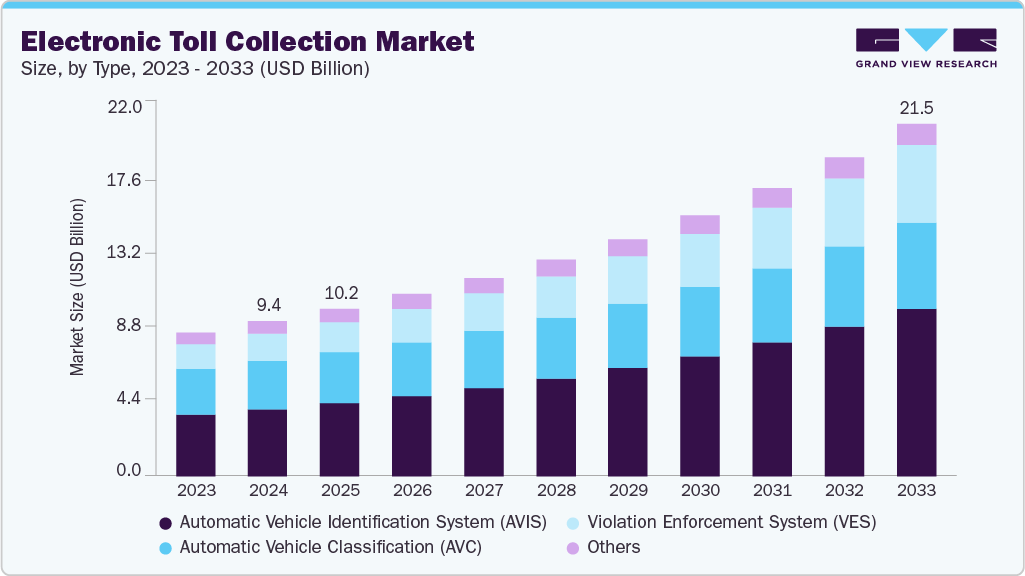 To learn more about this report, Download Free Sample Report
 The market's growth is further attributed to the increasing integration of advanced technologies such as Radio Frequency Identification (RFID), Dedicated Short-Range Communication (DSRC), and Global Navigation Satellite Systems (GNSS). These technologies have enabled vehicle identification, classification, and toll deduction automation with minimal human intervention. Mobile-based tolling, including cell phone tolling and app-integrated systems, has also gained traction in urban corridors. Moreover, AI-powered analytics and cloud-based platforms are integrated into ETC solutions to support dynamic pricing and predictive maintenance.
The regulatory landscape surrounding ETC systems has become more structured and supportive, with mandates and compliance standards being enforced to ensure uniformity and accountability. Initiatives such as the European Electronic Toll Service (EETS) and India’s FASTag mandate have been rolled out to streamline tolling across regions. Standardization of protocols and interoperability guidelines has been emphasized to facilitate seamless toll collection across multiple jurisdictions. In several countries, national transport authorities have introduced incentives or deadlines to accelerate ETC adoption among vehicle owners and operators.
Despite its rapid adoption, the electronic toll collection market has faced challenges such as high initial deployment costs, legacy system compatibility issues, and data privacy concerns. Limited digital infrastructure and low consumer awareness have hampered large-scale rollouts in developing economies. Moreover, resistance to technological change and concerns over surveillance and personal data usage have slowed adoption in certain regions. Operational disruptions, cyber threats, and maintenance complexities have also posed challenges for ETC system integrators and stakeholders.
Market Dynamics
The electronic toll collection market is driven by increasing investments in smart transportation infrastructure, rising highway traffic volumes, and government initiatives promoting cashless, automated tolling systems. The market benefits from advancements in RFID, ANPR, and connected mobility technologies that improve toll collection efficiency and traffic management. While high infrastructure deployment costs remain a challenge, opportunities are emerging through the adoption of multi-lane free-flow tolling, interoperability initiatives, and smart city development programs, positioning ETC systems as a critical component of modern transportation networks.
Increasing government investments in intelligent transportation systems (ITS) and smart highway infrastructure are driving the growth of the electronic toll collection (ETC) market. Transportation authorities worldwide are adopting ETC systems to reduce traffic congestion, improve toll collection efficiency, and enhance road network management. Traditional manual toll collection methods often lead to vehicle delays, increased fuel consumption, and operational inefficiencies, prompting governments to deploy RFID, DSRC, and GNSS-based tolling technologies. The growing emphasis on smart mobility and digital transportation infrastructure is accelerating ETC implementation across highways, bridges, tunnels, and urban road networks.
In addition, governments are increasingly mandating cashless toll collection to improve revenue transparency and reduce toll evasion. National initiatives such as open-road tolling, interoperable tolling networks, and electronic payment integration are further supporting market expansion. As vehicle ownership and highway traffic volumes continue to rise, transportation agencies are investing in advanced toll management systems to enhance traffic flow, lower operational costs, and improve the overall commuter experience, creating sustained demand for ETC solutions.
The substantial capital investment required to deploy electronic toll collection infrastructure is restraining the growth of the market. ETC systems require the installation of toll gantries, RFID readers, cameras, sensors, communication networks, backend software platforms, and data processing centers. For transportation authorities operating across large highway networks, these deployment costs can be considerable, particularly in developing economies where budget constraints may limit infrastructure modernization initiatives.
Ongoing maintenance, system upgrades, cybersecurity measures, and interoperability requirements further increase the total cost of ownership. Smaller transportation agencies and governments with aging road infrastructure may face challenges in justifying large-scale ETC investments despite the long-term operational benefits. Therefore, financial constraints and lengthy implementation timelines can slow the adoption of advanced toll collection systems in certain regions.
The growing adoption of multi-lane free flow (MLFF) tolling presents an opportunity for the growth of the electronic toll collection market. MLFF systems allow vehicles to pass through tolling points at highway speeds without slowing down or stopping, using technologies such as RFID, vehicle detection sensors, and automatic number plate recognition (ANPR). These systems improve traffic efficiency, reduce congestion, and enhance the overall transportation experience, making them increasingly attractive to highway operators and government agencies.
As countries modernize transportation infrastructure and pursue smart city initiatives, the demand for barrier-free tolling solutions is expected to increase. MLFF technology also supports interoperability across toll networks, enabling seamless cross-regional travel and more efficient toll revenue collection. The transition from conventional toll plazas to fully automated tolling environments creates substantial growth opportunities for technology providers, system integrators, and transportation infrastructure operators.
Analyst Perspective
The electronic toll collection (ETC) market is evolving from a traditional toll payment system into a broader intelligent mobility management platform. Market growth is being fueled by the increasing need to optimize road utilization, reduce travel delays, and enhance transportation efficiency through automated tolling technologies. The shift toward open-road tolling and integrated transportation networks is encouraging governments and highway operators to replace manual toll collection methods with advanced digital solutions. Moreover, the convergence of ETC systems with vehicle connectivity, traffic analytics, and smart mobility initiatives is expanding their role beyond revenue collection to support real-time traffic management and data-driven transportation planning.
Type Insights
Based on type, the automatic vehicle identification system (AVIS) segment led the market with the largest revenue share of 43.6% in 2025. The increasing demand for real-time, contactless tolling solutions is driving the growth of AVIS. AVIS enables the identification of vehicles using RFID tags, DSRC transponders, or license plate recognition, ensuring accurate and efficient toll collection without manual intervention. Governments and toll operators aim to streamline traffic flow and reduce revenue leakage, leading to widespread deployment of AVIS systems across urban and intercity routes. Their integration with centralized tolling databases and enforcement systems further supports scalability and interoperability, especially in regions with high vehicle density and multi-lane free-flow tolling environments.
The Violation Enforcement System (VES) segment is expected to witness the fastest CAGR over the forecast period. The demand for VES is expanding due to the need to curb toll evasion and enforce traffic compliance in electronic tolling environments. VES typically includes license plate recognition, vehicle tracking, and automated fine issuance for vehicles that bypass toll gates or lack valid payment methods. With the increasing adoption of open-road tolling and the removal of physical toll booths, enforcement has become a critical component of ETC operations. Growth in this segment is being supported by smart city initiatives and digital infrastructure investments emphasizing safety, surveillance, and revenue protection.
Technology Insights
Based on technology, radio frequency identification (RFID) led the market with the largest revenue share of 38.6% in 2025. The growth of RFID-based tolling systems is being propelled by their cost-efficiency, simplicity, and reliability in large-scale deployments. RFID uses passive or active tags to identify vehicles passing toll collection points, enabling quick and contactless payment processing. The technology has become a preferred choice for many developing economies and high-density traffic corridors due to its low infrastructure requirements and ease of adoption.
The Global Navigation Satellite System (GNSS) and GPS segment is expected to witness the fastest CAGR over the forecast period. The implementation of Global Navigation Satellite System (GNSS) and GPS-based tolling has introduced distance-based models that revolutionize how tolls are calculated and collected. These systems are particularly effective across large national road networks and for freight and commercial vehicle operations. GNSS tolling requires minimal roadside infrastructure, thereby lowering deployment costs and simplifying scalability. Governments are adopting this model to ensure fairer road usage charges, especially in response to reduced fuel tax revenues driven by electric vehicle (EV) adoption.
Application Insights
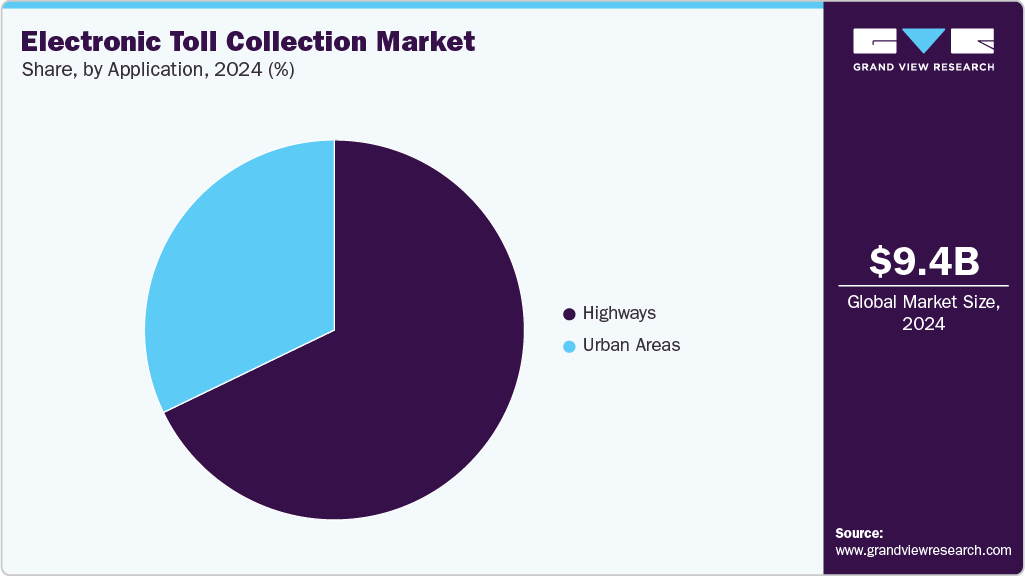
Based on application, the highways segment led the market with the largest revenue share of 67.6% in 2025. The expansion of ETC systems on highways is being driven by increased vehicle movement across long-distance corridors and the modernization of national transportation infrastructure. Governments and private operators prioritize highway toll automation to reduce congestion, improve fuel efficiency, and increase toll revenue accuracy. Emerging economies invest heavily in national highway development, integrating ETC systems from the outset to support smart mobility objectives. In addition, freight and commercial logistics sectors have reinforced demand for efficient, uninterrupted tolling solutions on major trucking routes.
 To learn more about this report, Download Free Sample Report
 The urban areas segment is expected to witness the fastest CAGR over the forecast period. Rising concerns over traffic congestion, air pollution, and the need for dynamic traffic management are fueling the rapid implementation of ETC in urban areas. Urban tolling is evolving beyond traditional toll booths to include congestion pricing, low-emission zones, and smart parking integrations. Cities leverage ETC to influence driver behavior, reduce peak-hour traffic, and promote public transportation alternatives. This application segment is experiencing robust growth, particularly in metropolitan areas aiming to achieve sustainability and climate goals.
Regional Insights
The North America electronic toll collection market is expected to grow at a CAGR of 7.9% during the forecast period. The region’s growth is driven by large-scale deployments and a shift toward interoperability and mobile-based tolling. Public-private partnerships and state-level agencies have driven infrastructure investment, particularly in highway and express lane automation, thereby driving the growth of the market.
U.S. Electronic Toll Collection Market Trends
The U.S. electronic toll collection market held a dominant position in the region in 2024, driven by robust infrastructure and decades-long implementation of tolling networks such as E-ZPass, SunPass, and TxTag. The country is also exploring mileage-based user fees (MBUF) as a potential replacement for declining fuel tax revenues, signaling new use cases and growth opportunities for ETC technologies.
Asia Pacific Electronic Toll Collection Market Trends
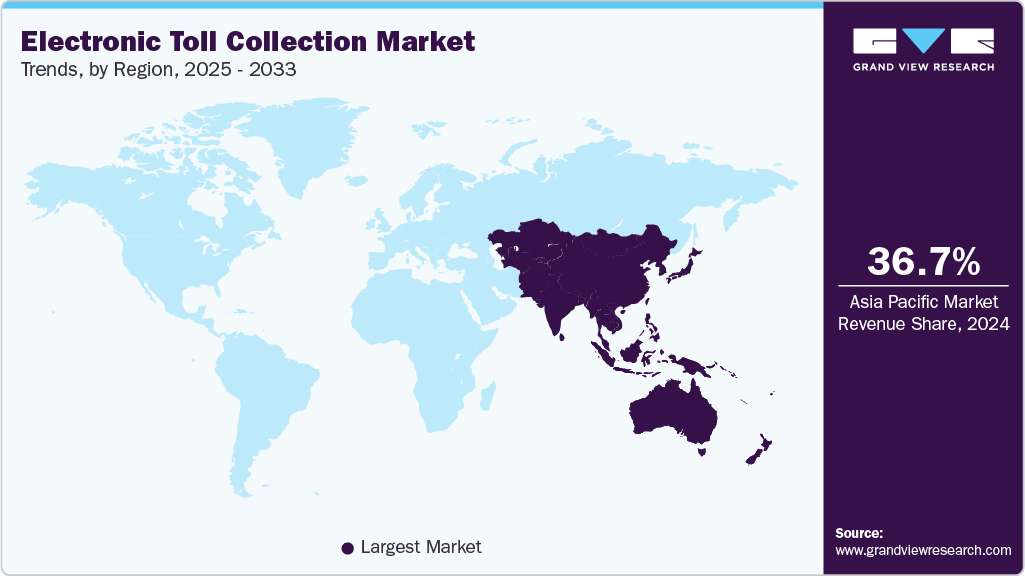
Asia Pacific dominated the global electronic toll collection market with the largest revenue share of 37.2% in 2025. Asia Pacific represents the largest and fastest-growing market for electronic toll collection, driven by rapid infrastructure development, high vehicle density, and government-led digitalization programs. Countries across the region are actively investing in smart mobility solutions, with ETC being a key component in reducing traffic congestion and improving toll revenue efficiency. The demand is especially strong in emerging economies, where the transition from manual to automated toll systems is being prioritized under national transportation modernization agendas.
 To learn more about this report, Download Free Sample Report
 The India electronic toll collection market is expected to grow at the fastest rate during the forecast period. India has emerged as one of the most dynamic markets for ETC, primarily due to the successful rollout of the FASTag system under the National Electronic Toll Collection (NETC) program. The mandate for RFID-based tolling across national highways has led to near-universal adoption, drastically improving toll collection efficiency and reducing congestion at plazas.
China electronic toll collection held the largest revenue share in the Asia Pacific, driven by state policies aimed at modernizing highway networks and improving tolling efficiency nationwide. The full elimination of manual toll booths on major expressways and the mandatory installation of ETC devices in vehicles have resulted in widespread deployment. The integration of ETC with smart city platforms, AI-based traffic management, and digital payment ecosystems has further enhanced user experience and system performance.
Europe Electronic Toll Collection Market Trends
The Europe electronic toll collection market is expected to register a moderate CAGR from 2025 to 2033. The region’s market growth is driven by advanced technology adoption, policy harmonization, and cross-border interoperability efforts under frameworks such as the European Electronic Toll Service (EETS). Europe's high regulatory standards and digital integration are driving demand for sophisticated tolling solutions that offer flexibility, scalability, and compliance.
The UK electronic toll collection market is expected to grow significantly from 2025 to 2033. The government’s push toward sustainable transportation and emission reduction creates new opportunities for ETC solution providers, particularly those offering cloud-based and mobile-integrated platforms. Investments in connected vehicle infrastructure are also expected to complement ETC advancements in the coming years.
The Germany electronic toll collection market held a substantial market share in 2024. Germany has pioneered GNSS-based tolling for commercial vehicles through its Toll Collect system, one of the most advanced in Europe. Germany is also exploring ETC expansion for passenger vehicles and regional roadways to enhance equity in road usage and meet climate policy objectives, thereby driving the market’s growth.
Key Electronic Toll Collection Company Insights
Some of the key companies in the electronic toll collection industry include Kapsch TrafficCom AG, Conduent Incorporated, and TransCore, among others. These players leverage proprietary technologies, strategic partnerships, and government contracts to strengthen their market position.Competition is driven by advancements in RFID, GNSS, and cloud-based platforms, as well as the ability to offer interoperable, scalable, and data-integrated solutions.
-
Kapsch TrafficCom AG is a global provider of intelligent transportation systems, specializing in electronic toll collection, traffic management, and connected mobility solutions. The company operates in over 30 countries and has been pivotal in deploying nationwide ETC systems across Europe, the Americas, and Asia.
-
Conduent Incorporated is a prominent business process services provider with a strong presence in the tolling and transportation sector. The company manages complex electronic toll collection systems, customer service centers, and transaction processing platforms through its transportation solutions division for public agencies and private operators.
Key Electronic Toll Collection Companies
The following key companies have been profiled for this study on the electronic toll collection market.
-
Kapsch TrafficCom AG
-
Conduent Incorporated
-
EFKON GmbH
-
TransCore
-
Thales
-
Mitsubishi Heavy Industries, Ltd.
-
Neology, Inc.
-
Toshiba Infrastructure Systems & Solutions Corporation
-
STAR Systems International
-
VaaaN
Competitive Benchmarking
Category
Operating Strategies
Competitive Edge
Weakness
Established Players (Kapsch TrafficCom AG, Thales, EFKON GmbH)
- Focus on large-scale tolling infrastructure projects, nationwide ETC deployments, interoperability solutions, multi-lane free-flow tolling systems, and intelligent transportation system (ITS) integration.
- These companies actively pursue government contracts, public-private partnerships, and technology upgrades to expand their global footprint.
- Strong technological expertise, extensive project portfolios, established relationships with transportation authorities, broad geographic presence, and comprehensive hardware-software-service offerings.
- Their ability to deliver end-to-end tolling ecosystems provides a significant competitive advantage.
- High dependence on government infrastructure spending and lengthy procurement cycles.
Emerging Players (STAR Systems International, VaaaN)
- Focus on specialized tolling applications, video analytics, vehicle recognition technologies, traffic monitoring solutions, and customized deployments for regional transportation authorities.
- These companies often emphasize innovation, niche applications, and cost-effective solutions to strengthen market presence.
- Greater operational agility, faster technology adaptation, and the ability to address specific customer requirements through customized solutions.
- Their specialized expertise can create strong positioning in selected market segments and regional markets.
- Dependence on regional projects and narrower product portfolios may constrain long-term scalability.
Recent Developments
- In January 2025, TransCore introduced its next-generation tolling technology on the West Virginia Turnpike, enhancing both driver convenience and operational efficiency. The deployment includes a toll-by-plate payment option, upgraded E-ZPass infrastructure, and advanced in-lane digital signage. As part of the West Virginia Parkways Authority’s mission to improve the overall traveler experience, TransCore implemented its Infinity Digital Lane System, which features fully integrated toll-by-plate transaction processing at all four toll plazas along the Turnpike. This comprehensive upgrade will streamline toll collection while supporting the state’s long-term smart transportation goals.
Electronic Toll Collection Market Report Scope
Report Attribute
Details
Market size in 2025
USD 10.2 billion
Estimated market size in 2026
USD 11.1 billion
Projected market size by 2033
USD 21.5 billion
Growth rate
CAGR of 9.9% from 2026 to 2033
Base year for estimation
2025
Historical data
2021 - 2024
Forecast period
2026 - 2033
Quantitative units
Revenue in USD million/billion and CAGR from 2026 to 2033
Report coverage
Revenue forecast, company ranking, competitive landscape, growth factors, and trends
Segments covered
Type, technology, application, region
Regional scope
North America; Europe; Asia Pacific; Latin America; MEA
Country scope
U.S.; Canada; Mexico; U.K.; Germany; France; China; Japan; India; Australia; South Korea; Brazil; UAE; South Africa
Key companies profiled
Kapsch TrafficCom AG, Conduent Incorporated, EFKON GmbH, TransCore, Thales, Mitsubishi Heavy Industries, Ltd., Neology, Inc., Toshiba Infrastructure Systems & Solutions Corporation, STAR Systems International, VaaaN
Customization scope
Free report customization (equivalent up to 8 analysts' working days) with purchase. Addition or alteration to country, regional & segment scope.
Pricing and purchase options
Avail customized purchase options to meet your exact research needs. Explore purchase options
Global Electronic Toll Collection Market Report Segmentation
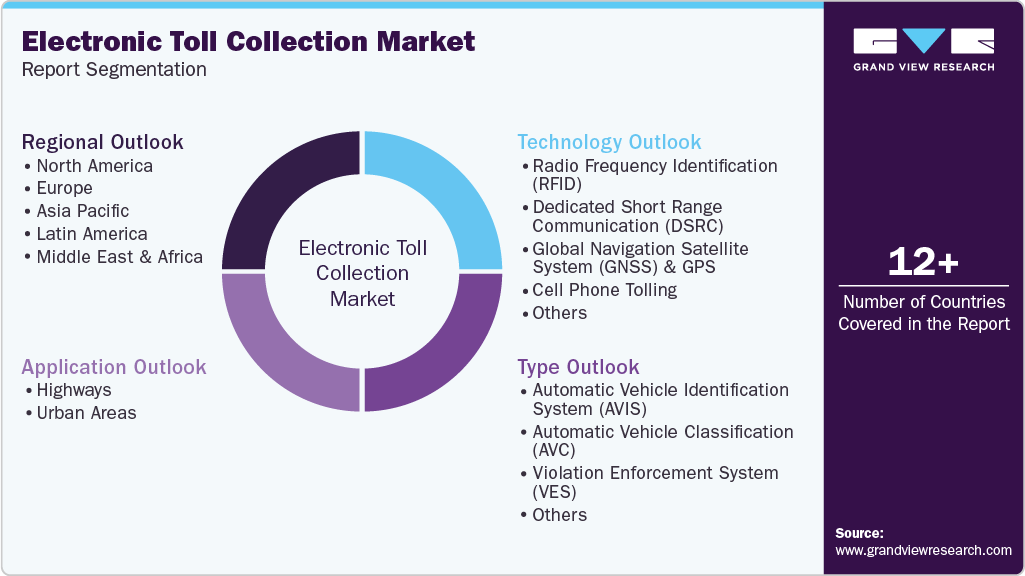
This report forecasts revenue growth at global, regional, and country levels and provides an analysis of the latest industry trends in each of the sub-segments from 2021 to 2033. For this study, Grand View Research has segmented the global electronic toll collection market report based on type, technology, application, and region.
 To learn more about this report, Download Free Sample Report
 -
Type Outlook (Revenue, USD Million, 2021 - 2033)
-
Automatic Vehicle Identification System (AVIS)
-
Automatic Vehicle Classification (AVC)
-
Violation Enforcement System (VES)
-
Others
-
-
Technology Outlook (Revenue, USD Million, 2021 - 2033)
-
Radio Frequency Identification (RFID)
-
Dedicated Short Range Communication (DSRC)
-
Global Navigation Satellite System (GNSS) and GPS
-
Cell Phone Tolling
-
Others
-
-
Application Outlook (Revenue, USD Million, 2021 - 2033)
-
Highways
-
Urban Areas
-
- Regional Outlook (Revenue, USD Million, 2021 - 2033)
-
North America
-
U.S.
-
Canada
-
Mexico
-
-
Europe
-
Germany
-
UK
-
France
-
-
Asia Pacific
-
China
-
Japan
-
India
-
South Korea
-
Australia
-
-
Latin America
-
Brazil
-
-
Middle East and Africa (MEA)
-
KSA
-
UAE
- South Africa
-
-
Research Methodology
The electronic toll collection market figures in this report are based on a proven research process that combines executive interviews with secondary research from proprietary databases, company filings, and recognized regulatory and institutional sources. Market size is built through value-chain sizing - reconciling supply-side and demand-side estimates - and triangulated with bottom-up and top-down approaches. Every estimate passes multiple levels of expert validation before publication, with each electronic toll collection segment quantified using the revenue-capture definitions in the table below.
Segment Definition
Segment - Type
Revenue capture definition
Automatic Vehicle
Identification System (AVIS)The automatic vehicle identification system (AVIS) segment generates revenue from technologies and solutions that electronically identify vehicles passing through tolling points. Revenue is captured through the sale, deployment, licensing, and maintenance of RFID tags, transponders, vehicle identification readers, antenna systems, and associated software platforms.
Automatic Vehicle
Classification (AVC)The automatic vehicle classification (AVC) segment captures revenue from solutions that classify vehicles based on characteristics such as axle count, vehicle size, weight, and vehicle category for accurate toll assessment. Revenue includes sales and deployment of classification technologies such as sensors, weigh-in-motion systems, laser scanners, inductive loops, cameras, and AI-enabled classification software used by toll operators and transportation authorities.
Violation Enforcement System (VES)
The violation enforcement system (VES) segment generates revenue from technologies and services designed to detect, record, process, and enforce toll payment violations. Revenue is captured through the deployment of automatic number plate recognition (ANPR) cameras, image processing software, violation detection systems, enforcement management platforms, and supporting hardware infrastructure installed at tolling locations.
Segment -Technology
Revenue capture definition
Radio Frequency
Identification (RFID)Radio frequency identification (RFID) is an electronic toll collection technology that uses radio waves to automatically identify vehicles and facilitate toll payments without requiring vehicles to stop at toll plazas. The system consists of RFID tags or transponders installed on vehicles and RFID readers positioned at tolling points.
Dedicated Short Range
Communication (DSRC)Dedicated short range communication (DSRC) is a wireless communication technology that enables high-speed data exchange between vehicles and roadside infrastructure for toll collection and transportation management applications. In ETC systems, DSRC transponders installed in vehicles communicate with roadside units at tolling locations, enabling toll transactions to be processed rapidly and accurately as vehicles travel at highway speeds.
Global Navigation Satellite
System (GNSS) and GPSGlobal navigation satellite system (GNSS) and global positioning system (GPS) technologies enable distance- and location-based toll collection by tracking vehicle movements via satellite positioning. Instead of relying on physical tolling infrastructure at specific locations, GNSS/GPS-based ETC systems calculate toll charges based on the distance traveled, road usage, geographic zones, or predefined routes.
Cell Phone Tolling
Cell phone tolling refers to electronic toll payment systems that utilize mobile phones and cellular networks to process toll transactions. Drivers can register vehicles and payment methods via mobile applications, digital wallets, or mobile accounts, enabling toll payments to be completed automatically or via mobile transaction authorization.
Others
The others segment includes emerging and complementary toll collection technologies that do not fall under RFID, DSRC, GNSS/GPS, or cell phone tolling categories. These technologies may include Automatic Number Plate Recognition (ANPR), video tolling systems, and infrared communication systems.
Segment - Application
Revenue capture definition
Highways
Highways represent the largest application segment of the electronic toll collection (ETC) market and encompass the deployment of automated tolling systems across national highways, expressways, intercity road networks, bridges, and tunnels. ETC solutions in highways are designed to facilitate seamless toll collection by enabling vehicles to pass through tolling points without stopping, thereby reducing congestion, improving traffic flow, and enhancing overall transportation efficiency.
Urban Areas
Urban Areas refer to the deployment of electronic toll collection systems within cities and metropolitan regions to manage traffic, implement congestion pricing, impose road usage charges, and establish access-controlled transportation zones. ETC solutions in urban environments are used for toll roads, city expressways, congestion charging programs, low-emission zones, and managed traffic corridors where efficient vehicle movement and traffic optimization are critical objectives.
Estimation Model
Layer Name
Key Question
Description
Transportation Infrastructure & Toll Road Network Layer
What is the total addressable market for ETC systems?
Evaluates the overall tolling ecosystem, including toll roads, highways, expressways, bridges, tunnels, urban congestion charging zones, and transportation infrastructure projects. The analysis considers vehicle parc, traffic volumes, road expansion programs, government transportation spending, and smart mobility initiatives that create demand for electronic toll collection solutions.
ETC Technology Adoption Layer
What proportion of tolling infrastructure utilizes electronic toll collection technologies?
Assesses the penetration and deployment of ETC technologies across transportation networks. This layer evaluates the adoption of RFID, DSRC, GNSS/GPS, Cell Phone Tolling, ANPR, and hybrid tolling solutions by toll operators and transportation authorities. Factors such as interoperability mandates, cashless tolling initiatives, and intelligent transportation system (ITS) investments are analyzed to determine market penetration.
Application & System Component Demand Layer
Which applications and system types generate demand?
Analyzes demand across applications such as highways and urban areas, as well as system types including Automatic Vehicle Identification Systems (AVIS), Automatic Vehicle Classification (AVC), and Violation Enforcement Systems (VES). The layer evaluates deployment trends, vehicle traffic density, toll transaction volumes, and regulatory requirements that influence demand for specific ETC solutions and technologies.
Revenue Monetization Layer
How is market value generated?
Estimates market revenue generated through ETC hardware, software, and services. Revenue streams include RFID tags, transponders, roadside readers, tolling gantries, sensors, cameras, communication equipment, toll management software, analytics platforms, maintenance contracts, system integration services, managed services, and violation enforcement solutions. Revenues are aggregated across toll operators, transportation authorities, system integrators, and technology providers.
Delivered Customizations
This report has been delivered with the following In-depth customizations
Client Request
Customization Delivered
Value Adds
Competitive Landscape and Benchmarking Analysis
Comprehensive profiling and benchmarking of major ETC vendors based on product portfolio, technology offerings, geographic presence, strategic partnerships, contracts awarded, mergers & acquisitions, and recent developments derived from company disclosures and public records.
Supports competitive intelligence, market positioning, partnership identification, and strategic planning activities.
Transportation and Traffic Trend Analysis
Analysis of vehicle registrations, traffic volumes, commercial vehicle movement, road utilization rates, and urban mobility trends influencing ETC adoption, utilizing transportation authority and statistical agency data.
Supports demand forecasting and long-term market opportunity assessment.
Country-Level Electronic Toll Collection Market Assessment
Detailed analysis of ETC adoption across key countries, covering toll road infrastructure, cashless tolling initiatives, highway expansion projects, vehicle parc trends, and regulatory developments using publicly available government and industry sources.
Identifies country-specific growth opportunities, infrastructure maturity, and investment attractiveness for market participants and investors.
Frequently Asked Questions About This Report
Asia Pacific dominant with a 37.2% market share in 2025.
The automatic vehicle identification system (AVIS) segment lead with the 43.6% revenue share in 2025, while violation enforcement system (VES) segment is expected to grow at the fastest CAGR over the forecast period.
The radio frequency identification (RFID) segment held the largest revenue share in 2025, while global navigation satellite system (GNSS) and GPS represents significant growing area.
The highways held the largest revenue share (67.6)% revenue share in 2025, while urban areas segment is expected to grow at fastest CAGR over the forecast period.
The electronic toll collection market size was estimated at USD 10.2 billion in 2025 and is expected to reach USD 11.1 billion in 2026.
The electronic toll collection market is expected to grow at a compound annual growth rate of 9.9% from 2026 to 2033 to reach USD 21.5 billion by 2033.
Increasing government investments in intelligent transportation systems (ITS) and smart highway infrastructure are driving the growth of the electronic toll collection market.
Some key players operating in the electronic toll collection market include Kapsch TrafficCom AG, Conduent Incorporated, EFKON GmbH, TransCore, Thales, Mitsubishi Heavy Industries, Ltd., Neology, Inc., Toshiba Infrastructure Systems & Solutions Corporation, STAR Systems International, VaaaN.
About the Author(s)
Automotive & Transportation Research Team
Technology · Automotive & TransportationThis report was authored by the automotive & transportation research team at Grand View Research - comprising two research analysts, one senior research analyst, and one industry expert - with specialized expertise in the automotive & transportation segment of the technology industry. All findings are based on proprietary technology databases, executive interviews, and regulatory analysis, subject to internal peer review prior to publication.
Last Updated:
Speak to Analyst

Customize this report to your needs - add regions, segments, or data points, with 20% free customization.
Or view our licence options:


ISO 9001:2015 & 27001:2022 Certified
We are GDPR and CCPA compliant! Your transaction & personal information is safe and secure. For more details, please read our privacy policy.


