
- Home
- »
- Next Generation Technologies
- »
-
Embodied AI Market Size & Share, Industry Report, 2033GVR Report cover
![Embodied AI Market Size, Share & Trends Report]()
Embodied AI Market (2026 - 2033) Size, Share & Trends Analysis Report By Component (Hardware, Software, Services), By Product (Robots, Exoskeletons, Autonomous Systems), By End Use (Healthcare, Automotive, Retail, Education), By Region, And Segment Forecasts
Market Size, 2025
$4.7BMarket Estimate, 2026
$6.5BMarket Forecast, 2033
$67.6BCAGR, 2026–2033
39.7%Embodied AI Market Summary
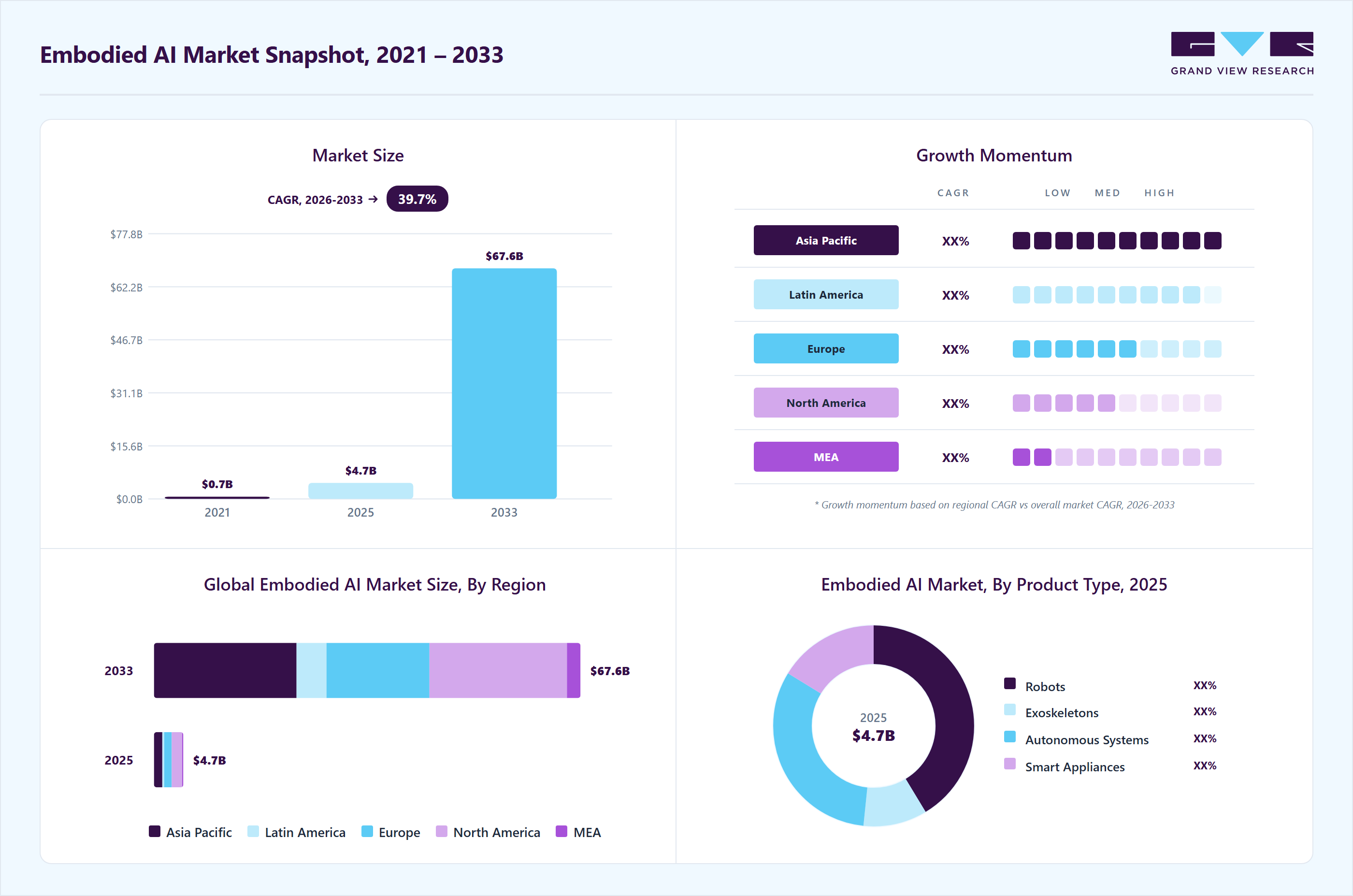
The global embodied AI market size was valued at USD 4.7 billion in 2025 and is projected to grow from USD 6.5 billion in 2026 to USD 67.6 billion by 2033, at a CAGR of 39.7% from 2026 to 2033. The North America embodied AI market held the largest share of 35.6% of the global market in 2025. The market is witnessing strong growth driven by the integration of artificial intelligence with robotics and autonomous systems.
Key Market Trends & Insights
- By component: Hardware led the market and held the largest revenue share of 51.2% in 2025.
- By product: Robots segment accounted for the largest revenue share of 41.3% in 2025.
- By end use: Logistics & supply chain segment is expected to grow at the fastest CAGR of 42.2% from 2026 to 2033.
Regional Highlights
- Largest regional market: North America (35.6% revenue share, 2025)
- Fastest-growing regional market: Asia Pacific (highest CAGR, 2026-2033)
- By country: The embodied AI market in the U.S. led the North America market in 2025.
Market Size & Forecast
- Market size in 2025: USD 4.7 Billion
- Estimated market size in 2026: USD 6.5 Billion
- Projected market size by 2033: USD 67.6 Billion
- CAGR (2026-2033): 39.7%
The growing integration of foundation models into robotic systems is contributing to market expansion. Companies are developing large multimodal AI systems that combine text, vision, audio, and physical action capabilities to enhance robot intelligence. This approach reduces reliance on task-specific programming and enables robots to perform a wider range of complex tasks. Foundation models enhance generalization, allowing robotic systems to adapt to new environments, objects, and instructions with minimal retraining. Consequently, robotics development is becoming more scalable, flexible, and cost-efficient. This advancement is expected to accelerate commercialization and contribute to sustained market growth. For instance, in March 2025, Google DeepMind introduced Gemini Robotics and Gemini Robotics-ER, advanced AI models based on Gemini 2.0 designed to enable embodied reasoning and direct robot control in real-world environments. These models enhance robots’ generalization, interactivity, and dexterity, supporting the development of next-generation humanoid and industrial robots through partnerships and real-world testing.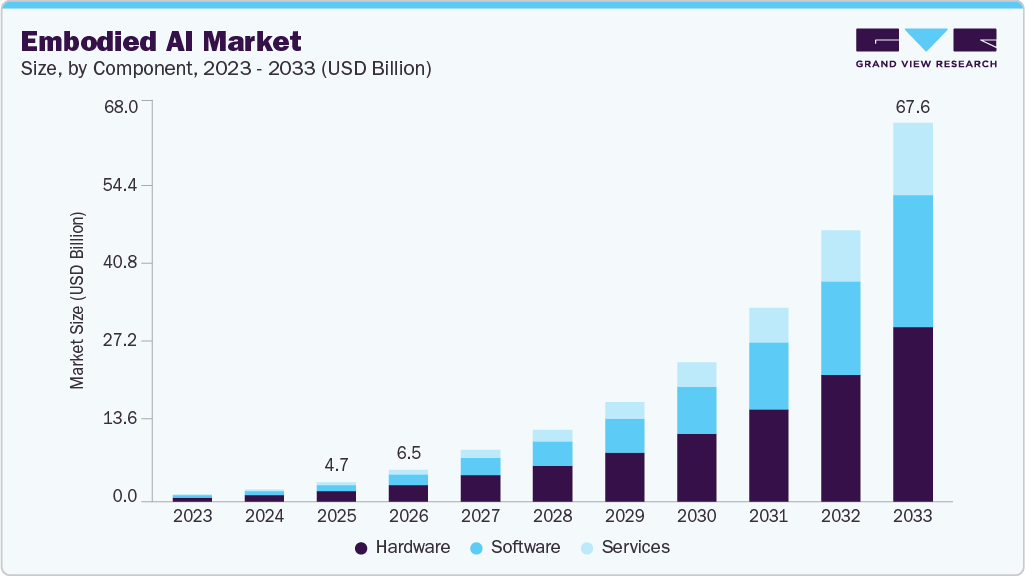
The integration of embodied AI with enterprise software is becoming increasingly important in industrial environments. Connecting robotic systems to ERP and warehouse management hardware enables real-time data exchange and enhanced business context awareness. This allows robots to align their actions with production schedules, inventory levels, and operational requirements. Such integration improves efficiency, traceability, and decision-making across enterprise workflows. As a result, embodied AI solutions are becoming more scalable and commercially viable for large-scale deployment. For instance, in November 2025, Humanoid, a UK-based robotics company, announced a collaboration with SAP to integrate humanoid robotics with SAP’s embodied AI agents for industrial applications, beginning with a proof-of-concept in automotive seat assembly and intelligent kitting integrated with SAP Extended Warehouse Management. The partnership aims to bring cognitive humanoid robots into enterprise environments on a large scale.
An embodied AI is a hardware platform where API providers can showcase and offer their products to potential buyers. This marketplace simplifies the process for buyers seeking suitable APIs for their business needs. Buyers can easily explore and purchase the most fitting products that align with their specific requirements by visiting the marketplace. An Embodied AI is a dedicated Hardware where APIs are the primary service being exchanged. These marketplaces aim to create an open ecosystem that facilitates the usage of various end uses. It provides a convenient marketplace for consumers to find and access APIs and monetization opportunities for developers who create and provide them. Moreover, the marketplace typically includes features such as tracking and analytics to help measure the end use programming interface usage, providing valuable insights for consumers and providers.
Advancements in robotic hands and fine motor control systems are significantly expanding the capabilities of embodied AI solutions. Modern robotic manipulators are now capable of performing delicate and highly precise movements. These improvements enable robots to handle tasks such as packaging, small-part assembly, wiring, and tool operation with greater accuracy. Enhanced tactile sensing and adaptive grip control further improve reliability in dynamic environments. As a result, robots can manage fragile, irregular, or complex components more efficiently. This is particularly valuable in high-mix, low-volume manufacturing settings where flexibility is essential. Traditional automation systems often struggle with such variability and customization requirements. Improved dexterity helps overcome these limitations and reduces dependency on manual labor. Consequently, embodied AI is becoming increasingly viable for broader industrial adoption and complex production workflows.
Component Insights
The hardware segment dominated the global market with a revenue share of 51.2% in 2025. High demand for robotic hardware, advanced sensors, actuators, and edge computing devices significantly contributed to this growth. Rising investments in next-generation robotics infrastructure further reinforced the segment’s leadership. Expanding adoption of embodied AI solutions across industries continues to drive spending on physical system components. Hardware remains essential for enabling real-world interaction, mobility, and perception capabilities. As deployments scale, investment in core robotic equipment continues to account for a substantial share of total market expenditure.
The service segment is witnessing steady market growth. Increasing demand for system integration, customization, and deployment support is driving this expansion. Organizations require consulting and technical expertise to implement embodied AI solutions effectively. Ongoing maintenance, software updates, and performance optimization further contribute to recurring revenue streams. As embodied AI systems become more complex, reliance on specialized service providers continues to increase. This growing need for end-to-end support is strengthening the role of Software within the overall market ecosystem.
Product Insights
The robots segment dominated the market in 2025. Strong demand for autonomous and semi-autonomous robotic systems supported this dominance. Industries are increasingly deploying robots to automate complex and repetitive tasks. Advancements in perception, mobility, and manipulation capabilities have enhanced their commercial viability. Growing adoption across manufacturing, logistics, healthcare, and retail sectors further strengthened their market position. As embodied AI applications expand, robots continue to represent the primary revenue-generating product category. Continued investments in robotic innovation are expected to sustain their leadership in the coming years.
Exoskeletons represent an emerging product category within the market. These wearable robotic systems are designed to augment human strength, mobility, and endurance. They are increasingly used in industrial, healthcare, and defense applications. In manufacturing and logistics, exoskeletons help reduce worker fatigue and improve productivity. In medical settings, they support rehabilitation and mobility assistance for patients. Growing emphasis on workplace safety and human augmentation is expected to drive further adoption of AI-enabled exoskeleton systems.
End Use Insights
Automation & manufacturing dominated the market in terms of end use. The segment accounted for the largest revenue share due to early adoption of intelligent robotic systems. Manufacturers are increasingly integrating embodied AI to enhance precision, speed, and operational efficiency. The need to minimize labor shortages and reduce production costs has further accelerated deployment. Smart factory initiatives and Industry 4.0 investments are also contributing to segment growth. As industrial automation advances, this segment continues to maintain its leading market position.
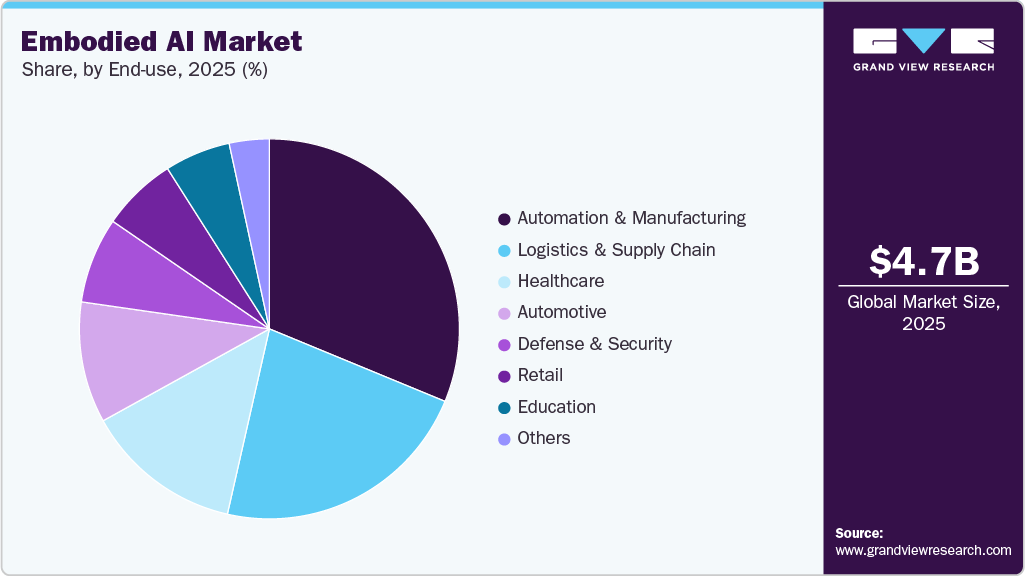
Logistics & Supply Chain is witnessing significant market growth. Rising e-commerce activity and increasing warehouse automation are driving adoption. Companies are deploying AI-enabled robots for picking, sorting, packaging, and inventory management. The need for faster order fulfillment and real-time tracking further supports market expansion. Labor shortages in warehousing operations are also accelerating automation investments. As supply chains become more complex, embodied AI solutions are playing a critical role in improving efficiency and operational resilience.
Regional Insights
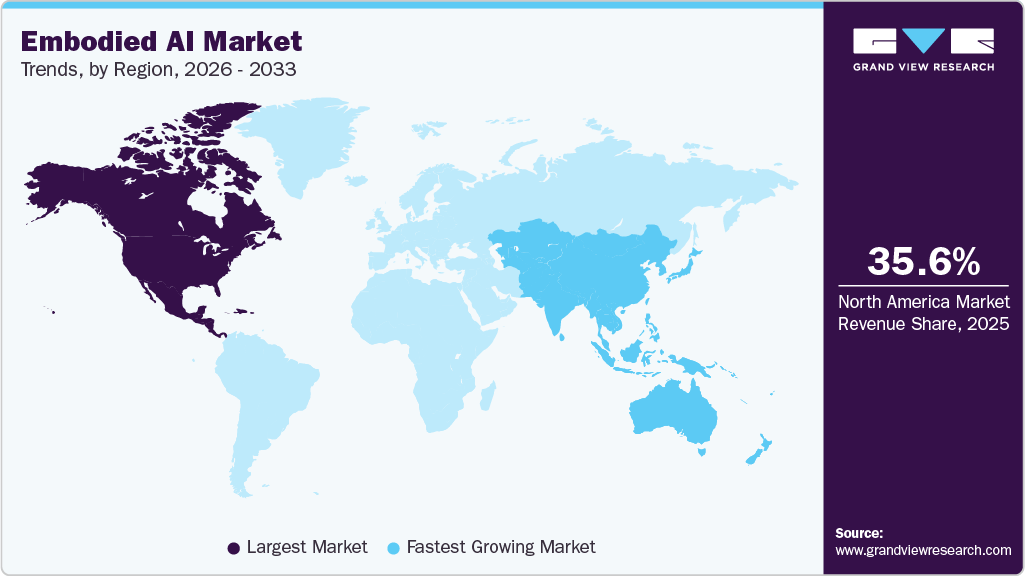
North America embodied AI market dominated the global industry with a revenue share of 35.6% in 2025. The region benefits from a strong ecosystem of AI research institutions and robotics companies. Significant investments from technology firms and venture capital have accelerated innovation and commercialization. Early adoption across manufacturing, logistics, healthcare, and defense sectors has further strengthened market growth. Supportive government initiatives and funding programs also contribute to technological advancement.
U.S. Embodied AI Market Trends
The embodied AI market in the U.S. held a significant revenue share within the North America region. This growth is driven by strong investments in artificial intelligence and advanced robotics technologies. The presence of leading technology companies and innovative startups further supports market expansion. Increasing adoption across manufacturing, healthcare, logistics, and defense sectors is also contributing to revenue growth.
Europe Embodied AI Market Trends
The embodied AI market in Europe is growing as industries adopt intelligent robots for manufacturing, logistics, healthcare, and service sectors. Investments from governments and collaborations between academia and industry are driving innovation in perception, navigation, and human‑robot interaction. Labor shortages, automation needs, and regulatory support are boosting demand across European economies.
Asia Pacific Embodied AI Market Trends
The embodied AI market in the Asia Pacific is the fastest‑growing globally, driven by rising adoption of intelligent robots in manufacturing, logistics, healthcare, and retail. China, Japan, South Korea, and India are the fastest contributors due to strong automation demand and supportive AI policies. Investments in AI research, robotics startups, and smart factory projects are accelerating technology deployment. Labor shortages, efficiency goals, and demand for service robots are the fastest drivers boosting market growth. Challenges include skills gaps, safety regulations, and integration with existing systems.
Key Embodied AI Company Insights
Some of the key companies in the Embodied AI industry include 1X Technologies, ABB, AGIBOT Innovation (Shanghai) Technology Co., Ltd., and others. Organizations are focusing on increasing their customer base to gain a competitive edge in the industry. Therefore, key players are taking several strategic initiatives, such as mergers and acquisitions, and partnerships with other major companies.
-
Toyota Motor Corporation is advancing robotics and embodied AI to enhance mobility, manufacturing automation, and assistive technologies. Its research includes humanoid robots, exoskeletons, and autonomous systems for industrial and service applications. The company collaborates with academic institutions and technology partners to accelerate AI-driven robotics innovation. Toyota leverages its automotive expertise to integrate AI with advanced perception, navigation, and human-robot interaction capabilities.
-
Covariant develops embodied AI solutions for industrial automation, focusing on warehouses, logistics, and manufacturing. Its AI-powered robots can learn new tasks autonomously, improving flexibility and efficiency in diverse operations. The company combines deep learning, reinforcement learning, and computer vision to enable robots to handle complex and unstructured environments. Covariant partners with leading enterprises to deploy intelligent robotic arms and mobile systems in real-world settings.
Key Embodied AI Companies:
The following key companies have been profiled for this study on the embodied AI market.
- 1X Technologies
- ABB
- AGIBOT Innovation (Shanghai) Technology Co., Ltd.
- Apptronik
- Covariant
- DataMesh Inc.
- NEURA Robotics GmbH
- Sanctuary Cognitive Systems Corporation
- Toyota Motor Corporation
- Unitree Robotics
Recent Developments
-
In January 2026, DataMesh Inc. launched DataMesh Robotics, an embodied AI data product solution for industrial environments that uses an executable industrial digital twin to simulate dynamic operations, generate synthetic training data, and define task objectives and reward signals. The solution enables robot OEMs and application teams to train and validate robots in evolving, realistic industrial scenarios.
-
In October 2025, 1X Technologies launched NEO, a consumer-ready humanoid robot designed to automate household chores, provide personalized assistance, and learn new skills over time. NEO features advanced AI, human-level dexterity, a soft body, and connectivity through Wi-Fi, Bluetooth, and 5G, offering a safe, quiet, and consumer-friendly design for home use.
Embodied AI Market Report Scope
Report Attribute
Details
Market size in 2025
USD 4.7 billion
Market size value in 2026
USD 6.5 billion
Revenue forecast in 2033
USD 67.6 billion
Growth rate
CAGR of 39.7% from 2026 to 2033
Historical data
2021 - 2025
Forecast period
2026 - 2033
Quantitative units
Revenue in USD million/billion and CAGR from 2026 to 2033
Report coverage
Revenue forecast, company ranking, competitive landscape, growth factors, and trends
Segments covered
Component, product, end use, region
Regional scope
North America; Europe; Asia Pacific; Latin America; MEA
Country scope
U.S.; Canada; Mexico; UK; Germany; France; China; Japan; India; South Korea; Australia; Brazil; KSA; UAE; South Africa
Key companies profiled
1X Technologies; ABB; AGIBOT Innovation (Shanghai) Technology Co., Ltd.; Apptronik; Covariant; DataMesh Inc.; NEURA Robotics GmbH; Sanctuary Cognitive Systems Corporation; Toyota Motor Corporation; Unitree Robotics
Customization scope
Free report customization (equivalent up to 8 analysts working days) with purchase. Addition or alteration to country, regional & segment scope.
Pricing and purchase options
Avail customized purchase options to meet your exact research needs. Explore purchase options
Global Embodied AI Market Report Segmentation
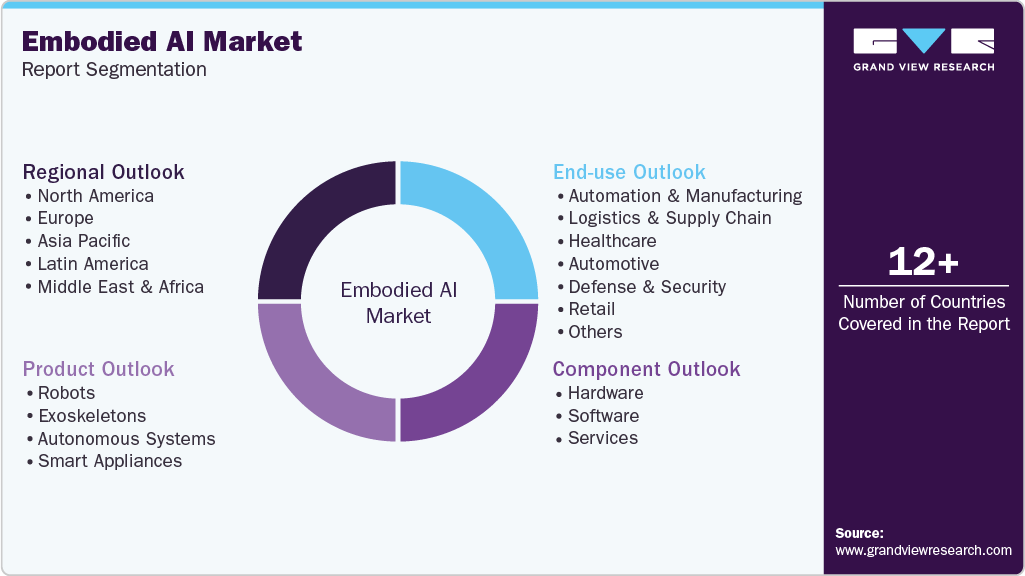
This report forecasts revenue growth at global, regional, and country levels and provides an analysis of the latest industry trends in each of the sub-segments from 2021 to 2033. For this study, Grand View Research has segmented the global embodied AI market report based on component, product, end use, and region:
-
Component Outlook (Revenue, USD Million, 2021 - 2033)
-
Hardware
-
Software
-
Services
-
-
Product Outlook (Revenue, USD Million, 2021 - 2033)
-
Robots
-
Exoskeletons
-
Autonomous Systems
-
Smart Appliances
-
-
End Use Outlook (Revenue, USD Million, 2021 - 2033)
-
Automation & Manufacturing
-
Logistics & Supply Chain
-
Healthcare
-
Automotive
-
Defense & Security
-
Retail
-
Education
-
Others
-
-
Regional Outlook (Revenue, USD Million, 2021 - 2033)
-
North America
-
U.S.
-
Canada
-
Mexico
-
-
Europe
-
UK
-
Germany
-
France
-
-
Asia Pacific
-
China
-
Japan
-
India
-
South Korea
-
Australia
-
-
Latin America
-
Brazil
-
-
Middle East and Africa (MEA)
-
KSA
-
UAE
-
South Africa
-
-
Frequently Asked Questions About This Report
Asia Pacific is the fastest-growing region over the forecast period.
The hardware segment led with a 51.2% revenue share in 2025.
The robots segment held the largest revenue share in 2025.
The automation & manufacturing segment held the largest revenue share in 2025.
The global embodied AI market is expected to grow at a CAGR of 39.7% from 2026 to 2033, reaching USD 67.6 billion by 2033.
The global embodied AI market size was valued at USD 4.7 billion in 2025 and is estimated at USD 6.5 billion for 2026.
North America dominated the embodied AI market with a share of 35.6% in 2025. This is attributable to strong investments in artificial intelligence, robotics development, and the presence of major technology companies in the region.
Key players include 1X Technologies; ABB; AGIBOT Innovation (Shanghai) Technology Co., Ltd.; Apptronik; Covariant; DataMesh Inc.; NEURA Robotics GmbH; Sanctuary Cognitive Systems Corporation; Toyota Motor Corporation; Unitree Robotics.
Key factors that are driving the market growth include increasing investments in artificial intelligence and robotics technologies. Growing adoption of embodied AI across industries such as healthcare, manufacturing, and logistics is further supporting market expansion.
About the Author(s)
Next Generation Technologies Research Team
Technology · Next Generation TechnologiesThis report was authored by the next generation technologies research team at Grand View Research - comprising two research analysts, one senior research analyst, and one industry expert - with specialized expertise in the next generation technologies segment of the technology industry. All findings are based on proprietary technology databases, executive interviews, and regulatory analysis, subject to internal peer review prior to publication.
Last Updated:
Speak to Analyst


Customize this report to your needs — add regions, segments, or data points, with 20% free customization.
Or view our licence options:


ISO 9001:2015 & 27001:2022 Certified
We are GDPR and CCPA compliant! Your transaction & personal information is safe and secure. For more details, please read our privacy policy.


