
- Home
- »
- Next Generation Technologies
- »
-
Encryption As A Service Market Size, Industry Report, 2033GVR Report cover

Encryption As A Service Market (2025 - 2033) Size, Share, & Trend Analysis By Component (Solutions, Services), By Deployment Mode, By Enterprise Size, By Application, By End Use, By Region, And Segment Forecasts
Market Size, 2024
$1.8BMarket Estimate, 2026
$2.2BMarket Forecast, 2033
$12.8BCAGR, 2025–2033
24.7%Encryption As A Service Market Summary
The global encryption as a service market size was estimated at USD 1.79 billion in 2024 and is projected to reach USD 12.78 billion by 2033, growing at a CAGR of 24.7% from 2025 to 2033. The market growth is driven by the increasing demand for scalable, cloud-native encryption platforms that enable secure data exchange, regulatory compliance, and zero-trust security across distributed digital ecosystems.
 Source: Grand View Research, IR Documents, Primary Interviews, Paid DatabasesTo learn more about this report,
 Download Free Sample Report
 Key Market Trends & Insights
- North America held a 37.26% revenue share of the global Encryption as a Service (EaaS) market in 2024.
- In the U.S., the market is expanding significantly due to the confluence of federal cybersecurity mandates, rising incidents of ransomware attacks, and the accelerated adoption of multi-cloud architectures across critical infrastructure sectors.
- By component, the solutions segment held the largest revenue share of 69.2% in 2024.
- By deployment mode, the private segment held the largest revenue share in 2024.
Market Size & Forecast
- 2024 Market Size: USD 1.79 Billion
- 2033 Projected Market Size: USD 12.78 Billion
- CAGR (2025-2033): 24.7%
- North America: Largest market in 2024
- Asia Pacific: Fastest growing market
Three ways to get this report
Buy it, customize it, or ask a question.Ask an Analyst
A direct answer, usually in 1 working day
- AccessReport author, directly
- Reply timeWithin 1 working day
- No sales callDirect answer only
- FormatEmail reply
- CostFree, no cost
Get the Full Report
What the study covers
- FormatsPDF · Excel · Dashboard
- Timeline2025–2033 annual, 2024 base
- Coverage20+ countries, 5 regions
- Companies10+ key players profiled
Customize the Report
20% free customization
- IncludeCountries, segments, points
- TailorTo your product definition
- ExtendDeeper competitor detail
- OrA fully bespoke study
- Turnaround5–10 working days
Organizations across verticals such as BFSI, IT & telecom, healthcare, and manufacturing are increasingly adopting modular EaaS platforms over traditional encryption toolkits to enable agile deployment, flexible pricing, and real-time scalability. This shift is driven by growing demand for encryption-as-a-utility models that support Bring Your Own Key (BYOK), Customer Managed Key (CMK), and multi-tenant encryption capabilities in SaaS and IaaS environments. Cloud-first enterprises are also moving toward containerized encryption agents and FIPS 140-2 validated modules that can be embedded directly into Kubernetes clusters and serverless workloads. This shift is further accelerated by the surge in cross-border cloud adoption and the need for granular data residency controls across geographies.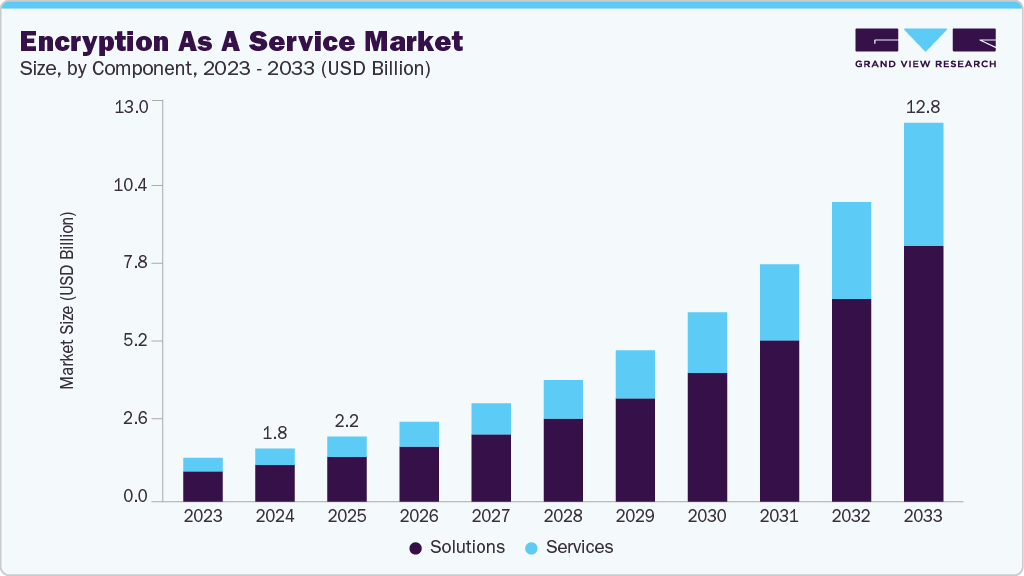 To learn more about this report, Download Free Sample Report
 The EaaS market is witnessing increasing integration of quantum-resilient encryption algorithms and post-quantum cryptography (PQC) support, as enterprises are preparing for long-term cryptographic agility. Vendors are differentiating by offering unified key management systems (KMS) with dynamic rotation policies, audit trails, and role-based access controls that comply with ISO/IEC 27001, PCI DSS, and regional standards like India’s DPDP Act and the EU’s NIS2 directive. Additionally, the rising adoption of EaaS by cloud-native startups and SaaS vendors, who integrate white-labeled encryption APIs to ensure compliance without building proprietary security stacks. Moreover, financial institutions and healthcare providers are piloting envelope encryption and homomorphic encryption as part of privacy-preserving analytics and confidential computing.
Consequently, the EaaS landscape is evolving into a differentiated service layer within cloud security architectures, marked by the convergence of encryption lifecycle automation, multi-cloud orchestration, and policy-based access control. Market leaders are investing in AI-driven anomaly detection within encrypted traffic, automated certificate lifecycle management, and SaaS-delivered key vaults that integrate natively with AWS KMS, Azure Key Vault, and Google Cloud KMS. As organizations seek to mitigate vendor lock-in and align with shared responsibility models in cloud security, EaaS is no longer positioned as a niche encryption tool but as a foundational pillar for data governance, risk management, and compliance observability across modern cloud-native ecosystems.
Component Insights
The solutions segment accounted for the largest revenue share of 69.23% in the global Encryption as a Service (EaaS) market in 2024, driven by rising enterprise demand for zero trust-aligned encryption platforms that offer granular visibility, centralized policy enforcement, and secure key orchestration across hybrid and multi-cloud environments. As organizations face mounting risks from unmanaged secrets, unsecured code, and decentralized cryptographic operations, they are prioritizing EaaS solutions that enable authenticated code signing, dynamic key lifecycle management, and hardened hardware-based security. In addition, the shift toward integrated compliance dashboards and encryption governance tools that help enterprises adhere to evolving mandates while maintaining developer velocity and cross-cloud agility is also bolstering market growth. For instance, in September 2023, Entrust introduced new zero trust-ready capabilities including Code Signing as a Service, enhanced CodeSafe within nShield HSMs, and a unified Compliance Manager for KeyControl, providing organizations with end-to-end control over applications, encryption keys, and secrets across on-premises and cloud-native environments. Consequently, these innovations highlight the segment’s continued dominance as enterprises seek modular, policy-driven encryption solutions that align with secure software development, regulatory compliance, and zero trust architecture frameworks.
The services segment is expected to register the fastest CAGR of 25.5% in the global Encryption as a Service (EaaS) market during the forecast period, driven by increasing enterprise dependence on managed and professional services to navigate encryption complexities and ensure continuous compliance. As data security becomes integral to digital transformation initiatives are leveraging managed services for 24/7 key lifecycle management, tokenization, and real-time encryption orchestration, while relying on professional services for risk assessments, regulatory alignment, and tailored deployment strategies. Moreover, the growing demand for expert-led and cloud-native encryption solutions is further reinforced by the integration of these services into DevSecOps pipelines and zero trust frameworks. For instance, in November 2024, Thales introduced CipherTrust Transparent Encryption-as-a-Service via its CipherTrust Data Security Platform, enabling enterprises to centralize encryption policy enforcement and streamline key management across hybrid and multi-cloud environments without infrastructure overhaul. This evolution highlights the segment’s growth, as enterprises increasingly adopt service-led encryption models to enhance security posture, optimize operational agility, and meet stringent compliance mandates at scale.
Deployment Mode Insights
The private segment accounted for the largest market share of 60.28% in the Encryption as a Service (EaaS) market in 2024, driven by sustained enterprise preference for environments that offer maximum control over data governance, residency, and compliance frameworks. Organizations prioritize private-cloud EaaS solutions to meet stringent regulatory requirements, retain critical cryptographic keys on-premises, and reduce dependency on third-party cloud providers. Additionally, the growing need for cross-region data protection within private environments is compelling enterprises to invest in encryption platforms with built-in support for secure inter-region key management and network-layer encryption controls. For instance, in March 2025, Liquid Web introduced fully encrypted cross-region private networking as a default feature across its bare-metal hosting offerings, enabling secure data transmission between its data centers without the need for manual VPN configurations or third-party tools. This development reinforces the enterprise demand for encryption by default within trusted environments and highlights the segment’s continued dominance as organizations prioritize resilience, compliance, and centralized security control.
The public segment of the Encryption as a Service (EaaS) market is experiencing strong growth, with a projected CAGR of 25.5%, fueled by increasing enterprise migration to public cloud platforms and the corresponding need for scalable, on-demand encryption solutions. Key trends driving the growth include the proliferation of cloud-native workloads, where enterprises require seamless encryption integration across IaaS, PaaS, and SaaS environments, and the rising use of BYOK/HYOK models to maintain cryptographic key control while using third-party cloud services. In addition, cloud hyperscalers such as AWS, Azure, and Google Cloud are embedding encryption as a default offering, with advanced capabilities like customer-managed keys, envelope encryption, and integrated key management services (KMS) becoming standard across public cloud deployments. Furthermore, organizations are prioritizing data sovereignty and cross-border compliance, leading to the adoption of region-specific encryption policies and automated key rotation across multi-tenant environments. The rise of industry-specific cloud frameworks such as FedRAMP-authorized public cloud services for government or HIPAA-compliant environments for healthcare also accelerates public EaaS adoption by reducing implementation complexity. Collectively, these trends are reshaping enterprise approaches to securing cloud workloads, positioning public encryption services as a core enabler of scalable, compliant, and agile cloud strategies.
Enterprise Size Insights
The large enterprises segment accounted for the largest share of 71.27% in the global Encryption as a Service (EaaS) market in 2024, reflecting their substantial demand for centralized, enterprise-grade encryption capabilities across hybrid and multi-cloud infrastructures. Large organizations particularly in sectors like BFSI, healthcare, and public administration are leveraging EaaS platforms to unify cryptographic key management, enforce consistent encryption policies, and integrate controls within DevSecOps pipelines at scale. A burgeoning trend within this segment is the deployment of client-side file encryption tools that enable client-end encryption with centralized orchestration to secure data regardless of its storage or sharing mode. For instance, in November 2023, Utimaco introduced its u.trust LAN Crypt Cloud, a cloud-based file encryption-as-a-service solution offering end-to-end encryption, role-based access control, and administrative visibilitydesigned for rapid deployment and robust file protection across enterprise environments. These developments strengthen the segment’s dominance, as large enterprises favor scalable, compliant encryption solutions that ensure governance, resilience, and consistent security across globally distributed operations.
The Small and Medium Enterprises (SMEs) segment is expected to grow at the fastest CAGR of 25.4% during the forecast period, driven by factors such as the accelerated shift to cloud-native architectures, the need for lean cybersecurity operations, and mounting regulatory requirements across data-sensitive sectors including healthcare, retail, and fintech. SMEs are increasingly adopting managed encryption services to compensate for limited in-house cybersecurity expertise and to ensure rapid compliance with evolving frameworks such as GDPR, HIPAA, and PCI DSS. In addition, the growing demand for modular, API-driven encryption solutions that can integrate seamlessly into existing SaaS platforms and digital ecosystems, allowing SMEs to secure customer data, financial records, and business-critical communications is also boosting the growth. Furthermore, SMEs are prioritizing encryption tools that offer multi-cloud compatibility, centralized key management, and automated policy enforcement, enabling secure data mobility and resilient operations across distributed teams. Subsequently, the segment’s rapid growth highlights a broader industry shift toward democratizing enterprise-grade encryption capabilities, positioning SMEs as pivotal contributors to the expansion of the EaaS market.
Application Insights
The data encryption segment accounted for the largest market share of 41.09% in the global Encryption as a Service (EaaS) market in 2024, driven by growing enterprise demand for data-centric protection. Organizations are prioritizing client-side and end-to-end encryption to embed robust control policies directly into data exchanges, ensuring secure sharing and revocation capabilities while retaining ownership of cryptographic enforcement regardless of storage or transmission context. Moreover, the adoption of standards-based techniques such as Trusted Data Format (TDF), which support seamless integration into platforms like Microsoft Outlook and Google Workspace is enabling policy-bound data encryption that persists with the information itself. For instance, in June 2021, Virtru launched its Microsoft 365 Outlook Data Encryption solution, which integrates data-centric protection across Outlook clients on PC, Mac, iPad, and mobile, allowing enterprises to secure messages and attachments with user-friendly controls such as revocation, expiration, disabling forwarding, and enforcing watermarks. Therefore, these developments increase the data encryption segment’s market share, as enterprises seek scalable, persistent encryption mechanisms that support security and compliance uniformly across hybrid and cloud-native environments.
The cloud encryption segment is projected to register the fastest CAGR of 25.8% over the forecast period, driven by surging demand for scalable encryption services that seamlessly integrate with public cloud platforms and support multi-cloud deployments. Organizations are increasingly seeking Bring Your Own Key (BYOK) and Customer Managed Key (CMK) models to retain cryptographic control while leveraging cloud-native analytics and storage services. Also, the growing adoption of API-based encryption frameworks and centralized key management systems that enable real-time key rotation, granular policy enforcement, and compliance across distributed cloud environments is driving the market growth. For instance, in October 2022, Cryptomathic launched a cloud-based BYOK encryption key management service for users of Amazon Web Services, delivering fully managed key lifecycle capabilities compatible with AWS KMS and offering enterprises greater autonomy over their cloud cryptographic policies. Hence, these developments support the cloud encryption segment’s accelerated growth, as enterprises increasingly adopt policy-driven, interoperable encryption frameworks to ensure data confidentiality, regulatory compliance, and operational control across cloud environments.
End Use Insights
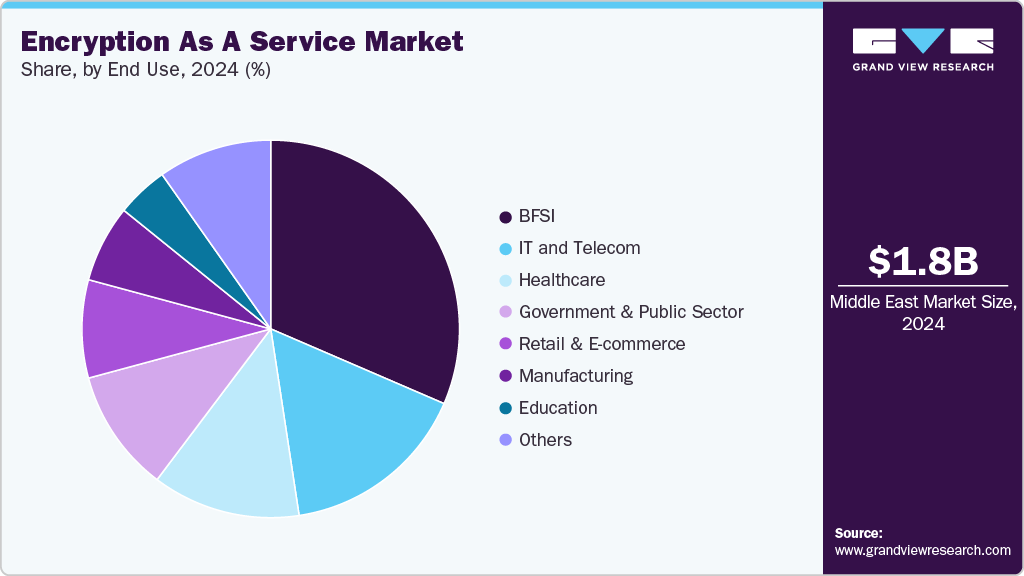
The BFSI segment accounted for the largest market share of 31.48% in the global Encryption as a Service (EaaS) market in 2024, driven by the sector’s stringent compliance requirements, sensitivity of transactional data, and rising exposure to sophisticated cyber threats. Financial institutions are adopting centralized key management systems, tokenization solutions, and real-time data encryption to secure digital banking services, streamline cross-border payments, and meet evolving regulatory standards such as PCI DSS, GDPR, and RBI’s cybersecurity guidelines. Moreover, the segment is also witnessing heightened integration of EaaS into AI-based fraud detection and secure APIs for open banking, as well as greater demand for post-quantum cryptographic readiness in preparation for future security challenges. Additionally, the growth of embedded finance and digital lending ecosystems has increased the need for policy-driven, scalable encryption frameworks that protect customer data across distributed cloud and mobile platforms. Consequently, the aforementioned factors are contributing substantially to spurring the EaaS market share.
 To learn more about this report, Download Free Sample Report
 The IT and Telecom segment is expected to register the fastest growth of 25.6% during the forecast period in the global Encryption as a Service (EaaS) market, fueled by escalating data privacy concerns, exponential growth in 5G infrastructure, and the rising complexity of multi-cloud and edge-native environments. Enterprises in this segment are adopting EaaS to implement secure-by-design architectures, encrypt high-volume transactional data across global networks, and enable zero-trust frameworks within increasingly decentralized systems. Key trends include the integration of encryption orchestration with DevSecOps pipelines, automated certificate lifecycle management, and identity-based encryption for API-driven services. The proliferation of IoT devices, SD-WAN deployment, and hyperscale cloud adoption has further elevated the demand for scalable, latency-optimized encryption models capable of securing data in motion, at rest, and in use. These factors collectively position the IT and Telecom segment as the fastest-growing vertical, reflecting its critical role in safeguarding the digital backbone of interconnected global enterprises.
Regional Insights
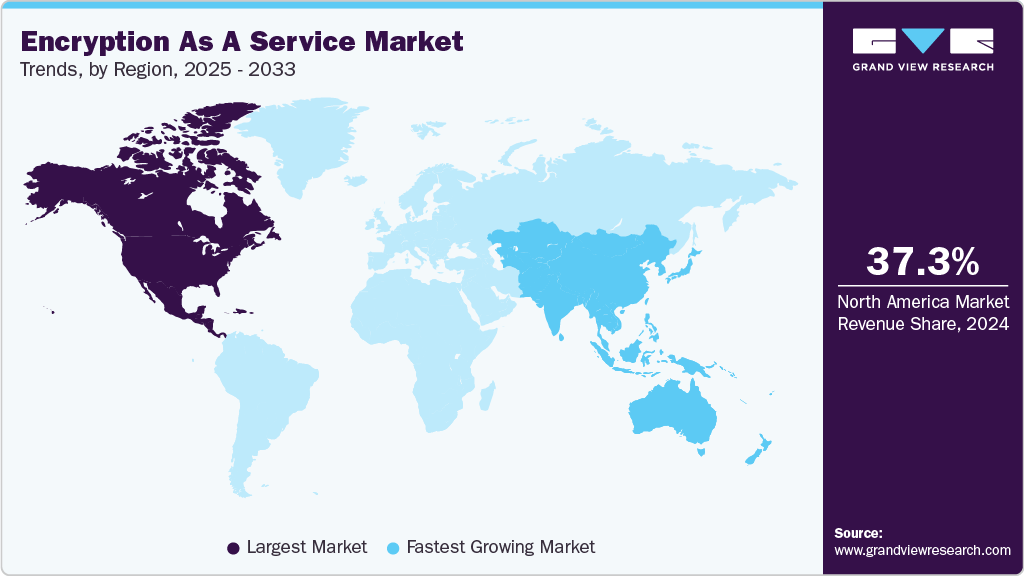
North America Encryption as a Service market accounted for the largest market share of 37.26% in 2024, driven by developments such as the implementation of zero trust security frameworks across both federal and commercial enterprises, alongside stringent enforcement of data protection regulations including the California Consumer Privacy Act and the New York Department of Financial Services Cybersecurity Regulation. Additionally, the shift of public sector workloads to FedRAMP-compliant cloud infrastructure has accelerated demand for encryption services with advanced key lifecycle management, policy-based access controls, and compliance-ready configurations. Moreover, the region’s mature cloud service ecosystem, comprising Amazon Web Services, Microsoft Azure, and Google Cloud, is further supporting the adoption of embedded encryption solutions across enterprise-scale SaaS and platform-based deployments. Furthermore, collaborations between North American cybersecurity vendors and hardware providers are enabling hardware-anchored encryption for applications across the industrial internet of things and next-generation connected vehicles. These dynamics collectively position North America as the most security-conscious and compliance-driven region in the global EaaS landscape.
 To learn more about this report, Download Free Sample Report
 U.S. Encryption As A Service Market Trends
The U.S. Encryption as a Service (EaaS) market is expanding significantly due to the confluence of federal cybersecurity mandates, rising incidents of ransomware attacks, and the accelerated adoption of multi-cloud architectures across critical infrastructure sectors. Also, the implementation of the Executive Order on improving the Nation’s Cybersecurity has compelled public and private entities to enhance encryption standards and adopt zero trust security models, particularly for protecting classified and mission-critical data. Additionally, enterprises are integrating encryption services with cloud-native platforms and secure access service edge frameworks to achieve scalable, policy-driven data protection. Furthermore, the U.S. financial services and healthcare sectors are witnessing heightened deployment of EaaS solutions to meet stringent regulatory requirements under HIPAA, GLBA, and FFIEC guidelines. Also, the proliferation of quantum-readiness initiatives by federal agencies is also spurring demand for post-quantum encryption capabilities within EaaS offerings. With a strong ecosystem of cloud service providers, cybersecurity startups, and regulatory leadership, the U.S. continues to be the epicenter of innovation and adoption in the global EaaS market.
Europe Encryption As A Service Market Trends
The Encryption as a Service (EaaS) market in Europe is anticipated to register significant growth from 2025 to 2033, drivenby regionally specific dynamics including escalating regulatory scrutiny over encryption integrity, evolving digital sovereignty mandates, and a coordinated push toward cryptographic agility across member states. Privacy legislation underpinned by GDPR continues to drive demand for robust encryption services that enable key sovereignty, data localization and continuous compliance auditing. In parallel, proposals such as Denmark’s revived “Chat Control” law and the broader EU ProtectEU initiative are intensifying debates around exceptional lawful access requirements for encrypted communications, prompting enterprises to seek EaaS platforms that can sustain compliance while preserving end-to-end encryption integrity. Moreover, Europe’s transition strategy toward post‑quantum cryptography is also gaining momentum, with EU member states aligning standards to adopt quantum-resistant algorithms across critical infrastructure and government networks.In addition, the emergence of continuous certification frameworks like EUCS highlights the need for EaaS offerings that seamlessly support certification-as-a-service regimes interoperable with cloud and edge environments. These developments collectively underscore Europe's position as a highly regulated, privacy-focused market where encryption services are essential for legal compliance, data sovereignty, and future-proof security strategies.
Encryption as a Service market in the UK is defined by distinct regulatory and security dynamics that deeply influence enterprise encryption strategies. Heightened enforcement of the UK GDPR and the Data Protection Act 2018 has led organizations to prioritize encryption as a default security measure for personal data at rest, in transit, and on removable media as underscored by guidance from the UK Information Commissioner’s Office on appropriate technical measures. Additionally, the proposed reforms to the Investigatory Powers Act and the Online Safety Act 2023 have heightened concerns regarding mandated access to encrypted communications and prompted businesses to seek encryption solutions that allow them to retain sovereign control over cryptographic keys and resist any legislative demands for backdoors.
Germany Encryption as a Service market is characterized by high encryption awareness and regulatory motivation embedded within its enterprise culture. Germany is also advancing post-quantum cryptographic readiness and leveraging certified encryption compliance capabilities aligned with BSI mandates. Federal guidance such as BSI TR‑02102 reinforces strict requirements for cryptographic mechanisms, influencing enterprise EaaS preferences toward FIPS-validated, BSI-certified solutions with audit capabilities and enforcement policies.Meanwhile, companies such as Adva Network Security are pioneering quantum-safe networking products with Layer 1‑3 encryption certified by German authorities, supporting encrypted backhaul connectivity across critical infrastructure and aligning with broader national cryptographic resilience initiatives.
Asia Pacific Encryption As A Service Market Trends
Asia Pacific is expected to register the fastest CAGR of 25.5% from 2025 to 2033, driven by trends that reflect its rapid digital transformation and regulatory evolution. Governments and enterprises across markets such as India, China, Singapore, Japan, and Southeast Asia are driving demand for encryption through investments in cybersecurity infrastructure and advanced data protection mandates. Regulatory fragmentation and cross-border data residency laws are compelling multinational firms to adopt centralized encryption strategies that enable secure data movement while staying compliant across jurisdictions.Additionally, cloud-native transformation is a central catalyst for adoption of EaaS. More than 75% of Asia Pacific organizations operate multi-cloud or hybrid environments, creating demand for managed EaaS offerings that support Bring Your Own Key (BYOK) and secure key rotation across platforms.At the same time, the increasing use of IoT, mobile payments, and BYOD strategies is driving uptake of endpoint encryption and data protection embedded into distributed cloud-native architectures. Consequently, the aforementioned factors are contributing substantially in bolstering the market growth in Asia Pacific.
The Encryption as a Service market in Japan is poised for robust growth from 2025 to 2033, driven by the convergence of national cybersecurity policy mandates, increased enterprise migration to cloud-native architectures, and a growing emphasis on zero-trust security models. Japanese organizations are prioritizing end-to-end encryption solutions to address evolving threat landscapes associated with smart infrastructure, IoT, and industrial automation, particularly in sectors such as advanced manufacturing, automotive, and healthcare. The government's continued emphasis on digital transformation under initiatives such as Society 5.0 has led to a heightened demand for scalable, interoperable encryption platforms that ensure data confidentiality across hybrid environments. Additionally, enterprises are increasingly integrating EaaS into DevSecOps workflows and multi-cloud deployments to comply with stringent domestic data residency and privacy requirements. The rising integration of quantum-resilient cryptography research into commercial use cases further positions Japan as a key driver of innovation in the regional EaaS landscape.
The China Encryption as a Service market is being shaped by specific drivers that reflect China’s regulatory environment, technological strategy, and security priorities. China’s legal framework including the Personal Information Protection Law (PIPL), Data Security Law (DSL), Cryptography Law, and Multi-Level Protection Scheme (MLPS) mandates strict data localization and usage of locally certified cryptographic standards such as SM2, SM3, SM4, and SM9.As a result, EaaS providers must deploy hybrid encryption architectures that segregate domestic and international data flows, while ensuring auditability and adherence to state-mandated supervision controls.Another trend driving growth is the scaling of Key Management-as-a-Service (KMaaS) solutions designed to meet both enterprise and government encryption needs, offering centralized key orchestration compatible with China’s standardized cryptographic stack.Consequently, these factors including regulatory compliance, national cryptography standards, and emerging digital identity ecosystems position China as a uniquely regulated but rapidly evolving market for encryption services tailored to sovereign requirements and data governance frameworks.
India’s Encryption as a Service market is experiencing accelerated growth driven by the convergence of regulatory mandates, digital infrastructure expansion, and increasing enterprise focus on data protection. The implementation of the Digital Personal Data Protection (DPDP) Act has elevated encryption from a best practice to a regulatory requirement, compelling organizations to adopt robust, scalable encryption solutions across cloud, on-premise, and hybrid environments. Simultaneously, the rapid development of hyperscale data centers across major Indian cities is amplifying the need for encryption services that offer centralized key management and support for multi-cloud architectures. Enterprises across BFSI, healthcare, and government sectors are prioritizing EaaS platforms that ensure compliance, mitigate risks associated with distributed workforces, and seamlessly integrate with DevSecOps pipelines. As data sovereignty and zero-trust frameworks become central to cybersecurity strategy, India is emerging as a strategic market for EaaS adoption, characterized by strong policy tailwinds, growing cloud-native demand, and heightened sensitivity to digital risk.
Key Encryption As A Service Company Insights
Key players operating in the Encryption as a Service (EaaS) industry are Amazon Web Services, Inc., AxCrypt AB, Broadcom Inc., CipherCloud, Inc. and others. Companies are focusing on various strategic initiatives, including new product development, partnerships & collaborations, and agreements to gain a competitive advantage over their rivals. The following are some instances of such initiatives:
-
In November 2024, Fortanix entered the U.S. public sector via a partnership with Carahsoft, making its Confidential Computing and post-quantum encryption solutions available to federal entities through SEWP V and NASPO ValuePoint contracts.
-
In August 2024, the company launched KeyControl as a Service (KCaaS), a cloud-based key management platform that enables geographically distributed vaults and integration with FIPS 140‑3 certified hardware modules.
-
In March 2024, Fortanix collaborated with AppViewX to deliver machine identity management and code signing services integrated into their DSM platform and accessible via the AWS Marketplace.
Key Encryption As A Service Companies:
The following are the leading companies in the encryption as a service (EaaS) market. These companies collectively hold the largest market share and dictate industry trends.
- Amazon Web Services, Inc.
- AxCrypt AB
- Broadcom Inc.
- CipherCloud, Inc.
- Entrust Corporation
- Fortanix Inc.
- Google LLC
- Hewlett Packard Enterprise Development LP
- IBM Corporation
- McAfee, LLC
- Microsoft Corporation
- Oracle Corporation
- Sophos Limited
- Thales Group
- Trend Micro Incorporated
Encryption As A Service (EaaS) Market Report Scope
Report Attribute
Details
Market size in 2025
USD 2.18 billion
Revenue forecast in 2033
USD 12.78 billion
Growth rate
CAGR of 24.7% from 2025 to 2033
Actual data
2021 - 2024
Forecast period
2025 - 2033
Quantitative units
Revenue in USD million/billion and CAGR from 2025 to 2033
Report coverage
Revenue forecast, company share, competitive landscape, growth factors, and trends
Segments covered
Component, deployment mode, enterprise size, application, end use, and region
Regional scope
North America; Europe; Asia Pacific; Latin America; MEA
Country scope
U.S.; Canada; Mexico; UK; Germany; France; China; India; Japan; Australia; South Korea; Brazil; UAE; Kingdom of Saudi Arabia; South Africa
Key companies profiled
Amazon Web Services, Inc.; AxCrypt AB; Broadcom Inc.; CipherCloud, Inc.; Entrust Corporation; Fortanix Inc.; Google LLC; Hewlett Packard Enterprise Development LP; IBM Corporation; McAfee, LLC; Microsoft Corporation; Oracle Corporation; Sophos Limited; Thales Group; Trend Micro Incorporated
Customization scope
Free report customization (equivalent to 8 analysts working days) with purchase. Addition or alteration to country, regional & segment scope.
Application and purchase options
Avail customized purchase options to meet your exact research needs. Explore purchase options
Global Encryption As A Service (EaaS) Market Report Segmentation
This report forecasts revenue growth at global, regional, and country levels and provides an analysis of the latest industry trends in each of the sub-segments from 2021 to 2033. For this study, Grand View Research has segmented the Encryption as a Service (EaaS) market report based on component, deployment mode, enterprise size, application, end use, and region.
-
Component Outlook (Revenue, USD Billion, 2021 - 2033)
-
Solutions
-
Services
-
Professional Services
-
Managed Services
-
-
-
Deployment Mode Outlook (Revenue, USD Billion, 2021 - 2033)
-
Public
-
Private
-
Hybrid
-
-
Enterprise Size Outlook (Revenue, USD Billion, 2021 - 2033)
-
Large Enterprises
-
Small and Medium Enterprises (SMEs)
-
-
Application Outlook (Revenue, USD Billion, 2021 - 2033)
-
Email Encryption
-
Disk Encryption
-
Network Traffic Encryption
-
Cloud Encryption
-
Data Encryption
-
- End Use Outlook (Revenue, USD Billion, 2021 - 2033)
-
IT and Telecom
-
BFSI
-
Healthcare
-
Retail and E-commerce
-
Manufacturing
-
Education
-
Government and Public Sector
-
Others
-
-
Regional Outlook (Revenue, USD Billion, 2021 - 2033)
-
North America
-
U.S.
-
Canada
-
Mexico
-
-
Europe
-
UK
-
Germany
-
France
-
-
Asia Pacific
-
China
-
India
-
Japan
-
South Korea
-
Australia
-
-
Latin America
- Brazil
-
Middle East & Africa
-
UAE
-
Saudi Arabia
-
South Africa
-
-
Frequently Asked Questions About This Report
The global encryption as a service market size was estimated at USD 1.79 billion in 2024 and is expected to reach USD 2.18 billion in 2025.
The global encryption as a service market is expected to grow at a compound annual growth rate of 24.7% from 2025 to 2033 to reach USD 12.78 billion by 2033.
The BFSI segment dominated the Encryption as a Service (EaaS) market with a market share of 31.48% in 2024. The growth is driven by the sector’s stringent compliance requirements, sensitivity of transactional data, and rising exposure to sophisticated cyber threats.
Some key players operating in the EaaS market include Amazon Web Services, Inc., AxCrypt AB, Broadcom Inc., CipherCloud, Inc., Entrust Corporation, Fortanix Inc., Google LLC, Hewlett Packard Enterprise Development LP, IBM Corporation, McAfee, LLC, Microsoft Corporation, Oracle Corporation, Sophos Limited, Thales Group, Trend Micro Incorporated and Others.
Factors such as the increasing demand for scalable, cloud-native encryption platforms that enable secure data exchange, regulatory compliance, and zero-trust security across distributed digital ecosystems plays a key role in accelerating the Encryption as a Service (EaaS) market.
About the Author(s)
Next Generation Technologies Research Team
Technology · Next Generation TechnologiesThis report was authored by the next generation technologies research team at Grand View Research - comprising two research analysts, one senior research analyst, and one industry expert - with specialized expertise in the next generation technologies segment of the technology industry. All findings are based on proprietary technology databases, executive interviews, and regulatory analysis, subject to internal peer review prior to publication.
Last Updated:
Speak to Analyst

Customize this report to your needs - add regions, segments, or data points, with 20% free customization.
Or view our licence options:


ISO 9001:2015 & 27001:2022 Certified
We are GDPR and CCPA compliant! Your transaction & personal information is safe and secure. For more details, please read our privacy policy.


