
- Home
- »
- Advanced Interior Materials
- »
-
Energy-harvesting Textiles Market Size, Share Report, 2033GVR Report cover

Energy-harvesting Textiles Market (2026 - 2033)
Size, Share & Trends Analysis Report By Technology (Photovoltaic Textiles, Piezoelectric Textiles, Triboelectric Textiles, Thermoelectric Textiles), By Application, By Region, And Segment Forecasts
Market Size, 2025
$1.5BMarket Estimate, 2026
$1.8BMarket Forecast, 2033
$6.8BCAGR, 2026–2033
21.3%Energy-harvesting Textiles Market Summary
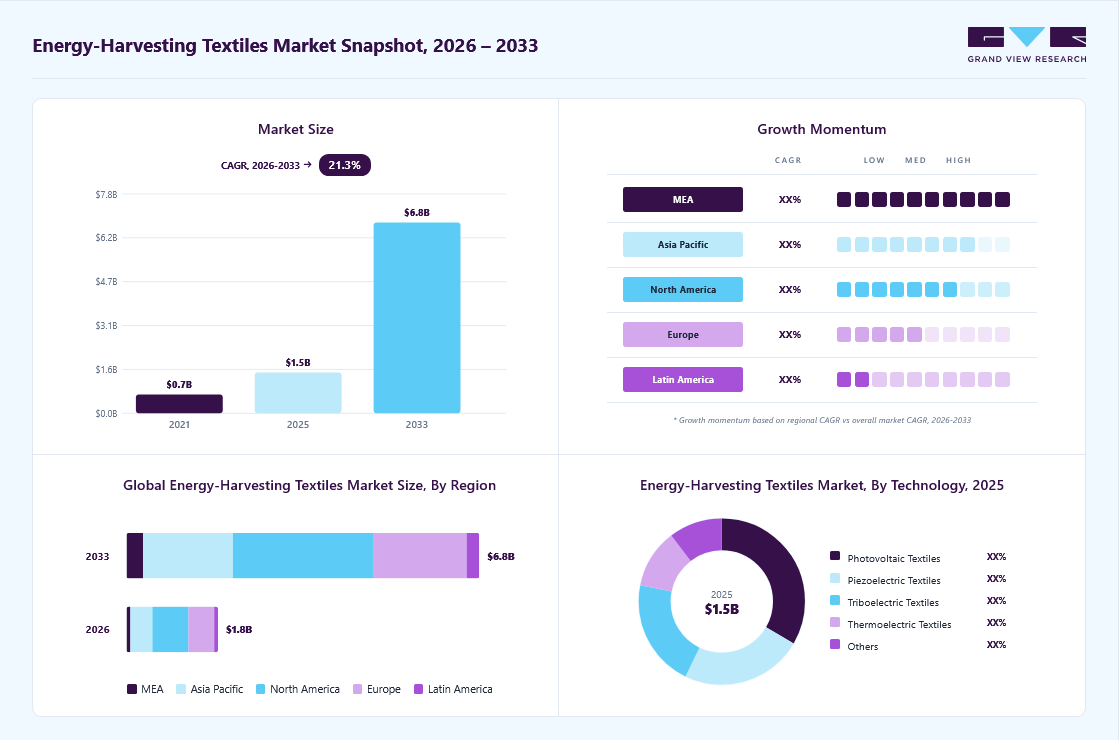
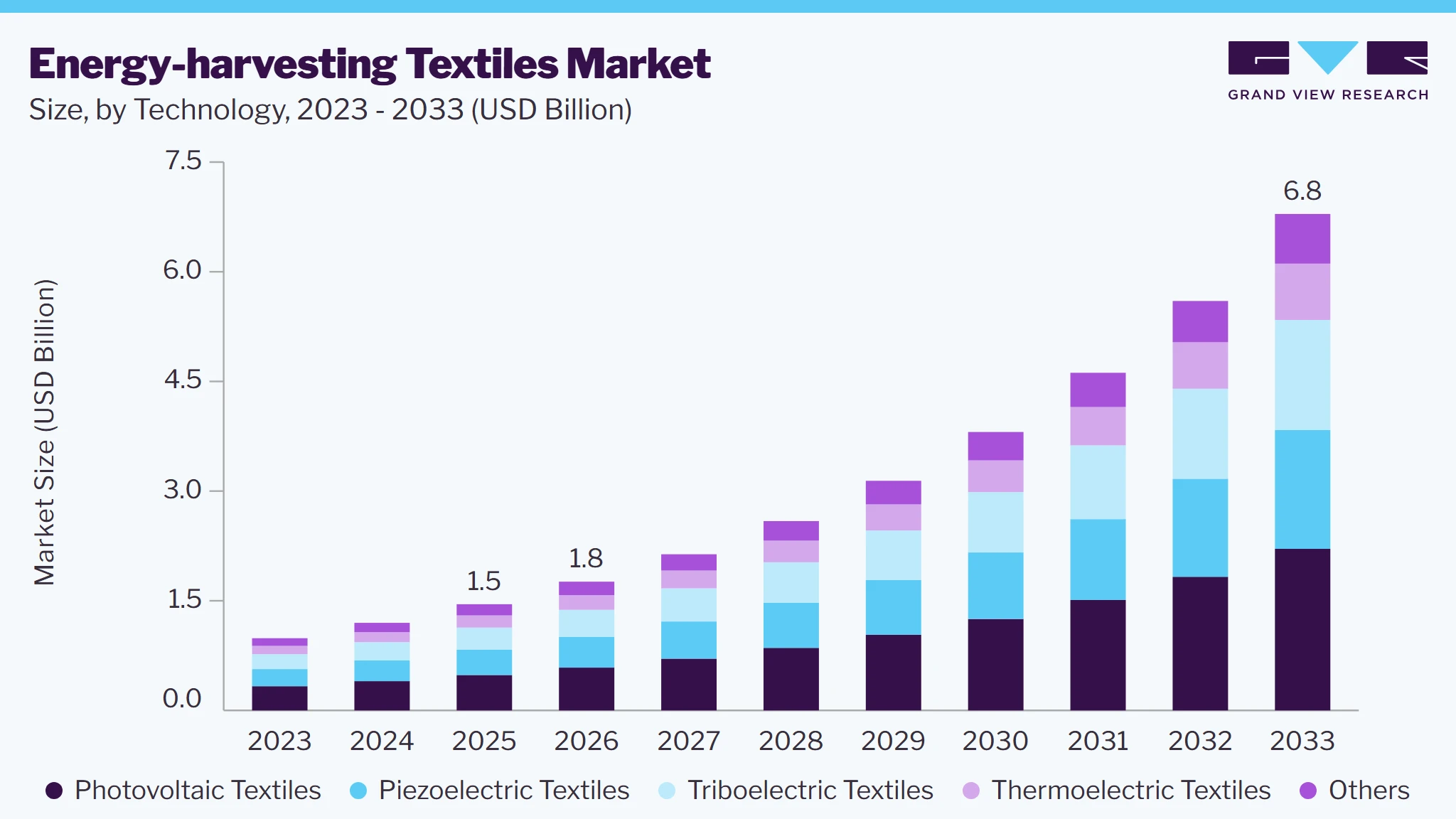
The global energy-harvesting textiles market size was valued at USD 1.5 billion in 2025 and is projected to grow from USD 1.8 billion in 2026 to USD 6.8 billion by 2033, at a CAGR of 21.3% from 2026 to 2033. North America dominated the market, accounting for the largest revenue share of 39.4% in 2025. The energy-harvesting textiles market comprises textiles engineered to capture and convert ambient energy from sources such as sunlight, body movement, heat, and mechanical motion into usable electrical energy.
 Source: Grand View Research, IR Documents, Primary Interviews, Paid DatabasesTo learn more about this report,
 Download Free Sample Report
Key Market Trends & Insights
- By technology: Triboelectric textiles segment is expected to grow at a CAGR of 22.1% over the forecast period.
- By application: Apparel & personal wearables segment dominated the market with a revenue share of 30.5% in 2025.
Regional Highlights
- Largest regional market: North America (39.4% revenue share, 2025)
- Fastest-growing regional market: Middle East & Africa (highest CAGR, 2026-2033)
- By country: The U.S. held the largest market share in 2025.
Market Size & Forecast
- Market size in 2025: USD 1.5 Billion
- Estimated market size in 2026: USD 1.8 Billion
- Projected market size by 2033: USD 6.8 Billion
- CAGR (2026-2033): 21.3%
Three ways to get this report
Buy it, customize it, or ask a question.Ask an Analyst
Analyst response in 1 business day
- AccessReport author, directly
- Reply timeWithin 1 working day
- No sales callDirect answer only
- FormatEmail reply
- CostFree, no cost
Get the Full Report
What the study covers
- FormatsPDF · Excel · Dashboard
- Timeline2026–2033 annual, 2025 base
- Coverage20+ countries, 5 regions
- Companies10+ key players profiled
Customize the Report
20% free customization
- IncludeCountries, segments, points
- TailorTo your product definition
- ExtendDeeper competitor detail
- OrA fully bespoke study
- Turnaround5–10 working days
The market is supported by increasing interest in self-powered wearable systems across healthcare, sports and fitness, defense, consumer electronics, and industrial applications. Textile-integrated energy generation can reduce reliance on conventional batteries and external charging systems, particularly in applications where flexibility, mobility, and continuous operation are important. Manufacturers are therefore focusing on improving energy conversion efficiency while maintaining textile comfort and durability.
 To learn more about this report, Download Free Sample Report
Market Dynamics
The energy-harvesting textiles market is shaped by the increasing integration of electronic functionality into fabrics and the need for lightweight, flexible, and self-powered solutions. Demand is being influenced by the expansion of wearable electronics, advances in energy-harvesting materials, and the development of multifunctional textiles. At the same time, limitations related to power output, durability, washability, and manufacturing complexity continue to affect large-scale adoption. Opportunities are emerging through the integration of multiple energy-harvesting technologies and their application across specialized end-use industries.
The increasing adoption of wearable electronics is creating demand for textile-based power sources that can support sensors, monitoring devices, communication components, and other low-power electronics. Smart garments and connected textile products require power solutions that can operate without adding significant weight or compromising flexibility. Energy-harvesting textiles address this requirement by converting available environmental or human energy into electricity directly within the textile structure.
The growing development of healthcare monitoring, sports and fitness wearables, and connected clothing is further supporting demand for self-powered textile systems. Integrating energy generation into fabrics can reduce dependence on conventional batteries and minimize the need for frequent charging or replacement. This is particularly beneficial for applications requiring continuous monitoring or where access to external power sources is limited.
Limited energy output remains a major restraint because the amount of energy available from sunlight, body movement, heat, or mechanical activity varies significantly with operating conditions. Many energy-harvesting textiles are currently more suitable for powering low-energy sensors and intermittent electronic functions than energy-intensive devices. In addition, maintaining performance after repeated bending, stretching, washing, abrasion, and environmental exposure remains challenging, increasing development complexity and limiting widespread commercialization.
The integration of multiple energy-harvesting mechanisms within a single textile platform presents a significant opportunity for improving energy availability and reliability. Combining technologies such as photovoltaic, triboelectric, piezoelectric, and thermoelectric harvesting can enable textiles to capture energy from different sources under varying operating conditions. This approach can expand the use of self-powered textiles across wearable electronics, healthcare monitoring, sports equipment, defense systems, and industrial applications.
Market Concentration & Characteristics
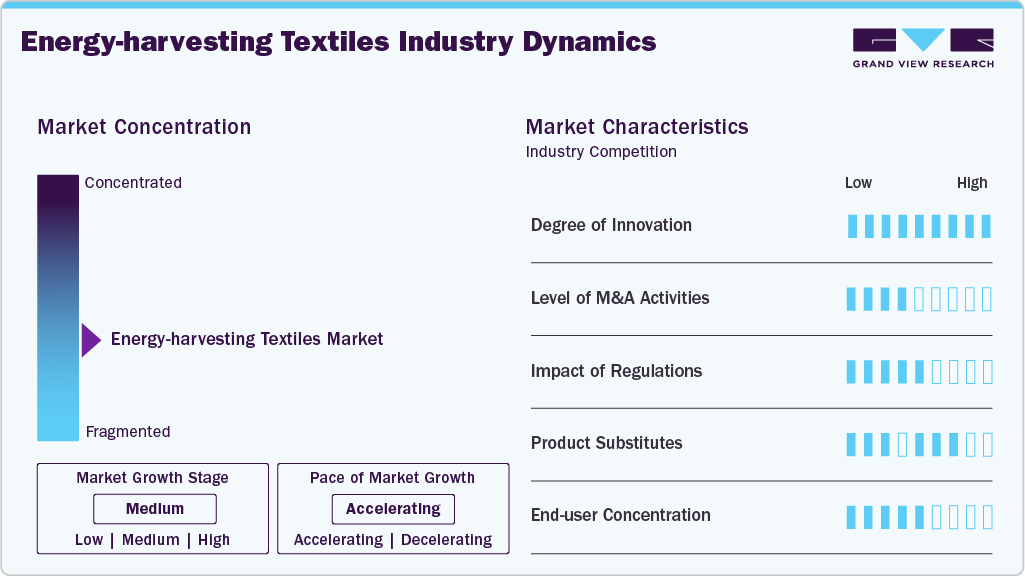
The energy-harvesting textiles market remains relatively fragmented, with competition involving advanced textile manufacturers, smart-textile developers, material companies, electronics companies, and research-driven technology providers. Many participants focus on specific energy-harvesting technologies or application areas rather than offering broad product portfolios. Collaboration between textile manufacturers, material developers, electronics companies, and research institutions is therefore important for technology development, product integration, and commercialization.
 To learn more about this report, Download Free Sample Report
Conventional batteries, rechargeable batteries, flexible batteries, and external portable power sources are the primary substitutes for energy-harvesting textiles. These technologies generally provide more predictable power output but add weight, require charging or replacement, and can limit flexibility in wearable applications. Energy-harvesting textiles have greater substitution potential in low-power applications where lightweight construction, continuous supplementary power, and direct integration into textile structures are important.
Analyst Perspective
The energy-harvesting textiles market is transitioning from research-driven development toward early commercial adoption, supported by growing demand for self-powered wearable electronics and multifunctional smart textiles. Photovoltaic, triboelectric, and piezoelectric technologies are expected to remain important areas of development as manufacturers focus on improving energy output, flexibility, durability, and textile integration. Demand is likely to remain concentrated in specialized applications such as apparel and personal wearables, military and defense, sports and fitness, and healthcare, where low-power energy generation can provide clear functional benefits. As technology costs decline and integration with sensors and other electronic components improves, energy-harvesting textiles are expected to gain broader commercial acceptance across technical and consumer textile applications.
Technology Insights
The photovoltaic textiles segment held the highest revenue share of 33.3% in 2025, driven by the growing integration of flexible solar technologies into fabrics, garments, architectural textiles, and portable structures. Photovoltaic textiles generate electricity directly from ambient light and can be incorporated into lightweight, flexible textile platforms without the need for conventional rigid solar panels. Increasing demand for renewable power solutions across wearable electronics, outdoor equipment, and smart textile applications has further supported the segment's leading position.
The triboelectric textiles segment is expected to grow at a CAGR of 22.1% over the forecast period, driven by growing interest in self-powered textile systems that convert mechanical motion, friction, and pressure into electrical energy. Triboelectric technologies are particularly suitable for garments and wearable devices because they can harvest energy from routine body movements while maintaining textile flexibility. Continued development of conductive fibers, functional fabrics, and compact wearable electronics is expected to create additional opportunities for triboelectric textiles.
Application Insights
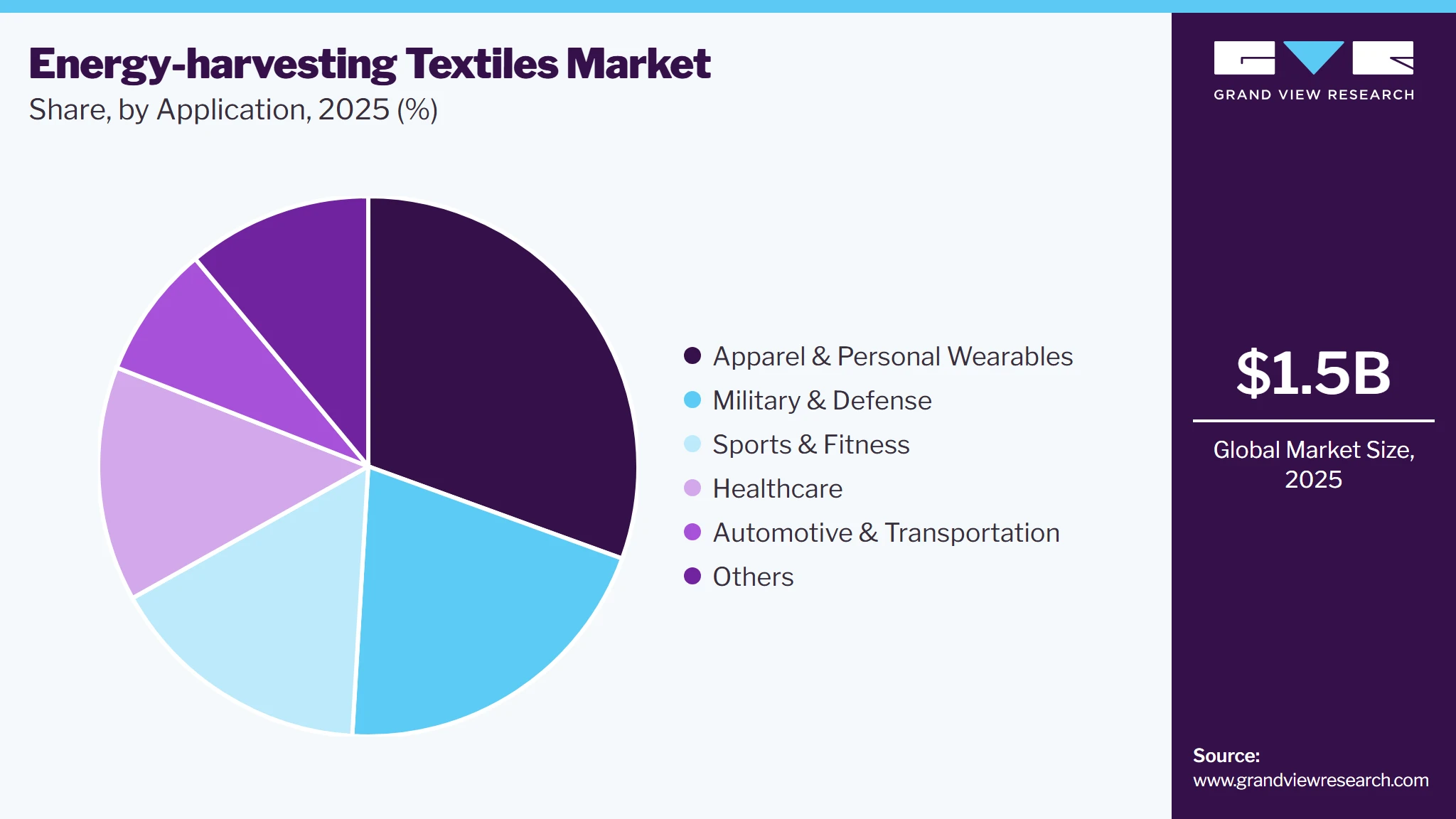
The apparel & personal wearables segment held the highest revenue share of 30.5% in 2025, supported by the increasing adoption of smart clothing, connected garments, wearable sensors, and other textile-integrated electronic devices. Energy-harvesting textiles can provide localized power while preserving the flexibility, comfort, and lightweight characteristics required for wearable products. Growing interest in self-powered wearable electronics and multifunctional apparel has strengthened demand for energy-generating fabrics within this application segment.
 To learn more about this report, Download Free Sample Report
The healthcare segment is expected to grow at a CAGR of 22.0% over the forecast period, driven by increasing adoption of wearable health-monitoring devices, smart garments, biosensors, and remote patient-monitoring technologies. Energy-harvesting textiles can support low-power medical sensors and wearable electronics by generating electricity from body movement, heat, or ambient light, potentially reducing reliance on frequent battery replacement or recharging. Continued development of flexible medical electronics and connected healthcare solutions is expected to expand the use of energy-generating textiles in healthcare applications.
Regional Insights
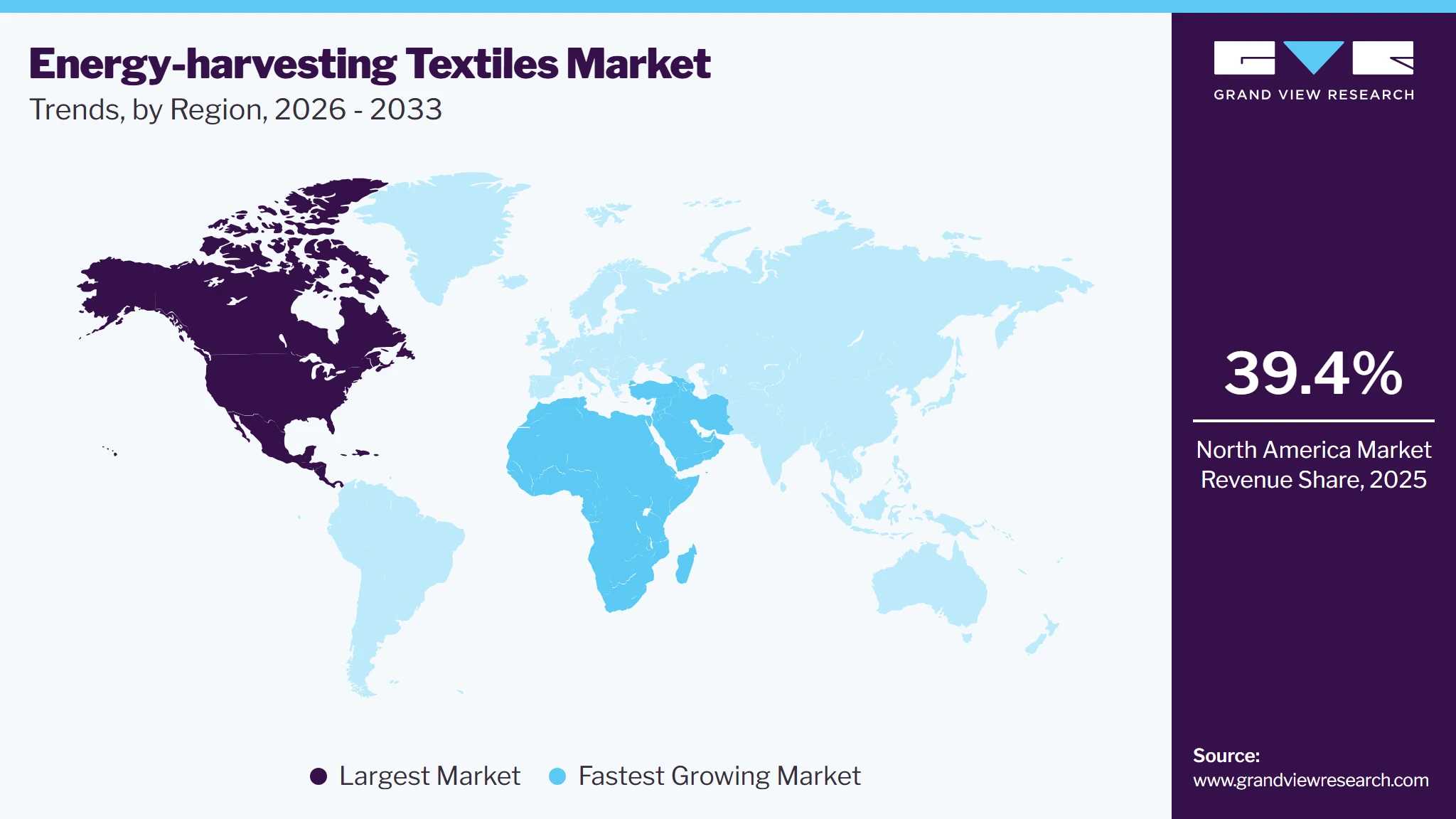
North America dominated the global energy-harvesting textiles market, accounting for the largest revenue share of 39.4% in 2025, owing to strong capabilities in advanced textiles, wearable electronics, flexible energy systems, and defense technologies. The U.S. accounts for a significant portion of regional development, supported by research institutions, technology companies, and specialized textile manufacturers. Healthcare, defense, sports, and consumer applications provide opportunities for self-powered textile systems. Continued investment in wearable technologies and low-power electronics is expected to support commercialization across specialized applications.
 To learn more about this report, Download Free Sample Report
U.S. Energy-harvesting Textiles Market Trends
The U.S. market is supported by strong research and development capabilities in smart textiles, flexible electronics, advanced materials, and wearable technologies. Demand from defense and military applications is creating opportunities for lightweight and self-powered textile systems that can support integrated sensors and electronic components. Healthcare applications are also gaining attention as textile-based monitoring systems increasingly require compact power solutions. Collaboration between technology developers, textile companies, universities, and government-supported research programs is supporting market advancement.
Asia Pacific Energy-harvesting Textiles Market Trends
Asia Pacific represents a major growth market for energy-harvesting textiles due to its strong textile manufacturing base and established electronics supply chain. China, Japan, South Korea, and other regional markets have significant capabilities in the development of advanced materials, flexible electronics, and smart textiles. Increasing investment in wearable electronics and functional textiles is supporting technology development across the region. The presence of large-scale textile manufacturers also provides opportunities for commercial production and integration. Growing demand for connected consumer products and advanced technical textiles is expected to further support market development.
The China energy-harvesting textiles market benefits from a large textile manufacturing industry, extensive electronics supply chains, and increasing development of advanced functional materials. Manufacturers and research institutions are focusing on flexible electronics, conductive textiles, photovoltaic fabrics, and mechanical energy-harvesting technologies. The country's established manufacturing infrastructure provides opportunities to scale textile-based energy technologies from prototypes toward commercial applications. The growing adoption of wearable electronics and smart textile products is also driving demand for integrated power solutions.
Europe Energy-harvesting Textiles Market Trends
Europe has a well-established ecosystem for technical textiles, advanced materials, wearable electronics, and sustainable textile technologies. Manufacturers and research institutions are developing flexible energy-harvesting systems that can be integrated into fabrics while retaining textile properties. The region's focus on sustainability is also supporting interest in technologies that can reduce dependence on disposable batteries. Germany, France, the U.K., Italy, and other European markets are contributing to technology development and commercialization across specialized applications.
The Germany energy-harvesting textiles market is an important European market due to its strong technical textile, automotive, industrial manufacturing, and advanced materials industries. These capabilities create opportunities for energy-harvesting textiles in industrial wearables, smart workwear, automotive textiles, and connected textile systems. German research and industrial organizations are also active in developing multifunctional textile structures that combine energy generation with sensing and communication. The country's advanced manufacturing capabilities can support the transition of energy-harvesting textiles toward industrial applications.
Central And South America Energy-harvesting Textiles Market Trends
Central & South America represents an emerging market for energy-harvesting textiles, supported by gradual adoption of smart textiles, wearable electronics, and advanced technical fabrics. Brazil offers particular potential due to its established textile and apparel industry and growing interest in functional textile products. Initial opportunities are expected to remain concentrated in specialized applications such as sports, healthcare, industrial monitoring, and advanced apparel. Market development will depend on technology costs, local manufacturing capabilities, and broader adoption of smart textile technologies.
Middle East & Africa Energy-harvesting Textiles Market Trends
The Middle East & Africa market remains at an earlier stage of development but offers opportunities for specialized energy-harvesting textile applications. High solar availability in several Middle Eastern countries creates potential for solar-integrated textile systems, particularly in outdoor, defense, and industrial applications. Demand for autonomous and low-maintenance power sources can also support adoption in remote environments. Further market development will depend on the affordability of technology, local technical capabilities, and the increasing adoption of smart textiles and wearable technologies.
Key Energy-harvesting Textiles Company Insights
Some of the key players operating in the market include Pvilion and PIECLEX Co., Ltd.
-
Pvilion is a U.S.-based company specializing in flexible solar structures and building-integrated photovoltaic solutions. Its portfolio combines lightweight photovoltaic technologies with fabric structures, canopies, and other architectural applications to provide on-site renewable power generation.
-
PIECLEX is a Japanese textile technology company that develops piezoelectric fiber and textile solutions capable of generating electrical energy from movement and pressure. Its technology is particularly suited to smart textiles, wearable applications, and products requiring integrated energy generation.
Key Energy-harvesting Textiles Companies
The following key companies have been profiled for this study on the energy-harvesting textiles market.
-
Pvilion
-
Solar Cloth System
-
ASCA GmbH & Co. KG
-
Sphelar Power Corporation
-
PIECLEX Co., Ltd.
-
Pauline van Dongen
Competitive Benchmarking
Category
Operating Strategies
Competitive Edge
Weakness
Established Players (Pvilion, Solar Cloth System, ASCA GmbH & Co. KG, Sphelar Power Corporation, PIECLEX Co., Ltd.)
Develop and commercialize flexible energy-harvesting solutions based on photovoltaic, piezoelectric, and other textile-integrated technologies.
Expand applications through partnerships with textile manufacturers, electronics companies, architects, designers, and industrial users.
Focus on integrating energy generation into fabrics, structures, garments, and other functional textile products.
Established expertise in integrating energy-generation technologies with flexible and textile-based platforms.
Specialized technology portfolios covering lightweight, flexible, and application-specific energy solutions.
Established industry relationships and commercialization experience support adoption across diverse applications.
High costs associated with advanced materials, technology development, and specialized manufacturing.
Energy output and performance can vary depending on textile structure, environmental conditions, and application.
Limited economies of scale compared with conventional energy-generation technologies can affect cost competitiveness.
Emerging Players (Pauline van Dongen)
Develop design-led wearable and textile concepts that integrate energy harvesting with clothing and other functional textile applications.
Collaborate with technology developers, research institutions, and industry partners to demonstrate new applications.
Focus on innovative prototypes and user-oriented applications to expand the role of textiles as functional energy-generating surfaces.
Strong combination of textile design, fashion, and energy-harvesting concepts.
Ability to translate emerging technologies into visually distinctive and user-focused textile applications.
Innovation-led approach supports differentiation in smart clothing and wearable applications.
Smaller commercial and manufacturing scale compared with established technology suppliers.
Greater reliance on collaborations and technology partners for commercialization and production.
Transition from innovative prototypes to scalable, cost-effective products can constrain broader market penetration.
Recent Developments
-
In February 2026, Pvilion launched a solar-powered integrated trailer system using its solar-cell-integrated fabric technology, designed to provide portable power for communications, lighting, environmental controls, and other electrical equipment in off-grid and expeditionary environments.
-
In May 2025, Pvilion partnered with Accu-Steel on a 12,000-square-foot industrial solar structure integrating 42 kW of solar generation and 135 kWh of energy storage, demonstrating the use of solar-integrated fabric structures for agricultural and industrial applications.
Energy-harvesting Textiles Market Report Scope
Report Attribute
Details
Market size in 2025
USD 1.5 Billion
Estimated market size in 2026
USD 1.8 Billion
Projected market size by 2033
USD 6.8 Billion
Growth rate
CAGR of 21.3% from 2026 to 2033
Base year for estimation
2025
Actual data
2021 - 2024
Forecast period
2026 - 2033
Quantitative units
Revenue in USD billion and CAGR from 2026 to 2033
Report coverage
Revenue forecast, company ranking, competitive landscape, growth factors, and trends
Segments covered
Technology, application, region
Regional scope
North America; Europe; Asia Pacific; Central and South America; Middle East and Africa
Country scope
U.S.; Canada; Mexico; Germany; UK; France; Italy; Spain; China; Japan; India; South Korea; Brazil; Saudi Arabia
Key companies profiled
Pvilion; Solar Cloth System; ASCA GmbH & Co. KG; Sphelar Power Corporation; PIECLEX Co., Ltd.; Pauline van Dongen
Customization scope
Free report customization (equivalent up to 8 analysts working days) with purchase. Addition or alteration to country, regional & segment scope.
Pricing and purchase options
Avail customized purchase options to meet your exact research needs. Explore purchase options
Global Energy-harvesting Textiles Market Report Segmentation
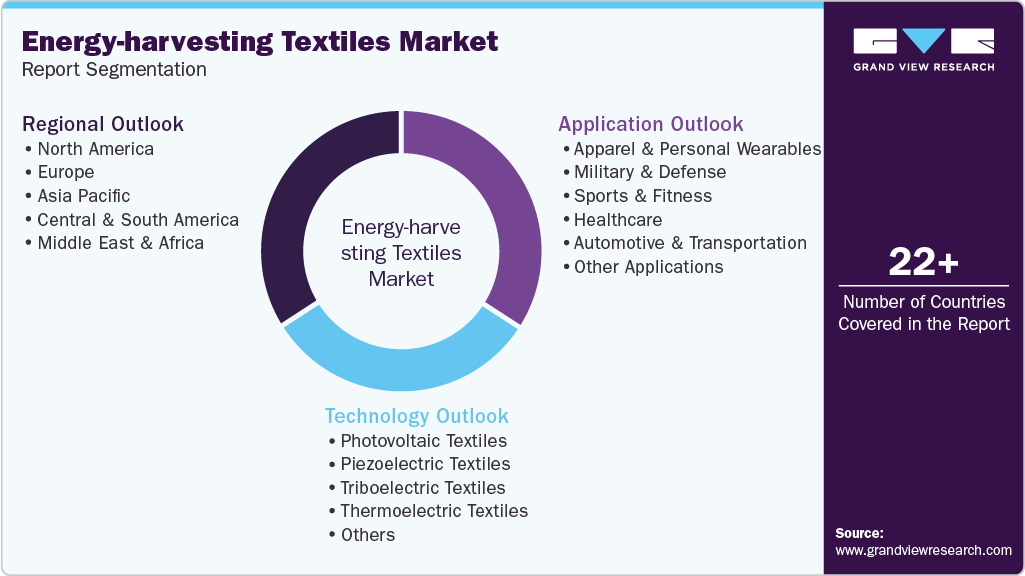
This report forecasts revenue growth at regional & country levels and provides an analysis on the industry trends in each of the sub-segments from 2021 to 2033. For the purpose of this study, Grand View Research has segmented the energy-harvesting textiles market on the basis of technology, application, and region:
 To learn more about this report, Download Free Sample Report
-
Technology Outlook (Revenue, USD Million, 2021 - 2033)
-
Photovoltaic Textiles
-
Piezoelectric Textiles
-
Triboelectric Textiles
-
Thermoelectric Textiles
-
Others
-
-
Application Outlook (Revenue, USD Million, 2021 - 2033)
-
Apparel & Personal Wearables
-
Military & Defense
-
Sports & Fitness
-
Healthcare
-
Automotive & Transportation
-
Other Applications
-
-
Regional Outlook (Revenue, USD Million, 2021 - 2033)
-
North America
-
U.S.
-
Canada
-
Mexico
-
-
Europe
-
UK
-
Germany
-
France
-
Italy
-
Spain
-
-
Asia Pacific
-
China
-
Japan
-
India
-
South Korea
-
-
Central and South America
-
Brazil
-
-
Middle East and Africa
-
Saudi Arabia
-
-
Research Methodology
The energy-harvesting textiles market figures in this report are based on a proven research process that combines executive interviews with secondary research from proprietary databases, company filings, and recognized regulatory and institutional sources. Market size is built through value-chain sizing-reconciling supply-side and demand-side estimates-and triangulated with bottom-up and top-down approaches. Every estimate passes multiple levels of expert validation before publication, with each energy-harvesting textiles segment quantified using the revenue-capture definitions in the table below.
Segment Definition
Segment - Technology
Revenue Capture Definition
Photovoltaic Textiles
Revenue generated from textiles that incorporate photovoltaic materials or structures to convert light energy into electrical energy, including solar-integrated fabrics, fibers, yarns, and textile-based power-generating surfaces.
Piezoelectric Textiles
Revenue generated from textiles incorporating piezoelectric materials that produce electrical energy in response to mechanical deformation, pressure, stretching, bending, or vibration.
Triboelectric Textiles
Revenue generated from textiles that generate electrical energy through contact electrification and electrostatic induction caused by friction, contact, separation, or movement between textile materials.
Thermoelectric Textiles
Revenue generated from textiles incorporating thermoelectric materials that convert temperature differences between textile surfaces or the textile and surrounding environment into electrical energy.
Others
Revenue generated from energy-harvesting textile technologies other than photovoltaic, piezoelectric, triboelectric, and thermoelectric technologies, including emerging or hybrid energy-harvesting approaches.
Segment - Application
Revenue Capture Definition
Apparel & Personal Wearables
Revenue generated from energy-harvesting textiles incorporated into clothing, garments, accessories, and personal wearable products designed to generate or supply power for integrated electronic functions.
Military & Defense
Revenue generated from energy-harvesting textiles used in military uniforms, tactical clothing, protective equipment, field gear, and other defense textile systems requiring integrated or self-powered electronic functionality.
Sports & Fitness
Revenue generated from energy-harvesting textiles used in sportswear, fitness apparel, athletic accessories, and performance-monitoring textile products incorporating sensors or other low-power electronic functions.
Healthcare
Revenue generated from energy-harvesting textiles used in medical garments, health-monitoring wearables, rehabilitation products, patient-monitoring systems, and other healthcare textile applications requiring integrated power generation.
Automotive & Transportation
Revenue generated from energy-harvesting textiles incorporated into vehicle interiors, seating, upholstery, transportation equipment, and other automotive or mobility-related textile systems with integrated electronic or sensing functions.
Other Applications
Revenue generated from energy-harvesting textiles used in applications outside apparel, defense, sports, healthcare, and automotive and transportation, including industrial, consumer, and specialized technical textile applications.
Estimation Model
Layer Name
Key Question
Description
Parent Market Analysis
What is the overall size and growth outlook of the global smart and functional textiles market?
The estimation begins by evaluating the broader smart and functional textiles market. Growth in wearable electronics, technical textiles, connected garments, flexible electronics, advanced textile materials, and demand for multifunctional fabrics is analyzed to establish the total addressable market for energy-harvesting textiles.
Energy-Harvesting Technology Penetration Analysis
What proportion of the smart and functional textiles market is represented by energy-harvesting textiles across different technologies?
This layer estimates the penetration of Photovoltaic Textiles, Piezoelectric Textiles, Triboelectric Textiles, Thermoelectric Textiles, and other energy-harvesting technologies. Technology adoption, commercialization levels, material integration, energy-generation capabilities, product development, and use in textile-based electronic systems are analyzed to determine the market contribution of each technology.
Application & Regional Demand Assessment
Which regions and applications contribute the highest demand for energy-harvesting textiles?
Market demand is evaluated across Asia Pacific, North America, Europe, Central & South America, and the Middle East & Africa based on smart textile adoption, wearable electronics development, technical textile production, research activity, and end-user demand. Demand is further assessed across Apparel & Personal Wearables, Military & Defense, Sports & Fitness, Healthcare, Automotive & Transportation, and Other Applications to determine revenue contribution.
Company Revenue Validation & Market Forecasting
How is the final market size validated and forecast?
The final market estimates are validated using company revenues, energy-harvesting textile product portfolios, technology commercialization, manufacturing capabilities, product launches, partnerships, investments, application development, and secondary research. Bottom-up and top-down approaches are triangulated to generate reliable market size estimates and long-term forecasts for the Energy-Harvesting Textiles Market.
Delivered Customizations
We have successfully delivered the following deep-dive customizations
Client Request
Customization Delivered
Value Adds
Energy-Harvesting Technology Benchmarking
Comparative assessment of Photovoltaic, Piezoelectric, Triboelectric, Thermoelectric, and other technologies based on energy source, conversion mechanism, power-generation potential, flexibility, durability, textile integration, and technology maturity.
Helps identify the most commercially viable technologies, evaluate technology trade-offs, and prioritize product development and R&D investments.
Self-Powered Textile System Analysis
Assessment of how energy-harvesting textiles integrate with sensors, wearable electronics, energy-storage components, conductive materials, and power-management systems to create self-powered textile platforms.
Helps companies identify integration requirements, system-level technology gaps, and opportunities to develop higher-value multifunctional textile products.
Commercialization & End-use Opportunity Assessment
Evaluation of commercialization potential across Apparel & Personal Wearables, Military & Defense, Sports & Fitness, Healthcare, Automotive & Transportation, and other applications based on product requirements, technology readiness, adoption barriers, and use-case suitability.
Supports prioritization of commercially attractive applications, product positioning, partnership strategies, and market-entry decisions based on technology readiness and end-user requirements.
About the Author(s)
Advanced Interior Materials Research Team
Advanced Materials · Advanced Interior MaterialsThis report was authored by the advanced interior materials research team at Grand View Research - comprising two research analysts, one senior research analyst, and one industry expert - with specialized expertise in the advanced interior materials segment of the advanced materials industry. All findings are based on proprietary advanced materials databases, executive interviews, and regulatory analysis, subject to internal peer review prior to publication.
Last Updated:
Speak to Analyst

Customize this report to your needs - add regions, segments, or data points, with 20% free customization.
Or view our licence options:


ISO 9001:2015 & 27001:2022 Certified
We are GDPR and CCPA compliant! Your transaction & personal information is safe and secure. For more details, please read our privacy policy.


