
- Home
- »
- Next Generation Technologies
- »
-
Energy Insurance Market Size, Share & Trends Report, 2033GVR Report cover

Energy Insurance Market (2026 - 2033)
Size, Share & Trends Analysis Report By Type (Property Insurance, Liability Insurance, Business Interruption) By Application (Oil & Gas, Power Generation, Utilities, Renewables, Mining), By Region, And Segment Forecasts
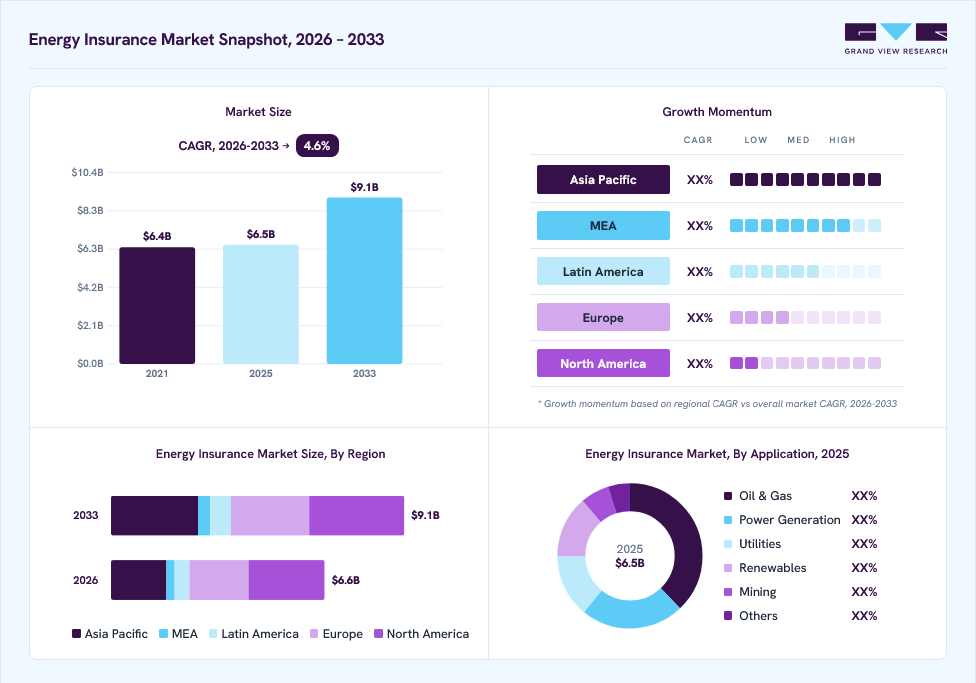
Market Size, 2025
$6.5BMarket Estimate, 2026
$6.6BMarket Forecast, 2033
$9.1BCAGR, 2026–2033
4.6%Energy Insurance Market Summary
The global energy insurance market size was valued at USD 6.5 billion in 2025 and is projected to grow from USD 6.6 billion in 2026 to USD 9.1 billion by 2033, at a CAGR of 4.6% from 2026 to 2033. North America dominated the market, accounting for 36.1% of the revenue share in 2025. Increasing investment in renewable energy infrastructure is growing demand for insurance coverage to protect energy assets and manage operational risks.
 Source: Grand View Research, IR Documents, Primary Interviews, Paid DatabasesTo learn more about this report,
 Download Free Sample Report
Key Market Trends & Insights
- By type: Property insurance segment led the market and accounted for 39.4% of the global revenue in 2025.
- By application: Oil & gas segment led the market with the largest revenue share in 2025.
Regional Highlights
- Largest regional market: North America (36.1% revenue share, 2025)
- Fastest-growing regional market: Asia Pacific (fastest CAGR, 2026-2033)
- By country: The U.S. held the largest share of North America in 2025.
Market Size & Forecast
- Market size in 2025: USD 6.5 Billion
- Estimated market size in 2026: USD 6.6 Billion
- Projected market size by 2033: USD 9.1 Billion
- CAGR (2026-2033): 4.6%
Prism AI by Grand View Research Free to tryAsk a question about the energy insurance marketTry asking✓Every figure cited from GVR research Prefer the report? Download free sample →
Extreme weather events are increasing risks for energy infrastructure and creating greater chances of physical damage and operational disruption. Changing weather patterns can increase the exposure of energy assets to storms, floods, wildfires, and extreme temperatures. Such events can lead to equipment damage, repair costs, and disruptions to energy operations. As these risks become more difficult to predict, energy companies are seeking stronger financial protection against potential losses. This is driving demand for energy insurance coverage across the energy sector.Artificial intelligence is improving risk assessment by enabling insurers to analyze large volumes of data more efficiently. AI helps identify risk patterns and supports faster and more consistent underwriting decisions. This improves risk evaluation, pricing accuracy, claims assessment, and operational efficiency. As energy-related risks become more complex, insurers are increasingly adopting AI-based analytics for underwriting and risk management. The growing integration of AI into insurance processes is supporting technology advancement in the energy insurance market.
 To learn more about this report, Download Free Sample Report
Regulatory frameworks are strengthening requirements for the identification, assessment, and management of climate-related risks in the insurance sector. These requirements encourage insurers to integrate climate-related risks into governance, risk management, internal controls, valuation, reporting, and disclosure processes. This underscores the importance of climate risk assessment in evaluating energy-related risks and determining coverage. Insurers are strengthening their risk management frameworks to improve their ability to assess physical and transition risks. Moreover, stronger climate-risk supervision is encouraging more structured risk management across the energy insurance market.
Limited insurance coverage for emerging energy risks makes it difficult for businesses to obtain adequate protection for evolving operational and technology-related risks. This can increase financial uncertainty, affect the availability of coverage, and make insurers more cautious when underwriting such risks. As a result, limited coverage can slow the adoption of energy insurance across emerging areas of the market.
Market Dynamics
The energy insurance market is being shaped by rising investment in energy infrastructure, increasing operational complexity, and the transition toward renewable and low-carbon energy sources. Energy companies are facing a broader range of property, liability, business interruption, natural catastrophe, cyber, and technology-related risks. At the same time, insurers are using advanced risk analytics, digital underwriting, remote monitoring, and specialized risk engineering to improve risk assessment. These developments are driving demand for broader, more customized insurance solutions across traditional and emerging energy applications.
The growing investment in energy infrastructure is increasing the need for insurance protection across the energy value chain. Oil and gas facilities, power plants, transmission infrastructure, mining operations, and renewable energy projects involve large physical assets that can be affected by equipment failures, fires, natural disasters, accidents, and operational disruptions. The expansion of renewable capacity is also introducing new infrastructure with different risk characteristics, particularly in wind, solar, energy storage, and other emerging technologies. As the number and value of energy assets increase, businesses require insurance to protect capital-intensive projects from unexpected financial losses. This is strengthening the underlying demand for Energy Insurance solutions.
Energy insurance helps businesses transfer part of these financial risks to insurers through property, liability, business interruption, construction, machinery, and other specialized coverage. Policies can help protect physical assets while also providing financial support when an insured event interrupts operations or creates third-party liabilities. Risk engineering and loss-prevention services further help energy companies identify potential hazards before they result in major losses. This combination of financial protection and risk management is encouraging energy companies to maintain comprehensive insurance programs. As energy infrastructure investment continues, the need for specialized coverage is expected to support market growth.
Energy projects can involve very large assets, hazardous operating environments, complex equipment, and significant concentrations of risk. A single incident at an offshore facility, refinery, power plant, pipeline, or large renewable installation can result in substantial property damage and prolonged business interruption. Natural catastrophes, equipment failures, fires, explosions, and supply-chain disruptions can further increase the potential size of claims. These characteristics make energy risks more difficult to price than many conventional commercial risks. As a result, insurers need to carefully manage capacity, pricing, deductibles, and policy conditions.
Higher loss severity can increase premiums and make comprehensive coverage more expensive for energy companies, particularly for projects with high catastrophe exposure or limited historical loss data. The effect can be stronger for emerging technologies where insurers have less historical information to evaluate potential losses. Smaller energy operators and projects with tight financing structures may therefore find it more difficult to obtain broad coverage at attractive prices. This can encourage greater use of deductibles, risk retention, captive insurance, or limited coverage structures. Consequently, high loss severity can restrict affordability and slow insurance adoption in some energy segments.
The transition toward cleaner energy is creating new insurance requirements for technologies that were previously smaller or less established within the energy industry. Solar and wind installations, battery energy storage, hydrogen projects, carbon capture facilities, alternative fuels, and other emerging technologies involve new equipment, operating processes, and performance risks. These technologies can also face limited historical claims data, creating uncertainty for conventional underwriting models. The development of specialized insurance products can therefore help address risks that are not adequately covered by traditional energy policies. This creates an important opportunity for insurers with specialized underwriting and risk-engineering capabilities.
The opportunity extends beyond basic property coverage, as emerging projects require protection against construction, performance, liability, business interruption, technology, and financing risks. Parametric insurance, structured risk transfer, performance-based coverage, and other alternative risk solutions can help address risks that are difficult to insure through conventional policies. Insurers with expertise in both traditional energy and new energy technologies are well positioned to develop these solutions. The opportunity is particularly relevant as energy infrastructure becomes more interconnected and projects move from pilot stages toward commercial deployment. This expansion can create new premium pools while allowing insurers to participate in the long-term energy transition.
Market Concentration & Characteristics
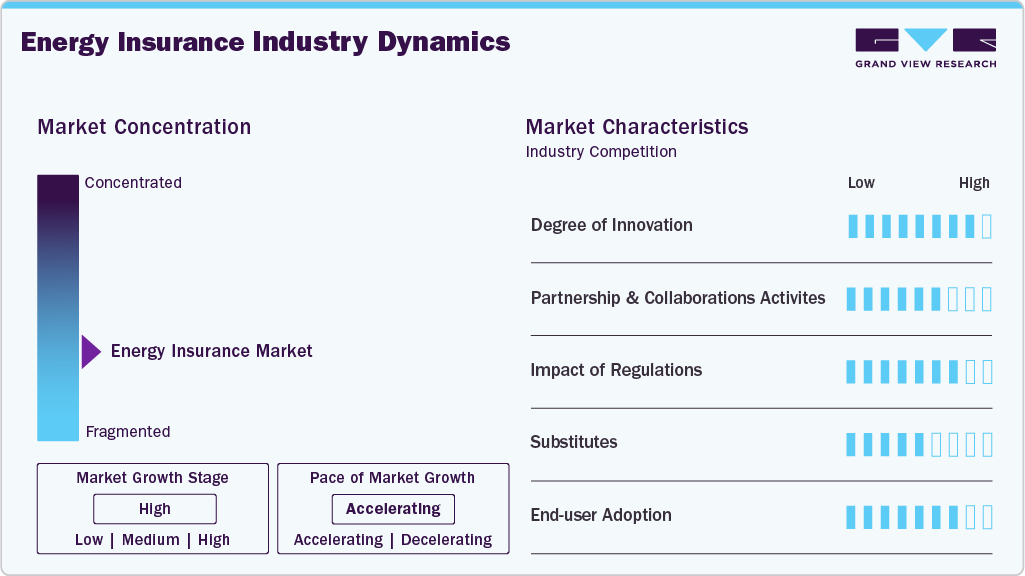
The energy insurance market is moderately consolidated, as the market is supported by a group of large insurers with strong underwriting capacity, extensive risk-management expertise, and the ability to cover high-value energy assets. At the same time, specialized and regional insurers continue to participate in specific areas such as oil and gas, power generation, renewables, mining, and energy infrastructure, which prevents the market from becoming highly concentrated. Competition remains high because insurers differentiate through pricing, coverage terms, technical underwriting, risk engineering, and capacity for complex projects. The market is also becoming more competitive in renewable energy, where established insurers and new entrants are increasing their participation and offering customized solutions for solar, wind, battery storage, and other emerging technologies.
 To learn more about this report, Download Free Sample Report
The market demonstrates a high degree of innovation and end-user adoption, supported by growing use of advanced risk analytics, data-driven underwriting, parametric solutions, and specialized coverage for emerging energy technologies. Partnerships and collaborations remain medium to high as insurers increasingly work with brokers, technology providers, project developers, and risk-management specialists to evaluate complex energy exposures. The impact of regulations is high because environmental requirements, safety standards, energy-transition policies, and project financing conditions influence both risk exposure and insurance requirements. Substitutes such as self-insurance, captive insurance, and alternative risk-transfer mechanisms create some competitive pressure, but large and complex energy projects continue to require substantial external insurance capacity. Moreover, the market is in an exponential growth stage with an accelerating pace of growth, driven by expanding energy infrastructure, renewable-energy investment, and the emergence of new risks requiring specialized insurance solutions.
Analyst Perspective
The energy insurance market is moving toward broader and more specialized risk protection as energy infrastructure expands and the industry undergoes significant technology and energy transition. Growth is being supported by increasing investment in power infrastructure, renewable projects, energy networks, and large-scale industrial assets. Digital risk assessment, predictive analytics, remote monitoring, and advanced risk-engineering capabilities are improving underwriting and claims management. Going forward, investment is expected to increasingly target renewable energy, energy storage, hydrogen, carbon capture, and other emerging technologies alongside traditional energy assets. Competitive positioning is therefore shifting toward insurers that can combine strong underwriting capacity with specialized technical expertise and flexible risk-transfer solutions.
Type Insights
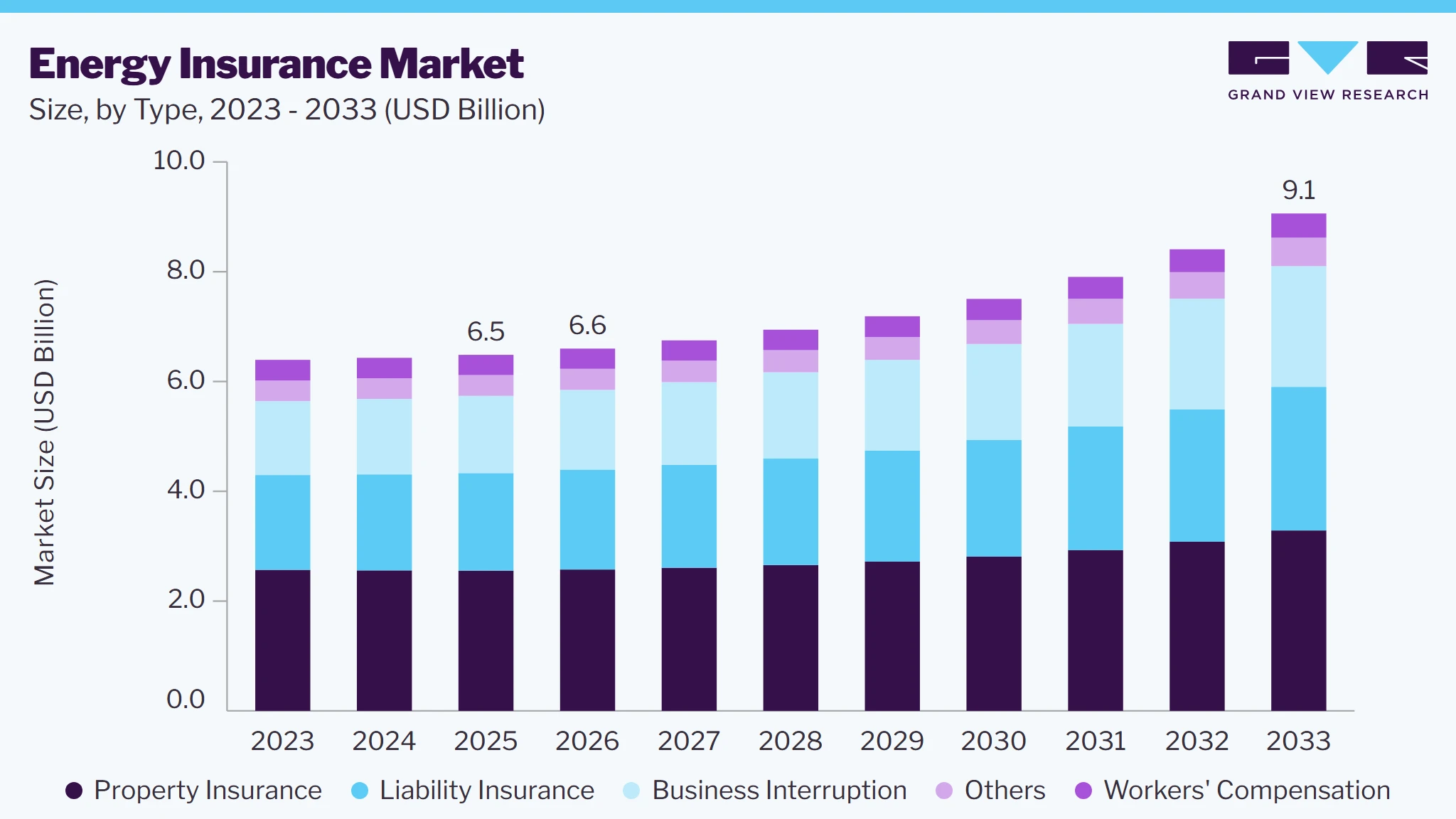
Based on type, the property insurance segment accounted for 39.4%, the largest share of global revenue in 2025. This segment dominance in the energy insurance market due to the extensive use of high-value physical assets across energy operations. It provides financial protection against physical damage or loss to infrastructure, equipment, and other operational assets. This coverage helps energy businesses manage repair costs and reduce financial exposure from asset-related incidents. The crucial role of physical infrastructure in energy operations supports the widespread adoption of property insurance. As a result, property insurance maintains a leading position within the energy insurance market.
The Business interruption segment is projected to grow at the fastest CAGR over the forecast period. The segment growth can be attributed to the growing need to protect against financial losses arising from operational disruptions. When unexpected events disrupt business operations, business interruption insurance covers lost income and additional expenses, helping energy businesses maintain financial stability. This protection reduces the financial impact of downtime and supports business continuity during operational disruptions. As energy businesses place greater emphasis on operational resilience, the adoption of business interruption insurance is increasing across the energy sector.
Application Insights
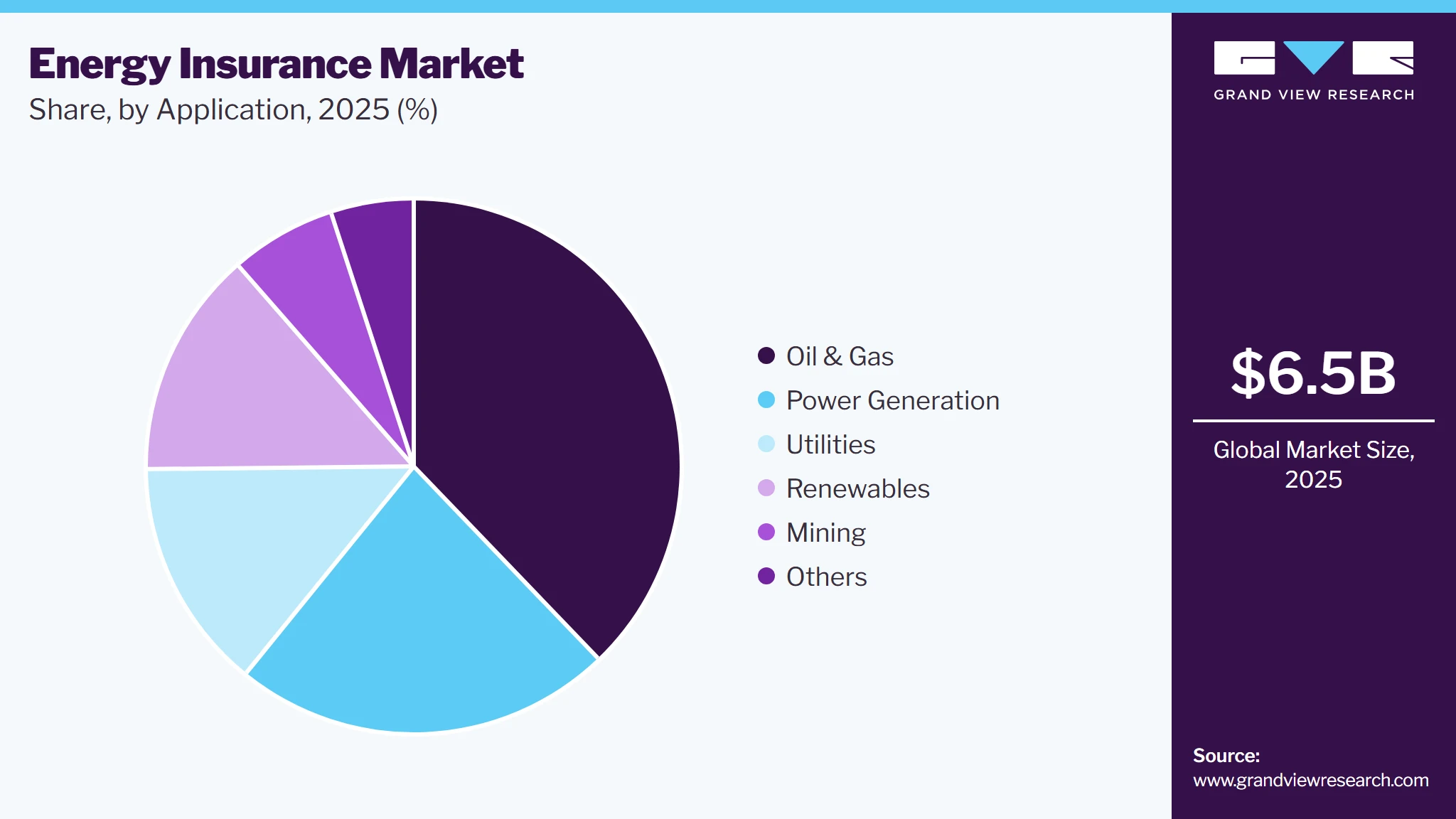
Based on application, the oil & gas segment accounted for the largest share of global revenue in 2025. The oil & gas segment holds a dominant position in the energy insurance market due to the high financial value of its assets and the need for comprehensive risk protection. The segment uses energy insurance to protect infrastructure, equipment, and operations against potential financial losses. The wide range of risks across oil and gas activities creates a strong need for different types of insurance coverage. This supports consistent adoption of energy insurance across the segment.
 To learn more about this report, Download Free Sample Report
The renewables segment is projected to grow at the fastest CAGR over the forecast period, driven by the rapid expansion of renewable energy projects and infrastructure. As the number of renewable energy assets increases, businesses are seeking insurance protection against financial losses arising from property damage, equipment failure, and business interruption. This growing need for asset and operational protection is increasing demand for energy insurance across the renewables sector. As a result, the expansion of renewable energy deployment is supporting the wider adoption of energy insurance and contributing to the segment’s rapid growth.
Regional Insights
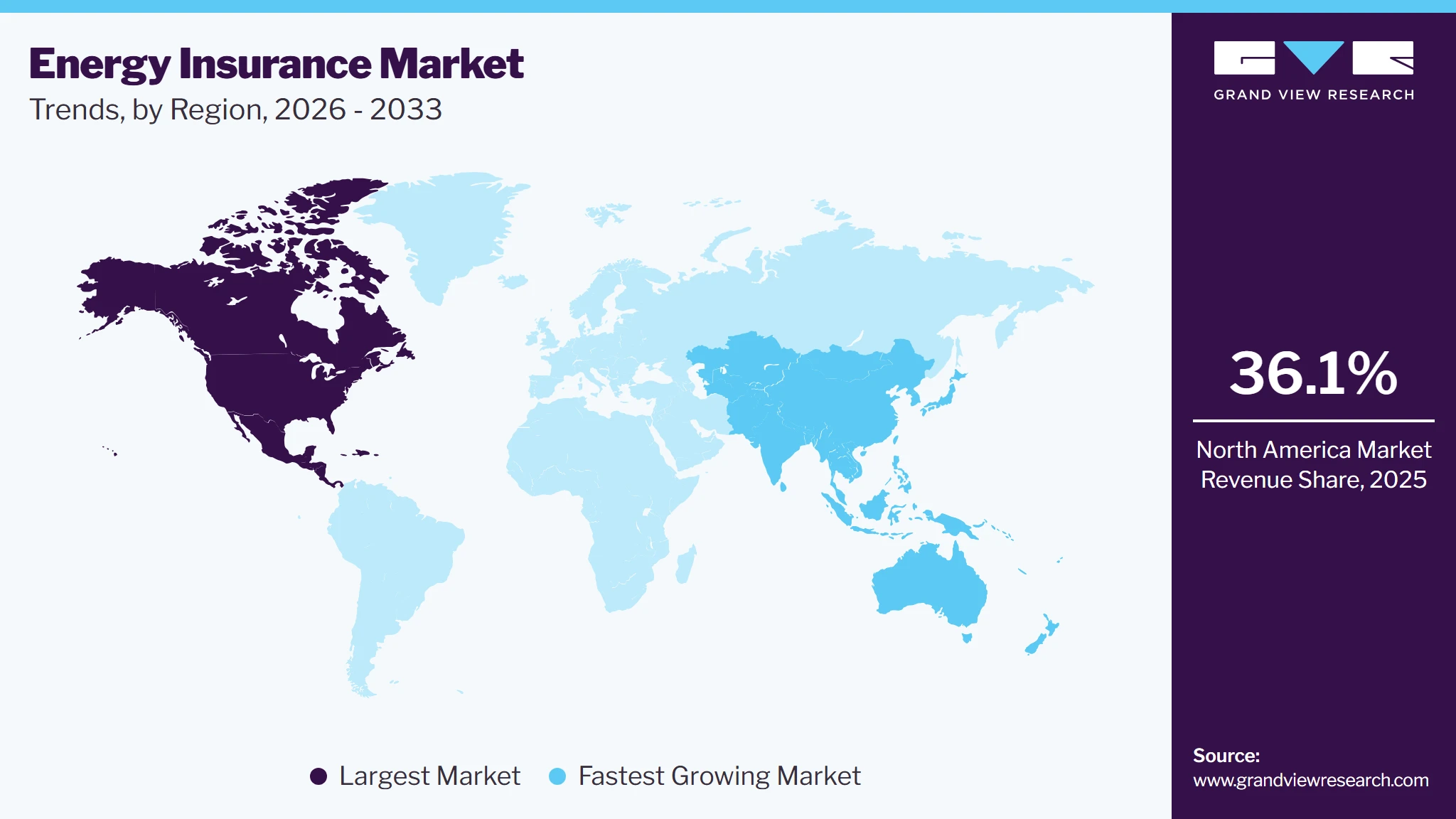
North America energy insurance marketled the global market and accounted for 36.1% of the global revenue in 2025. Rising investment in oil and gas infrastructure, power generation, utilities, and renewable energy is expanding the base of assets requiring insurance protection. The growing scale of these assets is increasing exposure to property damage, operational disruptions, third-party liabilities, and equipment-related losses. This is creating sustained demand for property, liability, and business interruption insurance across the regional energy sector.
 To learn more about this report, Download Free Sample Report
U.S. Energy Insurance Market Trends
The Energy Insurancemarket inU.S. held the largest market share in 2025. Growing grid modernization and expansion of electricity infrastructure are increasing the value and complexity of assets requiring insurance coverage. New transmission, generation, storage, and utility infrastructure are creating additional exposure to physical damage, equipment failure, and operational interruption. This is strengthening demand for specialized property, liability, and business interruption insurance.
Asia Pacific Energy Insurance Market Trends
The Asia Pacific Energy Insurancemarketis projected to grow at the fastest CAGR over the forecast period. Rapid growth in electricity demand is driving investment across power generation, utilities, oil and gas, and renewable energy infrastructure. The combination of expanding conventional assets and large-scale clean-energy projects is creating a wider range of physical, operational, and liability risks. This is increasing demand for comprehensive insurance solutions across the regional energy sector.
China held a dominant share in the Asia Pacific energy insurance. Expanding renewable power generation and supporting electricity infrastructure are increasing the number of energy assets requiring insurance protection. Large-scale solar, wind, grid, storage, and other clean-energy projects are creating exposure to equipment failure, physical damage, weather conditions, and operational interruptions. This is creating opportunities for specialized property, liability, and business interruption insurance.
Japan energy insurance is expected to grow at a significant CAGR over the forecast period. Increasing investment in renewable energy, electricity infrastructure, energy storage, and diversified power generation is changing the country's energy risk profile. The development of multiple energy technologies is creating different requirements for property protection, liability coverage, and business interruption insurance. This diversification is creating greater opportunities for customized energy insurance solutions.
Europe Energy Insurance Market Trends
The Europe Energy Insurance market is expected to grow at a significant CAGR over the forecast period. The transition toward renewable power and cleaner energy infrastructure is increasing investment across wind, solar, electricity networks, and energy storage. The changing energy mix is introducing new operational, technology, performance, and physical asset risks that require specialized insurance protection. This is creating opportunities for insurers with capabilities across both conventional energy and emerging energy technologies.
The UK is gaining momentum in the energy insurance market. Growing development of offshore wind, renewable generation, electricity networks, and supporting infrastructure is increasing demand for specialized energy insurance. Large and technically complex projects create exposure to construction damage, equipment failure, liability, and delays in operations. This is creating opportunities for insurers offering customized property, liability, and business interruption coverage.
The Germany held a substantial share in the Europe Energy Insurance. Increasing renewable energy deployment is expanding the number of solar, wind, grid, and power-generation assets requiring insurance coverage. Greater dependence on decentralized and weather-dependent generation is creating additional exposure to equipment damage, weather-related losses, and interruptions in electricity production. This is supporting demand for property and business interruption insurance across renewable energy projects.
Key Energy Insurance Company Insights
Key players operating in the Energy Insurance include Allianz, American International Group, Inc., AXA SA, Chubb, Liberty Mutual Insurance Company, Sukoon Insurance PJSC, Tawuniya, Zurich, Tokio Marine HCC, ADNIC Key players in the energy insurance are focusing on expanding specialized insurance solutions, strengthening risk assessment capabilities, developing coverage for emerging energy risks, and supporting clients with broader risk management services. Insurers are also increasing their focus on renewable energy, advanced analytics, climate-related risks, and customized coverage as the energy sector becomes more complex.
-
Allianz is the commercial insurance business of Allianz Group, providing insurance solutions for mid-sized businesses, large enterprises, and specialist risks. The company offers energy insurance across upstream, downstream, offshore, and onshore renewables, conventional power, and other natural-resource activities. Its energy insurance solutions cover physical damage, business interruption, third-party liability, machinery breakdown, and construction-related risks.
-
American International Group, Inc. (AIG) is a global insurance organization offering solutions. In the energy insurance market, it provides specialized coverage for upstream, oil and petrochemical, chemical, power generation, renewables, and mining activities. Its offerings include property, casualty, business interruption, machinery, and energy-related risk consulting services.
Key Energy Insurance Companies
The following key companies have been profiled for this study on the energy insurance market:
-
Allianz
-
American International Group, Inc.
-
AXA SA
-
Chubb
-
Liberty Mutual Insurance Company
-
Sukoon Insurance PJSC
-
Tawuniya
-
Zurich
-
Tokio Marine HCC
-
ADNIC
Competitive Benchmarking
Operating Strategies
Competitive Edge
Weaknesses
Mature Players: Allianz, American International Group, Inc., AXA SA, Chubb, Zurich
- Mature players in the energy insurance are focus on broad insurance portfolios to serve multiple energy sectors and provide customized coverage for complex and high-value risks. Strong underwriting, risk assessment, global servicing, and long-term customer relationships support market presence.
- Mature players gain a competitive advantage through strong financial capacity, extensive industry experience, advanced risk-management capabilities, and the ability to handle large and complex energy risks across multiple regions provide a strong competitive advantage.
- These companies face challenges related to large-scale operations can result in complex decision-making and stricter underwriting requirements. Limited appetite for highly uncertain emerging technologies with insufficient loss history can restrict participation in some new energy projects.
Emerging Players: ADNIC, Sukoon Insurance PJSC
- Emerging players in the energy insurance are focus on regional energy markets and selected commercial risks where specialized expertise can be developed. Local market knowledge, flexible underwriting, and customized insurance solutions support market expansion.
- Emerging players gain market traction through faster decision-making, strong regional relationships, knowledge of local energy industries, and flexible customer service provide competitive advantages in targeted markets.
- Emerging players face limitations due to smaller geographic presence and lower underwriting capacity can limit participation in large multinational energy projects. Fewer resources for advanced risk analytics and global risk-management services can also restrict broader market expansion.
Recent Developments
-
In March 2026, American International Group, Inc. and McGill and Partners, a boutique specialist insurance and reinsurance broker, launched a strategic collaboration using agentic AI to improve insurance capacity deployment for specialty risks. The company uses portfolio data and AI-driven analytics to support real-time underwriting, risk assessment, and capacity management. The collaboration is designed to improve underwriting efficiency and provide clients with faster access to insurance solutions.
-
In June 2025, In May 2025, Tokio Marine HCC launched Tokio Marine GX (TMGX) to provide specialized insurance and risk management solutions for businesses pursuing decarbonization and green transformation. TMGX offers tailored coverage for renewable energy, hydrogen, nuclear, power, and other sustainable projects, strengthening the company's position in the energy transition insurance market.
Energy Insurance Market Report Scope
Report Attribute
Details
Market size in 2025
USD 6.5 billion
Estimated market size in 2026
USD 6.6 billion
Projected market size by 2033
USD 9.1 billion
Growth rate
CAGR of 4.6% from 2026 to 2033
Base year for estimation
2025
Historical data
2021 - 2024
Forecast period
2026 - 2033
Quantitative units
Revenue in USD million/billion, and CAGR from 2026 to 2033
Report coverage
Revenue forecast, company ranking, competitive landscape, growth factors, and trends
Segments covered
Type, application, region
Regional scope
North America; Europe; Asia Pacific; Latin America; MEA
Country scope
U.S.; Canada; Mexico; Germany; UK; France; China; Japan; India; South Korea; Australia; Brazil; Kingdom of Saudi Arabia (KSA); UAE; South Africa
Key companies profiled
Allianz; American International Group, Inc.; AXA SA; Chubb; Liberty Mutual Insurance Company; Sukoon Insurance PJSC; Tawuniya; Zurich; Tokio Marine HCC; ADNIC
Customization scope
Free report customization (equivalent up to 8 analysts working days) with purchase. Addition or alteration to country, regional & segment scope.
Pricing and purchase options
Avail customized purchase options to meet your exact research needs. Explore purchase options
Global Energy Insurance Market Report Segmentation
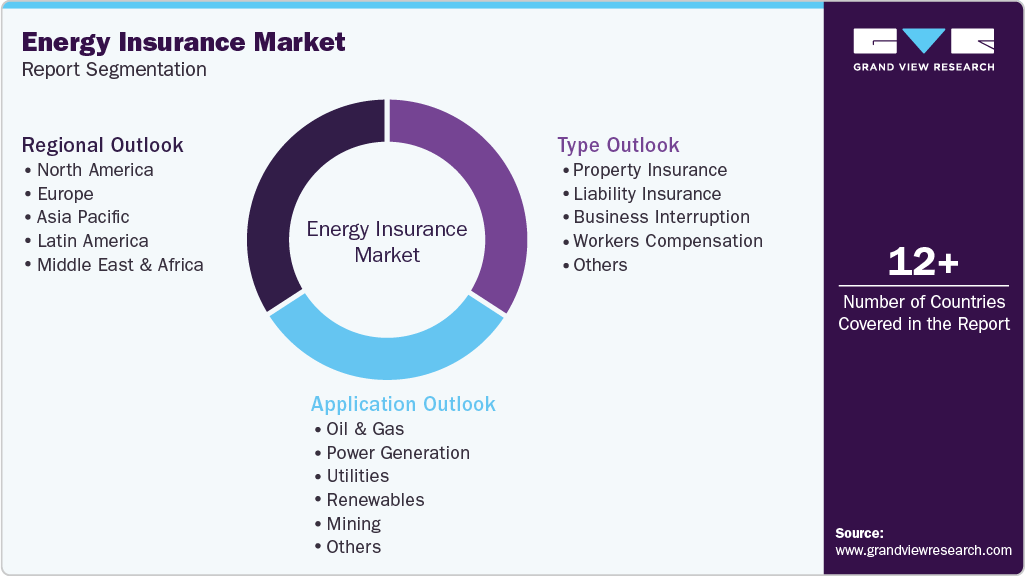
The report forecasts revenue growth at global, regional, and country levels and provides an analysis of the latest industry trends in each of the sub-segments from 2021 to 2033. For this study, Grand View Research has segmented the global energy insurance market report based on type, application, and region.
 To learn more about this report, Download Free Sample Report
-
Type Outlook (Revenue, USD Billion, 2021 - 2033)
-
Property Insurance
-
Liability Insurance
-
Business Interruption
-
Workers’ Compensation
-
Others
-
-
Application Outlook (Revenue, USD Billion, 2021 - 2033)
-
Oil & Gas
-
Power Generation
-
Utilities
-
Renewables
-
Mining
-
Others
-
-
Regional Outlook (Revenue, USD Billion, 2021 - 2033)
-
North America
-
U.S.
-
Canada
-
Mexico
-
-
Europe
-
Germany
-
UK
-
France
-
-
Asia Pacific
-
China
-
India
-
Japan
-
South Korea
-
Australia
-
-
Latin America
-
Brazil
-
-
Middle East & Africa (MEA)
-
UAE
-
Kingdom of Saudi Arabia (KSA)
-
South Africa
-
-
Research Methodology
The energy insurance market figures in this report are based on a proven research process that combines executive interviews with secondary research from proprietary databases, company filings, and recognized regulatory and institutional sources. Market size is built through value-chain sizing-reconciling supply-side and demand-side estimates-and triangulated with bottom-up and top-down approaches. Every estimate passes multiple levels of expert validation before publication, with each energy insurance segment quantified using the revenue-capture definitions in the table below.
Segment Definition
Segment - Type
Revenue capture definition
Property Insurance
The segment revenue is generated from premiums collected for coverage against physical loss or damage to energy-related buildings, plants, machinery, equipment, pipelines, storage facilities, offshore assets, renewable installations, and other insured property. Revenue also includes premiums associated with specialized property extensions and coverage for machinery-related physical damage, where included within the policy.
Liability Insurance
The segment revenue is generated from premiums earned for third-party liability protection arising from bodily injury, property damage, pollution-related liabilities, operational incidents, contractual exposures, and other legal liabilities associated with energy activities. It includes primary, excess, and umbrella liability coverage, which are specifically written for energy-related risks.
Business Interruption
The segment revenue is generated from premiums associated with coverage for loss of income, lost profits, continuing expenses, and other financial losses resulting from an insured interruption to energy operations. Revenue includes coverage linked to physical damage that prevents an insured facility from operating and may include loss-of-profit or delay-related extensions.
Workers’ Compensation
The segment revenue is generated from premiums collected for coverage of employee-related workplace injuries, occupational illnesses, medical expenses, wage replacement, and statutory compensation obligations arising from energy-sector employment. It includes workers' compensation programs designed for oil and gas, power, utilities, mining, construction, and other energy-related operations.
Others
The segment revenue is generated from premiums associated with specialized energy insurance products not separately classified under property, liability, business interruption, or workers' compensation. This can include construction risks, machinery breakdown, environmental or pollution coverage, marine-related energy risks, political risk, cyber coverage, and other specialized risk-transfer solutions.
Segment - Application
Revenue capture definition
Oil & Gas
The segment revenue is generated from insurance premiums associated with upstream exploration and production, drilling, pipelines, terminals, transportation, refining, petrochemical processing, storage, and other oil and gas operations.
Power Generation
The segment revenue is generated from premiums covering conventional and renewable power generation assets, including plants, generation equipment, construction activities, machinery, operational risks, liability, and business interruption exposures.
Utilities
The segment revenue is generated from premiums associated with electricity, gas, water, and other utility infrastructure, including transmission, distribution, network assets, substations, equipment, liability, and operational interruption risks.
Renewables
The segment revenue is generated from premiums covering renewable energy projects and associated assets, including solar, wind, hydro, biomass, geothermal, battery storage, hydrogen, and other emerging low-carbon energy technologies.
Mining
The segment revenue is generated from premiums associated with mining operations and related assets, including surface and underground mines, processing facilities, heavy equipment, infrastructure, contractors, liability, and business interruption risks.
Others
The segment revenue is generated from insurance premiums associated with energy-related activities outside the primary oil and gas, power generation, utilities, renewable, and mining applications. This includes selected alternative fuels, energy infrastructure services, energy construction activities, and other specialized energy operations.
Estimation Model
Layer Name
Key Question
Description
Energy Industry Exposure Base
What energy assets and operations require insurance protection?
This layer identifies the addressable energy industry base across oil and gas, power generation, utilities, renewables, mining, and related activities. It considers the number, scale, value, and type of insured assets and operations. The analysis also distinguishes between traditional energy infrastructure and emerging energy technologies. This establishes the underlying exposure pool from which insurance demand is generated.
Insurance Coverage Demand
What types of insurance coverage are purchased by energy businesses?
This layer evaluates demand for property, liability, business interruption, workers' compensation, and specialized insurance products. It considers the level of risk associated with different energy operations and the extent to which companies transfer these risks to insurers. Coverage requirements are assessed according to asset value, operational complexity, regulatory requirements, financing conditions, and contractual obligations. This layer converts the underlying energy exposure into potential insurance demand.
Premium and Revenue Capture
How much insurance revenue can be captured from the covered risks?
This layer estimates premium generation based on insured values, coverage limits, policy structures, deductibles, risk characteristics, and applicable premium rates. It considers differences between high-value offshore and industrial assets and smaller or less complex energy facilities. The model also accounts for specialized coverage and alternative risk-transfer structures where relevant. This layer converts insurance demand into estimated market revenue.
Market Revenue and Competitive Allocation
What portion of the addressable premium pool is captured by insurers?
This layer determines the overall Energy Insurance Market revenue by consolidating premium contributions across coverage types and applications. It considers insurer participation, underwriting capacity, geographic presence, distribution channels, reinsurance arrangements, and competitive positioning. The analysis also evaluates how market growth is shifting toward renewable energy and emerging technologies. This final layer produces the estimated market value and provides the basis for assessing competitive dynamics and future growth.
Delivered Customization
We have successfully delivered the following deep-dive customizations:
Client Request
Customization Delivered
Value Adds
Regional Energy Insurance Market Opportunity Assessment
Country/region-wise market sizing and forecasts
Analysis of demand, adoption trends, and regulatory landscape
Identification of high-growth regions and investment hotspots
Identified region-specific growth opportunities
Supported expansion and go-to-market strategy
Enabled informed regional investment decisions
Cross-Segmentation Analysis for the Energy Insurance Market
Criss-cross market analysis by type, application
Demand and adoption assessment across key segments
Segment attractiveness and growth potential benchmarking
Identified high-potential market segments
Supported targeted application positioning and marketing strategy
Improved customer and segment prioritization
Competitive Benchmarking and Strategic Positioning in the Energy Insurance Market
Benchmarking of key competitors across applications, pricing, partnerships, and innovation
Comparative assessment of market share, capabilities, and strategies
Analysis of competitive strengths, gaps, and differentiation areas
Identified competitive white spaces and growth gaps
Supported strategic positioning and differentiation
Enabled data-driven competitive strategy development
Frequently Asked Questions About This Report
The global energy insurance market size was valued at USD 6.5 billion in 2025 and is estimated at USD 6.6 billion in 2026.
The global energy insurance market is expected to grow at a compound annual growth rate of 4.6% from 2026 to 2033, reaching USD 9.1 billion by 2033.
Property insurance segment accounted for 39.4%, the largest share of global revenue in 2025. This segment dominance in the energy insurance market due to the extensive use of high-value physical assets across energy operations
North America Energy Insurance led the global market and accounted for 36.1% of the global revenue in 2025. Rising investment in oil and gas infrastructure, power generation, utilities, and renewable energy is expanding the base of assets requiring insurance protection.
Increasing investment in renewable energy infrastructure is growing demand for insurance coverage to protect energy assets and manage operational risks.
Some key players operating in the energy insurance market include Allianz, American International Group, Inc., AXA SA, Chubb, Liberty Mutual Insurance Company, Sukoon Insurance PJSC, Tawuniya, Zurich, Tokio Marine HCC, ADNIC
Oil & gas segment accounted for the largest share of global revenue in 2025, while renewable segment is projected to grow at the fastest CAGR over the forecast period
The Asia Pacific Energy Insurance is projected to grow at the fastest CAGR over the forecast period.
U.S. held the largest market share in 2025.
About the Author(s)
Next Generation Technologies Research Team
Technology · Next Generation TechnologiesThis report was authored by the next generation technologies research team at Grand View Research - comprising two research analysts, one senior research analyst, and one industry expert - with specialized expertise in the next generation technologies segment of the technology industry. All findings are based on proprietary technology databases, executive interviews, and regulatory analysis, subject to internal peer review prior to publication.
Last Updated:
Speak to Analyst

Customize this report to your needs - add regions, segments, or data points, with 20% free customization.
Or view our licence options:


ISO 9001:2015 & 27001:2022 Certified
We are GDPR and CCPA compliant! Your transaction & personal information is safe and secure. For more details, please read our privacy policy.


