
- Home
- »
- IT Services & Applications
- »
-
Enterprise Architecture Tools Market Size Report, 2026-2033GVR Report cover

Enterprise Architecture Tools Market (2026 - 2033)
Size, Share & Trends Analysis Report By Component (Solution), By Solution (Infrastructure Architecture), By Services (Managed), By Deployment (On-premise, Cloud), By Enterprise Size, By End Use, By Region, And Segment Forecasts
Market Size, 2025
$1.2BMarket Estimate, 2026
$1.3BMarket Forecast, 2033
$2.0BCAGR, 2026–2033
6.8%Enterprise Architecture Tools Market Summary
The global enterprise architecture tools market size was valued at USD 1.2 billion in 2025 and is projected to grow from USD 1.3 billion in 2026 to USD 2.0 billion by 2033, at a CAGR of 6.8% from 2026 to 2033. The market in North America dominated with a revenue share of 40.4% in 2025. As organizations accelerate their digital transformation initiatives, they increasingly encounter the challenge of managing and integrating complex IT environments, creating a growing need for advanced Enterprise Architecture (EA) tools.
 Source: Grand View Research, IR Documents, Primary Interviews, Paid DatabasesTo learn more about this report,
 Download Free Sample Report
 Key Market Trends & Insights
- By enterprise size: Large enterprises segment held the largest revenue share of 68.7% in 2025.
- By component: Solution segment held the largest market share of 65.1% in 2025.
- By services: Managed services segment held the largest market share of 57.9% in 2025.
- By deployment: Cloud segment held the largest market share of 51.8% in 2025.
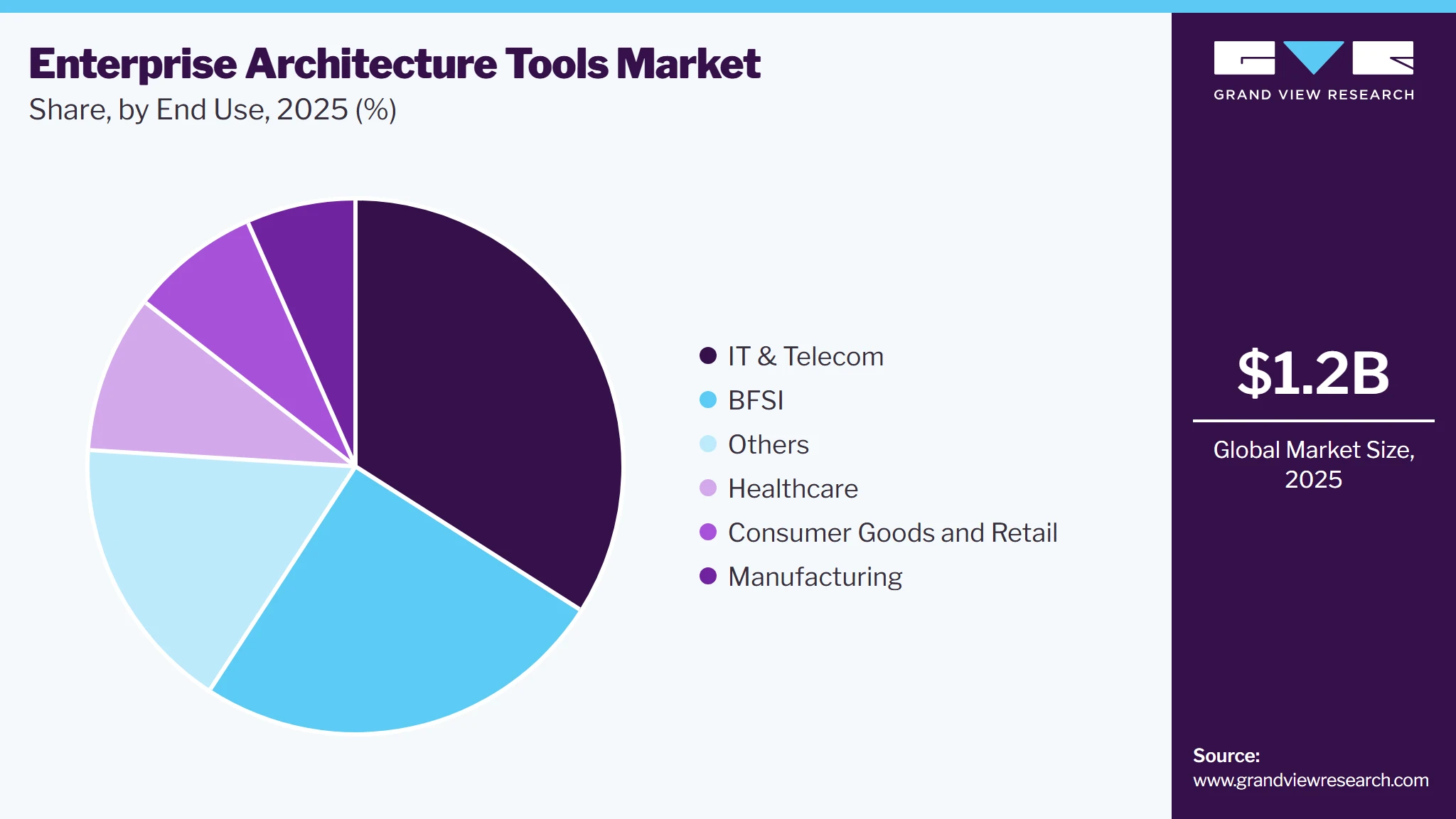
- By end use: IT & telecom segment held the largest market share of 34.0% in 2025.
- By solution: Application architecture segment held the largest market share of 31.0% in 2025.
Regional Highlights
- Largest regional market: North America (40.4% revenue share, 2025)
- Fastest-growing regional market: Asia Pacific (highest CAGR, 2026-2033)
- By country: The U.S. held the largest market share in 2025
Market Size & Forecast
- Market size in 2025: USD 1.2 Billion
- Estimated market size in 2026: USD 1.3 Billion
- Projected market size by 2033: USD 2.0 Billion
- CAGR (2026-2033): 6.8%
Three ways to get this report
Buy it, customize it, or ask a question.Ask an Analyst
Analyst response in 1 business day
- AccessReport author, directly
- Reply timeWithin 1 working day
- No sales callDirect answer only
- FormatEmail reply
- CostFree, no cost
Get the Full Report
What the study covers
- FormatsPDF · Excel · Dashboard
- Timeline2026–2033 annual, 2025 base
- Coverage20+ countries, 5 regions
- Companies10+ key players profiled
Customize the Report
20% free customization
- IncludeCountries, segments, points
- TailorTo your product definition
- ExtendDeeper competitor detail
- OrA fully bespoke study
- Turnaround5–10 working days
The Enterprise Architecture tools market is experiencing strong growth, supported by rising demand for automation, analytics, data governance, regulatory compliance, and enhanced business performance. By aligning data, infrastructure, and application architectures within a unified framework, EA tools enable organizations to improve collaboration, streamline decision-making processes, and optimize the utilization of technology resources while maintaining greater business agility. Organizations leverage EA to control their IT environments, enabling them to assess application portfolios for cost savings, rationalize systems, analyze application criticality, and eliminate redundancies. In this context, EA helps businesses minimize risks, manage complexity, and streamline digital transformation efforts. To learn more about this report, Download Free Sample Report
 Companies increasingly adopt enterprise architecture management as part of their digital transformation strategies. For instance, The TOGAF Standard, Version 9.2, provides a proven framework for using EA as a strategic discipline, supporting digital transformation success. Global standards, such as the European Interoperability Framework (EIF) and the United States Federal Enterprise Architecture (FEA), also play a key role in shaping enterprise architecture practices to meet organizational goals.
Enterprise architecture (EA) tools play a critical role in ensuring compliance with data privacy regulations, such as the General Data Protection Regulation (GDPR) and the Electronic Communications Privacy Act (ECPA). As businesses become more cautious about data exchange and accessibility, EA tool vendors must prioritize robust privacy and security measures. However, the rising incidence of data breaches and cyberattacks has significantly increased the cost of data breaches, posing a restraint on the global EA tools market.
Analyst Perspective
The Enterprise Architecture (EA) Tools market is evolving from a traditional IT governance function into a strategic enabler of business transformation. Demand is rising as organizations use EA platforms for cloud migration, application rationalization, business capability mapping, and digital transformation. Growing hybrid and multi-cloud complexity, along with regulatory and cybersecurity requirements, is driving demand for greater visibility across business, application, data, and technology assets. Vendors integrating AI-powered analytics, automation, and real-time architecture intelligence are expected to gain a competitive edge. Looking ahead, adoption of business-driven architecture and Digital Twins of Organizations (DTOs) is expected to support market growth. Mature vendors will continue to lead large enterprises, while emerging players may gain opportunities with agile, cloud-native, and user-friendly solutions. As enterprises focus on optimizing technology investments and strengthening business-IT alignment, demand for scalable and collaborative EA tools is expected to remain strong.
Component Insights
Based on component, the solution segment led the market with the largest revenue share of 65.1% in 2025, driven by the increasing demand for real-time data analysis and decision-making capabilities. As organizations adopt more agile and data-driven strategies, EA tools that offer advanced analytics, real-time insights, and seamless integration across IT systems are becoming essential.
The services segment is expected to expand significantly over the forecast period. This segment includes consulting, training, support, and implementation services. These services are critical for organizations that adopt EA tools but need guidance in configuring, deploying, and maximizing their usage to align with business objectives. The complexity of EA tools and their integration with existing IT infrastructure drive the demand for these services.
Solution Insights
Based on solution, the application architecture segment led the market with the largest revenue share of 31.0% in 2025, driven by the increasing need for scalable and flexible software systems. As businesses prioritize rapid application development and deployment, they are expected to adopt EA tools that support modular architectures, microservices, and cloud-native solutions to help streamline application management, improve scalability, and ensure seamless integration.
The security architecture segment is expected to expand at a CAGR of 7.0% over the forecast period. With cyberattacks becoming increasingly frequent and sophisticated, organizations prioritize security from the design phase. Enterprise architecture tools that offer built-in security features help businesses address vulnerabilities proactively, reducing the risk of data breaches and other security incidents.
Services Insights
Based on services, the managed services segment led the market with the largest revenue share of 57.9% in 2025, driven by the preference to outsource the management of complex IT environments to third-party service providers. As organizations focus on digital transformation, they prefer approaching managed services providers to optimize their EA tools, reduce operational costs, and enhance system performance. The professional segment is poised for the fastest growth over the forecast period, owing to the rising demand for expert guidance and customized implementation.
The professional segment is expected to grow significantly over the forecast period. The increasing demand for cloud-based and hybrid EA tools has augmented the importance of professional services, as they assist in customizing and deploying them within diverse environments.
Deployment Insights
Based on the deployment, the cloud segment led the market with the largest revenue share of 51.8% in 2025, driven by the increasing adoption of cloud-based infrastructure by organizations seeking scalability, flexibility, and cost efficiency. As businesses move away from on-premise solutions, the demand for EA tools that support cloud environments, seamless integration, remote access, and easier collaboration across teams is expected to gain traction. Cloud-based solutions allow organizations to manage complex IT ecosystems more effectively while reducing infrastructure costs and improving agility.
The on-premise segment is expected to grow significantly over the forecast period. Regulatory compliance in industries such as financial services and healthcare requires strict control over data storage and access, prompting companies to opt for on-premise deployments to meet legal and compliance obligations.
Enterprise Size Insights
By enterprise size, the large enterprises segment led the market, accounting for 68.7% of revenue in 2025, driven by the need for comprehensive IT governance and strategic alignment across complex, global operations. As large enterprises manage vast IT infrastructures and multiple business units, EA tools help ensure consistency, optimize resource utilization, and improve decision-making by providing a unified view of IT systems.
The small & medium enterprises (SMEs) segment is expected to grow significantly over the forecast period. As cloud-based solutions gain prominence, many SMEs are drawn to EA tools because they provide flexibility and scalability at a lower upfront cost. Additionally, as regulatory requirements and data compliance pressures increase, EA tools help SMEs adhere to industry standards and maintain operational transparency.
End-use Insights
Based on end use, the IT & telecom segment led the market with the largest revenue share of 34.0% in 2025, driven by the increasing need for seamless network and system integration to support emerging technologies, such as 5G, IoT, and edge computing. As IT & telecom companies expand their infrastructure to handle growing data volumes and new digital services, EA tools become crucial for ensuring interoperability, optimizing network performance, and managing complex, distributed systems.
 To learn more about this report, Download Free Sample Report
 The manufacturing segment is expected to grow significantly over the forecast period. This growth is driven by the rising demand for efficient supply chain management, the growing complexity of IT and operational systems, and the pressure to remain agile in response to market changes. The need for digital twins, which offer virtual models of physical manufacturing systems and improved product lifecycle management (PLM), has also accelerated the deployment of EA solutions.
Regional Insights
North America dominated the global enterprise architecture tools market, with the largest revenue share of 40.4% in 2025. Enterprises in North America are undertaking digital transformation initiatives as they strive to remain competitive in an increasingly technology-driven marketplace. This transformation involves integrating digital technologies into all aspects of a business, changing how operations are being conducted, and delivering value to customers.
 To learn more about this report, Download Free Sample Report
 U.S. Enterprise Architecture Tools Market Trends
The enterprise architecture tools market in the U.S. held the largest share of the North American market in 2025. Digital transformation has become a priority for enterprises aiming to boost operational efficiency, enhance customer experiences, and foster innovation. This transformation involves integrating digital technologies into all aspects of business operations, requiring a cohesive alignment between IT strategies and overarching business objectives.
Europe Enterprise Architecture Tools Market Trends
The enterprise architecture tools market in Europe is growing with a significant CAGR from 2026 to 2033. The growing shift towards cloud-based solutions is significantly transforming the market. As more organizations migrate their operations to the cloud, EA tools become essential in managing the complexity of hybrid IT environments.
The UK enterprise architecture tools market is expected to grow rapidly in the coming years as businesses are increasingly investing in cybersecurity due to the rising frequency of data breaches and cyber-attacks. These incidents highlight vulnerabilities in IT systems, especially with the proliferation of remote work and cloud services.
The enterprise architecture tools market in Germany held a substantial market share in 2025. The increasing adoption of Industry 4.0 and smart manufacturing in Germany drives the demand for Enterprise Architecture (EA) tools. As businesses integrate advanced technologies like the Internet of Things (IoT), artificial intelligence (AI), and robotics into their operations, they face increasingly complex IT infrastructures that require effective management.
Asia Pacific Enterprise Architecture Tools Market Trends
The enterprise architecture tools market in Asia Pacific is expected to grow at the highest CAGR of 8.0% from 2026 to 2033, driven by the rapid expansion of digital transformation initiatives among businesses striving to enhance operational efficiency and competitiveness. As companies across various industries embrace advanced technologies, such as AI, big data, and IoT, there is a growing demand for EA tools that facilitate integrating and managing these technologies, enabling organizations to streamline processes, improve agility, and respond effectively to market changes.
Japan enterprise architecture tools market is expected to grow rapidly in the coming years. Japan's aging population and shrinking workforce drive companies to invest in automation and artificial intelligence (AI) to maintain productivity. EA tools play a crucial role in supporting the integration of these advanced technologies by providing frameworks to optimize operations and streamline processes, helping businesses address labor shortages efficiently.
The enterprise architecture tools market in China held a substantial market share in 2025. China's push towards Industry 4.0 and the "Made in China 2025" initiative play a crucial role in driving the integration of advanced technologies like the Internet of Things (IoT), artificial intelligence (AI), and automation in manufacturing. The initiative focuses on modernizing China's manufacturing sector by promoting advanced technologies to improve production efficiency, reduce costs, and enhance global competitiveness. This transformation requires sophisticated management of complex systems, where Enterprise Architecture (EA) tools become essential.
Key Enterprise Architecture Tools Company Insights
Key players operating in the market include Software GmbH, SAP SE, MEGA International, Sparx Systems Pty Ltd., Orbus Software, BOC Products & Services AG, and LeanIX GmbH. The companies focus on various strategic initiatives, including new product development, partnerships & collaborations, and agreements, to gain a competitive advantage over their rivals. The following are some instances of such initiatives.
Key Enterprise Architecture Tools Companies
The following key companies have been profiled for this study on the enterprise architecture tools market.
-
Avolution
-
BiZZdesign
-
BOC Products & Services AG.
-
LeanIX GmbH
-
MEGA International
-
Orbus Software
-
QualiWare ApS.
-
Quest Software Inc. (erwin, Inc.)
-
Software GmbH
-
ValueBlue
Competitive Benchmarking
Operating Strategies
Competitive Edge
Weaknesses
Mature Players (Avolution, BiZZdesign, LeanIX GmbH, MEGA International, Orbus Software, Quest Software Inc. (erwin), Software AG)
- Invest in AI-driven enterprise architecture, application portfolio management, and digital transformation planning capabilities to strengthen business-IT alignment.
- Expand cloud-based EA offerings through strategic partnerships and integrations with ITSM, GRC, BPM, and cloud platforms.
- Strong enterprise customer base, established brand recognition, and extensive experience in large-scale transformation initiatives.
- Comprehensive product portfolios supporting architecture governance, business capability mapping, process modeling, and portfolio rationalization.
- Complex implementations and extensive feature sets may increase deployment timelines and total cost of ownership.
- Continuous investment is required to keep pace with emerging technologies such as AI, automation, and digital twin capabilities.
Emerging Players (BOC Products & Services AG, QualiWare ApS, ValueBlue)
- Focus on niche enterprise architecture, governance, and business process management use cases with agile product development approaches.
- Emphasize cloud-native deployment models, simplified user experiences, and faster implementation cycles to attract mid-market customers.
- Greater agility and flexibility in addressing evolving customer requirements and industry-specific needs.
- Typically offer quicker deployment, lower implementation complexity, and more personalized customer engagement.
- Limited global presence and smaller partner ecosystems compared with established enterprise architecture vendors.
- Lower financial and R&D resources may restrict large-scale innovation and expansion into new markets.
Recent Developments
-
In September 2024, ValueBlue partnered with Iasa Global, a global association for all technology architects, to enhance career guidance and training for architects in the Netherlands. The collaboration combines Iasa Global’s global frameworks with ValueBlue’s BlueDolphin platform, offering architects training, networking, and tools to drive innovation and support business transformations through advanced architecture strategies.
-
In January 2024, Sparx Systems Pty Ltd. completed the acquisition of Prolaborate, a platform designed for collaborative enterprise architecture. The acquisition aimed to strengthen Sparx Systems Pty Ltd.’s Enterprise Architect platform, allowing better collaboration, data visualization, and stakeholder engagement. The move aligned with Sparx Systems Pty Ltd.’s goal to expand its offerings in the enterprise architecture domain.
Enterprise Architecture Tools Market Report Scope
Report Attribute
Details
Market size in 2025
USD 1.2 billion
Estimated market size in 2026
USD 1.3 billion
Projected market size by 2033
USD 2.0 billion
Growth rate
CAGR of 6.8% from 2026 to 2033
Base year for estimation
2025
Historical data
2021 - 2024
Forecasts period
2026 - 2033
Quantitative units
Revenue in USD million/billion and CAGR from 2026 to 2033
Report coverage
Revenue forecasts, company market share analysis, competitive landscape, growth factors, and trends
Segments covered
Component, solution, services, deployment, enterprise Size, end use, and Region
Regional scope
North America; Europe; Asia Pacific; Latin America; MEA
Country scope
U.S.; Canada; Mexico; Germany; UK; France; Italy; Spain; China; Japan; India; South Korea; Australia; Brazil; Saudi Arabia; South Africa; UAE
Key companies profiled
Avolution; BiZZdesign; BOC Products & Services AG.; LeanIX GmbH; MEGA International; Orbus Software; QualiWare ApS.; Quest Software Inc. (erwin, Inc.); Software GmbH; ValueBlue
Customization scope
Free report customization (equivalent to up to 8 analysts' working days) with purchase. Addition or alteration to country, regional & segment scope.
Pricing and purchase options
Avail customized purchase options to meet your exact research needs. Explore purchase options
Global Enterprise Architecture Tools Market Report Segmentation
This report forecasts revenue growth at global, regional, and country levels and provides an analysis of the latest industry trends in each of the sub-segments from 2021 to 2033. For this study, Grand View Research has segmented the global enterprise architecture tools market report based on component, deployment, solution, services, deployment, enterprise size, end-use, and region.
-
Component Outlook (Revenue, USD Million, 2021 - 2033)
-
Solution
-
Services
-
-
Solution Outlook (Revenue, USD Million, 2021 - 2033)
-
Infrastructure Architecture
-
Application Architecture
-
Data Architecture
-
Security Architecture
-
Others
-
-
Services Outlook (Revenue, USD Million, 2021 - 2033)
-
Managed
-
Professional
-
-
Deployment Outlook (Revenue, USD Million, 2021 - 2033)
-
On-premise
-
Cloud
-
-
Enterprise Size Outlook (Revenue, USD Million, 2021 - 2033)
-
Large Enterprises
-
Small and Medium-sized Enterprises (SMEs)
-
-
End-use Outlook (Revenue, USD Million, 2021 - 2033)
-
BFSI
-
Consumer Goods and Retail
-
IT & Telecom
-
Manufacturing
-
Healthcare
-
Others
-
-
Regional Outlook (Revenue, USD Million, 2021 - 2033)
-
North America
-
U.S.
-
Canada
-
Mexico
-
-
Europe
-
UK
-
Germany
-
France
-
-
Asia Pacific
-
China
-
India
-
Japan
-
South Korea
-
Australia
-
-
Latin America
-
Brazil
-
-
Middle East & Africa
-
UAE
-
Saudi Arabia
-
South Africa
-
-
Research Methodology
The enterprise architecture tools market figures in this report are based on a proven research process that combines executive interviews with secondary research from proprietary databases, company filings, and recognized regulatory and institutional sources. Market size is built through value-chain sizing-reconciling supply-side and demand-side estimates-and triangulated with bottom-up and top-down approaches. Every estimate passes multiple levels of expert validation before publication, with each enterprise architecture tools segment quantified using the revenue-capture definitions in the table below.
Segment Definition
Segment – Component
Revenue Capture Definition
Solutions
Revenue is generated through enterprise architecture software platforms, application portfolio management solutions, business process modeling tools, IT governance platforms, technology risk assessment solutions, architecture repositories, strategic planning tools, and subscription-based SaaS EA offerings.
Services
Revenue is earned through consulting, enterprise architecture design, implementation, customization, integration, migration, training, support, managed services, architecture assessment, and ongoing governance and optimization services.
Segment – Solution
Revenue Capture Definition
Infrastructure Architecture
Tools used to design, model, visualize, and manage the underlying IT infrastructure, including servers, networks, storage, cloud environments, data centers, and other technology components.
Application Architecture
Tools used to design and document the structure, components, interfaces, dependencies, and interactions of applications to ensure scalability, integration, and alignment with business requirements.
Data Architecture
Tools used to design, organize, model, and manage an organization's data structures, flows, repositories, databases, and integration mechanisms to support data governance and accessibility.
Security Architecture
Tools used to design and assess security frameworks, controls, policies, identity systems, network security, and protection mechanisms across IT environments to manage security risks and compliance requirements.
Others
Includes specialized architecture tools covering areas such as business architecture, technology portfolio management, enterprise architecture governance, process architecture, and other architecture domains not classified under the major categories above.
Segment – Services
Revenue Capture Definition
Managed Services
Outsourced services in which a third-party provider continuously operates, monitors, maintains, and manages architecture tools and related infrastructure on behalf of an organization.
Professional Services
Specialized consulting and implementation services that help organizations deploy, configure, customize, integrate, and optimize architecture tools according to their specific business and IT requirements.
Segment – Deployment
Revenue Capture Definition
Cloud
Revenue is captured through cloud-based enterprise architecture platforms, SaaS subscriptions, architecture-as-a-service offerings, cloud-hosted repositories, collaborative modeling environments, and managed cloud deployment services.
On-premise
Revenue is generated through perpetual software licenses, on-premise deployment and implementation services, infrastructure integration, system maintenance, upgrades, security management, and technical support contracts.
Segment – Enterprise Size
Revenue Capture Definition
Large Enterprises
Revenue is captured through enterprise-wide architecture transformation programs, large-scale application portfolio rationalization projects, governance and compliance initiatives, digital transformation planning, and multi-year software licensing and service agreements.
Small and Medium-sized Enterprises (SMEs)
Revenue is generated through subscription-based EA solutions, business process mapping tools, IT planning and governance platforms, architecture consulting services, and cost-effective cloud-based architecture management solutions tailored for growing organizations.
Segment – End Use
Revenue Capture Definition
BFSI
Revenue is generated through enterprise architecture solutions supporting digital banking transformation, regulatory compliance management, risk governance, application modernization, data architecture planning, and financial technology integration initiatives.
Consumer Goods and Retail
Revenue is captured through architecture tools used for omnichannel retail transformation, supply chain optimization, customer experience management, application portfolio modernization, and data-driven business planning initiatives.
IT & Telecom
Revenue is earned through enterprise architecture platforms supporting network transformation, OSS/BSS modernization, cloud migration planning, technology lifecycle management, service delivery optimization, and IT governance programs.
Manufacturing
Revenue is generated through architecture solutions that support smart manufacturing initiatives, industrial digital transformation, Industry 4.0 adoption, operational technology (OT)-IT integration, supply chain modernization, and process optimization.
Healthcare
Revenue is captured through enterprise architecture tools used for healthcare IT modernization, electronic health record (EHR) integration, interoperability management, regulatory compliance, digital health transformation, and data governance initiatives.
Others
Revenue is generated through enterprise architecture deployments across government, education, energy and utilities, transportation, media and entertainment, and other industries requiring technology governance, business process optimization, and digital transformation planning capabilities.
Estimation Model
Layer Name
Key Question
Description
Enterprise & IT Governance Base Layer (Total Addressable Market)
Who can potentially use Enterprise Architecture tools?
Estimate the total number of enterprises, government agencies, and organizations requiring business-IT alignment, technology governance, digital transformation planning, application portfolio management, and strategic IT decision-making capabilities.
Architecture Readiness Layer (Serviceable Market)
Who can technically adopt Enterprise Architecture tools?
Refine the market by evaluating organizations with established IT governance frameworks, digital transformation programs, application management practices, cloud adoption initiatives, and enterprise-wide technology planning requirements.
Enterprise Architecture Adoption Layer (Active Market)
Who actively utilizes Enterprise Architecture tools?
Includes organizations deploying enterprise architecture platforms for business capability mapping, application portfolio rationalization, technology lifecycle management, process modeling, governance, compliance management, and transformation planning.
Monetization Layer (Revenue Realization)
How is revenue generated?
Revenue is generated through software licensing, SaaS subscriptions, architecture repository and modeling solutions, consulting services, implementation and integration projects, training, support, managed services, and ongoing architecture governance and optimization engagements.
Delivered Customizations
This report has been delivered with the following In-depth customizations
Client Request
Customization Delivered
Value Adds
Enterprise Architecture Maturity & Adoption Assessment
Conducted a detailed assessment of enterprise architecture adoption trends across business capability mapping, application portfolio management, technology governance, process modeling, digital transformation planning, and architecture modernization initiatives.
Helps stakeholders identify high-growth adoption areas, evaluate enterprise architecture maturity levels, and align product development and investment strategies with evolving market demand.
Industry-Specific Enterprise Architecture Transformation Analysis
Evaluated the use of enterprise architecture tools across BFSI, healthcare, manufacturing, retail, IT & telecom, government, and other industries, highlighting key use cases, governance requirements, modernization priorities, and digital transformation initiatives.
Enables targeted go-to-market strategies by identifying industry-specific opportunities, architecture challenges, and technology investment priorities across key end-user sectors.
Regional Enterprise Architecture Opportunity & Competitive Landscape Assessment
Delivered a comprehensive analysis of enterprise architecture adoption across North America, Europe, Asia Pacific, Latin America, and MEA, covering digital transformation investments, cloud migration trends, regulatory environments, enterprise modernization initiatives, and competitive positioning.
Supports strategic expansion and market entry decisions by identifying regional growth opportunities, customer adoption patterns, competitive dynamics, and long-term market potential.
Frequently Asked Questions About This Report
Asia Pacific is the fastest-growing region over the forecast period.
The solution segment led with a 65.1% revenue share in 2025, while services is the fastest-growing segment.
The cloud segment led with a 51.8% revenue share in 2025 and is also the fastest-growing segment.
The large enterprises segment led with 68.7% revenue share in 2025, while Small & Medium Enterprises (SMEs) segment is the fastest-growing segment.
North America dominated with 40.4% revenue share in 2025.
The global enterprise architecture tools market size was valued at USD 1.2 billion in 2025 and is estimated at USD 1.3 billion for 2026.
The global enterprise architecture tools market is expected to grow at a CAGR of 6.8% from 2026 to 2033, reaching USD 2.0 billion by 2033.
Key factors driving the enterprise architecture tools market growth include the emphasis organizations are putting on managing and aligning their IT infrastructure with business objectives efficiently. As enterprises pursue digital transformation, they typically face the challenge of integrating complex IT systems, necessitating robust Enterprise Architecture (EA) tools to ensure agility and optimize resource utilization.
Some key players operating in the enterprise architecture tools market include SAvolution, BiZZdesign, BOC Products & Services AG., LeanIX GmbH, MEGA International, Orbus Software, QualiWare ApS., Quest Software Inc. (erwin, Inc.), Software GmbH, an ValueBlue
About the Author(s)
IT Services & Applications Research Team
Technology · IT Services & ApplicationsThis report was authored by the it services & applications research team at Grand View Research - comprising two research analysts, one senior research analyst, and one industry expert - with specialized expertise in the it services & applications segment of the technology industry. All findings are based on proprietary technology databases, executive interviews, and regulatory analysis, subject to internal peer review prior to publication.
Last Updated:
Speak to Analyst

Customize this report to your needs - add regions, segments, or data points, with 20% free customization.
Or view our licence options:


ISO 9001:2015 & 27001:2022 Certified
We are GDPR and CCPA compliant! Your transaction & personal information is safe and secure. For more details, please read our privacy policy.


