
- Home
- »
- IT Services & Applications
- »
-
Enterprise Asset Management Market, Industry Report, 2030GVR Report cover

Enterprise Asset Management Market (2025 - 2030) Size, Share, & Trends Analysis Report By Deployment (Cloud, On-Premise), By Enterprise Size (Large Enterprises, SMEs), By End Use, By Region, And Segment Forecasts
Market Size, 2024
$7.7BMarket Estimate, 2026
$8.9BMarket Forecast, 2030
$19.7BCAGR, 2025–2030
17.2%Enterprise Asset Management Market Summary
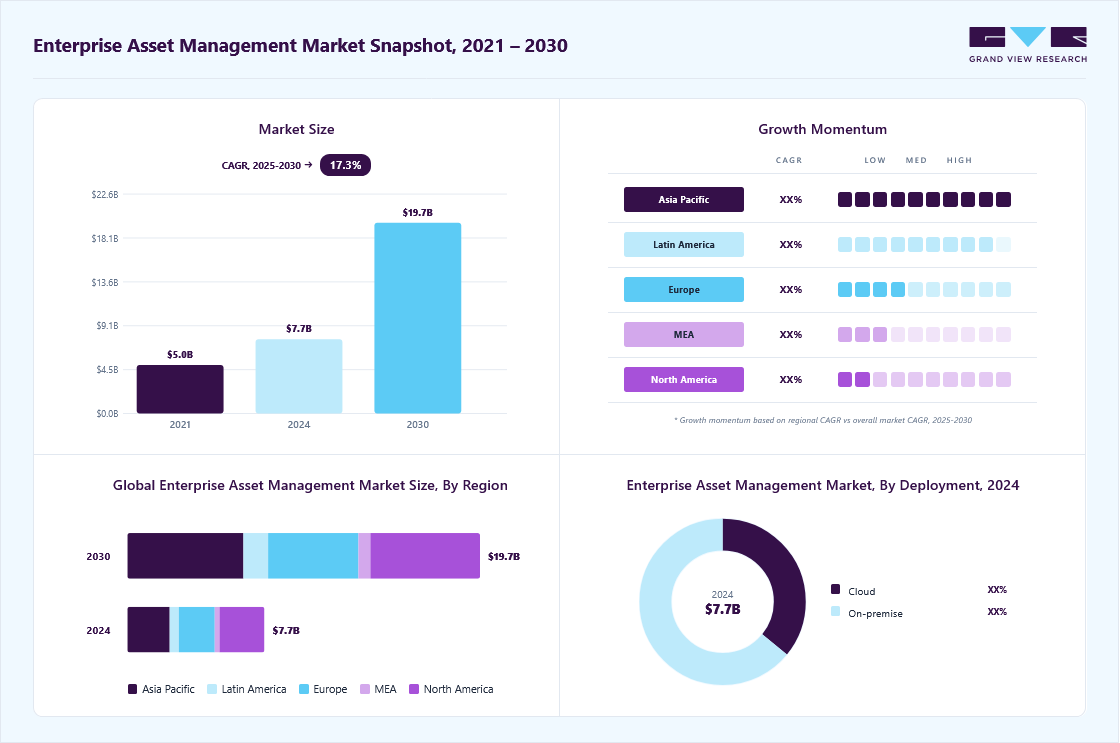
The global enterprise asset management market size was estimated at USD 7.65 billion in 2024 and is projected to reach USD 19.68 billion by 2030, growing at a CAGR of 17.2% from 2025 to 2030. The market's growth is driven by a stronger emphasis on improving asset availability and reducing asset breakdowns that impair business operations.
 Source: Grand View Research, IR Documents, Primary Interviews, Paid DatabasesTo learn more about this report,
 Download Free Sample Report
 Key Market Trends & Insights
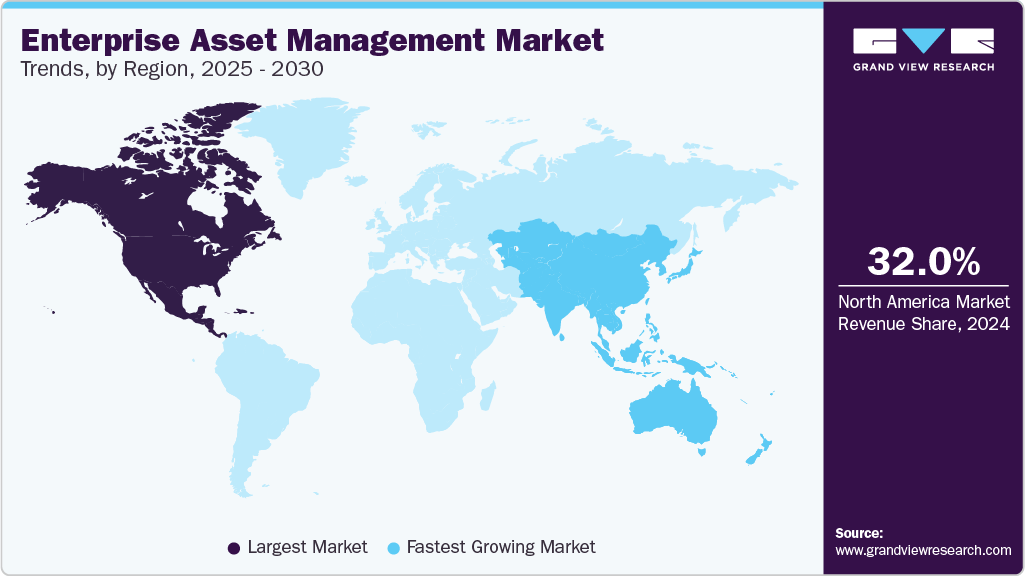
- North America held the major share of over 32.0% of the enterprise asset management industry in 2024.
- The demand for enterprise asset management in the Asia Pacific is growing at fastest a CAGR of 18.5% from 2025 to 2030.
- Based on deployment, the on-premise segment dominated the market and accounted for a revenue share of over 64.0% in 2024 in the market.
- Based on enterprise size, the large enterprises segment accounted for the largest market share of over 60.0% in 2024.
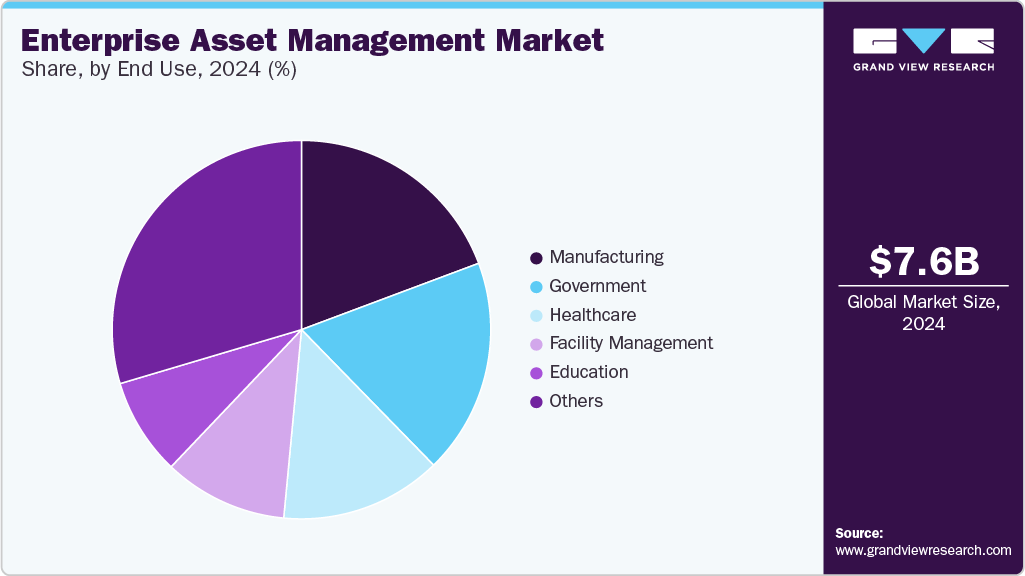
- Based on end use, the manufacturing segment accounted for a market share of over 19.0% in 2024.
Market Size & Forecast
- 2024 Market Size: USD 7.65 Billion
- 2030 Projected Market Size: USD 19.68 Billion
- CAGR (2025-2030): 17.2%
- North America: Largest market in 2024
- Asia Pacific: Fastest growing market
Three ways to get this report
Buy it, customize it, or ask a question.Ask an Analyst
Analyst response in 1 business day
- AccessReport author, directly
- Reply timeWithin 1 working day
- No sales callDirect answer only
- FormatEmail reply
- CostFree, no cost
Get the Full Report
What the study covers
- FormatsPDF · Excel · Dashboard
- Timeline2025–2030 annual, 2024 base
- Coverage20+ countries, 5 regions
- Companies10+ key players profiled
Customize the Report
20% free customization
- IncludeCountries, segments, points
- TailorTo your product definition
- ExtendDeeper competitor detail
- OrA fully bespoke study
- Turnaround5–10 working days
The enterprise asset management (EAM) industry is expected to grow more rapidly due to the rising demand for a 360-degree view of assets, the elimination of compliance-related overheads, the integration of technologies such as IoT, AI, and analytics, and the ongoing use of IoT platforms and devices to sustain enterprise assets.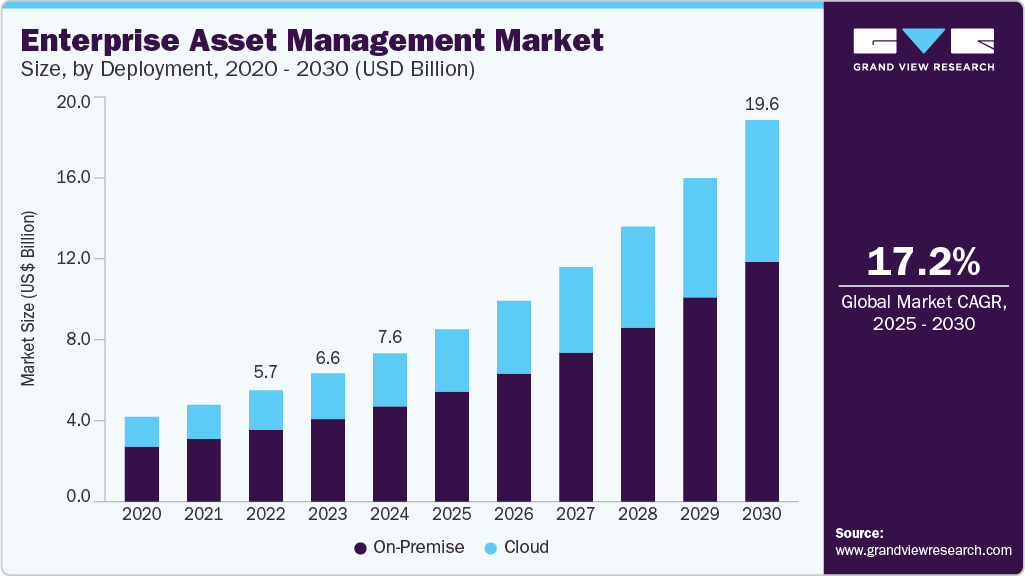 To learn more about this report, Download Free Sample Report
 Furthermore, the demand for cloud-based EAM setups has been affected by increased adoption of internet enterprise size, rising data security concerns, and cell phones that empower and inform users about using highly effective software. The market is undergoing a substantial transformation with supplemental and new technologies. The Internet of Things (IoT), real-time analytics, augmented reality, Artificial Intelligence (AI), digital twins, and telematics are integrated with EAM deployments to assist with more profound insights into asset management. As a result, EAM is increasingly becoming an intelligent program capable of ingesting real-time data, interacting with devices, and providing sophisticated insights to engineers and operators. A maturing market and broad usage of cloud and micro-enterprise size architectures in EAM and facility management software offer new market growth potential.
Integrating IoT and predictive analytics is also a major force behind market growth. Smart sensors and IoT-enabled devices allow real-time monitoring of assets, providing data on temperature, vibration, energy consumption, and more. This data feeds into EAM platforms that use AI and analytics to predict maintenance needs and optimize asset performance. The shift from reactive to predictive maintenance models is improving reliability and minimizing interruptions, making modern EAM solutions indispensable for digital transformation efforts.
Additionally, the globalization of operations and the need for centralized asset visibility push enterprises to adopt scalable EAM solutions. Large organizations with facilities across multiple regions require a unified system to manage asset performance, procurement, maintenance, and inventory across sites. EAM software enables this by centralizing asset data and standardizing processes, leading to better coordination, informed decision-making, and more efficient resource allocation. This centralized oversight becomes even more critical as businesses expand their operational footprints and integrate supply chains.
Furthermore, the trend toward sustainability and energy efficiency is contributing to EAM adoption. As companies pursue ESG goals and look to reduce their environmental impact, EAM tools provide data and insights that support more sustainable operations. By tracking energy use, emissions, and equipment efficiency, EAM platforms help organizations identify areas for improvement and ensure that assets are operating within environmentally responsible parameters. This aligns with growing consumer and stakeholder demand for green practices and long-term asset stewardship.
Deployment Insights
The on-premise segment dominated the market and accounted for a revenue share of over 64.0% in 2024 in the market. Large enterprises with huge assets and sensitive data prefer deploying an on-premise EAM setup to meet compliance requirements and relevant legislation. Concern regarding data security is a significant driving factor contributing to on-premise EAM software adoption. Enterprises demand on-premise asset management deployments where the organizations have low internet, particularly in remote places.
The cloud segment is anticipated to grow at the highest CAGR during the forecast period. The growing demand for remote asset monitoring and management, particularly in the context of distributed or global operations, is driving the segment's growth. Cloud platforms facilitate centralized oversight of assets across multiple locations, which is essential for companies with geographically dispersed facilities or mobile workforces. These systems allow maintenance teams, plant managers, and executives to access critical asset information through dashboards and mobile applications, promoting quicker responses to issues and more informed strategic planning.
Enterprise Size Insights
The large enterprises segment accounted for the largest market share of over 60.0% in 2024 in the enterprise asset management industry. Large enterprises rely heavily on EAM software to streamline their operations and gain a competitive edge. The growing need of large enterprises to track KPIs associated with asset performance, fleet, and other facilities, and the increasing urge to integrate multiple functions such as maintenance activities, inventory management, work order management, and reporting into a cohesive system are observed as crucial factors driving the segment growth. Also, implementing EAM software allows heavy machinery industrial organizations to comply with safety codes and industry regulations and avoid expensive penalties. This factor is also attributed to triggering the adoption rate of EAM in the heavy machinery industry.
The small and medium enterprises (SMEs) segment is anticipated to grow at the fastest CAGR during the forecast period. Small & medium enterprises initially depended on spreadsheets and manual methods for scheduling asset management and maintenance activities. However, to gain a competitive advantage in the global market, SMEs have shifted to modernized deployments that help streamline operations, provide a centralized platform for asset management, and reduce excessive maintenance and management activities costs. Moreover, growing awareness regarding the benefits of cloud-based EAM software in business processes and increasing government support for small businesses across the globe are further expected to create numerous opportunities for EAM vendors over the forecasted period.
End Use Insights
The manufacturing segment accounted for a market share of over 19.0% in 2024. The manufacturing industry has significantly progressed by implementing digital solutions in business processes. The growing need of these organizations to control and reduce maintenance costs, improve the usable lifespan of their business assets and equipment, streamline workflow, and maximize production efficiency are critical factors driving the adoption of EAM solutions in the industry. Several large-scale organizations are increasingly dependent on EAM solutions. General Motors (GM) relies on its EAM solution data, one globally recognized vehicle manufacturer. By using RFID tracking and other connected devices, the company can track and monitor its assets and collect accurate performance data.
 To learn more about this report, Download Free Sample Report
 The government segment is anticipated to grow at the fastest CAGR of 18.4% during the forecast period. Managing and maintaining assets for local, state, and federal government agencies is crucial, as security, compliance with standards, and seamless processes are paramount. Deployment of EAM software helps government organizations extend the life of the most critical assets and increase accountability and transparency across the entire organization. The growing need to automate the manual and time-consuming processes of filling spreadsheets, the increasing emphasis on preventing loss of information, and constant communication failures that restrict the organization's overall functioning are primary factors influencing government agencies to teach EAM software in business processes.
Regional Insights
North America held the major share of over 32.0% of the enterprise asset management industry in 2024. The presence of major EAM players such as Aptean, AssetWorks, LLC, CGI Inc., and Infor, among others, in the region is the key driving factor of the region. Moreover, early adoption of the latest technologies, the proliferation of cloud-based deployments, a highly developed IT infrastructure, government investments in advanced technologies, and the increasing focus of organizations on meeting regulatory and compliance requirements are all factors that contribute to this region's large share.
 To learn more about this report, Download Free Sample Report
 U.S. Enterprise Asset Management Trends
The U.S. enterprise asset management market is projected to grow during the forecast period. Digital transformation and cloud adoption fuel EAM market growth across the U.S. Enterprises are moving away from traditional, siloed asset tracking systems in favor of cloud-based, integrated platforms that offer real-time visibility and remote access. Cloud deployment is particularly attractive due to its scalability, faster implementation, and lower maintenance costs. With a tech-savvy workforce and mature IT infrastructure, U.S. organizations can adopt cloud EAM solutions that support mobile access, real-time analytics, and seamless integration with other enterprise software such as ERP and supply chain systems.
Europe Enterprise Asset Management Trends
The enterprise asset management market in Europe is growing significantly during the forecast period. The modernization of aging infrastructure and the rise in public sector investments are important factors driving the market growth. Many European countries actively invest in infrastructure renewal, smart cities, and resilient energy grids. These large-scale projects require effective asset management solutions to control costs, ensure quality, and monitor asset condition over time. Governments and municipalities are adopting EAM systems to manage public assets such as roads, bridges, buildings, and utility networks. This contributes to the overall market expansion, particularly in Western and Northern Europe.
The enterprise asset management industry in the UK is expected to grow during the forecast period. The UK’s commitment to net-zero emissions and climate resilience is influencing how organizations manage their assets. With national climate targets in place, businesses are under increasing pressure to reduce emissions, improve energy efficiency, and ensure the sustainability of their physical infrastructure. EAM systems support this transition by enabling performance tracking, energy consumption analysis, and lifecycle assessments. These capabilities are crucial for companies seeking to make environmentally informed investment decisions and meet evolving ESG expectations.
Asia Pacific Enterprise Asset Management Trends
The demand for enterprise asset management in the Asia Pacific is growing at fastest a CAGR of 18.5% from 2025 to 2030. Digitalization and the adoption of smart technologies are also significantly influencing the growth of the EAM market in Asia Pacific. With Industry 4.0 gaining momentum, companies are integrating IoT sensors, cloud computing, and AI-based analytics into their operations to achieve smarter asset management. EAM platforms that support these technologies enable real-time condition monitoring, predictive maintenance, and automated work orders. This is especially critical in manufacturing hubs like China, Japan, and South Korea, where digital competitiveness and operational agility are top priorities.
The enterprise asset management industry in China is projected to grow during the forecast period. The rising demand for cloud-based and mobile EAM solutions is driving growth, especially among small and mid-sized enterprises that need scalable and affordable tools. Cloud EAM platforms provide the flexibility to deploy quickly and operate without significant upfront IT investments. With widespread mobile device usage in the Chinese workforce, mobile-enabled EAM systems allow technicians to access asset data on the go, improving efficiency and communication. These digital capabilities align well with China’s broader goal of becoming a technology-driven, service-oriented economy.
Key Enterprise Asset Management Company Insights
Some of the key companies operating in the market IBM Corporation, Infor, and Oracle Corporation, among others are some of the leading participants in the enterprise asset management market.
-
IBM Corporation, a global company in technology and innovation, offers comprehensive enterprise asset management (EAM) solutions through its flagship product, IBM Maximo. The IBM Maximo Application Suite offers a modular approach to EAM, encompassing various tools designed to enhance operational efficiency. For instance, Maximo Manage focuses on asset and work management, enabling organizations to track asset health and schedule maintenance activities effectively. Maximo Monitor provides real-time monitoring of asset conditions, facilitating predictive maintenance strategies.
-
Infor, a prominent American enterprise software company, specializes in providing industry-specific applications tailored for various sectors.
-
Infor EAM is designed to help organizations optimize the performance and longevity of their physical assets. The platform offers comprehensive tools for tracking assets, scheduling maintenance, and ensuring compliance with industry regulations. Infor EAM supports both cloud-based and on-premises deployments, providing flexibility to meet diverse organizational needs. In 2021, Infor EAM was acquired by Hexagon AB, a global leader in digital reality solutions, and rebranded as HxGN EAM. This acquisition aimed to enhance the capabilities of the asset management solution by integrating Hexagon's expertise in sensors, software, and autonomous technologies.
Asset Infinity and AssetWorks, LLC are some of the emerging market participants in the enterprise asset management market.
-
Asset Infinity, developed by PcsInfinity Pvt. Ltd., is a cloud-based enterprise asset management (EAM) solution. Its core offering is its comprehensive EAM software, which facilitates the entire asset lifecycle, from acquisition and deployment to maintenance and eventual disposal. The platform supports various asset tracking technologies, including barcodes, QR codes, RFID, and GPS, enabling organizations to monitor asset locations, conditions, and usage in real time. This real-time visibility aids in reducing asset loss, optimizing utilization, and enhancing operational efficiency.
-
AssetWorks LLC provides enterprise asset management (EAM) solutions, specializing in helping asset- and infrastructure-intensive organizations manage their assets efficiently. AssetWorks' flagship EAM solution, AiM, is a comprehensive, web-based platform designed to manage the entire lifecycle of assets from acquisition to disposal. AiM integrates various functionalities, including asset tracking, maintenance management, inventory control, work order management, and capital planning. This integration allows organizations to streamline operations, reduce costs, and improve decision-making through centralized data and real-time analytics.
Key Enterprise Asset Management Companies:
The following are the leading companies in the enterprise asset management market. These companies collectively hold the largest market share and dictate industry trends.
- Aptean, Inc.
- AssetWorks, LLC
- CGI, Inc.
- IFS AB
- Infor
- IBM Corporation
- Oracle Corporation
- Asset Infinity
- Sage Group PLC
- SAP SE
- Trimble Inc.
Recent Developments
-
In January 2025, IFS AB announced that TotalEnergies, a global energy company involved in oil, biofuels, natural gas, green gases, renewables, and electricity, has selected IFS Cloud as the unified platform for managing and servicing its worldwide operated asset portfolio. TotalEnergies has opted for a comprehensive IFS.ai-driven solution, utilizing the composable and scalable capabilities of the IFS Cloud platform, including Enterprise Asset Management (EAM) and Service, all within a single data model. This solution will support the transformation of its asset operations management process.
-
In October 2024, IBM Corporation acquired Prescinto, bolstering the IBM Maximo Application Suite. This acquisition will also enhance IBM's capacity to support clients in achieving sustainability goals and net-zero targets. It will enable users to monitor and track the performance of energy storage assets in near real-time, identify causes of underperformance, and recommend actions to optimize energy generation.
-
In April 2023, Trimble Inc., a global industrial technology company, launched the Trimble Unity AMS, an enterprise asset management solution designed for electric utilities. Built on the company’s Cityworks platform, this solution enables utilities to efficiently manage their asset infrastructure throughout construction, maintenance, and replacement processes.
Enterprise Asset Management Market Report Scope
Report Attribute
Details
Market size value in 2025
USD 8.89 billion
Revenue forecast in 2030
USD 19.68 billion
Growth Rate
CAGR of 17.2% from 2025 to 2030
Actual data
2018 - 2024
Forecast period
2025 - 2030
Report updated
May 2025
Quantitative units
Revenue in USD billion and CAGR from 2025 to 2030
Report coverage
Revenue forecast, company share, competitive landscape, growth factors, and trends
Segments covered
Deployment, enterprise size, end use, and region
Regional scope
North America; Europe; Asia Pacific; Latin America; MEA
Country scope
U.S.; Canada; Mexico; UK; Germany; France; China; India; Japan; Australia; South Korea; Brazil; UAE; Saudi Arabia; South Africa
Key companies profiled
Aptean, Inc.; AssetWorks, LLC; CGI, Inc.; IFS AB; Infor; IBM Corporation; Oracle Corporation, Asset Infinity; Sage Group PLC; SAP SE; Trimble Inc.
Customization scope
Free report customization (equivalent to 8 analysts working days) with purchase. Addition or alteration to country, regional & segment scope.
Pricing and purchase options
Avail customized purchase options to meet your exact research needs. Explore purchase options
Global Enterprise Asset Management Market Report Segmentation
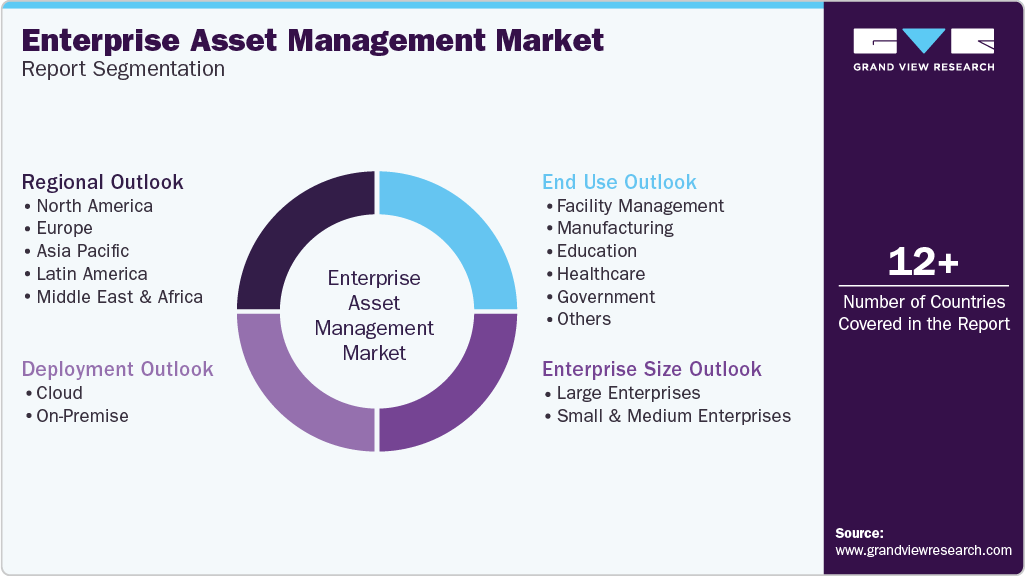
This report forecasts revenue growth at global, regional, and country levels and provides an analysis of the latest industry trends in each of the sub-segments from 2018 to 2030. For this study, Grand View Research has segmented the enterprise asset management market report based on component, enterprise size, end use, and region.
 To learn more about this report, Download Free Sample Report
 -
Deployment Outlook (Revenue, USD Million, 2018 - 2030)
-
Cloud
-
On-Premise
-
-
Enterprise Size Outlook (Revenue, USD Million, 2018 - 2030)
-
Large Enterprises
-
Small and Medium Enterprises
-
-
End Use Outlook (Revenue, USD Million, 2018 - 2030)
-
Facility Management
-
Manufacturing
-
Education
-
Healthcare
-
Government
-
Others
-
-
Regional Outlook (Revenue, USD Million, 2018 - 2030)
-
North America
-
U.S.
-
Canada
-
Mexico
-
-
Europe
-
Germany
-
UK
-
France
-
-
Asia Pacific
-
China
-
India
-
Japan
-
South Korea
-
Australia
-
-
Latin America
-
Brazil
-
-
Middle East & Africa
-
UAE
-
Saudi Arabia
-
South Africa
-
-
Frequently Asked Questions About This Report
The global enterprise asset management market size was estimated at USD 7.65 billion in 2024 and is expected to reach USD 8.89 billion in 2025.
The global enterprise asset management market is expected to witness a compound annual growth rate of 17.2% from 2025 to 2030 to reach USD 19.68 billion by 2030.
The large enterprises segment accounted for the largest market share of over 60.0% in 2024 in the enterprise asset management industry. Large enterprises rely heavily on EAM software to streamline their operations and gain a competitive edge. The growing need of large enterprises to track KPIs associated with asset performance, fleet, and other facilities, and the increasing urge to integrate multiple functions such as maintenance activities, inventory management, work order management, and reporting into a cohesive system are observed as crucial factors driving the segment growth.
Key players in the market include Aptean, AssetWorks, LLC; CGI, Inc., IFS AB, Infor, International Business Machines (IBM) Corporation, Oracle Corporation, PcsInfinity (Asset Infinity), Sage Group PLC, and SAP SE.
The increasing demand for a 360-degree view of assets, elimination of compliance-related overheads; integration of technologies such as IoT, AI, and analytics; and the continued use of IoT platforms and devices to maintain enterprise assets are anticipated to accelerate the EAM market growth.
About the Author(s)
IT Services & Applications Research Team
Technology · IT Services & ApplicationsThis report was authored by the it services & applications research team at Grand View Research - comprising two research analysts, one senior research analyst, and one industry expert - with specialized expertise in the it services & applications segment of the technology industry. All findings are based on proprietary technology databases, executive interviews, and regulatory analysis, subject to internal peer review prior to publication.
Last Updated:
Speak to Analyst

Customize this report to your needs - add regions, segments, or data points, with 20% free customization.
Or view our licence options:


ISO 9001:2015 & 27001:2022 Certified
We are GDPR and CCPA compliant! Your transaction & personal information is safe and secure. For more details, please read our privacy policy.


