
- Home
- »
- Next Generation Technologies
- »
-
Enterprise LLM Market Size & Share, Industry Report, 2033GVR Report cover
![Enterprise LLM Market Size, Share & Trends Report]()
Enterprise LLM Market (2025 - 2033) Size, Share & Trends Analysis Report By Component (Software, Hardware), By Deployment Mode (Cloud, Hybrid), By Model Type, By Enterprise size, By Industry Vertical, By Region, And Segment Forecasts
Market Size, 2024
$4,586.4MMarket Estimate, 2026
$5,651.8MMarket Forecast, 2033
$41,577.6MCAGR, 2025–2033
28.3%Enterprise LLM Market Summary
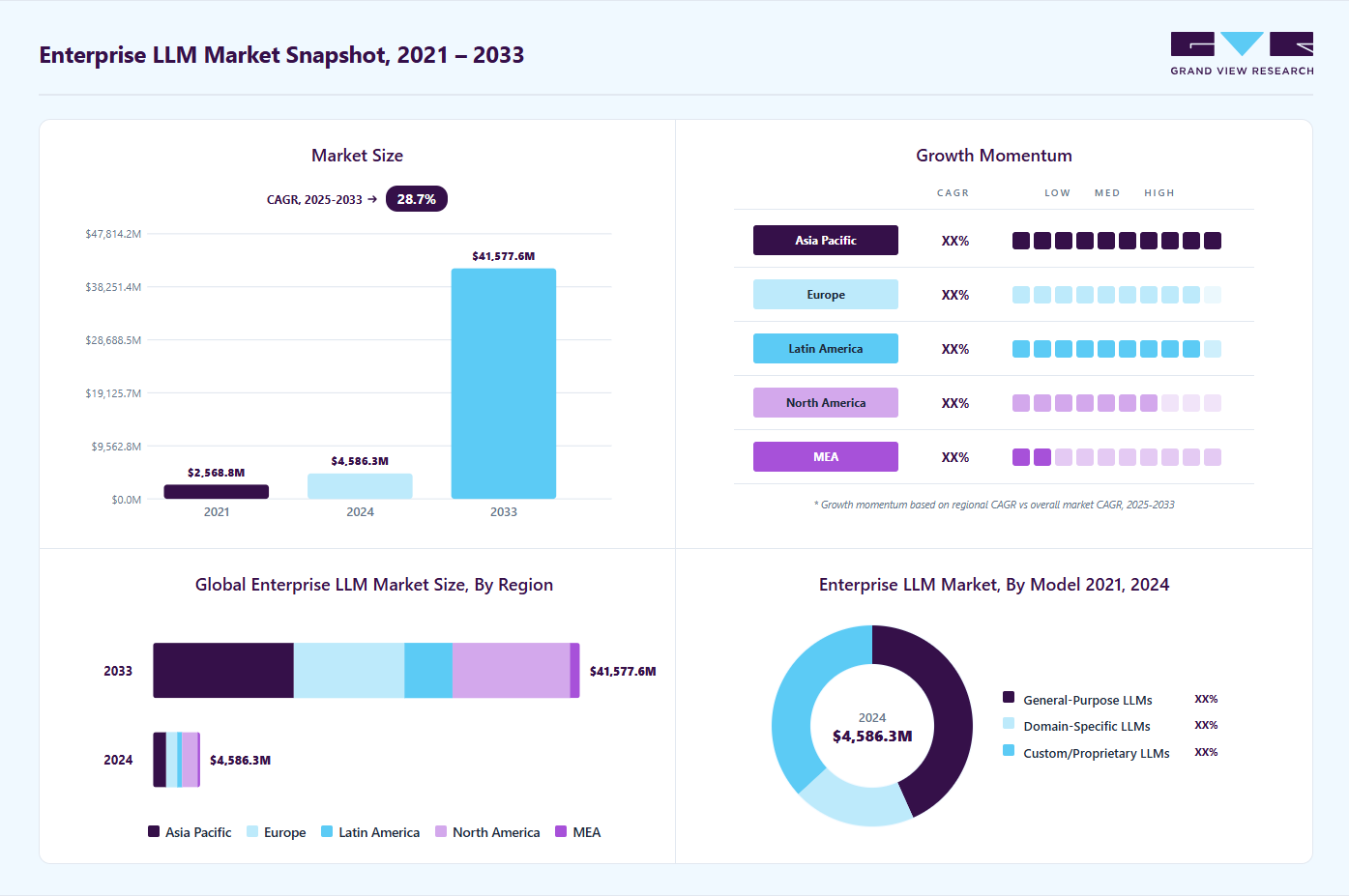
The global enterprise LLM market size was estimated at USD 4,586.4 million in 2024 and is projected to reach USD 41,577.6 million by 2033, growing at a CAGR of 28.3% from 2025 to 2033. The market is growing rapidly due to the rising demand for intelligent automation in business processes.
Key Market Trends & Insights
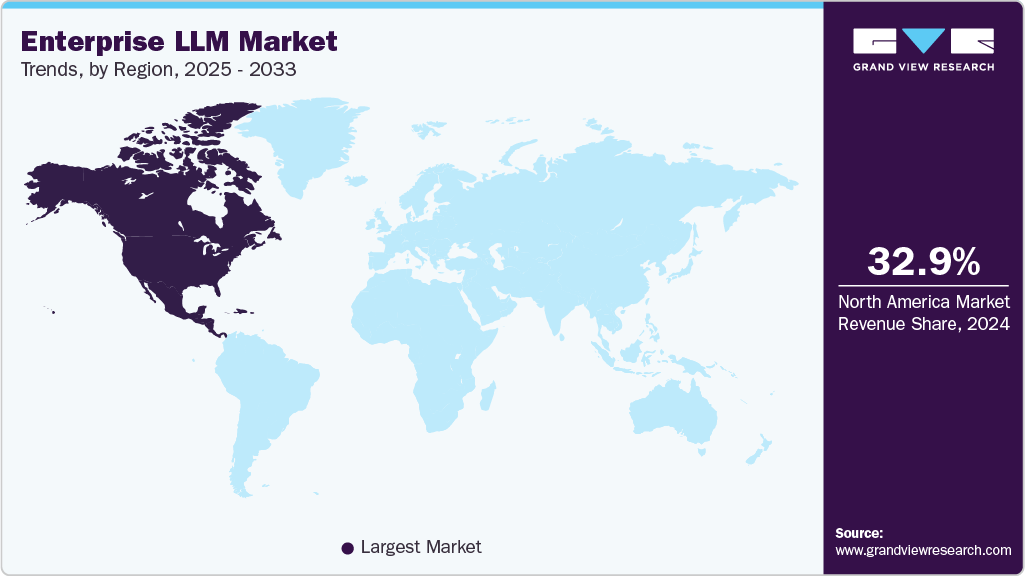
- North America dominated the global enterprise LLM market with the largest revenue share of 32.9% in 2024.
- The enterprise LLM market in the U.S. led the North America market and held the largest revenue share in 2024.
- By model type, general-purpose LLMs led the market and held the largest revenue share of 41.6% in 2024.
- By component, software segment held the dominant position in the market and accounted for the leading revenue share of 35.0% in 2024.
- By industry vertical, healthcare segment is expected to grow at the fastest CAGR of 32.2% from 2025 to 2033.
Market Size & Forecast
- 2024 Market Size: USD 4,586.4 Million
- 2033 Projected Market Size: USD 41,577.6 Million
- CAGR (2025-2033): 28.3%
- North America: Largest Market in 2024
This trend supports the need for 24x7, multilingual, and highly personalized services, enabling organizations to handle large interaction volumes while delivering enhanced customer experiences. Enterprises are increasingly implementing LLM-driven chatbots, virtual assistants, and content creation tools to improve customer service, optimize workflows, and cut operational expenses. These efficiency gains free up resources for more strategic, high-value activities. Advancements in model accuracy, scalability, and support for multi-turn, context-aware interactions further strengthen their attractiveness for enterprise use. This also ensures strong security, data privacy, and adherence to regulatory standards, critical for enterprises handling sensitive data.
Another major driver is LLMs’ capability to extract greater value from large volumes of unstructured data. Through advanced natural language processing, they deliver real-time analytics, sentiment analysis, risk evaluation, and actionable insights from sources such as internal records, customer feedback, and market intelligence. This allows faster, data-driven decision-making, eliminating delays common in manual analysis and giving companies a competitive advantage as businesses focus more on nuanced data interpretation. Integrating LLMs helps maintain relevance and agility when adapting to shifting market conditions.
Furthermore, the rise of specialized, domain-focused LLMs further drives market expansion. These customized models, enhanced for healthcare, finance, education, and energy industries, meet sector-specific regulations, language needs, and workflow demands. By enhancing accuracy and trust, they integrate smoothly with existing systems via strong APIs and middleware. This approach enables organizations to adopt AI with lower risk, stronger compliance, and higher ROI, accelerating digital transformation across multiple sectors.
Model Type Insights
The general-purpose LLMs segment led the market and accounted for 41.6% of the global revenue in 2024. The rise of general-purpose LLMs in the enterprise market is driven by growing demand for AI-powered automation in areas such as content creation, customer service, and data analysis, helping organizations improve efficiency and reduce costs. Businesses use these models for their scalability, high performance, and versatility across a broad range of workflows to access large datasets. With advances in cloud computing and model architectures, deployment and integration into enterprise systems are more seamless. Improved transparency, explainability, and the option to fine-tune models for specific requirements further boost adoption. In addition, the flexibility to tap into domain expertise via outsourcing and planning platforms accelerates enterprise adoption.
The domain-specific LLMs segment is expected to register the fastest CAGR of over 38% from 2025 to 2033, due to its greater accuracy, relevance, regulatory compliance, and data privacy in industry-specific workflows. Organizations look for models capable of understanding specialized terminology and proprietary data to provide safer, context-aware insights while reducing hallucinations and errors. The use of proprietary business data and rapid progress in Retrieval-Augmented Generation (RAG) enables more current, fact-based outputs. Moreover, the availability of efficient, customizable open-source models and the push for automation and cost reduction further accelerate adoption. For instance, in August 2023, Gupshup launched ACE LLM, a suite of domain-specific large language models tailored for sectors such as banking, retail, and utilities, supporting functions like marketing, commerce, customer support, HR, and IT. Built on foundation models like Meta’s Llama 2 and OpenAI’s GPT-3.5 Turbo, ACE LLM features enterprise-grade safety measures, multilingual support for over 100 languages, and flexible deployment options across public or private clouds to ensure data security and scalability.
Component Insights
The software segment accounted for the largest market revenue share in 2024. The growth is driven by the rising need for advanced AI platforms that streamline model training, fine-tuning, and deployment for diverse business workflows. Demand for customizable, scalable, and secure LLM software is fueled by enterprises seeking automation, improved decision-making, and enhanced customer engagement. Furthermore, continuous advancements in model architectures, open-source ecosystems, and integration tools further accelerate industry adoption. For instance, in June 2025, CrowdStrike integrated its Falcon Cloud Security with NVIDIA’s global LLM NeMo Safety and NIM microservices to deliver end-to-end protection for more than 100,000 LLMs in enterprise AI environments. This integration enables secure, scalable AI deployments across hybrid and multi-cloud setups, safeguarding against threats such as data poisoning and tampering, also strengthens AI security throughout the entire lifecycle from development to runtime, empowering enterprises to innovate with AI safely and at scale.
The services segment is predicted to foresee significant growth in the forecast period, primarily driven by growing demand for expert guidance in model selection, customization, and integration to meet specific business needs. Enterprises rely on consulting, implementation, and managed services to accelerate deployment, ensure regulatory compliance, and optimize model performance; hence, rising complexity in fine-tuning, data preparation, and orchestration further fuels the need for specialized service providers, boosting market growth. For instance, in May 2025, the U.S. Army launched the Army Enterprise LLM Workspace, a secure generative AI platform developed with Ask Sage to enhance communication, efficiency, and innovation. Hosted on the Army’s secure cloud, it offers token-based subscriptions and has already streamlined personnel description updates, demonstrating AI’s operational impact.
Deployment Mode Insights
The cloud segment accounted for the largest market revenue share in 2024, driven by its scalability, flexibility, and cost-efficiency, enabling organizations to rapidly scale AI workloads without heavy upfront infrastructure investment, as it facilitates faster deployment, seamless integration, and global accessibility, making LLM-powered solutions easier to adopt across geographies. In addition, continuous cloud-based updates, managed services, and high-performance computing resources support better model performance, security, and compliance for enterprises of all sizes. For instance, in June 2023, Hewlett Packard Enterprise showed HPE GreenLake for LLMs, an on-demand, multi-tenant supercomputing cloud service that allows businesses to securely train, fine-tune, and deploy large-scale AI models by using advanced, energy-efficient supercomputers and AI software. The platform delivers customizable LLMs focused on industry needs, helping accelerate AI-driven innovation.
The hybrid segment is predicted to experience significant growth in the forecast period. Enterprises aim to maintain governance and compliance by self-hosting sensitive workloads, ensuring data sovereignty and audit readiness under regulations such as GDPR and HIPAA. Cost efficiency also drives adoption as hybrid deployments help to reduce vendor lock-in and strengthen security by keeping critical data in controlled environments while utilizing the cloud for fast experimentation and deployment. For instance, in May 2025, Red Hat introduced an open-source project, llm-d, enabling scalable, distributed generative AI inference for enterprise LLMs. Built on Kubernetes and vLLM, llm-d is compatible with any AI model, accelerator, or cloud environment, ensuring efficient, high-performance inference across hybrid cloud setups.
Enterprise Size Insights
The large enterprises segment accounted for the largest market revenue share in 2024, owing to their strategic pursuit of intelligent automation to enhance operational efficiency, reduce costs, and deliver highly personalized, multilingual customer experiences. Leveraging their extensive repositories of proprietary and unstructured data, large enterprises are harnessing LLMs for real-time analytics, advanced risk assessment, and actionable insights, enabling faster, data-driven decision-making. Furthermore, the capability to fine-tune models for industry-specific requirements and seamlessly integrate them with existing enterprise systems significantly amplifies their value and impact across large-scale operations.
The small & medium size segment is predicted to foresee significant growth in the forecast period, primarily driven by adopting LLMs to automate routine tasks, improve efficiency, and reallocate resources toward strategic initiatives. AI-powered chatbots, virtual assistants, and multilingual capabilities enhance customer service, boost engagement, and enable market expansion through consistent brand messaging. Affordable access to pre-trained LLMs and AI-as-a-Service (AIaaS) offerings lowers entry barriers by eliminating the need for costly infrastructure investments. For instance, in July 2025, Zoho launched Zia, its proprietary suite of enterprise LLMs designed to provide SMEs with AI-powered tools for workflows such as CRM, finance, and customer support. Developed in-house and hosted within Zoho’s secure data centers, Zia emphasizes data privacy and cost efficiency, offering SMEs scalable, accessible AI capabilities without additional expenses.
Industry Vertical Insights
The retail and e-commerce segment accounted for the largest market revenue share in 2024, are gaining power due to several core drivers such as the push to merge digital and physical shopping through conversational commerce and visual product discovery, the growing demand for hyper-personalization enabled by real-time analysis of customer behavior and preferences; and the need to boost operational efficiency in areas like procurement, marketing, and in-store processes through AI automation. LLMs also strengthen customer service with always-available, personalized AI assistants. Furthermore, AI-powered search optimization and content creation help increase conversion rates and engagement, empowering retailers to deliver seamless, intelligent shopping experiences that meet evolving consumer expectations.

The healthcare segment is projected to grow significantly over the forecast period, owing to the growing availability of extensive healthcare datasets for training advanced models and the decreasing cost of computing power that supports scalable AI implementations. There is a rising demand for personalized treatments driven by AI analysis of patient data, along with opportunities to enhance clinical accuracy and efficiency by automating administrative and diagnostic processes, helping reduce clinician burnout. In addition, technological advancements are enabling healthcare providers to extract greater value from unstructured data, leading to improved patient outcomes and operational performance. For instance, in June 2024, Cognizant introduced its first healthcare-focused LLM solutions, developed using Google Cloud’s generative AI technology, to simplify administrative processes such as marketing, call center operations, and provider management. These AI-driven tools are designed to ease administrative workloads, boost operational efficiency, and enhance patient care experiences.
Regional Insights
North America dominated the market and accounted for a 32.9% share in 2024. North America’s enterprise LLM market is driven by its strong technological infrastructure, substantial investments in AI R&D, and a strong culture of early adoption among businesses. The region’s mix of major tech companies and innovative startups drives fast-paced product development and competitive growth, as well as the well-established regulatory frameworks and ethical AI standards promote trust and responsible implementation, while the continued growth of cloud computing and industry-wide digitization accelerates the integration of scalable AI solutions.
U.S. Enterprise LLM Market Trends
The enterprise LLM market in the U.S. dominates in North America, driven by substantial venture capital and corporate investments in AI innovation, particularly within healthcare, finance, retail, and its strong AI research ecosystem and abundance of data enable ongoing model optimization and the creation of domain-specific solutions. Government programs and public-private collaborations further strengthen AI infrastructure, while the nation’s emphasis on AI-driven automation boosts operational efficiency and customer experiences, fueling greater demand for LLMs. For instance, in September 2024, Fujitsu introduced “Takane,” an advanced Japanese-language LLM built for secure enterprise applications, particularly in sectors demanding high accuracy and strong data protection. It boosts productivity and innovation by enabling fine-tuning with organization-specific data, making it a strong fit for SMEs seeking safe and efficient adoption of generative AI.
Europe Enterprise LLM Market Trends
The enterprise LLM market in Europe is growing, driven by strict data privacy regulations such as GDPR, which stress secure and compliant AI deployment. Investments focus on ensuring transparency, explainability, and ethical AI to meet regulatory and societal demands. The region’s well-established industries are turning to AI to improve workflows and tackle workforce challenges, while partnerships between industry and academia foster innovation. Rising adoption of cloud infrastructure further enables scalable enterprise AI implementations.
Asia Pacific Enterprise LLM Market Trends
The enterprise LLM market in the Asia Pacific is anticipated to register the fastest CAGR over the forecast period. The market is rapidly expanding, fueled by a growing digital economy, rising AI awareness, and government-led initiatives promoting adoption in smart cities, healthcare, and manufacturing sectors. Nations such as China, India, and Japan invest substantially in AI research and infrastructure, supporting large-scale LLM deployment. Increasing demand for localized, multilingual AI solutions serves the region’s diverse populations, while cost advantages and accelerating enterprise digitization further drive market growth. For instance, in November 2024, ASEAN SMEs are at the forefront of training LLMs with enterprise data, accelerating smarter AI adoption in the region. To maximize AI’s growth potential, SMEs are advised to focus on strong data privacy measures and centralized AI governance.
Key Enterprise LLM Company Insights
Some key companies in the enterprise LLM industry are Microsoft, H2O.ai, Meta, and Google.
-
Microsoft is a global technology leader known for its software offerings such as Windows and Microsoft Office, along with a rapidly growing presence in cloud computing and artificial intelligence via Microsoft Azure. The company has made major strides in AI innovation and enterprise cloud solutions, fostering transformation across industries. Microsoft prioritizes trust, sustainability, inclusion, and empowering customers and employees to achieve more through its technologies.
-
Meta is a global technology company dedicated to shaping the future of human connection through its suite of social media platforms, including Facebook, Instagram, WhatsApp, and Threads. Serving active users, Meta fosters an interconnected digital ecosystem that influences online communication and engagement. It earns most of its revenue from advertising while making significant investments in emerging technologies like artificial intelligence and virtual/augmented reality. Through continuous innovation and extensive infrastructure, Meta remains at the forefront of the evolving digital landscape.
Key Enterprise LLM Companies:
The following are the leading companies in the enterprise LLM market. These companies collectively hold the largest market share and dictate industry trends.
- Microsoft
- Google Inc.
- IBM Corporation
- NVIDIA Corporation
- Oracle
- Meta
- H2O.ai
- Apple Inc.
- Anthropic PBC
- Alibaba Cloud
Recent Developments
-
In April 2025, Alibaba launched Qwen3, the open-source large language model family, comprising six dense models and two Mixture-of-Experts (MoE) models for a wide range of AI applications, from mobile devices to robotics enterprises. Qwen3 features hybrid reasoning that blends advanced analytical thinking with rapid response capabilities, improved multilingual support for 119 languages, and enhanced reasoning performance. Trained on 36 trillion tokens, it achieves leading scores on AI benchmarks while reducing deployment costs through the efficiency of its MoE models.
-
In March 2025, H2O.ai introduced Enterprise LLM Studio, a Fine-Tuning-as-a-Service platform that allows organizations to securely customize and deploy large language models on Dell infrastructure using their own private datasets. The solution streamlines the full LLM workflow from data preparation through model fine-tuning to deployment, making it easier for businesses to create domain-specific AI models. Enterprises can lower costs and boost inference performance by utilizing open-source and multimodal LLMs. Developed by leading Kaggle Grandmasters, the platform is designed to accelerate and simplify AI adoption for essential business operations.
-
In February 2025, IBM announced the launch of Granite 3.2, the latest generation in its Granite AI model family designed for enterprises. These models offer advanced capabilities, including multi-modal vision language processing, improved reasoning with chain-of-thought options, and enhanced safety features, all while being smaller, efficient, and developer-friendly. Available under the Apache 2.0 license, Granite 3.2 delivers powerful performance for document understanding, forecasting, and math reasoning, rivaling larger models but optimized for real-world business applications. This release underscores IBM's commitment to providing accessible, cost-effective, and practical AI solutions for enterprises worldwide.
Enterprise LLM Market Report Scope
Report Attribute
Details
Market size value in 2025
USD 5,651.8 million
Revenue forecast in 2033
USD 41,577.6 million
Growth rate
CAGR of 28.3% from 2025 to 2033
Base year for estimation
2024
Historical data
2021 - 2023
Forecast period
2025 - 2033
Quantitative units
Revenue in USD million/billion and CAGR from 2025 to 2033
Report coverage
Revenue forecast, company ranking, competitive landscape, growth factors, and trends
Segments covered
Model type, component, deployment mode, enterprise size, industry vertical, region
Regional scope
North America; Europe; Asia Pacific; Latin America; MEA
Country scope
U.S.; Canada; Mexico; Europe; UK; Germany; France; China; Japan; India; South Korea; Australia; Brazil; KSA; UAE; South Africa
Key companies profiled
Microsoft; Google Inc.; IBM Corporation; NVIDIA Corporation; Oracle; Meta; H2O.ai; Apple Inc.; Anthropic PBC; Alibaba Cloud
Customization scope
Free report customization (equivalent up to 8 analysts working days) with purchase. Addition or alteration to country, regional & segment scope.
Pricing and purchase options
Avail customized purchase options to meet your exact research needs. Explore purchase options
Global Enterprise LLM Market Report Segmentation
This report forecasts revenue growth at global, regional, and country levels and provides an analysis of the latest industry trends in each of the sub-segments from 2021 to 2033. For this study, Grand View Research has segmented the global enterprise LLM market report based on model type, component, deployment mode, enterprise size, industry vertical, and region:
-
Model Type Outlook (Revenue, USD Million, 2021 - 2033)
-
General-Purpose LLMs
-
Domain-Specific LLMs
-
Custom/Proprietary LLMs
-
-
Component Outlook (Revenue, USD Million, 2021 - 2033)
-
Software
-
Hardware
-
Services
-
-
Deployment Mode Outlook (Revenue, USD Million, 2021 - 2033)
-
Cloud
-
On-premises
-
Hybrid
-
-
Enterprise Size Outlook (Revenue, USD Million, 2021 - 2033)
-
Small & Medium size
-
Large Enterprises
-
-
Industry Vertical Outlook (Revenue, USD Million, 2021 - 2033)
-
BFSI
-
Healthcare
-
Retail and e-commerce
-
Legal and Compliance
-
Manufacturing
-
Others
-
-
Regional Outlook (Revenue, USD Million, 2021 - 2033)
-
North America
-
U.S.
-
Canada
-
Mexico
-
-
Europe
-
UK
-
Germany
-
France
-
-
Asia Pacific
-
China
-
Japan
-
India
-
South Korea
-
Australia
-
-
Latin America
-
Brazil
-
-
Middle East and Africa (MEA)
-
KSA
-
UAE
-
South Africa
-
-
Frequently Asked Questions About This Report
The global enterprise LLM market size was estimated at USD 4,586.4 million in 2024 and is expected to reach USD 5,651.8 million in 2025.
The global enterprise LLM market is expected to grow at a compound annual growth rate of 28.3% from 2025 to 2033 to reach USD 41,577.6 million by 2033.
North America dominated the enterprise LLM market with a share of 32.9% in 2024. North America’s enterprise LLM market is driven by its strong technological infrastructure, substantial investments in AI R&D, and a strong culture of early adoption among businesses.
Some key players operating in the enterprise LLM market include Microsoft; Google Inc.; IBM Corporation; NVIDIA Corporation; Oracle; Meta; H2O.ai; Apple Inc.; Anthropic PBC; Alibaba Cloud
Key factors that are driving the market growth include Enterprises that are increasingly implementing LLM-driven chatbots, virtual assistants, and content creation tools to improve customer service, optimize workflows, and cut operational expenses. These efficiency gains free up resources for more strategic, high-value activities
About the Author(s)
Next Generation Technologies Research Team
Technology · Next Generation TechnologiesThis report was authored by the next generation technologies research team at Grand View Research - comprising two research analysts, one senior research analyst, and one industry expert - with specialized expertise in the next generation technologies segment of the technology industry. All findings are based on proprietary technology databases, executive interviews, and regulatory analysis, subject to internal peer review prior to publication.
Last Updated:
Speak to Analyst

Need a Tailored Report?
Customize this report to your needs — add regions, segments, or data points, with 20% free customization.
Or view our licence options:


ISO 9001:2015 & 27001:2022 Certified
We are GDPR and CCPA compliant! Your transaction & personal information is safe and secure. For more details, please read our privacy policy.












