
- Home
- »
- Green Building Materials
- »
-
Environmental Remediation Market Size Report, 2026-2033GVR Report cover

Environmental Remediation Market (2026 - 2033)
Size, Share & Trends Analysis Report By Site Type (Public, Private) By Medium (Soil, Water, Air), By End Use (Mining and Forestry, Oil and Gas, Agriculture, Automotive, Waste Management, Manufacturing, Construction), By Region And Segment Forecasts
Market Size, 2025
$130.6BMarket Estimate, 2026
$139.6BMarket Forecast, 2033
$233.6BCAGR, 2026–2033
7.6%Environmental Remediation Market Summary
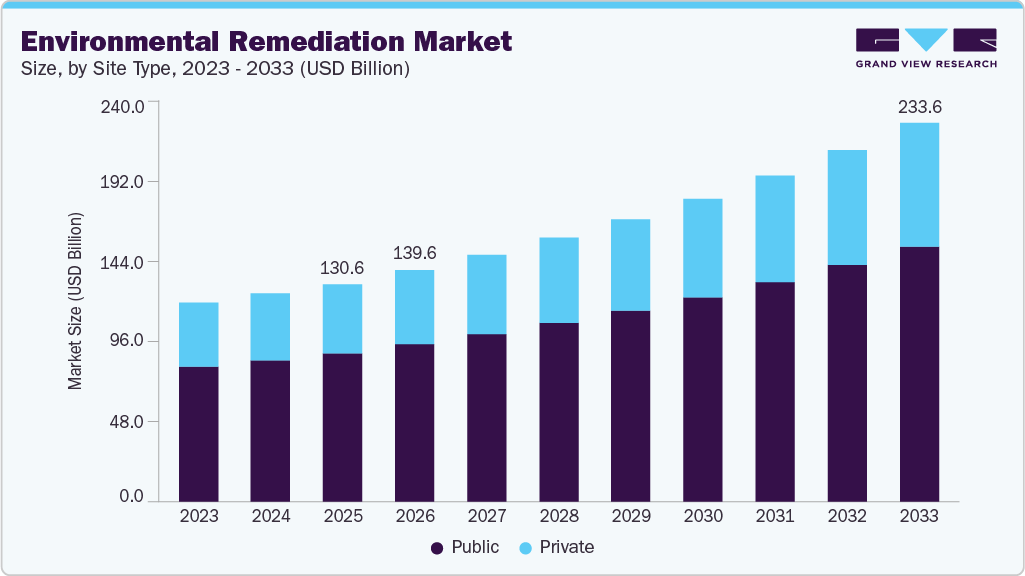
The global environmental remediation market size was estimated at USD 130.6 billion in 2025 and is projected to grow from USD 139.6 billion in 2026 to USD 233.6 billion by 2033, at a CAGR of 7.6% from 2026 to 2033. Asia Pacific held the largest revenue share of 38.0% of the global market in 2025. The global environmental remediation market is experiencing significant growth due to a confluence of factors that underscore the increasing urgency for effective environmental management and pollution control.
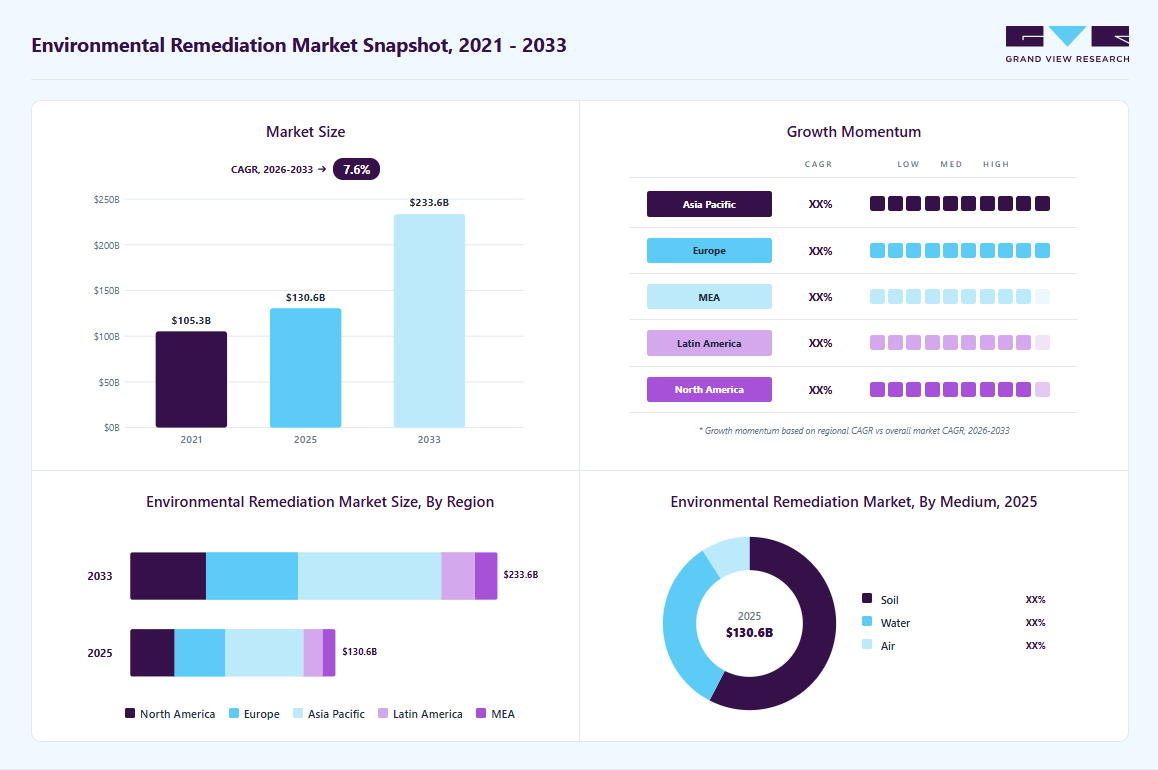 Source: Grand View Research, IR Documents, Primary Interviews, Paid DatabasesTo learn more about this report,
 Download Free Sample Report
 Key Market Trends & Insights
- By site type: Public segment held the largest market share of 67.8% in 2025.
- By medium: Soil segment held the largest market share of 57.6% in 2025.
- By end use: Waste management segment held the largest market share of 26.3% in 2025.
Regional Highlights
- Largest regional market: Asia Pacific (38.0% market share, 2025)
- Fastest-growing regional market: Asia Pacific
- By country: The U.S. held the largest market share in 2025.
Market Size & Forecast
- Market size in 2025: USD 130.6 Billion
- Estimated market size in 2026: USD 139.6 Billion
- Projected market size by 2033: USD 233.6 Billion
- CAGR (2026-2033): 7.6%
Three ways to get this report
Buy it, customize it, or ask a question.Ask an Analyst
Analyst response in 1 business day
- AccessReport author, directly
- Reply timeWithin 1 working day
- No sales callDirect answer only
- FormatEmail reply
- CostFree, no cost
Get the Full Report
What the study covers
- FormatsPDF · Excel · Dashboard
- Timeline2026–2033 annual, 2025 base
- Coverage20+ countries, 5 regions
- Companies10+ key players profiled
Customize the Report
20% free customization
- IncludeCountries, segments, points
- TailorTo your product definition
- ExtendDeeper competitor detail
- OrA fully bespoke study
- Turnaround5–10 working days
Technological advancements play a crucial role in the market's growth trajectory. Innovations in remediation technologies, such as bioremediation, nanoremediation, and advanced oxidation processes, are enhancing the efficiency and effectiveness of environmental cleanup.
 To learn more about this report, Download Free Sample Report
 These technologies not only offer more sustainable and cost-effective solutions but also address a broader range of contaminants, including emerging pollutants such as pharmaceuticals and microplastics.
 To learn more about this report, Download Free Sample Report
 Market Dynamics
The growing global concern over environmental pollution and contamination is one of the major factors driving the environmental remediation market. Rapid industrialization, mining activities, oil & gas operations, chemical manufacturing, and improper waste disposal over the years have resulted in significant contamination of soil, groundwater, and surface water across many regions. Governments and environmental agencies are increasingly implementing strict regulations and cleanup programs to restore contaminated sites, reduce environmental risks, and protect public health. This is creating strong demand for environmental remediation services and technologies across industrial, municipal, and commercial sectors.
One of the key challenges affecting the environmental remediation market is the high cost and complexity associated with remediation projects. Cleaning contaminated soil, groundwater, sediments, and industrial sites often requires extensive site investigation, regulatory approvals, specialized equipment, and long-term monitoring, which can significantly increase project costs. Large-scale remediation projects, particularly those involving hazardous chemicals, heavy metals, or petroleum contamination, may take several years to complete and require continuous technical supervision and environmental compliance management.
Site Type Insights
The private segment is expected to grow at a significant CAGR of 7.9% from 2026 to 2033 in terms of revenue.The public segment dominated the market in 2025, accounting for a 67.8% market share. The public sector’s involvement in environmental remediation is driven primarily by increasing regulatory pressures and the need to comply with stringent environmental standards. Government agencies are tasked with addressing large-scale contamination issues, including hazardous waste sites and polluted public lands, thereby fostering market growth.
Demand in the private site segment is driven by corporate liability management, regulatory compliance obligations, and the need to de-risk contaminated land prior to redevelopment or asset transactions. Industrial operators, real estate developers, and commercial landowners increasingly invest in remediation to meet environmental due diligence requirements and avoid long-term legal and financial exposure. Rising brownfield redevelopment and mergers and acquisitions (M&A) activity further reinforce remediation demand across privately owned sites.
Medium Insights
The demand for the water segment is expected to grow at a rapid CAGR of 8.0% from 2026 to 2033 in terms of revenue.The soil segment accounted for 57.6% of the market share in 2025 and is driven by increasing industrial activity and urban development, which often lead to soil contamination through the release of pollutants such as heavy metals, hydrocarbons, and toxic chemicals. As industries expand and urban areas develop, the demand for cleaning and restoring contaminated soil to make it suitable for reuse or development grows.
 To learn more about this report, Download Free Sample Report
 The water remediation segment is growing due to regulatory requirements related to water quality and safety, with governments and international organizations setting stringent standards for drinking water and wastewater discharge. Health problems caused by hazardous chemicals, heavy metals, and pathogens in water sources is driving investments in advanced water treatment technologies.
End Use Insights
The growth of the automotive segment is expected to grow at a significant CAGR of 7.8% from 2026 to 2033 in terms of revenue.The waste management segment dominated the global revenue share in 2025, accounting for 26.3% of the share. Demand from the waste management segment is driven by landfill remediation, leachate control, and cleanup of legacy disposal sites under tightening environmental regulations. Long-term liability and compliance requirements sustain investment in remediation solutions. Opportunities exist in advanced treatment technologies and integrated remediation approaches that support site closure, redevelopment, and regulatory compliance.
In the automotive segment, remediation demand stems from contamination at manufacturing plants, fuel storage areas, and legacy industrial sites. Regulatory compliance, asset redevelopment, and facility modernization continue to drive cleanup activity. Growth opportunities are linked to electric vehicle production expansion and brownfield redevelopment aligned with sustainability and environmental, social, and governance (ESG) objectives.
Regional Insights
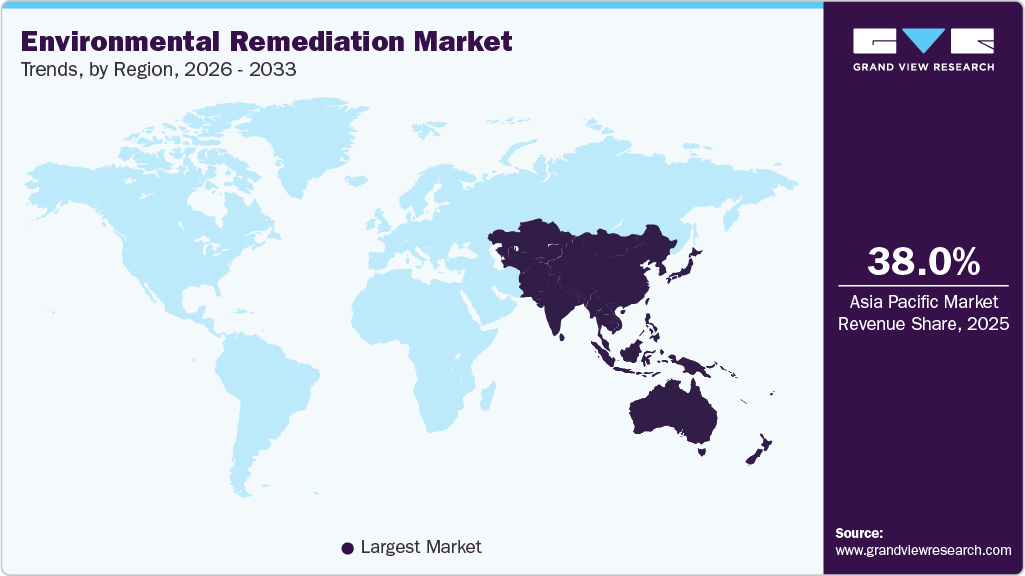
Asia Pacific dominated the environmental remediation market with the largest revenue share of 38.0% in 2025. The market is experiencing robust growth in the Asia Pacific due to several key factors. Rapid industrialization and urbanization are primary drivers, with countries such as China, India, and Southeast Asian nations experiencing significant increases in industrial activities and population growth. This expansion has led to increased emissions of pollutants and contamination of soil, water, and air, necessitating advanced remediation solutions to address environmental challenges.
 To learn more about this report, Download Free Sample Report
 Moreover, public awareness and advocacy for environmental sustainability are also rising. Growing concerns about air and water quality, coupled with increased environmental activism, are pushing governments and corporations to prioritize remediation efforts and invest in cleaner technologies.
China Environmental Remediation Market Trends
The environmental remediation market in China is estimated to grow significantly over the forecast period.China's commitment to achieving carbon neutrality by 2060 and its participation in international agreements like the Paris Agreement signal a long-term strategy to address environmental challenges. This commitment is likely to drive investments in green technologies and remediation practices, as the country seeks to balance economic growth with environmental sustainability.
The environmental remediation market growth in India is driven by stricter environmental enforcement, rising industrial contamination, and increasing brownfield redevelopment. Urbanization, infrastructure expansion, and stronger corporate environmental, social, and governance (ESG) focus are supporting demand for remediation solutions. Government initiatives on pollution control and waste management further reinforce market expansion.
North America Environmental Remediation Market Trends
The presence of a well-established environmental remediation industry, coupled with technological innovation, contributes to market growth. North American companies are at the forefront of developing and implementing advanced remediation technologies, such as bioremediation and nanoremediation, to address complex contamination issues. This technological leadership supports continued growth and expansion in the region.
The environmental remediation market in the U.S. is expanding due to tightening federal and state regulations on soil, groundwater, and hazardous waste cleanup, which compel both public and private sector cleanup investments. Increased enforcement of superfund, brownfield, and underground storage tank (UST) remediation requirements drives demand for remediation technologies and services. Growth is further supported by infrastructure renewal, industrial site redevelopment, and strong corporate focus on environmental, social, and governance (ESG) performance. Advances in remediation technology and rising awareness of emerging contaminants also contribute to the market’s momentum.
Europe Environmental Remediation Market Trends
The European Union’s stringent environmental regulations and policies are a major driver, with frameworks such as the EU soil strategy for 2030 and the Water Framework Directive setting high standards for environmental protection and remediation. These regulations mandate the cleanup of contaminated sites and the implementation of sustainable practices, creating a strong demand for remediation services.
The environmental remediation market growth in Germany is supported by stringent environmental regulations and strong enforcement of soil and groundwater cleanup standards, which drive demand for remediation technologies and services. Industrial legacy contamination from manufacturing, chemical processing, and mining sectors is prompting remediation activity, while brownfield redevelopment and sustainable urban regeneration initiatives further support investment. Technological adoption and corporate environmental responsibility goals also contribute to market expansion.
The UK environmental remediation market growth is driven by regulatory frameworks such as the Environmental Protection Act and increased focus on polluted land remediation and groundwater protection. Redevelopment of former industrial sites and growing awareness of contaminants such as PFAS and hydrocarbons are sustaining demand for cleanup solutions. Government funding for brownfield regeneration and private sector emphasis on environmental, social, and governance (ESG) commitments are additional growth catalysts.
Latin America Environmental Remediation Market Trends
The Latin America environmental remediation market’s growth is driven by rising industrial activity, legacy contamination from mining and manufacturing, and increasing enforcement of environmental regulations. Government efforts to rehabilitate brownfield sites, develop safe waste disposal practices, and improve water and soil quality are supporting demand for remediation services. Corporate environmental, social, and governance (ESG) commitments and foreign investment in infrastructure and industrial expansion further contribute to market momentum.
The environmental remediation market growth in Brazil is driven by ongoing industrial expansion, particularly in sectors such as oil & gas, mining, and manufacturing, which generate demand for soil and groundwater remediation. Regulatory strengthening and increased enforcement around environmental liabilities are prompting companies to invest in cleanup technologies and services. Additionally, brownfield redevelopment and greater corporate focus on environmental, social, and governance (ESG) performance are supporting broader adoption of remediation solutions across the country.
Middle East & Africa Environmental Remediation Market Trends
Market growth in the Middle East & Africa is supported by expanding infrastructure development, industrial diversification, and increased investment in urbanization projects that often uncover contaminated land requiring remediation. Governments across the region are strengthening environmental regulations and waste management frameworks, prompting greater demand for cleanup technologies and services. Additionally, initiatives focused on sustainable development and natural resource protection are encouraging both public and private stakeholders to invest in remediation solutions.
The Saudi Arabia environmental remediation market growth is supported by substantial infrastructure and industrial development under national economic diversification programs. Environmental regulations and sustainability initiatives are gradually tightening, prompting the cleanup of contaminated sites and improved waste management practices. The drive toward sustainable urbanization and protection of natural resources, combined with increased private-sector participation, is generating demand for remediation technologies and services.
Key Environmental Remediation Company Insights
Some of the key players operating in the market include ENTACT and WSP, among others.
-
ENTACT is a company that specializes in environmental remediation services such as bioremediation, decontamination, Ex-situ treatment, marine sediment sampling support, radiological licensing and waste disposal, and several others. The company has remediated more than 170 superfund sites and over 150 batteries, smelter, and mine sites.The company also offers geotechnical services and caters to industries such as oil & gas, chemical, real estate, and others.
-
WSP is a global professional services consulting firm, providing engineering and design solutions across a wide range of sectors. The company offers a comprehensive range of services including remediation for contaminated land, urban planning and design, airport master planning, process consulting, mine engineering, and transport planning. The firm serves clients across various sectors such as acute care and general hospitals, the chemical industry, consumer products, aerospace, education, food and beverage, marine, aviation, transport, and infrastructure.
Key Environmental Remediation Companies:
The following key companies have been profiled for this study on the environmental remediation market.
- ENTACT
- DEME
- WSP
- CLEAN HARBORS, INC.
- Sequoia Environmental
- Bristol Industries, LLC.
- In-Situ Oxidative Technologies, Inc.
- HDR, Inc.
- AECOM.
- Tetra Tech Inc.
- BRISEA
- Jacobs
- Enviroserve
- The ERM International Group Limited
- Environmental Works, Inc.
Competitive Benchmarking
Operating Strategies
Competitive Edge
Weaknesses
Mature Players: AECOM; Tetra Tech Inc.; Jacobs; WSP; HDR, Inc.; The ERM International Group Limited; DEME
- Focus on large-scale environmental remediation, ecological restoration, water management, and brownfield redevelopment projects
- Strong involvement in government-funded cleanup programs, industrial remediation, mining restoration, and infrastructure redevelopment projects
- Integration of engineering, environmental consulting, sustainability advisory, and remediation execution capabilities
- Established relationships with government agencies, industrial clients, and infrastructure developers
- Broad technical expertise across soil, groundwater, sediment, and hazardous waste remediation
- Strong multidisciplinary engineering and regulatory compliance capabilities
- High dependence on government spending, infrastructure funding, and industrial capital expenditure cycles
- Longer project approval and execution timelines for large remediation programs
- Complex organizational structures and high operational costs
Emerging Players: CLEAN HARBORS, INC; ENTACT; Sequoia Environmental; Bristol Industries, LLC.; In-Situ Oxidative Technologies, Inc.; Environmental Works, Inc.; Enviroserve
- Flexible project execution and customized remediation solutions for industrial and municipal clients
- Increasing use of biological treatment, chemical oxidation, and sustainable remediation techniques
- Focus on faster turnaround projects and regional environmental service contracts
- Competitive positioning in regional and mid-sized remediation contracts
- Strong expertise in hazardous waste handling and environmental compliance services
- Ability to deliver cost-effective remediation solutions for specific contamination challenges
- Narrower service diversification across large infrastructure programs
- Limited access to very large government-led remediation contracts
- Exposure to fluctuations in industrial cleanup spending and environmental enforcement trends
Recent Developments
-
In April 2025, The ERM International Group Limited completed the acquisition of the Environmental Division of NewFields, bringing approximately 110 technical experts into its operations to strengthen its environmental remediation and consulting capabilities. The expanded team will enhance ERM’s technical offerings in areas such as environmental forensics, emerging contaminants, human health risk assessment, data analytics, and hydrogeology, supporting clients in managing environmental liabilities across North America and globally. The remainder of NewFields will continue to operate independently, with its trademarks used under license in the acquisition.
-
In May 2025, AECOM was awarded a 10-year, USD 81.3 million Optimized Remediation Contract (ORC) by the U.S. Army Corps of Engineers (USACE) Los Angeles District to provide environmental remediation services at Vandenberg Space Force Base in California. The contract, one of the largest of its kind from the USACE Los Angeles District covers remediation and management activities across 60 sites at the base and will incorporate digital tools for enhanced data collection and reporting to optimize cleanup efforts.
Environmental Remediation Market Report Scope
Report Attribute
Details
Market size value in 2025
USD 130.6 billion
Estimated Market size in 2026
USD 139.56 billion
Projected Market size by 2033
USD 233.62 billion
Growth Rate
CAGR of 7.6% from 2026 to 2033
Base year for estimation
2025
Historical data
2021 - 2024
Forecast period
2026 - 2033
Quantitative units
Revenue in USD billion and CAGR from 2026 to 2033
Report coverage
Revenue forecast, company market position analysis, competitive landscape, growth factors, and trends
Segments covered
Site type, medium, end use, and region
Regional scope
North America; Europe; Asia Pacific; Latin America; Middle East & Africa
Country Scope
U.S.; Canada; Mexico; UK; Germany; France; Italy; Spain; China; India; Japan; South Korea; Australia; Brazil;
Argentina; South Africa; Saudi Arabia; UAE
Key companies profiled
ENTACT; DEME; WSP; Clean Harbors, Inc.; Sequoia Environmental; Bristol Industries, LLC.; In-Situ Oxidative Technologies, Inc.; HDR, Inc.; AECOM, Tetra Tech Inc.; BRISEA; Jacobs; Enviroserve; The ERM International Group Limited.; Environmental Works, Inc.
Customization scope
Free report customization (equivalent up to 8 analysts working days) with purchase. Addition or alteration to country, regional & segment scope.
Pricing and purchase options
Avail customized purchase options to meet your exact research needs. Explore purchase options
Global Environmental Remediation Market Report Segmentation
This report forecasts revenue growth at global, regional & country levels and provides an analysis on the industry trends in each of the sub-segments from 2021 to 2033. For the purpose of this study, Grand View Research has segmented the global environmental remediation market on the site type, medium, end use, and region:
 To learn more about this report, Download Free Sample Report
 -
Site Type Outlook (Revenue, USD Billion, 2021 - 2033)
-
Public
-
Private
-
-
Medium Outlook (Revenue, USD Billion, 2021 - 2033)
-
Soil
-
Water
-
Air
-
-
End Use (Revenue, USD Billion, 2021 - 2033)
-
Mining and Forestry
-
Oil and Gas
-
Agriculture
-
Automotive
-
Waste Management
-
Other
-
-
Regional Outlook (Revenue, USD Billion, 2021 - 2033)
-
North America
-
U.S.
-
Canada
-
Mexico
-
-
Europe
-
UK
-
Germany
-
France
-
Italy
-
Spain
-
-
Asia Pacific
-
China
-
India
-
Japan
-
South Korea
-
Australia
-
-
Latin America
-
Brazil
-
Argentina
-
-
Middle East & Africa
-
South Africa
-
Saudi Arabia
-
UAE
-
-
Delivered Customizations
This report has been delivered with the following In-depth customizations
Client Request
Customization Delivered
Value Adds
Regional Segmentation
Detailed evaluation of environmental remediation demand across North America, Europe, Asia Pacific, Latin America, and Middle East & Africa, including country-level analysis of contaminated industrial sites, mining regions, landfill restoration projects, oil spill incidents, and groundwater pollution hotspots.
Helps identify regions with the highest remediation activity and future cleanup investments. Supports regional expansion planning and prioritization of high-potential environmental service markets.
Opportunity Assessment
Identification of future growth opportunities linked to PFAS remediation, sustainable land redevelopment, groundwater restoration, industrial decommissioning, renewable energy site cleanup, and climate resilience projects.
Helps companies align long-term growth strategies with emerging environmental priorities and evolving regulatory focus areas.
Competitive Benchmarking
Comparative assessment of environmental remediation companies based on remediation expertise, project execution capability, hazardous waste handling, sustainability initiatives, and geographic reach.
Provides clearer visibility into competitive positioning and technical strengths across the remediation ecosystem.
Frequently Asked Questions About This Report
The global environmental remediation market size was estimated at USD 130.6 billion in 2025 and is expected to reach USD 139.6 billion in 2026.
The global environmental remediation market, in terms of revenue, is expected to grow at a compound annual growth rate of 7.6% from 2026 to 2033 to reach USD 233.6 billion by 2033.
The Asia Pacific environmental remediation market dominated the global revenue share in 2025 accounting for 38.0% of the share, driven by rapid industrialization, urban expansion, and tightening environmental regulations, which are increasing demand for soil and groundwater remediation across manufacturing, mining, and infrastructure projects.
Some of the key players operating in the Environmental Remediation market ENTACT, DEME, WSP, Clean Harbors, Inc., Sequoia Environmental, Bristol Industries, LLC., In-Situ Oxidative Technologies, Inc., HDR, Inc., AECOM, Tetra Tech Inc., BRISEA, Jacobs, Enviroserve, The ERM International Group Limited, and Environmental Works, Inc.
Key factors driving the environmental remediation market include tightening environmental regulations, rising industrial and urban contamination, increased brownfield redevelopment, and growing focus on environmental, social, and governance (ESG) compliance.
The public segment led the market with 67.8% share in 2025, while the private segment is expected to grow at the fastest CAGR of 7.9% over the forecast period.
Asia Pacific represents the fastest-growing and leading regional market over the forecast period.
The soil segment held the largest market share of 57.6% in 2025, while the water segment is expected to expand at the fastest CAGR of 8.0% over the forecast period.
The waste management segment led the global revenue share with 26.3% in 2025, while the waste management segment is also projected to grow at the fastest CAGR of 8.1% over the forecast period.
About the Author(s)
Green Building Materials Research Team
Advanced Materials · Green Building MaterialsThis report was authored by the green building materials research team at Grand View Research - comprising two research analysts, one senior research analyst, and one industry expert - with specialized expertise in the green building materials segment of the advanced materials industry. All findings are based on proprietary advanced materials databases, executive interviews, and regulatory analysis, subject to internal peer review prior to publication.
Last Updated:
Speak to Analyst

Customize this report to your needs - add regions, segments, or data points, with 20% free customization.
Or view our licence options:


ISO 9001:2015 & 27001:2022 Certified
We are GDPR and CCPA compliant! Your transaction & personal information is safe and secure. For more details, please read our privacy policy.


