
- Home
- »
- Renewable Chemicals
- »
-
Ethyl Lactate Market Size, Share, Growth Report, 2026-2033GVR Report cover

Ethyl Lactate Market (2026 - 2033)
Size, Share & Trends Analysis Report By Grade (Food Grade, Medical Grade, Industrial Grade), By Application (Solvent, Additive, Fragrances), By End-use, By Region, And Segment Forecasts
Market Size, 2025
$71.6MMarket Estimate, 2026
$74.1MMarket Forecast, 2033
$97.3MCAGR, 2026–2033
4.0%Ethyl Lactate Market Summary
The global ethyl lactate market size was valued at USD 71.6 million in 2025 and is projected to grow from USD 74.1 million in 2026 to USD 97.3 million by 2033, at a CAGR of 4.0% from 2026 to 2033. The market in North America dominated with a revenue share of 36.0% in 2025. The demand for the product is set to witness substantial growth owing to its increasing consumption in the cosmetic & personal care industry due to its low cost and flexible nature.
 Source: Grand View Research, IR Documents, Primary Interviews, Paid DatabasesTo learn more about this report,
 Download Free Sample Report
 Key Market Trends & Insights
- By grade: Industrial segment held the largest market share of 39.8% in 2025.
- By application: Solvent segment held the largest market share of 49.1% in 2025.
- By end use: Pharmaceuticals segment held the largest market share of 32.7% in 2025.
Regional Highlights
- Largest regional market: North America (36.0% revenue share, 2025)
- By country: The U.S. held the largest market share in 2025/li>
Market Size & Forecast
- Market size in 2025: USD 71.6 Million
- Estimated market size in 2026: USD 74.1 Million
- Projected market size by 2033: USD 97.3 Million
- CAGR (2026-2033): 4.0%
Three ways to get this report
Buy it, customize it, or ask a question.Ask an Analyst
A direct answer, usually in 1 working day
- AccessReport author, directly
- Reply timeWithin 1 working day
- No sales callDirect answer only
- FormatEmail reply
- CostFree, no cost
Get the Full Report
What the study covers
- FormatsPDF · Excel · Dashboard
- Timeline2026–2033 annual, 2025 base
- Coverage20+ countries, 5 regions
- Companies10+ key players profiled
Customize the Report
20% free customization
- IncludeCountries, segments, points
- TailorTo your product definition
- ExtendDeeper competitor detail
- OrA fully bespoke study
- Turnaround5–10 working days
Ethyl lactate is a less toxic and carcinogenic substance, which makes it a desirable product in the cosmetics & personal care industry. It is 100% biodegradable and can be recycled easily, which makes the product a popular choice across many industries. A primary objective of the climate goal agreed by the United Nations Climate Change Conference in Glasgow (COP28) was ensuring a safe and environmentally sustainable environment through aligning industries using technology to produce clean, green products. Solvents have originally been major pollutants to the environment. Hence, ethyl lactate is the most feasible substitute for solvents in applications such as industrial coatings that help industries achieve sustainability goals. Coatings provide an enhanced visual appearance and protection against corrosion. The growth in the industrial coatings industry has been attributed to infrastructural development, the growing automotive industry, and sustained construction activity worldwide. To learn more about this report, Download Free Sample Report
 Ethyl lactate is an ideal substitute for acetone and ethyl acetate, both harsher on the skin. Hence, it is used as an additive in cosmetics and perfumes, and its growing global demand is expected to boost perfume consumption. The increased consumer preference for environmentally safe, biodegradable beauty products has been resulting in the usage of sustainable compounds such as ethyl lactate to be increasingly used in the personal care & cosmetics industry. Hence, a number of brands have announced geographic expansion to cater to the growing number of users across the world. For instance, in December 2023, Coty, a fragrance and beauty care brand announced its expansion plans for the Indian market to cater to the country’s booming beauty industry.
Lactic acid is a key raw material used to produce ethyl lactate. In the past few years, climate change has resulted in irregular rainfall, adversely impacting cultivation and crop yield worldwide. This has resulted in increased prices of lactic acid, which is expected to increase in the coming years owing to increased energy and logistics costs. This is expected to place a key restraint on the growth of the ethyl lactate market. Moreover, the increase in input cost has resulted in a decline in profitability in the industry.
Market Dynamics
The ethyl lactate market is experiencing steady growth, driven by increasing demand for bio-based and environmentally friendly solvents across paints and coatings, pharmaceuticals, electronics, industrial cleaning, and food processing industries. Stringent environmental regulations promoting the replacement of conventional volatile organic compound (VOC)-based solvents, coupled with rising adoption of sustainable manufacturing practices, continue to support market expansion.
The increasing preference for bio-based and low-VOC solvents across industrial applications is a major driver of the ethyl lactate market. Industries such as paints and coatings, pharmaceuticals, electronics, and industrial cleaning are increasingly adopting ethyl lactate as a sustainable alternative to conventional petrochemical solvents to comply with stringent environmental regulations and reduce emissions. Its biodegradability, low toxicity, and favorable solvency characteristics make it well suited for green manufacturing processes.
Rising corporate sustainability initiatives and stricter regulatory standards governing the use of hazardous chemicals are accelerating the adoption of ethyl lactate globally. Continuous investments in green chemistry and renewable chemical production, coupled with growing demand for environmentally responsible products, are expected to strengthen market growth and expand its commercial applications across multiple end-use industries.
The growth of the ethyl lactate market is constrained by its relatively higher production costs compared to conventional petroleum-based solvents. As ethyl lactate is primarily produced from renewable feedstocks through fermentation and esterification processes, fluctuations in raw material prices and processing costs can increase overall manufacturing expenses. This cost differential limits its competitiveness in price-sensitive industrial applications.
The widespread availability and lower cost of conventional solvents continue to challenge the broader adoption of ethyl lactate, particularly in developing markets. Industries with tight operating budgets may prioritize cost-effective alternatives over sustainable solvents, slowing the pace of market penetration despite increasing environmental awareness.
The increasing transition toward sustainable manufacturing presents a significant opportunity for the ethyl lactate market. Rising demand for environmentally friendly solvents in electronics, pharmaceuticals, paints and coatings, inks, and industrial cleaning is creating new avenues for market expansion. As industries seek to reduce volatile organic compound (VOC) emissions and improve environmental compliance, the adoption of bio-based solvents such as ethyl lactate is expected to accelerate.
Continuous advancements in green chemistry and increasing investments in renewable chemical production are broadening the commercial scope of ethyl lactate. The development of high-performance formulations and expanding regulatory support for eco-friendly products are expected to enhance market penetration and generate long-term revenue opportunities for manufacturers.
Market Concentration & Characteristics
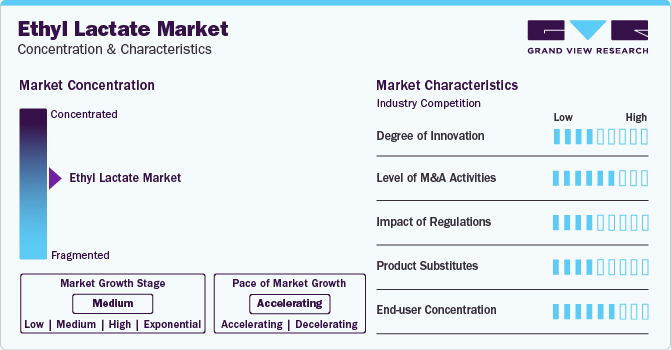
Market growth stage is exponential, and pace of the market growth is accelerating. Ethyl lactate is an essential ingredient in cleaners, solvents, additives, and fragrances, among others. It is supplied to end-use industries, namely paints & coatings, food & beverages, pharmaceuticals, personal care & cosmetics. Key end-users include Procter and Gamble, S.C. Johnson, Reckitt Benckiser, Henkel AG, Unilever, Avon, THE ESTÉE LAUDER COMPANIES, DNE Nutraceuticals Inc., Trillium Health Care Products Inc., Cafe Bravo Coffee Roasting Co Inc, Citrus Systems Inc., L’Oréal, PepsiCo, and Nestlé.
The paints & coatings industry was characterized by a series of expansions that reflected the growth in its end-use industries. For instance, in February 2024, AkzoNobel Powder Coatings completed an expansion at its Como, Italy plant for an investment of EUR 21.0 million (~USD 22.7 million). The plant will cater to the demand from segments such as consumer appliances, architecture, automotive, agriculture & construction machinery, furniture, and general industry.
 To learn more about this report, Download Free Sample Report
 In addition, in September 2023, PPG completed the expansion of its powder coatings plant in Sumare, Brazil for an investment of Brazilian Reals 13.0 million (~USD 2.7 million) and increased its production capacity by 40%. This would help the plant to cater to appliance manufacturers, agricultural machinery, transportation, and other consumer goods products. Furthermore, in April 2023, the company announced the completion of its USD 15 million-investment-capacity powder coatings plant in Brazil, Indiana, U.S.
Analyst Perspective
The ethyl lactate market is expected to witness stable growth, supported by the increasing transition toward bio-based solvents and stringent environmental regulations governing VOC emissions across industrial applications. Demand is strengthening across paints and coatings, pharmaceuticals, electronics, and personal care as manufacturers prioritize sustainable and high-performance formulations. Although higher production costs and competition from conventional solvents remain key challenges, ongoing advancements in green chemistry, expanding production capacities, and growing investments in renewable chemicals are expected to enhance long-term market competitiveness and revenue potential.
Grade Insights
By grade, the industrial grade segment held a dominant position, contributing 39.8% of total revenue in 2025. This is attributed to its versatile & environment-friendly solvent with diverse uses across various industries. Its excellent solvency properties make it suitable for paint and coating formulations, adhesive production, and as a cleaning agent in the electronics and automotive manufacturing industries.
Medical-grade ethyl lactate serves as a versatile compound with several beneficial properties. It is primarily used as a solvent for pharmaceuticals, excipients, and active ingredients, due to its ability to dissolve a wide range of compounds. Its low toxicity and biodegradability make it suitable for various pharmaceutical formulations, including topical creams, ointments, and oral solutions.
One of the key advantages of ethyl lactate in food-grade applications is that it exhibits good stability under typical food processing conditions, including moderate temperatures and pH ranges, ensuring consistent performance and quality in food products. Such advantages of ethyl lactate in food-grade applications are expected to drive the segment in the coming years.
Application Insights
Based on application, the solvent segment accounted for the largest revenue of 49.1% in 2025. This is attributable to the rising demand for ethyl lactate as a green solvent for isolating biologically active ingredients from natural sources. An example includes the extraction of phytosterol from damp corn fibers, resulting in oil products enriched with free fatty acids and phytosterol. Compared to conventional solvents, ethyl lactate stands out as one of the most synthesized organic solvents. Derived from agricultural sources, it can be extracted from plants or synthesized from carbohydrates, such as corn waste or sugar, making it a sustainable and eco-friendly option for various industrial applications.
Ethyl lactate serves as a fragrance agent in various products, due to its pleasant fruity odor. As a fragrance ingredient, ethyl lactate adds a subtle fruity scent to perfumes, colognes, lotions, creams, and other cosmetic and personal care products. Its fruity aroma is often described as sweet and refreshing, making it appealing in a wide range of fragrance formulations. The low volatility and stability of ethyl lactate contribute to its longevity in fragranced products, ensuring the scent remains consistent.
Additionally, ethyl lactate enhances the olfactory experience of consumers by imparting a pleasant and subtle fruity fragrance to various consumer goods. It can soften the harsh edges of other fragrance components, add a touch of fruitiness, and improve fragrance diffusion. This versatility allows perfumers to achieve a more balanced and nuanced final scent.
End-use Insights
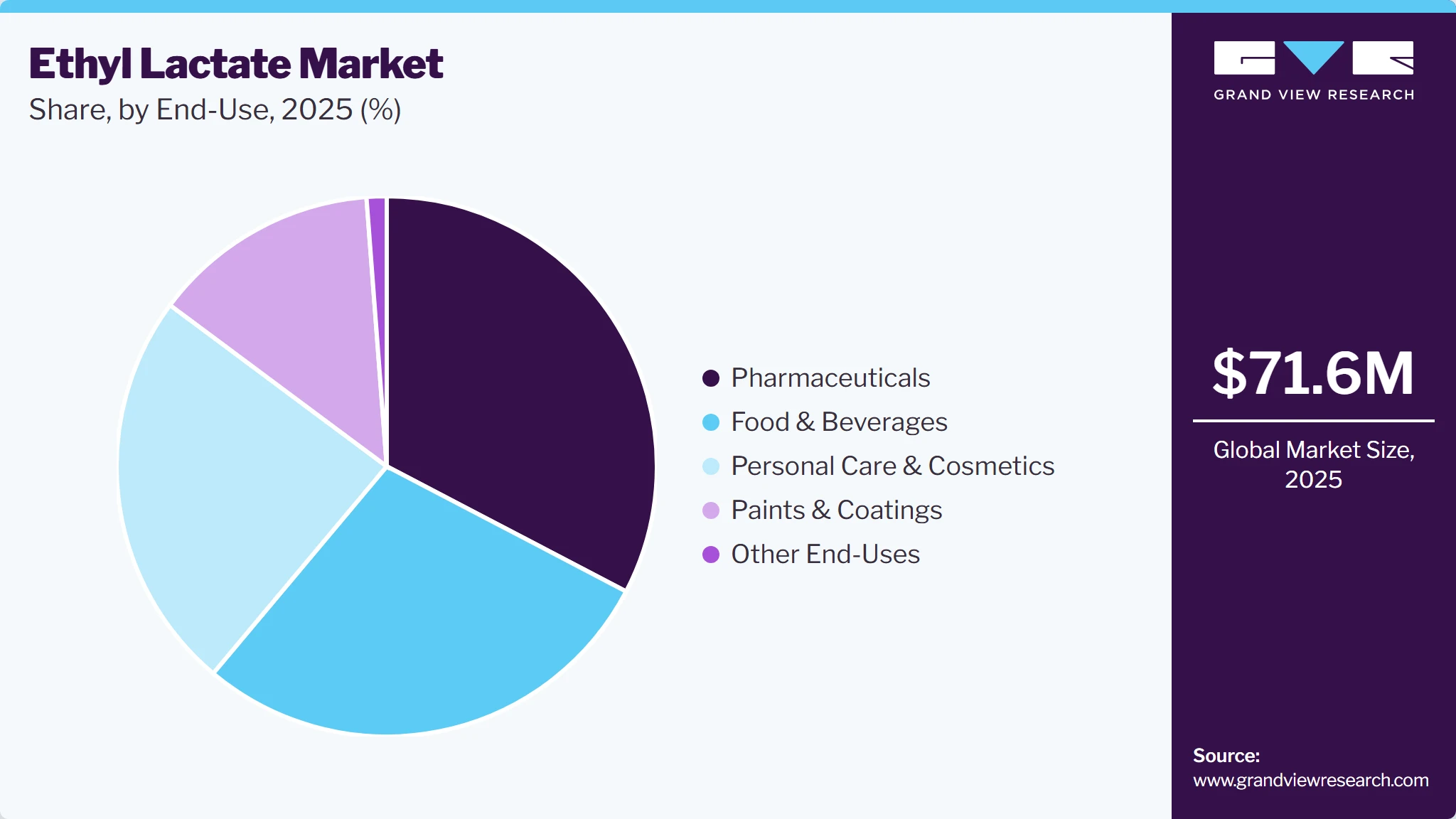
In 2025, the pharmaceuticals segment captured the largest share of revenue of 32.7% in the market. This is attributed to its use as a carrier solvent for drug delivery systems, such as injectables, transdermal patches, and topical creams. Its ability to solubilize hydrophobic drugs and enhance their bioavailability makes it valuable in improving drug delivery efficiency and patient compliance. Additionally, the low toxicity and biodegradability of ethyl lactate contribute to its acceptance in pharmaceutical formulations, ensuring safety and minimizing environmental impact.
 To learn more about this report, Download Free Sample Report
 Users in the paints & coatings industry prefer ethyl lactate, as it enhances the performance of coatings by acting as a coalescing agent, promoting film formation, and improving adhesion, durability, and weather resistance. Its compatibility with various resins and additives allows users to tailor coating formulations to meet specific performance requirements while maintaining consistency and quality.
Moreover, ethyl lactate has applications as a preservative in the food industry, helping to extend the shelf life of perishable products by inhibiting the growth of microorganisms and spoilage bacteria. Its antimicrobial properties make it particularly useful in preserving sauces, dressings, marinades, and other liquid food products, thereby reducing food waste and enhancing product safety.
Regional Insights
North America dominated the ethyl lactate market with the highest revenue share of 36.0% in 2025. This high share is attributable to the growing demand from manufacturers in the region to create products that taste good and deliver functional benefits such as energy enhancement, immune support, or stress relief, the demand for innovative flavor combinations and natural ingredients. Thus, the increasing demand for functional beverages is expected to positively impact the demand for ethyl lactate in the coming years.
 To learn more about this report, Download Free Sample Report
 U.S. Ethyl Lactate Market Trends
The U.S. dominated the North America ethyl lactate market in 2025. The U.S. ethyl lactate market is experiencing significant growth from several industries, particularly the food & beverage industry. Ethyl lactate exhibits antimicrobial properties, making it suitable for use as a natural preservative in food products. It can help inhibit the growth of spoilage microorganisms, thereby extending the shelf life of perishable items such as sauces, dressings, marinades, and ready-to-eat meals. In addition, it can be used as a mold inhibitor in bakery products.
Europe Ethyl Lactate Market Trends
Europe has the largest market for personal care products, a factor strongly influencing the ethyl lactate market. The surge in demand for personal care items, notably in Germany, Italy, France, Spain, and the UK, stems from consumers' growing focus on grooming to positively boost self-esteem. With increasing urbanization, there's a corresponding rise in the usage of skincare products, haircare solutions, and cosmetics among city dwellers. Ethyl lactate's adaptability across a spectrum of formulations, from cleansers to exfoliants, underscores its significance within the personal care industry.
Germany ethyl lactate market is growing as the country is the largest producer of biopharmaceuticals in Europe. This is attributed to several crucial factors, including the robust industrial infrastructure, the enduring strength of the local chemical industry, and a highly skilled workforce. The positive trajectory of the German pharmaceutical industry is expected to drive the growth of the ethyl lactate market in the country. Ethyl lactate is a valuable component in pharmaceutical formulations, acting as a solvent for active pharmaceutical ingredients (APIs) and excipients. As the German pharmaceutical sector continues to flourish, the demand for ethyl lactate is anticipated to rise owing to its essential role in producing high-quality pharmaceutical products.
Asia Pacific Ethyl Lactate Market Trends
The easy availability of low-cost labor in various countries of the region makes it an attractive destination for manufacturing companies looking to reduce their overall production costs by undertaking the economies-of-scale approach. Asia Pacific has become a central hub in the global supply chain due to its strategic location and efficient logistics network. Due to these factors, the region has grown significantly in numerous industries including pharmaceutical, healthcare, automotive, mining, and oil & gas. According to the India Brand Equity Foundation (IBEF) report, the size of Indian pharmaceutical market is expected to be USD 130 billion by 2030.
China ethyl lactate market is growing as the country is the world’s largest consumer and importer of food, displaying a significant appetite for imported food and beverage items. According to the China Food Import Report, 2023 China's food imports have demonstrated an impressive CAGR of 12.3% from 2013 to 2023. In 2023 alone, the country's total food imports surged beyond USD 139 billion, solidifying its robust presence as a significant player in the global market. This upward trajectory in China's food and beverage imports underscores the immense scale of the market and the dynamic interplay of consumer preferences and economic factors propelling this growth.
The ethyl lactate market in India is growing as India is the foremost supplier of generic medicines globally, commanding a substantial 20% share of the global supply by volume, according to Invest India. Bolstering this status are over 3,000 pharmaceutical companies nationwide, supported by a network of 10,500 manufacturing facilities and a highly skilled workforce. India's prominence extends to the production of active pharmaceutical ingredients (APIs), with approximately 500 API manufacturers contributing 8% to the global API industry. With a portfolio encompassing 60,000 generic brands spanning 60 therapeutic categories, India accounts for 20% of the global generics supply thereby playing a pivotal role in the pharmaceutical sector.
Central & South America Ethyl Lactate Market Trends
The region is also witnessing an emerging trend of functional drinks. The popularity of functional drinks containing protein and promising increased energy is rising, particularly among fitness enthusiasts. Additionally, immunity-boosting claims have gained prominence in the market. The proliferation of fitness centers in the region further fuels this trend, indicating a growing demand for functional beverages that support overall health and wellness. Thus, the positive influence of users for the functional beverages is anticipated to boost market growth over the forecast period. Ethyl lactate, derived from natural sources such as lactic acid and ethanol, aligns well with this trend. Its natural origin and eco-friendly properties make it an attractive choice for beverage manufacturers aiming to meet consumer preferences for clean-label products.
Brazil ethyl lactate market is growing as Brazil’s pharmaceutical industry expands to meet its population's growing healthcare needs, creating a higher demand for solvents like ethyl lactate. Ethyl lactate is used as a solvent in drug formulations, particularly for oral medications and topical preparations. The rise in drug manufacturing activities will consequently lead to an increased requirement for ethyl lactate.
Middle East & Africa Ethyl Lactate Market Trends
The Middle East is experiencing notable expansion, driven by the increasing purchasing power of its local consumers. With digitalization playing a key role, the region, particularly the Gulf countries, presents abundant growth opportunities, mainly due to untapped per capita potential. The surge in disposable incomes and overall wealth, particularly among the burgeoning younger urban middle class, also creates opportunities for value-added beauty products focusing on health and well-being. Considering these factors, the demand for personal care products is anticipated to grow substantially, consequently positively impacting the market for ethyl lactate in the upcoming years.
The food & beverage market in Saudi Arabia is experiencing notable expansion, propelled by the thriving food and dairy industry and the rising consumption of various food & beverage products, notably milk and dairy items. Furthermore, increasing awareness regarding the health benefits associated with milk and related products, coupled with the growing fitness trend, is expected to further fuel market growth throughout the forecast period.
Key Ethyl Lactate Company Insights
Some of the key players operating in the market include Corbion N.V., ADM, Stepan, and Galactic among others.
-
Corbion N.V. produces and distributes biochemical, biomedical, bioplastic, and food ingredient solutions. Its product line includes lactic acid and its derivatives, emulsifiers, functional enzyme mixes, minerals, vitamins, and algal components. The company provides food solutions to numerous industries, including bakery, poultry, oils, meat, dairy, seafood, drinks, fruits, vegetables, refrigerated foods, and emulsifiers. The company offers biochemical solutions to agrochemicals, animal health and nutrition, pharmaceuticals, chemicals, home care, and personal care applications.
-
Archer Daniels Midland Co (ADM) produces, processes, transports, stores, and markets agricultural products, commodities, and ingredients. The company manufactures food & beverage ingredients and other products from corn, wheat oilseeds, and other agricultural commodities.
Aurochemicals, Henan Kangyuan, Musashino Chemical Laboratory, Ltd. are some of the emerging market participants in the Ethyl Lactate market.
-
Aurochemicals specializes in the research, production, and quality assurance of flavor and aroma ingredients. The company offers its products to various industries, such as food & beverages, pharmaceuticals, and cosmetics. The company serves its customers on five continents, including client corporations such as Givaudan and Firmenich.
-
Henan Kangyuan is engaged in the manufacturing and sales of food additives, edible essences, and fine chemical products. Its main products for production and sales include food additives (ethyl caproate, ethyl lactate, ethyl octanoate, propyl acetate, phenylethanol, 2,3 butanedione, ethyl propionate, ethyl isobutyrate, ethyl butyrate, isoamyl acetate, glacial acetic acid (low-pressure carbonylation method), acetal, glycerol, allyl hexanoate, allyl heptanate), ethyl acetate, ethyl heptanate, lactic acid, caproic acid, butyric acid, and propionic acid.
Key Ethyl Lactate Companies:
The following key companies have been profiled for this study on the ethyl lactate market.
-
Corbion N.V.
-
ADM
-
Stepan
-
Musashino Chemical Laboratory
-
Vertec Biosolvents
-
Galactic
-
Henan Kangyuan
-
Godavari Biorefineries Ltd
-
Aurochemicals
Competitive Benchmarking
Category
Operating Strategies
Competitive Edge
Weakness
Established Players (Corbion N.V., ADM, Stepan, Galactic, Musashino Chemical Laboratory)
- Established participants focused on expanding bio-based solvent portfolios and strengthening integration across lactic acid and fermentation-based value chains.
- Strategic investments were directed toward high-purity ethyl lactate grades for pharmaceutical, food, coatings, and industrial cleaning applications.
- Companies emphasized sustainability-driven production models aligned with green chemistry and low-VOC regulatory requirements.
- Established players benefited from strong raw material integration and advanced fermentation technology capabilities.
- Broad manufacturing networks and established relationships across pharmaceutical, food, and industrial sectors strengthened market positioning.
- Strong technical expertise supported production of high-purity and application-specific ethyl lactate formulations.
- High dependence on agricultural feedstock pricing created exposure to raw material cost volatility.
- Bio-based production processes involved higher operational and processing costs compared to conventional solvents.
- Large-scale operational structures sometimes reduced flexibility in addressing niche regional requirements.
Emerging Players (Vertec Biosolvents, Henan Kangyuan, Godavari Biorefineries Ltd, Aurochemicals)
- Emerging companies concentrated on cost-competitive production and regional expansion within specialty solvent markets.
- Focus remained on industrial-grade ethyl lactate applications, including coatings, cleaners, and chemical intermediates.
- Companies increasingly targeted export opportunities through localized manufacturing and distributor partnerships.
- Regional manufacturers benefited from lower production costs and flexible manufacturing capabilities.
- Faster response to local demand and customized supply arrangements supported regional customer retention.
- Competitive pricing strategies strengthened penetration within cost-sensitive industrial applications.
- Limited global distribution reach and lower brand recognition restricted international expansion opportunities.
- Lower investment capacity in advanced R&D and purification technologies constrained premium product development.
- Dependence on regional demand patterns increased exposure to local economic fluctuations.
Recent Developments
-
In September 2022, Stepan announced the acquisition of the surfactant business and associated assets of PerformanX Specialty Chemicals, LLC. Headquartered in Westerville, Ohio. PerformanX includes ethoxylates, disinfectants, lubricant additives, and a variety of specialty products for markets that range from the paints and coatings, cleaning & detergents to oil and gas, personal care, and pulp and paper industries.
-
In July 2021, Corbion NV announced the acquisition of a Mexico-based provider of functional blends, Granolife. The company plans to expand its market reach in the Mexican bakery and fortification industries. By expanding Granolife's presence, expertise, blending capabilities and application laboratories, Corbion NV pans to make a significant difference in the Mexican market.
Ethyl Lactate Market Report Scope
Report Attribute
Details
Market size in 2025
USD 71.6 million
Estimated market size in 2026
USD 74.1 million
Projected market size by 2033
USD 97.3 million
Growth rate
CAGR of 4.0% from 2026 to 2033
Base year for estimation
2025
Historical data
2021 - 2024
Forecast period
2026 - 2033
Quantitative units
Revenue in USD million, Volume in kilotons, and CAGR from 2026 to 2033
Report coverage
Revenue forecast, company ranking, competitive landscape, growth factors, and trends
Segments covered
Grade, application, end use, region
Regional scope
North America; Europe; Asia Pacific; Latin America; MEA
Country scope
U.S.; Canada; Mexico; Germany; UK; France; Italy; Spain; China; India; Japan; South Korea; Brazil; Argentina; South Africa; Saudi Arabia
Key companies profiled
Corbion N.V.; ADM; Stepan; Musashino Chemical Laboratory; Vertec Biosolvents; Galactic; Henan Kangyuan; Godavari Biorefineries Ltd; Aurochemicals
Customization scope
Free report customization (equivalent up to 8 analysts' working days) with purchase. Addition or alteration to country, regional & segment scope.
Pricing and purchase options
Avail customized purchase options to meet your exact research needs. Explore purchase options
Global Ethyl Lactate Market Report Segmentation
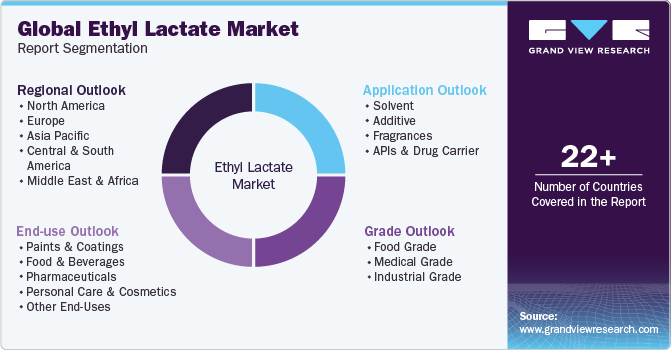
This report forecasts volume & revenue growth at global, regional, and country levels and provides an analysis of the latest industry trends in each of the sub-segments from 2021 to 2033. For this study, Grand View Research has segmented the global ethyl lactate market report based on grade, application, end-use, and region:
 To learn more about this report, Download Free Sample Report
 -
Grade Outlook (Volume, Tons; Revenue, USD Thousand, 2021 - 2033)
-
Food Grade
-
Medical Grade
-
Industrial Grade
-
-
Application Outlook (Volume, Tons; Revenue, USD Thousand, 2021 - 2033)
-
Solvent
-
Additive
-
Fragrances
-
APIs & Drug Carrier
-
-
End-use Outlook (Volume, Tons; Revenue, USD Thousand, 2021 - 2033)
-
Paints & Coatings
-
Food & Beverages
-
Pharmaceuticals
-
Personal Care & Cosmetics
-
Other End-Uses
-
-
Region Outlook (Volume, Tons; Revenue, USD Thousand, 2021 - 2033)
-
North America
-
U.S.
-
Canada
-
Mexico
-
-
Europe
-
Germany
-
UK
-
France
-
Italy
-
Spain
-
-
Asia Pacific
-
China
-
India
-
Japan
-
South Korea
-
-
Central & South America
-
Brazil
-
Argentina
-
-
Middle East & Africa
-
South Africa
-
Saudi Arabia
-
-
Research Methodology
The ethyl lactate market figures in this report are based on a proven research process that combines executive interviews with secondary research from proprietary databases, company filings, and recognized regulatory and institutional sources. Market size is built through value-chain sizing - reconciling supply-side and demand-side estimates - and triangulated with bottom-up and top-down approaches. Every estimate passes multiple levels of expert validation before publication, with each ethyl lactate segment quantified using the revenue-capture definitions in the table below.
Segment Definition
Segment - Grade
Revenue capture definition
Food Grade
Revenue is generated from the supply of high-purity ethyl lactate for food processing and food-contact applications, where compliance with food safety standards and clean-label requirements drives demand.
Medical Grade
Revenue is captured through the sale of pharmaceutical-quality ethyl lactate used in drug formulations, medical processing, and healthcare applications requiring stringent purity specifications.
Industrial Grade
Revenue is derived from the use of industrial-grade ethyl lactate as a bio-based solvent in paints, coatings, inks, electronics cleaning, and other industrial manufacturing processes.
Segment - Application
Revenue capture definition
Solvents
Revenue is generated from the adoption of ethyl lactate as a biodegradable solvent across coatings, cleaning products, printing inks, and electronics manufacturing, supported by environmental regulations.
Additives
Revenue is captured from the incorporation of ethyl lactate as a functional additive that enhances formulation stability, processing efficiency, and product performance across industrial and specialty chemical applications.
Fragrances
Revenue is derived from the use of ethyl lactate as a solvent and carrier in fragrance formulations, providing improved ingredient compatibility and formulation stability in personal care products.
APIs & Drug Carrier
Revenue is generated from the application of ethyl lactate as a solvent and carrier in active pharmaceutical ingredient (API) manufacturing and drug delivery systems, supported by its favorable safety and biodegradability profile.
Segment - End-use
Revenue capture definition
Paints & Coatings
Revenue is captured from the demand for ethyl lactate as a low-VOC, environmentally friendly solvent in paints and coatings, enabling compliance with stringent emission regulations while maintaining product performance.
Food & Beverages
Revenue is generated using food-grade ethyl lactate in flavor processing, food manufacturing, and food-contact cleaning applications where safety and regulatory compliance are critical.
Pharmaceutical
Revenue is derived from pharmaceutical manufacturers utilizing ethyl lactate in drug formulations, active ingredient processing, and specialty healthcare products requiring high-purity solvents.
Personal Care & Cosmetics
Revenue is captured from the incorporation of ethyl lactate into skincare, cosmetics, and fragrance formulations as a biodegradable solvent that supports premium and sustainable product positioning.
Other End-Uses
Revenue is generated from applications including electronics cleaning, agrochemicals, printing inks, adhesives, and specialty chemicals, where ethyl lactate offers effective solvency and environmental benefits.
Estimation Model
Layer Name
Key Question
Description
Raw Material & Feedstock Assessment
What is the availability of feedstocks required for ethyl lactate production?
Estimates the supply of lactic acid, ethanol, and other key feedstocks by evaluating production capacity, pricing trends, and regional availability.
Manufacturing Capacity Analysis
How much ethyl lactate can global manufacturers produce?
Assesses installed capacity, plant utilization rates, technology adoption, and capacity expansion plans across major manufacturers.
Application Demand Analysis
Which applications account for the highest ethyl lactate consumption?
Estimates demand across solvents, additives, fragrances, and APIs & drug carrier applications by analyzing industry-specific consumption patterns and adoption rates.
Market Forecast & Pricing Analysis
What is the future growth potential of the ethyl lactate market?
Integrates historical demand, pricing trends, technological advancements, regulatory developments, and macroeconomic indicators to forecast market volume and revenue through the forecast period.
Delivered Customizations
This report has been delivered with the following In-depth customizations
Client Request
Customization Delivered
Value Adds
Regional Segmentation
A comprehensive regional assessment of the ethyl lactate market was conducted across North America, Europe, Asia Pacific, Latin America, and Middle East & Africa. The study evaluated country-level demand for food, medical, and industrial grades while examining consumption across paints & coatings, food & beverages, pharmaceuticals, personal care & cosmetics, and other end-use industries. Regional manufacturing activity, regulatory landscape, and bio-based solvent adoption trends were also assessed.
Provides enhanced visibility into regional demand patterns and country-specific consumption trends. Supports market expansion planning, localization strategies, and identification of high-growth regions for bio-based solvents.
Cross-Segmentation Analysis
The relationship between grade, application, and end-use industry was assessed to determine demand across food, medical, and industrial grades. The analysis examined the use of ethyl lactate as a solvent, additive, fragrance ingredient, and API & drug carrier across paints & coatings, pharmaceuticals, food & beverages, and personal care applications.
Enables identification of high-value grade-application-end-use combinations. Supports portfolio optimization, product positioning, and commercialization strategies tailored to evolving customer requirements.
Trade Assessment
Global trade activity for ethyl lactate was examined through an assessment of export-import flows, production concentration, supply chain dependencies, and trade patterns across key manufacturing and consuming regions. The analysis also evaluated international demand for bio-based solvents across pharmaceutical, coatings, and personal care industries.
Provides insights into sourcing opportunities, trade dependencies, and supply chain resilience. Assists in supplier diversification, procurement planning, and regional market entry strategies.
Frequently Asked Questions About This Report
The industrial segment held a dominant position, contributing 39.8% of total revenue in 2025, driven by increasing utilization of high-purity ethyl lactate as a solvent and processing aid in pharmaceutical manufacturing, supported by growing demand for environmentally preferred ingredients and stringent quality requirements for drug production.
The solvent segment accounted for the largest revenue share of 49.1% in 2025, driven by increasing adoption of ethyl lactate as a biodegradable, low-VOC solvent in coatings, inks, adhesives, cleaning formulations, and industrial processing applications, where regulatory compliance and sustainability objectives are accelerating the shift away from conventional petrochemical solvents.
In 2025, the pharmaceuticals segment captured the largest share of revenue of 32.7% in the market, supported by increasing use of ethyl lactate as a green solvent and formulation ingredient in drug manufacturing processes, where its low toxicity, biodegradability, and compatibility with stringent pharmaceutical quality standards enhance its adoption.
The growth of the ethyl lactate market is restrained by its relatively higher production cost compared to conventional petrochemical solvents and limited commercial-scale availability in some regions, which can restrict adoption in price-sensitive industrial applications
The global ethyl lactate market size was valued at USD 71.6 million in 2025 and is estimated at USD 74.1 million for 2026.
The global ethyl lactate market is expected to grow at a CAGR of 4.0% from 2026 to 2033, reaching USD 97.3 million by 2033.
North America dominated the ethyl lactate market with the highest revenue share of 36.0% in 2025, supported by strong demand for bio-based solvents across the paints and coatings, pharmaceuticals, and industrial cleaning industries, along with stringent environmental regulations encouraging the adoption of low-VOC and sustainable chemical formulations.
Some key players operating in the ethyl lactate market include Corbion, Galactic, Vertec Biosolvents, Godavari Biorefineries Ltd, Henan Kangyuan, Musashino Chemical (China) Co., Ltd, etc.
Key factors driving market growth include increasing consumption in the cosmetic and personal care industry due to its low cost and flexible nature.
About the Author(s)
Renewable Chemicals Research Team
Specialty & Chemicals · Renewable ChemicalsThis report was authored by the renewable chemicals research team at Grand View Research - comprising two research analysts, one senior research analyst, and one industry expert - with specialized expertise in the renewable chemicals segment of the specialty & chemicals industry. All findings are based on proprietary specialty & chemicals databases, executive interviews, and regulatory analysis, subject to internal peer review prior to publication.
Last Updated:
Speak to Analyst

Customize this report to your needs - add regions, segments, or data points, with 20% free customization.
Or view our licence options:


ISO 9001:2015 & 27001:2022 Certified
We are GDPR and CCPA compliant! Your transaction & personal information is safe and secure. For more details, please read our privacy policy.


