
- Home
- »
- Electronic & Electrical
- »
-
Europe Household Appliances Market, Industry Report, 2033GVR Report cover

Europe Household Appliances Market (2026 - 2033) Size, Share & Trends Analysis Report By Product (Major Appliances, Small Appliances), By Distribution Channel (Hypermarkets & Supermarkets, Electronic Stores, Brand Outlets, Online), By Country, And Segment Forecasts
Market Size, 2025
$101.7BMarket Estimate, 2026
$105.4BMarket Forecast, 2033
$140.8BCAGR, 2026–2033
4.2%Europe Household Appliances Market Summary
The Europe household appliances market size was valued at USD 101.7 billion in 2025 and is projected to grow from USD 105.4 billion in 2026 to USD 140.8 billion by 2033, at a CAGR of 4.2% from 2026 to 2033. The household appliances market in Germany dominated the market with the largest revenue share 23.9% in 2025. The growth is strongly shaped by Europe’s increasingly aggressive transition toward energy-efficient, environmentally compliant household appliances, where regulation is directly influencing consumer replacement cycles and manufacturer innovation.
Key Market Trends & Insights
- The UK led the growth of the household appliances market in Europe.
- Major household appliances accounted for the largest revenue share of 85.9% of the revenue in 2025.
- Sales of household appliances through electronic stores accounted for a revenue share of 44.9% of the revenue in 2025.
Market Size & Forecast
- 2025 Market Size: USD 101.7 Billion
- 2033 Projected Market Size: USD 140.8 Billion
- CAGR (2026-2033): 4.2%
- Germany: Largest market in 2025
Prism AI by Grand View Research Free to tryAsk a question about the europe household appliances marketTry asking✓Every figure cited from GVR research Prefer the report? Download free sample →
EU-driven frameworks such as Ecodesign requirements and Energy Labelling standards are pushing brands to redesign core appliance categories around lower electricity and water use, quieter operation, and longer product lifetimes. This is particularly evident in the rapid shift toward high-efficiency heat pump tumble dryers, which are steadily replacing traditional condenser models across Germany, France, and the Netherlands due to significantly lower energy consumption. Similarly, next-generation dishwashers with eco-cycle optimization and reduced water intake are becoming mainstream in sustainability-conscious markets, as households prioritize appliances that deliver measurable cost savings alongside reduced environmental impact.Another major contributor is the rising penetration of smart, sensor-driven appliances, which are increasingly positioned as premium lifestyle infrastructure rather than optional upgrades. European consumers are increasingly willing to pay for appliances that offer automation, predictive maintenance, and personalized usage insights. For instance, in September 2025, LG introduced its latest ThinQ AI smart home strategy in Europe, aiming to deliver more seamless and personalized connected living experiences across its appliance ecosystem. The company highlighted how ThinQ AI will enhance everyday convenience through smarter automation, improved device connectivity, and adaptive features that respond to user routines. LG’s approach focuses on integrating appliances, energy management, and home control into a unified platform, positioning ThinQ AI as a key step in expanding intelligent home solutions across the European market. The announcement reflects LG’s broader push to strengthen smart home innovation and accelerate the adoption of AI-driven household technologies. This smart adoption is especially strong among younger, urban consumers seeking seamless integration with broader smart home ecosystems.
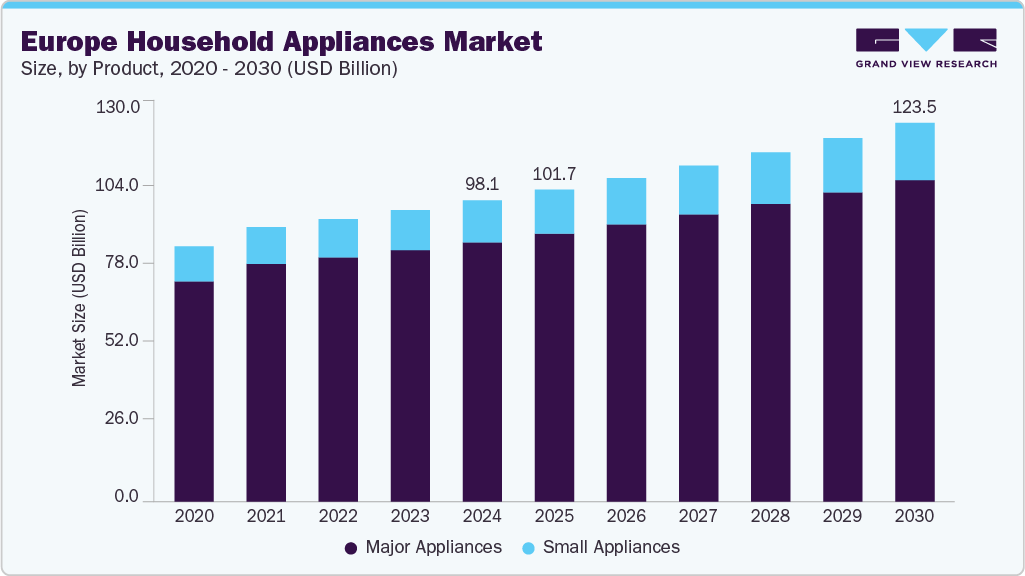 Source: Grand View Research, IR Documents, Primary Interviews, Paid DatabasesTo learn more about this report,
 Download Free Sample Report
Urbanization and the structural constraints of European housing are also reshaping appliance demand toward multifunctional and space-efficient formats. Across dense urban centers such as Paris, Milan, and Madrid, consumers are increasingly investing in appliances that combine multiple functions without compromising performance. The market has seen rising demand for built-in combi steam ovens from brands like Siemens and Miele, which appeal to consumers seeking healthier cooking options while maximizing limited kitchen space. Similarly, washer-dryer hybrids are gaining momentum in apartment-heavy markets, as consumers seek flexible laundry solutions that reduce the need for separate machines. This premiumization trend is not merely aesthetic; it is driven by practical lifestyle needs, with buyers prioritizing compact engineering, low-noise operation, and advanced fabric-care technologies.
In addition, replacement demand is being accelerated by Europe’s push toward circular-economy models and stricter expectations for product durability and repairability. Manufacturers are increasingly promoting longer warranties, modular components, and easier servicing as differentiators, particularly in Northern and Western Europe, where consumers are more value-focused over the long term.
Market Dynamics
The growth of e-commerce and omnichannel retailing is becoming a major driver for the Europe household appliances market, as consumers increasingly prefer digital platforms for appliance purchases due to convenience, broader product availability, and competitive pricing. According to the European E-commerce Report 2025, Europe’s B2C e-commerce turnover grew by 7% in 2024 to reach €842 billion (USD 877.0 billion), supported by rising online shopping penetration across the region. In addition, leading European retailers such as Fnac Darty are strengthening omnichannel strategies through click-and-collect services, integrated delivery networks, and enhanced digital shopping experiences.
Intensifying competition from low-cost Asian manufacturers is emerging as a major restraint for the Europe household appliances market, as regional brands face increasing pressure on pricing, profitability, and market share retention. According to industry analysis published by Whitegoodsnow in 2025, Chinese brands and Chinese-owned appliance companies accounted for nearly 42% of the European consumer electronics and appliance market in 2025, compared to 18% in 2015, highlighting the rapid expansion of low-cost Asian players across Europe. In addition, companies such as JD.com are aggressively expanding into Europe through acquisitions and retail partnerships, further strengthening the presence of competitively priced Asian appliance products in the region.
Consumer Insights
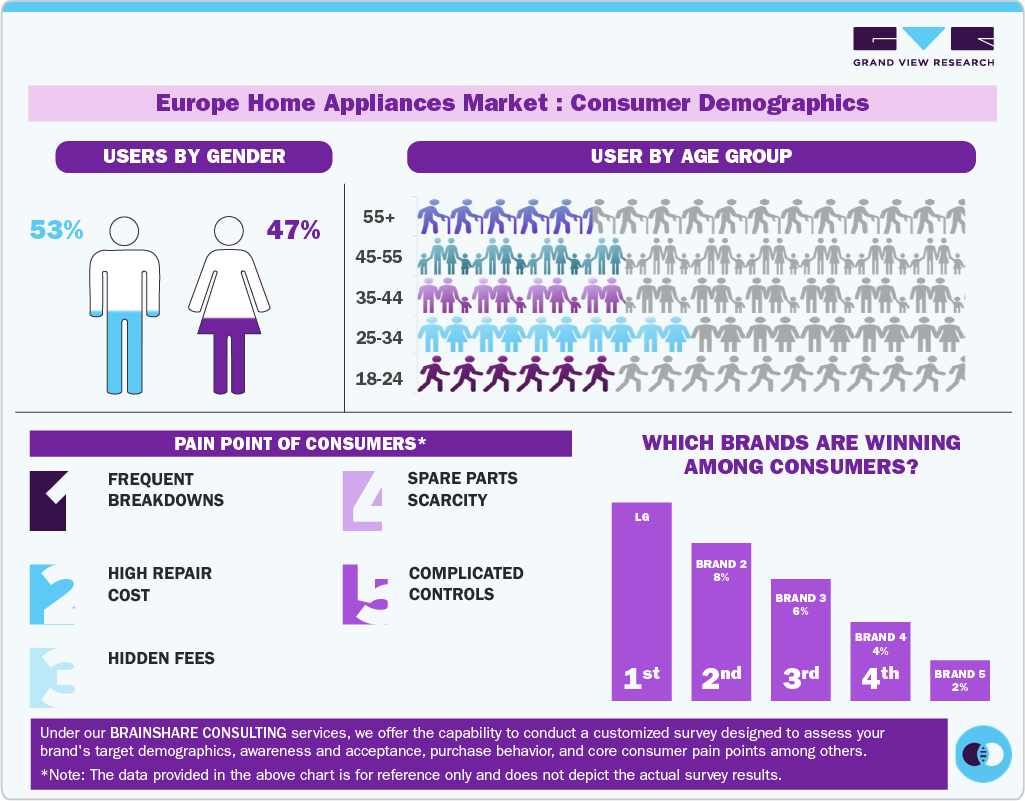
Demand is expanding beyond core essentials such as refrigerators, washing machines, and dishwashers into faster-growing convenience-driven categories, including air fryers, bean-to-cup espresso machines, robotic vacuum cleaners, and compact multifunctional cooking appliances. Younger professionals, dual-income families, and apartment-based consumers are major drivers of this shift, as limited time availability and smaller living spaces increase reliance on appliances that deliver high utility with minimal manual involvement. The popularity of space-efficient washer-dryers, countertop cooking devices, and smart cleaning robots reflects a broader European preference for appliances that enhance convenience without compromising energy discipline.
 To learn more about this report, Download Free Sample Report
Consumer decision-making across Europe is becoming increasingly performance-led and cost-rational, with buyers evaluating appliances through a long-term ownership lens rather than upfront price alone. Operating efficiency has become a primary purchase filter, particularly in energy-intensive categories such as refrigeration, laundry, and air conditioning, where electricity price sensitivity remains high across many European markets. Consumers closely compare energy ratings, annual running costs, motor efficiency, noise output, and cycle performance consistency before selecting models. Functional metrics such as cooling stability, fabric-care precision, hygiene wash cycles, and load capacity alignment are now central to brand choice. Appliances positioned around health and indoor cleanliness, such as steam-based laundry sanitization, anti-bacterial refrigerator interiors, and high-filtration vacuum systems, are gaining stronger traction as households prioritize safer and cleaner home environments.
Product Insights
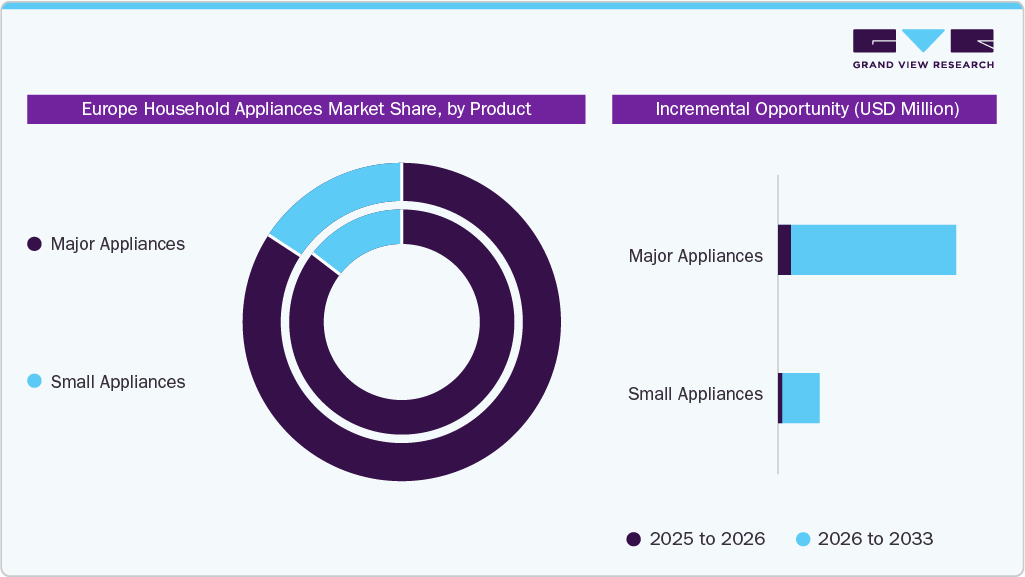
Based on product, the major household appliances segment led the market with the largest revenue share of 85.9% in 2025, primarily due to the essential and high-value nature of these products, which include refrigerators, washing machines, ovens, and dishwashers. These appliances are fundamental to everyday household functioning, driving consistent demand for replacements and upgrades. A key driver is the growing consumer focus on energy efficiency and sustainability, spurred by strict EU regulations such as the Ecodesign Directive, which are pushing manufacturers to innovate with eco-friendly, energy-saving technologies. For instance, the refrigerator segment, which commands the largest share of major appliances, has seen rapid adoption of smart features such as AI-powered food management systems that extend freshness and reduce waste. In addition, premiumization trends have led consumers to invest in higher-end, multifunctional appliances that offer advanced connectivity and convenience. The combination of regulatory pressure, technological innovation, and evolving consumer preferences for durable, efficient, and smart appliances underpins the dominant market share of major appliances in Europe.
 To learn more about this report, Download Free Sample Report
Small household appliances are anticipated to grow at the fastest CAGR of 5.7% from 2026 to 2033, driven by rising consumer demand for convenience, multifunctionality, and energy efficiency. Busy lifestyles and increasing urbanization are encouraging consumers to adopt compact, easy-to-use appliances such as microwave ovens, air fryers, and coffee makers that save time and enhance daily routines. For instance, the popularity of smart coffee machines, which offer customizable brewing and remote control via apps, reflects this trend toward convenience and technology integration. In addition, growing health consciousness is boosting demand for appliances such as juicers and blenders that support nutritious diets. The market is also benefiting from technological advancements, including smart connectivity and AI features, which appeal to Europe’s tech-savvy younger generation. Furthermore, rising disposable incomes and a shift toward premium products encourage consumers to invest in innovative small appliances that combine style with functionality, reinforcing steady market expansion during the forecast period.
Distribution Channel Insights
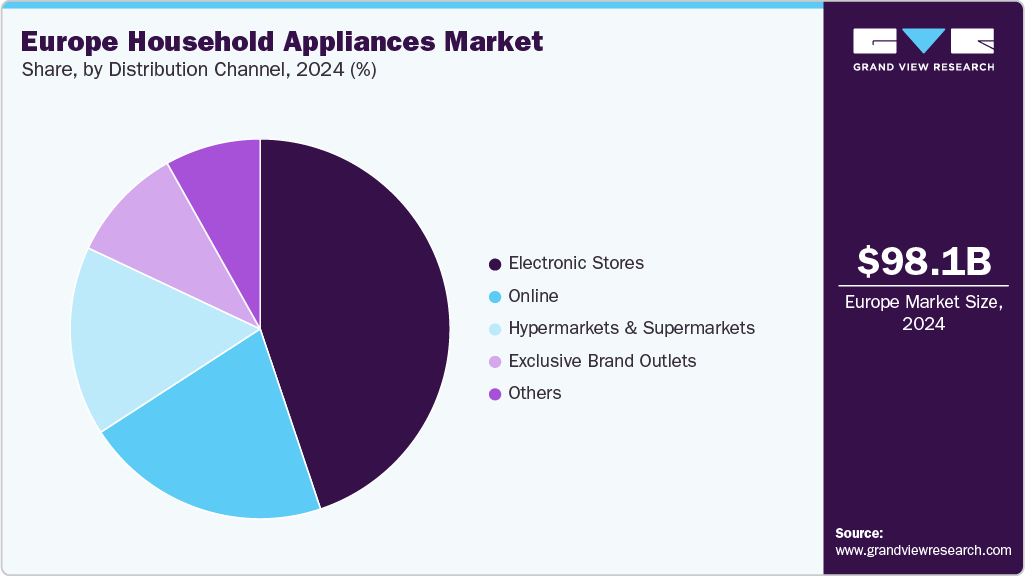
The sale of household appliances through electronic stores led the market with the largest revenue share of 44.9% in 2025. The growth is attributed to the availability of a wide product assortment from multiple brands under one roof, enabling easy comparison and informed purchasing decisions. Leading retailers like MediaMarkt and Euronics have extensive physical store networks across Europe, providing customers with hands-on experience, expert advice, and immediate product availability, which remain crucial factors for high-value appliance purchases. For instance, MediaMarkt’s omnichannel strategy, combining in-store expertise with online convenience, has strengthened its market position by catering to diverse consumer preferences. In addition, electronic stores have embraced digital tools such as virtual demonstrations and augmented reality, enhancing customer engagement and confidence in their choices.
 To learn more about this report, Download Free Sample Report
Online sales of household appliances are projected to grow at the substantial CAGR of 5.0% from 2026 to 2033, driven by rising consumer comfort with buying high-ticket products digitally and the expansion of omnichannel retail across key markets such as the UK, Germany, and France. European buyers increasingly use online platforms to compare EU Energy Label ratings, noise performance, and built-in fit specifications for appliances like washing machines, refrigerators, and dishwashers, where space constraints and energy costs shape decision-making. Retailers, including MediaMarktSaturn, Currys, and Fnac Darty, are strengthening online conversion through bundled delivery, installation, and WEEE-compliant old-appliance take-back services.
Country Insights
Germany Household Appliances Market Trends
The household appliances industry in Germany accounted for a revenue share of 23.9% in 2025, supported by the country’s high appliance penetration, strong domestic manufacturing presence, and consistent upgrade-driven consumer demand. German households actively invest in high-efficiency refrigeration, advanced laundry systems, and premium built-in kitchen appliances, reflecting a market where durability, technical performance, and energy compliance are key purchase priorities. Rising adoption of heat pump drying technology, low-noise inverter motors, and smart-enabled appliance ecosystems from brands such as Miele, Bosch, and Siemens continue to shape replacement cycles.
UK Household Appliances Market Trends
The UK household appliances industry is expected to grow at a CAGR of 5.3% from 2026 to 2033. Demand is particularly strong for integrated ovens, built-in dishwashers, and modern refrigeration systems, as homeowners invest in fitted kitchen remodels and space-efficient appliance replacements. The market is also benefiting from the UK’s high penetration of rental housing and frequent household turnover, which drives recurring purchases of essential appliances such as washing machines and cooker units. In addition, fast-growing adoption of convenience-led small appliances, including air fryers and coffee machines, reflects shifting consumer preferences toward at-home cooking and lifestyle-oriented home upgrading.
France Household Appliances Market Trends
The household appliances industry in France is expected to grow at a CAGR of 4.9% from 2026 to 2033. Demand remains particularly strong for built-in cooking appliances, integrated dishwashers, and premium refrigeration systems, as French consumers prioritize fitted kitchen upgrades and space-efficient designs in urban apartments. The market is also benefiting from France’s large base of multi-family housing and ongoing residential renovation activity, which drives recurring purchases of essential appliances such as washing machines, cooker units, and compact laundry solutions. In addition, rising adoption of lifestyle-oriented small appliances, including espresso machines, air fryers, and multifunctional food preparation devices, reflects growing consumer preference for at-home dining and convenience-driven home improvement.
Italy Household Appliances Market Trends
The Italy household appliances industry is expected to grow at a CAGR of 3.9% from 2026 to 2033. Demand is especially concentrated in integrated ovens, dishwashers, refrigeration, and compact laundry appliances, as renovation activity and fitted-kitchen upgrades remain key purchase triggers across cities such as Milan, Rome, and Turin. Italy’s market is also shaped by rising consumer preference for eco-efficient models that meet strict EU energy standards, accelerating the adoption of inverter-driven washing machines and low-consumption refrigeration designed to manage household electricity costs.
Spain Household Appliances Market Trends
The household appliances industry in Spain is expected to grow at a CAGR of 4.3% from 2026 to 2033. Market demand is largely replacement-driven, as consumers upgrade aging appliance stock toward newer models that comply with stricter EU energy and water-efficiency requirements. Adoption is increasing for inverter-based laundry systems, eco-program dishwashers, and high-efficiency refrigeration that help reduce electricity usage in a cost-sensitive environment.
Key Europe Household Appliances Company Insights
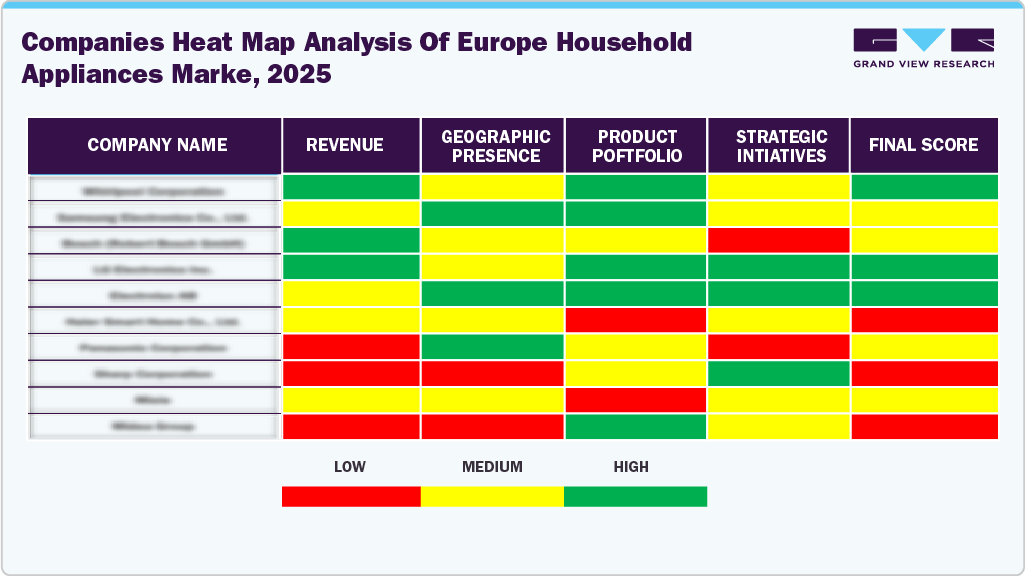
The Europe household appliances market is highly competitive, characterized by the presence of several international brands and regional manufacturers. Major players are focusing on product innovation through smart and energy-efficient appliances, premium designs, and sustainable technologies to strengthen their market positions. In addition, local retailers and appliance companies are enhancing customer experience by offering advanced features, multifunctional products, and eco-friendly solutions tailored to evolving consumer preferences across European countries.
-
Whirlpool Corporation is a leading player in the Europe household appliances market, leveraging its strong brand reputation and extensive product portfolio to maintain a competitive position. In 2025, the company focused on expanding its range of energy-efficient and smart home appliances, particularly across the kitchen and laundry segments. Innovations in connected appliances and sustainable technologies supported demand across European households. The company also strengthened its market presence through product premiumization and enhanced consumer-centric solutions.
-
Samsung Electronics Co. Ltd. is recognized for its advanced and premium household appliance offerings in Europe. The company’s product portfolio includes smart refrigerators, washing machines, air conditioners, vacuum cleaners, and kitchen appliances integrated with AI and IoT capabilities. Samsung continues to attract a broad consumer base through innovative designs, energy-efficient technologies, and connected home ecosystems. In 2025, the company witnessed steady growth in its digital appliances segment, supported by rising adoption of smart home solutions and premium household appliances across Europe.
 To learn more about this report, Download Free Sample Report
Key Europe Household Appliances Companies
-
Whirlpool Corporation
-
Samsung Electronics Co. Ltd.
-
Robert Bosch GmbH
-
LG Electronics Inc.
-
Electrolux AB
-
Haier Smart Home Co., Ltd.
-
Panasonic Corporation
-
Sharp Corporation
-
Miele
-
Midea Group
-
Koninklijke Philips N.V.
-
Breville Group Limited
-
De'Longhi S.p.A.
-
SEB Groupe (Groupe SEB)
-
Dyson Limited
Recent Developments
-
In January 2026, Tapo launched a new flagship robot vacuum and mop with Matter support, enabling smoother integration with major smart-home ecosystems. The model features laser navigation with obstacle avoidance, app-based control, and a high-capacity battery for extended cleaning. It also includes an advanced self-cleaning dock that can wash and hot-air dry mop pads, reducing manual maintenance. The release highlights the trend toward more automated, connected premium robot cleaners.
-
In September 2025, Midea unveiled two new dishwasher lines, GreenApex and Titan, at IFA, showcasing its push toward more advanced, sustainable dishwashing solutions. The company emphasized improved cleaning performance, greater energy and water efficiency, and smarter features that enhance everyday household convenience. The new models reflect Midea’s broader strategy of combining innovative technology with environmentally conscious design, positioning its latest dishwashers as next-generation appliances aimed at modern kitchens and evolving consumer expectations.
Europe Household Appliances Market Report Scope
Report Attribute
Details
Market size value in 2026
USD 105.4 billion
Revenue forecast in 2033
USD 140.8 billion
Growth rate (revenue)
CAGR of 4.2% from 2026 to 2033
Actuals
2021 - 2025
Forecast period
2026 - 2033
Quantitative units
Revenue in USD Billion, Volume Thousand Units, and CAGR from 2026 to 2033
Report coverage
Revenue forecast, company ranking, competitive landscape, growth factors, and trends
Segments covered
Product, distribution channel, country
Regional scope
Europe
Country scope
Germany; UK; France; Italy; Spain; Benelux; Nordics
Key companies profiled
Whirlpool Corporation; Samsung Electronics Co. Ltd.;Robert Bosch GmbH; LG Electronics Inc.; Electrolux AB; Haier Smart Home Co., Ltd.; Panasonic Corporation; Sharp Corporation; Miele; Midea Group; Koninklijke Philips N.V.; Breville Group Limited; De'Longhi S.p.A.; SEB Groupe (Groupe SEB); Dyson Limited
Customization scope
Free report customization (equivalent up to 8 analysts working days) with purchase. Addition or alteration to country, regional & segment scope.
Pricing and purchase options
Avail customized purchase options to meet your exact research needs. Explore purchase options
Europe Household Appliances Market Report Segmentation
This report forecasts revenue growth at the country level and provides an analysis of the latest industry trends and opportunities in each of the sub-segments from 2021 to 2033. For the purpose of this study, Grand View Research has segmented the Europe household appliances market report on the basis of product, distribution channel, and country.
-
Product Outlook (Volume, Thousand Units; Revenue, USD Billion, 2021 - 2033)
-
Major Appliances
-
Water Heater
-
Dishwasher
-
Refrigerator
-
Cooktop, Cooking Range, Microwave, and Oven
-
Vacuum Cleaner
-
Washing Machine and Dryers
-
Air Conditioner
-
-
Small Appliances
-
Coffee Makers
-
Toasters
-
Juicers, Blenders and Food Processors
-
Hair Dryers
-
Irons
-
Deep Fryers
-
Space Heaters
-
Electric Trimmers and Shavers
-
Air Purifiers
-
Humidifiers & Dehumidifiers
-
Rice Cookers & Steamers
-
Air Fryers
-
-
-
Distribution Channel Outlook (Volume, Thousand Units; Revenue, USD Billion, 2021 - 2033)
-
Hypermarkets & Supermarkets
-
Electronic Stores
-
Exclusive Brand Outlets
-
Online
-
Others
-
-
Country Outlook (Volume, Thousand Units; Revenue, USD Billion, 2021 - 2033)
-
UK
-
Germany
-
France
-
Italy
-
Spain
-
Benelux
-
Nordics
-
Delivered Customizations
This report has been delivered with the following In-depth customizations
Client Request
Customization Delivered
Value Adds
Global Appliance Production & Manufacturer Output Analysis (2021-2025)
Developed a concise assessment of global appliance production trends from 2021 to 2025, including analysis of annual output volumes, regional manufacturing shifts, and production distribution across leading and mid-tier manufacturers. The study further evaluated manufacturer-level production data by product portfolios, capacity expansion strategies, and export-oriented supply dynamics across key global hubs.
Enables stakeholders to understand global supply trends, benchmark manufacturer production capabilities, and support strategic decisions related to sourcing, capacity planning, and competitive positioning.
Smart Appliance Adoption & Connected Home Ecosystem Analysis
Delivered a customized evaluation of smart household appliance adoption trends across Europe, including consumer demand analysis for Wi-Fi-enabled appliances, AI-powered automation features, voice assistant integration, remote diagnostics, and connected home interoperability platforms. The assessment also examined regional smart appliance penetration patterns, ecosystem partnerships, replacement cycles, and consumer willingness to pay for connected functionality across premium and mid-range segments.
Provides actionable insights into connected appliance adoption behavior, evolving smart home ecosystem preferences, and premiumization opportunities, helping clients identify commercially attractive product segments, optimize technology integration strategies, and strengthen positioning within the expanding connected living environment.
Household Appliance Replacement Cycle Study
Conducted a focused assessment of appliance replacement dynamics across Europe, including analysis of household purchasing behavior across Europe, including evaluation of refurbishment demand, repair-versus-replacement preferences, financing adoption, inflation-driven spending adjustments, and seasonality trends across white goods and small domestic appliances. The study also analyzed demographic influences, urban housing constraints, and retailer-led promotional dynamics shaping replacement demand across European markets.
Supports strategic planning for appliance manufacturers, retailers, and distributors by quantifying replacement demand trends, identifying underserve
Frequently Asked Questions About This Report
Some prominent players in the Europe household appliances market includeWhirlpool Corporation; Samsung Electronics Co. Ltd.; Robert Bosch GmbH; LG Electronics Inc.; Electrolux AB; Haier Smart Home Co., Ltd.; Panasonic Corporation; Sharp Corporation; Miele; Midea Group; Koninklijke Philips N.V.; Breville Group Limited; De'Longhi S.p.A.; SEB Groupe (Groupe SEB) and Dyson Limited
The growth is attributable to the increasing consumer demand for energy-efficient and environmentally sustainable appliances. European consumers and governments are highly focused on reducing carbon footprints, with stringent regulations such as the EU’s Ecodesign and Energy Labelling Directives pushing manufacturers to innovate in energy-saving technologies.
The Europe household appliances market size was estimated at USD 101.7 billion in 2025 and is expected to reach USD 105.4 billion in 2026.
The major appliances market accounted for a share of 85.9% of the Europe revenue in 2025, primarily due to the essential and high-value nature of these products, which include refrigerators, washing machines, ovens, and dishwashers
The Europe household appliances market is expected to grow at a compound annual growth rate (CAGR) of 4.2% from 2026 to 2033 to reach USD 140.8 billion by 2033.
About the Author(s)
Electronic & Electrical Research Team
Consumer Goods · Electronic & ElectricalThis report was authored by the electronic & electrical research team at Grand View Research - comprising two research analysts, one senior research analyst, and one industry expert - with specialized expertise in the electronic & electrical segment of the consumer goods industry. All findings are based on proprietary consumer goods databases, executive interviews, and regulatory analysis, subject to internal peer review prior to publication.
Last Updated:
Speak to Analyst

Customize this report to your needs - add regions, segments, or data points, with 20% free customization.
Or view our licence options:


ISO 9001:2015 & 27001:2022 Certified
We are GDPR and CCPA compliant! Your transaction & personal information is safe and secure. For more details, please read our privacy policy.


