
- Home
- »
- Medical Devices
- »
-
Europe Orthokeratology Lens Market, Industry Report, 2030GVR Report cover
![Europe Orthokeratology Lens Market Size, Share & Trends Report]()
Europe Orthokeratology Lens Market (2025 - 2030) Size, Share & Trends Analysis Report By Product (Daytime, Overnight Ortho-K Lenses), By Distribution Channel (Hospitals, Optometry Clinics), By Indication, And Segment Forecasts
- Report ID: GVR-4-68040-526-4
- Number of Report Pages: 130
- Format: PDF
- Historical Range: 2018 - 2024
- Forecast Period: 2025 - 2030
- Industry: Healthcare
- Report Summary
- Table of Contents
- Segmentation
- Methodology
- Download FREE Sample
-
 Download Sample Report
Europe Orthokeratology Lens Market Trends
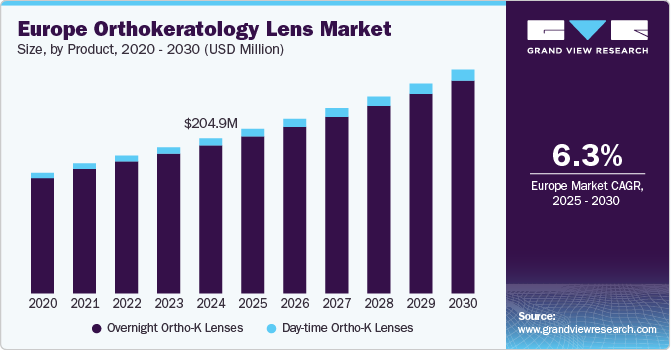
The Europe orthokeratology lens market size was valued at USD 204.9 million in 2024 and is projected to grow at a CAGR of 6.3% from 2025 to 2030. The industry is growing due to the rising prevalence of myopia, increasing awareness of non-surgical vision correction, and advancements in lens materials and design. The market benefits from strong regulatory support and a high adoption rate among children and young adults. Germany, the UK, and France lead in market share, driven by optometric innovations and expanding specialty eye care services.
The Europe orthokeratology lens industry is experiencing significant growth, driven by the rising prevalence of myopia and increasing awareness of non-surgical vision correction. Orthokeratology lenses are specialized gas-permeable contact lenses designed to reshape the cornea overnight, allowing users to enjoy clear vision during the day without the need for glasses or traditional contact lenses. As concerns over myopia escalate, more individuals, particularly children and young adults, are turning to ortho-K lenses as a preferred solution.
One of the primary factors fueling the market's expansion is the alarming rise in myopia across Europe. According to the International Agency for the Prevention of Blindness (IAPB), in March 2021, myopia prevalence in Europe surged to nearly 50% among individuals aged 25-29. The impact is most pronounced in children over the age of six, with the highest myopia onset rate observed in children aged 7-10. In response, the European Society of Ophthalmology has provided guidance to children and parents on managing risk factors, emphasizing preventive strategies to slow the progression of myopia.
Regionally, the prevalence of myopia varies, with Western Europe reporting the highest rates at 36.7%, followed by Central Europe at 34.6% and Eastern Europe at 32.2%. Research indicates that increased indoor time is a key driver of myopia development, particularly among children and adolescents. Studies show that each additional hour spent outdoors per week reduces the risk of developing myopia by 2%, highlighting the importance of outdoor activities as a preventive measure. Other contributing factors include prolonged screen exposure (computers, smartphones), urban residency, ethnicity, gender, education level, and socioeconomic background.
As myopia rates continue to rise, orthokeratology lenses have gained popularity for their effectiveness in slowing myopia progression, making them a preferred choice for pediatric eye care. Ortho-K lenses offer an alternative to corrective surgery, appealing to patients seeking non-invasive vision correction. The demand for these lenses is expected to increase further, driven by growing parental awareness and support from ophthalmologists promoting early myopia management.
Europe’s healthcare infrastructure plays a crucial role in supporting market expansion, with initiatives like ERN-EYE (European Reference Network for Rare Eye Diseases) enhancing access to specialized eye care and research collaboration. ERN-EYE connects healthcare professionals, researchers, and patient organizations across EU member states, improving knowledge-sharing and treatment options for rare eye diseases, including pediatric myopia and retinal disorders.
Market Concentration & Characteristics
The European orthokeratology lens industry is moderately concentrated, with key players focusing on R&D, advanced lens materials, and customized fitting technologies. The market is characterized by specialized manufacturers, strong regulatory oversight, and increasing clinical adoption for myopia management. Western Europe dominates due to high awareness and advanced optometric practices, while Central and Eastern Europe are experiencing growing adoption. The industry benefits from rising pediatric myopia cases, increasing outdoor activity advocacy, and technological innovations. Strategic collaborations, specialty eye clinics, and regulatory frameworks drive market expansion, positioning orthokeratology as a preferred non-surgical myopia control solution across Europe.
The industry exhibits a high degree of innovation, driven by advanced gas-permeable materials, AI-powered lens fitting, and customized lens designs for optimal corneal reshaping. Innovations include high-oxygen permeability lenses, accelerated adaptation technologies, and smart ortho-K solutions for improved comfort and efficacy. Research-backed myopia control strategies enhance adoption, particularly in pediatric eye care. Digital imaging and topography-guided lens designs improve precision, reducing patient discomfort and adaptation time.
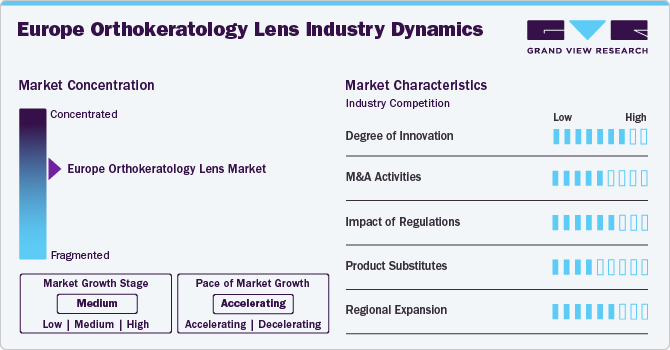
Regulations significantly impact the Europe orthokeratology lens industry by ensuring safety, efficacy, and compliance with EU Medical Device Regulation (MDR) 2017/745. Strict CE marking requirements, clinical trials, and post-market surveillance create high entry barriers but enhance consumer trust. National health authorities regulate fitting procedures, emphasizing optometrist training and patient safety. Stricter oversight on myopia control affects marketing strategies, while cross-border collaboration through ERN-EYE supports research.
Strategic partnerships enhance innovation and allow firms to combine resources for research and development. For instance, in June 2022, CooperVision acquired EnsEyes, a top provider of orthokeratology and scleral contact lenses in the Nordic region of Europe. EnsEyes will now operate under the CooperVision Specialty EyeCare group. Based in Kolding, Denmark, the company has served customers in Denmark, Sweden, Norway, and Finland for over a decade. This acquisition aims to expand specialty lens adoption across these markets.
In the Europe orthokeratology lens industry, product substitutes include soft multifocal contact lenses, atropine eye drops, and refractive surgery (LASIK, PRK) for myopia management. Daily disposable and extended-wear contact lenses offer convenience, while spectacles remain a non-invasive alternative. Atropine therapy, supported by clinical studies, is gaining traction as a pharmaceutical solution for myopia control. Refractive surgeries provide permanent correction, appealing to adults seeking long-term solutions. Despite alternatives, orthokeratology remains a preferred choice for children and non-surgical candidates, driven by its reversible, non-invasive nature and growing awareness of myopia progression control in Europe.
The Europe orthokeratology lens market is experiencing notable expansion. In April 2023, ZEISS launched its progressive myopia management solutions in the region. Studies emphasize varying prevalence rates and the necessity for customized approaches for different patient groups. The introduction of ZEISS MyoCare lenses is expected to be instrumental in managing progressive myopia, providing specialized solutions to cater to the diverse needs of patients across Europe.
Product Insights
The overnight ortho-K lenses segment accounted for the largest revenue share of 95.5% in 2024. This growth is driven by the high adoption rates and effectiveness of overnight ortho-K lenses. These lenses significantly alleviate discomfort often associated with conventional contact lenses, making them an attractive option for individuals who prefer not to wear glasses or contacts during the day, especially during sports. Their convenience particularly appeals to children and young adults, providing an effective solution for myopia management. As myopia prevalence rises and awareness of non-surgical alternatives increases, these lenses gain popularity. Additionally, improvements in lens materials and design enhance comfort and effectiveness, fostering continued growth in this segment as more consumers seek innovative vision correction options.
The daytime ortho-K lenses segment in the Europe orthokeratology lens market is projected to experience the fastest compound annual growth rate (CAGR) over the forecast period. Daytime ortho-K lenses, typically worn at night, can cause discomfort and symptoms like dry eye when worn during the day, potentially hindering market growth. However, they attract a wide consumer base, especially children and young adults seeking non-surgical myopia solutions. Increased awareness of myopia’s long-term effects and advancements in lens technology enhance comfort and visual clarity, driving demand. As more eye care professionals recommend these lenses, this segment is likely to maintain a leading position in market revenues.
Indication Insights
The myopia segment held the largest share of 40.7% in 2024. The rising prevalence of myopia is expected to drive growth in the orthokeratology lens market during the study period. As reported in the journal Investigative Ophthalmology and Visual Science, around 1.9 billion people, or about 27% of the global population, are affected by myopia. The International Myopia Institute indicates that myopia is on the rise globally, with recent estimates suggesting that 30% of the population is currently myopic, potentially increasing to nearly 50%-about 5 billion people-by 2050. This condition poses significant risks of ocular complications and high healthcare costs, making it a leading cause of permanent blindness worldwide during the forecast period.
The astigmatism segment is projected to grow at the fastest CAGR during the forecast period, driven by rising awareness of ortho-K for astigmatism correction and technological advancements in toric lens designs. Increasing myopia and astigmatism prevalence, especially among children, fuels the demand for non-surgical vision correction options.
Distribution Channel Insights
The ophthalmology clinics segment accounted for the largest revenue share of 31.3% in 2024. This growth can be attributed to the increasing number of specialized clinics offering advanced myopia management solutions. These clinics provide comprehensive eye care, including personalized consultations and fitting of orthokeratology lenses, enhancing patient experiences. Additionally, the rising awareness of myopia and its associated risks has led more individuals to seek professional care. With the continued emphasis on non-surgical vision correction options and innovative treatment strategies, ophthalmology clinics are well-positioned to drive further market expansion in the orthokeratology lens sector.
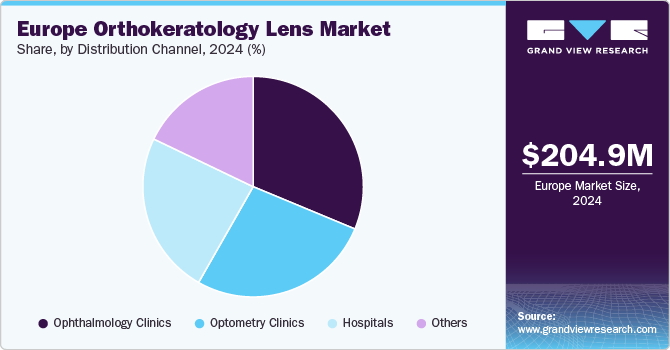
The optometry clinics segment is expected to experience notable growth over the forecast period. This growth is driven by the rising demand for personalized eye care services, as more patients seek effective myopia management solutions. Optometry clinics play a crucial role in educating patients about the benefits of orthokeratology lenses, facilitating their adoption. Additionally, advancements in lens technology and fitting techniques enhance patient outcomes, further encouraging visits to these clinics. As awareness of vision health continues to grow, optometry clinics are expected to become key players in the market.
Country Insights
UK Orthokeratology Lens Market Trends
The UK orthokeratology lens market is experiencing notable growth, driven by increasing screen time among the population. According to data from Independent UK published in June 2024, Brits spend an average of 1 hour and 52 minutes daily on social media. This prolonged exposure to screens raises concerns about eye strain and exacerbates existing vision issues. As a result, there is a growing demand for effective diagnostic tools like orthokeratology lenses to assess and address these vision-related problems.
France Orthokeratology Lens Market Trends
The orthokeratology lens market in France is expanding, driven by a rising awareness of retinal disorders and the aging population. The increasing incidence of conditions like diabetic retinopathy and macular degeneration is fueling demand for advanced diagnostic tools. Enhanced research initiatives and improved healthcare infrastructure further support market growth in the country. According to World Bank data, France’s healthcare expenditure was around 12.31% of its GDP in 2021.
Germany Orthokeratology Lens Market Trends
Germany orthokeratology lens market is experiencing robust growth, primarily driven by increasing awareness of retinal health and a significant rise in eye disorders. Notably, Staar Surgical reports that the EuroEyes clinic group performed the highest number of ICL surgeries in Germany in 2021. The aging population, coupled with a high prevalence of conditions such as diabetic retinopathy and macular degeneration, intensifies the demand for precise diagnostic tools. Germany's well-established healthcare system, supported by advanced research and technological innovations, facilitates the adoption of orthokeratology lens devices in clinical settings.
Key Europe Orthokeratology Lens Company Insights
The scenario in the Europe orthokeratology lens market is highly competitive, with key players such as Bausch & Lomb Inc., CooperVision; and Johnson & Johnson Vision Care, Inc. holding significant positions. The major companies are undertaking various organic as well as inorganic strategies such as new product development, collaborations, acquisitions, mergers, and regional expansion to serve the unmet needs of their customers.
Key Europe Orthokeratology Lens Companies:
- Bausch & Lomb Inc.
- Euclid Systems Corp.
- CooperVision
- Johnson & Johnson Vision Care, Inc.
- Alpha Corporation (Menicon Group)
- Brighten Optix, Co.
- GP Specialists
- MiracLens L.L.C.
Recent Developments
-
In May 2021, CooperVision’s DreamLite orthokeratology (ortho-k) lenses received European approval for myopia management. Designed for children with progressive myopia, these lenses reshape the cornea overnight, providing clear daytime vision. The approval expands access to non-surgical myopia control solutions across Europe, supporting growing demand for effective myopia management options.
Europe Orthokeratology Lens Market Report Scope
Report Attribute
Details
Market size value in 2025
USD 217.4 million
Revenue forecast in 2030
USD 295.6 million
Growth rate
CAGR of 6.3% from 2025 to 2030
Actual Data
2018 - 2024
Forecast period
2025 - 2030
Quantitative units
Revenue in USD million/billion and CAGR from 2025 to 2030
Report coverage
Revenue forecast, company ranking, competitive landscape, growth factors, and trends
Segments covered
Product, indication, and distribution channel
Regional scope
Europe
Country scope
U.K.; Germany; France; Italy; Spain; Denmark; Sweden; Norway;
Key companies profiled
Bausch & Lomb Inc.; Euclid Systems Corp.; CooperVision; Johnson & Johnson Vision Care, Inc.; Alpha Corporation (Menicon Group); Brighten Optix, Co.; GP Specialists; MiracLens L.L.C.
Customization scope
Free report customization (equivalent up to 8 analysts working days) with purchase. Addition or alteration to country, regional & segment scope.
Pricing and purchase options
Avail customized purchase options to meet your exact research needs. Explore purchase options
Europe Orthokeratology Lens Market Report Segmentation
This report forecasts revenue growth at the regional level and provides an analysis of the latest industry trends and opportunities in each of the sub-segments from 2018 to 2030. For this study, Grand View Research has segmented the Europe orthokeratology lens market report on the basis of product, indication, distribution channel and region:
-
Product Outlook (Revenue, USD Million, 2018 - 2030)
-
Overnight Ortho-K lenses
-
Day-time Ortho-K lenses
-
-
Indication Outlook (Revenue, USD Million, 2018 - 2030)
-
Myopia
-
Presbyopia
-
Hypermetropia
-
Astigmatism
-
-
Distribution Channel Outlook (Revenue, USD Million, 2018 - 2030)
-
Hospitals
-
Optometry Clinics
-
Ophthalmology Clinics
-
Others
-
-
Regional Outlook (Revenue, USD Million, 2018 - 2030)
-
Europe
-
UK
-
Germany
-
France
-
Italy
-
Spain
-
Denmark
-
Sweden
-
Norway
-
-
Frequently Asked Questions About This Report
b. The Europe orthokeratology lens market size was estimated at USD 204.9 million in 2024 and is expected to reach USD 217.4 million in 2025.
b. The Europe orthokeratology lens market is expected to grow at a compound annual growth rate of 6.3% from 2025 to 2030, reaching USD 295.6 million by 2030.
b. Germany dominated the Europe orthokeratology lens market, with a share of 17.1% in 2024. This is attributable to the increasing awareness of retinal health and a significant rise in eye disorders.
b. Some key players operating in the Europe orthokeratology lens market include Bausch & Lomb Inc.; Euclid Systems Corp.; CooperVision; Johnson & Johnson Vision Care, Inc.; Alpha Corporation (Menicon Group); Brighten Optix, Co.; GP Specialists; MiracLens L.L.C.
b. Key factors driving the growth of the European orthokeratology lens market include the rising awareness of myopia management and the increasing prevalence of refractive errors. Innovative lens technologies and materials enhance comfort and effectiveness, attracting consumers and eye care professionals.

Share this report with your colleague or friend.
Need a Tailored Report?
Customize this report to your needs — add regions, segments, or data points, with 20% free customization.


ISO 9001:2015 & 27001:2022 Certified
We are GDPR and CCPA compliant! Your transaction & personal information is safe and secure. For more details, please read our privacy policy.
Trusted market insights - try a free sample
See how our reports are structured and why industry leaders rely on Grand View Research. Get a free sample or ask us to tailor this report to your needs.













