
- Home
- »
- Plastics, Polymers & Resins
- »
-
Europe PE & PP Compounding Market, Industry Report 2033GVR Report cover
![Europe PE And PP Compounding Market Size, Share & Trends Report]()
Europe PE And PP Compounding Market (2026 - 2033) Size, Share & Trends Analysis Report By Type (PE, PP), By PE Polymer (LLDPE, LDPE, MDPE, HDPE), By PP Polymer, By PE Compound, By PP Compound, By PE Application, By PP Application, By Region, And Segment Forecasts
- Report ID: GVR-4-68040-875-3
- Number of Report Pages: 200
- Format: PDF
- Historical Range: 2021 - 2024
- Forecast Period: 2026 - 2033
- Industry: Bulk Chemicals
- Report Summary
- Table of Contents
- Segmentation
- Methodology
- Download FREE Sample
-
 Download Sample Report
Europe PE & PP Compounding Market Summary
The Europe PE and PP compounding market size was estimated at USD 32.1 billion in 2025 and is projected to reach USD 52.9 billion by 2033, growing at a CAGR of 6.4% from 2026 to 2033. The European market for PE and PP compounding is expected to grow substantially, driven by expanding disposable incomes and increased construction activity to meet rising housing demand.
Key Market Trends & Insights
- Germany dominated the Europe PE and PP compounding industry with the largest revenue share of 20.8% in 2025.
- By type, PP Compounding dominated the Europe PE and PP compounding industry in 2025 with a revenue share of 58.7%.
- By PE type, the LLDPE segment is expected to grow at a considerable CAGR of 7.1% from 2026 to 2033 in terms of revenue.
- By PP type, the terpolymer PP segment is expected to grow at a considerable CAGR of 8.2% from 2026 to 2033 in terms of revenue.
- By PE application, the wire & cable segment is expected to grow at the fastest CAGR of 7.7% from 2026 to 2033 in terms of revenue.
Market Size & Forecast
- 2025 Market Size: USD 32.1 Billion
- 2033 Projected Market Size: USD 52.9 Billion
- CAGR (2026-2033): 6.4%
The growing demand from key end use industries, such as automotive, consumer goods, and electrical & electronics, is driving demand for PE and PP compounds. In the European plastic compounding industry, compounds made from polyethylene (PE) and polypropylene (PP) account for a significant share due to their versatility, cost advantages, and extensive use in packaging, automotive, construction, and consumer goods industries. The market is marked by strong demand for enhanced-performance compounds, including filled, reinforced, flame-retardant, and impact-modified grades designed to meet increasingly stringent mechanical, thermal, and regulatory standards.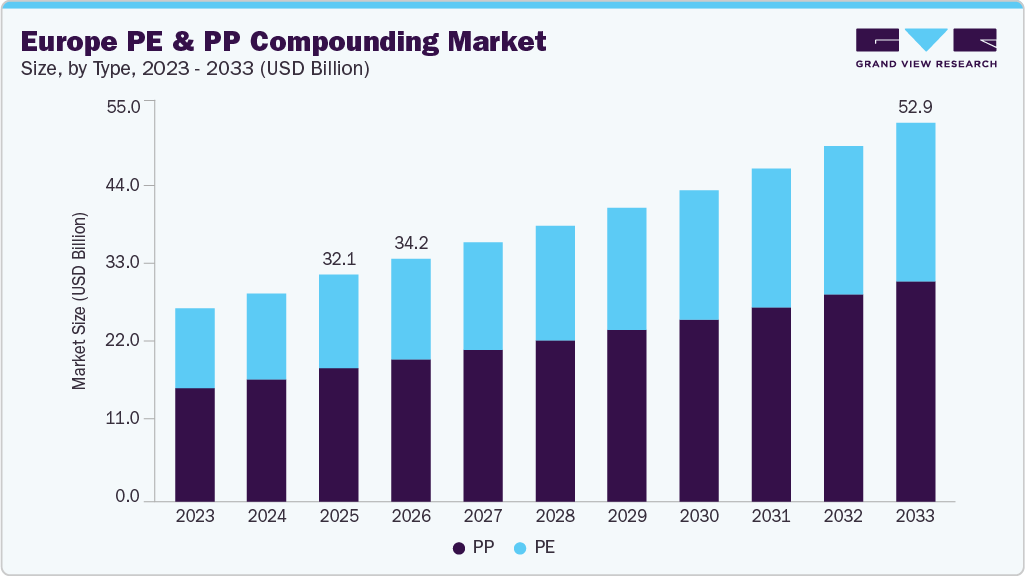
The growth is being fueled by trends such as the lightweighting of automotive parts, a greater emphasis on recyclable materials in packaging, and the growing acceptance of custom compounds designed for specific processing techniques, such as injection molding and extrusion. Furthermore, European regulations that promote circular economy practices are motivating compounders to use recycled PE and PP resins and to create sustainable formulations, transforming product development approaches and competitive landscapes within the regional compounding sector.
Drivers, Opportunities & Restraints
The growing demand from the packaging and automotive sectors is a significant factor driving the use of PE and PP compounds in Europe. These polymers provide an advantageous combination of affordability, mechanical performance, and ease of processing, making them popular choices for both rigid and flexible packaging, as well as interior automotive components and consumer goods. Furthermore, the growing emphasis on lightweight materials to enhance fuel efficiency and reduce emissions in the automotive industry continues to boost the use of PP compounds, while PE compounds remain essential for high-volume packaging applications.
The shift to a circular economy in Europe is presenting opportunities for compounders to develop sustainable PE and PP formulations that incorporate recycled materials and advanced additives. There is growing demand for recycled-content compounds among manufacturers in the packaging, automotive, and consumer goods sectors, as companies strive to achieve sustainability goals and comply with regulations. This trend is fostering innovation in compounding technologies, particularly in enhancing the compatibility of recycled polymers and creating high-performance recycled PE and PP compounds.
However, strict environmental regulations and increased examination of traditional plastics pose a challenge for the PE and PP compounding sector in Europe. Rules designed to minimize plastic waste and limit single-use plastics are encouraging manufacturers to transition to alternative materials or allocate resources to expensive recycling processes and compliance requirements. These regulatory challenges, combined with fluctuations in polymer feedstock prices, can affect compounders' production expenses and profit margins.
Market Concentration & Characteristics
The European market for PE and PP compounding exhibits moderate to high levels of innovation, with a primary focus on developing performance-enhanced, sustainable formulations. Compounders are channeling investments into advanced additive technologies, incorporating recycled materials, and developing application-specific material solutions to satisfy the changing demands of customers in packaging, automotive, and consumer goods sectors. Simultaneously, the market has experienced consistent merger and acquisition activity, as major compounders aim to broaden their geographic reach, bolster technical expertise, and improve their product offerings. Strategic acquisitions and collaborations are frequently employed to gain access to specialized compounding technologies and strengthen positions in rapidly growing areas such as sustainable and engineered polyolefin compounds.
Regulatory frameworks in Europe significantly influence the PE and PP compounding industry. Environmental regulations aimed at reducing plastic waste, recycling mandates, and initiatives promoting a circular economy are shaping material choices and product development strategies. Producers are increasingly obligated to incorporate recycled materials, enhance product recyclability, and comply with strict environmental and chemical regulations.
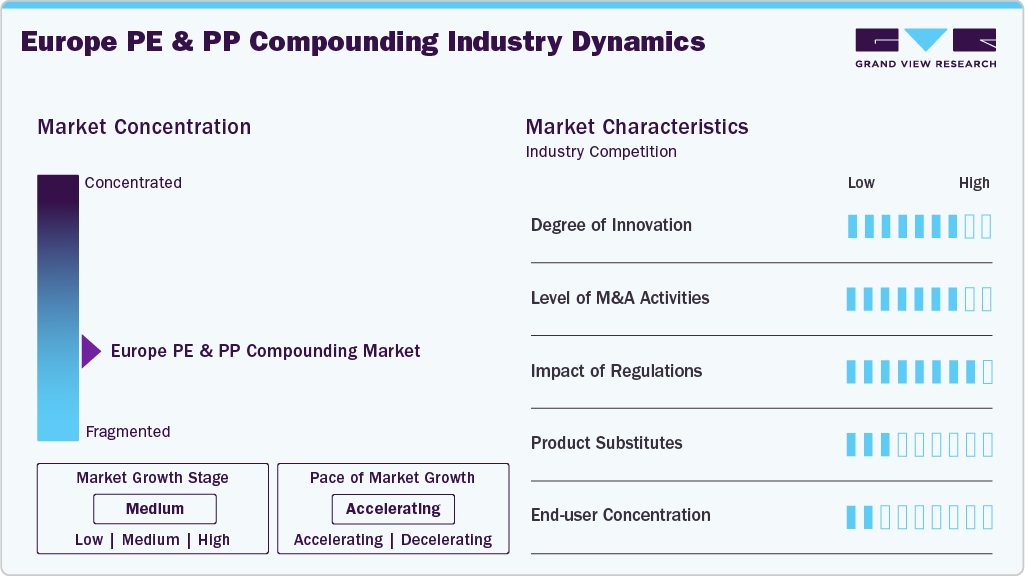
The compounding market for PE and PP faces moderate competitive pressure from alternative materials, including engineering plastics, biopolymers, and, occasionally, metals or composites, especially in applications that demand superior thermal or mechanical performance. Nevertheless, the cost-effectiveness and processing benefits of polyolefins help maintain their broad usage. In terms of demand, the market serves a diverse set of end users. Although the packaging and automotive industries account for a major share of consumption, PE and PP compounds are also extensively used in the construction, electrical and electronics, and consumer goods sectors. This wide-ranging application landscape distributes demand across various industries, reducing reliance on any single end use sector and promoting consistent market consumption across economic cycles.
PE Compounding Polymer Insights
In terms of PE polymer, HDPE accounted for the largest revenue share, 38.2%, in 2025. The demand is driven by the need for strong, chemically resistant materials used in packaging, piping, construction, automotive parts, and rigid consumer products.
PP Compounding Polymer Insights
In terms of PP polymer, the Homopolymer PP segment accounted for the largest revenue share of 73.0% in 2025. The segment is primarily driven by the need for durable, affordable polypropylene compounds suitable for injection molding, extrusion, and thermoforming.
PE Compounding Insights
Based on PE compounding compound, the HDPE pipe compound segment accounted for the largest revenue share of 34.8% of the overall market in 2025. The growing need for corrosion-resistant materials used in water distribution, gas pipelines, sewage systems, and infrastructure for transporting industrial fluids is expected to drive the demand in the coming years.
PP Compounding Insights
Based on the PP Compounding compound, the mineral-filled segment accounted for the largest revenue share of 32.8% in 2025. The segment growth is driven by their enhanced rigidity, thermal resilience, economic viability, and adaptability across automotive, consumer products, and industrial applications.
PE Compounding Application Insights
In terms of PE compounding application, the packaging segment accounted for the largest revenue share of 34.6% of the overall market in 2025. The packaging segment’s main commercial impulse is rapid omnichannel retail and e-commerce growth, which creates persistent demand for protective, lightweight, and multi-format packaging films and rigid formats.
PP Compounding Application Insights
In terms of PE compounding application, the packaging segment accounted for the largest revenue share of 34.6% of the overall market in 2025. The automotive segment accounted for the largest revenue share of 36.6% of the overall market in 2025. The sheer scale of plastic use in European vehicles is a structural demand driver for PP compounders, as it creates a large, steady baseline of parts that require replacement, refurbishment, and new-model qualification.
Type Insights
By type, the PP segment accounted for the largest share at 58.7% in 2025, driven by its cost-effectiveness, mechanical properties, and processing flexibility. These compounds are commonly employed in high-volume applications, including automotive parts, rigid packaging, appliances, and consumer products, where features such as impact resistance, chemical durability, and lightweight design are essential. In the automotive industry, PP compounds are widely used for both interior and exterior components as manufacturers increasingly emphasize lightweight materials to enhance fuel efficiency and minimize emissions.
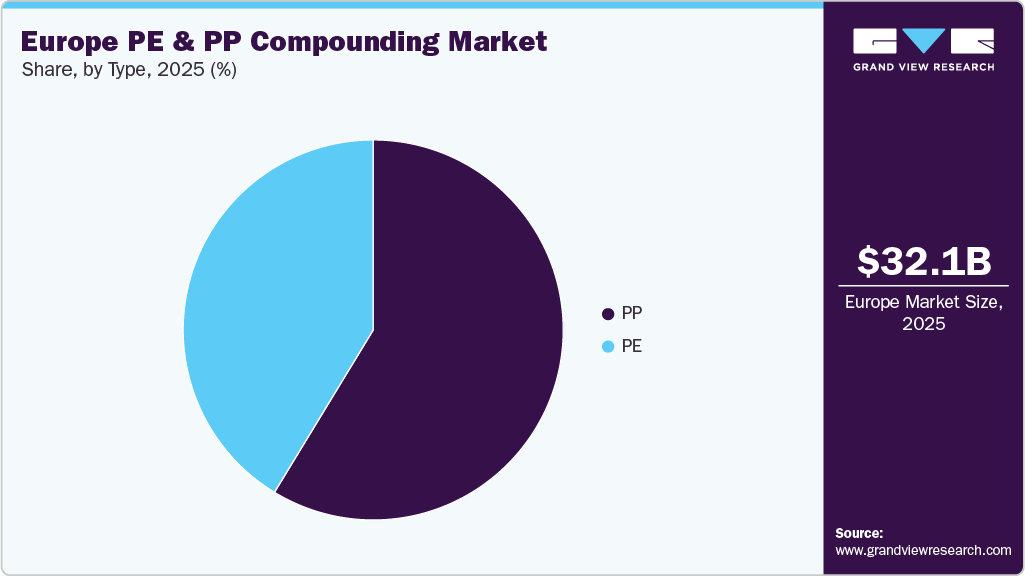
The PE segment is expected to grow significantly over the coming years. Market growth is supported by growing demand in the packaging, construction, and infrastructure sectors. PE compounds offer outstanding chemical resistance, flexibility, durability, and excellent processability, making them ideal for a wide range of film, pipe, and molded applications. The swift growth of flexible packaging, especially in the food and consumer goods industry, is significantly boosting demand for PE compounds in this sector.
Regional Insights
The polyethylene (PE) and polypropylene (PP) compounding industry in Europe is a well-established yet continuously evolving segment of the regional plastics industry, driven by robust demand from sectors such as packaging, automotive, construction, and consumer goods. Compounders in Europe are focusing on developing tailored formulations that enhance the mechanical, thermal, and processing properties of polyolefins to meet end use needs. The market is also shaped by the region's robust regulatory framework and sustainability efforts, which promote the incorporation of recycled materials and the creation of recyclable compound solutions.
Germany PE And PP Compounding Market Trends
The Germany PE and PP compounding industry is among the largest and most established in Europe, supported by the country's strong manufacturing infrastructure and advanced plastics processing industry. Key drivers of demand are the automotive, packaging, electrical and electronics, and industrial sectors, where compounded polyolefins are widely used for lightweight, durable, and cost-effective components. The country's prominent automotive manufacturing capabilities and the transition to electric vehicles are significantly boosting demand for high-performance polypropylene compounds used in interior trims, bumpers, battery casings, and various under-the-hood components.
UK PE And PP Compounding Market Trends
The industry for PE and PP compounding in the UK is marked by consistent demand, bolstered by the country's well-established sectors in packaging, automotive, construction, and electrical industries. Packaging remains a major sector of consumption, driven by a strong demand for lightweight, recyclable plastic materials used for food, beverages, and consumer products. Furthermore, rising regulatory pressure on plastic waste management and recycling is prompting compounders to develop sustainable formulations that incorporate recycled materials.
Key Europe PE And PP Compounding Company Insights
Key companies are adopting a range of organic and inorganic growth strategies, such as new product development, mergers & acquisitions, and joint ventures, to maintain and expand their market share.
-
In January 2026, SABIC agreed to sell its European Petrochemicals business to AEQUITA. The transaction covers multiple European sites and was framed as portfolio optimization to focus SABIC on core global activities; regulatory and consultation steps were noted as the next milestones. This affects regional olefin/polyolefin value chains.
-
In June 2025, LyondellBasell Industries N.V. announced exclusive negotiations with AEQUITA for the sale of selected European olefins & polyolefins assets. The carve-out was presented as part of the strategic reshaping of European operations and will transfer integrated and non-integrated assets, along with supporting functions, to AEQUITA, pending approvals and consultations.
Key Europe PE And PP Compounding Companies:
- LyondellBasell Industries
- SABIC
- Borealis AG
- ExxonMobil Chemical
- Dow Inc.
- INEOS Group Limited
- Chevron Phillips Chemical Company
- Ravago Group
- Mitsui Chemicals
- HDC HYUNDAI EP COMPANY
Europe PE And PP Compounding Market Report Scope
Report Attribute
Details
Market size value in 2026
USD 34.2 billion
Revenue forecast in 2033
USD 52.9 billion
Growth rate
CAGR of 6.4% from 2026 to 2033
Historical data
2021 - 2024
Forecast period
2026 - 2033
Quantitative Units
Revenue in USD million and CAGR from 2026 to 2033
Report coverage
Volume forecast, capacity forecast, revenue forecast, competitive landscape, growth factors, and trends
Segments covered
Type, PE polymer, PP polymer, PE compound, PP compound, PE compounding application, PP compounding application, and region
Country scope
Germany; UK; France; Italy; Spain; The Netherlands; Belgium; Poland
Key companies profiled
LyondellBasell Industries; SABIC; Borealis AG; ExxonMobil Chemical; Dow Inc.; INEOS Group Limited; Chevron Phillips Chemical Company; Ravago Group; Mitsui Chemicals; HDC HYUNDAI EP COMPANY
Customization scope
Free report customization (equivalent up to 8 analysts working days) with purchase. Addition or alteration to country, regional & segment scope.
Pricing and purchase options
Avail customized purchase options to meet your exact research needs. Explore purchase options
Europe PE And PP Compounding Market Report Segmentation
This report forecasts revenue growth at the regional and country levels and analyzes the latest industry trends and opportunities across sub-segments from 2021 to 2033. For this study, Grand View Research has segmented the Europe PE and PP compounding market report based on type, PE polymer, PP polymer, PE compound, PP compound, PE compounding application, PP compounding application, and region:
-
Type Outlook (Volume, Kilotons; Revenue, USD Million, 2021 - 2033)
-
PE
-
PP
-
-
PE Polymer Outlook (Volume, Kilotons; Revenue, USD Million, 2021 - 2033)
-
LLDPE
-
LDPE
-
MDPE
-
HDPE
-
-
PP Polymer Outlook (Volume, Kilotons; Revenue, USD Million, 2021 - 2033)
-
Homopolymer PP
-
Copolymer PP
-
Terpolymer PP
-
-
PE Compounding Outlook (Volume, Kilotons; Revenue, USD Million, 2021 - 2033)
-
HDPE pipe compound
-
LDPE/LLDPE modified
-
Cross-linkable PE (XLPE)
-
Carbon-black filled PE
-
Conductive PE
-
-
PP Compounding Outlook (Volume, Kilotons; Revenue, USD Million, 2021 - 2033)
-
Talc-filled
-
Glass-filled
-
Mineral-filled
-
Impact-modified
-
Thermoplastic Polyolefin (TPO)
-
Flame-Retardant (FR) PP
-
Conductive PP
-
-
PE Compounding Application Outlook (Volume, Kilotons; Revenue, USD Million, 2021 - 2033)
-
Pipe & Infrastructure
-
Gas distribution pipes (PE80, PE100)
-
Drinking water pressure pipes
-
Sewer & drainage pipes
-
Cable protection ducts
-
Irrigation pipes
-
-
Wire & Cable
-
Power cable insulation (XLPE)
-
Medium & high voltage insulation
-
Telecom cable sheathing
-
Flame-retardant cable jacketing
-
Semiconductive cable layers
-
-
Packaging
-
Milk & beverage bottles
-
Detergent bottles
-
Jerry cans & drums
-
Chemical storage containers
-
Food-grade bottles
-
-
Automotive
-
Fuel tanks
-
Fuel lines
-
Washer fluid reservoirs
-
Coolant tanks
-
Underbody shields
-
-
Construction
-
Geomembranes (landfill liners)
-
Waterproof membranes
-
Damp proof sheets
-
Protective construction films
-
-
Other applications
-
-
PP Compounding Application Outlook (Volume, Kilotons; Revenue, USD Million, 2021 - 2033)
-
Automotive
-
Bumpers
-
Instrument panels
-
Door trims
-
Battery housings (EV)
-
Air intake manifolds
-
Front-end modules
-
-
Electrical & Electronics
-
Switch housings
-
Circuit breaker casings
-
Distribution boxes
-
Cable trucking
-
EV fuse housings
-
-
Packaging
-
Thin-wall food containers
-
Dairy cups
-
Microwave trays
-
Caps & closures
-
Reusable crates
-
-
Construction
-
PP-R plumbing pipes
-
Hot & cold-water fittings
-
Roofing membranes (TPO)
-
Structural profiles
-
-
Consumer Goods & Appliances
-
Washing machine components
-
Refrigerator liners
-
Furniture parts
-
Storage bins
-
-
Medical & Healthcare
-
Syringes
-
IV components
-
Lab containers
-
Diagnostic trays
-
-
Other applications
-
-
Regional Outlook (Volume, Kilotons; Revenue, USD Million, 2021 - 2033)
-
Europe
-
Germany
-
UK
-
France
-
Italy
-
Spain
-
The Netherlands
-
Belgium
-
Poland
-
-
Frequently Asked Questions About This Report
b. The Europe PE and PP Compounding Market size was estimated at USD 32.1 billion in 2025 and is expected to reach USD 34.2 billion in 2026.
b. The Europe PE and PP Compounding Market is expected to grow at a compound annual growth rate of 6.4% from 2026 to 2033, reaching USD 52.9 billion by 2033.
b. PP type segment accounted for the largest share at 58.7% in 2025, driven by its cost-effectiveness, mechanical properties, and processing flexibility. These compounds are commonly employed in high-volume applications, including automotive parts, rigid packaging, appliances, and consumer products, where features such as impact resistance, chemical durability, and lightweight design are essential.
b. Some of the key players operating in this industry include LyondellBasell Industries, SABIC, Borealis AG, ExxonMobil Chemical, Dow Inc., INEOS Group Limited, Chevron Phillips Chemical Company, and Ravago Group, among others.
b. The European PE and PP compounding market is expected to grow substantially, driven by expanding disposable incomes and increased construction activity to meet rising housing demand. The growing demand from key end-use industries, such as automotive, consumer goods, and electrical & electronics, is driving demand for PE and PP compounds.


Share this report with your colleague or friend.
Need a Tailored Report?
Customize this report to your needs — add regions, segments, or data points, with 20% free customization.


ISO 9001:2015 & 27001:2022 Certified
We are GDPR and CCPA compliant! Your transaction & personal information is safe and secure. For more details, please read our privacy policy.
Trusted market insights - try a free sample
See how our reports are structured and why industry leaders rely on Grand View Research. Get a free sample or ask us to tailor this report to your needs.













