
- Home
- »
- Next Generation Technologies
- »
-
Face-swiping Payment Market Size, Growth Report, 2026-2033GVR Report cover

Face-swiping Payment Market (2026 - 2033)
Size, Share & Trends Analysis Report By Type (Payment Equipment, Payment System), By Application (Retail, Restaurant, Travel), By Region, And Segment Forecasts
Market Size, 2025
$8.0BMarket Estimate, 2026
$9.5BMarket Forecast, 2033
$37.8BCAGR, 2026–2033
18.5%Face-swiping Payment Market Summary
The global face-swiping payment market size was valued at USD 8.0 billion in 2025 and is projected to grow from USD 9.5 billion in 2026 to USD 37.8 billion in 2033, at a CAGR of 18.5%from 2026 to 2033. Asia Pacific dominated the market in 2025 and accounted for a share of over 47.0% of the global revenue. The growth can be attributed to the increasing adoption of face-swiping payment technology by consumers and merchants for small-scale transactions.
Key Market Trends & Insights
- By type: The payment equipment segment dominated the market, with a revenue share of over 56.0% in 2025.
- By application: The retail segment held the largest revenue share of around 31.0% in 2025.
Regional Insights
- Largest regional market: Asia Pacific (Approximately 47.0% revenue share, 2025)
- Fastest-growing regional market: Asia Pacific (highest CAGR, 2026-2033)
Market Size & Forecast
- Market size in 2025: USD 8.0 Billion
- Estimated market size in 2026: USD 9.5 Billion
- Projected market size by 2033: USD 37.8 Billion
- CAGR (2026-2033): 18.5%
Three ways to get this report
Buy it, customize it, or ask a question.Ask an Analyst
Analyst response in 1 business day
- AccessReport author, directly
- Reply timeWithin 1 working day
- No sales callDirect answer only
- FormatEmail reply
- CostFree, no cost
Get the Full Report
What the study covers
- FormatsPDF · Excel · Dashboard
- Timeline2026–2033 annual, 2025 base
- Coverage20+ countries, 5 regions
- Companies10+ key players profiled
Customize the Report
20% free customization
- IncludeCountries, segments, points
- TailorTo your product definition
- ExtendDeeper competitor detail
- OrA fully bespoke study
- Turnaround5–10 working days
The rise in the adoption of technology can be attributed to lucrative benefits offered by face payments such as reduced transaction time and ease in processing payments. In addition, the rising demand for contactless payments worldwide is another major factor expected to drive the industry’s growth. Moreover, the face-swiping payment systems are based on facial recognition technology, making it more secure than other digital payment methods, which use PINs and passcode to authenticate a user. Source: Grand View Research, IR Documents, Primary Interviews, Paid DatabasesTo learn more about this report,
 Download Free Sample Report
 Several governments are using face recognition technology to improve customer experience. This allows travelers to make payments by scanning their faces. For instance, in January 2025, Russia started rolling out a nationwide facial recognition payment system. This was done in partnership with Sber and the National Payment Card System (NSPK). The plan involved installing about two million biometric terminals across the country. This builds on the existing Face Pay system that was first launched in Moscow's metro and later expanded to cities such as Kazan and Nizhny Novgorod. As a result, these initiatives are expected to boost market growth.
Technological progress in Artificial Intelligence (AI) and machine learning has improved the accuracy and speed of facial recognition technology. This makes it more suitable for payment transactions. In addition, advancements in face-swiping technology, such as the integration of internet of things (IoT) in these solutions, are expected to boost market growth. The increasing number of face-swiping solutions and services from market players, which allow customers to make payments using this technology, also supports this growth. For instance, in December 2025, NEC Orchestrating Future Fund, a corporate venture capital fund focused on ecosystems, invested in PopID, Inc. This U.S.-based company provides face authentication payment services. The goal was to combine NEC's biometric authentication technology with PopID's payment platform to create a new global standard for secure and seamless digital transactions. At that time, PopID had expanded its platform to over 1,000 merchants across the U.S., including major quick-service chains such as Whataburger and Steak 'n Shake.
The face-swiping payment market is anticipated to be driven by a variety of high-tech technological features. Some of these features include facial 3D depth, blink detection, facial motion recognition, bright pupil effect detection, average difference detection, optical flow field judgment, and other algorithms that enable quick and secure payments. Furthermore, the growing investments in the face-swiping payment technology providing companies by venture capital firms bode well for the industry's growth. For instance, in June 2025, PopID secured a Series C funding round led by Verifone, with participation from PayPal, Visa Ventures, Commerce Ventures, and Chipotle's Cultivate Next venture fund, aimed at scaling its biometric payment platform, expanding its network of strategic partnerships, and retrofitting Verifone's existing payment terminals globally with embedded face recognition capabilities.
Market Dynamics
The face-swiping payment market is mainly driven by the growing need for secure, convenient, and touch-free payment options for consumers and businesses. The rise in digital wallets, biometric authentication technologies, and cashless payment systems has increased the demand for facial recognition payment solutions. Retailers, financial institutions, and payment service providers are adopting face-swiping payment systems to speed up transactions, improve customer experience, and enhance fraud prevention efforts. In addition, advancements in artificial intelligence (AI), facial recognition accuracy, and real-time verification technologies are making biometric payment solutions more reliable and scalable, encouraging wider market adoption.
The face-swiping payment market is mainly driven by the growing need for secure, convenient, and touch-free payment experiences among consumers and businesses. The increased use of digital wallets, biometric authentication technologies, and cashless payment systems has boosted the demand for facial recognition payment solutions. Retailers, financial institutions, and payment service providers are adopting face-swiping payment systems to speed up transaction times, improve customer experiences, and enhance fraud prevention. In addition, progress in artificial intelligence (AI), facial recognition accuracy, and real-time identity verification technologies are making biometric payment solutions more reliable and scalable, which helps to support wider market acceptance.
The rising acceptance of facial authentication technologies is clear from the rapid increase in biometric verification transactions. According to India's Ministry of Electronics & Information Technology (MeitY), the facial authentication system run by the Unique Identification Authority of India (UIDAI) has seen over 1.305 billion cumulative authentication transactions since its start in October 2022, with around 1.02 billion transactions occurring during FY 2024-25. In the January to March 2025 quarter alone, the platform handled 395 million transactions, including 152.5 million in March 2025, which is a 21.6% rise from the previous month. This significant growth in facial authentication shows increasing consumer confidence in facial recognition technologies and indicates a greater acceptance of biometric digital transactions. This trend lays a strong foundation for the use of face-swiping payment solutions in retail, banking, transportation, and other business sectors.
The face-swiping payment market faces several challenges related to data privacy, cybersecurity, and regulatory compliance. Facial recognition payment systems rely on collecting, storing, and processing sensitive biometric data. This raises concerns about unauthorized access, data breaches, identity theft, and possible misuse of personal information. Keeping up with evolving data protection laws, such as the General Data Protection Regulation (GDPR) and other biometric privacy statutes, can make operations more complex and costly for service providers. Moreover, setting up face-swiping payment systems requires a significant investment in high-resolution cameras, biometric authentication software, AI-powered recognition systems, and secure cloud or edge-computing platforms. Consumer hesitation to share facial data and differing regulatory frameworks across countries may also limit widespread adoption and slow market growth.
Opportunity - Growth of Smart Retail, AI-Powered Biometric Payments, and Digital Economy Initiatives
The face-swiping payment market offers considerable growth potential as smart retail technologies, AI-driven payment systems, and cashless transactions become increasingly prevalent. Retailers are investing more in cashier-less stores, self-service checkout solutions, smart vending machines, and automated payment systems that benefit from seamless facial recognition transactions. Continuous improvements in artificial intelligence, computer vision, liveness detection, and anti-spoofing technologies are boosting authentication accuracy, security, and user trust, making face-swiping payments more feasible for large-scale use. Furthermore, government-led digital transformation initiatives, smart city development programs, and rising investments in digital financial infrastructure in emerging economies are creating favorable conditions for the adoption of biometric payments. Integrating facial recognition payments with digital banking platforms, loyalty programs, and omnichannel retail systems is expected to open up new revenue opportunities and speed up market growth in the coming years.
Analyst Perspective
The face-swiping payment market is supported by strong long-term growth drivers, including the rapid adoption of biometric authentication technologies, increasing consumer preference for seamless and contactless payment experiences, and growing deployment of facial recognition-enabled payment terminals across retail, food service, transportation, and financial service environments worldwide. The market is highly influenced by the continuous advancement of artificial intelligence, computer vision, and liveness detection technologies, which is improving the accuracy, speed, and security of face-swiping payment systems and making them increasingly viable for large-scale commercial deployment across both developed and emerging economies.
COVID-19 Impact Analysis
The COVID-19 pandemic positively impacted the growth of the face-swiping payment industry. The norms and regulations for social distancing benefited the companies offering face-swiping technology owing to the demand created for touchless payments. Furthermore, the growth in the partnerships and launches of face-swiping solutions during the COVID-19 pandemic is projected to drive the industry’s growth over the forecast period. For instance, in May 2022, Mastercard, a financial services company, announced the launch of the biometric payment technology enabling consumers to process payments with their face or hand at checkout.
Type Insights
The payment equipment segment accounted for the largest share of more than 56.0% in 2025. The factors such as the growing adoption of biometric-enabled self-ordering kiosks and face-payment terminals across quick-service restaurants and retail environments are driving growth. For instance, in January 2024, Steak 'n Shake, a U.S.-based fast-casual restaurant chain, commenced the full-scale deployment of PopID-powered facial recognition kiosks across its locations, allowing customers to authenticate their identity and complete payments through a single facial scan at self-ordering terminals, eliminating the need for cards, cash, or mobile devices at the point of sale.
The payment system segment is anticipated to witness the fastest growth in the forecast period. The growing deployment of payment systems acquired with biometric sensors for face recognition within POS allowing customers to make payments through face-swiping is propelling the growth of the segment. Furthermore, these systems can be built with smart contracts on custom blockchain deployment, making payments efficient and secure. Hence, the rising popularity of blockchain technology is anticipated to fuel the growth of acceptance of payment systems. The increasing integration of artificial intelligence and machine learning algorithms into face-swiping payment systems is further enhancing transaction accuracy, fraud detection capabilities, and real-time identity verification, making these systems more reliable and commercially viable for large-scale deployment across retail, food service, and financial service environments.
Application Insights
The retail segment dominated the market with a revenue share of around 31.0% in 2025. The majority of the market players across the globe are rolling out face-swiping payments as part of the efforts to streamline their operations and enhance customer experience. For instance, in February 2023, Network International, a financial services company, and Carrefour, a retail company, implemented PopID’s face verification platform. With this implementation Carrefour customers were allowed to utilize Face Pay at Deira and Amsaf stores. Thus, such product development and capability expansion initiatives by market players in the retail sector are expected to fuel the segment’s growth over the forecast period.
The travel segment is expected to witness steady growth over the forecast period. The rapid growth of face-swiping payment technology and the increasing preference for seamless, contactless payment experiences among modern travelers is among the significant factors expected to drive the segment's growth. Furthermore, various initiatives taken by transport companies to encourage the use of face-recognition payment systems are further boosting segment growth. The increasing deployment of biometric-enabled payment and ticketing systems across airports, metro rail networks, and bus rapid transit corridors is significantly streamlining passenger flow, reducing queue times, and eliminating the need for physical tickets, travel cards, or cash transactions at fare gates and boarding checkpoints.
Regional Insights
Asia Pacific Face-swiping Payment Market Trends
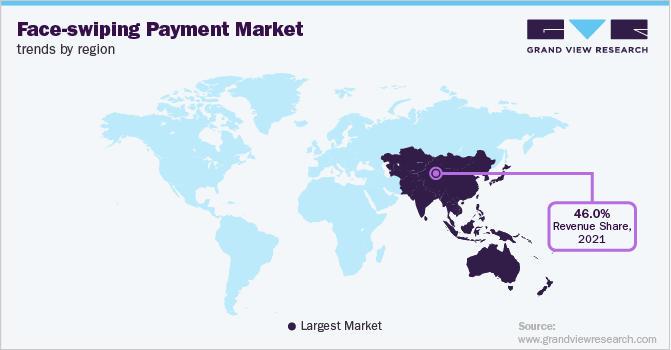
Asia Pacific dominated the market in 2025 and accounted for a share of over 47.0% of the global revenue. The growth of the market across the Asia Pacific region can be attributed to the support from government authorities for adopting face recognition technology. For instance, as per the article by Business Standard Private Ltd. magazine, the Indian government allowed banks to verify individual transactions using facial recognition technology in a bid to lower the frauds. Furthermore, the innovative efforts made by various cities to encourage the use of face-swiping payments are also expected to contribute to regional growth. The regulatory momentum in the region is further strengthening market growth, for instance, in March 2025, China issued the Security Management Measures for the Application of Facial Recognition Technology, effective June 2025, establishing a structured legal framework for facial recognition payment scenarios, reflecting the government's commitment to regulating the technology while supporting its continued commercial development.
 To learn more about this report, Download Free Sample Report
 North America Face-swiping Payment Market Trends
North America is expected to witness steady growth over the forecast period. The increasing launches of face-swiping payment platforms across the region are anticipated to fuel the market's growth. For instance, in January 2025, J.P. Morgan Payments announced the release of two new proprietary biometric payment terminals, the Paypad and the Pinpad, both integrating facial recognition and infrared palm vein authentication technology, as part of a major push to offer biometric payment options to quick-service restaurants, event venues, convenience stores, and grocery retailers across the United States. The new payment terminals are designed to decrease transaction time, shorten store queues, increase security, and support a fully touchless checkout experience, reflecting the growing institutional confidence among major North American financial players in the commercial viability of face-swiping payment infrastructure.
Key Face-swiping Payment Companies Insights
The market is highly consolidated due to the presence of several predominant players. The industry players aim for new product launches as part of their efforts to improve their offerings. In addition, to broaden their global presence, multiple companies are working on strategic planning such as mergers, partnerships, and acquisitions.
Key Face-swiping Payment Companies Insights
The following key companies have been profiled for this study on the face-swiping payment market.
-
PopID, Inc.
-
FacePay
-
PayByFace B.V.
-
VisionLabs
-
Telpo Technology Co., Ltd.
-
PAX Global Technology Limited
-
Alipay
-
NEC Corporation
-
SnapPay Inc.
-
Mastercard
-
CloudWalk Technology Co. Ltd.
Recent Developments
-
In August 2024, Federal Bank introduced SmilePay, a payment solution that uses facial authentication. This allows customers to complete transactions with facial recognition technology, removing the need for traditional payment methods like cards, mobile devices, or PINs. SmilePay uses biometric authentication to provide a secure, smooth, and contactless payment experience. The solution aims to improve customer convenience and boost transaction efficiency for merchants.
-
In June 2024, Mastercard announced it would expand its Biometric Checkout Program into Latin America. This allows consumers in the region to authorize payments using facial scans at participating stores. This move shows that major financial services companies aim to introduce face-swiping payment options in fast-growing emerging markets.
Face-swiping Payment Market Report Scope
Report Attribute
Details
Market size in 2025
USD 8.0 billion
Estimated market size in 2026
USD 9.5 billion
Projected market size by 2033
USD 37.8 billion
Growth rate
CAGR of 18.5% from 2026 to 2033
Base year for estimation
2025
Historical data
2021 - 2024
Forecast period
2026 - 2033
Quantitative units
Revenue in USD billion, and CAGR from 2026 to 2033
Report coverage
Revenue forecast, company ranking, competitive landscape, growth factors, and trends
Segments covered
Type, application, region
Regional scope
North America; Europe; Asia Pacific; Latin America; Middle East & Africa
Country scope
U.S.; Canada; Germany; UK; France; China; India; Japan; South Korea; Australia; Brazil; Mexico; UAE; Kingdom of Saudi Arabia (KSA); South Africa
Key companies profiled
PopID, Inc.; FacePay; PayByFace B.V.; VisionLabs; Telpo Technology Co., Ltd.; PAX Global Technology Limited; Alipay; NEC Corporation; SnapPay Inc.; Mastercard; CloudWalk Technology Co. Ltd.
Customization scope
Free report customization (equivalent up to 8 analysts working days) with purchase. Addition or alteration to country, regional & segment scope.
Pricing and purchase options
Avail of customized purchase options to meet your exact research needs. Explore purchase options
Global Face-swiping Payment Market Report Segmentation
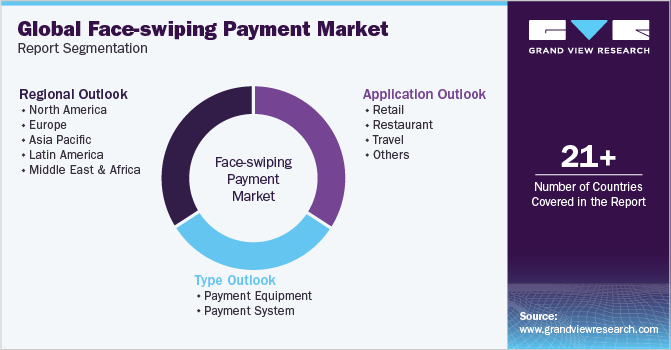
This report forecasts revenue growth at the regional, and country levels and provides an analysis on the latest industry trends and opportunities in each of the sub-segments from 2021 to 2033. For this study, Grand View Research has segmented the global face-swiping payment market report on the basis of type, application, and region:
 To learn more about this report, Download Free Sample Report
 -
Type Outlook (Revenue, USD Billion, 2021 - 2033)
-
Payment Equipment
-
POS Equipment
-
Kiosk
-
-
Payment System
-
-
Application Outlook (Revenue, USD Billion, 2021 - 2033)
-
Retail
-
Restaurant
-
Travel
-
Others
-
-
Regional Outlook (Revenue, USD Billion, 2021 - 2033)
-
North America
-
U.S.
-
Canada
-
-
Europe
-
Germany
-
UK
-
France
-
-
Asia Pacific
-
China
-
India
-
Japan
-
South Korea
-
Australia
-
-
Latin America
-
Brazil
-
Mexico
-
-
Middle East & Africa
-
UAE
-
Kingdom of Saudi Arabia (KSA)
-
South Africa
-
-
Frequently Asked Questions About This Report
The global face-swiping payment market size was valued at USD 8.0 billion in 2025 and is estimated at USD 9.5 billion for 2026.
Asia Pacific dominated with a 47.0% revenue share in 2025.
Key players include AECOM; Lennox International Inc.; Teledyne Technologies Incorporated; Thermo Fisher Scientific Inc.; Abatement Technologies; Waste Connections Inc.; Biffa; Svante Technologies Inc.; Carbon Clean; Veolia
Payment equipment dominated the face-swiping payment market with a share of 56.0% in 2025, while retail is the fastest-growing segment.
The global face-swiping payment market is expected to grow at a CAGR of 18.5% from 2026 to 2033, reaching USD 37.8 billion.
About the Author(s)
Next Generation Technologies Research Team
Technology · Next Generation TechnologiesThis report was authored by the next generation technologies research team at Grand View Research - comprising two research analysts, one senior research analyst, and one industry expert - with specialized expertise in the next generation technologies segment of the technology industry. All findings are based on proprietary technology databases, executive interviews, and regulatory analysis, subject to internal peer review prior to publication.
Last Updated:
Speak to Analyst

Customize this report to your needs - add regions, segments, or data points, with 20% free customization.
Or view our licence options:


ISO 9001:2015 & 27001:2022 Certified
We are GDPR and CCPA compliant! Your transaction & personal information is safe and secure. For more details, please read our privacy policy.


