
- Home
- »
- Next Generation Technologies
- »
-
Farm Equipment Rental Market Size Report, 2026-2033GVR Report cover

Farm Equipment Rental Market (2026 - 2033)
Size, Share & Trends Analysis Report By Equipment (Tractors, Harvesters, Balers), By Propulsion Type (Manual Equipment, Electric Equipment), By Mode Of Rental, By End Use, And Segment Forecasts
Market Size, 2025
$34.6BMarket Estimate, 2026
$37.2BMarket Forecast, 2033
$58.3BCAGR, 2026–2033
6.6%Farm Equipment Rental Market Summary
The global farm equipment rental market size was valued at USD 34.6 billion in 2025 and is projected to grow from USD 37.2 billion in 2026 to USD 58.3 billion by 2033, at a CAGR of 6.6% from 2026 to 2033. Asia Pacific dominated the market, accounting for a revenue share of 33.9% in 2025. Market growth is primarily driven by rising agricultural machinery costs, increasing adoption of precision farming practices, growing demand from small and medium-sized farms, seasonal utilization patterns of farm equipment, and improved availability of organized rental platforms.
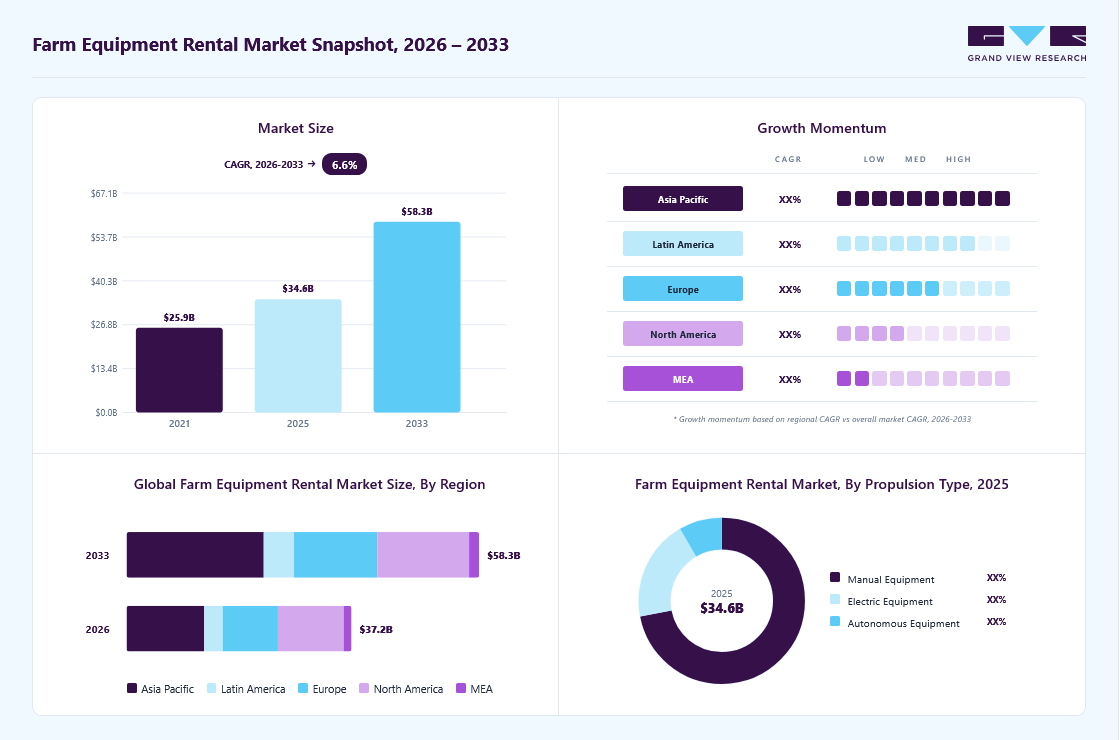 Source: Grand View Research, IR Documents, Primary Interviews, Paid DatabasesTo learn more about this report,
 Download Free Sample Report
Key Market Trends & Insights
- By equipment: Tractors segment led the market with the largest revenue share of 39.1% in 2025.
- By propulsion type: Manual equipment segment led the market with the largest revenue share of 71.9% in 2025.
- By mode of rental: Offline segment led the market with the largest revenue share of 80.2% in 2025.
- By end use: Individual farmers segment held the largest revenue share in 2025.
Regional Highlights
- Largest regional market: Asia Pacific (33.9% revenue share, 2025)
- Fastest-growing regional market: Asia Pacific (highest CAGR, 2026-2033)
- By country: India held the largest market share in 2025.
Market Size & Forecast
- Market size in 2025: USD 34.6 Billion
- Estimated market size in 2026: USD 37.2 Billion
- Projected market size by 2033: USD 58.3 Billion
- CAGR (2026-2033): 6.6%
Three ways to get this report
Buy it, customize it, or ask a question.Ask an Analyst
Analyst response in 1 business day
- AccessReport author, directly
- Reply timeWithin 1 working day
- No sales callDirect answer only
- FormatEmail reply
- CostFree, no cost
Get the Full Report
What the study covers
- FormatsPDF · Excel · Dashboard
- Timeline2026–2033 annual, 2025 base
- Coverage20+ countries, 5 regions
- Companies10+ key players profiled
Customize the Report
20% free customization
- IncludeCountries, segments, points
- TailorTo your product definition
- ExtendDeeper competitor detail
- OrA fully bespoke study
- Turnaround5–10 working days
Farmers are increasingly shifting toward rental models to reduce upfront capital expenditure while gaining access to technologically advanced machinery. In addition, labor shortages in agriculture and the growing need for operational efficiency are encouraging the use of mechanized farming solutions through rental services.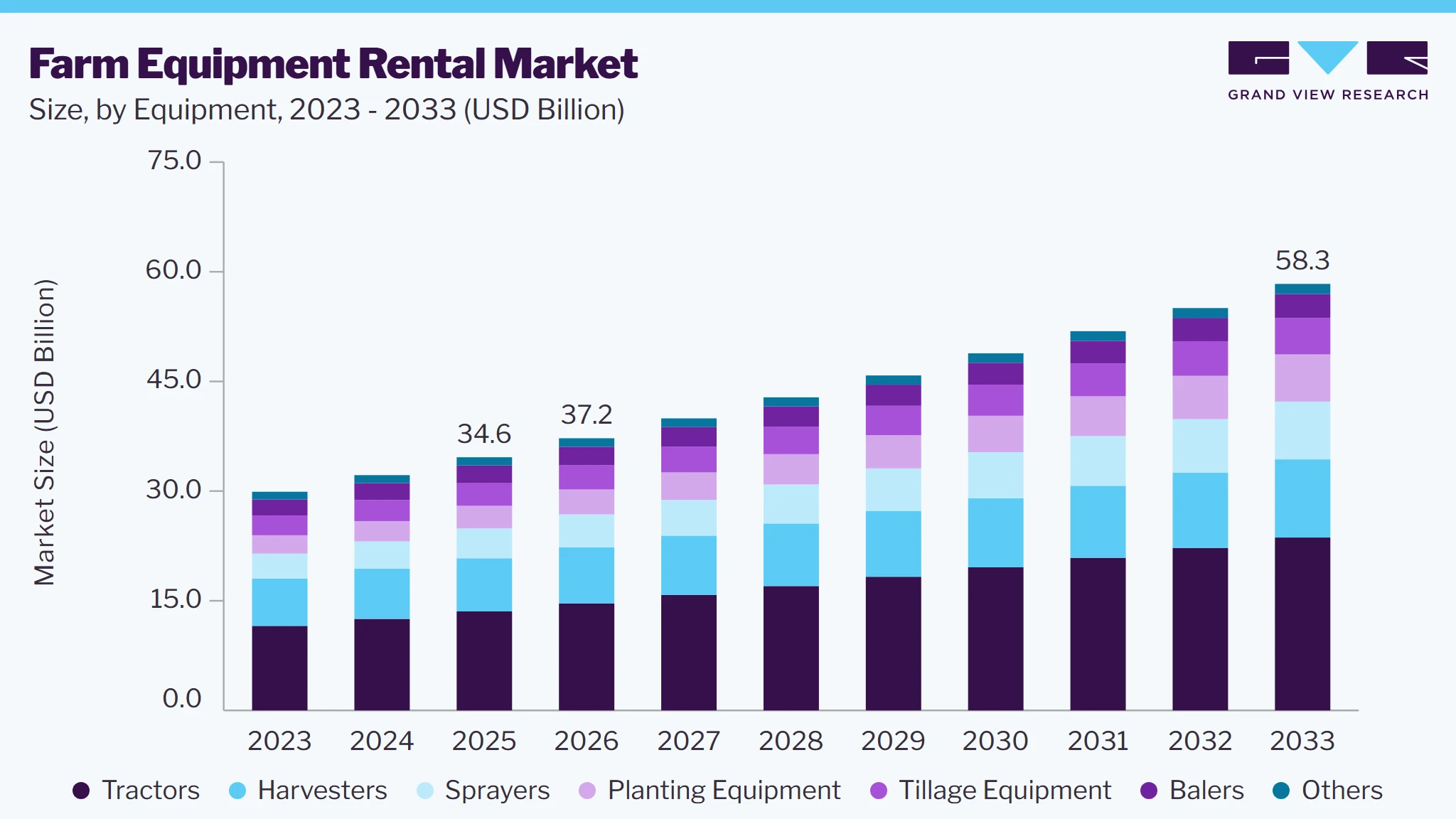 To learn more about this report, Download Free Sample Report
The high acquisition and maintenance costs associated with modern agricultural equipment drive growth in the farm equipment rental market. Advanced tractors, harvesters, sprayers, and planting machinery require substantial investments, making ownership economically challenging for small and mid-sized farmers. Rental services provide a cost-effective alternative by allowing farmers to access expensive equipment only during critical farming periods such as planting and harvesting seasons. This approach helps optimize farm operating costs while reducing financial risks associated with machinery depreciation, storage, and maintenance.
The increasing adoption of precision agriculture and smart farming technologies is further accelerating demand for farm equipment rentals. Modern agricultural operations increasingly rely on GPS-enabled tractors, automated irrigation systems, drones, and data-driven farming equipment to improve crop yields and resource efficiency. However, many farmers are unable to invest directly in advanced technologies due to limited capital. Rental providers are bridging this gap by offering access to technologically advanced machinery on flexible rental terms, enabling farmers to benefit from precision farming without bearing the full ownership burden.
Another important growth driver is the rising fragmentation of farmland and the dominance of smallholder farming across several developing economies. In regions where average farm sizes remain small, purchasing heavy agricultural machinery is often economically unviable because utilization rates remain low year-round. Rental services address this challenge by enabling multiple farmers to share machinery resources in line with seasonal needs. The increasing penetration of digital platforms and mobile-based booking systems is also improving accessibility to rental equipment in rural areas, thereby supporting market growth.
Growing labor shortages in the agricultural sector and the increasing focus on improving farm productivity are also driving significant market expansion. Many agricultural regions are experiencing a decline in the availability of manual labor due to urban migration and demographic shifts, leading to an increased reliance on mechanized farming practices. Rental equipment helps farmers complete time-sensitive agricultural activities efficiently while reducing labor dependency. Furthermore, government initiatives promoting farm mechanization, along with expanding dealer and cooperative rental networks, are expected to strengthen equipment accessibility and create long-term growth opportunities for the farm equipment rental market.
Market Dynamics
The farm equipment rental market is gaining momentum as farmers increasingly seek access to modern agricultural machinery without the significant capital investment required for ownership. Rental providers are offering tractors, harvesters, sprayers, seeders, tillage equipment, and other specialized machinery on short-term, seasonal, and project-based terms, enabling farmers to align equipment use with cropping cycles and operational needs. Rising equipment costs, fluctuating farm incomes, labor shortages, and the growing demand for mechanization are encouraging both small and large agricultural producers to adopt rental models that improve operational flexibility and reduce financial risk. In addition, the expansion of custom hiring centers, digital rental platforms, and equipment-sharing networks is making access to machinery more convenient and efficient across rural agricultural regions.
The growing expansion of commercial farming is driving market growth in the farm equipment rental market, as agricultural enterprises increasingly cultivate larger land areas and diversify crop production across multiple growing seasons. Commercial farms require a wide range of tractors, harvesters, sprayers, planters, tillage equipment, and specialized machinery to maintain operational efficiency throughout different agricultural cycles. Renting equipment allows commercial operators to access machinery that matches seasonal requirements without committing capital to a large permanent equipment fleet. As commercial farming operations become more mechanized and professionally managed, demand for flexible access to equipment continues to increase across both crop and mixed-farming enterprises. The ongoing enlargement of commercial agricultural operations is propelling demand for organized farm equipment rental services.
High maintenance and repair costs for rental fleets are constraining growth in the farm equipment rental market, as rental providers must keep machinery in operational condition across multiple agricultural seasons and diverse farming environments. Rental equipment is often used intensively by operators with varying skill levels, in field conditions, and with different operating practices, leading to faster wear on engines, transmissions, hydraulic systems, tires, and electronic components. Large fleets require regular servicing, preventive maintenance, replacement of consumable parts, and periodic overhauls to maintain reliability and equipment availability during peak agricultural periods. Rental companies must maintain extensive inventories of spare parts, service tools, diagnostic equipment, and trained technicians capable of supporting multiple machinery models and brands simultaneously. The continuous financial burden associated with maintaining large rental fleets can limit expansion plans and reduce the ability of providers to increase equipment inventories across additional agricultural regions.
The growing adoption of GPS-enabled and connected rental equipment is creating major opportunities in the farm equipment rental market as rental providers increasingly integrate precision agriculture technologies into their machinery fleets. Modern tractors, harvesters, sprayers, planters, and tillage equipment equipped with GPS guidance, telematics systems, remote diagnostics, and connectivity platforms allow rental companies to offer technologically advanced equipment to a much broader customer base. Farmers increasingly seek machinery that improves field navigation accuracy, reduces overlap during operations, optimizes fuel consumption, and supports data-driven farming decisions without requiring ownership of expensive precision equipment. Rental companies can position connected machinery as a premium service offering that differentiates them from traditional equipment providers while expanding access to advanced agricultural technologies across commercial and medium-scale farms. The continued integration of GPS and connectivity features into rental fleets is creating new opportunities for technology-oriented service models throughout the agricultural machinery ecosystem.
Market Concentration & Characteristics
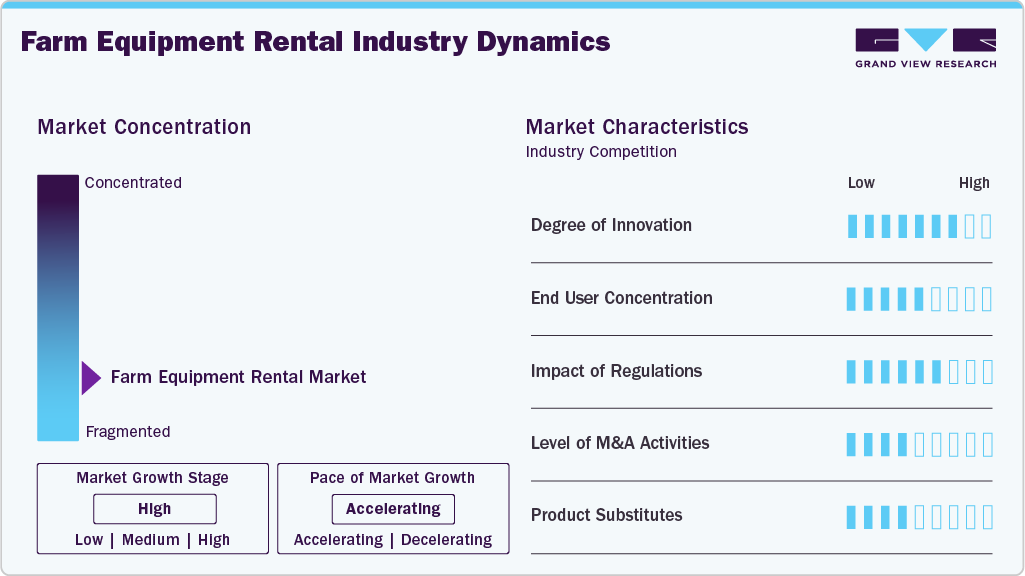
The farm equipment rental market is highly fragmented, with numerous regional rental providers, local equipment dealers, cooperatives, and small independent operators competing alongside a limited number of organized national players. Market fragmentation is primarily driven by varying agricultural practices, regional crop patterns, seasonal demand differences, and the localized nature of farming operations. Small and medium-sized rental businesses dominate many rural markets by offering flexible pricing, customized rental durations, and strong local farmer relationships. At the same time, increasing digitalization and partnerships between manufacturers and dealers are gradually improving market organization, although no single company currently holds a dominant global market share.
 To learn more about this report, Download Free Sample Report
Innovation in the farm equipment rental market is growing rapidly and has become an important factor for competition among companies. Rental providers are increasingly offering advanced technologies such as GPS-enabled equipment, IoT-based fleet monitoring, precision farming tools, and AI-driven maintenance systems to improve farming efficiency and reduce downtime. New developments like autonomous tractors and smart spraying systems are transforming rental services from simple machinery access into technology-driven farming solutions. At the same time, the market is moving toward flexible “Equipment-as-a-Service” and pay-per-use rental models. Digital platforms now allow farmers to check equipment availability, compare pricing, book machinery online, and monitor equipment usage in real time. These innovations help farmers access modern and expensive agricultural machinery without large upfront investments, while also creating new revenue opportunities for rental providers through technology-based services.
Analyst Perspective
The farm equipment rental market is transforming agricultural mechanization by shifting value from equipment ownership to equipment access and utilization efficiency. Unlike the agricultural machinery market, where revenue depends primarily on unit sales, the rental market is driven by asset utilization rates, fleet management capabilities, geographic reach, and service responsiveness during peak farming seasons. Providers that can maintain well-managed equipment fleets, ensure high machine availability, offer maintenance support, and optimize equipment deployment across multiple agricultural regions are likely to build stronger competitive advantages. As farmers increasingly prioritize cash flow management and operational flexibility, equipment rental is expected to become an integral part of farm machinery strategies, particularly in markets characterized by fragmented landholdings and seasonal demand for equipment.
Equipment Insights
Based on equipment, the tractors segment led the market with the largest revenue share of 39.1% in 2025. The segment’s dominance is primarily driven by the widespread use of tractors across multiple farming activities such as plowing, planting, hauling, spraying, and land preparation. Rising farm mechanization, increasing labor shortages, and the high purchase cost of tractors are encouraging farmers, particularly small and medium-sized landowners, to opt for rental services instead of direct ownership. In addition, the growing demand for high-horsepower, technologically advanced tractors for precision farming applications is further supporting segment growth.
The planting equipment segment is anticipated to grow at the fastest CAGR during the forecast period, driven by the increasing focus on improving crop productivity, precision seeding practices, and efficient farm operations. Farmers are increasingly adopting advanced planting machinery through rental services to reduce reliance on manual labor, optimize planting accuracy, and avoid high capital investments. The rising adoption of modern farming techniques, growing awareness of yield improvement, and expanding availability of specialized rental equipment are further accelerating demand for planting equipment rentals across both developed and emerging agricultural markets.
Propulsion Type Insights
Based on propulsion type, the manual equipment segment led the market with the largest revenue share of 71.9% in 2025, due to its widespread adoption across conventional farming operations and its lower operational complexity compared to advanced autonomous systems. Farmers, particularly in developing economies, continue to prefer manually operated tractors, harvesters, and tillage equipment because of lower rental costs, easier maintenance requirements, and better familiarity with traditional machinery. In addition, the availability of skilled operators for manual equipment and the limited penetration of advanced automation technologies in rural agricultural regions further supported the segment’s market leadership.
The autonomous equipment segment is expected to register the highest CAGR from 2026 to 2033, driven by the growing adoption of precision agriculture, labor shortages, and increasing demand for efficient, technology-driven farming operations. Autonomous tractors, robotic harvesters, GPS-guided machinery, and AI-enabled farming systems are gaining traction as they help improve productivity, reduce human intervention, and optimize resource utilization. Rental services are playing a crucial role in accelerating adoption by enabling farmers to access high-cost autonomous technologies without major upfront investments, thereby supporting rapid segment growth.
Mode Of Rental Insights
Based on mode of rental, the offline segment led the market with the largest revenue share of 80.2% in 2025. This dominance is driven by the strong presence of local dealers, cooperatives, and independent rental providers operating under traditional business models. Many farmers, particularly in rural and developing agricultural regions, continue to rely on direct interactions, physical equipment inspections, and long-established relationships with local rental operators before renting machinery. Limited digital literacy, lower internet penetration in remote farming areas, and the immediate availability of equipment through local dealer networks further contributed to the dominance of the offline segment.
The online segment is expected to register the fastest CAGR from 2026 to 2033, driven by the increasing adoption of digital platforms, smartphone penetration, and growing awareness regarding convenient equipment booking services. Online rental marketplaces allow farmers to compare pricing, check equipment availability, schedule rentals, and access a wider range of machinery through mobile applications and web-based platforms. The integration of GPS tracking, digital payment systems, telematics, and real-time fleet management solutions is further accelerating the shift toward online rental models, particularly among technologically aware farmers and organized agricultural enterprises.
End Use Insights
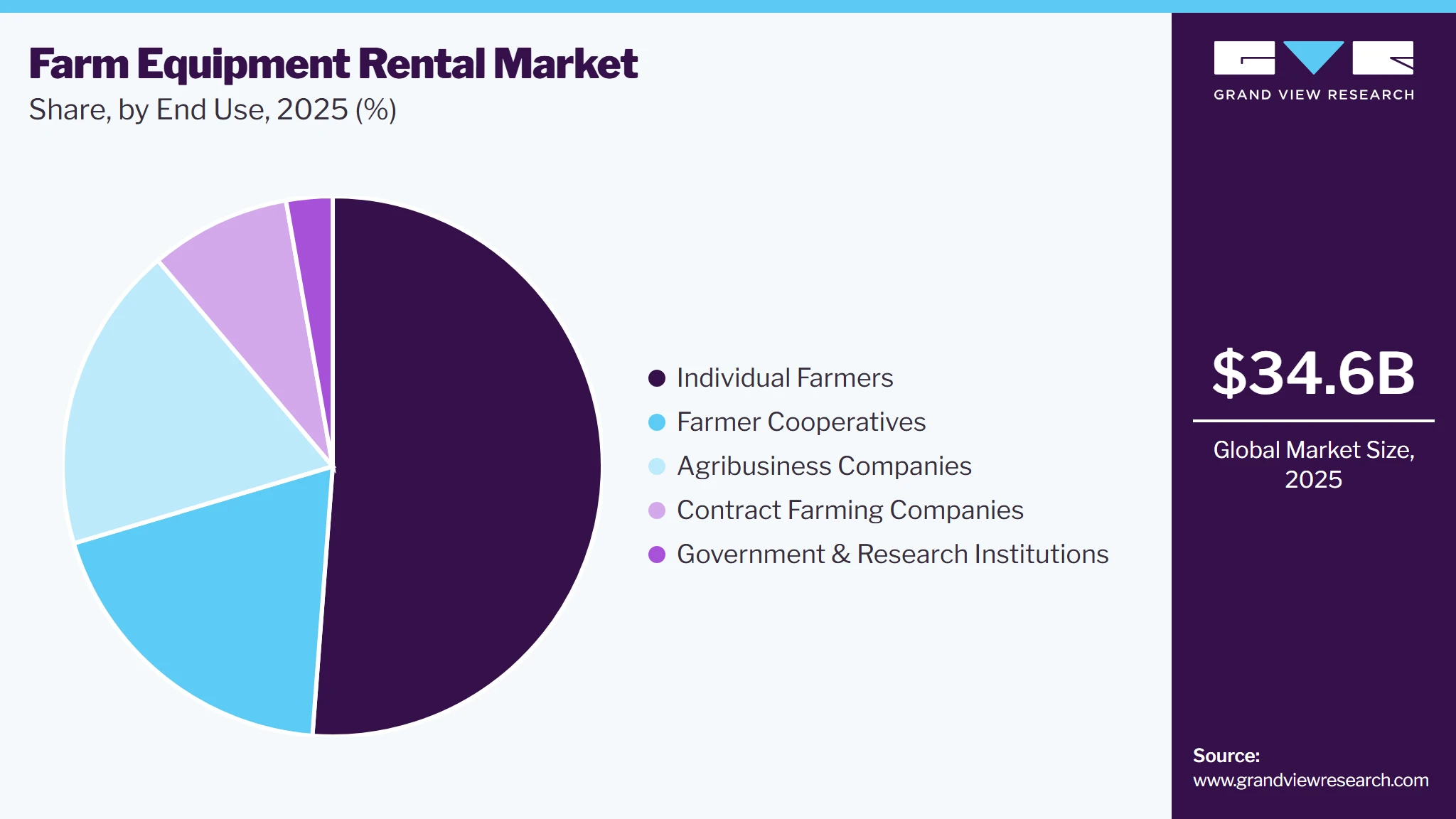
Based on end use, the individual farmers segment led the market with the largest revenue share of 51.2% in 2025, due to the high dependence of small and medium-sized farmers on cost-effective mechanization solutions. Rising agricultural machinery costs, limited access to financing, and low equipment utilization rates for small landholdings are encouraging individual farmers to adopt rental services instead of purchasing expensive machinery. In addition, the growing need to improve farm efficiency, reduce labor dependency, and access modern agricultural equipment during peak farming seasons further strengthened this segment's dominance.
 To learn more about this report, Download Free Sample Report
The contract farming companies segment is anticipated to register the fastest CAGR during the forecast period. This growth is driven by the increasing commercialization of agriculture and the growing focus on large-scale, productivity-oriented farming operations. Contract farming companies require advanced, high-capacity machinery for efficient cultivation, harvesting, and crop management across extensive farmland. Rental services enable these companies to access technologically advanced equipment while reducing capital investment and fleet maintenance costs. The rising adoption of precision agriculture and data-driven farming practices is further accelerating demand for rental equipment among contract farming enterprises.
Regional Insights
Asia Pacific Farm Equipment Rental Market Trends
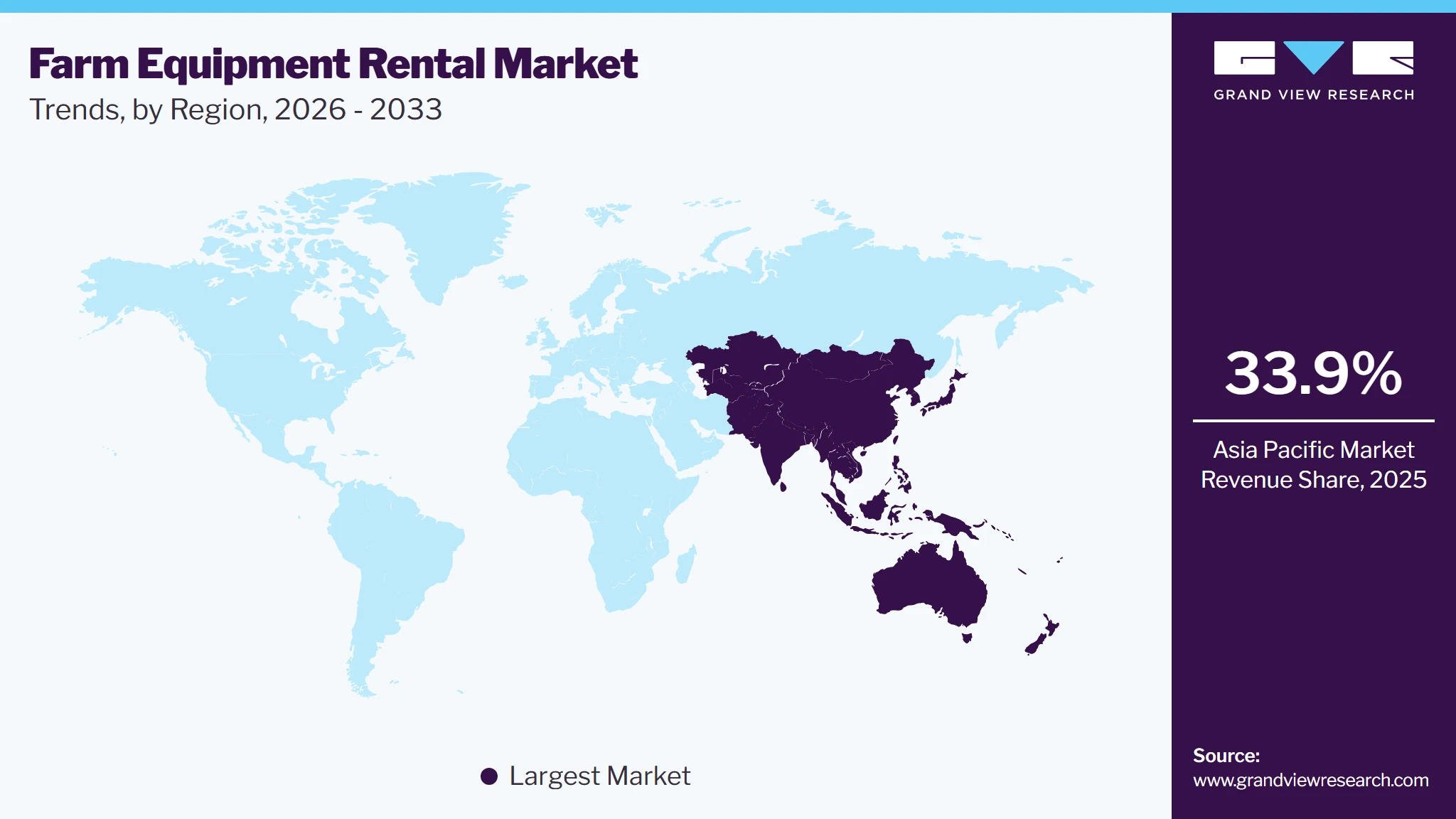
Asia Pacific dominated the global farm equipment rental market with the largest revenue share of 33.9% in 2025 and is expected to grow at the fastest CAGR during the forecast period. The farm equipment rental market in the India held the largest share in the Asia Pacific region in 2025. Growth is mainly driven by rapid agricultural mechanization, a large base of small and mid-sized farmers who cannot afford to buy costly machinery outright, rising rural labor shortages due to urbanization, and strong government support for shared-use farming. Government-backed rental access is a key supporting factor, for instance, according to India's Ministry of Agriculture & Farmers Welfare, between 2014-15 and 2025-26, 27,554 Custom Hiring Centres (CHCs) were established to enhance smallholder access to farm mechanization services, where a Custom Hiring Centre is a unit comprising a set of farm machinery, implements, and equipment meant for hiring by farmers. This pay-per-use model lets small farmers rent tractors, harvesters, and other implements instead of buying them, highlighting that rental adoption is scaling fastest in the APAC region.
 To learn more about this report, Download Free Sample Report
The farm equipment rental industry in China is projected to grow significantly during the forecast period. Rapid mechanization and the ongoing consolidation of farmland through cooperative farming models raise demand for advanced machinery that small and mid-sized farmers cannot afford to own. A continued rural labor shortage caused by urbanization is pushing farms toward machinery-based operations, while government subsidies for agricultural machinery and support for shared-use service centers make renting a convenient, low-cost option. Together, these factors are steadily expanding the farm equipment rental market.
The farm equipment rental industry in Southeast Asia is expected to grow significantly from 2026 to 2033. Governments across countries such as Indonesia, Thailand, Vietnam, and the Philippines are increasingly supporting farm modernization and mechanization programs to improve crop productivity and food security, which is driving growth in the farm equipment rental market. In addition, growing adoption of rice harvesters, tractors, and planting equipment on a rental basis, along with the expansion of local dealer networks and digital rental platforms, is further supporting market growth across Southeast Asia.
North America Farm Equipment Rental Market Trends
The North America farm equipment rental industry is expected to grow at a significant CAGR during the forecast period. Growth is driven by the region's technologically advanced agricultural sector, the high and rising cost of owning modern equipment, and persistent farm labor shortages. Strong adoption of precision farming and smart machinery, which is expensive to buy but can be rented at a fraction of the cost, also encourages farmers to choose flexible rental models over ownership.
The U.S. farm equipment rental market is projected to grow significantly during the forecast period. Key drivers include rising input and machinery costs (with tractor prices rising sharply in recent years), continued advancements in agricultural technology such as GPS-guided and automated equipment, and a shortage of skilled labor. Flexible, asset-light rental models help farmers access advanced machinery without large capital investment, supporting steady market growth.
Europe Farm Equipment Rental Market Trends
The farm equipment rental industry in Europe is anticipated to grow steadily from 2026 to 2033, Growth is driven by the aging farmer population and rising farm labor shortages. Government and EU support programs are also encouraging farm mechanization. Strict environmental regulations are increasing the demand for low-emission and precision farming equipment. Since advanced machinery is expensive to purchase, many small and medium-sized farmers prefer rental and leasing services as a more affordable option.
The farm equipment rental industry in the UK is expected to grow significantly during the forecast period. Post-Brexit subsidy reforms, particularly the Environmental Land Management Scheme (ELMS), are encouraging farmers to invest in efficient, low-emission machinery. A strong focus on climate-smart and precision agriculture, combined with labor shortages and high equipment ownership costs, is driving demand for leasing and rental, allowing farmers to access modern equipment without heavy upfront spending.
Key Farm Equipment Rental Company Insights
Some prominent players in the farm equipment rental market include Tractors and Farm Equipment Limited, Titan Machinery Inc., The Papé Group, Inc., United Rentals, Inc., Sunbelt Rentals, Inc., Flaman Group of Companies, among others.
-
Pacific Ag Rentals is a specialized agricultural equipment rental company focused on serving farmers and growers across the U.S. agricultural sector. The company operates as a farmer-owned rental business and has expanded its presence across California, Arizona, the Pacific Northwest, and the Southeastern U.S. regions. Its farm equipment rental portfolio includes tractors, forklifts, utility vehicles, water trucks, tillage equipment, light towers, and precision agriculture technologies from brands such as John Deere, Kubota, New Holland, and Massey Ferguson. The company also offers GPS guidance systems, automated cultivation equipment, and flexible rental, lease, and purchase options, helping farmers access advanced machinery without the high upfront costs of ownership.
-
Sunbelt Rentals is one of North America’s largest equipment rental companies, offering a broad range of rental solutions across construction, industrial, and agricultural sectors. The company operates through a large network of more than 1,400 locations across North America and provides agricultural equipment rental solutions for farming, forestry, and livestock applications. Its offerings in the farm equipment rental market include tractors, skid steer loaders, forklifts, trailers, water trucks, earthmoving equipment, climate control systems, pumps, and power solutions. Sunbelt Rentals also supports customers through digital rental platforms, delivery and pickup services, and customized equipment solutions designed to improve operational efficiency for agricultural businesses.
Key Farm Equipment Rental Companies:
The following key companies have been profiled for this study on the farm equipment rental market.
-
Titan Machinery Inc.
-
The Papé Group, Inc.
-
United Rentals, Inc.
-
Sunbelt Rentals, Inc.
-
Flaman Group of Companies
-
Messick Farm Equipment, Inc.
-
Pacific Ag Rentals, LLC
-
German-Bliss Equipment, Inc.
-
Friesen Sales & Rentals Ltd.
-
Cheshire County Conservation District
-
CLAAS KGaA mbH
-
Escorts Kubota Limited
-
J.C. Bamford Excavators Ltd.
-
Associated Supply Company, Inc.
Competitive Benchmarking
Category
Operating Strategies
Competitive Edge
Weakness
Established Players (United Rentals; Sunbelt Rentals; The Cat Rental Store; John Deere Financial; CNH Industrial Capital)
- Established players focus on offering broad fleets of tractors, harvesters, tillage equipment, and other agricultural machinery through structured short-term and seasonal rental programs. They invest in fleet management, preventive maintenance, financing solutions, and digital booking platforms to improve equipment utilization and customer retention. Their strategies also emphasize partnerships with agricultural cooperatives, dealers, and large farming enterprises to expand regional coverage.
- These companies benefit from extensive equipment inventories, established service networks, and strong relationships with equipment manufacturers and commercial farms. Their ability to provide maintenance support, financing options, and reliable equipment availability enhances customer confidence. Large operational scale also enables better fleet utilization and competitive pricing.
- High capital requirements for fleet ownership and maintenance can increase operating costs. Seasonal demand fluctuations may reduce equipment utilization during off-peak periods. Managing logistics, transportation, and equipment depreciation across multiple regions also creates operational complexity.
Emerging Players (Hello Tractor; Trringo; EM3 AgriServices; Gold Farm; Farmease)
- Emerging players focus on digital rental marketplaces, pay-per-use equipment access, and mobile-based booking platforms designed for small and medium-sized farmers. They emphasize technology-enabled scheduling, asset sharing, and localized equipment availability to improve accessibility and reduce ownership costs. Their strategies also prioritize data-driven fleet optimization and partnerships with local equipment owners and rural service providers.
- These companies offer flexible rental models, faster booking processes, and improved access to agricultural machinery in underserved farming regions. Their digital platforms reduce transaction friction and increase equipment utilization through shared-access models. Technology-driven operations also enable quicker expansion with lower infrastructure investment.
- Limited fleet ownership and smaller geographic coverage can restrict service availability. Dependence on local equipment partners may affect service consistency and maintenance quality. Building farmer trust and expanding operations across fragmented rural markets remain important growth challenges.
Recent Developments
-
In May 2025, Titan Machinery completed the acquisition of Farmers Implement & Irrigation, a two-store New Holland dealership located in Brookings and Watertown, South Dakota. The acquisition was aimed at expanding Titan Machinery’s New Holland dealership presence in eastern South Dakota and strengthening its agricultural equipment distribution and service network. Farmers Implement & Irrigation generated approximately USD 20 million in revenue during calendar year 2024.
-
In January 2025, United Rentals announced plans to acquire H&E Equipment Services for approximately USD 4.8 billion. The acquisition was aimed at expanding the company’s rental fleet capacity, strengthening its presence across key U.S. markets, and enhancing its equipment rental offerings. The transaction was expected to add nearly 64,000 equipment units to United Rentals’ fleet and support broader growth opportunities in the equipment rental industry, including agricultural and farm equipment rental services.
Farm Equipment Rental Market Report Scope
Report Attribute
Details
Market size in 2025
USD 34.6 billion
Estimated market size in 2026
USD 37.2 billion
Projected market size by 2033
USD 58.3 billion
Growth rate
CAGR of 6.6% from 2026 to 2033
Base year for estimation
2025
Historical data
2021 - 2024
Forecast period
2026 - 2033
Quantitative units
Revenue in USD million/billion and CAGR from 2026 to 2033
Report coverage
Revenue forecast, company market share analysis, competitive landscape, growth factors, and trends
Segments covered
Equipment, propulsion type, mode of rental, end use and, region
Regional scope
North America; Europe; Asia Pacific; Latin America; MEA
Country scope
U.S.; Canada; Mexico; Germany; UK; France; China; Japan; India; South Korea; Australia; Brazil; Saudi Arabia; South Africa; UAE
Key companies profiled
Tractors and Farm Equipment Limited; Titan Machinery Inc.; The Papé Group, Inc.; United Rentals, Inc.; Sunbelt Rentals, Inc.; Flaman Group of Companies; Messick Farm Equipment, Inc.; Pacific Ag Rentals, LLC; German-Bliss Equipment, Inc.; Friesen Sales & Rentals Ltd.; Cheshire County Conservation District; CLAAS KGaA mbH; Escorts Kubota Limited; J.C. Bamford Excavators Ltd.; Associated Supply Company, Inc.
Customization scope
Free report customization (equivalent up to 8 analysts' working days) with purchase. Addition or alteration to country, regional & segment scope.
Pricing and purchase options
Avail customized purchase options to meet your exact research needs. Explore purchase options
Global Farm Equipment Rental Market Report Segmentation
This report forecasts revenue growth at global, regional, and country levels and provides an analysis of the latest industry trends in each of the sub-segments from 2021 to 2033. For this study, Grand View Research has segmented the farm equipment rental market report based on equipment, propulsion type, mode of rental, end use, and region:
-
Equipment Outlook (Revenue, USD Billion, 2021 - 2033)
-
Tractors
-
Harvesters
-
Balers
-
Sprayers
-
Tillage Equipment
-
Planting Equipment
-
Others
-
-
Propulsion Type Outlook (Revenue, USD Billion, 2021 - 2033)
-
Manual Equipment
-
Electric Equipment
-
Autonomous Equipment
-
-
Mode of Rental Outlook (Revenue, USD Billion, 2021 - 2033)
-
Offline
-
Online
-
-
End Use Outlook (Revenue, USD Billion, 2021 - 2033)
-
Individual Farmers
-
Farmer Cooperatives
-
Agribusiness Companies
-
Contract Farming Companies
-
Government & Research Institutions
-
-
Regional Outlook (Revenue, USD Billion, 2021 - 2033)
-
North America
-
U.S.
-
Canada
-
Mexico
-
-
Europe
-
Germany
-
UK
-
France
-
-
Asia Pacific
-
China
-
India
-
Japan
-
South Korea
-
Australia
-
Southeast Asia
-
-
Latin America
-
Brazil
-
-
Middle East & Africa
-
UAE
-
Saudi Arabia
-
South Africa
-
-
Research Methodology
The farm equipment rental market figures in this report are based on a proven research process that combines executive interviews with secondary research from proprietary databases, company filings, and recognized regulatory and institutional sources. Market size is built through value-chain sizing - reconciling supply-side and demand-side estimates - and triangulated with bottom-up and top-down approaches. Every estimate passes multiple levels of expert validation before publication, with each farm equipment rental segment quantified using the revenue-capture definitions in the table below.
Segment Definition
Segment - Equipment
Revenue capture definition
Tractors
The largest rental category, capturing value through short-term and seasonal leasing of utility, compact, and high-horsepower tractors for plowing, hauling, planting, spraying, and general farm operations. Rental providers benefit from high utilization rates during peak agricultural seasons and recurring demand from farmers seeking mechanization without large capital investment.
Harvesters
Commercial demand is driven by the need for combine harvesters and specialized harvesting machinery during narrow harvest windows when equipment availability is critical. Rental operators generate premium returns by supplying high-value machinery that many farmers prefer to rent rather than own due to its limited annual use.
Balers
Market activity centers on balers used for hay, straw, and forage collection in livestock and fodder production systems. Equipment rental companies benefit from seasonal demand and the ability to serve multiple farms with the same machinery across different harvesting cycles.
Sprayers
Value is created through the rental of boom sprayers, self-propelled sprayers, and precision-application equipment for pesticides, herbicides, fungicides, and fertilizers. Farmers increasingly choose rental services to access advanced spraying technology and reduce the cost of maintaining specialized equipment.
Tillage Equipment
Demand originates from soil preparation activities such as plowing, cultivating, harrowing, and seedbed preparation. Rental providers capitalize on periodic equipment needs, allowing farmers to access heavy tillage machinery only when required while avoiding ownership and storage costs.
Planting Equipment
Commercial opportunities arise from the rental of seed drills, planters, transplanters, and precision planting systems that improve planting accuracy and operational efficiency. Access to modern planting equipment through rental helps farmers adopt advanced seeding technologies without significant upfront expenditure.
Others
This category includes irrigation equipment, loaders, trailers, mowers, fertilizer spreaders, drones, and specialty crop machinery. Rental businesses create additional revenue by offering diversified equipment portfolios that address niche agricultural operations and emerging mechanization needs.
Segment - Propulsion Type
Revenue capture definition
Manual Equipment
Market value is supported by basic farm implements and manually operated equipment rented by smallholder farmers, horticulture growers, and low-mechanization agricultural operations. Demand remains significant in regions where affordability and simplicity take precedence over automation.
Electric Equipment
Commercial activity is increasing for battery-powered agricultural machinery, electric sprayers, compact electric tractors, and electrically operated farm equipment. Rental providers benefit from growing interest in lower operating costs, reduced emissions, and sustainable farming practices.
Autonomous Equipment
The fastest-growing propulsion segment is capturing value through the rental of driverless tractors, robotic field equipment, autonomous sprayers, and AI-enabled agricultural machinery. Farmers increasingly rent autonomous equipment to access advanced precision farming capabilities without committing to the expense of owning expensive technology.
Segment - Mode of Rental
Revenue capture definition
Offline
The largest rental channel is driven by local equipment dealers, agricultural machinery rental centers, cooperatives, and regional service providers. Strong customer relationships, equipment inspection, maintenance support, and localized service networks continue to make offline rental highly prevalent in agricultural markets.
Online
Market growth is fueled by digital rental platforms that connect equipment owners, dealers, and farmers through mobile applications and online marketplaces. These platforms improve equipment availability, pricing transparency, booking convenience, and access to machinery across wider geographic areas.
Segment - End Use
Revenue capture definition
Individual Farmers
The largest end-use segment is with farmers renting equipment to reduce capital expenditure, manage seasonal machinery requirements, and improve farm productivity. Rental models are particularly valuable for small and medium farms that cannot economically justify owning multiple specialized machines.
Farmer Cooperatives
Cooperatives rent agricultural machinery for shared use among member farmers, enabling collective access to tractors, harvesters, planters, and other equipment. This model improves equipment utilization while lowering the cost burden for individual members.
Agribusiness Companies
Agribusiness firms use rental fleets to support large-scale farming operations, procurement networks, contract farming, and agricultural service delivery. Flexible access to machinery helps these organizations optimize operational capacity across multiple production sites.
Contract Farming Companies
Contract farming operators rent equipment to provide mechanized services across distributed farming networks while maintaining flexibility in fleet deployment. Rental arrangements support efficient land preparation, planting, crop protection, and harvesting across multiple contracted farms.
Government & Research Institutions
Public agencies and agricultural research organizations rent farm equipment for demonstration projects, mechanization programs, field trials, training activities, and agricultural extension services. Temporary access to specialized machinery allows institutions to conduct research and outreach programs without maintaining large permanent equipment inventories.
Estimation Model
Layer
Question
Analysis
Seasonal Equipment Access Layer
Where does farm equipment rental solve agricultural constraints?
Identify farming environments where ownership of machinery is uneconomical due to seasonal use, small landholdings, diversified cropping patterns, or limited capital. These include small and medium farms, specialty crop operations, horticulture, orchards, and emerging mechanization markets. This layer defines demand based on the need for temporary access to tractors, harvesters, sprayers, seeders, tillage equipment, and other machinery during specific stages of the crop cycle.
Rental Network Availability Layer
What enables farmers to obtain equipment on demand?
Assess the presence of rental fleets, dealer networks, agricultural cooperatives, custom hiring centers, digital rental platforms, logistics capabilities, financing support, and equipment maintenance infrastructure. Market accessibility depends on how efficiently machinery can be reserved, transported, serviced, and returned while minimizing downtime during critical planting and harvesting windows.
Utilization Flexibility Layer
How is rented equipment incorporated into farm operations?
Analyze the operational use of rented machinery for land preparation, planting, irrigation support, spraying, harvesting, baling, transport, and post-harvest handling. Farmers increasingly use rental equipment to access higher-capacity or technologically advanced machines only when required, allowing them to match equipment capability with seasonal workload, crop requirements, and short-term production needs.
Asset Utilization & Service Revenue Layer
How is value generated within the farm equipment rental ecosystem?
Evaluate revenue streams from hourly, daily, seasonal, and acreage-based rental contracts; equipment delivery and pickup; operator services; maintenance packages; telematics-enabled fleet management; and digital booking platforms. Additional value is created through higher fleet utilization rates, lower capital burden for farmers, faster access to modern machinery, and recurring income for rental providers through continuous circulation of equipment across multiple farms and growing seasons.
Delivered Customizations
This report has been delivered with the following In-depth customizations
Client Request
Customization Delivered
Value Adds
Farm Equipment Rental & Seasonal Mechanization Demand Trends
Conducted a focused analysis of rental demand for tractors, harvesters, seeders, sprayers, tillage equipment, and balers across seasonal farming operations, contract farming, and small-to-medium agricultural holdings.
Helps stakeholders identify high-demand rental categories, evaluate seasonal equipment utilization trends, and assess commercialization opportunities in asset-light farm mechanization models.
Rental Platform Digitization & Fleet Utilization Optimization Trends
Evaluated adoption trends for online equipment booking platforms, fleet management systems, telematics-enabled rental assets, pay-per-use models, and shared machinery networks serving farmers and agricultural cooperatives.
Provides insights into fleet efficiency opportunities, digital rental business models, and commercially attractive platform capabilities that improve equipment utilization and customer access.
Rural Equipment Access & Agricultural Service Ecosystem Opportunity Assessment
Assessed demand for equipment rental networks, financing-linked rental programs, operator-assisted rental services, maintenance support, and village-level machinery hubs, along with challenges related to equipment availability, logistics, financing, and service reliability.
Supports investment and expansion strategies by identifying underserved rural markets, evaluating equipment access readiness, and strengthening long-term growth potential in shared agricultural equipment ecosystems.
Frequently Asked Questions About This Report
Prominent players in the farm equipment rental market are Tractors and Farm Equipment Limited; Titan Machinery Inc.; The Papé Group, Inc.; United Rentals, Inc.; Sunbelt Rentals, Inc.; Flaman Group of Companies; Messick Farm Equipment, Inc.; Pacific Ag Rentals, LLC; German-Bliss Equipment, Inc.; Friesen Sales & Rentals Ltd.; Cheshire County Conservation District; CLAAS KGaA mbH; Escorts Kubota Limited; J.C. Bamford Excavators Ltd.; Associated Supply Company, Inc.
The global farm equipment rental market size was estimated at USD 34.6 billion in 2025 and is expected to reach USD 38.1 billion in 2026.
The global farm equipment rental market is expected to reach USD 59.7 billion by 2033 at a compound annual growth rate of 6.6% by 2033.
The tractors segment accounted for the largest market share of over 38.0% in 2025 in the farm equipment rental market, driven by the widespread use of tractors across multiple farming activities such as plowing, planting, hauling, spraying, and land preparation.
Factors such as rising agricultural mechanization, increasing cost of farm machinery ownership, and growing labor shortages in the agriculture sector play a key role in accelerating the farm equipment rental market.
About the Author(s)
Next Generation Technologies Research Team
Technology · Next Generation TechnologiesThis report was authored by the next generation technologies research team at Grand View Research - comprising two research analysts, one senior research analyst, and one industry expert - with specialized expertise in the next generation technologies segment of the technology industry. All findings are based on proprietary technology databases, executive interviews, and regulatory analysis, subject to internal peer review prior to publication.
Last Updated:
Speak to Analyst

Customize this report to your needs - add regions, segments, or data points, with 20% free customization.
Or view our licence options:


ISO 9001:2015 & 27001:2022 Certified
We are GDPR and CCPA compliant! Your transaction & personal information is safe and secure. For more details, please read our privacy policy.


