
- Home
- »
- Agrochemicals
- »
-
Fatty Acid Methyl Ester Market Size Report, 2026-2033GVR Report cover
![Fatty Acid Methyl Ester Market (2026 - 2033)Report]()
Fatty Acid Methyl Ester Market (2026 - 2033)
Size, Share & Trends Analysis Report By Raw Material (Vegetable Oils, Animal Fats), By Product (Saturated FAME, Unsaturated FAME), By Application (Biodiesel, Lubricants, Food, Agriculture, Coatings), By Region And Segment Forecasts
Market Size, 2025
$19.3BMarket Estimate, 2026
$20.1BMarket Forecast, 2033
$28.1BCAGR, 2026–2033
4.9%Fatty Acid Methyl Ester Market Summary
The global fatty acid methyl ester market size was valued at USD 19.3 billion in 2025 and is projected to grow from USD 20.1 billion in 2026 to USD 28.1 billion by 2033, at a CAGR of 4.9% from 2026 to 2033. The market in Asia Pacific dominated with a revenue share of 35.9% in 2025. The market’s growth is driven by rising demand for biodiesel as a renewable alternative to fossil fuels, supported by favorable regulatory frameworks and blending mandates across major economies.

Key Market Trends & Insights
- By raw material: Vegetable oils segment held the largest market share of 71.6% in 2025.
- By product: Unsaturated FAME segment held the largest market share of 64.6% in 2025.
- By application: Biodiesel segment held the largest market share of 66.8% in 2025.
Regional Highlights
- Largest regional market: Asia Pacific (35.9% revenue share, 2025)
- Fastest-growing regional market: Europe (highest CAGR, 2026-2033)
Market Size & Forecast
- Market size in 2025: USD 19.3 Billion
- Estimated market size in 2026: USD 20.1 Billion
- Projected market size by 2033: USD 28.1 Billion
- CAGR (2026-2033): 4.9%
The increasing adoption of bio-based chemicals in lubricants, personal care, and industrial applications is further driving sustained market expansion. The fatty acid methyl ester (FAME) market is mainly driven by the global shift towards renewable energy and sustainable fuel alternatives, particularly through biodiesel mandates and blending policies established in major economies. Growing concerns about carbon emissions, along with supportive government incentives and regulatory frameworks, are driving the adoption of FAME-based biodiesel across both the transportation and industrial sectors. The increasing volatility of crude oil prices and the need for energy security are further boosting the demand for bio-based fuel substitutes, thereby enhancing market growth.

There are significant growth opportunities in the FAME market, driven by advancements in feedstock diversification. This includes the use of waste oils, non-edible crops, and algae, which together enhance cost efficiency and sustainability. Increasing investments in second and third-generation biofuels, as well as technological innovations in transesterification processes, are expected to improve production yields and scalability. Rising demand from emerging economies, particularly in the Asia-Pacific and Latin America, along with corporate sustainability commitments, creates a promising avenue for market expansion.
Despite having growth prospects, the fatty acid methyl esters market faces several challenges. These include fluctuations in feedstock prices and supply chain constraints, which can greatly affect production costs and profit margins. Competition with food-grade oils raises concerns regarding sustainability and ethics. Inconsistent policy frameworks across different regions also create uncertainty for long-term investments. Technical limitations such as poor cold-flow properties and low oxidative stability of FAME-based biodiesel may impede its widespread adoption in certain climates, leading to operational and performance challenges.
Market Concentration & Characteristics
The fatty acid methyl ester market is moderately consolidated, characterized by the presence of vertically integrated agribusiness giants such as Cargill, Archer Daniels Midland Company, and Wilmar International, alongside specialty chemical players like BASF SE and Emery Oleochemicals. These companies leverage strong control over feedstock supply chains, large-scale production capabilities, and global distribution networks to maintain a competitive advantage. Their ability to integrate upstream sourcing with downstream processing enables cost optimization and supply reliability, particularly in biodiesel production, which remains the core revenue-generating segment.
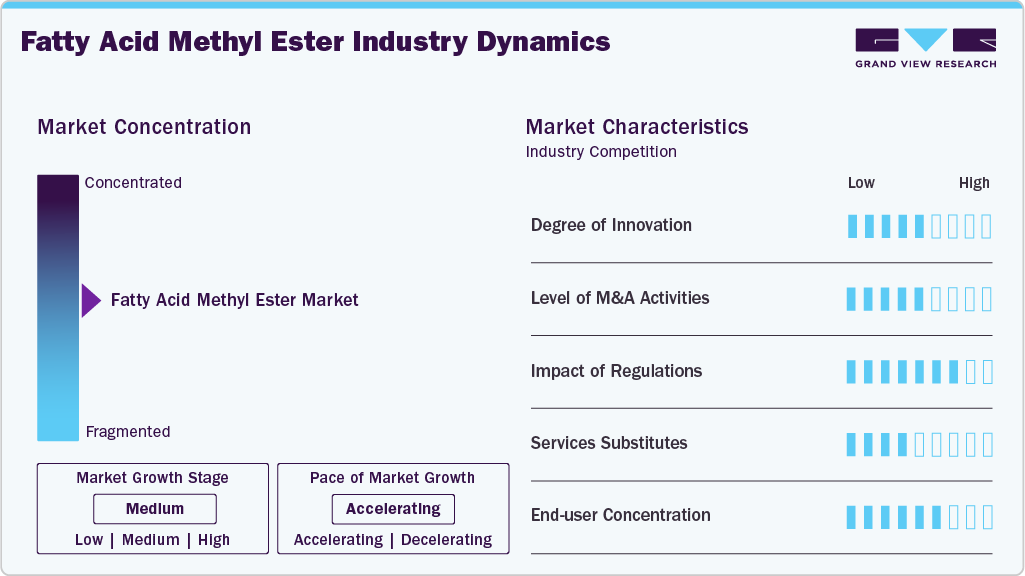
The market features a mix of regional and niche players, such as Aemetis Inc., Hefei TNJ Chemical Industry Co., Ltd., and Mohini Organics Pvt Ltd., which compete through pricing strategies, customized product offerings, and a focus on specific end-use industries. The increasing emphasis on sustainability and regulatory compliance is intensifying competition, prompting companies to invest in waste-based feedstocks, process innovation, and low-emission production technologies. Strategic partnerships, capacity expansions, and geographic diversification, particularly in emerging markets, are key approaches adopted by market participants to strengthen their position and capture future growth opportunities.
Raw Material Insights
Vegetable oils continue to dominate the raw material segment, accounting for 71.6% of the market share in 2025, owing to their reliable availability, standardized quality, and well-established global trade networks. Feedstocks such as soybean, palm, rapeseed, and sunflower oil are widely preferred due to their high conversion efficiency and compatibility with existing transesterification processes. The segment benefits significantly from supportive government policies, including biodiesel blending mandates and subsidies, particularly across regions such as Asia-Pacific, Europe, and North America. The presence of integrated agribusiness players with strong upstream control over feedstock sourcing enhances supply stability and cost competitiveness. However, the segment remains sensitive to price volatility and sustainability concerns, including land use and deforestation, which are increasingly influencing sourcing strategies and regulatory scrutiny.
The animal fats segment is expected to grow at a CAGR of 5.5% from 2026 to 2033, driven by rising interest in low-cost, waste-based feedstocks that support sustainable production models. Derived from tallow, lard, and other animal by-products, these feedstocks offer a cost advantage over conventional vegetable oils and align with circular economy initiatives by utilizing waste streams from the meat processing industry. Increasing regulatory emphasis on reducing carbon intensity and waste disposal is further accelerating their adoption in biodiesel production. Technological advancements in pre-treatment and processing have improved the quality, yield, and consistency of FAME derived from animal fats, making them more commercially viable. Despite these advantages, the segment faces limitations in feedstock availability, supply chain fragmentation, and compositional variability, which may hinder large-scale scalability and uniform product performance.
Product Insights
Unsaturated FAME held a dominant position in the product segment, accounting for 64.6% of the market share in 2025, due to its superior cold flow properties and strong suitability for biodiesel applications across diverse climatic conditions. Derived largely from vegetable oil feedstocks, it offers enhanced fluidity at lower temperatures, making it ideal for transportation fuels in colder regions. The segment benefits from robust demand driven by global decarbonization goals, renewable fuel mandates, and increasing adoption of biodiesel blends in both developed and emerging economies. Its relatively lower production complexity and compatibility with existing engine systems further support widespread usage. However, unsaturated FAMEs are more prone to oxidative degradation, which can affect storage stability and performance, prompting manufacturers to invest in antioxidants and improved stabilization techniques.
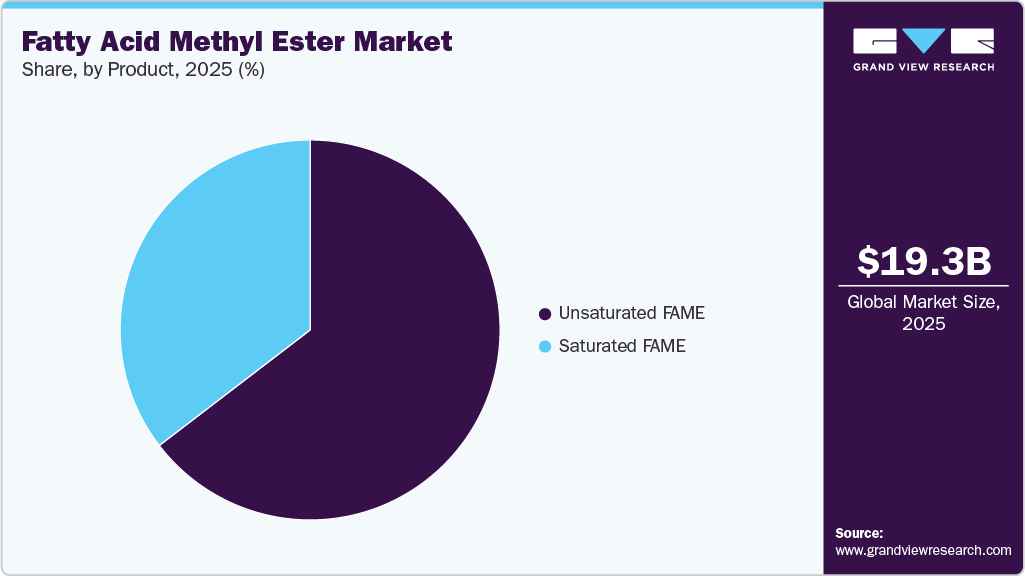
Saturated FAME is projected to grow at a CAGR of 5.0% from 2026 to 2033, driven by its higher oxidative stability, longer shelf life, and superior resistance to thermal degradation. These properties make it particularly suitable for industrial applications such as lubricants, coatings, and specialty chemicals, where durability and performance consistency are critical. Typically derived from feedstocks such as animal fats and certain tropical oils, saturated FAME is gaining traction in non-fuel applications that require enhanced stability under varying operating conditions. The segment is also benefiting from the increasing demand for bio-based industrial inputs and environmentally friendly alternatives to petroleum-derived chemicals. Despite its advantages, limitations related to poor cold flow properties restrict its use in biodiesel applications in colder climates, thereby influencing its application scope and growth dynamics.
Application Insights
Biodiesel dominated the application segment of the fatty acid methyl ester market, accounting for 66.8% of the market share in 2025, driven by strong regulatory support, including blending mandates and carbon reduction targets across key economies. Its widespread adoption as a renewable alternative to conventional diesel is supported by compatibility with existing engines and infrastructure, making it a scalable solution for decarbonizing the transportation sector. Rising concerns over energy security and fossil fuel dependency continue to strengthen demand, positioning biodiesel as the primary growth engine of the FAME market.
The lubricants segment is projected to grow at a CAGR of 5.9% from 2026 to 2033, supported by increasing demand for biodegradable, low-toxicity, and environmentally friendly alternatives to conventional petroleum-based lubricants. FAME-based lubricants offer superior lubricity and a higher flash point, making them suitable for automotive, industrial, and marine applications. Growing regulatory pressure to reduce environmental impact, coupled with rising adoption in sensitive applications such as agriculture and forestry, is accelerating segment expansion and encouraging further product innovation.
Regional Insights
The Asia Pacific fatty acid methyl ester industry dominated the global market with a share of 35.9% in 2025. This growth was driven by the availability of abundant feedstocks, particularly palm and soybean oil, along with strong government support for biodiesel blending programs in countries like India, Indonesia, and Malaysia. Rapid industrialization, rising energy demand, and an increasing emphasis on renewable energy sources further reinforce the region’s market position. Cost-competitive production and expanding domestic consumption also contribute to this positive trend.

China Fatty Acid Methyl Ester Market Trends
The fatty acid methyl ester industry in China is a crucial growth market in the Asia Pacific region, backed by rising investments in renewable energy and a gradual transition towards sustainable fuel alternatives. Government initiatives that promote the utilization of waste oil and practices related to the circular economy are driving the production of fatty acid methyl esters. The growing use of FAME across various industrial applications, including lubricants and chemicals, is further driving market growth.
Europe Fatty Acid Methyl Ester Market Trends
The fatty acid methyl ester industry in Europe accounted for a significant share of 31.5% in 2025. This strong share is driven by strict environmental regulations, a well-established biodiesel infrastructure, and robust policy frameworks, including renewable energy directives. The region's commitment to reducing greenhouse gas emissions and promoting sustainable transport fuels continues to fuel demand. Advancements in technology and high-quality standards are shaping the dynamics of the market.
The Germany fatty acid methyl ester industry plays a vital role in the European market, largely due to its advanced automotive industry and strong commitment to adopting renewable energy. The country has significant biodiesel production capacity, bolstered by regulatory incentives and growing demand for bio-based lubricants and specialty chemicals across various industrial applications.
North America Fatty Acid Methyl Ester Market Trends
The fatty acid methyl ester industry in North America holds a significant share of the global market, supported by favorable regulatory policies such as renewable fuel standards and tax incentives for biodiesel production. The region benefits from well-established supply chains and advanced technologies that enhance production efficiency. The increasing adoption of sustainable fuels across the transportation and industrial sectors is driving demand, while strong infrastructure and policy support continue to encourage the transition to cleaner, renewable energy sources.
The fatty acid methyl ester industry in the U.S. is the leading market in North America, bolstered by strong federal mandates like renewable fuel standards and substantial production capacity. The availability of soybean oil as a primary feedstock, combined with rising demand for low-carbon fuels, are significant factor driving market growth. Increased investments in advanced biofuel technologies contribute to this expansion.
Middle East & Africa Fatty Acid Methyl Ester Market Trends
The fatty acid methyl ester industry in the Middle East and Africa region is gradually growing in the FAME market, driven by a rising awareness of renewable energy and efforts to diversify economies beyond fossil fuels. Although the market is still in its early stages, increasing investments in sustainable energy projects and the growing adoption of bio-based products in industrial applications are expected to support steady growth.
Latin America Fatty Acid Methyl Ester Market Trends
The fatty acid methyl ester industry in Latin America is emerging as a promising market, driven by abundant agricultural resources and a favorable climate for feedstock production. Countries such as Brazil and Argentina are leveraging strong biodiesel programs and expanding export opportunities. Increasing domestic consumption and supportive government policies are enhancing the region’s growth potential and strengthening its position in the global FAME market.
Key Fatty Acid Methyl Ester Company Insights
Companies in the fatty acid methyl ester market are enhancing their positions by pursuing vertical integration to secure a steady supply of feedstock while optimizing production costs and profit margins. They are also investing in sustainable and waste-based raw materials, as well as expanding their capacities in biodiesel and specialty chemicals to comply with changing regulatory and environmental standards.
-
Cargill is a prominent player in the fatty acid methyl ester market, benefiting from its strong global presence and a vertically integrated value chain that includes feedstock sourcing, processing, and distribution. The company has extensive access to key raw materials, such as soybeans and palm oil, enabling cost efficiency and a reliable supply for biodiesel production. Cargill's strategic focus on sustainability, including investments in waste-based feedstocks and low-carbon fuel solutions, enhances its competitive position. Its diversified portfolio spans food, agriculture, and industrial applications, allowing it to capitalize on the growing demand for bio-based chemicals beyond biodiesel.
-
Archer Daniels Midland Company (ADM) is a leading player in the FAME market, bolstered by its extensive agricultural sourcing network and large-scale oilseed processing capabilities. The company's integrated operations efficiently convert feedstocks, such as soybean oil, into biodiesel and other bio-based products, allowing for optimal operational scale and improved profit margins. ADM is committed to innovation and sustainability, actively investing in expanding its renewable fuel capacity and enhancing supply chain traceability. Its strategic focus on regulatory compliance and the growing demand for low-emission fuels positions ADM as a significant contributor to the global energy transition.
Key Fatty Acid Methyl Ester Companies:
The following key companies have been profiled for this study on the fatty acid methyl ester market.
- Tokyo Chemical Industry Co., Ltd.
- Cargill
- BASF SE
- Aemetis Inc.
- Emery Oleochemicals
- Archer Daniels Midland Company
- Wilmar
- Krohne
- Hefei TNJ Chemical Industry Co., Ltd
- Mercuria
- Mohini Organics Pvt Ltd.
Recent Development
-
In May 2025, NYK Group announced the launch of BioxiGuard, Japan’s first antioxidant for marine biodiesel (FAME). The solution improves fuel stability by significantly reducing oxidation degradation, enhancing storage and performance. It supports cleaner maritime operations and strengthens decarbonization efforts in the shipping industry.
Fatty Acid Methyl Ester Market Report Scope
Report Attribute
Details
Market size in 2025
USD 19.3 billion
Estimated market size in 2026
USD 20.1 billion
Projected market size by 2033
USD 28.1 billion
Growth rate
CAGR of 4.9% from 2026 to 2033
Base year for estimation
2025
Historical data
2021 - 2024
Forecast period
2026 - 2033
Quantitative units
Revenue in USD million/billion, volume in kilotons, and CAGR from 2026 to 2033
Report coverage
Revenue forecast, volume forecast, company ranking, competitive landscape, growth factors, and trends
Segments covered
Raw material, product, application, region
Regional scope
North America; Europe; Asia Pacific; Middle East & Africa; Latin America
Country scope
U.S.; Canada; Mexico; Germany; UK; France; Italy; Spain; China; India; Japan; South Korea; Brazil; Argentina; South Africa; Saudi Arabia.
Key companies profiled
Tokyo Chemical Industry Co., Ltd.; Cargill; BASF SE; Aemetis Inc.; Emery Oleochemicals; Archer Daniels Midland Company; Wilmar; Krohne; Hefei TNJ Chemical Industry Co. Ltd; Mercuria; Mohini Organics Pvt Ltd.
Customization scope
Free report customization (equivalent up to 8 analysts’ working days) with purchase. Addition or alteration to country, regional & segment scope.
Pricing and purchase options
Avail customized purchase options to meet your exact research needs. Explore purchase options
Global Fatty Acid Methyl Ester Market Report Segmentation
This report forecasts volume & revenue growth at global, regional, and country levels and provides an analysis of the latest industry trends in each of the sub-segments from 2021 to 2033. For this study, Grand View Research has segmented the global fatty acid methyl ester market report based on raw material, product, application, and region:

-
Raw Material Outlook (Volume, Kilotons; Revenue, USD Million, 2021 - 2033)
-
Vegetable Oils
-
Animal Fats
-
-
Product Outlook (Volume, Kilotons; Revenue, USD Million, 2021 - 2033)
-
Saturated FAME
-
Unsaturated FAME
-
-
Application Outlook (Volume, Kilotons; Revenue, USD Million, 2021 - 2033)
-
Biodiesel
-
Lubricants
-
Food
-
Agriculture
-
Coatings
-
Solvents and Cleaners
-
Personal Care & Cosmetics
-
Other Applications
-
-
Regional Outlook (Volume, Kilotons; Revenue, USD Million, 2021 - 2033)
-
North America
-
U.S.
-
Canada
-
Mexico
-
-
Europe
-
Germany
-
UK
-
France
-
Italy
-
Spain
-
-
Asia Pacific
-
China
-
India
-
Japan
-
South Korea
-
-
Middle East & Africa
-
Saudi Arabia
-
South Africa
-
-
Latin America
-
Brazil
-
Argentina
-
-
Frequently Asked Questions About This Report
Asia Pacific dominated with a 35.9% revenue share in 2025.
Europe is the fastest-growing region over the forecast period.
The vegetable oils segment led with a 71.6% revenue share in 2025.
The biodiesel segment led with a 66.8% revenue share in 2025.
The global fatty acid methyl ester market size was estimated at USD 19.3 billion in 2025 and is expected to reach USD 20.1 billion in 2026.
The unsaturated FAME segment led with a 64.6% revenue share in 2025.
Some of the key players operating in the fatty acid methyl ester market include Tokyo Chemical Industry Co., Ltd., Cargill, Basf SE, Aemetis Inc., Emery Oleochemicals, Archer Daniels Midland Company, Wilmar, Krohne, Hefei TNJ Chemical Industry Co.,Ltd, Mercuria, Mohini Organics Pvt Ltd.
The fatty acid methyl ester (FAME) market is driven by increasing demand for biodiesel, supported by government mandates and global efforts to reduce carbon emissions and dependence on fossil fuels. Rising preference for biodegradable and bio-based chemicals across industries such as lubricants, personal care, and agriculture is further accelerating market growth.
The global fatty acid methyl ester market is expected to grow at a CAGR of 4.9% from 2026 to 2033 to reach USD 28.1 billion by 2033.
About the Author(s)
Agrochemicals Research Team
Specialty & Chemicals · AgrochemicalsThis report was authored by the agrochemicals research team at Grand View Research - comprising two research analysts, one senior research analyst, and one industry expert - with specialized expertise in the agrochemicals segment of the specialty & chemicals industry. All findings are based on proprietary specialty & chemicals databases, executive interviews, and regulatory analysis, subject to internal peer review prior to publication.
Last Updated:
Speak to Analyst


Need a Tailored Report?
Customize this report to your needs — add regions, segments, or data points, with 20% free customization.
Or view our licence options:


ISO 9001:2015 & 27001:2022 Certified
We are GDPR and CCPA compliant! Your transaction & personal information is safe and secure. For more details, please read our privacy policy.












