
- Home
- »
- Advanced Interior Materials
- »
-
Fire Safety Valve Market Size And Share Report, 2026-2033GVR Report cover

Fire Safety Valves Market (2026 - 2033)
Size, Share & Trends Analysis Report By Valve (Ball, Butterfly), By Actuation (Manual, Pneumatic), By End Use (Oil & Gas, Chemical & Petrochemical), By Region, And Segment Forecasts
Market Size, 2025
$3.3BMarket Estimate, 2026
$3.5BMarket Forecast, 2033
$4.9BCAGR, 2026–2033
4.9%Fire Safety Valves Market Summary
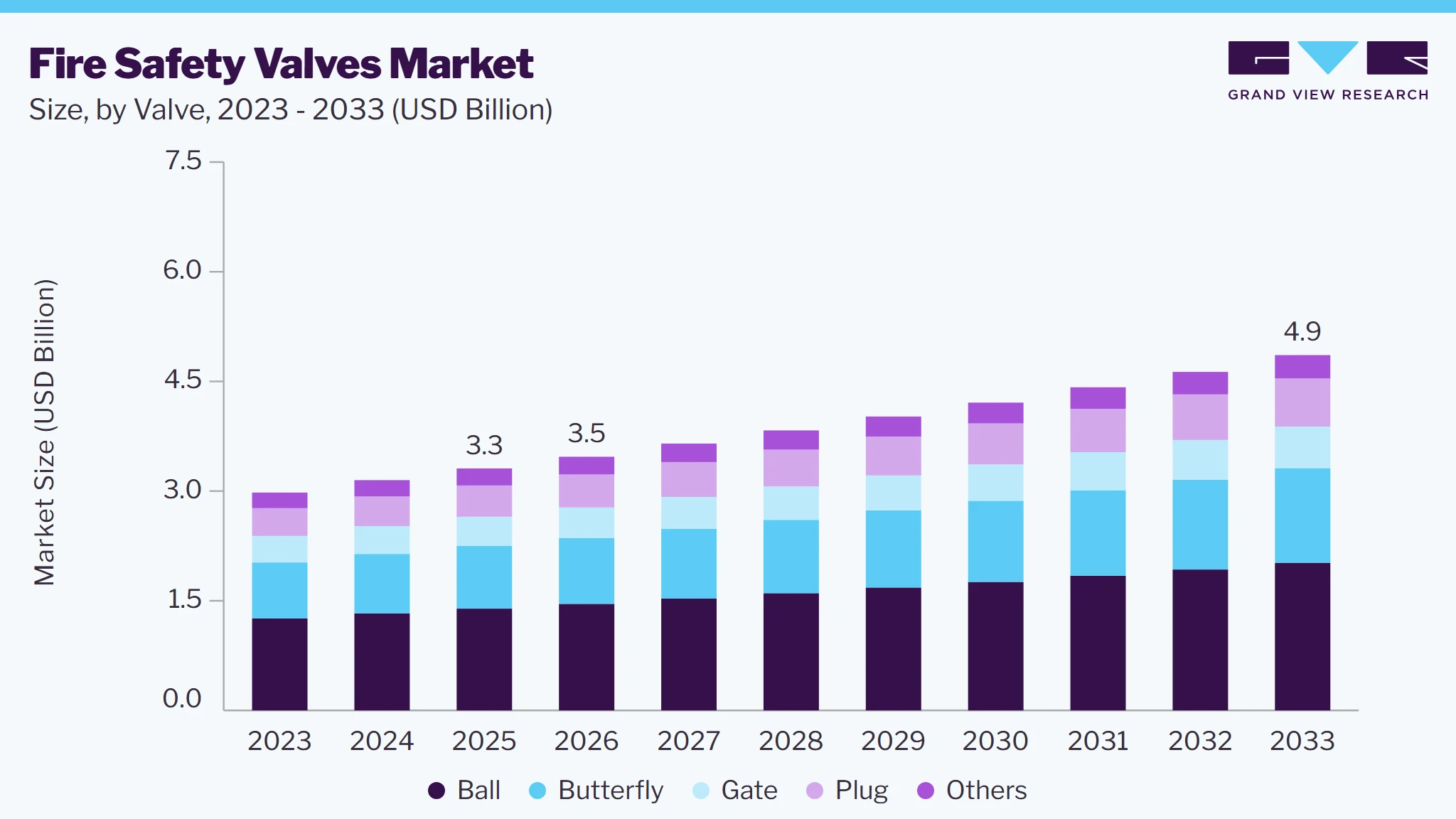
The global fire safety valves market size was valued at USD 3.3 billion in 2025 and is projected to grow from USD 3.5 billion in 2026 to USD 4.9 billion by 2033, at a CAGR of 4.9% from 2026 to 2033. Asia Pacific dominated the market, accounting for a revenue share of 30.6% in 2025. The global market is driven by the increasing emphasis on fire risk management across commercial and industrial facilities.
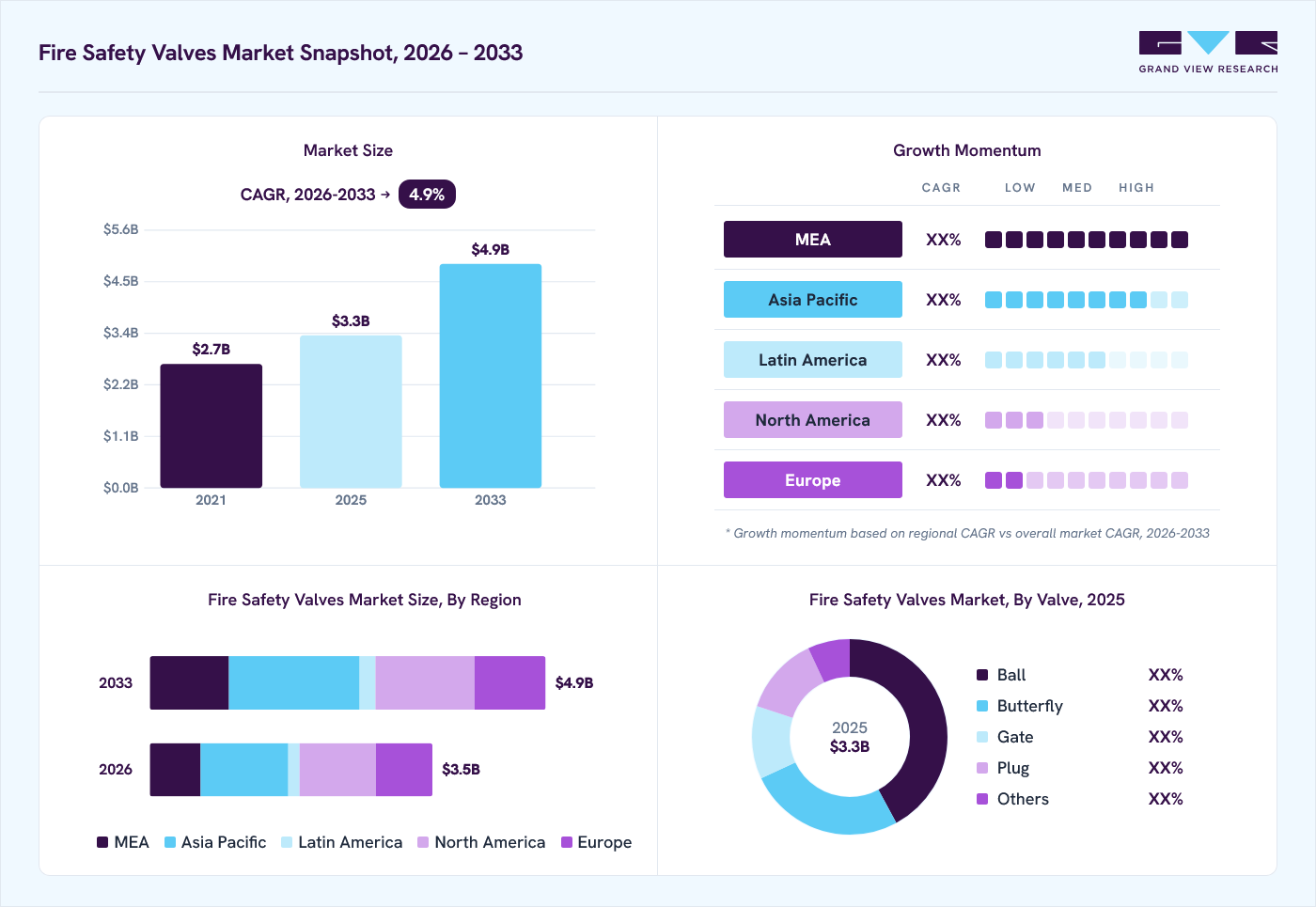 Source: Grand View Research, IR Documents, Primary Interviews, Paid DatabasesTo learn more about this report,
 Download Free Sample Report
 Key Market Trends & Insights
- By valve: The ball segment accounted for the largest revenue share of 42.1% in 2025.
- By actuation: The pneumatic segment dominated the market in 2025, accounting for 45.1% market share.
- By end use: The power generation segment is expected to grow at the fastest CAGR of 6.2% from 2026 to 2033.
Regional Highlights
- Largest regional market: Asia Pacific (30.6% revenue share, 2025)
- Fastest-growing regional market: Middle East & Africa (highest CAGR, 2026-2033)
- By country: China held the largest share in the Asia Pacific region in 2025.
Market Size & Forecast
- Market Size in 2025: USD 3.3 Billion
- Estimated Market Size in 2026: USD 3.5 Billion
- Projected Market Size by 2033: USD 4.9 Billion
- CAGR (2026-2033): 4.9%
Three ways to get this report
Buy it, customize it, or ask a question.Ask an Analyst
A direct answer, usually in 1 working day
- AccessReport author, directly
- Reply timeWithin 1 working day
- No sales callDirect answer only
- FormatEmail reply
- CostFree, no cost
Get the Full Report
What the study covers
- FormatsPDF · Excel · Dashboard
- Timeline2026–2033 annual, 2025 base
- Coverage20+ countries, 5 regions
- Companies10+ key players profiled
Customize the Report
20% free customization
- IncludeCountries, segments, points
- TailorTo your product definition
- ExtendDeeper competitor detail
- OrA fully bespoke study
- Turnaround5–10 working days
Growing awareness of property protection, operational continuity, and life safety is encouraging facility operators to strengthen fire protection infrastructure and replace outdated components. The need for dependable flow control during fire emergencies is supporting demand for valves used across sprinkler, hydrant, deluge, and other suppression systems.
 To learn more about this report, Download Free Sample Report
 In addition, the expansion of industrial facilities with higher fire-risk profiles is creating demand for application-specific valve solutions. Oil & gas, chemical, power generation, and manufacturing facilities require fire protection networks designed to manage varying flow conditions and emergency scenarios. Regular inspection, testing, maintenance, and replacement of installed valves are also generating recurring demand across the existing infrastructure base.
Market Dynamics
The global market for fire safety valve is shaped by the technical requirements of fire suppression networks, regulatory compliance, valve certification, and the need for dependable fluid control during fire events. Market demand varies according to valve configuration, pressure rating, actuation mechanism, system design, and facility requirements. Competitive activity is also influenced by manufacturers' ability to meet regional approval standards and provide valves compatible with different fire protection architectures.
Increasing enforcement of fire protection codes and mandatory certification requirements is encouraging the specification of approved fire safety valves in new and existing facilities. Valves used in critical fire protection applications must meet defined performance criteria related to pressure resistance, flow control, durability, and emergency operation. Compliance requirements therefore influence equipment selection and create demand for certified valves across regulated commercial, industrial, and infrastructure projects.
Fire safety valves often need to be selected, installed, tested, and maintained according to specific system and regulatory requirements. Large actuations may require multiple valve configurations, specialized components, professional actuation, and documented testing, increasing project complexity and associated expenditure. These requirements can extend procurement and commissioning timelines and may create barriers for smaller facilities with limited technical resources or capital budgets.
The integration of sensing, remote monitoring, and automated actuation technologies presents an opportunity for valve development in the market. Connected valves can provide information on valve position, pressure conditions, and operating status, enabling centralized supervision of fire protection networks. Such capabilities can expand the role of valves from conventional flow-control components to monitored system elements, particularly in large commercial facilities, industrial plants, and other complex actuation systems.
Market Concentration & Characteristics
The global fire safety valves industry is characterized by the presence of established fire protection equipment manufacturers, dedicated valve producers, and regional suppliers. Market participants compete primarily through valve range, certification compliance, pressure-handling capabilities, distribution reach, and compatibility with fire suppression systems. The competitive structure varies across regions, with international manufacturers serving large-scale projects and specialized applications, while regional companies address local requirements.
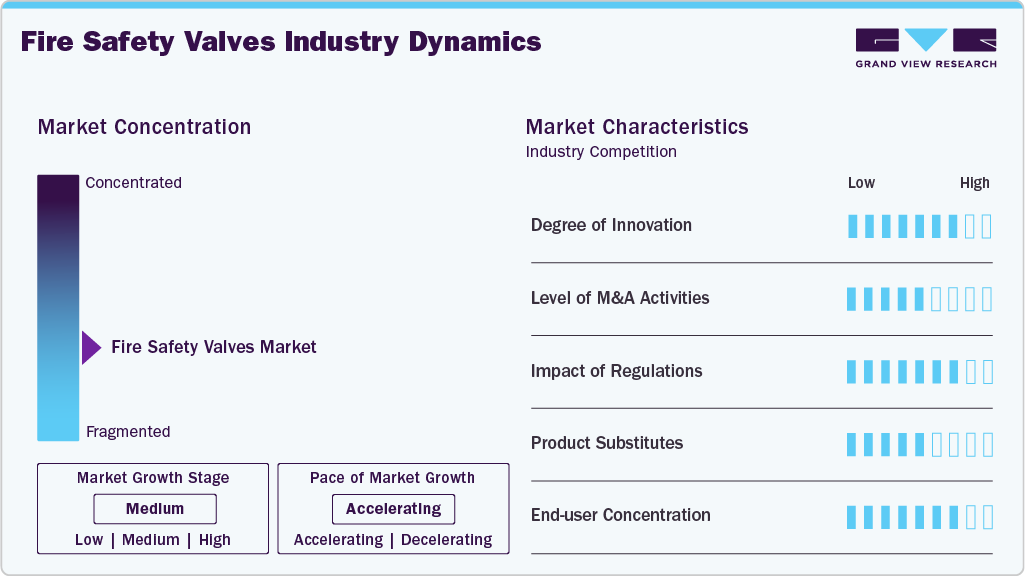 To learn more about this report, Download Free Sample Report
 Product offerings are differentiated by valve type, actuation mechanism, pressure class, connection configuration, and intended fire-protection application. The market includes alarm valves, butterfly valves, check valves, deluge valves, gate valves, and other specialized configurations designed for specific system functions. Certification and performance testing represent important purchasing criteria, as fire safety valves must meet applicable technical and safety requirements before being incorporated into regulated fire protection actuations.
The market has both project-based and replacement-driven demand characteristics. New commercial, industrial, and infrastructure projects generate demand for complete valve actuations, while the existing installed base creates recurring requirements for inspection, maintenance, refurbishment, and replacement. Procurement decisions are therefore influenced not only by initial valve specifications but also by serviceability, component availability, system compatibility, and the long-term operating requirements of fire protection actuations.
Analyst Perspective
The market is shaped by regulatory requirements, fire protection system specifications, and demand across oil & gas, chemical & petrochemical, power generation, commercial, residential, and marine facilities. Valve selection is influenced by valve, actuation, pressure rating, certification, and system configuration. Demand comes from both new installations and replacement or modernization of existing systems. Suppliers with certified product portfolios, multiple valve configurations, and the ability to meet application-specific requirements are better positioned to address diverse procurement needs.
Valve Insights
The ball segment accounted for the largest revenue share of 42.1% in 2025. The segment's revenue position reflects the established use of ball valves in fire protection systems for isolation and shutoff functions, particularly where dependable operation and straightforward flow control are required. Demand is associated with their application across sprinkler, hydrant, and other water-based fire protection arrangements, with valve selection influenced by pressure ratings, connection specifications, certification requirements, and system configuration.
The plug segment is projected to register the fastest CAGR over the forecast period. Its growth is linked to applications requiring positive shutoff and controlled fluid flow within fire protection actuations. Increasing specification of plug valves in systems where valve configuration, operating conditions, and flow requirements call for this design is expected to contribute to segment expansion. The segment's performance is also influenced by replacement requirements and the incorporation of suitable valve configurations into new fire protection projects.
Actuation Insights
The pneumatic segment accounted for the largest revenue share of 45.1% in 2025. Its leading position reflects its established application in fire protection systems where rapid and controlled valve movement is required. Pneumatic actuation is particularly relevant in actuations with centralized control arrangements and applications requiring dependable operation under emergency conditions.
The electric segment is projected to register the fastest CAGR of 6.4% during the forecast period. Increasing adoption is associated with the growing use of electrically operated equipment in fire protection actuations, particularly where automated control and system-level monitoring are required. Integration with electronic control panels and supervisory systems is also broadening the use of electric actuation across modern fire protection infrastructure.
End Use Insights
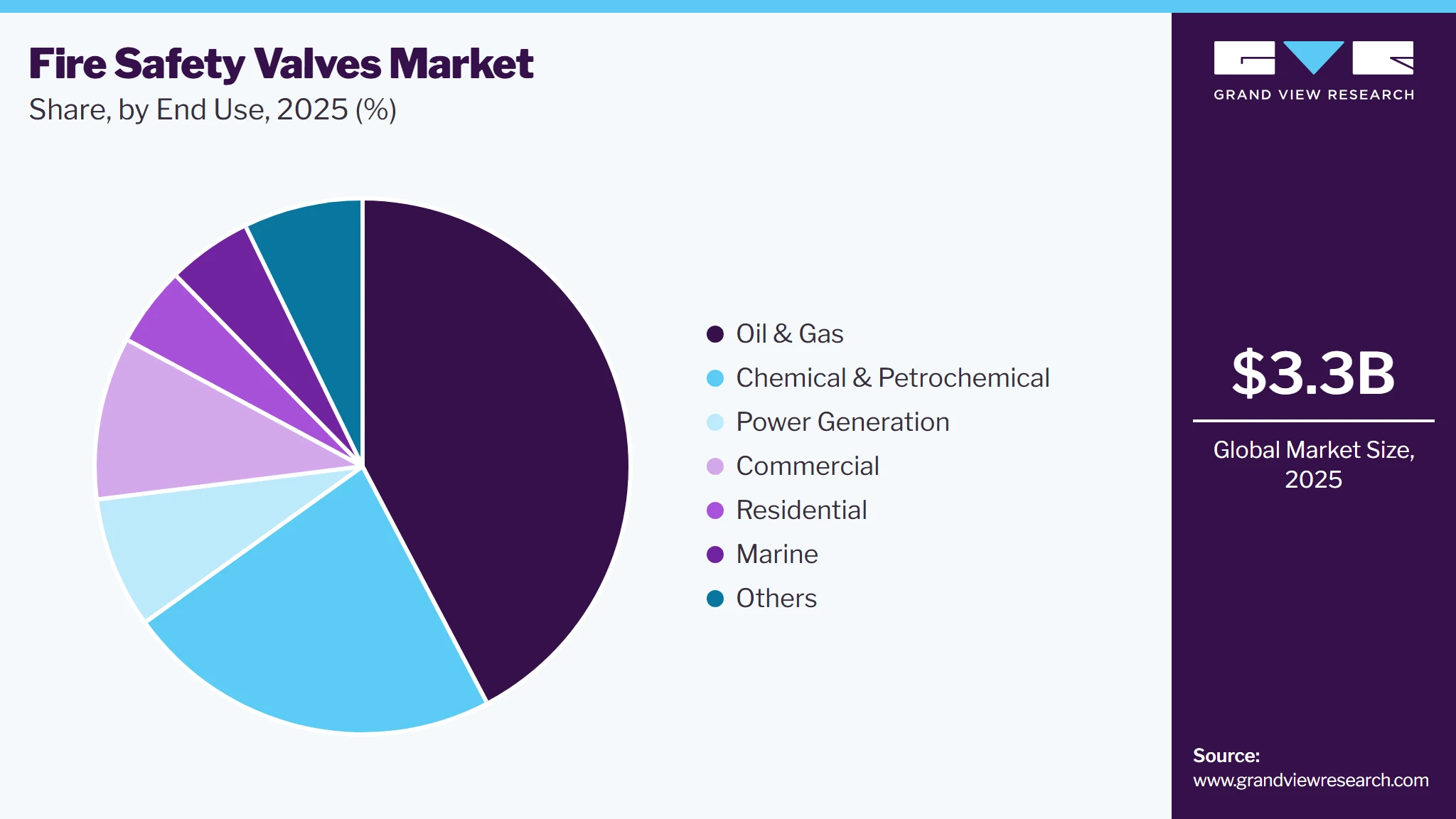
The oil & gas segment accounted for the largest revenue share, at 42.3%, in 2025. The segment represents a substantial demand base because fire safety valves are incorporated across refineries, petrochemical plants, processing facilities, tank farms, terminals, and pipeline-related infrastructure. The handling of flammable hydrocarbons and the concentration of process equipment require dedicated isolation and flow-control arrangements, resulting in demand for valves designed for specific pressure, temperature, and system conditions.
 To learn more about this report, Download Free Sample Report
 The power generation segment is projected to register the fastest CAGR during the forecast period. Expansion of generating capacity and refurbishment of aging power infrastructure are increasing requirements for fire protection components across thermal and other power facilities. Fire safety valves are applied in areas such as fuel handling, lubrication systems, turbine halls, transformers, and auxiliary equipment, where localized fire risks require controlled isolation and suppression. The development of new plants and upgrades to existing fire protection networks is expected to provide further avenues for segment growth.
Regional Insights
Asia Pacific Fire Safety Valves Market Trends
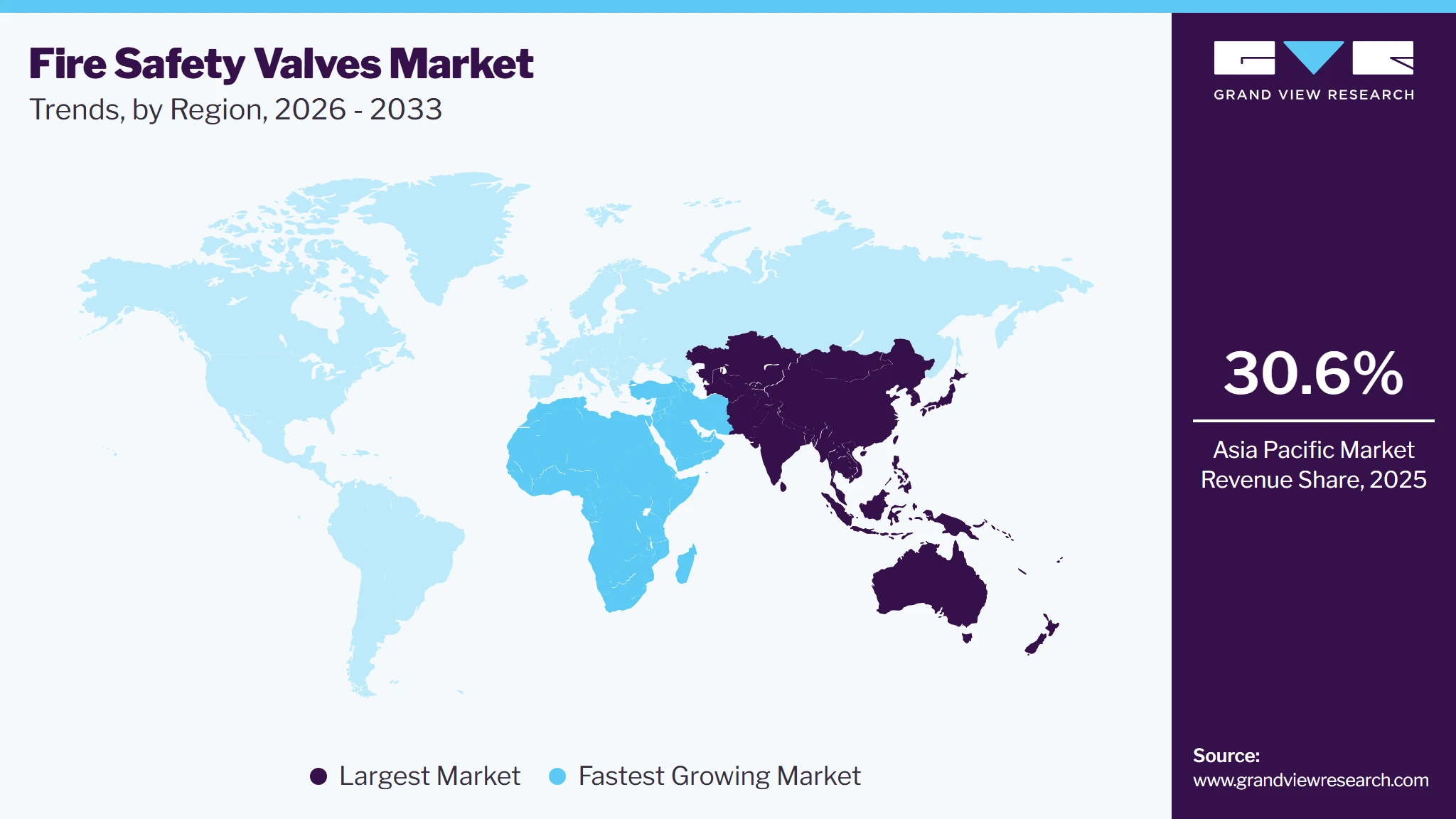
The fire safety valves industry in Asia Pacific dominated the global market with the largest revenue share of 30.6% in 2025. The Asia Pacific market is characterized by a broad application base across manufacturing facilities, commercial complexes, energy assets, logistics infrastructure, and large-scale construction projects. Rapid development of industrial parks, warehouses, high-rise buildings, and utility infrastructure is increasing the incorporation of dedicated fire protection networks into new facilities. The region also has considerable variation in market maturity, with developed economies emphasizing system upgrades and emerging economies generating demand through new actuations.
 To learn more about this report, Download Free Sample Report
 China Fire Safety Valves Market Trends
China fire safety valves industry accounted for the largest revenue share of 44.6% in the Asia Pacific market in 2025. Its position is associated with the scale of industrial facilities, commercial development, energy infrastructure, and construction activity across the country. Applications span manufacturing plants, warehouses, petrochemical facilities, power projects, and commercial properties, creating demand for different valve configurations according to system design and operating requirements.
The fire safety valves industry in India offers opportunities through the development of industrial corridors, manufacturing facilities, commercial properties, data centers, and infrastructure projects. The increasing incorporation of dedicated fire protection provisions in new facilities is expanding the addressable application base. Japan and South Korea are driven by demand from established industrial and commercial infrastructure, where technically specified valves and system modernization are relevant to procurement.
North America Fire Safety Valves Market Trends
The fire safety valves industry in North America is a mature market, with demand substantially shaped by the existing stock of commercial, industrial, institutional, and infrastructure facilities. Fire safety valve procurement is closely associated with inspection schedules, system modifications, renovation projects, and replacement of components that no longer meet current specifications. This creates a recurring aftermarket alongside demand from new construction.
U.S. Fire Safety Valves Market Trends
The U.S. fire safety valves industry represents the principal application base within the region, with requirements extending across industrial plants, high-rise buildings, warehouses, healthcare facilities, educational institutions, and energy infrastructure. Large facilities often require multiple valve configurations integrated into complex suppression networks, resulting in specification-driven procurement.
Canada fire safety valves industry presents opportunities across commercial properties, industrial facilities, utilities, and resource-related infrastructure. Climatic conditions, facility characteristics, and project-specific engineering requirements influence system design and valve selection, while refurbishment of established buildings contributes to ongoing demand.
Europe Fire Safety Valves Market Trends
The fire safety valves industry in Europe is influenced by its mature building stock, established fire protection infrastructure, and emphasis on standardized technical requirements. Renovation and conversion of existing commercial and industrial properties form an important source of demand alongside new developments. The replacement of older components with certified valves is also relevant in facilities undergoing system modernization.
The fire safety valves industry in Germany represents an important market due to its extensive industrial and commercial infrastructure. Applications span manufacturing plants, logistics facilities, warehouses, industrial complexes, and large commercial properties. The country's engineering-oriented industrial base also creates demand for valves selected according to precise system specifications and operating conditions.
France fire safety valves industry offers demand across commercial buildings, manufacturing facilities, transportation infrastructure, hospitality properties, and public-sector facilities. Renovation activity and incorporation of fire protection provisions into new projects contribute to market development, while application requirements vary according to building type and system architecture.
Middle East & Africa Fire Safety Valves Market Trends
The fire safety valves industry in Middle East & Africa is projected to register the fastest CAGR of 6.5% over the forecast period. The MEA market is closely connected with large-scale energy, infrastructure, hospitality, transportation, and urban development projects. Fire safety valves are particularly relevant in facilities where fire protection forms an integral part of project engineering, including refineries, processing facilities, airports, hotels, commercial complexes, and utility assets. Large project sizes can also result in demand for specialized valve configurations and engineered systems.
Saudi Arabia fire safety valves industry represents an important market, with demand influenced by large infrastructure developments, industrial projects, tourism-related construction, utilities, and energy facilities. The development of new urban and industrial assets is broadening the range of applications beyond traditional oil & gas facilities, creating demand across multiple building and infrastructure categories.
Latin America Fire Safety Valves Market Trends
The fire safety valves industry in Latin America is witnessing demand associated with industrial facilities, commercial properties, mining operations, energy assets, logistics centers, and public infrastructure. Market development varies considerably between countries, reflecting differences in construction activity, industrial investment, and the maturity of installed fire protection infrastructure. New projects and refurbishment of existing facilities therefore contribute to demand through different channels.
Brazil fire safety valves industry represents a key market in the region, with applications spanning industrial plants, commercial buildings, warehouses, energy facilities, mining operations, and large infrastructure projects. The country's diverse industrial base creates requirements for multiple valves and actuation configurations, while modernization of established facilities provides an additional source of demand.
Key Fire Safety Valves Company Insights
Some of the key players operating in the market include Johnson Controls, Victaulic, among others.
-
Johnson Controls, headquartered in Cork, Ireland, is a manufacturer of fire protection equipment and systems, offering a portfolio of valves and related components for water-based fire suppression applications. Its valve range includes valves for wet, dry, deluge, and preaction systems, along with shut-off, check, gate, butterfly, pressure-reducing, and pressure-relief valves. The company serves commercial, industrial, energy, oil and gas, transportation, storage, and other facilities requiring dedicated fire protection systems and certified flow-control components.
-
Victaulic, headquartered in Easton, Pennsylvania, U.S., is a manufacturer of mechanical pipe joining, flow control, and fire protection valves, with a dedicated portfolio of valves and system components for fire sprinkler and suppression applications. Its offerings include valves and associated valves for wet, dry, deluge, and preaction systems, serving commercial buildings, industrial facilities, infrastructure, data centers, storage facilities, healthcare facilities, and other applications. The company designs and manufactures its fire protection valves and offers UL-listed and FM-approved valves for fire protection actuations.
Key Fire Safety Valve Companies:
The following key companies have been profiled for this study on the fire safety valves market.
-
Johnson Controls
-
Victaulic
-
Viking Group
-
Reliable Automatic Sprinkler
-
Fivalco
-
HD Fire Protect
-
WEFLO Valve
-
Kennedy Valve
-
NIBCO
-
Cla-Val
-
BERMAD
-
Potter Roemer
-
Milwaukee Valve
-
Watts
-
Apollo Valves (Conbraco)
Competitive Benchmarking
Category
Operating Strategies
Competitive Edge
Weakness
Established Players (e.g., Johnson Controls; Victaulic; Viking Group; Reliable Automatic Sprinkler; Fivalco; HD Fire Protect; WEFLO Valve)
Expand fire safety valve ranges across sprinkler, deluge, dry, preaction, alarm, and isolation applications.
Strengthen valve approvals, engineering capabilities, project specification activities, and relationships with fire protection contractors and distributors.
Broad application expertise and established valve portfolios enable participation in complex fire protection projects across multiple end-use industries.
Established brands, recognized certifications, and extensive market networks facilitate specification in large-scale and regulated actuations.
Higher certification, testing, valve development, and operating costs can reduce flexibility in price-sensitive projects.
Large valve portfolios and organizational structures can make rapid customization for localized requirements more challenging.
Emerging & Regional Players (e.g., Kennedy Valve; NIBCO; Cla-Val; BERMAD; Potter Roemer; Milwaukee Valve; Watts; Apollo Valves (Conbraco))
Focus on selected valve categories and application requirements while expanding through regional distributors, contractors, and system integrators.
Emphasize localized manufacturing, shorter lead times, customized configurations, and competitive commercial terms.
Stronger knowledge of regional standards and customer requirements can facilitate responsive project support.
Focused operations can provide flexibility in customized orders and regional applications.
Limited international presence and approval coverage can restrict participation in multinational and highly standardized projects.
Smaller scale may constrain investment in extensive valve development, testing infrastructure, and global service networks.
Recent Developments
-
On January 6, 2026, AVK Industrial Solutions S.r.l. announced the acquisition of PetrolValves S.p.A.’s manufacturing facility in Piacenza, Italy. The transaction strengthens AVK’s manufacturing capacity for high-performance valves and expands its capabilities in triple offset and ball valve production. The facility is expected to become part of AVK’s broader production network, strengthening its ability to serve industrial and energy-related applications. The development is relevant to the market as AVK maintains a portfolio of valves for fire protection systems.
-
On June 30, 2026, Flowserve announced the completion of its acquisition of Trillium Flow Technologies’ Valves Division for $490 million. The transaction expands Flowserve’s engineered valve portfolio and strengthens its capabilities in power generation, industrial, and other critical infrastructure applications. The acquisition also broadens the company’s installed product base and valve technologies, supporting its position across specialized flow-control markets.
Fire Safety Valves Market Report Scope
Report Attribute
Details
Market size in 2025
USD 3.3 billion
Estimated market size in 2026
USD 3.5 billion
Revenue forecast in 2033
USD 4.9 billion
Growth rate
CAGR of 4.9% from 2026 to 2033
Base year for estimation
2025
Historical data
2021-2024
Forecast period
2026 - 2033
Quantitative units
Revenue in USD billion and CAGR from 2026 to 2033
Report coverage
Revenue forecast, company market position analysis, competitive landscape, growth factors, and trends
Segments covered
Valve, actuation, end use, region
Regional scope
North America; Europe; Asia Pacific; Latin America; Middle East & Africa
Country Scope
U.S.; Canada; Mexico; Germany; UK; Italy; Spain; France; China; Japan; India; Australia; South Korea; Brazil; Argentina; Saudi Arabia; UAE; South Africa
Key companies profiled
Johnson Controls; Victaulic; Viking Group; Reliable Automatic Sprinkler; Fivalco; HD Fire Protect; WEFLO Valve; Kennedy Valve; NIBCO; Cla-Val; BERMAD; Potter Roemer; Milwaukee Valve; Watts; Apollo Valves (Conbraco).
Customization scope
Free report customization (equivalent up to 8 analysts working days) with purchase. Addition or alteration to country, regional & segment scope.
Pricing and purchase options
Avail customized purchase options to meet your exact research needs. Explore purchase options
Global Fire Safety Valves Market Report Segmentation
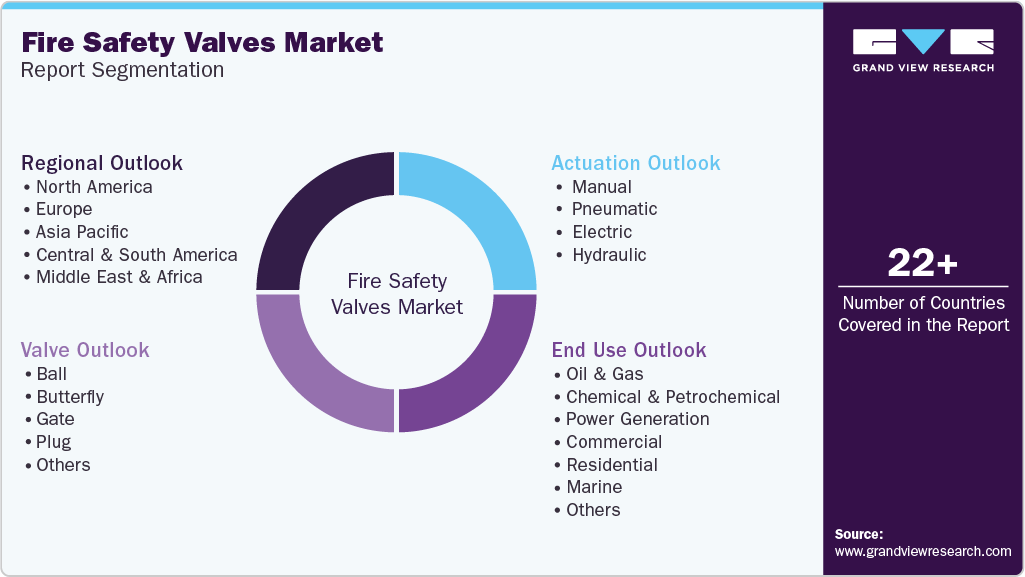
This report forecasts revenue growth at global, regional & country levels and provides an analysis on the industry trends in each of the sub-segments from 2021 to 2033. For this study, Grand View Research has segmented the fire safety valves market report based on valve, actuation, end use, and region:
 To learn more about this report, Download Free Sample Report
 -
Valve Outlook (Revenue, USD Billion, 2021 - 2033)
-
Ball
-
Butterfly
-
Gate
-
Plug
-
Others
-
-
Actuation Outlook (Revenue, USD Billion, 2021 - 2033)
-
Manual
-
Pneumatic
-
Electric
-
Hydraulic
-
-
End Use Outlook (Revenue, USD Billion, 2021 - 2033)
-
Oil & Gas
-
Chemical & Petrochemical
-
Power Generation
-
Commercial
-
Residential
-
Marine
-
Others
-
-
Regional Outlook (Revenue, USD Billion, 2021 - 2033)
-
North America
-
U.S.
-
Canada
-
Mexico
-
-
Europe
-
Germany
-
France
-
UK
-
Spain
-
Italy
-
-
Asia Pacific
-
China
-
India
-
Japan
-
South Korea
-
Australia
-
-
Latin America
-
Brazil
-
Argentina
-
-
Middle East & Africa
-
Saudi Arabia
-
UAE
-
South Africa
-
-
Research Methodology
The fire safety valves market figures in this report are based on a proven research process that combines executive interviews with secondary research from proprietary databases, company filings, and recognized regulatory and institutional sources. Market size is built through value-chain sizing-reconciling supply-side and demand-side estimates-and triangulated with bottom-up and top-down approaches. Every estimate passes multiple levels of expert validation before publication, with each fire safety valves segment quantified using the revenue-capture definitions in the table below.
Segment Definition
Valve
Revenue Capture Definition
Ball
Revenue captured from the sale of ball fire safety valves as finished valve products, including standard and certified variants, with value derived from the product price charged to customers or intermediaries.
Butterfly
Revenue captured from sales of butterfly fire safety valves, covering commercially supplied valve configurations and associated integral components included within the invoiced product value.
Gate
Revenue captured from the sale of gate fire safety valves, including different body, connection, and certification configurations offered as standalone valve products or assemblies.
Plug
Revenue captured from plug fire safety valve sales, encompassing the invoiced value of plug valve products supplied in specified sizes, pressure classes, and operating configurations.
Others
Revenue captured from fire safety valve products outside the ball, butterfly, gate, and plug categories, including check, deluge, alarm, pressure-reducing, and pressure-relief valve products.
Actuation
Revenue Capture Definition
Manual
Revenue captured from fire safety valves supplied with manual operating mechanisms, with segment value reflecting the selling price of manually actuated valve products and applicable integrated components.
Pneumatic
Revenue captured from pneumatically actuated fire safety valve products, including the valve and pneumatic actuation assembly when supplied as a combined commercial unit.
Electric
Revenue captured through sales of electrically actuated fire safety valves, including complete valve assemblies incorporating electric actuation components where included in the product sale.
Hydraulic
Revenue captured from sales of hydraulically actuated fire safety valves, covering the commercial value of the valve and integrated hydraulic actuation arrangement supplied to the customer.
End Use
Revenue Capture Definition
Oil & Gas
Revenue generated through fire safety valve sales to oil and gas industry customers, including product orders placed directly by operators, contractors, distributors, or engineering and procurement companies.
Chemical & Petrochemical
Revenue derived from fire safety valve orders associated with chemical and petrochemical projects, encompassing individually purchased valves as well as products procured under larger equipment or project orders.
Power Generation
Revenue attributable to fire safety valve sales within the power generation customer base, including direct purchases, distributor transactions, and project-specific procurement of valve products.
Commercial
Revenue derived from fire safety valve sales for commercial building projects and facilities, including products purchased through manufacturers, distributors, contractors, or other authorized sales channels.
Residential
Revenue attributable to fire safety valve products sold for residential construction and related projects, including direct product transactions and sales made through distributors or fire protection contractors.
Marine
Revenue generated from the sale of fire safety valves for marine-related procurement, including individual product transactions and valve packages supplied as part of vessel or marine infrastructure projects.
Others
Revenue generated from fire safety valve sales across end-use categories outside the specified segments, covering individual product purchases, distributor sales, and project-based orders.
Estimation Model
Layer Name
Key Question
Description
Fire Safety Valve Demand Layer
Where is demand for fire safety valves generated?
Assess demand for fire safety valves across oil & gas, chemical & petrochemical, power generation, commercial, residential, marine, and other end-use sectors. Evaluate new installations, system modifications, and valve replacement requirements to determine the addressable product demand.
Valve Procurement Layer
What factors influence fire safety valve procurement?
Evaluate procurement requirements based on fire protection system specifications, valve functions, pressure ratings, connection requirements, certification standards, and project requirements. Assess purchases made through direct manufacturer sales, distributors, contractors, and system integrators.
Valve & Actuation Adoption Layer
Which fire safety valve configurations are being purchased?
Determine the adoption of ball, butterfly, gate, plug, and other valves across manual, pneumatic, electric, and hydraulic actuation. Assess product selection based on flow-control requirements, operating conditions, system configuration, pressure requirements, and applicable fire safety certifications.
Revenue Generation Layer
How much revenue is generated from fire safety valve sales?
Estimate annual revenue from the sale of fire safety valves by valve, actuation, end use, and region. Capture the value of new and replacement fire safety valve products sold by manufacturers through direct and indirect sales channels, excluding revenue from installation, maintenance, inspection, and other services.
Customization Table
Client Request
Customization Delivered
Value Adds
Competitive Benchmarking
A structured assessment of leading fire safety valve manufacturers was conducted across valve coverage, actuation configurations, product approvals, pressure classes, connection types, application coverage, geographic presence, distribution networks, and recent product developments. Company strategies, portfolio positioning, and areas of specialization were also reviewed.
Enables stakeholders to compare manufacturers on technical capabilities, product breadth, certification coverage, commercial reach, and strategic focus. The analysis also helps identify areas of differentiation and gaps within existing supplier portfolios.
Regional Segmentation
The market was evaluated across North America, Europe, Asia Pacific, Latin America, and the Middle East & Africa, with selected country-level analysis. Regional assessment covered regulatory frameworks, fire safety codes, industrial composition, building infrastructure, project activity, installed equipment base, procurement channels, and replacement practices.
Provides a detailed understanding of how market conditions differ by geography. The analysis assists stakeholders in identifying region-specific requirements, assessing market accessibility, adapting distribution approaches, and developing geographically relevant business strategies.
Opportunity Assessment
Commercial opportunities were evaluated across ball, butterfly, gate, plug, and other valves, as well as manual, pneumatic, electric, and hydraulic actuation. The assessment also examined opportunities arising from system modernization, replacement of aging valves, automation, certification upgrades, and application-specific requirements across oil & gas, chemical & petrochemical, power generation, commercial, residential, and marine sectors.
Supports identification of addressable opportunities across product and application categories. The assessment helps stakeholders prioritize portfolio expansion, evaluate technology-related opportunities, identify potential customer segments, and determine areas for future investment.
Frequently Asked Questions About This Report
The market is influenced by fire safety regulations and certification requirements, expansion and modernization of fire protection systems, demand from oil & gas and power generation facilities, and the replacement of existing valves. Product specifications, pressure ratings, actuation mechanisms, system compatibility, and installation requirements also influence purchasing decisions.
Key players include Johnson Controls, Victaulic, Viking Group, Reliable Automatic Sprinkler, Fivalco, HD Fire Protect, WEFLO Valve, Kennedy Valve, NIBCO, Cla-Val, BERMAD, Potter Roemer, Milwaukee Valve, Watts, and Apollo Valves (Conbraco).
Middle East & Africa is the fastest-growing region over the forecast period.
The global fire safety valve market size was valued at USD 3.3 billion in 2025 and is estimated at USD 3.5 billion in 2026.
The global fire safety valve market is projected to grow at a CAGR of 4.9% from 2026 to 2033, reaching USD 4.9 billion by 2033.
Asia Pacific dominated the global fire safety valve market with a revenue share of 30.6% in 2025.
The ball segment accounted for the largest revenue share of 42.1% in the global fire safety valve market in 2025.
The pneumatic segment dominated the market in 2025, accounting for 45.1% market share while electric segment is expected to be the fastest-growing market.
The oil & gas segment accounted for the largest revenue share, at 42.3%, in 2025. The segment represents a substantial demand base because fire safety valves are incorporated across refineries, petrochemical plants, processing facilities, tank farms, terminals, and pipeline-related infrastructure.
About the Author(s)
Advanced Interior Materials Research Team
Advanced Materials · Advanced Interior MaterialsThis report was authored by the advanced interior materials research team at Grand View Research - comprising two research analysts, one senior research analyst, and one industry expert - with specialized expertise in the advanced interior materials segment of the advanced materials industry. All findings are based on proprietary advanced materials databases, executive interviews, and regulatory analysis, subject to internal peer review prior to publication.
Last Updated:
Speak to Analyst

Customize this report to your needs - add regions, segments, or data points, with 20% free customization.
Or view our licence options:


ISO 9001:2015 & 27001:2022 Certified
We are GDPR and CCPA compliant! Your transaction & personal information is safe and secure. For more details, please read our privacy policy.


