
- Home
- »
- Power Generation & Storage
- »
-
Flexible Battery Market Size, Growth Report, 2026-2033GVR Report cover

Flexible Battery Market (2026 - 2033)
Size, Share & Trends Analysis Report By Type (Secondary, Primary), By Capacity (Below 10 mAh, 10-100 mAh, Above 100 mAh), By Technology, By Application, By Region, And Segment Forecasts
Market Size, 2025
$267.3MMarket Estimate, 2026
$280.7MMarket Forecast, 2033
$1,049.8MCAGR, 2026–2033
20.7%Flexible Battery Market Summary
The global flexible battery market size was valued at USD 267.3 million in 2025 and is projected to grow from USD 280.7 million in 2026 to USD 1,049.8 million by 2033, at a CAGR of 20.7% from 2026 to 2033. North America dominated the global market, accounting for the largest revenue share of 34.4% in 2025. The industry is witnessing rapid expansion, driven by the surging demand for lightweight, compact, and bendable power sources in wearable technology, IoT devices, and smart medical electronics.
 Source: Grand View Research, IR Documents, Primary Interviews, Paid DatabasesTo learn more about this report,
 Download Free Sample Report
 Key Market Trends & Insights
- By type: Secondary rechargeable flexible batteries segment held the highest market share of 75.7% in 2025.
- By technology: Thin-film batteries segment held the largest share of 44.3% in 2025.
- By capacity: 10-100 mAh segment held the largest share of 46.6% in 2025.
Regional Highlights
- Largest regional market: North America (34.4% revenue share, 2025)
- Fastest-growing regional market: Asia Pacific (highest CAGR, 2026-2033)
- By country: The U.S. flexible battery industry is a major contributor to the global market.
Market Size & Forecast
- Market size in 2025: USD 267.3 Million
- Estimated market size in 2026: USD 280.7 Million
- Projected market size by 2033: USD 1,049.8 Million
- CAGR (2026-2033): 20.7%
Three ways to get this report
Buy it, customize it, or ask a question.Ask an Analyst
Analyst response in 1 business day
- AccessReport author, directly
- Reply timeWithin 1 working day
- No sales callDirect answer only
- FormatEmail reply
- CostFree, no cost
Get the Full Report
What the study covers
- FormatsPDF · Excel · Dashboard
- Timeline2026–2033 annual, 2025 base
- Coverage20+ countries, 5 regions
- Companies10+ key players profiled
Customize the Report
20% free customization
- IncludeCountries, segments, points
- TailorTo your product definition
- ExtendDeeper competitor detail
- OrA fully bespoke study
- Turnaround5–10 working days
Rapid advancements in thin-film and printed battery technology, coupled with the need for flexible power in IoT, are accelerating adoption. The global industry is experiencing robust growth, driven by the rising demand for wearable electronics, increasing adoption of flexible and foldable consumer devices, and the widespread adoption of connected IoT technologies. As digitalization accelerates across industries, particularly in emerging economies, the need for compact, lightweight, and adaptable energy storage solutions has become a key driver of market expansion. A structural shift is underway in the electronics ecosystem, with manufacturers increasingly designing miniaturized and flexible devices, thereby creating strong demand for thin, bendable battery technologies that can seamlessly integrate into unconventional form factors.
 To learn more about this report, Download Free Sample Report
 The growing emphasis on performance optimization and product innovation is significantly influencing the development of the industry. The integration of flexible batteries with next-generation applications, including smart healthcare devices, electronic skin, and smart packaging, is gaining momentum, enabling diversified application potential and new revenue streams. Continuous advancements in materials science and battery design are improving energy density, flexibility, and lifecycle performance, supporting scalability and broader commercialization across industries.
Drivers, Opportunities & Restraints
The primary driver of the industry is the growing demand for wearable devices such as smartwatches, fitness trackers, and health monitoring systems, which require lightweight, compact, and bendable power sources that can comfortably conform to the human body. The rapid deployment of smart, connected IoT devices across industries is significantly increasing the need for small, efficient, and flexible batteries to power sensors and embedded systems. Continuous advancements in flexible electronics and miniaturization technologies are enabling the development of thinner, more adaptable devices, thereby accelerating the adoption of flexible energy storage solutions across a wide range of emerging applications.
A key opportunity in the industry lies in the growing adoption of smart packaging and logistics solutions, where printed batteries are increasingly being used to power smart labels and RFID tags. These applications enable real-time tracking, product authentication, and shelf-life monitoring, significantly improving supply chain transparency and efficiency across industries such as retail, pharmaceuticals, and food & beverages. As companies continue to invest in intelligent packaging to enhance customer engagement and reduce losses, the demand for low-cost, thin, and flexible power sources is expected to rise.
However, a major challenge in the industry is the high manufacturing cost, as production involves specialized materials and advanced fabrication techniques such as thin-film deposition and printed electronics. These processes require significant capital investment and technical expertise, making flexible batteries more expensive than conventional alternatives. This cost barrier continues to hinder large-scale commercialization despite the growing demand for flexible and lightweight energy storage solutions.
One of the main restraints faced by the industry is the low energy density and limited capacity of flexible batteries. This confines their usage to low-power devices such as wearables and sensors. Unlike conventional batteries, they store less energy, making them unsuitable for high-power applications or devices requiring long operating times. This limitation also impacts their scalability and restricts their penetration into broader consumer electronics and industrial applications.
Type Insights
Based on type, the secondary (rechargeable flexible batteries) segment accounted for the largest market share of 75.7% in 2025, driven by their eco-friendly and reusable nature, making them a sustainable alternative to single-use batteries. They offer long-term cost advantages, as they can be charged and reused multiple times, reducing the need for frequent replacements. This makes them particularly important for IoT devices and connected systems that require continuous and reliable power over extended periods, supporting efficient and uninterrupted operation.
The primary (non-rechargeable flexible batteries) segment is projected to register the fastest CAGR of 21.4% over the forecast period of 2026-2033, supported by their disposable, single-use nature, which makes them ideal for applications where battery replacement or recharging is impractical, such as medical patches and smart packaging. These batteries offer a cost-effective and convenient solution for low-power, short-term use cases, particularly in high-volume industries like healthcare, logistics, and consumer goods, where ease of use and compact design are critical.
Technology Insights
Based on technology, thin-film batteries accounted for the largest revenue share of 44.3% in 2025, driven by their strong suitability for miniaturized and compact electronic devices. Their ability to seamlessly fit into small, lightweight, or curved forms makes them essential for applications such as smartwatches, fitness trackers, and smart cards. Thin-film batteries also offer high performance and enhanced safety, often utilizing solid-state designs that reduce the risk of leakage and improve reliability. Their capability for fast charging, with some variants able to charge within minutes, further strengthens their adoption across advanced consumer electronics and low-power applications.
The printed batteries segment is projected to register the fastest CAGR of 21.2% over the forecast period, supported by their low-cost manufacturing, scalability, and suitability for disposable applications. These batteries can be produced using printing technologies on flexible substrates, enabling high-volume production and customizable designs for compact devices. Their growing adoption in smart packaging, RFID tags, and IoT sensors is further driving demand, as they provide an efficient and lightweight power solution for short-term and low-power applications across various industries.
Capacity Insights
Based on capacity, the 10 mAh - 100 mAh segment accounted for the largest market share of 46.6% in 2025, driven by its strong alignment with the power requirements of most wearable devices, IoT sensors, and compact consumer electronics. Batteries in this range offer an optimal balance between size, weight, and energy capacity, making them ideal for applications such as smartwatches, fitness trackers, medical patches, and smart cards. Their compact form factor and sufficient runtime for low-to-moderate power consumption devices make them highly suitable for flexible and miniaturized electronics, thereby contributing to their dominant share in the market.
The below 10 mAh segment is projected to register the fastest CAGR of 21.1% over the forecast period of 2026-2033, driven by its strong adoption in ultra-low-power and disposable applications. These batteries are ideal for smart packaging, RFID tags and smart labels where minimal power is required along with thin, lightweight, and cost-efficient designs. The increasing use of printed and single-use flexible batteries in high-volume industries such as logistics, retail, and healthcare is further accelerating demand, supporting the rapid expansion of this segment.
Application Insights
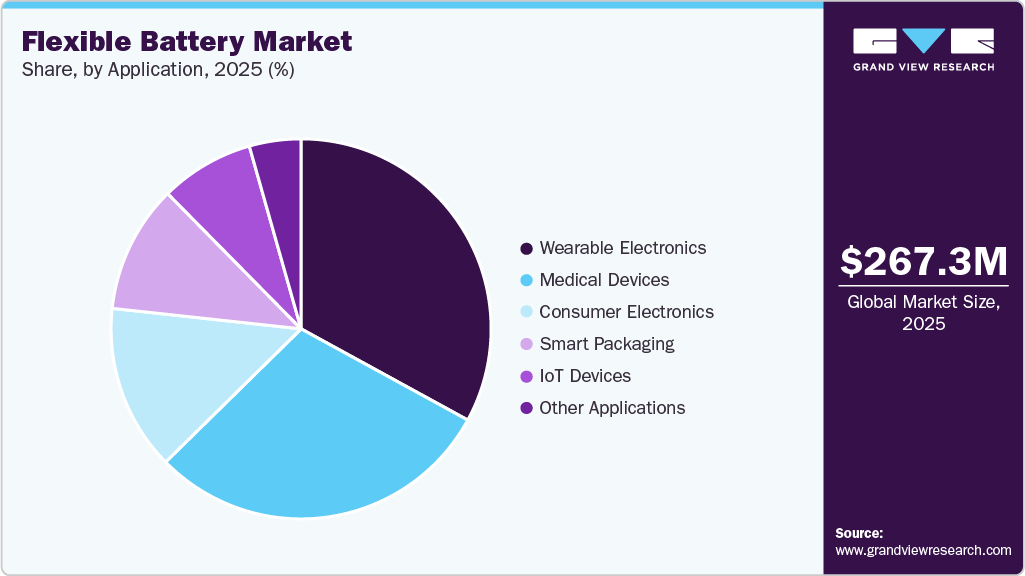
Based on application, the wearable electronics segment accounted for the largest market share of 33.0% in 2025, driven by the high demand for health tracking and monitoring solutions. The surging adoption of IoT-enabled wearable devices, including fitness trackers, smartwatches, and health-monitoring sensors, is significantly increasing the need for flexible, lightweight, and long-lasting energy sources. These devices require batteries that can conform to the human body while delivering reliable performance, thereby supporting the strong growth of flexible batteries in this segment.
 To learn more about this report, Download Free Sample Report
 The IoT devices segment is projected to register the fastest CAGR of 21.3% over the forecast period of 2026-2033, driven by the rapid expansion of connected sensors and smart devices across industries such as healthcare, industrial automation, logistics, and smart homes. These applications require compact, lightweight, and flexible power sources to support miniaturized and often irregularly shaped devices. The increasing deployment of wireless, low-power IoT sensors in remote and hard-to-access locations is accelerating demand for flexible batteries that offer reliability, efficiency, and ease of integration, thereby supporting the segment’s strong growth.
Regional Insights
The Asia Pacific flexible battery market is expected to grow at the fastest rate of 21.0%, driven by the increasing adoption of health monitoring devices, smart cards, and smart packaging, which is fueling demand for flexible and thin-film power sources. The region’s strong electronics manufacturing base in countries such as China, Japan, and South Korea, along with rising investments in IoT and wearable technologies, is further accelerating market growth. The expanding use of compact, connected devices across healthcare, consumer electronics, and logistics is reinforcing the demand for lightweight and adaptable energy storage solutions in the region.
Europe Flexible Battery Market Trends
The flexible battery market in Europe is experiencing growth, driven by increasing demand across diverse end-use industries such as healthcare, consumer electronics, and smart packaging, supported by continuous technological advancements in flexible and miniaturized energy storage solutions. Rising consumer awareness regarding performance, safety, and sustainability is further supporting market expansion, particularly in applications such as wearable health devices and eco-friendly packaging.
North America Flexible Battery Market Trends
The flexible battery market in North America held the largest share of 34.4% in 2025. The strong adoption of wearable devices, medical technologies, and IoT-enabled solutions across the region drives the market. The well-established healthcare infrastructure is accelerating the use of remote patient monitoring systems and portable medical devices, which require lightweight and flexible energy storage solutions. The growing popularity of smartwatches, fitness trackers, and other consumer electronics is further supporting market demand.
 To learn more about this report, Download Free Sample Report
 The region benefits from high investments in research and development, along with continuous technological innovation in battery materials and manufacturing processes. The presence of leading industry players and a strong focus on advanced electronics and digital transformation are accelerating commercialization. Increasing adoption of smart packaging and connected devices in logistics and retail is also contributing to sustained growth in the North American market.
U.S. Flexible Battery Market Trends
The flexible battery market in the U.S. is driven by the strong demand for wearable electronics, advanced medical devices, and IoT-enabled solutions, supported by the country’s highly developed technology and healthcare sectors. The increasing adoption of remote patient monitoring systems, biosensors, and smart health devices is significantly boosting the need for lightweight and flexible power sources. The presence of leading technology companies, startups, and research institutions is accelerating innovation in flexible battery technologies. The growing deployment of smart packaging, RFID tags, and connected logistics systems across the retail and supply chain industries is further contributing to market expansion in the United States.
Latin America Flexible Battery Market Trends
The flexible battery market in Latin America is driven by the growing demand for affordable and compact energy solutions in emerging consumer electronics and industrial applications. Increasing penetration of mobile devices and low-power electronics, along with the need for efficient power sources in remote and off-grid areas, is supporting adoption. The expansion of e-commerce and retail sectors is boosting the use of smart labels and tracking technologies, further driving demand for flexible batteries. Rising focus on lightweight, portable, and easy-to-integrate power solutions across developing economies is also contributing to market growth.
Middle East & Africa Flexible Battery Market Trends
The flexible battery market in the Middle East & Africa (MEA) is driven by the growing implementation of smart city initiatives in GCC countries, which is increasing the demand for connected devices and advanced energy solutions. The rising adoption of IoT in healthcare, including remote monitoring and wearable medical devices, is further boosting the need for flexible and lightweight batteries. The increasing demand for thin, bendable power sources in consumer electronics is supporting market growth, as manufacturers focus on developing compact and innovative electronic products across the region.
Key Flexible Battery Companies Insights
Some of the key participants in the global flexible battery market include Samsung SDI, LG Energy Solution, Panasonic, ProLogium Technology, Enfucell, Ultralife Corporation, CCL Design, CATL, Zinergy UK Limited and AMOGREENTECH Co., Ltd. These companies are focusing on enhancing battery performance, flexibility, and cost efficiency while ensuring long-term reliability. Strategic initiatives such as technological innovation, capacity expansion, and advanced material development are helping them strengthen their competitive position. Their efforts are also directed toward improving energy density and product durability to meet evolving application requirements.
Their operations typically include battery design, material innovation, cell manufacturing, and integration into end-use devices, ensuring efficient and scalable deployment. Industry leaders are emphasizing thin-film technologies, printed batteries, and solid-state solutions to enhance safety, flexibility, and performance. Significant investments are being made in next-generation materials, scalable production techniques, and sustainable manufacturing processes. The adoption of AI-driven design optimization and smart manufacturing systems is improving operational efficiency and product quality.
As global demand for wearable electronics, IoT devices, and smart packaging continues to grow, companies are prioritizing supply chain resilience, capacity optimization, and diversification of raw materials. Strategic collaborations, partnerships, and vertical integration across the value chain are key growth strategies in the market. Advancements in flexible electronics, miniaturization technologies, and sustainable energy solutions are reshaping the competitive landscape. Continuous innovation in materials and manufacturing processes is expected to drive long-term growth in the flexible battery market.
Key Flexible Battery Companies:
The following key companies have been profiled for this study on the flexible battery market.
- AMOGREENTECH Co., Ltd.
- CATL
- CCL Design
- Enfucell
- LG Energy Solution
- Panasonic
- ProLogium Technology
- Samsung SDI
- Ultralife Corporation
- Zinergy UK Limited
Recent Developments
-
In March 2025, Samsung SDI started mass production of its 46-series (46-phi) cylindrical batteries, marking a major step toward next-generation high-performance batteries. This strategic move aligns with the company’s objective to enhance its advanced battery portfolio, scale up production capabilities, and strengthen its position in high-performance and next-generation energy storage markets.
-
In September 2025, CATL unveiled Shenxing Pro, a next-generation LFP battery featuring enhanced safety systems (NP3.0). This strategic move aligns with the company’s objective to strengthen its advanced battery portfolio, enhance safety and performance standards, and reinforce its position in next-generation energy storage and high-performance battery markets.
Flexible Battery Market Report Scope
Report Attribute
Details
Market Definition
The Flexible Battery market refers to the global revenue generated from the sale of bendable, lightweight energy storage solutions across different types, technologies, capacities, and applications such as wearables, IoT devices, and smart packaging.
Market size value in 2026
USD 280.7 million
Revenue forecast in 2033
USD 1049.8 million
Growth rate
CAGR of 20.7% from 2026 to 2033
Base year for estimation
2025
Historical data
2021 - 2024
Forecast period
2026 - 2033
Quantitative units
Revenue in USD million/billion, and CAGR from 2026 to 2033
Report coverage
Revenue forecast, competitive landscape, growth factors, and trends
Segments covered
Type, technology, capacity, application, region
Regional scope
North America; Europe; Asia Pacific; Latin America; Middle East & Africa
Country scope
U.S.; Canada; Mexico; Germany; UK; France; Italy; Spain; China; India; Australia; Japan; South Korea; Brazil; Argentina; Saudi Arabia; UAE; South Africa
Key companies profiled
Samsung SDI; LG Energy Solution; Panasonic; ProLogium Technology; Enfucell; Ultralife Corporation; CCL Design; CATL; Zinergy UK Limited; AMOGREENTECH Co., Ltd.
Customization scope
Free report customization (equivalent up to 8 analysts working days) with purchase. Addition or alteration to country, regional & segment scope.
Pricing and purchase options
Avail customized purchase options to meet your exact research needs. Explore purchase options
Global Flexible Battery Market Report Segmentation
This report forecasts revenue growth at global, regional, and country levels and provides an analysis of the latest industry trends in each of the sub-segments from 2021 to 2033. For this study, Grand View Research has segmented the global flexible battery market report on the basis of type, technology, capacity, application, and region:
-
Type Outlook (Revenue, USD Million, 2021 - 2033)
-
Secondary (Rechargeable Flexible Batteries)
-
Primary (Non-Rechargeable Flexible Batteries)
-
-
Technology Outlook (Revenue, USD Million, 2021 - 2033)
-
Thin-Film Batteries
-
Printed Batteries
-
Curved / Laminated Lithium-ion Batteries
-
Solid-State Flexible Batteries
-
-
Capacity Outlook (Revenue, USD Million, 2021 - 2033)
-
Below 10 mAh
-
10 mAh - 100 mAh
-
Above 100 mAh
-
-
Application Outlook (Revenue, USD Million, 2021 - 2033)
-
Wearable Electronics
-
Medical Devices
-
Consumer Electronics
-
Smart Packaging
-
IoT Devices
-
Other Applications
-
-
Regional Outlook (Revenue, USD Million, 2021 - 2033)
-
North America
-
U.S.
-
Canada
-
Mexico
-
-
Europe
-
Germany
-
UK
-
France
-
Italy
-
Spain
-
-
Asia Pacific
-
China
-
India
-
Australia
-
Japan
-
South Korea
-
-
Latin America
-
Brazil
-
Argentina
-
-
Middle East & Africa
-
Saudi Arabia
-
UAE
-
South Africa
-
-
Frequently Asked Questions About This Report
North America dominated with a 34.4% revenue share in 2025.
Asia Pacific is the fastest-growing region over the forecast period.
Thin-film batteries segment led with a 44.3% revenue share in 2025, while printed batteries is the fastest-growing technology.
The 10 mAh - 100 mAh segment led with a 37.9% revenue share in 2025, while below 10 mAh is the fastest-growing capacity.
Wearable electronics segment held the largest share (over 33.0%) in 2025, while IoT devices is the fastest-growing application.
The global flexible battery market size was valued at USD 267.3 million in 2025 and is estimated at USD 280.7 million for 2026.
The global flexible battery market is expected to grow at a CAGR of 20.7% from 2026 to 2033, reaching USD 1,049.8 million by 2033.
The secondary (rechargeable flexible batteries) segment led with a 75.7% revenue share in 2025, while primary (non-rechargeable flexible batteries) is the fastest-growing type.
Key players include Samsung SDI; LG Energy Solution; Panasonic; ProLogium Technology; Enfucell; Ultralife Corporation; CCL Design; CATL; Zinergy UK Limited; AMOGREENTECH Co., Ltd.
The global flexible battery market is primarily driven by the increasing demand for wearable technologies, including smartwatches, fitness trackers, and health monitoring devices. The rapid expansion of smart, connected IoT devices across various industries is also fueling the need for compact, efficient, and flexible power solutions, particularly for sensors and embedded systems.
About the Author(s)
Power Generation & Storage Research Team
Energy & Power · Power Generation & StorageThis report was authored by the power generation & storage research team at Grand View Research - comprising two research analysts, one senior research analyst, and one industry expert - with specialized expertise in the power generation & storage segment of the energy & power industry. All findings are based on proprietary energy & power databases, executive interviews, and regulatory analysis, subject to internal peer review prior to publication.
Last Updated:
Speak to Analyst

Customize this report to your needs - add regions, segments, or data points, with 20% free customization.
Or view our licence options:


ISO 9001:2015 & 27001:2022 Certified
We are GDPR and CCPA compliant! Your transaction & personal information is safe and secure. For more details, please read our privacy policy.


