
- Home
- »
- Plastics, Polymers & Resins
- »
-
Flexible Polyurethane Foam Market Size Report, 2025-2030GVR Report cover

Flexible Polyurethane Foam Market (2025 - 2030)
Size, Share & Trends Analysis Report By Application (Automotive, Aviation, Mass Transit), By Region, And Segment Forecasts
Market Size, 2024
$5.9BMarket Estimate, 2026
$6.7BMarket Forecast, 2030
$8.5BCAGR, 2025–2030
6.1%Flexible PU Foam Market Size & Trends
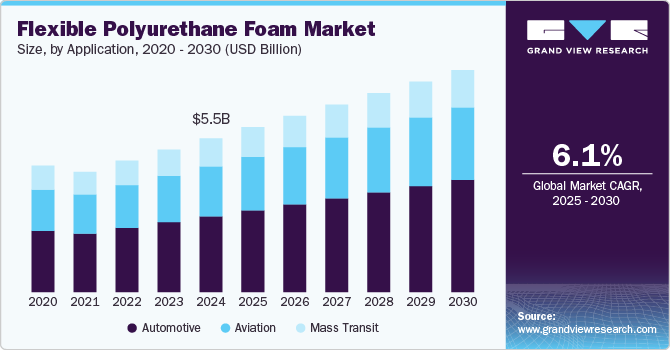
The global flexible polyurethane foam market size was valued at USD 5.9 billion in 2024 and is projected to grow from USD 6.7 billion in 2026 to USD 8.5 billion by 2030, at a CAGR of 6.1% from 2025 to 2030. North America dominated the global market, accounting for the largest revenue share of 44.7% in 2024. The growth of the market can be attributed to the increasing emphasis of different industries on energy efficiency, which has fueled the demand for polyurethane foams for usage, such as insulating and cushioning materials in diverse applications.
 Source: Grand View Research, IR Documents, Primary Interviews, Paid DatabasesTo learn more about this report,
 Download Free Sample Report
 Flexible polyurethane (PU) foam plays a significant role in meeting the demand for lightweight composites from the automotive industry. This foam offers an excellent combination of lightweight, strength, and versatility, thereby making it an ideal choice for various automotive applications. By incorporating flexible PU foam in automotive components, manufacturers can reduce the weight of their vehicles that leads to improved fuel efficiency and reduced emissions.
Drivers, Opportunities & Restraints
The increasing demand for lightweight and high-performance composites from the automotive industry directly impacts the growth of the flexible polyurethane (PU) foam market across the world. As the automotive industry strives for fuel efficiency, emission reduction, and enhanced vehicle performance, there is a growing requirement for lightweight materials that can replace traditional heavy components without compromising the safety or functionalities of vehicles.
The adoption of lightweight materials present a significant opportunity for the Flexible Polyurethane (PU) Foam Market. The demand for lightweight and high-performance composites in the automotive industry has spurred innovations in flexible PU foam. Manufacturers continuously invest in research and development activities to enhance the properties of their flexible PU foam, including its strength-to-weight ratio, fire resistance, and thermal insulation. These continuous innovations enable flexible PU foam to meet the evolving requirements of the automotive industry while providing exceptional performance and comfort.
Despite its potential, the volatility in raw material prices, particularly petroleum-based resins, remains a significant restraint for the market. The price trend of Flexible Polyurethane Foam (FPF) has been largely driven by fluctuations in raw material costs, particularly polyols and isocyanates (MDI and TDI). These chemicals, derived from crude oil, have seen price volatility due to the global instability in oil markets. Geopolitical tensions and production cuts by oil-producing nations have led to higher raw material costs, directly impacting the price of FPF. Additionally, the cost of additives and blowing agents, essential in foam production, has also risen, contributing to the overall increase in FPF prices.
Application Insights
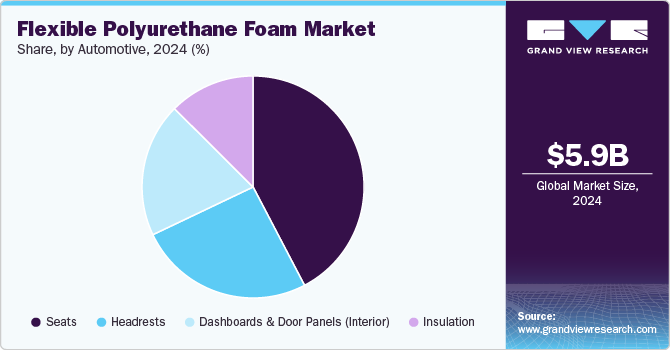
Based on application, the market has been segmented into automotive, aviation, and mass transit. The automotive segment accounted for the largest revenue share of 49.3% in 2024, owing to rising demand for lightweight nature of flexible PU foam. The global automotive industry is under increasing pressure to reduce vehicle weight to improve fuel efficiency and decrease carbon emissions. Automakers achieve significant weight savings by incorporating flexible PU foam in interior and structural components without compromising quality or durability.
Flexible PU foam is widely used in automotive seats as it provides superior comfort and support to passengers and absorbs vibration. The lightweight of this foam also helps reduce the overall weight of vehicles, thereby contributing to their fuel economy. Additionally, flexible PU foam is utilized in interior trim applications of vehicles, including headliners, door panels, and instrument panels, due to its lightness and ability to conform to complex shapes.
 To learn more about this report, Download Free Sample Report
 The aviation segment is expected to grow at a significant CAGR during the forecast period. The rapid expansion of air travel, especially in emerging markets, significantly contributes to the growing demand for flexible PU foam. Moreover, another significant factor contributing to this demand is the push toward enhancing long-term cost efficiency in airline operations. High durability and resistance to wear & tear make PU foam a preferred material for crew and cockpit seating, reducing the frequency of seat replacements and maintenance.
Regional Insights
North America holds a significant position in the global flexible polyurethane (PU) foam market. The demand for flexible PU foam in North America has witnessed steady growth over the years, primarily due to growth in various industries such as construction, automotive, furniture, and bedding.
U.S. Flexible Polyurethane Foam Market Trends
The U.S. plays a significant role in the global flexible polyurethane (PU) foam market, exhibiting its strong presence and influence. With a robust manufacturing sector and a technologically advanced market, the U.S. has emerged as one of the leading consumers and producers of flexible PU foam products worldwide. The country's construction, automotive, and furniture industries have been major drivers of flexible PU foam demand, fueling its widespread adoption across various applications.
Asia Pacific Flexible Polyurethane Foam Market Trends
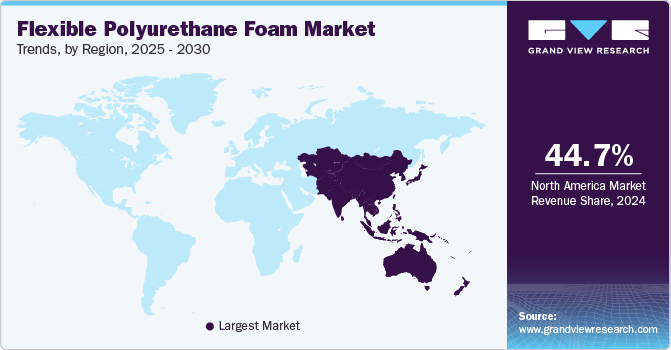
Asia Pacific dominated the global flexible PU Foam market and accounted for largest revenue share of 44.70% in 2024. Asia Pacific boasts a thriving and rapidly expanding polyurethane (PU) foam market, reflecting the region's robust economic growth and industrial development. Several key factors contribute to the market's growth and potential. The construction industry in countries like China, India, and Southeast Asian nations is witnessing significant growth, driving the demand for flexible PU foam in insulation applications.
 To learn more about this report, Download Free Sample Report
 China's flexible polyurethane foam market is a dynamic and thriving industry that plays a pivotal role in the country's economic growth. The construction sector in China is experiencing significant expansion, driving the demand for PU foam in insulation applications.
Europe Flexible Polyurethane Foam Market Trends
Europe's focus on research and development has fostered technological advancements and innovation in the flexible PU foam market. Collaborations between industry players, research institutes, and academia have resulted in the development of new formulations and improved manufacturing processes, enhancing the performance and environmental profile of flexible PU foam.
Key Flexible Polyurethane Foam Company Insights
The market is highly competitive, with several key players dominating the landscape. Major companies include BASF SE, Recticel, Eurofoam S.r.l., NMC SA, and Innocor (Huebach Corporation). The market is characterized by a competitive landscape with several key players driving innovation and market growth. Major companies in this sector are investing heavily in research and development to enhance the performance, cost-effectiveness, and sustainability of their products.
Key Flexible Polyurethane Foam Companies:
The following are the leading companies in the flexible polyurethane foam market. These companies collectively hold the largest market share and dictate industry trends.
- BASF SE
- Recticel
- Eurofoam S.r.l.
- NMC SA
- Innocor (Huebach Corporation)
- Alanto Ltd.
- Vita (Holdings) Limited
- Foamtec International Co., Ltd.
Three ways to get this report
Buy it, customize it, or ask a question.Ask an Analyst
Analyst response in 1 business day
- AccessReport author, directly
- Reply timeWithin 1 working day
- No sales callDirect answer only
- FormatEmail reply
- CostFree, no cost
Get the Full Report
What the study covers
- FormatsPDF · Excel · Dashboard
- Timeline2025–2030 annual, 2024 base
- Coverage20+ countries, 5 regions
- Companies10+ key players profiled
Customize the Report
20% free customization
- IncludeCountries, segments, points
- TailorTo your product definition
- ExtendDeeper competitor detail
- OrA fully bespoke study
- Turnaround5–10 working days
Recent Developments
-
In January 2023, Sheela Group, the parent company of Joyce, acquired Interplasp, a prominent Spanish company renowned for its expertise in flexible polyurethane foam manufacturing. This strategic move solidifies Sheela Group's position as a key player in the European market and emphasizes its commitment to expanding its offerings and capabilities. By incorporating Interplasp into its portfolio, Sheela Group gains access to top-notch technology, resources, and an extensive customer base. This acquisition strengthens the company's ability to deliver high-quality flexible polyurethane foam solutions and reinforces its reputation as an industry leader.
-
In February 2022, BASF announced a partnership with NeveonSA to develop a closed-loop recycling process for mattresses. This collaboration focuses on recycling used PU foam mattresses to create new, high-quality mattresses. BASF has developed a wet chemical recycling method that successfully recovers polyols, the primary component of flexible foam. NEVEON announced the launch of a mattress take-back initiative in Berlin to facilitate the collection and recycling process. The partnership aims to scale up the recycling process in the coming years to support the circular economy in the mattress industry.
Flexible Polyurethane Foam Market Report Scope
Report Attribute
Details
Market size in 2024
USD 5.9 billion
Estimated market size in 2026
USD 6.7 billion
Projected market size by 2030
USD 8.5 billion
Growth rate
CAGR of 6.1% from 2025 to 2030
Actual data
2018 - 2023
Base Year
2024
Forecast period
2025 - 2030
Quantitative units
Revenue in USD Billion/Million, Volume in Kilotons, and CAGR from 2025 to 2030
Report coverage
Revenue forecast, competitive landscape, growth factors and trends
Segments covered
Application, region
Regional scope
North America; Europe; Asia Pacific; Central & South America; Middle East & Africa
Country Scope
U.S.; Canada; Mexico; Germany; UK; Italy; France; Spain; China; India; Japan; South Korea; Brazil; Argentina; South Africa; Saudi Arabia
Key companies profiled
BASF SE; Recticel; Eurofoam S.r.l.; NMC SA; Innocor (Huebach Corporation); Alanto Ltd.; Vita (Holdings) Limited; Foamtec International Co., Ltd.
Customization scope
Free report customization (equivalent up to 8 analyst’s working days) with purchase. Addition or alteration to country, regional & segment scope
Pricing and purchase options
Avail customized purchase options to meet your exact research needs. Explore purchase options
Global Flexible Polyurethane Foam Market Report Segmentation
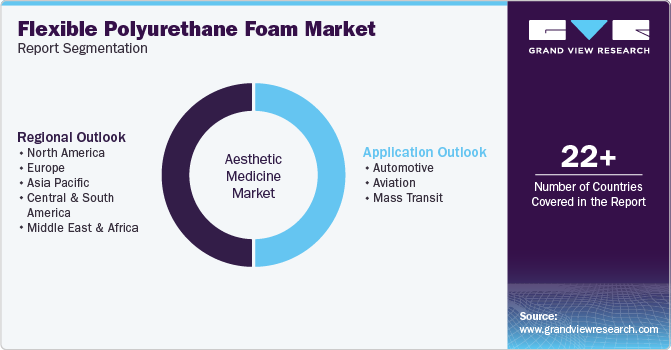
This report forecasts revenue growth at the global, regional, and country levels and provides an analysis of the latest industry trends and opportunities in each of the sub-segments from 2018 to 2030. For this study, Grand View Research has segmented the global flexible polyurethane foam market report on the basis of application and region:
 To learn more about this report, Download Free Sample Report
 -
Application Outlook (Revenue, USD Million; Volume, Kilotons; 2018 - 2030)
-
Automotive
-
Seats
-
Headrests
-
Dashboards & Door Panels (Interior)
-
Insulation
-
-
Aviation
-
Crew & Cockpit Seating
-
Passenger Seats
-
Crew Rest Mattress
-
Insulation
-
-
Mass Transit
-
-
Regional Outlook (Revenue, USD Million, Volume, Kilotons, 2018 - 2030)
-
North America
-
U.S.
-
Canada
-
Mexico
-
-
Europe
-
Germany
-
France
-
UK
-
Italy
-
Spain
-
-
Asia Pacific
-
China
-
India
-
Japan
-
South Korea
-
-
Central & South America
-
Brazil
-
Argentina
-
-
Middle East & Africa
-
South Africa
-
Saudi Arabia
-
-
Frequently Asked Questions About This Report
The global flexible polyurethane foam market is expected to grow at a CAGR of 6.1% from 2025 to 2030, reaching USD 8.5 billion by 2030.
The global flexible polyurethane foam market size was valued at USD 5.9 billion in 2024 and is estimated at USD 6.7 billion for 2026.
North America dominated with a revenue share of 44.7% in 2024.
Some key players operating in the flexible polyurethane foam market include BASF SE; Recticel; Eurofoam S.r.l.; NMC SA; Innocor (Huebach Corporation); Alanto Ltd.; Vita (Holdings) Limited, and others.
The growth of the market can be attributed to the increasing emphasis of different industries on energy efficiency, which has fueled the demand for PU foams for usage as insulating and cushioning materials in diverse applications.et growth include the rising demand for better adhesion in the composites & plastics sector. Additionally, automakers are increasingly attempting to improve road safety and fuel economy by creating ‘green tires’ using adhesion promoters such as silanes in tread compounds.
About the Author(s)
Plastics, Polymers & Resins Research Team
Bulk Chemicals · Plastics, Polymers & ResinsThis report was authored by the plastics, polymers & resins research team at Grand View Research - comprising two research analysts, one senior research analyst, and one industry expert - with specialized expertise in the plastics, polymers & resins segment of the bulk chemicals industry. All findings are based on proprietary bulk chemicals databases, executive interviews, and regulatory analysis, subject to internal peer review prior to publication.
Last Updated:
Speak to Analyst

Customize this report to your needs - add regions, segments, or data points, with 20% free customization.
Or view our licence options:


ISO 9001:2015 & 27001:2022 Certified
We are GDPR and CCPA compliant! Your transaction & personal information is safe and secure. For more details, please read our privacy policy.


