
- Home
- »
- Advanced Interior Materials
- »
-
Flexographic Printing Machine Market Size Report, 2033GVR Report cover

Flexographic Printing Machine Market (2026 - 2033)
Size, Share & Trends Analysis Report By Product Type (Central Impression Press, In-line Press, Stack Press) By Product (Wide Web, Medium Web, Narrow Web), By End-use, By Region, And Segment Forecasts
Market Size, 2025
$19.3BMarket Estimate, 2026
$21.1BMarket Forecast, 2033
$39.9BCAGR, 2026–2033
9.5%Flexographic Printing Machine Market Summary
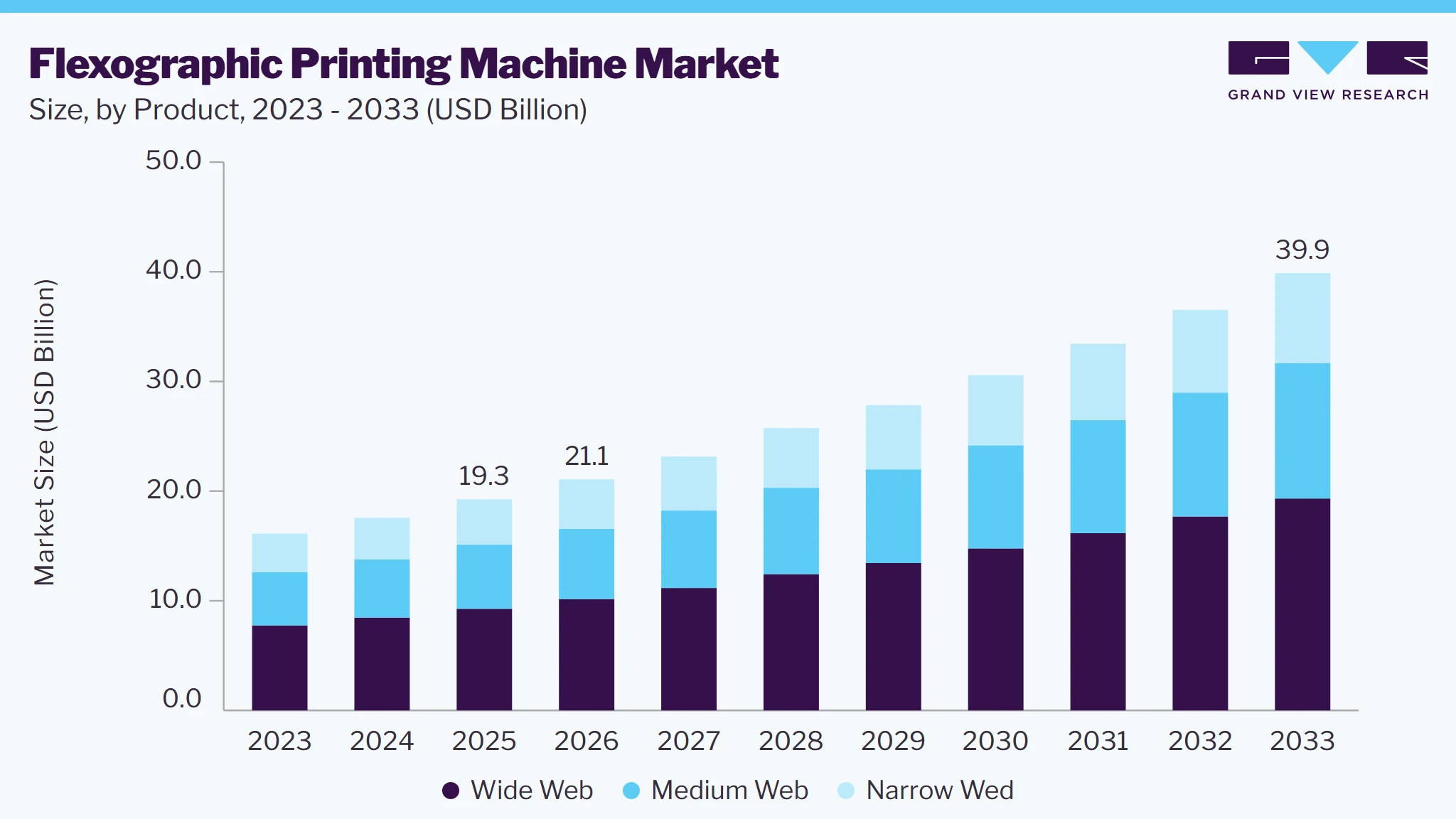
The global flexographic printing machine market size was valued at USD 19.3 billion in 2025 and is projected to grow from USD 21.1 billion in 2026 to USD 39.9 billion by 2033, at a CAGR of 9.5% from 2026 to 2033. Asia Pacific market dominated, with a revenue share of 37.0% in 2025. The global flexographic printing machine market is primarily driven by the growing demand for high-quality, cost-effective packaging solutions.
 Source: Grand View Research, IR Documents, Primary Interviews, Paid DatabasesTo learn more about this report,
 Download Free Sample Report
 Key Market Trends & Insights
- By product type: In-line press segment led the market with the largest revenue share of 38.6% in 2025.
- By product: Wide web segment led the market with the largest revenue share of 48.1% in 2025.
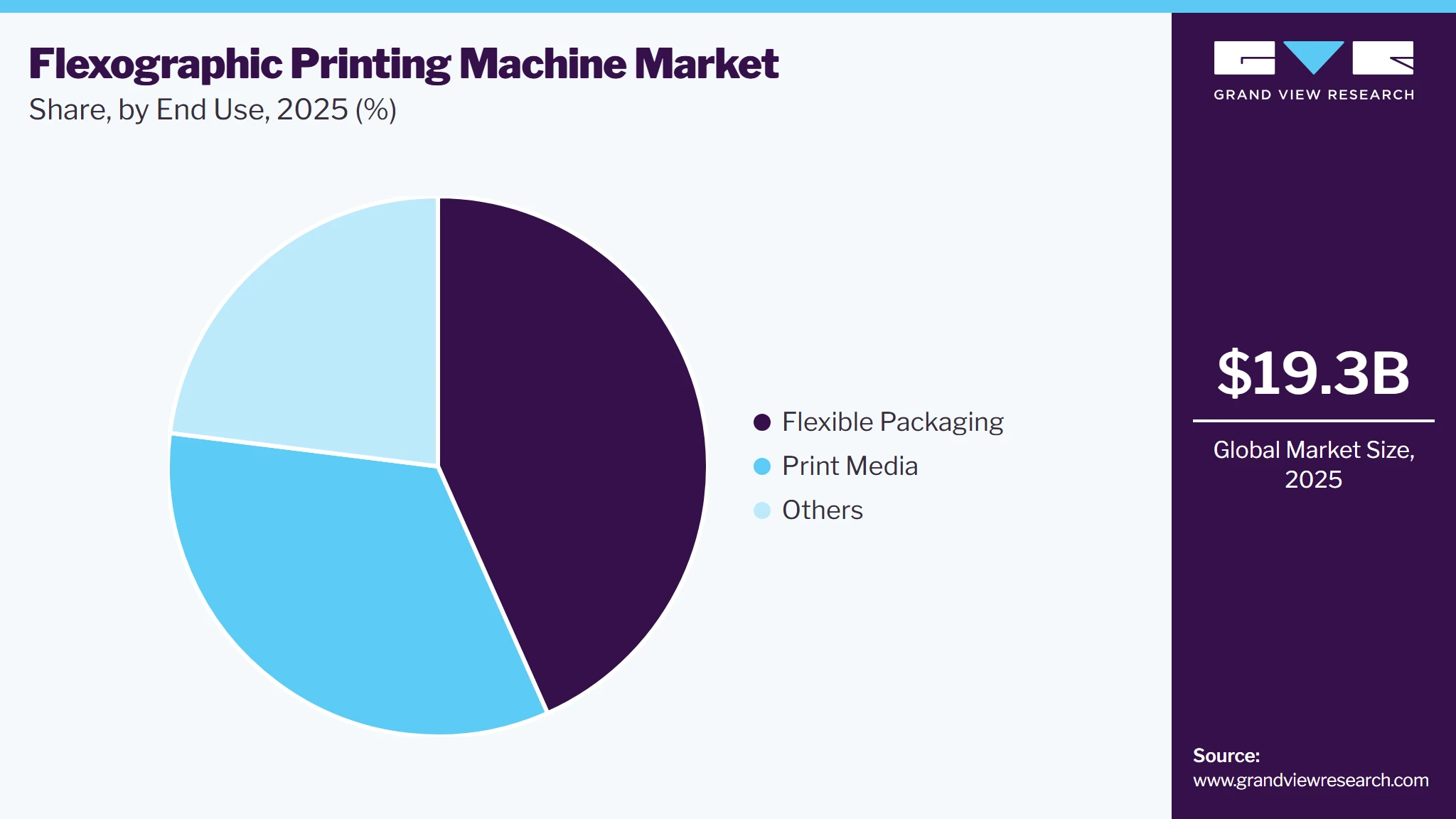
- By end-use: Flexible packaging segment led the market with the largest revenue share of 43.3% in 2025.
Regional Highlights
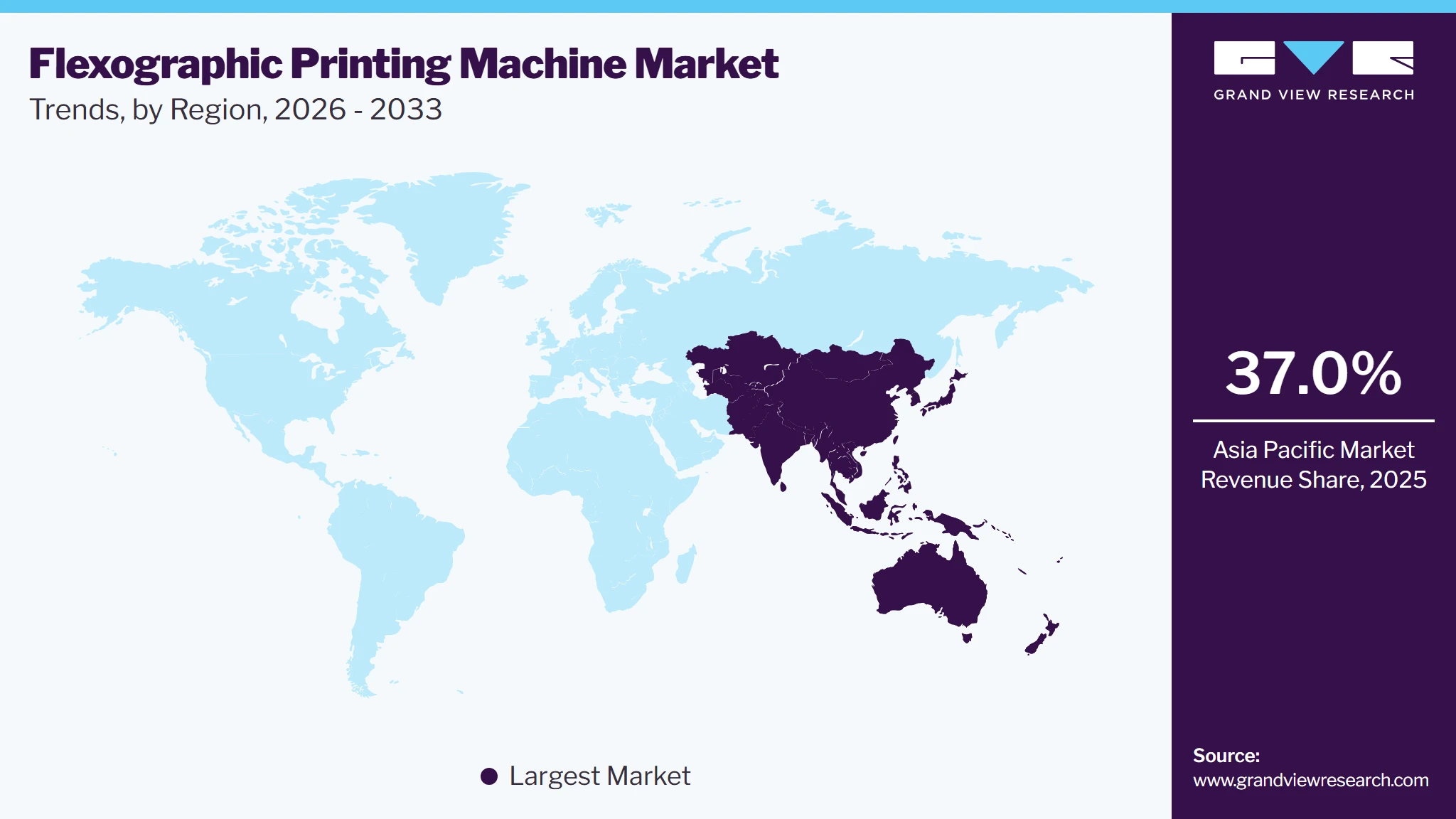
- Largest regional market: Asia Pacific (37.0% revenue share, 2025)
- By country: China held the largest market share in 2025.
Market Size & Forecast
- Market size in 2025: USD 19.3 Billion
- Estimated market size in 2026: USD 21.1 Billion
- Projected market size by 2033: USD 39.9 Billion
- CAGR (2026-2033): 9.5%
Three ways to get this report
Buy it, customize it, or ask a question.Ask an Analyst
Analyst response in 1 business day
- AccessReport author, directly
- Reply timeWithin 1 working day
- No sales callDirect answer only
- FormatEmail reply
- CostFree, no cost
Get the Full Report
What the study covers
- FormatsPDF · Excel · Dashboard
- Timeline2026–2033 annual, 2025 base
- Coverage20+ countries, 5 regions
- Companies10+ key players profiled
Customize the Report
20% free customization
- IncludeCountries, segments, points
- TailorTo your product definition
- ExtendDeeper competitor detail
- OrA fully bespoke study
- Turnaround5–10 working days
Flexographic printing, known for its efficiency and versatility, is becoming a preferred choice for producing a wide range of materials, including flexible packaging, labels, and cartons. The rise of e-commerce has increased the need for customized and aesthetically appealing packaging, which flexographic printing can efficiently provide.
 To learn more about this report, Download Free Sample Report
 The flexibility of the process in printing on various substrates, from plastic to paper, also supports its expansion in diverse industries. The continual improvements in ink formulations and press technology are helping to reduce operational costs and improve environmental sustainability, making flexographic printing an attractive option for manufacturers worldwide.
Market Dynamics
The growth of the flexographic printing machine market is being propelled by increasing demand for high-speed, cost-efficient, and high-quality printing solutions across the packaging industry. Expanding consumption of flexible packaging, corrugated boxes, labels, and folding cartons in food & beverages, pharmaceuticals, personal care, and e-commerce sectors is encouraging converters to invest in advanced flexographic printing systems. Continuous technological advancements, including servo-driven automation, digital workflow integration, rapid job changeovers, and enhanced print precision, are improving production efficiency while minimizing material waste and operating costs. Furthermore, the growing preference for sustainable packaging and the adoption of water-based and UV-curable inks are strengthening the appeal of flexographic printing machines, as they align with evolving environmental regulations and brand sustainability objectives.
The increasing use of flexible packaging, labels, corrugated boxes, folding cartons, and paper-based packaging across the food & beverages, pharmaceuticals, personal care, and consumer goods industries is driving demand for flexographic printing machines. Their ability to deliver high-speed, cost-effective printing on a wide range of substrates while supporting water-based and UV-curable inks makes them a preferred choice for large-scale packaging production. The rapid expansion of e-commerce and retail-ready packaging is further increasing the need for efficient, high-volume printing solutions. Continuous advancements in print quality, automation, and color management are also encouraging packaging converters to upgrade to next-generation flexographic printing systems.
The deployment of advanced flexographic printing machines requires substantial investment in printing presses, plate-making equipment, drying systems, and automated workflow technologies. In addition, expenses related to printing plates, machine maintenance, operator training, and periodic calibration increase the total cost of ownership. These financial and operational challenges can discourage adoption among small and medium-sized printing companies, particularly in cost-sensitive markets. Competition from digital printing technologies for short-run and customized print applications also limits the pace of investment in conventional flexographic equipment.
The integration of servo-driven automation, digital workflow management, AI-enabled print inspection, and remote machine monitoring is creating significant growth opportunities for the flexographic printing machine market. These technologies improve production efficiency, reduce setup times and material waste, and enhance print consistency across long production runs. Growing demand for sustainable packaging, recyclable substrates, and environmentally friendly ink systems is encouraging manufacturers to develop advanced flexographic solutions with improved operational efficiency and lower environmental impact. Furthermore, increasing investments in smart manufacturing and Industry 4.0 are accelerating the adoption of intelligent flexographic printing systems capable of meeting evolving packaging and labeling requirements.
Analyst Perspective
The flexographic printing machine market is expanding steadily as packaging manufacturers increasingly invest in high-speed and cost-efficient printing solutions to meet growing demand for flexible packaging, labels, corrugated boxes, and folding cartons. Demand is being driven by the expansion of the food & beverage, pharmaceutical, personal care, and e-commerce sectors, where high-volume printing with consistent quality is essential. In addition, advancements in servo-driven systems, automated registration, digital process controls, and quick-change printing technologies are improving production efficiency, minimizing material waste, and reducing downtime. The growing preference for sustainable packaging and water-based inks is further encouraging the adoption of modern flexographic printing equipment capable of supporting environmentally compliant production. As packaging converters continue to modernize manufacturing facilities and increase production capacity, manufacturers offering high-performance, automated, and application-specific flexographic printing machines are expected to benefit from sustained long-term market growth.
Product Type Insights
The central impression press segment is witnessing an increase in demand due to its ability to deliver high-quality, consistent prints over large web widths, making it ideal for flexible packaging and other high-volume applications. Its centralized design reduces the risk of print defects and ensures uniformity, driving its adoption among manufacturers seeking precision and efficiency.
Based on product type, the in-line press segment led the market with the largest revenue share of 38.6% in 2025. The in-line press segment thrives due to its versatility and space efficiency. This type of press integrates various printing and finishing processes in a single line, which streamlines production and reduces operational costs. Its suitability for producing a wide range of packaging types and its ability to handle quick job changes support its growth, particularly in markets demanding flexibility and fast turnaround times.
Product Insights
The medium web segment is growing due to its cost-effectiveness and versatility, balancing high-quality output with manageable production scales. Medium web presses are ideal for flexible packaging and labels, offering a practical solution for moderate volumes at a lower cost than wide web presses. Their adaptability to various substrates and advancements in automation enhance efficiency, making them well-suited for customized and rapid-response packaging needs.
Based on product, the wide web segment led the market with the largest revenue share of 48.1% in 2025. The growth of the wide web segment is driven by its capacity to handle large volumes of printing, which is essential for producing bulk quantities of flexible packaging and industrial applications. The efficiency of wide web presses in delivering high-speed, high-quality prints across large substrates makes them valuable for manufacturers aiming to scale production and meet high demand. In addition, advancements in wide web press technology, such as improved ink systems and automation features, enhance operational efficiency and reduce waste, further fueling the segment’s growth.
End Use Insights
Based on end-use, the flexible packaging segment led the market with the largest revenue share of 43.3% in 2025. Flexible packaging provides lightweight, versatile, and eco-friendly options that are ideal for a wide range of products. Innovations in materials and printing technologies enhance its appeal by improving durability and customization capabilities.
 To learn more about this report, Download Free Sample Report
 Based on end-use, the flexible packaging segment led the market with the largest revenue share of 43.3% in 2025z. The print media segment’s growth is fueled by the ongoing need for high-quality, visually appealing print materials in advertising, promotions, and publications. Advances in flexographic printing technology enable precise and vibrant color reproduction, meeting the demands of a competitive market that requires eye-catching and effective print media solutions.
Regional Insights
Asia Pacific dominated the flexographic printing machine market with the largest revenue share of 37.0% in 2025. The burgeoning middle class and rising disposable incomes are driving consumption and, consequently, the need for diverse and customized packaging solutions. In addition, the expansion of e-commerce platforms in the region is creating a heightened need for innovative and flexible packaging options to enhance product presentation and functionality.
 To learn more about this report, Download Free Sample Report
 The flexographic printing machine market in China held the largest share in the Asia Pacific region in 2025. Rapid industrialization and urbanization are creating a significant demand for packaging solutions across various sectors, including food and beverages, consumer goods, and pharmaceuticals. China's expanding middle class and rising disposable incomes are fuelling increased consumption and, consequently, the demand for diverse and attractive packaging options. The government's focus on modernizing manufacturing processes and promoting environmental sustainability is further accelerating market growth.
North America Flexographic Printing Machine Market Trends
The growth of the flexographic printing market in North America is bolstered by technological advancements and a strong emphasis on sustainability. The adoption of cutting-edge flexographic printing technologies helps companies meet the high standards of environmental regulations and consumer preferences for eco-friendly and recyclable packaging materials. This focus on sustainability is coupled with continuous innovation in printing processes, which improves efficiency and reduces waste, further fueling market expansion.
Europe Flexographic Printing Machine Market Trends
The flexographic printing market in Europe, benefits from a robust regulatory framework that promotes sustainability and recycling. The region's commitment to high-quality print products and packaging innovation drives demand for advanced flexographic printing solutions. European businesses are increasingly investing in technologies offering superior print quality and functionality, in response to consumer expectations and stringent environmental standards, supporting the market’s growth.
Key Flexographic Printing Machine Company Insights
Some of the key players operating in the market include John Cockerill and Thermax Limited among others.
-
BFM Srl is a prominent Italian company specializing in the design and manufacturing of machinery for the packaging industry, particularly focusing on flexographic printing machines and winders. The company has been in the market for 49 years and company exports to over 80 countries.
-
Edale Ltd is a company specializing in the design, manufacture, and marketing of industrial printing and converting solutions for the packaging industry. The company has been serving the print and packaging market for over 75 years. It offers worldwide support and spares, including installation by experienced engineers, comprehensive operator manuals, optional training packages, and a global network of partners providing spare parts, consumables, and maintenance services.
Key Flexographic Printing Machine Companies:
The following key companies have been profiled for this study on the flexographic printing machine market.
-
Barry-Wehmiller Companies
-
BFM srl
-
TAIYO KIKAI Ltd.
-
Comexi
-
Edale.
-
Heidelberger Druckmaschinen AG
-
Koenig & Bauer Coding GmbH
-
LohiaGroup
-
Mark Andy Inc.
-
Uteco
-
Nilpeter
-
OMET
-
OMSO SpA
-
ORIENT SOGYO Co. Ltd.
-
Windmöller & Hölscher
Competitive Benchmarking
Category
Operating Strategies
Competitive Edge
Weakness
Established Players (e.g., Barry-Wehmiller Companies; BFM srl; TAIYO KIKAI Ltd.; Comexi; Edale; Heidelberger Druckmaschinen AG)
- Strong investments in advanced printing technologies, automation systems, and sustainable packaging solutions
- Expansion of high-speed flexographic printing machines integrated with digital controls and robotic handling systems
- Focus on packaging, labels, corrugated printing, flexible films, and consumer goods applications
- Strong global brand presence and expertise in industrial printing and packaging technologies
- High printing precision, operational efficiency, and superior color consistency capabilities
- Extensive global sales, after-sales service, and technical support networks
- High equipment and implementation costs compared to conventional printing technologies
- Dependence on packaging industry capital expenditure and industrial production growth
- Complex machine integration, maintenance procedures, and skilled operator requirements
Emerging & Regional Players (e.g., Uteco; Nilpeter; OMET; OMSO SpA; ORIENT SOGYO Co. Ltd.; Windmöller & Hölscher)
- Focus on customized printing solutions and niche packaging applications
- Expansion into regional packaging, label printing, and flexible film manufacturing markets
- Increasing emphasis on sustainable inks, lightweight packaging, and flexible production capabilities
- Competitive pricing and flexibility in customized flexographic printing applications
- Strong responsiveness to customer-specific packaging and branding requirements
- Growing adoption across food packaging, e-commerce packaging, pharmaceuticals, and industrial labeling sectors
- Comparatively lower global market penetration and brand visibility
- Limited financial scale for large R&D and international expansion investments
- Lower diversification compared to multinational industrial printing equipment providers
Recent Developments
-
In August 2024, Edale. strengthened its position in the Chinese market by installing an in-line carton press at Rainbow Paper Products. This move marks a significant expansion for Edale in China, enhancing their ability to meet the growing demand for high-quality carton printing solutions.
-
In July 2024, Uteco announced a new partnership with Fotedar, as part of its expansion strategy. This collaboration aims to enhance Uteco's market presence and provide advanced packaging solutions to a broader customer base. The partnership will leverage Fotedar's expertise and distribution network to strengthen Uteco’s offerings in the industry.
Flexographic Printing Machine Market Report Scope
Report Attribute
Details
Market size in 2025
USD 19.3 billion
Estimated market size in 2026
USD 21.1 billion
Projected market size by 2033
USD 39.9 billion
Growth rate
CAGR of 9.5% from 2026 to 2033
Base year for estimation
2025
Historical data
2021 - 2024
Forecast period
2026 - 2033
Quantitative units
Revenue in USD billion and CAGR from 2026 to 2033
Report coverage
Revenue forecast, company ranking, competitive landscape, growth factors, and trends
Segments covered
Product, product type, end-use, region
Regional scope
North America; Europe; Asia Pacific; Latin America; Middle East & Africa
Country scope
U.S.; Canada; Mexico; UK; Germany; Spain; Italy; France; China; Japan; India; South Korea; Australia; Brazil; Argentina; UAE; South Africa; Saudi Arabia
Key companies profiled
Barry-Wehmiller Companies; BFM srl; TAIYO KIKAI Ltd.; Comexi; Edale.; Heidelberger Druckmaschinen AG; Koenig & Bauer Coding GmbH; LohiaGroup; Mark Andy Inc.; Uteco; Nilpeter; OMET; OMSO SpA; ORIENT SOGYO Co. Ltd.; Windmöller & Hölscher
Customization scope
Free report customization (equivalent up to 8 analysts' working days) with purchase. Addition or alteration to country, regional & segment scope.
Pricing and purchase options
Avail customized purchase options to meet your exact research needs. Explore purchase options
Global Flexographic Printing Machine Market Report Segmentation
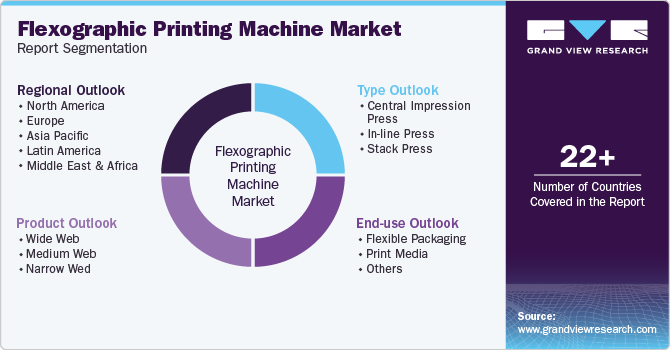
This report forecasts revenue growth at global, regional & country levels and provides an analysis on the industry trends in each of the sub-segments from 2021 to 2033. For the purpose of this study, Grand View Research has segmented the global flexographic printing machine market on the type, product, end use, and region:
 To learn more about this report, Download Free Sample Report
 -
Product Type Outlook (Revenue, USD Million, 2021 - 2033)
-
Central Impression Press
-
In-line Press
-
Stack Press
-
-
Product Outlook (Revenue, USD Million, 2021 - 2033)
-
Wide Web
-
Medium Web
-
Narrow Wed
-
-
End Use (Revenue, USD Million, 2021 - 2033)
-
Flexible Packaging
-
Print Media
-
Others
-
-
Regional Outlook (Revenue, USD Million, 2021 - 2033)
-
North America
-
U.S.
-
Canada
-
Mexico
-
Europe
-
UK
-
Germany
-
France
-
Italy
-
Spain
-
Asia Pacific
-
China
-
India
-
Japan
-
South Korea
-
Australia
-
Latin America
-
Brazil
-
Argentina
-
Middle East & Africa
-
South Africa
-
Saudi Arabia
-
UAE
-
Research Methodology
The flexographic printing machine market figures in this report are based on a proven research process that combines executive interviews with secondary research from proprietary databases, company filings, and recognized regulatory and institutional sources. Market size is built through value-chain sizing-reconciling supply-side and demand-side estimates-and triangulated with bottom-up and top-down approaches. Every estimate passes multiple levels of expert validation before publication, with each flexographic printing machine segment quantified using the revenue-capture definitions in the table below.
Segment Definition
Segment - Product
Revenue Capture Definition
Wide Web
Revenue is captured from the sale of wide-web flexographic printing machines, including high-capacity press systems with integrated automation, advanced control technologies, and customized production configurations.
Medium Web
Revenue is captured from the sale of medium-web flexographic printing machines supplied with configurable print stations, digital control systems, and optional production enhancements based on customer specifications.
Narrow Web
Revenue is captured from the sale of narrow-web flexographic printing machines, including compact press systems, modular machine designs, automation packages, and integrated inspection solutions.
Segment - Product Type
Revenue Capture Definition
Central Impression Press
Revenue is captured from the sale of Central Impression (CI) flexographic printing machines, including standard and customized configurations equipped with servo drives, tension control systems, drying units, and automated registration technologies.
In-line Press
Revenue is captured from the sale of In-line flexographic printing machines comprising multiple print stations and integrated process modules. Revenue includes machine packages with automation features, control software, and optional finishing integrations supplied as new equipment.
Stack Press
Revenue is captured from the sale of Stack flexographic printing machines, including complete press systems, configurable printing units, and optional automation upgrades offered by equipment manufacturers.
Segment - End Use
Revenue Capture Definition
Flexible Packaging
Revenue is captured from the sale of flexographic printing machines configured to meet flexible packaging production requirements. Revenue includes machine customization, integrated printing modules, and automation features specified at the time of equipment purchase.
Print Media
Revenue is captured from the sale of flexographic printing machines designed according to commercial printing production specifications. Revenue includes complete press systems, optional control technologies, and machine configurations purchased as capital equipment.
Others
Revenue is captured from the sale of flexographic printing machines supplied in customized configurations for specialized printing requirements. Revenue includes machine sales, integrated production modules, optional automation systems, and factory-installed performance enhancements delivered as part of the original equipment package.
Estimation Model
Layer Name
Key Question
Description
Printing & Packaging Demand Layer
Where are flexographic printing machines required?
Analyze demand across flexible packaging, labels, corrugated packaging, folding cartons, print media, and other industrial printing applications. Assess packaging production volumes, printing requirements, substrate utilization, and brand packaging demand to establish the addressable market for flexographic printing machines.
Manufacturing & Packaging Capacity Expansion Layer
Where is new equipment demand being created?
Evaluate investments in packaging converting facilities, printing plants, label manufacturing, and corrugated packaging production. Assess greenfield projects, capacity expansions, replacement of conventional printing equipment, and automation initiatives that drive procurement of new flexographic printing machines.
Product Adoption Layer
Which flexographic printing machine technologies are being deployed?
Segment demand by press type, web width, automation level, application, and end-use industry. Apply adoption rates based on production speed, print quality, substrate compatibility, color capability, and operational efficiency.
Revenue Generation Layer
How much market revenue is generated?
Estimate annual shipments of flexographic printing machines by press type, web width, application, end-use industry, and region. Quantify revenues generated exclusively from the sale of new flexographic printing machines supplied to packaging converters, label manufacturers, commercial printers, and industrial printing facilities.
Delivered Customizations
This report has been delivered with the following In-depth customizations
CLIENT REQUEST
CUSTOMIZATION DELIVERED
VALUE ADDS
Competitive Benchmarking
Detailed benchmarking of leading flexographic printing machine manufacturers based on automation capabilities, color consistency, substrate compatibility, sustainability initiatives, regional presence, and strategic developments.
Enable competitive intelligence and technology benchmarking. Support product positioning, partnership evaluation, operational efficiency improvement, and innovation strategy development.
Regional Segmentation
Detailed market estimates and forecasts for the flexographic printing machine market across North America, Europe, Asia Pacific, Latin America, and the Middle East & Africa. Country-level demand analysis covering packaging, food & beverage, pharmaceuticals, personal care, e-commerce, and industrial labeling industries.
Identify high-growth regional markets and packaging manufacturing investment hotspots. Support regional expansion planning, distributor network optimization, and demand forecasting.
Opportunity assessment
Identification of emerging growth opportunities driven by increasing demand for flexible packaging, rising e-commerce packaging requirements, sustainable printing initiatives, advancements in water-based and UV-curable inks, and growing adoption of smart packaging solutions.
Prioritize high-growth applications and investment opportunities. Support innovation roadmap development, market expansion strategies, and long-term business planning.
Frequently Asked Questions About This Report
The wide web segment led the market with the largest revenue share of 48.1% in 2025.
The in-line press segment accounted for the largest revenue share of 38.6% in 2025.
The flexible packaging segment led the market with the largest revenue share of 43.3% in 2025.
Key factors include increasing demand for flexible packaging, growing adoption of sustainable and recyclable packaging materials, rising investments in high-speed printing technologies, expanding food and beverage packaging production, and increasing automation in the printing industry.
Some of the key players operating in the flexographic printing machine market include Barry-Wehmiller Companies, BFM srl, TAIYO KIKAI Ltd., Comexi, Edale, Heidelberger Druckmaschinen AG, Koenig & Bauer Coding GmbH, Lohia Group, Mark Andy Inc., Uteco, Nilpeter, OMET, OMSO SpA, ORIENT SOGYO Co. Ltd., and Windmöller & Hölscher.
The global flexographic printing machine market size was valued at USD 19.3 billion in 2025 and is estimated at USD 21.1 billion in 2026.
The global flexographic printing machine market is expected to grow at a CAGR of 9.5% from 2026 to 2033, reaching USD 39.9 billion by 2033.
Asia Pacific market dominated, with a revenue share of 37.0% in 2025.
About the Author(s)
Advanced Interior Materials Research Team
Advanced Materials · Advanced Interior MaterialsThis report was authored by the advanced interior materials research team at Grand View Research - comprising two research analysts, one senior research analyst, and one industry expert - with specialized expertise in the advanced interior materials segment of the advanced materials industry. All findings are based on proprietary advanced materials databases, executive interviews, and regulatory analysis, subject to internal peer review prior to publication.
Last Updated:
Speak to Analyst

Customize this report to your needs - add regions, segments, or data points, with 20% free customization.
Or view our licence options:


ISO 9001:2015 & 27001:2022 Certified
We are GDPR and CCPA compliant! Your transaction & personal information is safe and secure. For more details, please read our privacy policy.


