
- Home
- »
- Renewable Energy
- »
-
Floating Offshore Wind Market Size, Share Report 2026-2033GVR Report cover

Floating Offshore Wind Market (2026 - 2033)
Size, Share & Trends Analysis Report By Floating Platform (Semi-submersible, Tension Leg Platform), By Turbine Capacity (Up To 5 MW, 5-10 MW, 10-15 MW, Above 15 MW), By Region, And Segment Forecasts
Market Size, 2025
$2.9BMarket Estimate, 2026
$3.7BMarket Forecast, 2033
$36.7BCAGR, 2026–2033
38.5%Floating Offshore Wind Market Summary
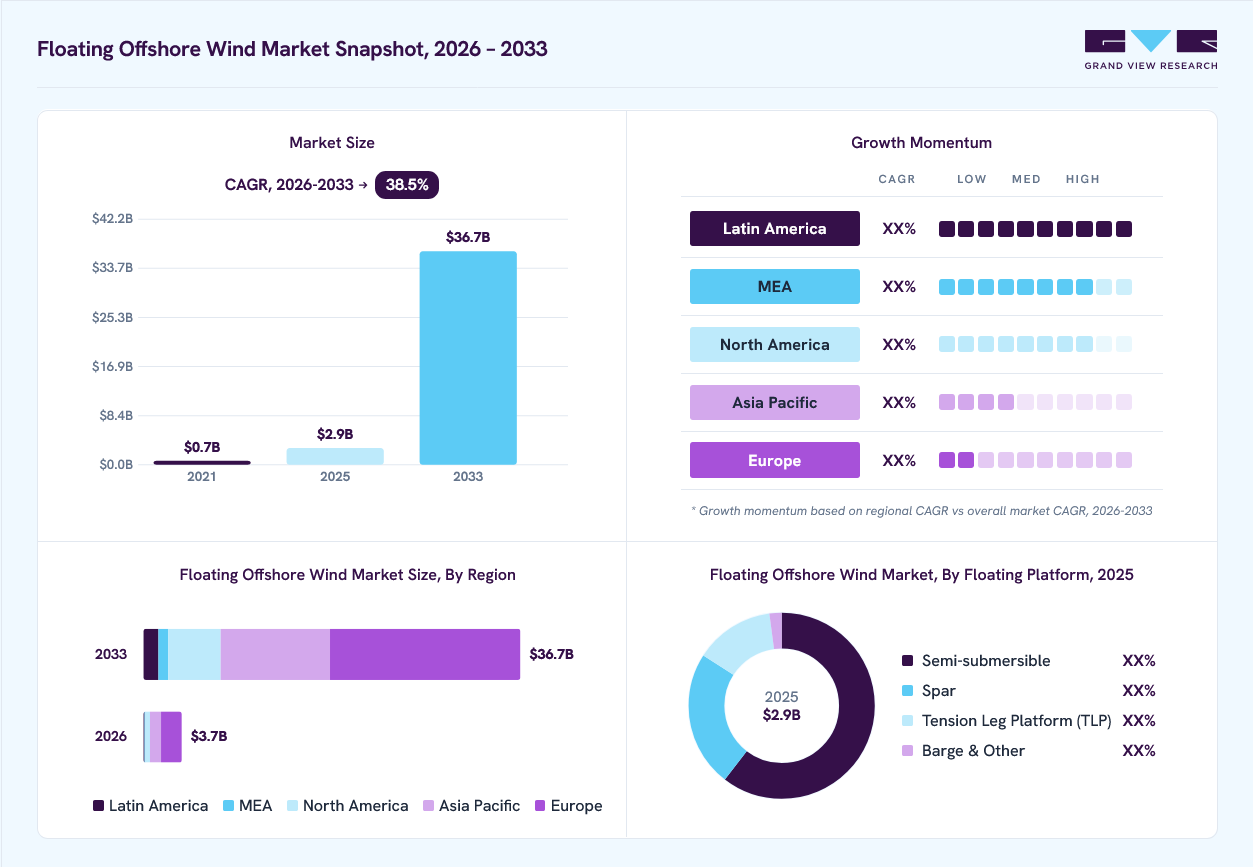
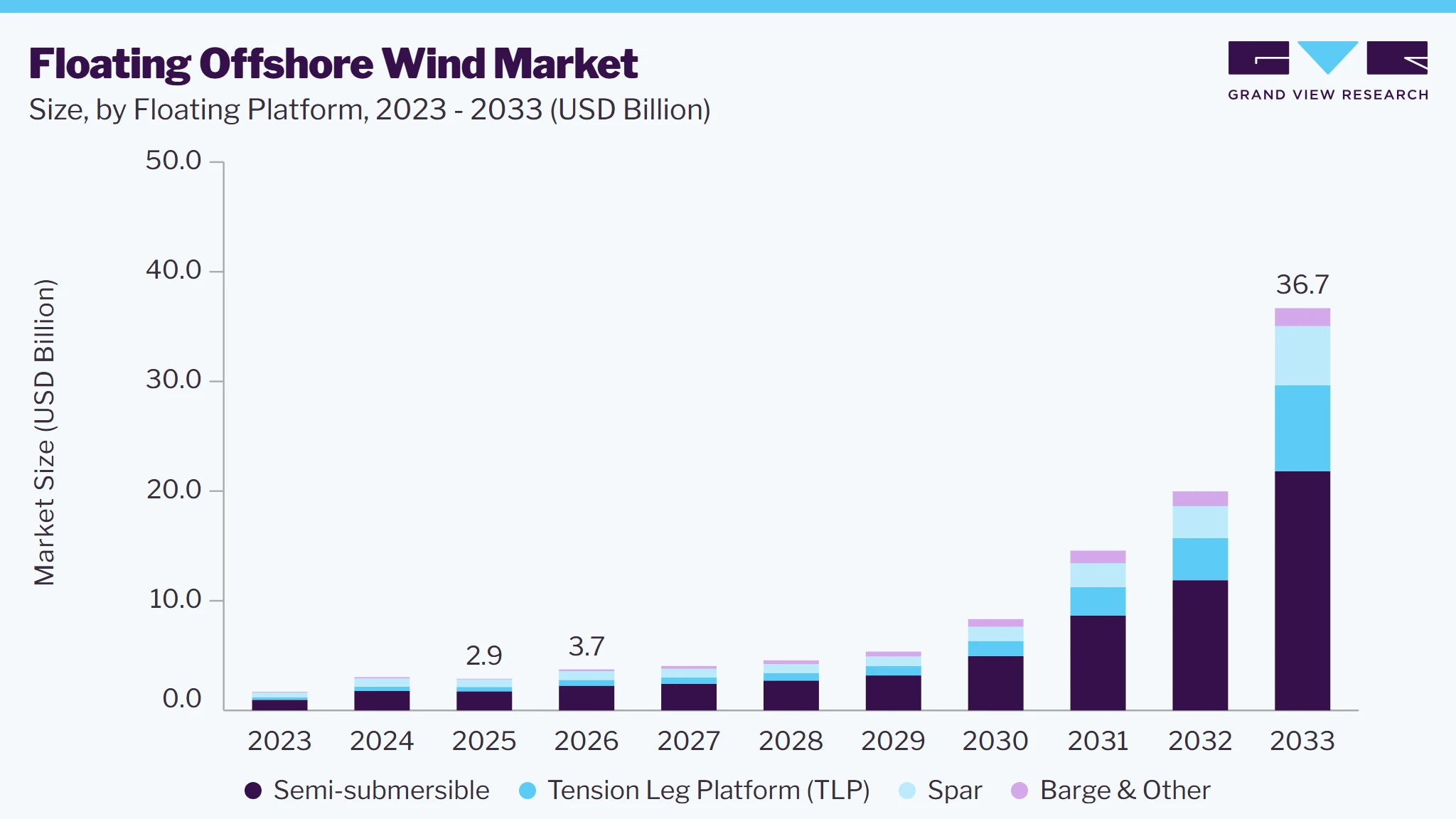
The global floating offshore wind market size was valued at USD 2.9 billion in 2025 and is projected to grow from USD 3.7 billion in 2026 to USD 36.7 billion by 2033, at a CAGR of 38.5% from 2026 to 2033. Europe dominated the market, accounting for the largest revenue share of 54.5% in 2025. The market is driven by the need to expand renewable power generation and access offshore wind resources in deeper waters beyond the practical limits of fixed-bottom turbines.
 Source: Grand View Research, IR Documents, Primary Interviews, Paid DatabasesTo learn more about this report,
 Download Free Sample Report
Key Market Trends & Insights
- By floating platform: Semi-submersible segment held the largest revenue share of 60.4% in 2025.
- By turbine capacity: 10-15 MW segment held the largest revenue share of 53.4% in 2025.
Regional Highlights
- Largest regional market: Europe (54.5% revenue share, 2025)
- Fastest-growing regional market: Latin America (highest CAGR, 2026-2033)
Market Size & Forecast
- Market size in 2025: USD 2.9 Billion
- Estimated market size in 2026: USD 3.7 Billion
- Projected market size by 2033: USD 36.7 Billion
- CAGR (2026-2033): 38.5%
Three ways to get this report
Buy it, customize it, or ask a question.Ask an Analyst
Analyst response in 1 business day
- AccessReport author, directly
- Reply timeWithin 1 working day
- No sales callDirect answer only
- FormatEmail reply
- CostFree, no cost
Get the Full Report
What the study covers
- FormatsPDF · Excel · Dashboard
- Timeline2026–2033 annual, 2025 base
- Coverage20+ countries, 5 regions
- Companies10+ key players profiled
Customize the Report
20% free customization
- IncludeCountries, segments, points
- TailorTo your product definition
- ExtendDeeper competitor detail
- OrA fully bespoke study
- Turnaround5–10 working days
 To learn more about this report, Download Free Sample Report
Floating offshore wind enables deployment in deeper waters with strong, consistent wind resources, while advancements in floating foundations, mooring systems, and turbine technology are improving project feasibility.Market Dynamics
The floating offshore wind market is being shaped by the growing deployment of offshore renewable energy and the need to access high-quality wind resources in deeper waters where fixed-bottom installations are less suitable. Advancements in floating foundation designs, mooring systems, dynamic cables, and larger-capacity turbines are improving project scalability and reducing installation constraints. At the same time, rising demand for low-carbon electricity, offshore wind targets, and increasing investment in large-scale demonstration and commercial projects are supporting market development, while high capital costs, complex installation requirements, port infrastructure limitations, and supply chain constraints continue to affect project economics.
The floating offshore wind market is driven by the need to access deeper-water areas with strong and consistent wind resources that are unsuitable for conventional fixed-bottom turbines. Floating foundations expand the geographic potential for offshore wind deployment and enable projects to be sited farther offshore. Growing clean-energy targets and advances in floating foundations, mooring systems, and dynamic cabling are further supporting commercial deployment.
In March 2026, the UK Government announced up to approximately USD 86 million to support the development of Port Talbot as a floating offshore wind hub in the Celtic Sea. The funding will enable essential design and engineering work for the port, which is expected to support an initial 4.5 GW of floating offshore wind projects. The investment highlights growing government support for port infrastructure required to scale floating offshore wind deployment.
The floating offshore wind market is restrained by high upfront project costs and the complex infrastructure required for commercial-scale deployment. Floating foundations, mooring systems, dynamic subsea cables, specialized vessels, and port facilities require substantially more capital investment than fixed-bottom offshore wind. Limited availability of suitable ports and installation vessels can increase project timelines and logistics costs. In addition, the relatively early stage of floating wind technology creates uncertainty around long-term operating and maintenance costs. These factors can affect project financing and slow the transition from demonstration projects to large-scale commercial deployment.
The expansion of floating offshore wind projects is creating opportunities across the emerging supply chain, particularly for floating foundations, mooring systems, dynamic cables, specialized installation vessels, and port infrastructure. Demand is also increasing for local fabrication and assembly facilities near planned offshore wind zones. As projects move toward larger commercial scale, suppliers with capabilities in modular manufacturing, marine engineering, installation, and operations and maintenance can participate in new revenue streams.
Analyst Perspective
The floating offshore wind market is moving from technology development toward early commercial deployment, supported by rising offshore renewable energy targets and the need to access deeper-water wind resources. A key trend is the development of larger-capacity turbines and advanced floating platforms to improve power output and project economics. Developers are also focusing on standardized platform designs, modular fabrication, and more efficient mooring and dynamic cable systems to reduce installation complexity. In parallel, port infrastructure development, strategic partnerships, and supply chain localization are becoming important factors in supporting large-scale project deployment.
Floating Platform Insights
The semi-submersible segment held the largest revenue share of 60.4% in 2025. Its leading position reflects its favorable balance of stability, scalability, and deployment flexibility across a wide range of water depths and seabed conditions. Semi-submersible platforms can be assembled and integrated at port facilities before offshore installation, reducing dependence on complex offshore construction activities. Their adaptability to larger turbine capacities and established floating wind project designs is also supporting their adoption in commercial-scale developments.
The tension leg platform (TLP) segment is anticipated to register the fastest CAGR of 46.9% during the forecast period. Growth is supported by its high structural stability and reduced platform movement, enabling efficient operation in deeper waters. TLPs also require relatively compact floating structures and provide strong motion control for larger offshore wind turbines. Increasing technological development and project demonstrations are further improving the feasibility of TLP-based floating wind projects.
Turbine Capacity Insights
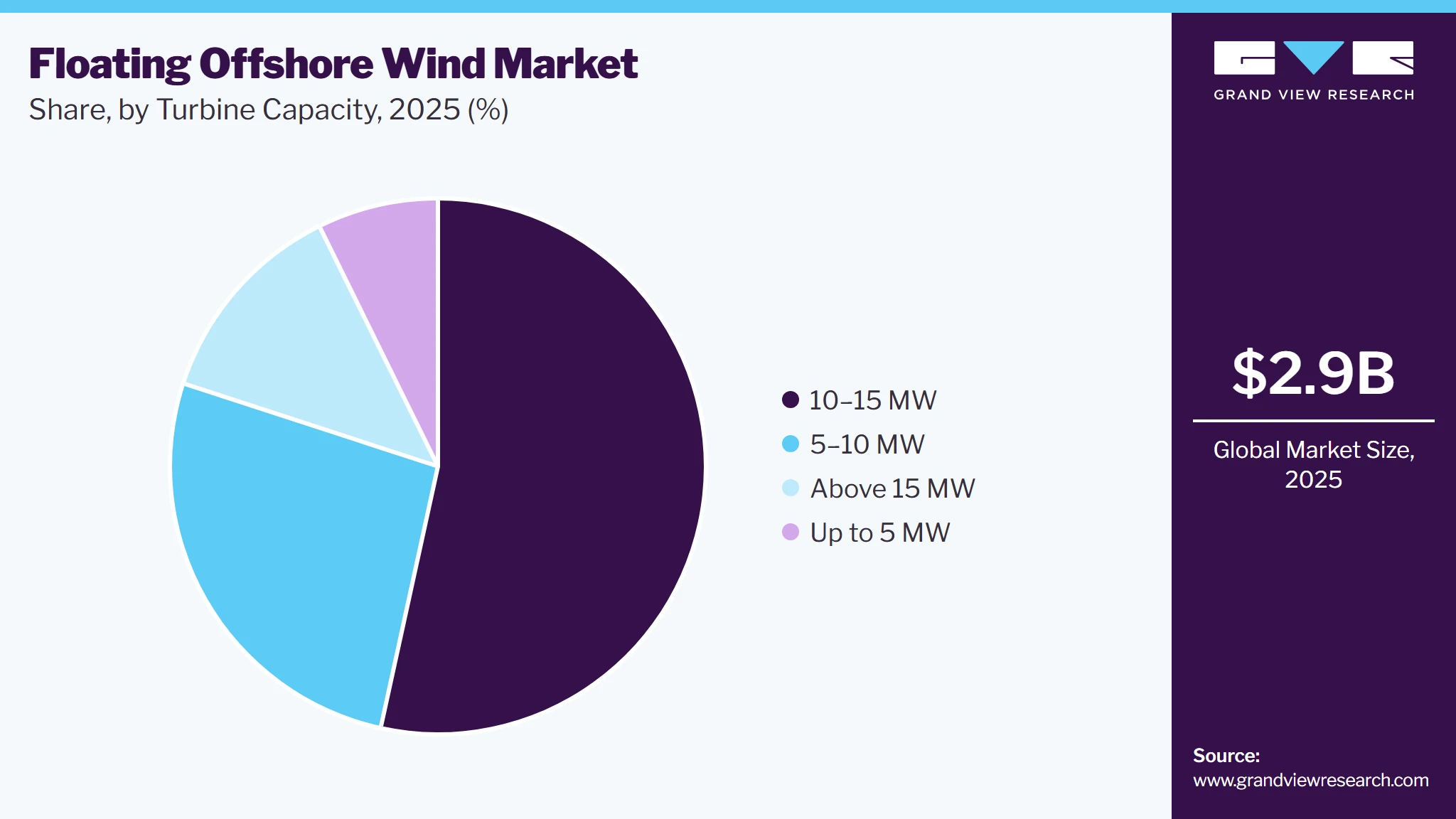
The 10-15 MW segment dominated the market with a revenue share of 53.4% in 2025, supported by the growing deployment of high-capacity turbines, which increase electricity output while reducing the number of turbines and associated balance-of-plant requirements per project. The segment also benefits from the availability of commercial-scale turbine platforms and compatibility with emerging floating foundation designs. Its adoption is further supported by developers seeking to improve project economics as floating offshore wind moves toward larger-scale deployment.
 To learn more about this report, Download Free Sample Report
The above 15 MW segment is expected to register the fastest CAGR of 58.3% from 2026 to 2033. This growth is attributed to the development of larger turbine platforms to increase power output from individual offshore units and improve project economics. Higher-capacity turbines can reduce the number of turbines, foundations, array cables, and associated infrastructure required for a given project capacity. Continued advancements in turbine design and floating foundation technology are further supporting the adoption of these large-scale turbines.
Regional Insights
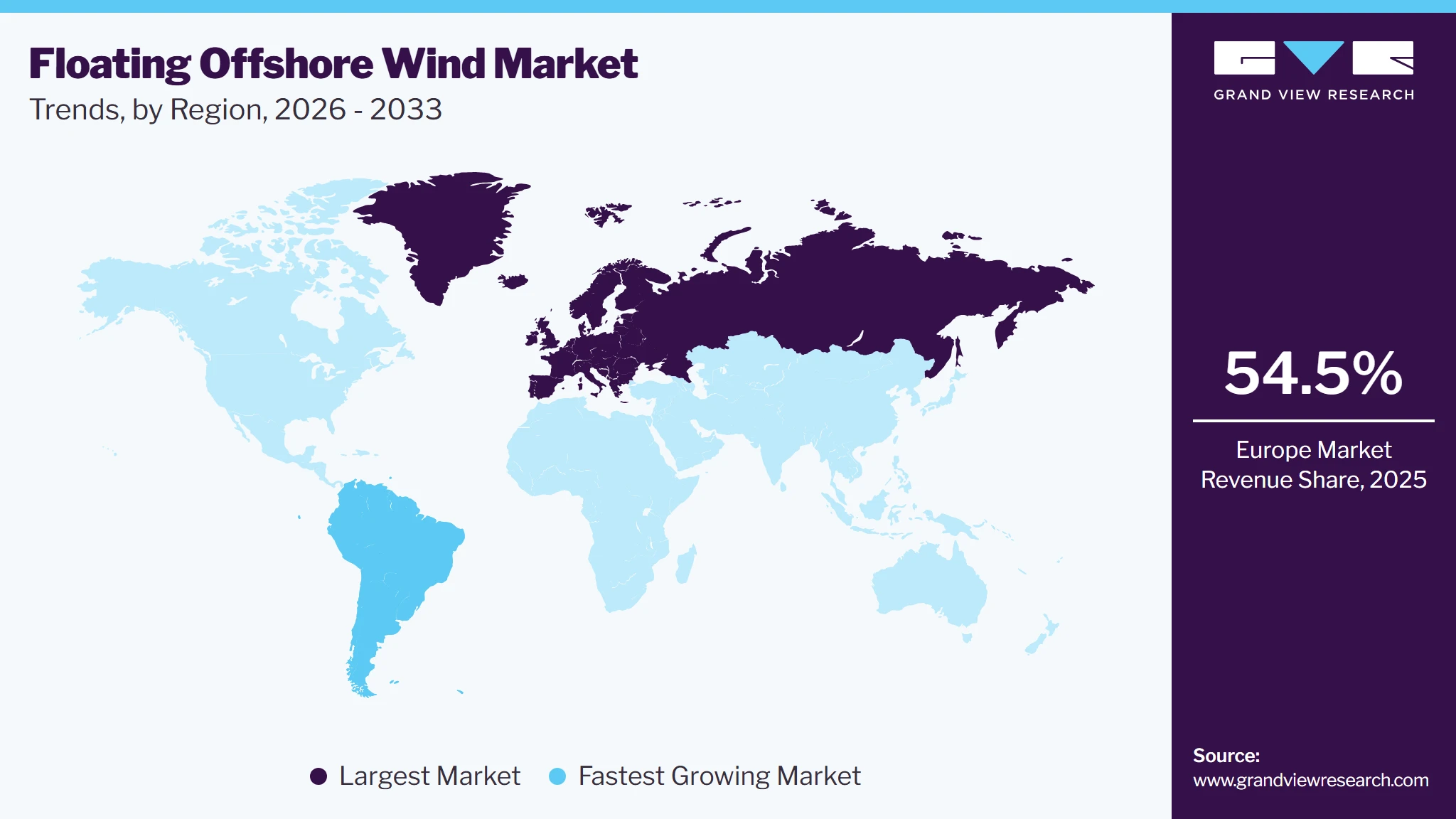
Europe dominated the global market with a revenue share of 54.5% in 2025. The region is emerging as a key market for floating offshore wind, supported by deep-water resources, established offshore wind capabilities, and national targets for floating projects. France, Italy, Spain, Portugal, Greece, and the UK are advancing auctions, demonstrations, and commercial-scale projects. The European Commission expects floating wind capacity in the EU to reach around 3 GW by 2030 and more than 40 GW by 2040, although high project costs, permitting, and infrastructure requirements remain challenges.
 To learn more about this report, Download Free Sample Report
Italy Floating Offshore Wind Market Trends
Italy represents an emerging floating offshore wind market, particularly across its deeper Mediterranean waters where fixed-bottom deployment is constrained. The country’s FER 2 support scheme allocates 3.8 GW to offshore wind projects during 2024-2028, providing a framework for future project development. Floating technology is gaining attention as developers target deeper-water areas and seek to expand Italy’s offshore renewable generation potential.
North America Floating Offshore Wind Market Trends
North America is developing its floating offshore wind market around deep-water resources, particularly along the U.S. West Coast, where seabed depths limit conventional fixed-bottom deployment. Government-supported R&D has focused on floating platforms, mooring systems, manufacturing, and supply-chain development. The region has substantial technical potential, but project economics, permitting conditions, infrastructure availability, and evolving policy support continue to influence commercialization.
The U.S. floating offshore wind market is primarily centered on California and other Pacific Coast opportunities, where deep waters necessitate floating foundations. The U.S. Department of Energy previously committed more than USD 950 million through the Floating Offshore Wind Shot to support technology development, leasing, research, manufacturing, and deployment activities. Commercial development remains dependent on project economics, federal and state policies, port infrastructure, and domestic supply chain readiness.
Latin America Floating Offshore Wind Market Trends
Latin America is growing at the fastest CAGR, at 43.0%, from 2026 to 2033. The region remains an early-stage floating offshore wind market, with opportunities concentrated in countries possessing strong offshore wind resources and deep coastal waters. Brazil and Chile are among the markets attracting interest because floating technology can expand offshore wind development beyond areas suitable for fixed-bottom projects. Future growth is expected to depend on regulatory frameworks, maritime planning, grid connectivity, port infrastructure, and the emergence of commercially viable demonstration projects.
Asia Pacific Floating Offshore Wind Market Trends
Asia Pacific is developing floating offshore wind capabilities as countries such as Japan, South Korea, and Australia seek to expand offshore renewable generation in deeper waters. The region benefits from strong offshore wind resources and established marine engineering and manufacturing capabilities, while Japan and South Korea are advancing floating wind projects and developing floating wind technology. Commercial scale-up is increasingly focused on larger turbines, standardized floating platforms, and integration with domestic offshore wind supply chains.
Middle East & Africa Floating Offshore Wind Market Trends
The Middle East & Africa floating offshore wind market remains in an early stage of development, with opportunities linked to countries seeking to diversify their renewable energy portfolios and develop new offshore power resources. Floating technology could enable offshore wind deployment in deeper coastal waters where fixed-bottom systems are less practical. Market development will depend on resource assessment, regulatory frameworks, port and marine infrastructure, grid availability, and the emergence of bankable projects.
Key Floating Offshore Wind Company Insights
Some of the key players operating in the global floating offshore wind market include Aker Solutions and Vestas, among others.
-
Aker Solutions participates in the offshore wind market through engineering, project development, fabrication, and offshore installation capabilities, with a focus on supporting large-scale offshore wind projects and floating wind infrastructure. Its offering spans engineering and project execution for floating and fixed-bottom developments, including offshore structures, mooring-related systems, and integration services. The company is also involved in partnerships and technology development to improve the scalability and industrialization of floating offshore wind projects. Its engineering and fabrication expertise positions it across multiple stages of the offshore wind project value chain.
-
Vestas participates in the offshore wind market primarily through the development, manufacture, installation, and servicing of offshore wind turbines. The company provides high-capacity turbine platforms designed for utility-scale offshore projects, supported by long-term service and maintenance capabilities. Vestas is also advancing turbine technologies with higher power ratings and improved efficiency, reducing the number of turbines required for large offshore wind farms. Its established turbine manufacturing and service network enables it to participate across the equipment supply and lifecycle management stages of offshore wind projects.
Key Floating Offshore Wind Companies:
The following key companies have been profiled for this study on the floating offshore wind market.
-
Aker Solutions
-
BW Ideol
-
Ekwil
-
Hexicon
-
Principle Power
-
SBM Offshore
-
Siemens Gamesa
-
TechnipFMC plc
-
Vestas
-
X1Wind
Competitive Benchmarking
Category
Operating Strategies
Competitive Edge
Weakness
Established Players (Aker Solutions, BW Ideol, Principle Power, SBM Offshore, Siemens Gamesa, TechnipFMC plc, Vestas)
- Expand floating wind capabilities by leveraging existing offshore engineering, turbine, EPC, and project-development expertise.
- Form strategic partnerships with utilities, developers, and technology providers to secure large-scale projects.
- Invest in technology development, supply-chain localization, and project execution capabilities.
- Diversify across multiple floating foundation technologies and offshore wind project stages.
- Strong financial capacity and access to capital-intensive projects.
- Established global customer relationships and project-development networks.
- Proven offshore engineering, manufacturing, and project execution capabilities.
- Access to mature global supply chains and established procurement networks.
- Higher organizational and operational complexity due to diversified business portfolios.
- Floating wind may represent a relatively small portion of revenues for diversified players.
- High capital requirements for large-scale floating wind projects.
- Longer development and commercialization cycles for new floating technologies.
Emerging Players (Ekwil, Hexicon, X1Wind)
- Focus on proprietary floating foundation and platform technologies.
- Develop demonstration projects to validate technology and improve commercial readiness.
- Partner with utilities, offshore developers, EPC companies, and established industry players.
- Target specific deepwater conditions, turbine sizes, or project configurations where their technology offers advantages.
- Specialized expertise focused specifically on floating offshore wind.
- Greater flexibility to develop and modify proprietary technologies.
- Faster innovation and shorter decision-making cycles.
- Potential for differentiated platform designs and lower installation requirements.
- Limited track record of commercial-scale project deployment.
- Smaller financial resources compared with major offshore energy companies.
- Dependence on strategic partners for financing, manufacturing, and project execution.
- Limited established supply-chain and customer networks.
Recent Developments
-
In April 2025, Aker Solutions introduced three floating wind foundation designs-YFloat, CONFloat-Omega, and CONFloat-7C, designed to support turbines of 15 MW and above. The YFloat is a steel floating substructure featuring a symmetrical design that supports prefabrication and potential local assembly, while the CONFloat-Omega is a circular concrete floater with a central moonpool designed for harsh environmental conditions and reduced maintenance. The CONFloat-7C uses a seven-cell configuration derived from Aker Solutions’ CONDEEP designs, with a centralized turbine and tower and reduced integration and completion draught to expand the range of suitable ports and execution locations. All three designs incorporate passive ballast systems and are intended to improve energy production, simplify construction, reduce maintenance requirements, and support cost-efficient scaling of floating offshore wind projects
Floating Offshore Wind Market Report Scope
Report Attribute
Details
Market Definition
The floating offshore wind market comprises wind power projects in which turbines are mounted on floating substructures moored to the seabed, enabling offshore electricity generation in water depths where fixed-bottom foundations are less suitable.
Market size in 2025
USD 2.9 billion
Estimated market size in 2026
USD 3.7 billion
Projected market size by 2033
USD 36.7 billion
Growth Rate
CAGR of 38.5% from 2026 to 2033
Base year for estimation
2025
Historical data
2021 - 2024
Forecast period
2026 - 2033
Quantitative Units
Revenue in USD billion and CAGR from 2026 to 2033
Report coverage
Revenue forecast, competitive landscape, growth factors, and trends
Segments covered
Floating platform, turbine capacity, region
Regional scope
North America; Europe; Asia Pacific; Latin America; Middle East & Africa
Country scope
U.S.; Canada; Sweden; Ireland; UK; Italy; China; Philippines; South Korea; Australia; Brazil; Saudi Arabia
Key companies profiled
Aker Solutions; BW Ideol; Ekwil; Hexicon; Principle Power; SBM Offshore; Siemens Gamesa; TechnipFMC plc; Vestas; X1Wind
Customization scope
Free report customization (equivalent up to 8 analysts working days) with purchase. Addition or alteration to country, regional & segment scope.
Pricing and purchase options
Avail customized purchase options to meet your exact research needs. Explore purchase options
Global Floating Offshore Wind Market Report Segmentation
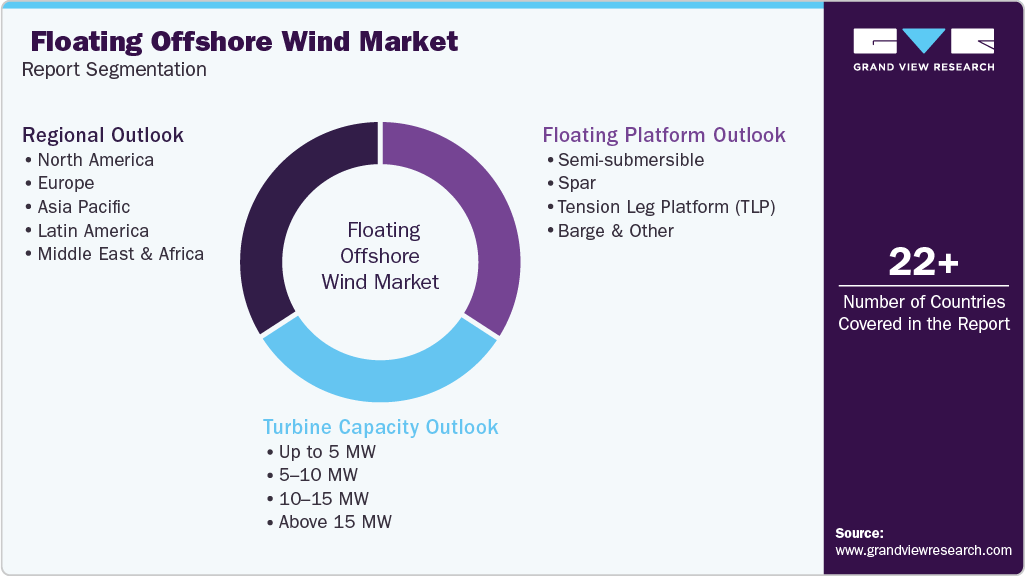
This report forecasts revenue growth at global, regional, and country levels and provides an analysis of the latest industry trends in each of the sub-segments from 2021 to 2033. For the purpose of this study, Grand View Research has segmented the global floating offshore wind market report on the basis of floating platform, turbine capacity, and region:
 To learn more about this report, Download Free Sample Report
-
Floating Platform Outlook (Revenue, USD Billion, 2021 - 2033)
-
Semi-submersible
-
Spar
-
Tension Leg Platform (TLP)
-
Barge & Other
-
-
Turbine Capacity Outlook (Revenue, USD Billion, 2021 - 2033)
-
Up to 5 MW
-
5-10 MW
-
10-15 MW
-
Above 15 MW
-
-
Regional Outlook (Revenue, USD Billion, 2021 - 2033)
-
North America
-
U.S.
-
Canada
-
-
Europe
-
UK
-
Italy
-
Sweden
-
Ireland
-
-
Asia Pacific
-
China
-
Philippines
-
South Korea
-
Australia
-
-
Latin America
-
Brazil
-
-
Middle East & Africa
-
Saudi Arabia
-
-
Research Methodology
The floating offshore wind market figures in this report are based on a proven research process that combines executive interviews with secondary research from proprietary databases, company filings, and recognized regulatory and institutional sources. Market size is built through value-chain sizing-reconciling supply-side and demand-side estimates-and triangulated with bottom-up and top-down approaches. Every estimate passes multiple levels of expert validation before publication, with each floating offshore wind segment quantified using the revenue-capture definitions in the table below.
Segment Definition
Segment - Floating Platform
Revenue capture definition
Semi-submersible
Revenue from semi-submersible floating platforms sold for supporting offshore wind turbines, covering the floating foundation and integrated platform components.
Spar
Sales of spar-type floating structures deployed with offshore wind turbines, including the spar foundation and associated platform systems.
Tension Leg Platform (TLP)
Revenue attributable to TLP structures supplied for floating offshore wind projects, including the platform and related tensioning and anchoring systems.
Barge & Other
Sales of barge-type and other floating platform designs used for offshore wind turbines, excluding semi-submersible, spar, and TLP configurations.
Segment - Turbine Capacity
Revenue capture definition
Up to 5 MW
Revenue generated through the sale of floating offshore wind turbines rated at up to 5 MW per turbine.
5-10 MW
Sales of floating offshore wind turbines with individual nameplate capacities exceeding 5 MW and reaching up to 10 MW.
10-15 MW
Revenue associated with floating wind turbine units rated above 10 MW and up to 15 MW, based on individual turbine capacity.
Above 15 MW
Sales of floating offshore wind turbines with an individual nameplate capacity greater than 15 MW.
Estimation Model
Layer Name
Key Question
Description
Demand Layer
Which factors generate demand for floating offshore wind?
Assess demand arising from increasing offshore renewable power requirements, limited availability of shallow-water sites, expansion into deeper waters, national floating wind targets, decarbonization initiatives, grid-scale renewable generation, and investment in offshore wind infrastructure.
Technology Layer
Which floating wind technologies generate market revenue?
Evaluate revenue across semi-submersible, spar, tension leg platform (TLP), and barge & other technologies based on platform design, water-depth suitability, turbine compatibility, stability, mooring requirements, fabrication complexity, installation approach, and technology maturity.
Turbine Capacity Layer
Which turbine capacity ranges generate market revenue?
Quantify revenue across up to 5 MW, 5-10 MW, 10-15 MW, and above 15 MW turbine classes based on individual turbine capacity, project configuration, turbine availability, platform compatibility, energy output, and commercial deployment scale.
Revenue Layer
How is floating offshore wind market revenue generated?
Market revenue is quantified through the sale of floating offshore wind turbines and floating platform systems supplied for offshore wind projects. Revenue varies by platform configuration, turbine capacity, project size, technology design, and geographic market, with the analysis focused on equipment sales rather than project development, electricity generation, or operating revenue.
Delivered Customizations
We have successfully delivered the following deep-dive customizations:
Client Request
Customization Delivered
Value Adds
Technology Opportunity Assessment
Market analysis was conducted across semi-submersible, spar, tension leg platform (TLP), and barge & other floating platform technologies by evaluating platform design, water-depth suitability, turbine compatibility, stability, mooring requirements, fabrication complexity, installation requirements, and technology maturity.
Identified high-potential floating platform technologies based on scalability, cost-reduction potential, turbine compatibility, installation efficiency, and commercialization progress.
Turbine Capacity Opportunity Assessment
Market analysis was performed across up to 5 MW, 5-10 MW, 10-15 MW, and above 15 MW turbine capacity ranges by assessing turbine availability, platform compatibility, project scale, energy output, and adoption across floating offshore wind projects.
Identified capacity ranges with strong deployment potential based on turbine technology development, project economics, platform requirements, and transition toward larger-capacity turbines.
Regional Opportunity Assessment
Country-level analysis was conducted to assess floating offshore wind adoption based on offshore wind potential, water depth, government targets, auction pipelines, grid infrastructure, supply-chain capabilities, and investment activity across key markets.
Identified countries and regions with strong floating wind potential based on project pipelines, supportive policies, deep-water resources, infrastructure readiness, and investment opportunities.
Frequently Asked Questions About This Report
The floating offshore wind market size was estimated at USD 2.9 billion in 2025 and is expected to reach USD 3.7 billion in 2026.
The floating offshore wind market is expected to grow at a CAGR of 38.5% from 2026 to 2033 to reach USD 36.7 billion by 2033.
The floating offshore wind market is driven by the expansion of offshore renewable energy targets, growing demand for clean power, and the ability to deploy turbines in deeper waters where fixed-bottom foundations are technically challenging.
The Europe region dominated the floating offshore wind market with a revenue share of 54.5% in 2025.
Italy dominated the Europe region market with a revenue share of 24.0% in 2025.
Latin America is anticipated to register the fastest CAGR of 43.0% over the forecast period.
Based on floating platform, the semi-submersible segment accounted for the largest revenue share of 60.4% in 2025.
Based on turbine capacity, the 10–15 MW segment accounted for the largest revenue share of 53.4% in 2025.
The key players operating in the floating offshore wind market are Aker Solutions, BW Ideol, Ekwil, Hexicon, Principle Power, SBM Offshore, Siemens Gamesa, TechnipFMC plc, Vestas, X1Wind, and others.
About the Author(s)
Renewable Energy Research Team
Energy & Power · Renewable EnergyThis report was authored by the renewable energy research team at Grand View Research - comprising two research analysts, one senior research analyst, and one industry expert - with specialized expertise in the renewable energy segment of the energy & power industry. All findings are based on proprietary energy & power databases, executive interviews, and regulatory analysis, subject to internal peer review prior to publication.
Last Updated:
Speak to Analyst

Customize this report to your needs - add regions, segments, or data points, with 20% free customization.
Or view our licence options:


ISO 9001:2015 & 27001:2022 Certified
We are GDPR and CCPA compliant! Your transaction & personal information is safe and secure. For more details, please read our privacy policy.


