
- Home
- »
- Organic Chemicals
- »
-
Fluid Loss Additives Market Size & Share Report, 2026-2033GVR Report cover
![Fluid Loss Additives Market (2026 - 2033)Report]()
Fluid Loss Additives Market (2026 - 2033)
Size, Share & Trends Analysis Report By Product (Synthetically Modified, Natural Additives, Synthetic Additives), By Application (Drilling Fluids, Cement Slurries), By Region, And Segment Forecasts
Market Size, 2025
$283.5MMarket Estimate, 2026
$289.8MMarket Forecast, 2033
$355.5MCAGR, 2026–2033
3.0%Fluid Loss Additives Market Summary
The global fluid loss additives market size was valued at USD 283.5 million in 2025 and is projected to grow from USD 289.8 million in 2026 to reach USD 355.5 million by 2033, at a CAGR of 3.0% from 2026 to 2033. North America dominated the market, accounting for the largest revenue share of 34.8% in 2025. The growth is supported by increasing oil and gas exploration and drilling activities, where fluid loss additives are widely used in drilling fluids and cement slurries to control filtration, maintain wellbore stability, minimize formation damage, and improve overall drilling performance.

Key Market Trends & Insights
- By product: Synthetically modified segment held the largest revenue share of 46.4% in 2025.
- By application: Drilling fluids segment projected the largest revenue share of 71.0% in 2025
Regional Highlights
- Largest regional market: North America (34.8%, revenue share, 2025)
- Fastest-growing region: Asia Pacific (highest CAGR, 2026-2033)
- By country: The U.S. dominated the North America market in 2025.
Market Size & Forecast
- Market size in 2025: USD 283.5 Million
- Estimated market size in 2026: USD 289.8 Million
- Projected market size by 2033: USD 355.5 Million
- CAGR (2026-2033): 3.0%
Rising oil and gas exploration and production activities, coupled with the increasing complexity of drilling operations, are driving the adoption of fluid loss additives. These additives help control fluid filtration into permeable formations, maintain wellbore stability, minimize formation damage, and improve overall drilling efficiency. Growing exploration of unconventional resources such as shale oil and gas, increasing deepwater and offshore drilling activities, and the development of high-temperature and high-pressure wells are supporting market growth. Rising investments in oilfield development, expanding drilling activities in emerging hydrocarbon-producing regions, and advancements in polymer-based and high-performance drilling fluid formulations are boosting the use of fluid loss additives across modern drilling operations.
Market Dynamics
The fluid loss additives market is driven by the growing demand for drilling fluids that maintain wellbore stability and control fluid filtration during oil and gas exploration and production activities. Fluid loss additives reduce the loss of liquid from drilling fluids into permeable formations, helping maintain formation pressure, minimize wellbore damage, and improve drilling efficiency. Rising exploration of unconventional oil and gas resources, increasing deepwater and offshore drilling activities, and the development of technically challenging wells are supporting market demand. Growing investments in drilling infrastructure, rising energy consumption, and advancements in high-performance drilling fluid formulations are strengthening the adoption of fluid loss additives across upstream operations. Manufacturers are focusing on polymer innovation, environmentally compatible formulations, and customized additives designed for high-temperature and high-pressure drilling environments.
The expansion of oil and gas exploration and production activities is a major driver of the fluid loss additives market. Increasing drilling activities across conventional and unconventional reservoirs are creating demand for drilling fluid additives that improve filtration control, maintain wellbore integrity, and reduce formation damage. The growing development of shale gas, tight oil, deepwater, and other complex reservoirs require drilling fluids capable of maintaining stable performance under high-temperature, high-pressure, and challenging geological conditions.
Rising investments in offshore exploration, mature field redevelopment, and well completion activities are increasing the consumption of specialized drilling fluid formulations. Advances in polymer-based and synthetic fluid loss additives are enabling operators to achieve improved filtration control and drilling performance across demanding conditions. The continued expansion of global drilling activity is expected to sustain demand for fluid loss additives throughout the forecast period.
Fluctuations in crude oil and natural gas prices can restrain the growth of the fluid loss additives market by influencing exploration and drilling expenditure. During periods of weak commodity prices, oil and gas companies may postpone drilling projects, reduce capital expenditure, or prioritize cost optimization, resulting in lower demand for drilling fluid additives.
Environmental concerns associated with certain chemical-based drilling fluid additives also pose challenges to market expansion. Stringent regulations governing the discharge and disposal of drilling fluids, particularly in offshore and environmentally sensitive areas, are increasing the need for safer and more environmentally compatible formulations. Compliance requirements can raise formulation, testing, and operational costs for manufacturers and drilling contractors.
The increasing development of unconventional hydrocarbon resources and offshore reserves presents significant opportunities for fluid loss additive manufacturers. Shale formations, tight oil and gas reservoirs, deepwater fields, and high-pressure/high-temperature wells require advanced drilling fluids capable of controlling filtration and maintaining rheological stability under demanding operating conditions. This creates demand for high-performance polymeric, synthetic, and specialty fluid loss additives.
Growing investment in deepwater exploration and the redevelopment of mature oil fields is expanding the need for customized drilling fluid solutions. Advances in water-based and environmentally acceptable drilling fluid technologies are creating opportunities for manufacturers to develop additives with improved thermal stability, salt tolerance, and filtration-control performance. Rising adoption of digital drilling technologies and real-time well monitoring is also encouraging the development of application-specific formulations that optimize drilling performance and reduce fluid-related losses.
Market Concentration & Characteristics
The fluid loss additives market is moderately fragmented, with competition among major oilfield chemical suppliers, specialty chemical manufacturers, and regional drilling fluid additive producers. Market competition is shaped by additive performance, filtration-control efficiency, thermal and chemical stability, compatibility with different drilling fluid systems, environmental compliance, and cost competitiveness. Leading manufacturers are investing in polymer technology, product development, strategic partnerships, and technical services to strengthen their positions across major oil and gas producing regions.
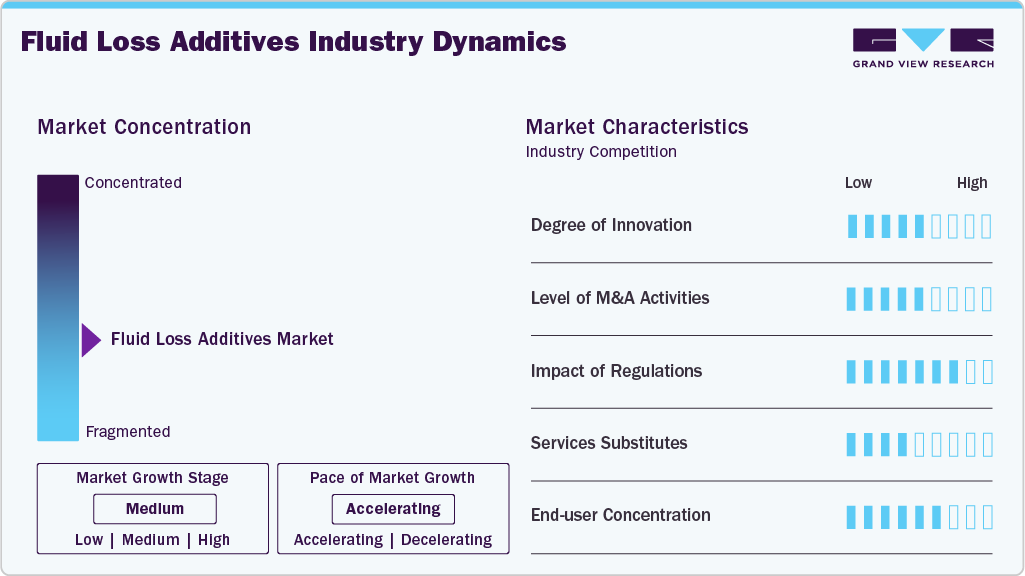
Companies are expanding their portfolios with high-temperature/high-pressure additives, environmentally preferred formulations, and products compatible with water-based, oil-based, and synthetic-based drilling fluids. Growing exploration in unconventional and offshore reservoirs is encouraging manufacturers to develop application-specific solutions, while regional production capabilities and established relationships with drilling contractors and oilfield service providers remain important factors influencing market competitiveness.
Analyst Perspective
The fluid loss additives market is driven by increasing oil and gas exploration activities and the growing demand for drilling fluid solutions that improve wellbore stability and filtration control. Rising development of unconventional oil and gas resources, expanding offshore and deepwater drilling, and increasing drilling operations in high-temperature and high-pressure formations are accelerating the use of fluid loss additives. Advancements in polymer-based formulations and drilling fluid technologies are improving filtration control, thermal stability, and compatibility with complex drilling environments, supporting efficient drilling operations and minimizing formation damage.
Product Insights
Synthetically modified segment dominated the product segment with a revenue share of 46.4% in 2025. Its leading position is supported by superior filtration-control performance, consistent product quality, and reliable functionality across a wide range of drilling conditions. Synthetically modified additives can be engineered to provide specific performance characteristics, including improved thermal stability, salt tolerance, rheological compatibility, and resistance to degradation under demanding downhole conditions. Their extensive use in water-based, oil-based, and synthetic-based drilling fluid systems makes them suitable for conventional as well as technically challenging drilling operations.
Natural additives segment is expected to grow at the fastest at a CAGR of 3.9% during the forecast period. Growth is supported by increasing demand for environmentally compatible drilling fluid solutions and rising interest in additives derived from renewable or natural sources. Natural additives, including starch-, cellulose-, and other biopolymer-based materials, provide filtration-control properties while offering potential environmental advantages over certain conventional chemical formulations. Their use is gaining importance in drilling operations where operators face stricter environmental requirements and disposal regulations.
Application Insights
Drilling fluids segment projected the largest revenue share of 71.0% in 2025, supported by the extensive incorporation of fluid loss additives into drilling fluid systems. These additives play an important role in controlling filtrate invasion into permeable formations, maintaining filter cake quality, preserving wellbore stability, and minimizing formation damage during drilling. Demand is closely linked to drilling activity across conventional oil and gas fields, shale and tight formations, offshore wells, and other complex reservoirs. Increasing well depths, challenging geological conditions, and the growing need for drilling fluids capable of maintaining performance under high-temperature and high-pressure environments.
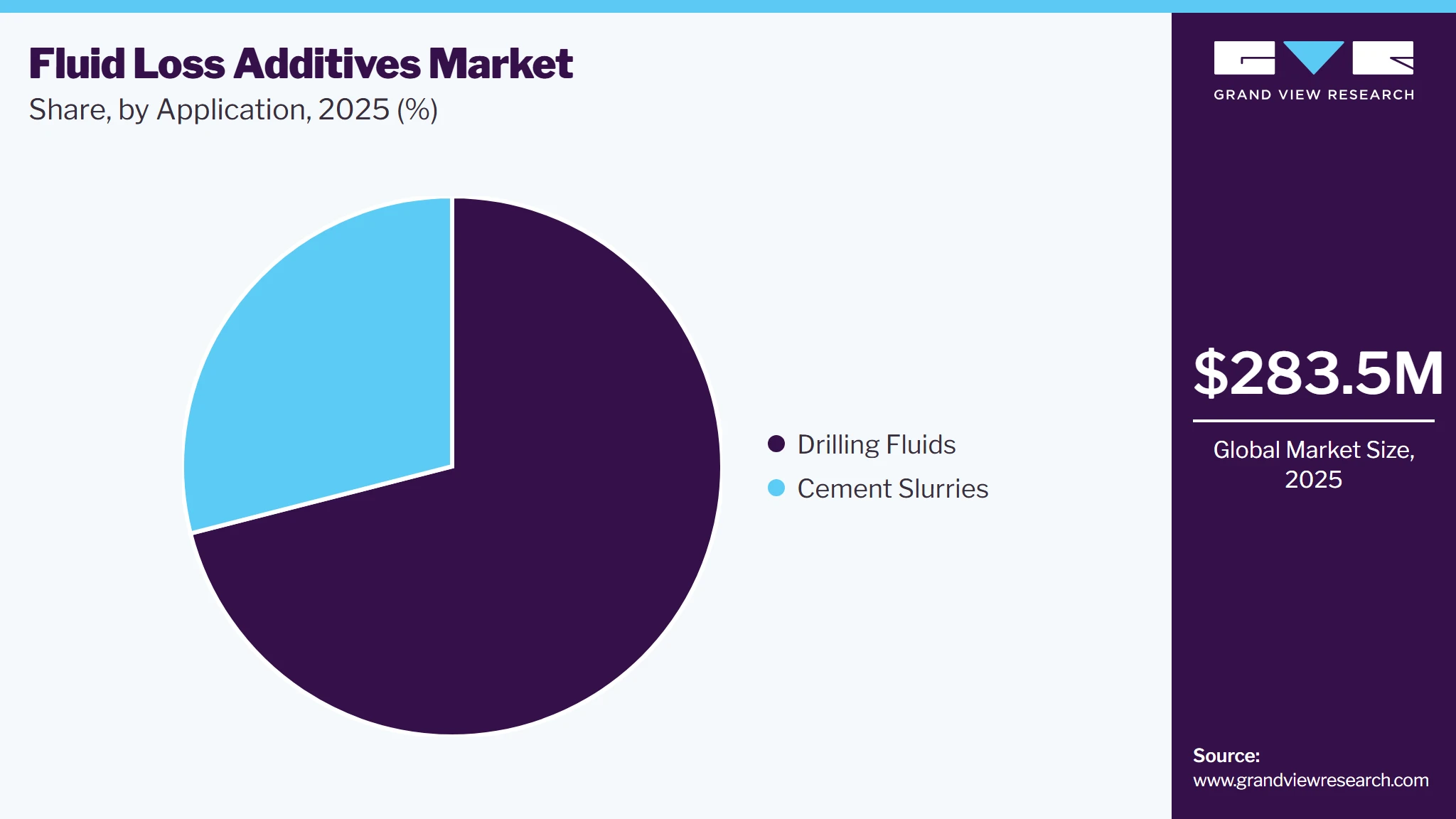
Cement slurries segment is expected to grow fastest at a CAGR of 3.7% during the forecast period. Fluid loss additives used in cement slurries help limit fluid migration into surrounding formations during cement placement, enabling better control of slurry properties and supporting effective zonal isolation. Their importance increases in deep, high-pressure, high-temperature, and highly permeable formations where uncontrolled fluid loss can compromise cementing performance and well integrity. Growing construction, completion, workover, and mature-field redevelopment activities are generating demand for improved cementing solutions.
Regional Insights
North America dominated the global fluid loss additives market, accounting for a 34.8% revenue share in 2025. The region's leading position is supported by extensive oil and gas drilling activities, particularly across unconventional shale and tight oil and gas formations. High drilling intensity in the U.S. and Canada generates sustained demand for advanced drilling fluid systems that provide effective filtration control, wellbore stability, and formation protection. Growing investments in horizontal drilling, hydraulic fracturing, offshore exploration, and mature-field development are supporting the use of high-performance fluid loss additives. Strong presence of major oilfield service providers and specialty chemical manufacturers also strengthens regional product availability and technical support.

U.S. Fluid Loss Additives Market Trends
The U.S. dominated the North American fluid loss additives market, supported by its extensive upstream oil and gas industry and high levels of drilling activity. The country's large shale oil and gas production base, particularly in regions such as the Permian, Eagle Ford, and Bakken formations, creates substantial demand for drilling fluid additives. Increasing horizontal drilling depths and technically complex well designs are encouraging operators to use specialized formulations capable of maintaining filtration control under demanding downhole conditions. Continued investments in domestic hydrocarbon production, drilling technology, and well completion activities are expected to sustain demand for fluid loss additives.
Asia Pacific Fluid Loss Additives Market Trends
The Asia Pacific fluid loss additives market is expected to grow at the fastest CAGR of 3.7% during the forecast period. Growth is supported by increasing exploration and production activities across China, India, Southeast Asia, and other emerging oil and gas markets. Governments and energy companies across the region are investing in domestic hydrocarbon development to reduce dependence on imported energy and strengthen energy security. Expansion of offshore exploration, unconventional resource development, and mature-field redevelopment is generating demand for advanced drilling fluid systems. Rising investments in drilling infrastructure and growing adoption of technically advanced fluid formulations are expected to support regional market expansion.
Fluid loss additives market in China represents a major market in Asia Pacific, supported by substantial domestic oil and gas exploration and drilling activities. Increasing development of shale gas, tight gas, offshore resources, and mature oil fields is creating demand for additives that provide effective filtration control under challenging geological conditions. National efforts to strengthen domestic energy production and improve energy security are encouraging investments in exploration and drilling infrastructure. Growing adoption of advanced drilling technologies and increasing demand for high-performance drilling fluid systems are expected to support consumption of fluid loss additives across the country.
Europe Fluid Loss Additives Market Trends
Europe represents an established market for fluid loss additives, supported by offshore oil and gas operations in the North Sea and ongoing redevelopment of mature hydrocarbon fields. The region's technically demanding offshore drilling environment creates demand for drilling fluid additives that deliver reliable filtration control, thermal stability, and wellbore protection. Environmental regulations are also encouraging the development and adoption of lower-impact drilling fluid formulations. Continued offshore activity, well intervention programs, and investments in mature-field optimization are expected to maintain demand, although the region's transition toward lower-carbon energy sources may moderate long-term growth in conventional drilling activity.
Latin America Fluid Loss Additives Market Trends
Latin America is witnessing increasing demand for fluid loss additives as oil and gas companies expand exploration and production activities across major hydrocarbon-producing countries. Brazil's deepwater and pre-salt developments represent a significant source of demand for advanced drilling fluid technologies capable of performing under high-pressure and technically challenging conditions. Growing exploration in Guyana and continued upstream investment in Mexico and Argentina are creating additional opportunities for drilling fluid additive suppliers. Rising offshore investments and development of unconventional resources are expected to strengthen demand for high-performance filtration-control solutions across the region.
Middle East Fluid Loss Additives Market Trends
The Middle East remains an important market for fluid loss additives due to its large oil and gas production base and continued investment in upstream development. Countries such as Saudi Arabia, the UAE, Qatar, Kuwait, and Oman are investing in new wells, field expansion, enhanced oil recovery, and mature-field redevelopment, supporting demand for drilling fluid systems. Increasing drilling depths and the development of technically complex reservoirs are creating demand for additives with improved filtration control and high-temperature performance. Continued efforts to maintain and expand hydrocarbon production capacity are expected to sustain the regional market, despite the gradual diversification of Middle Eastern economies into non-oil sectors.
Key Fluid Loss Additives Company Insights
Companies operating in the fluid loss additives market are adopting strategies centered on product innovation, advanced drilling fluid technologies, strategic collaborations, technical service expansion, and development of high-performance formulations. Leading oilfield service providers are investing in polymer technologies and specialized drilling fluid systems to improve filtration control, wellbore stability, and performance under high-temperature and high-pressure conditions. Companies are also strengthening their global presence through integrated drilling solutions and technical partnerships with oil and gas operators.
-
Halliburton is a leading provider of oilfield services and drilling fluid solutions, offering fluid loss control technologies designed to manage filtration, improve wellbore stability, and minimize formation damage during drilling operations. The company leverages its expertise in drilling fluids, polymer chemistry, and reservoir engineering to develop solutions for conventional, unconventional, offshore, and technically challenging wells. Halliburton strengthens its market position through continuous technology development, integrated well-construction services, and solutions tailored to high-temperature, high-pressure, and complex drilling environments.
-
SLB is a major provider of drilling fluid technologies and oilfield solutions, with fluid loss control products supporting efficient drilling and wellbore management across diverse reservoir conditions. The company combines expertise in drilling chemistry, digital technologies, and well construction to develop advanced fluid systems that provide filtration control and maintain wellbore integrity. SLB continues to strengthen its competitive position through technology innovation, integrated drilling solutions, and collaboration with oil and gas operators to improve drilling efficiency and performance in complex formations.
Key Fluid Loss Additives Companies
The following key companies have been profiled for the study on the fluid loss additives market.
-
Halliburton
-
SLB
-
BASF
-
Chevron Phillips Chemical Company LLC
-
Clariant
-
Nouryon
-
Newpark Drilling Fluids LLC
-
Baker Hughes Company
-
Italmatch Chemicals
-
Flotek Industries, Inc.
Competitive Benchmarking
Operating Strategies
Competitive Edge
Weaknesses
Mature Players: Halliburton, SLB, BASF, Clariant, Nouryon, Baker Hughes Company
- Invest heavily in R&D to develop high-performance fluid loss additives with improved filtration control, thermal stability, salt tolerance, and compatibility with complex drilling fluids.
- Expand drilling fluid and specialty chemical portfolios through product innovation, strategic partnerships, technology development, and acquisitions.
- Develop customized solutions for conventional, unconventional, offshore, deepwater, and HPHT drilling operations.
- Strengthening global manufacturing, technical service capabilities, and distribution networks.
- Focus on environmentally preferred formulations and advanced water-based, synthetic-based, and oil-based drilling fluid technologies.
- Strong global presence established customer relationships, and extensive technical service networks.
- Advanced R&D capabilities in drilling chemistry, polymers, filtration control, and wellbore engineering.
- Broad drilling fluid and oilfield chemical portfolios enable integrated solutions.
- Extensive field experience supports application-specific fluid loss control solutions.
- Strong financial and manufacturing capabilities support continuous product development.
- High R&D, testing, and regulatory compliance costs can increase commercialization expenses.
- Exposure to fluctuations in oil and gas exploration and production spending.
- Large organizational structures may result in slower decision-making.
- Premium formulations may carry higher costs in price-sensitive markets.
- Evolving environmental regulations can increase formulation and compliance costs.
Emerging Players: Chevron Phillips Chemical Company LLC, Newpark Drilling Fluids LLC, Italmatch Chemicals, Flotek Industries, Inc.
- Focus on specialized fluid loss additives and drilling fluid formulations for demanding well conditions.
- Expand product portfolios through polymer innovation, specialty chemical development, and customized solutions.
- Strengthening relationships with drilling contractors, oilfield service companies, and exploration and production operators.
- Expand regional production and technical service capabilities in key oil and gas markets.
- Develop environmentally preferred and performance-oriented formulations to address regulatory requirements.
- Greater flexibility in developing customized products for specific drilling conditions.
- Strong expertise in specialty chemicals, drilling fluids, and application-specific formulations.
- Faster response to opportunities in unconventional, offshore, and technically challenging drilling.
- Close customer relationships and technical support enable rapid adaptation to field requirements.
- Specialized portfolios support competition in targeted drilling fluid applications.
- Greater flexibility in developing customized products for specific drilling conditions.
- Strong expertise in specialty chemicals, drilling fluids, and application-specific formulations.
- Faster response to opportunities in unconventional, offshore, and technically challenging drilling.
- Close customer relationships and technical support enable rapid adaptation to field requirements.
- Specialized portfolios support competition in targeted drilling fluid applications.
Recent Developments
- In August 2023, Italmatch Chemicals Group’s Aubin CFL-600L fluid loss additive achieved its first sale to a customer in North Africa, marking the product’s entry into the regional market. The additive was developed for oilfield cementing applications and was qualified for high-temperature performance up to 200°C (400°F), providing fluid loss control under demanding well conditions.
Fluid Loss Additives Market Report Scope
Report Attribute
Details
Market size in 2025
USD 283.5 million
Estimated market size in 2026
USD 289.8 million
Projected market size by 2033
USD 355.5 million
Growth rate
CAGR of 3.0% from 2026 to 2033
Base year for estimation
2025
Historical data
2021 - 2024
Forecast period
2026 - 2033
Quantitative units
Revenue in USD million, and CAGR from 2026 to 2033
Report coverage
Revenue forecast, company ranking, competitive landscape, growth factors, and trends
Segments covered
Product, application, region
Regional scope
North America; Europe; Asia Pacific; Latin America; Middle East & Africa
Country scope
U.S.; Canada; Mexico; Germany; UK; France; Italy; Spain; China; India; Japan; South Korea; Brazil; Argentina; Saudi Arabia; South Africa
Key companies profiled
Halliburton; SLB; BASF; Chevron Phillips Chemical Company LLC; Clariant; Nouryon; Newpark Drilling Fluids LLC; Baker Hughes Company; Italmatch Chemicals; Flotek Industries, Inc.
Customization scope
Free report customization (equivalent up to 8 analysts’ working days) with purchase. Addition or alteration to country, regional & segment scope.
Pricing and purchase options
Avail customized purchase options to meet your exact research needs. Explore purchase options
Global Fluid Loss Additives Market Report Segmentation
This report forecasts revenue growth at global, regional, and country levels and provides an analysis of the latest industry trends in each of the sub-segments from 2021 to 2033. For this study, Grand View Research has segmented the global fluid loss additives market report based on product, application, and region:

-
Product Outlook (Revenue, USD Million, 2021 - 2033)
-
Synthetically Modified
-
Natural Additives
-
Synthetic Additives
-
-
Application Outlook (Revenue, USD Million, 2021 - 2033)
-
Drilling Fluids
-
Cement Slurries
-
-
Region Outlook (Revenue, USD Million, 2021 - 2033)
-
North America
-
U.S.
-
Canada
-
Mexico
-
-
Europe
-
Germany
-
UK
-
France
-
Italy
-
Spain
-
-
Asia Pacific
-
China
-
India
-
Japan
-
South Korea
-
-
Latin America
-
Brazil
-
Argentina
-
-
Middle East & Africa
-
Saudi Arabia
-
South Africa
-
-
Research Methodology
The fluid loss additives market figures in this report are based on a proven research process that combines executive interviews with secondary research from proprietary databases, company filings, and recognized regulatory and institutional sources. Market size is built through value-chain sizing-reconciling supply-side and demand-side estimates-and triangulated with bottom-up and top-down approaches. Every estimate passes multiple levels of expert validation before publication, with each fluid loss additives segment quantified using the revenue-capture definitions in the table below.
Segment Definition
Segment - Product
Revenue capture definition
Synthetically Modified
Market revenue is generated through the sale of chemically synthesized polymers and specialty additives used to control fluid filtration into permeable formations. These products provide consistent filtration control, thermal stability, and compatibility with water-based, oil-based, and synthetic-based drilling fluids, supporting their use across conventional and complex drilling operations.
Natural Additives
Revenue is generated through naturally derived materials such as starch, cellulose derivatives, lignosulfonates, and other biopolymer-based additives used to reduce fluid loss during drilling. Demand is supported by their biodegradability, functional performance, and suitability for environmentally sensitive drilling applications.
Synthetic Additives
Revenue is captured from chemically modified natural polymers, including modified starches and cellulose-based materials, designed to provide improved filtration control and stability compared with untreated natural additives. Their ability to perform under varying temperature, salinity, and pressure conditions supports adoption across diverse drilling environments.
Segment - Application
Revenue capture definition
Drilling Fluids
Revenue is generated through the sale of fluid loss additives incorporated into drilling fluid systems to reduce filtrate invasion, maintain filter cake quality, stabilize wellbores, and minimize formation damage. Increasing drilling activity across conventional, unconventional, offshore, and high-pressure/high-temperature wells supports demand for these additives.
Cement Slurries
Market revenue is generated from fluid loss control additives used in cement slurries to limit fluid migration into surrounding formations during well cementing. These additives help maintain slurry properties, improve cement placement, and support effective zonal isolation, particularly in deep, high-temperature, and high-pressure wells.
Estimation Model
Layer No.
Layer Name
Key Question
Description
01
Raw Material & Production Layer
What forms the supply base?
Identify the sourcing and production of fluid loss additives using polymers, starches, cellulose derivatives, lignosulfonates, synthetic polymers, and other specialty chemical ingredients. Assess raw material availability, polymer modification technologies, formulation processes, production capacities, quality control standards, and supply chain dynamics supporting commercial availability. Evaluate advances in polymer chemistry, formulation technologies, and manufacturing infrastructure that influence additive performance, thermal stability, filtration control, and scalability.
02
Application Adoption Layer
Where is fluid loss additives utilized?
Assess the adoption of fluid loss additives across key applications, including drilling fluids and cement slurries. Demand is primarily driven by the need to control filtration, maintain wellbore stability, minimize formation damage, and improve drilling and cementing performance. Increasing exploration of unconventional resources, offshore and deepwater drilling, and high temperature/high-pressure wells supports market expansion.
03
Consumption Intensity Layer
How much fluid loss additives is consumed?
Analyze consumption by evaluating additive usage across major drilling activities, including conventional, unconventional, offshore, deepwater, and complex well operations. The assessment considers drilling footage, number of active wells, well depth, formation characteristics, drilling fluid volumes, additive dosage requirements, and regional drilling activity to estimate annual demand.
04
Revenue Layer
How is market revenue generated?
Market revenue is generated through the production and commercial sale of fluid loss additives, including synthetic polymers, modified natural polymers, natural additives, and specialty formulations used in drilling fluids and cement slurries. Revenue growth is supported by increasing oil and gas exploration, expansion of unconventional and offshore drilling, demand for high-performance drilling fluid systems, technological advancements in filtration-control additives, and rising adoption of environmentally compatible formulations.
Delivered Customizations
This report has been delivered with the following In-depth customizations
Client Request
Customization Delivered
Value Adds
Regional segmentation
The assessment includes region-level market size and forecasts, demand trends by fluid loss additive type including synthetic, natural, and modified natural additives; application patterns across drilling fluids and cement slurries; consumption trends by conventional, unconventional, offshore, deepwater, and high-temperature/high-pressure drilling activities; production capacities; raw material availability; regulatory developments; competitive landscape; distribution networks; and advancements in drilling fluid technologies across key regions.
Enables identification of high-growth opportunities across the fluid loss additives value chain. Supports strategic decisions related to product development, manufacturing expansion, regional market entry, technical service capabilities, and partnerships through insights into drilling activity, oilfield investment, regulatory trends, and demand for high-performance filtration-control solutions.
Opportunity Assessment
Detailed evaluation of growth opportunities across unconventional oil and gas exploration, offshore and deepwater drilling, high temperature/high-pressure wells, mature field redevelopment, and environmentally preferred drilling fluid technologies. The assessment covers increasing demand for advanced filtration-control additives, polymer innovation, customized drilling fluid formulations, water-based and synthetic-based fluid systems, and technologies designed to improve wellbore stability and minimize formation damage.
Enables identification of high-growth investment opportunities across the fluid loss additives value chain. Supports strategic capacity expansion, product innovation, customer acquisition, technology investments, and market entry decisions through insights into drilling activity, technological advancements, regulatory requirements, and long-term demand drivers.
Competitive Benchmarking
Comparative assessment of leading fluid loss additive and oilfield service companies based on product portfolios, polymer and formulation technologies, manufacturing capabilities, geographic presence, R&D investments, technical service capabilities, regulatory compliance, distribution networks, strategic partnerships, and application expertise. The benchmarking evaluates filtration-control performance, thermal and chemical stability, compatibility with different drilling fluid systems, customer relationships, commercialization strategies, and ability to deliver customized solutions for complex drilling environments.
Supports benchmarking against key competitors while identifying opportunities to enhance formulation performance, expand product portfolios, strengthen technical support, improve regional coverage, and develop strategic collaborations. Enables informed decisions regarding R&D investments, manufacturing expansion, product differentiation, partnerships, and long-term competitive positioning in the fluid loss additives market.
About the Author(s)
Organic Chemicals Research Team
Bulk Chemicals · Organic ChemicalsThis report was authored by the organic chemicals research team at Grand View Research - comprising two research analysts, one senior research analyst, and one industry expert - with specialized expertise in the organic chemicals segment of the bulk chemicals industry. All findings are based on proprietary bulk chemicals databases, executive interviews, and regulatory analysis, subject to internal peer review prior to publication.
Last Updated:
Speak to Analyst


Customize this report to your needs — add regions, segments, or data points, with 20% free customization.
Or view our licence options:


ISO 9001:2015 & 27001:2022 Certified
We are GDPR and CCPA compliant! Your transaction & personal information is safe and secure. For more details, please read our privacy policy.


