
- Home
- »
- Plastics, Polymers & Resins
- »
-
Fluorocarbon Market Size, Share, Growth Report, 2026-2033GVR Report cover
![Fluorocarbon Market (2026 - 2033)Report]()
Fluorocarbon Market (2026 - 2033)
Size, Share & Trends Analysis Report Market By End-use (Oil & Gas, Chemical Processing, Aerospace & Defense, Semiconductor & Electronics, Energy & Power Generation), By Region, And Segment Forecasts
Market Size, 2025
$1.4BMarket Estimate, 2026
$1.5BMarket Forecast, 2033
$2.7BCAGR, 2026–2033
8.6%Fluorocarbon Market Summary
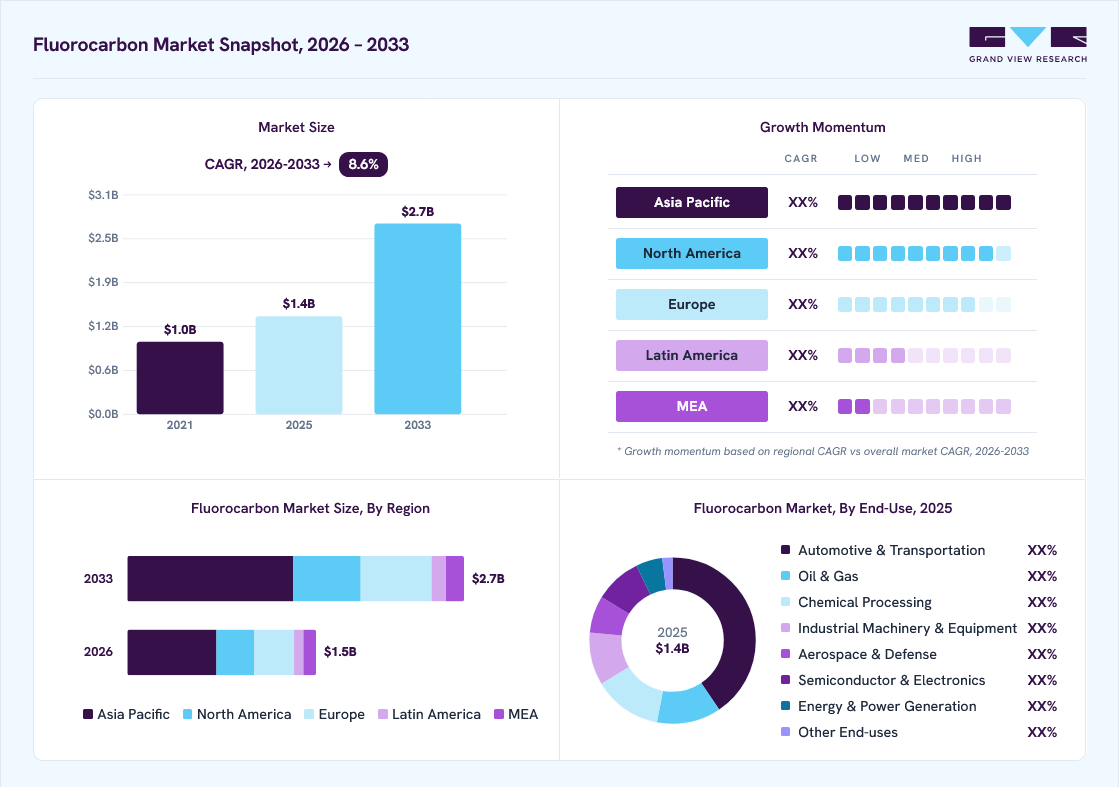
The global fluorocarbon market size was valued at USD 1.4 billion in 2025 and is projected to grow from USD 1.5 billion in 2026 to USD 2.7 billion by 2033, at a CAGR of 8.6% from 2026 to 2033. Asia Pacificdominated the market with the largest revenue share of 46.9% in 2025. The growing demand for fluorocarbon (FKM) elastomers across automotive and transportation, oil and gas, chemical processing, industrial machinery, aerospace and defense, and semiconductor applications is supporting market growth.
Key Market Trends & Insights
- By end use: Automotive & transportation segment dominated with the revenue share of 40.5% in 2025.
Regional Highlights
- Largest regional market: Asia Pacific (46.9% revenue share, 2025)
- By country: India held the largest market share in 2025
Market Size & Forecast
- Market size in 2025: USD 1.4 Billion
- Estimated market size in 2026: USD 1.5 Billion
- Projected market size by 2033: USD 2.7 Billion
- CAGR (2026-2033): 8.6%
These materials enable manufacturers to develop high-performance seals, gaskets, O-rings, hoses, and fluid-handling components that provide excellent thermal stability, chemical resistance, durability, and low compression set. Their ability to maintain sealing performance under extreme temperatures, pressures, aggressive chemicals, fuels, and process fluids is expanding commercial adoption across critical industrial applications.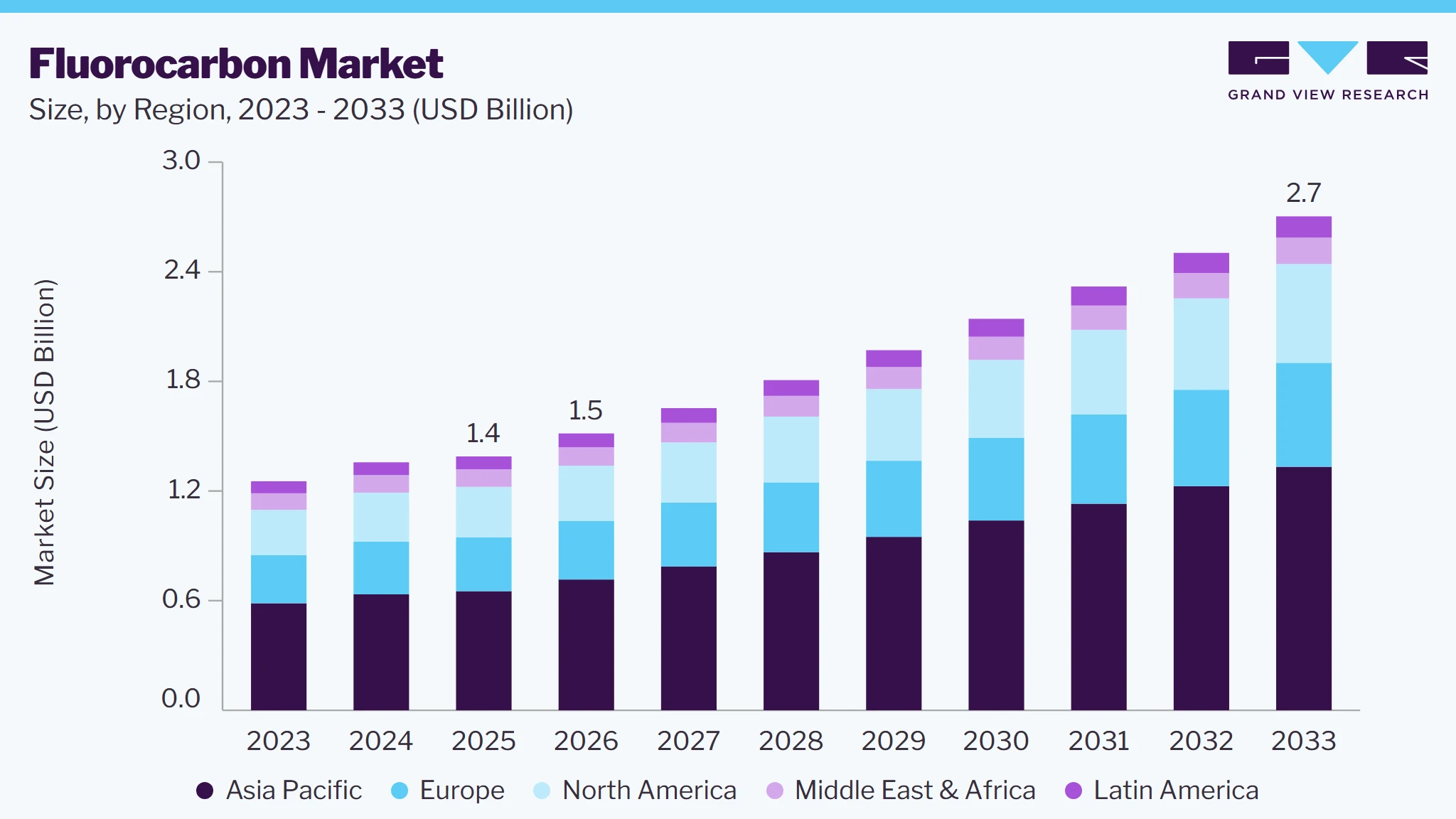
Rapid adoption of advanced FKM technologies is emerging as a key trend in the fluorocarbon market. Manufacturers are increasingly developing fluorosurfactant-free polymerization routes, advanced polymer architectures, peroxide-curable grades, and application-specific formulations that improve sealing reliability and processing consistency. Demand is rising across automotive, aerospace, semiconductor, chemical processing, and high-voltage applications, where thermal resistance, chemical durability, cleaner production chemistry, and long service life are becoming important performance requirements.
Rising regulatory scrutiny of PFAS-containing materials is a major driver for technology development in the fluorocarbon market. REACH, TSCA, and global chemical management frameworks are increasing requirements for chemical control, traceability, emissions management, and regulatory documentation. These pressures are encouraging manufacturers to adopt cleaner polymerization processes, improve impurity control, and develop high-performance FKM grades that maintain critical sealing properties while supporting compliance across automotive, electronics, industrial, and other regulated applications.
Expansion of high-performance and severe-service applications presents a significant opportunity for the fluorocarbon market. Increasing demand from semiconductor manufacturing, automotive electrification, aerospace, chemical processing, and renewable energy is creating opportunities for premium FKM grades with improved temperature resistance, fluid compatibility, flexibility, and durability. In addition, advancements in polymer architecture, compounding, processing aids, and high-purity formulations are enabling manufacturers to improve production efficiency and application performance while supporting long-term price growth.
Market Dynamics
Automotive manufacturing is emerging as a key end user for fluorocarbon (FKM), driven by the need for high-performance sealing materials that withstand elevated temperatures, aggressive fuels, lubricants, and demanding operating conditions. FKM is widely used in O-rings, gaskets, fuel hoses, turbocharger seals, valve stem seals, and transmission components, where thermal stability, chemical resistance, low compression set, and long service life are essential for reliable vehicle performance.
Growing adoption of electric vehicles is further accelerating FKM demand across automotive platforms. Manufacturers are developing advanced FKM grades for battery packs, thermal management systems, electric drive units, charging systems, and high-voltage connectors that require resistance to heat, coolants, lubricants, and electrical environments. Increasing EV production investments across China, India, and Southeast Asia are therefore creating favorable conditions for broader FKM adoption while strengthening demand for localized high-performance elastomer supply chains.
Evolving PFAS regulations are emerging as a key restraint for the market, driven by stricter chemical reporting, environmental monitoring, traceability, and product stewardship requirements. Manufacturers are facing higher compliance costs, capital investments, and longer qualification timelines as Europe, North America, and the Asia Pacific strengthen controls on fluorinated chemistries. These requirements can limit market participation, particularly for small and mid-sized producers, while increasing operating costs across regulated automotive, aerospace, electronics, and industrial applications.
Data center immersion cooling presents a significant market opportunity, driven by rising compute densities and increasing thermal management requirements. Manufacturers are developing specialized fluorocarbon dielectric coolants that provide effective heat transfer, electrical insulation, and chemical stability in high-performance computing environments. These cooling solutions can improve energy efficiency, equipment reliability, and thermal management performance across data centers, while supporting the expansion of artificial intelligence, cloud computing, and high-density server infrastructure.
Market Concentration & Characteristics
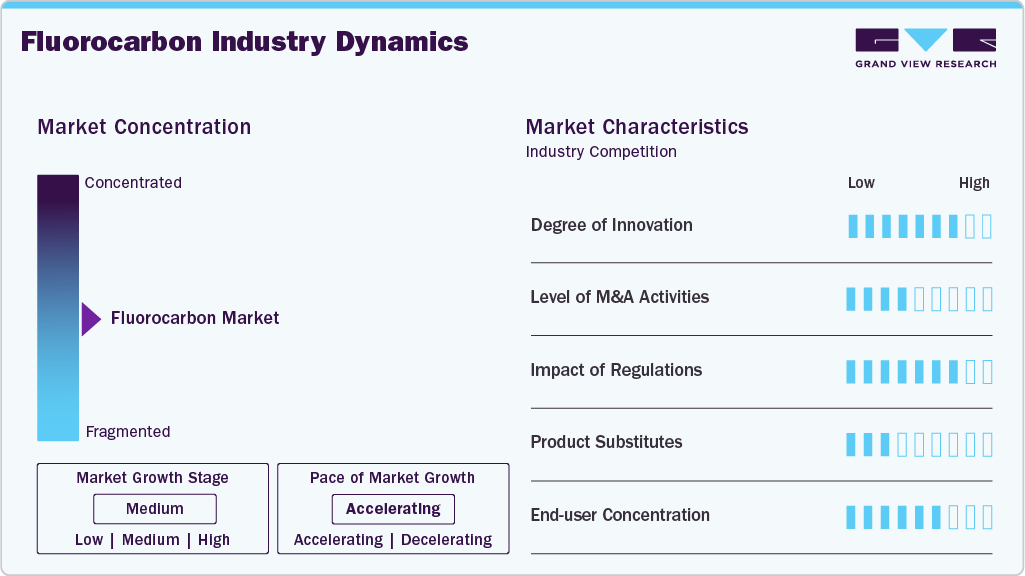
The market growth stage is medium, and growth is accelerating. The market exhibits slight fragmentation, with key players dominating the industry landscape. Major companies such as The Chemours Company, Daikin Industries, Ltd., AGC Inc., Syensqo, Sinochem Lantian Co., Ltd., 3F New Materials Co., Ltd., Gujarat Fluorochemicals Limited, Dyneon, Minnesota Rubber & Plastics, HaloPolymer OJSC, Precision Polymer Engineering Ltd., NOK Corporation, EagleBurgmann, James Walker Group, Datwyler Holding Inc., Zeon Corporation, Shin-Etsu Chemical Co., Ltd. and others play a significant role in shaping the market dynamics. These leading players often drive innovation in the market by introducing new products, technologies, and materials to meet the industry's evolving demands.
Innovation in the fluorocarbon (FKM) industry is driven by advances in polymer architecture, curing systems, and application-specific grade engineering. Copolymers, terpolymers, low-temperature grades, and peroxide-curable formulations are expanding performance capabilities across automotive, aerospace, semiconductor, chemical processing, and industrial applications. These developments enhance thermal stability, chemical resistance, flexibility, and sealing reliability while enabling manufacturers to address increasingly demanding severe-service requirements and capture premium-value applications.
Process efficiency and regulatory compliance also shape market development. Manufacturers are adopting fluorosurfactant-free polymerization, precompounding, improved processing aids, and tighter process controls to reduce environmental exposure, production losses, and batch variability. At the same time, stringent qualification and traceability requirements increase testing and certification costs. However, suppliers with strong R&D capabilities, formulation expertise, and validated product portfolios can strengthen customer retention, accelerate approvals, and expand adoption across mission-critical applications.
Analyst Perspective
The market is expected to transition from volume-led growth toward a more value-driven and application-specific phase over the next 5-10 years, supported by automotive electrification, semiconductor manufacturing, aerospace, chemical processing, energy, and advanced industrial equipment. Demand will increasingly favor premium FKM grades offering higher purity, improved low-temperature flexibility, peroxide curing, plasma resistance, chemical compatibility, and longer service life. Technology development will focus on fluorosurfactant-free polymerization, advanced polymer architectures, process efficiency, and application-specific formulations, while regulatory scrutiny of PFAS will increase compliance costs and accelerate cleaner production practices. Market leaders will differentiate through integrated fluorochemical supply chains, proprietary polymer technologies, global manufacturing capabilities, regulatory readiness, and close collaboration with OEMs and specialized sealing manufacturers. Supply chain volatility in fluorochemical feedstocks, energy costs, capacity additions, pricing pressure, and potential substitution in selected applications will remain key challenges.
End Use Insights
The automotive & transportation segment led the market, accounting for 40.5% of revenue in 2025, and is projected to grow at a 9.1% CAGR from 2026 to 2033. The automotive and transportation segment is gaining traction in the market due to increasing demand for high-performance sealing materials across conventional and electrified vehicles. FKM provides resistance to elevated temperatures, fuels, lubricants, coolants, and aggressive chemicals, supporting applications in engine, fuel, transmission, turbocharger, thermal management, and EV battery systems. Its ability to maintain sealing reliability under demanding conditions enhances vehicle durability, reduces maintenance requirements, and supports broader adoption across automotive platforms.
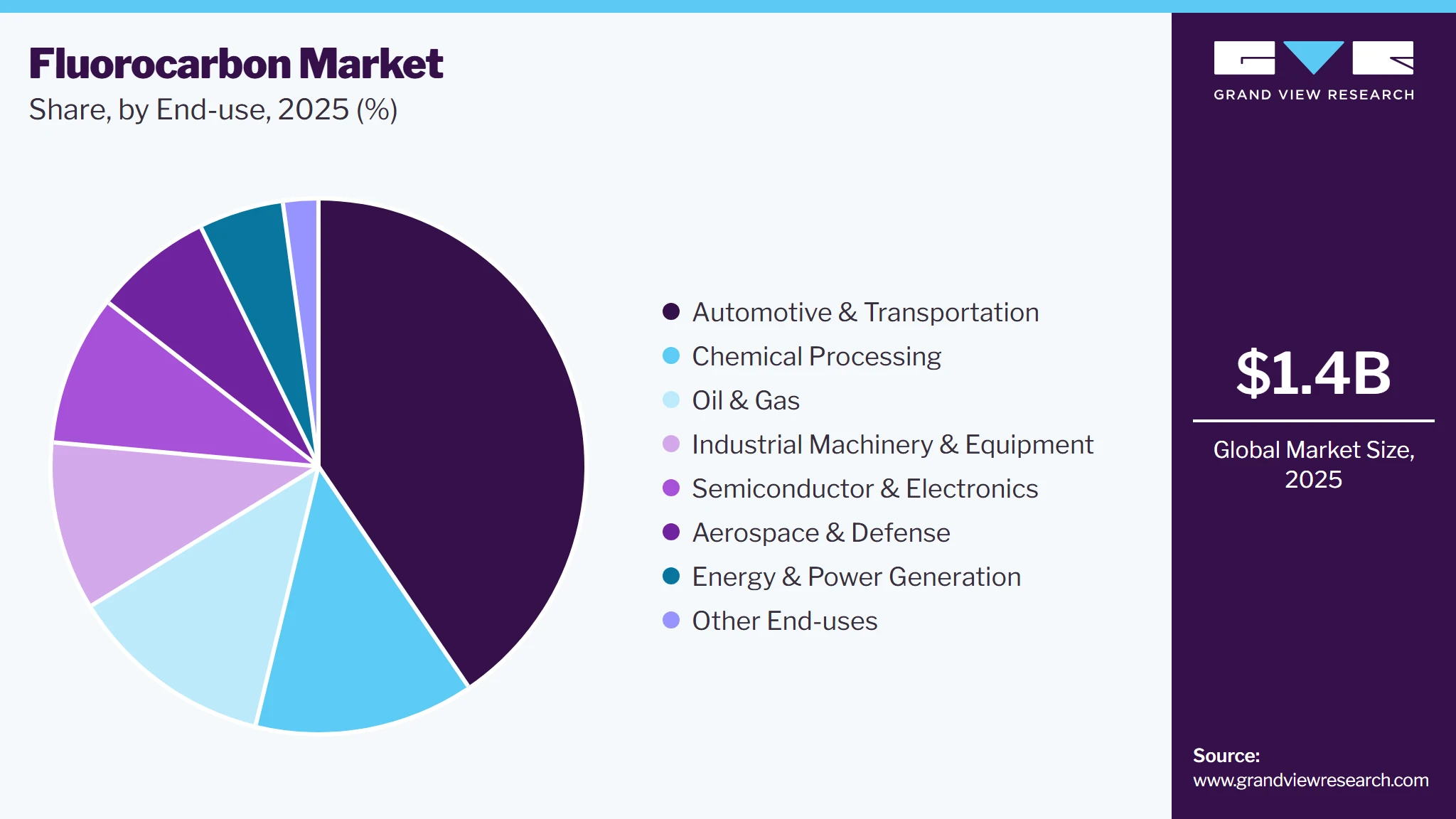
The semiconductor & electronics segment is expected to grow at the fastest CAGR of 10.8% over the forecast period. The semiconductor and electronics segment represents a high-value application area for fluorocarbon (FKM), supported by increasing demand for high-purity and chemically resistant sealing materials. FKM provides reliable performance under plasma exposure, aggressive chemicals, vacuum conditions, and elevated temperatures, supporting applications in wafer fabrication, etching and deposition systems, chemical and gas delivery equipment, and vacuum systems. Growing investments in advanced semiconductors, AI chips, and electronics manufacturing are further accelerating demand for specialized FKM grades.
Regional Insights
The Asia Pacific fluorocarbon market held the largest revenue share of 46.9% in 2025. The region is expected to grow at a CAGR of 9.3% over the forecast period. Rapid expansion of automotive, semiconductor, oil and gas, and industrial manufacturing is supporting the strong market growth across the Asia Pacific. China, India, Japan, and South Korea provide a large manufacturing base, driving demand for FKM in engines, fuel systems, EV thermal management, pumps, valves, and vacuum equipment. Rising semiconductor production, refining activity, and advanced industrial applications are further accelerating regional demand for high-performance sealing materials.

India Fluorocarbon Market Trends
The fluorocarbon market in India is expanding steadily, supported by growing automotive production and increasing investments across refining, petrochemicals, defense, semiconductors, and power infrastructure. Rising vehicle production is strengthening demand for FKM in engines, fuel systems, transmissions, turbochargers, exhaust systems, and EV thermal management. Expanding refining capacity, semiconductor investments, and industrial development are further driving adoption across chemical processing, gas delivery, vacuum equipment, and other demanding applications requiring reliable sealing performance.
North America Fluorocarbon Market Trends
The fluorocarbon market in North America is a key regional market, supported by strong demand from automotive, oil and gas, chemical processing, aerospace, electronics, and industrial manufacturing. Advanced manufacturing infrastructure and stringent performance requirements are driving the adoption of FKM in pumps, valves, compressors, hydraulic systems, and fluid-handling equipment. The material’s chemical resistance, thermal stability, low compression set, and durability support reliable performance across demanding operating environments.
The U.S. fluorocarbon market represents a major contributor to regional growth, supported by large automotive, petroleum, aerospace, defense, and semiconductor industries. High vehicle production, substantial crude oil output, and defense investments are strengthening demand for FKM across engines, fuel systems, drilling equipment, refineries, aerospace systems, and semiconductor equipment. Growing investments in advanced manufacturing and energy infrastructure are further supporting demand for premium sealing solutions requiring long service life and reliability.
Europe Fluorocarbon Market Trends
The fluorocarbon market in Europe is expanding steadily, supported by strong demand from automotive, aerospace, chemical processing, industrial machinery, pharmaceuticals, and semiconductor industries. Advanced manufacturing infrastructure is driving the adoption of FKM in pumps, valves, compressors, hydraulic systems, and precision equipment requiring thermal stability, chemical resistance, and long service life. Growing aerospace and defense investments, semiconductor manufacturing initiatives, vehicle electrification, and clean energy development are further strengthening demand for high-performance sealing solutions across the region.
Latin America Fluorocarbon Market Trends
The fluorocarbon market in Latin America is expanding steadily, supported by strong demand from automotive, mining, oil and gas, chemical processing, and power generation industries. FKM is increasingly used in engines, fuel systems, pumps, valves, compressors, pipelines, and process equipment requiring resistance to heat, fuels, chemicals, and harsh operating conditions. Growing industrial investments, infrastructure modernization, renewable energy development, and demand for reliable sealing solutions are further strengthening regional market growth.
Middle East and Africa Fluorocarbon Market Trends
The fluorocarbon market in MEA is expanding steadily, supported by strong demand from oil and gas, petrochemicals, mining, power generation, water treatment, and industrial manufacturing. FKM is increasingly used in drilling equipment, pipelines, pumps, valves, compressors, refineries, desalination systems, and processing equipment requiring high heat and chemical resistance. Growing investments in LNG, petrochemicals, hydrogen, advanced manufacturing, and infrastructure development are further strengthening demand for durable, high-performance sealing solutions.
Key Fluorocarbon Company Insights
Some of the key players operating in the market include The Chemours Company and
Daikin Industries.
-
The Chemours Company participates in the market through its portfolio of high-performance fluoropolymers and fluoroelastomer materials designed for automotive, aerospace, chemical processing, semiconductor, and industrial applications. Supported by advanced fluorochemical expertise and material innovation, the company provides solutions offering high-temperature resistance, chemical compatibility, durability, and reliable sealing performance, supporting growing demand for high-performance FKM materials across demanding and failure-sensitive applications.
-
Daikin Industries participates in the market through its high-performance fluorinated elastomer technologies designed for automotive, aerospace, chemical processing, and industrial sealing applications. Supported by advanced polymer development and fluorochemical expertise, the company provides FKM solutions offering excellent heat resistance, chemical resistance, low compression set, and durability, supporting growing demand for reliable sealing materials across demanding operating environments and high-performance applications.
Minnesota Rubber & Plastics and Precision Polymer Engineering Ltd. are some of the emerging participants.
-
Minnesota Rubber & Plastics is a manufacturer of engineered sealing solutions serving automotive, medical, industrial, and other demanding applications. Leveraging advanced elastomer formulation, molding, and sealing technologies, the company develops high-performance components that provide chemical resistance, thermal stability, durability, and reliable sealing performance. Its expertise in engineered rubber products supports the adoption of FKM-based sealing solutions across applications requiring consistent performance under harsh operating conditions and extended service intervals.
-
Precision Polymer Engineering Ltd. is a manufacturer focused on high-performance sealing solutions for demanding applications across semiconductor, chemical processing, aerospace, pharmaceutical, and industrial sectors. Leveraging expertise in advanced elastomer formulation and precision engineering, the company develops fluorocarbon-based sealing products that provide chemical resistance, thermal stability, durability, and reliable performance under severe operating conditions. Its product development capabilities support growing adoption of high-performance FKM solutions across critical industrial applications.
Key Fluorocarbon Companies
The following key companies have been profiled for this study on the fluorocarbon market.
-
The Chemours Company
-
Daikin Industries, Ltd.
-
AGC Inc.
-
Syensqo
-
Dongyue Group
-
Shandong Huaxia Shenzhou New Material Co., Ltd.
-
Zhejiang Juhua Co., Ltd.
-
Sinochem Lantian Co., Ltd.
-
3F New Materials Co., Ltd.
-
Gujarat Fluorochemicals Limited
-
Dyneon
-
Minnesota Rubber & Plastics
-
HaloPolymer OJSC
-
Freudenberg Sealing Technologies
-
Trelleborg Sealing Solutions
-
Parker Hannifin Corporation
-
Greene Tweed & Co.
-
Precision Polymer Engineering Ltd.
-
NOK Corporation
-
EagleBurgmann
-
James Walker Group
-
Datwyler Holding Inc.
-
Zeon Corporation
-
Shin-Etsu Chemical Co., Ltd.
Competitive Benchmarking
Operating Strategies
Competitive Edge
Weakness
Mature Players: The Chemours Company, Daikin Industries, Ltd., AGC Inc., Syensqo, Dongyue Group, Shandong Huaxia Shenzhou New Material Co., Ltd., Zhejiang Juhua Co., Ltd., Sinochem Lantian Co., Ltd.
- Broad focus on FKM resins, compounds, and high-performance sealing solutions for automotive, aerospace, chemical processing, semiconductor, and industrial applications.
- Continuous investment in fluorination chemistry, advanced polymer architecture, cleaner production routes, and application-specific formulations.
- Expansion through global customer relationships, technical service, regulatory compliance, and established manufacturing and distribution networks.
- Strong expertise in fluorocarbon chemistry, elastomer formulation, and severe-service sealing applications.
- Established brands, qualified product portfolios, and global commercial reach support strong market access.
- High process know-how and application validation capabilities enable premium positioning and long-term customer relationships.
- High compliance burden from PFAS regulations and tightening chemical restrictions across major markets.
- Capital-intensive manufacturing, emissions control, and process validation can increase operating costs.
- Dependence on automotive, aerospace, semiconductor, and industrial cycles exposes companies to demand volatility and qualification risk.
Emerging Players: Minnesota Rubber & Plastics, Precision Polymer Engineering Ltd.
- Focus on specialized FKM sealing products, engineered components, and custom compound development for critical industrial applications.
- Investment in formulation capability, niche application development, and customer-specific sealing solutions
- Expansion through technical partnerships, targeted end-user segments, and performance-driven product innovation.
- Flexible product development and strong customization capabilities support niche and high-value applications.
- Application-specific engineering and responsive customer support provide differentiation in qualified sealing markets.
- Ability to target specialized industries enables access to premium segments with less direct commodity competition.
- Smaller scale limits manufacturing breadth, global reach, and investment capacity compared with leading fluorochemical producers.
- Dependence on niche applications can constrain diversification and growth across broader FKM value chains.
- Rising regulatory requirements, qualification costs, and raw material dependence may pressure margins and slow expansion.
Recent Developments
-
In August 2025, Chemours and India’s SRF Limited entered into strategic collaboration and supply agreements to expand access to fluoropolymer and fluoroelastomer production capacity in India. The arrangement is intended to strengthen supply availability for essential applications by 2026, supporting demand across high-performance industrial and automotive end uses. This initiative reflects the growing focus on regional capacity expansion and supply chain resilience in the fluorocarbon market.
-
In 2025, Parker Hannifin advanced its FKM technology portfolio by developing specialized materials designed for extreme-temperature sealing applications. The technology addresses the conventional low-temperature performance limitations of FKM while maintaining strong compression-set resistance and sealing reliability. This development enhances the suitability of FKM for demanding automotive, aerospace, industrial, and other severe-service applications where components require consistent performance across broad temperature ranges and long operating cycles.
Fluorocarbon Market Report Scope
Report Attribute
Details
Market size in 2025
USD 1.4 billion
Estimated market size in 2026
USD 1.5 billion
Projected market size by 2033
USD 2.7 billion
Growth rate
CAGR of 8.6% from 2026 to 2033
Historical data
2021 - 2025
Forecast period
2026 - 2033
Quantitative units
Revenue in USD billion, volume in tons, and CAGR from 2026 to 2033
Report coverage
Revenue & volume forecast, competitive landscape, growth factors, and trends
Segments covered
End use, region
Regional scope
North America; Europe; Asia Pacific; CSA; MEA
Country scope
U.S.; Canada; Mexico; Europe; Germany; UK; France; Italy; Spain; China; India; Japan; South Korea; Australia; Brazil; Argentina; Saudi Arabia; UAE; South Africa
Key companies profiled
The Chemours Company; Daikin Industries, Ltd.; AGC Inc.; Syensqo; Dongyue Group; Shandong Huaxia Shenzhou New Material Co., Ltd.; Zhejiang Juhua Co., Ltd.; Sinochem Lantian Co., Ltd.; 3F New Materials Co., Ltd.; Gujarat Fluorochemicals Limited; Dyneon; Minnesota Rubber & Plastics; HaloPolymer OJSC; Freudenberg Sealing Technologies; Trelleborg Sealing Solutions; Parker Hannifin Corporation; Greene Tweed & Co.; Precision Polymer Engineering Ltd.; NOK Corporation; EagleBurgmann; James Walker Group; Datwyler Holding Inc.; Zeon Corporation; Shin-Etsu Chemical Co., Ltd.
Customization scope
Free report customization (equivalent to up to 8 analyst working days) with purchase. Addition or alteration to country, regional & segment scope
Pricing and purchase options
Avail customized purchase options to meet your exact research needs. Explore purchase options
Global Fluorocarbon Market Report Segmentation
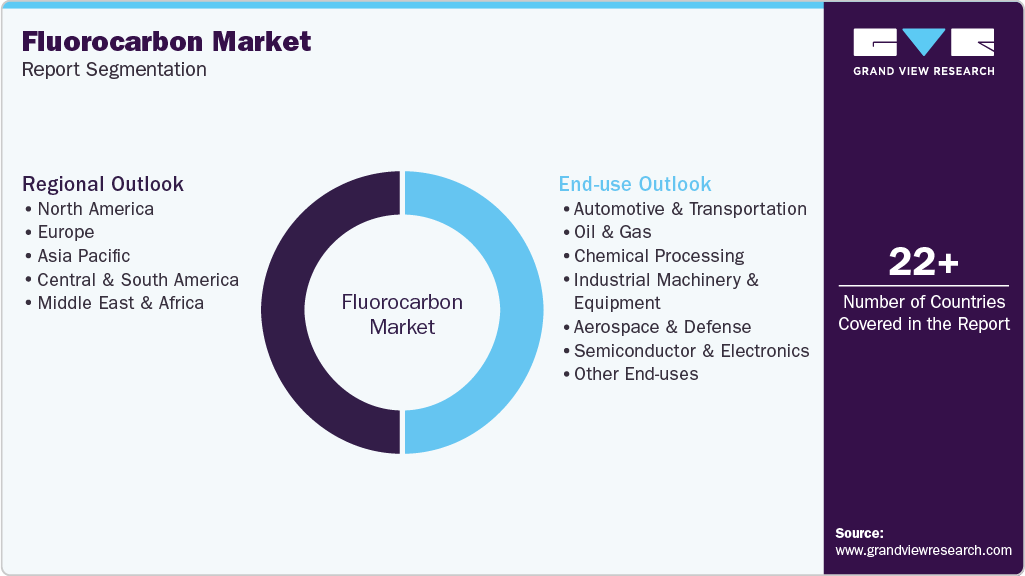
This report forecasts revenue growth at the global, regional, and country levels and provides an analysis of the latest industry trends across sub-segments from 2021 to 2033. For this study, Grand View Research has segmented the global fluorocarbon market report based on end use, and region:
-
End-use Outlook (Volume, Tons; Revenue, USD Million, 2021 - 2033)
-
Automotive & Transportation
-
Engine Systems
-
Fuel Systems
-
Transmission Systems
-
Turbocharger Systems
-
Thermal Management Systems
-
EV Battery & Powertrain Systems
-
Emission Control Systems
-
Other Automotive Applications
-
-
Oil & Gas
-
Upstream Production Systems
-
Midstream Transportation Systems
-
Downstream Refining & Petrochemical Systems
-
LNG & Gas Processing Systems
-
Other Oil & Gas Applications
-
-
Chemical Processing
-
Pumps & Fluid Handling Systems
-
Valves & Flow Control Systems
-
Reactors & Process Vessels
-
Chemical Transfer Systems
-
Other Chemical Processing Applications
-
-
Industrial Machinery & Equipment
-
Hydraulic Systems
-
Pneumatic Systems
-
Pumps & Compressors
-
Industrial Automation Equipment
-
Other Industrial Applications
-
-
Aerospace & Defense
-
Aircraft Engine Systems
-
Fuel Systems
-
Hydraulic & Actuation Systems
-
Environmental Control Systems
-
Other Aerospace & Defense Applications
-
-
Semiconductor & Electronics
-
Wafer Fabrication Equipment
-
Plasma Etching & Deposition Systems
-
Chemical & Gas Delivery Systems
-
Vacuum Systems
-
Display Panel Manufacturing Equipment
-
Other Semiconductor & Electronics Applications
-
-
Energy & Power Generation
-
Conventional Power Generation Systems
-
Renewable Energy Systems
-
Hydrogen Systems
-
Nuclear Power Systems
-
Other Energy Applications
-
-
Other End Uses
-
-
Regional Outlook (Volume, Tons; Revenue, USD Million, 2021 - 2033)
-
North America
-
U.S.
-
Canada
-
Mexico
-
-
Europe
-
Germany
-
UK
-
France
-
Italy
-
Spain
-
-
Asia Pacific
-
China
-
India
-
Japan
-
South Korea
-
Australia
-
-
Central & South America
-
Brazil
-
Argentina
-
-
Middle East & Africa
-
Saudi Arabia
-
UAE
-
South Africa
-
-
Research Methodology
The fluorocarbon marketfigures in this report are based on a proven research process that combines executive interviews with secondary research from proprietary databases, company filings, and recognized regulatory and institutional sources. Market size is built through value-chain sizing—reconciling supply-side and demand-side estimates—and triangulated with bottom-up and top-down approaches. Every estimate passes multiple levels of expert validation before publication, with each Ffluorocarbon (FKM) segment quantified using the revenue-capture definitions in the table below.
Segment Definition
Segment - End Use
Revenue capture definition
Automotive & Transportation
Revenue is captured through fluorocarbon (FKM) used in O-rings, gaskets, fuel hoses, valve stem seals, turbocharger seals, transmission seals, battery systems, and thermal management components. Value is driven by high-temperature resistance, chemical compatibility, low compression set, durability, and long service life. Demand is supported by expanding vehicle production, increasing adoption of electric and hybrid vehicles, and growing requirements for reliable sealing materials across next-generation automotive platforms.
Oil & Gas
Revenue is generated through fluorocarbon (FKM) used in seals, O-rings, gaskets, valves, pumps, and other components exposed to fuels, hydrocarbons, chemicals, and elevated temperatures. Value is driven by chemical resistance, thermal stability, pressure resistance, and durability under demanding operating conditions. Growth is supported by continued oil and gas exploration, refining activities, pipeline infrastructure, and increasing requirements for high-performance sealing materials that improve equipment reliability and reduce maintenance.
Chemical Processing
Revenue is captured through fluorocarbon (FKM) used in seals, gaskets, diaphragms, valve components, pumps, and other equipment operating in chemically aggressive environments. Value is driven by resistance to acids, solvents, fuels, aggressive chemicals, elevated temperatures, and compression set. Demand is supported by expanding chemical production, process equipment investment, and increasing requirements for durable sealing solutions that minimize leakage, equipment downtime, and maintenance across demanding processing applications.
Industrial Machinery & Equipment
Revenue is generated through fluorocarbon (FKM) used in O-rings, gaskets, shaft seals, hydraulic and pneumatic components, pumps, compressors, and industrial equipment. Value is driven by abrasion resistance, thermal stability, chemical resistance, dimensional stability, and long service life. Demand is supported by industrial automation, machinery modernization, manufacturing expansion, and increasing adoption of high-performance sealing materials that improve equipment reliability and support continuous operation under demanding industrial conditions.
Aerospace & Defense
Revenue is captured through fluorocarbon (FKM) used in aircraft engines, fuel systems, hydraulic systems, landing gear, actuators, valves, and defense equipment. Value is driven by exceptional temperature resistance, fuel and chemical compatibility, low compression set, durability, and reliable performance under severe operating conditions. Demand is supported by increasing aircraft production, defense spending, fleet modernization, and growing requirements for lightweight, high-performance sealing materials that provide reliability in mission-critical applications.
Semiconductor & Electronics
Revenue is generated through fluorocarbon (FKM) used in semiconductor processing equipment, vacuum seals, O-rings, chamber components, and electronic manufacturing systems. Value is driven by high purity, plasma resistance, chemical stability, low outgassing, thermal performance, and dimensional consistency. Growth is supported by expanding semiconductor manufacturing capacity, increasing demand for advanced electronic devices, and greater requirements for contamination-controlled sealing materials that maintain process reliability and improve equipment performance.
Energy & Power Generation
Revenue is captured through fluorocarbon (FKM) used in turbines, generators, pumps, valves, transformers, battery systems, and power-generation equipment. Value is driven by heat resistance, chemical compatibility, electrical reliability, durability, and resistance to aggressive fluids and operating environments. Demand is supported by investments in renewable energy, power infrastructure, energy storage, and modernization of conventional power-generation facilities, creating demand for reliable sealing solutions across increasingly complex energy systems.
Other End Uses
Revenue comes from specialized End Uses including pharmaceuticals, food processing, healthcare equipment, marine systems, mining, and general engineering applications. Value is supported by chemical resistance, temperature stability, low compression set, durability, high purity, and application-specific performance. These emerging End Uses create opportunities for advanced FKM formulations, high-purity grades, customized sealing components, and diversified revenue streams across regulated industries and specialized applications requiring reliable performance under demanding operating conditions.
Estimation Model
Layer Name
Key Question
Description
Top-Down Fluorocarbon (FKM) Demand Assessment Layer
What defines market boundaries?
This layer establishes global demand for fluorocarbon (FKM) across automotive & transportation, oil & gas, chemical processing, industrial machinery & equipment, aerospace & defense, semiconductor & electronics, energy & power generation, and other End Uses. Demand is filtered through macro drivers such as vehicle production, electrification, industrialization, semiconductor manufacturing, energy infrastructure investments, aerospace activity, chemical production, regulatory requirements, and increasing demand for high-performance sealing materials. This defines the total addressable market based on FKM consumption and revenue generated across resin, compound, and engineered sealing applications.
End-Use Demand Validation Layer
Where is demand generated?
This layer maps demand across automotive systems, oil and gas equipment, chemical processing facilities, industrial machinery, aircraft and defense systems, semiconductor manufacturing equipment, power-generation systems, and specialty applications. Market sizing is aligned with performance requirements such as high-temperature resistance, chemical compatibility, low compression set, durability, fuel and fluid resistance, plasma resistance, high purity, pressure resistance, and long service life across different FKM applications.
Consumption-to-Revenue Conversion Layer
Who captures market revenue?
This layer translates FKM resin and compound consumption and application volumes into revenue potential using material utilization rates, formulation requirements, grade specifications, fluorine content, curing systems, processing requirements, and application-specific performance standards. Pricing differentials across general-purpose, peroxide-curable, low-temperature, high-purity, and specialty FKM grades are incorporated to estimate value realization across fluorochemical manufacturers, elastomer compounders, sealing-component manufacturers, distributors, OEMs, and downstream industrial users.
Regional Demand Verification Layer
How are assumptions validated?
This layer validates demand distribution across North America, Europe, Asia Pacific, Central & South America, and the Middle East & Africa by assessing automotive production, EV adoption, oil and gas activity, chemical manufacturing, semiconductor investments, aerospace production, power infrastructure, and industrial development. Regional regulatory frameworks, PFAS restrictions, manufacturing capacity, raw material availability, supply chain dynamics, technology adoption, and application-specific qualification requirements are used to verify market penetration assumptions and strengthen forecast reliability.
Delivered Customizations
This report has been delivered with the following In-depth customizations
Client Request
Customization Delivered
Value Adds
Regional segmentation
Provided detailed analysis of the market across North America, Europe, Asia Pacific, Latin America, and the Middle East & Africa, including country-level assessment of automotive, semiconductor, aerospace, chemical processing, and industrial demand.
Identifies high-growth geographies, regional demand drivers, regulatory influences, and market expansion opportunities.
Cross-segmentation
Conducted cross-segmentation analysis across FKM product grades, applications, end-use industries, and regions to identify demand patterns and high-value application clusters.
Enables identification of attractive combinations of product type, application, end-use industry, and geography for targeted business strategies.
Competitive benchmarking
Benchmarked major FKM resin producers and engineered sealing solution providers based on product portfolios, technology capabilities, application coverage, geographic presence, manufacturing capabilities, and strategic positioning.
Provides a clear view of competitive strengths, differentiation factors, market positioning, and areas for competitive advantage.
About the Author(s)
Plastics, Polymers & Resins Research Team
Bulk Chemicals · Plastics, Polymers & ResinsThis report was authored by the plastics, polymers & resins research team at Grand View Research - comprising two research analysts, one senior research analyst, and one industry expert - with specialized expertise in the plastics, polymers & resins segment of the bulk chemicals industry. All findings are based on proprietary bulk chemicals databases, executive interviews, and regulatory analysis, subject to internal peer review prior to publication.
Last Updated:
Speak to Analyst

Customize this report to your needs — add regions, segments, or data points, with 20% free customization.
Or view our licence options:


ISO 9001:2015 & 27001:2022 Certified
We are GDPR and CCPA compliant! Your transaction & personal information is safe and secure. For more details, please read our privacy policy.












