
- Home
- »
- Automotive & Transportation
- »
-
FMCG Logistics Market Size And Share Report, 2026-2033GVR Report cover

FMCG Logistics Market (2026 - 2033)
Size, Share & Trends Analysis By Type (Transportation Services, Warehousing And Distribution Services, Freight Forwarding Services), By Product, By Mode of Transportation, By Logistics Model, By Temperature, By Operation, By Region, And Segment Forecasts
Market Size, 2025
$1.2BMarket Estimate, 2026
$1.3BMarket Forecast, 2033
$2.1BCAGR, 2026–2033
6.9%FMCG Logistics Market Summary
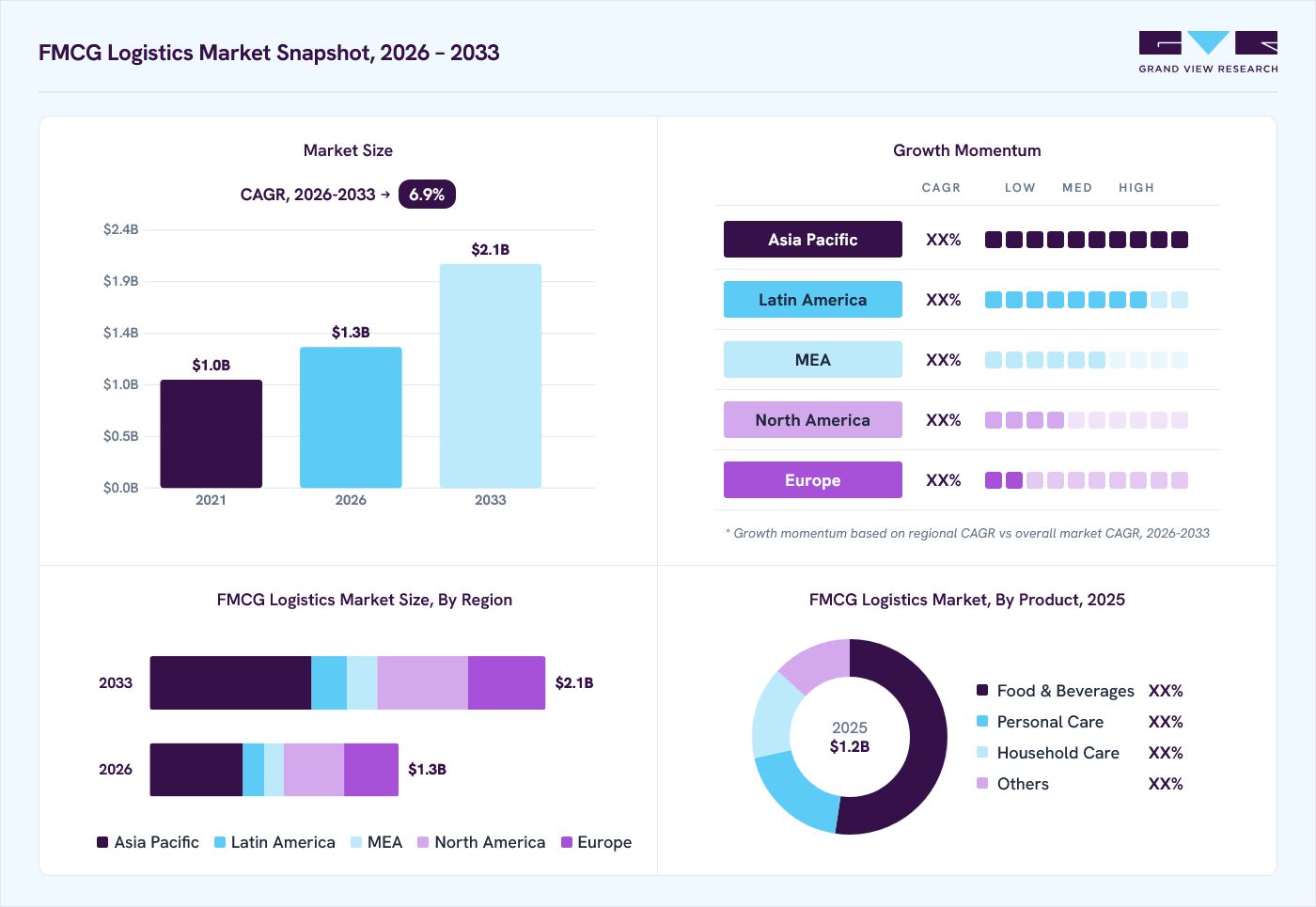
The global FMCG logistics market size was valued at USD 1.2 billion in 2025 and is projected to grow from USD 1.3 billion in 2026 to USD 2.1 billion by 2033, at a CAGR of 6.9% from 2026 to 2033. Asia Pacific dominated the market, accounting for a revenue share of 37.0% in 2025. The increasing demand for FMCG chips across AI, automotive, consumer electronics, and data center applications is driving the growth of the FMCG logistics market.
 Source: Grand View Research, IR Documents, Primary Interviews, Paid DatabasesTo learn more about this report,
 Download Free Sample Report
 Key Market Trends & Insights
- By type: Transportation services segment led the market and accounted for 31.7% of the global revenue in 2025
- By product: Food & beverages segment led the market and accounted for 52.4% of the global revenue in 2025.
- By mode of transportation: Road segment accounted for the largest share of global revenue in 2025.
- By logistic model: 3PL/contract logistics segment accounted for the largest market revenue share in 2025.
Regional Highlights
- Largest regional market: Asia Pacific (37.0% revenue share, 2025)
- By country: Japan held the largest market share in 2025.
Market Size & Forecast
- Market size in 2025: USD 1.2 billion
- Estimated market size in 2026: USD 1.3 billion
- Projected market size by 2033: USD 2.1 billion
- CAGR (2026-2033): 6.9%
Three ways to get this report
Buy it, customize it, or ask a question.Ask an Analyst
A direct answer, usually in 1 working day
- AccessReport author, directly
- Reply timeWithin 1 working day
- No sales callDirect answer only
- FormatEmail reply
- CostFree, no cost
Get the Full Report
What the study covers
- FormatsPDF · Excel · Dashboard
- Timeline2026–2033 annual, 2025 base
- Coverage20+ countries, 5 regions
- Companies10+ key players profiled
Customize the Report
20% free customization
- IncludeCountries, segments, points
- TailorTo your product definition
- ExtendDeeper competitor detail
- OrA fully bespoke study
- Turnaround5–10 working days
The rapid expansion of e-commerce and quick commerce is driving the evolution of FMCG logistics by increasing the need for faster and more agile supply chains. Rising consumer expectations for rapid deliveries are prompting companies to invest in efficient warehousing, real-time inventory management, and last-mile delivery capabilities. This shift is encouraging businesses to strengthen their logistics infrastructure and enhance operational efficiency to support high order volumes and shorter delivery timelines.
The increasing adoption of artificial intelligence (AI) plays a crucial role in transforming the FMCG logistics market. Companies are integrating AI-powered predictive analytics, warehouse automation, and real-time supply chain management solutions to improve demand forecasting, inventory optimization, and efficiency. These advancements enhance operational performance, reduce logistics costs, and improve customer satisfaction, supporting the growth of the FMCG logistics market.
 To learn more about this report, Download Free Sample Report
 The FMCG logistics market is governed by evolving tax regulations and compliance requirements that increase supply chain complexity. Changing documentation and regulatory obligations require logistics providers to strengthen compliance across transportation and distribution operations. Consequently, companies are investing in digital compliance solutions to improve operational efficiency and ensure regulatory adherence.
Maintaining optimal inventory levels remains a key challenge in FMCG logistics due to the high volume and fast movement of products. Fluctuating consumer demand and the short shelf life of many FMCG products make inventory planning more complex, requiring companies to balance product availability with inventory costs constantly. As a result, overstocking increases storage costs and the risk of product expiry, while understocking leads to stock shortages and lost sales. These challenges reduce operational efficiency, increase logistics costs, and hinder the performance of FMCG logistics operations.
Market Dynamics
The rapid expansion of supermarkets, convenience stores, e-commerce platforms, quick commerce, and direct-to-consumer (D2C) channels has significantly increased the complexity of FMCG distribution networks. Manufacturers are required to replenish inventory across multiple sales channels while maintaining high product availability, shorter delivery windows, and optimized inventory levels. Consumers increasingly expect same-day or next-day delivery of everyday essentials, compelling FMCG companies to redesign their logistics operations to achieve greater speed and flexibility.
FMCG logistics providers address these challenges by integrating transportation management systems, warehouse management systems, automated fulfillment centers, and route optimization technologies into distribution operations. These solutions improve inventory visibility, reduce delivery lead times, optimize fleet utilization, and enable seamless order fulfillment across diverse retail channels. As omnichannel retail continues to expand globally, demand for specialized FMCG logistics services is expected to accelerate, supporting sustained market growth.
FMCG logistics operations involve significant transportation expenses, warehouse operating costs, labor requirements, fuel consumption, packaging materials, and investments in digital technologies. Rising fuel prices, labor shortages, inflationary pressures, and increasing warehouse rental costs further elevate logistics expenditures. Since FMCG products typically operate on relatively thin profit margins, manufacturers and distributors often face challenges in absorbing continuously rising logistics costs.
The financial burden is particularly significant for small and medium-sized FMCG manufacturers, regional distributors, and emerging brands that operate with limited logistics budgets. Developing economies with fragmented transportation infrastructure and lower warehouse automation levels are also more affected by cost pressures. These challenges may delay technology adoption, reduce outsourcing opportunities, and limit investments in advanced logistics capabilities, thereby slowing overall market expansion.
Rapid advancements in artificial intelligence, predictive analytics, cloud computing, IoT, robotics, and digital twins are creating significant opportunities for the FMCG logistics market. Increasing supply chain complexity requires logistics providers to make faster operational decisions based on real-time demand, inventory levels, weather conditions, and transportation constraints. Digital transformation initiatives across retail and manufacturing sectors are further accelerating investments in intelligent logistics platforms.
AI-powered demand forecasting, automated warehouse operations, predictive route optimization, and real-time shipment visibility enable logistics providers to improve delivery accuracy while reducing operational costs. Vendors offering integrated digital logistics platforms, warehouse automation, cloud-based transportation management systems, and analytics-driven inventory optimization are well-positioned to capitalize on this opportunity. As supply chains become increasingly data-driven, digital logistics solutions are expected to become a key competitive differentiator across the FMCG ecosystem.
Market Concentration & Characteristics
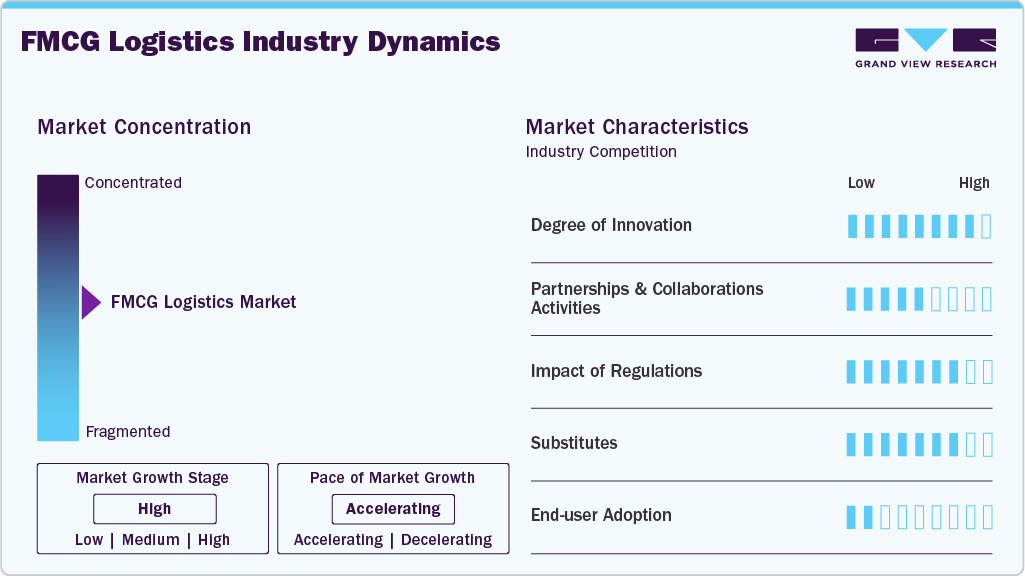
The FMCG logistics market is moderately fragmented due to the presence of numerous global logistics providers, regional transportation companies, warehousing operators, and specialized supply chain service providers competing across different logistics functions. Companies are actively focusing on expanding transportation networks, strengthening warehousing and distribution capabilities, integrating digital logistics solutions, and offering value-added services to enhance supply chain efficiency. The growing demand for faster deliveries, inventory optimization, and omnichannel fulfillment is further encouraging logistics providers to invest in advanced technologies and expand their service portfolios.
 To learn more about this report, Download Free Sample Report
 Fragmentation is also driven by the presence of regional logistics providers that offer cost-effective and localized distribution services alongside global companies such as DHL Group, Kuehne+Nagel, A.P. Moller-Maersk, GEODIS, and C.H. Robinson Worldwide, Inc. Market participants primarily compete on network coverage, service reliability, warehouse infrastructure, transportation capabilities, technology integration, and strategic partnerships rather than on market dominance, thereby maintaining the moderately fragmented structure of the FMCG logistics market.
Analyst Perspective
The FMCG logistics market continues to evolve as manufacturers and retailers prioritize faster fulfillment, greater inventory visibility, and resilient supply chains. Digital technologies, including AI, warehouse automation, IoT-enabled asset tracking, and predictive analytics, are transforming logistics operations and improving efficiency across transportation and warehousing networks. Investment is increasingly directed toward smart distribution centers, cold-chain infrastructure, and integrated logistics platforms that support omnichannel retail. Competition is shifting beyond transportation capacity toward technology capabilities, end-to-end service integration, and value-added logistics offerings, positioning digitally enabled providers for stronger long-term growth.
Type Insights
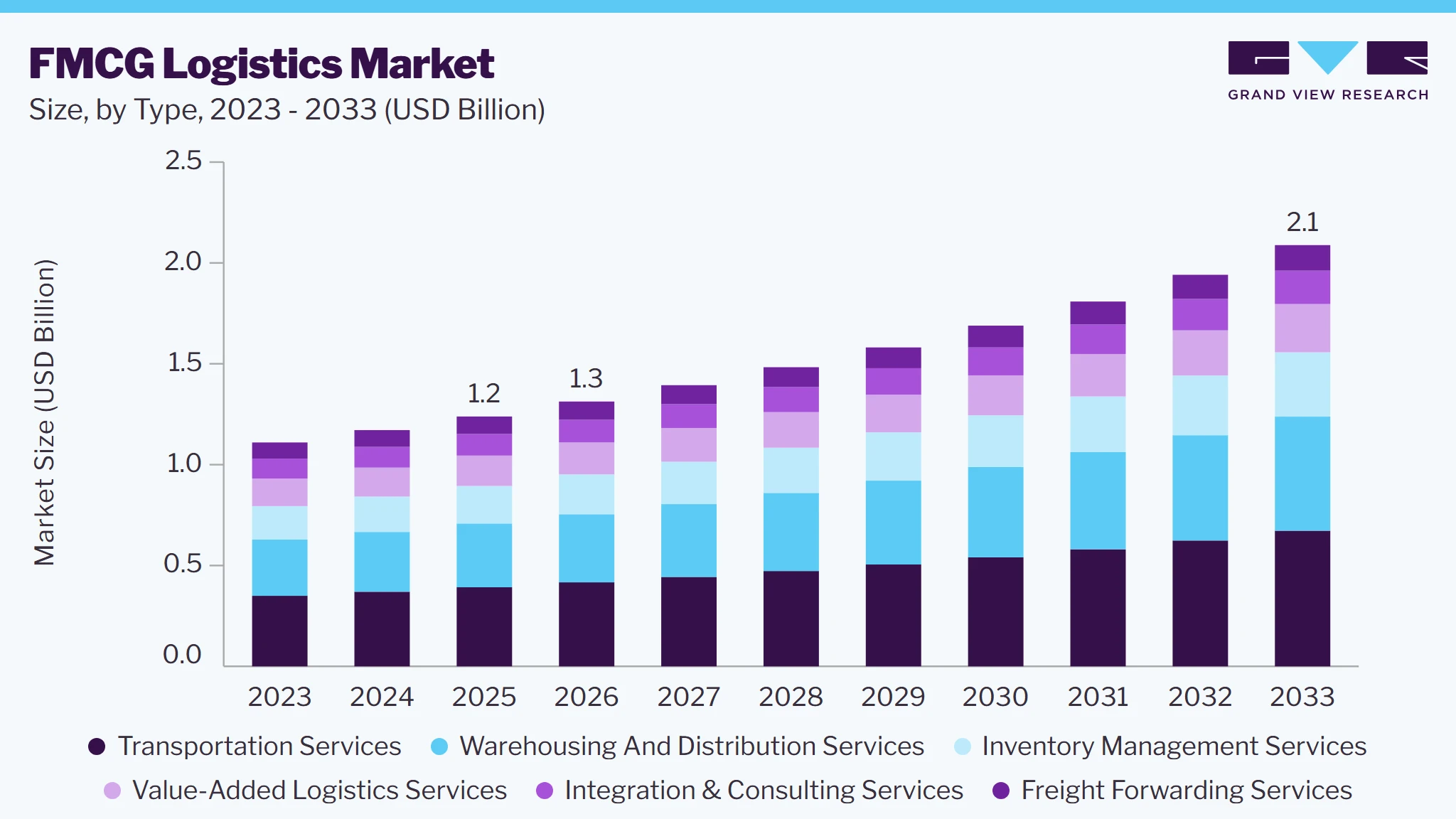
Based on type, the transportation services segment accounted for 31.7%, the largest share of global revenue in 2025. The rapid growth of e-commerce, quick-commerce, and organized retail is increasing the need for faster and more reliable transportation of FMCG products. Logistics providers are enhancing road, rail, air, and ocean transportation through route optimization, dedicated fleets, and real-time tracking, enabling quicker deliveries and more efficient supply chain operations, thereby driving the growth of transportation services.
The warehousing and distribution services segment is projected to grow at the fastest CAGR over the forecast period. The increasing demand for efficient warehouse operations and order fulfillment is driving the growth of the warehousing and distribution services segment. As FMCG companies manage growing product volumes, the need for efficient warehousing and inventory handling continues to increase. Furthermore, logistics providers are expanding warehouse capacity and adopting warehouse management systems (WMS) and automation technologies to improve operational efficiency and support seamless product flow.
Product Insights
Based on product, the food & beverages segment accounted for 52.4%, the largest share of global revenue in 2025, driven by evolving food safety and traceability regulations across global markets. Regulatory initiatives, including the implementation of the U.S. FDA's Food Safety Modernization Act (FSMA) Rule 204, are encouraging food manufacturers and logistics providers to strengthen end-to-end supply chain visibility. Moreover, logistics operators are investing in temperature monitoring, digital traceability systems, and IoT-enabled tracking technologies to improve regulatory compliance, maintain product integrity, and reduce food loss during transportation.
The personal care product segment is projected to grow at the fastest CAGR over the forecast period. The increasing demand for premium skincare, cosmetics, and clinically formulated beauty products is driving the growth of the personal care segment. As these products require controlled storage conditions and faster delivery to maintain product quality, logistics providers are expanding climate-controlled warehousing and urban fulfillment centers. These investments are improving last-mile delivery efficiency and supporting the growing direct-to-consumer (DTC) and omnichannel distribution of personal care products.
Mode of Transportation Insights
Based on mode of transportation, the road segment led the market and accounted for the global revenue in 2025. The growing product distribution is driving the growth of the road transportation segment. Road transport offers flexible door-to-door delivery and efficiently supports both full truckload (FTL) and less-than-truckload (LTL) shipments. Its ability to provide timely last-mile deliveries and faster transportation over short and medium distances makes it the preferred mode for FMCG logistics.
The ocean segment is projected to grow at the fastest CAGR over the forecast period. The increasing volume of international FMCG trade is driving the ocean transportation segment. This segment provides a cost-effective solution for transporting large volumes of packaged foods, beverages, and household products across global markets. Its ability to handle bulk cargo at lower transportation costs makes it the preferred mode for international FMCG logistics.
Logistics Model Insights
Based on the logistics model, the 3PL/ contract logistics segment accounted for the largest share of global revenue in 2025. The growing use of digital supply chain solutions is accelerating the adoption of 3PL services. Logistics providers are integrating warehouse management systems (WMS), transportation management systems (TMS), real-time tracking, and analytics platforms to improve visibility and operational performance. These capabilities are encouraging FMCG companies to shift toward technology-driven logistics.
The 4PL/lead logistics segment is projected to grow at the fastest CAGR over the forecast period. The increasing complexity of FMCG distribution networks is increasing the adoption of 4PL/Lead Logistics services. FMCG companies are increasingly partnering with 4PL providers to integrate multiple logistics functions, optimize transportation networks, and manage supply chain operations through advanced technologies and analytics. These solutions help reduce logistics costs, improve coordination, and enable companies to achieve more flexible and efficient supply chain management.
Temperature Insights
Based on temperature, the ambient segment accounted for the largest share of global revenue in 2025. The increasing demand for shelf-stable FMCG products is supporting the growth of the ambient temperature segment. Products such as packaged foods, beverages, personal care items, and household care products can be stored and transported under standard conditions, reducing the need for temperature-controlled logistics. As FMCG companies expand their distribution networks, logistics providers are enhancing ambient warehousing and transportation capabilities to ensure efficient product movement and availability.
The chilled segment is projected to grow at the fastest CAGR over the forecast period. The increasing demand for fresh and perishable FMCG products is driving the growth of the chilled temperature segment. Rising consumption of dairy products, beverages, ready-to-eat meals, and other temperature-sensitive goods is increasing the need for controlled-temperature transportation and storage to maintain product quality and extend shelf life. Moreover, logistics providers are expanding refrigerated warehousing and chilled transportation capabilities to support efficient distribution.
Operation Insights
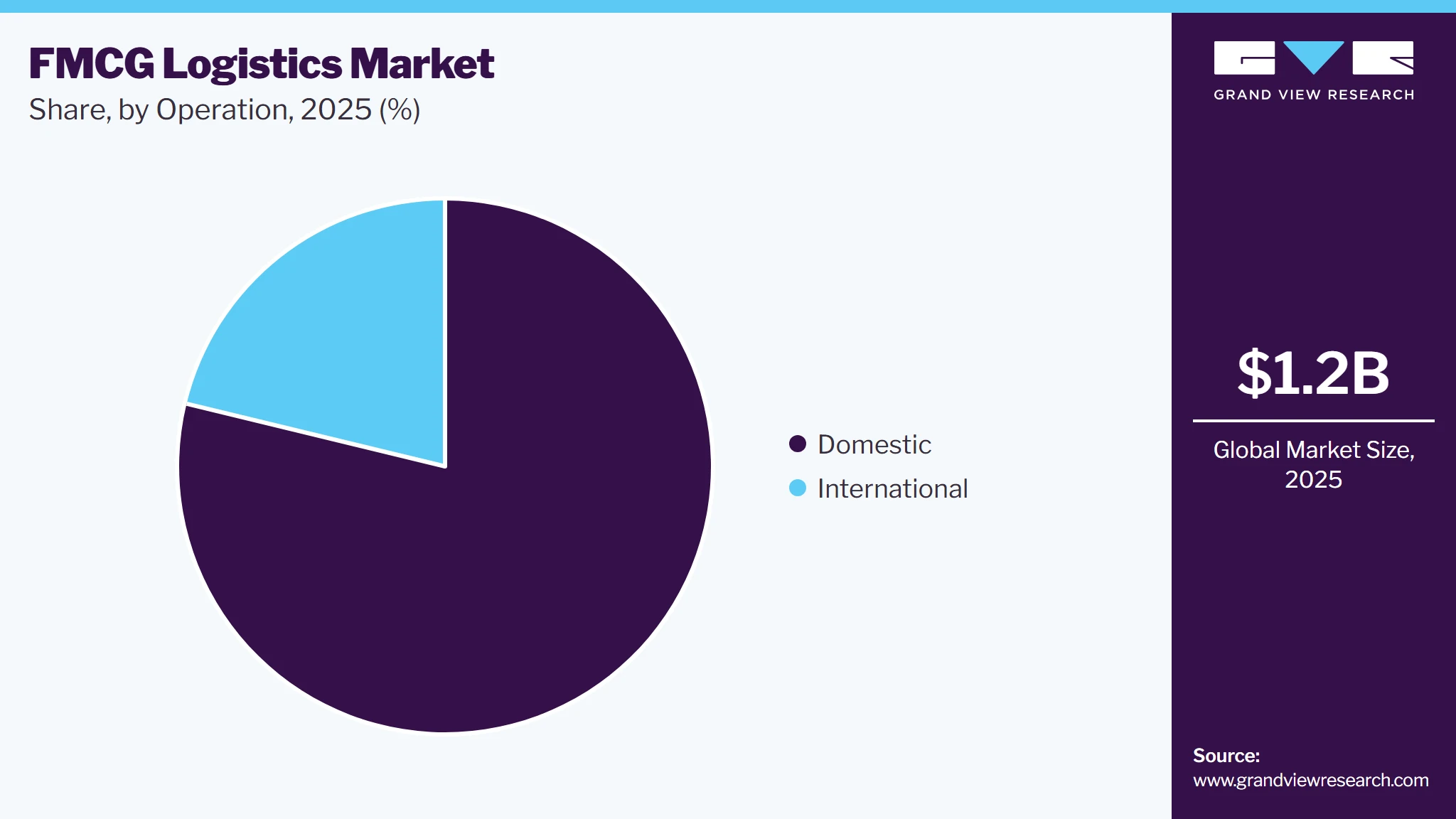
Based on operations, the domestic segment accounted for the largest market revenue share in 2025. The increasing demand for faster product replenishment and wider distribution networks is driving the growth of the domestic segment. Growth in food & beverages, personal care, and household care products is increasing the need for efficient domestic transportation, warehousing, and distribution services. In addition, digital logistics solutions such as real-time tracking and inventory management are improving supply chain efficiency and shipment visibility.
 To learn more about this report, Download Free Sample Report
 The international segment is projected to grow at the fastest CAGR over the forecast period. The increasing globalization of FMCG supply chains and cross-border trade is driving the growth of the international segment. As companies expand global distribution networks for food & beverages, personal care, and household products, the demand for efficient international transportation and freight management solutions is increasing. Additionally, logistics providers support businesses in managing customs compliance and complex global supply chain operations.
Regional Insights
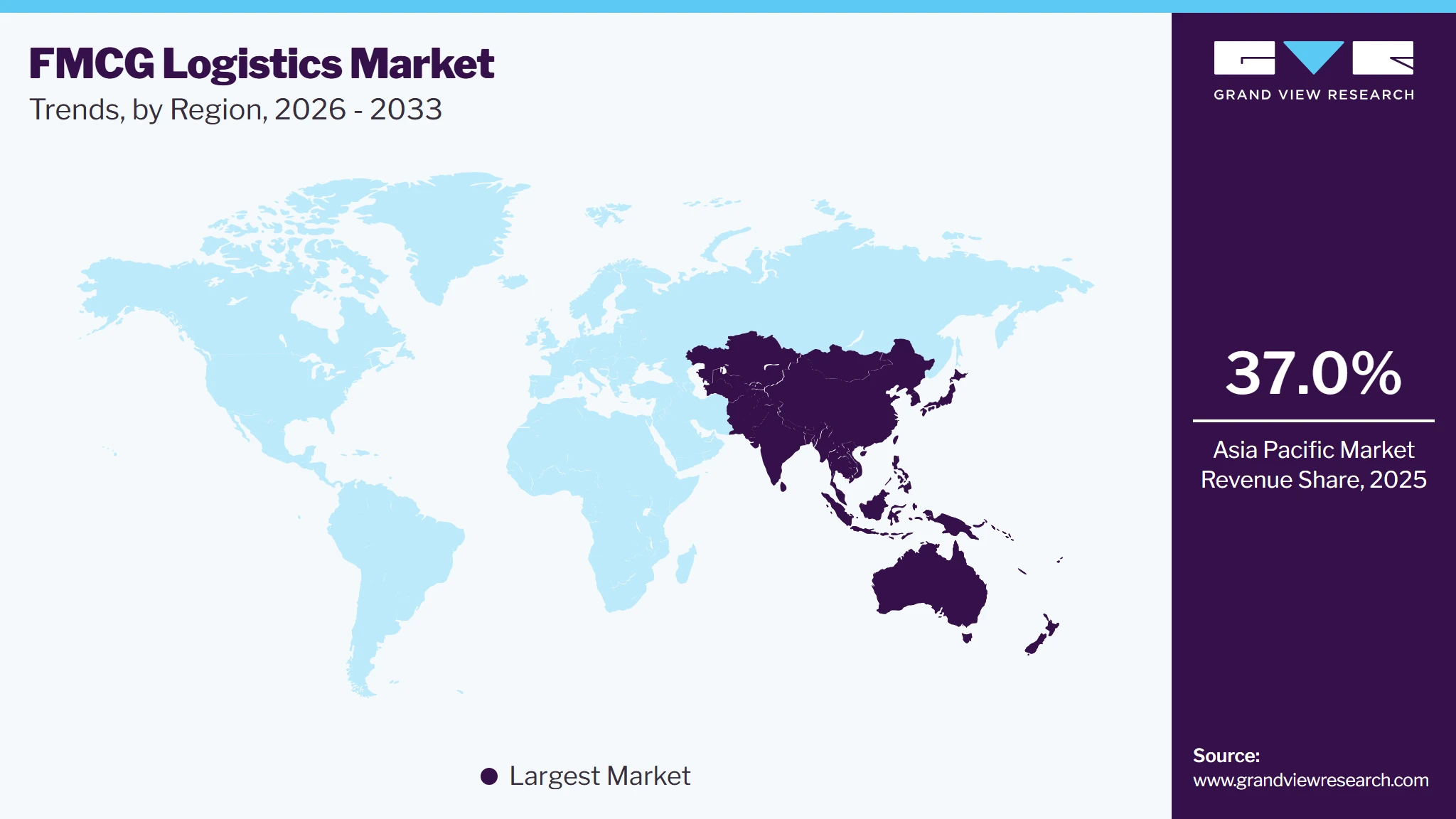
The Asia Pacific FMCG logistics industry led the global market and accounted for 37.0% of the global revenue in 2025 and is expected to register the highest growth from 2026 to 2033. The Asia-Pacific region is becoming one of the fastest-growing consumer markets as household spending continues to rise. The increasing purchase of everyday consumer goods is driving demand across the FMCG sector and supporting market expansion.
 To learn more about this report, Download Free Sample Report
 The FMCG logistics industry in China held a dominant share in the Asia Pacific market. The increasing consumption of FMCG products and the expansion of retail and e-commerce channels are driving the growth of the FMCG logistics market in China. The rising demand for food, beverages, personal care, and household products is increasing the need for efficient transportation, warehousing, inventory management, and distribution solutions to support evolving consumer purchasing patterns.
The Japan FMCG logistics industry is expected to grow at a significant CAGR over the forecast period. The expansion of automated logistics infrastructure is supporting the growth of FMCG logistics in Japan. Rising labor shortages and increasing demand for faster product delivery are encouraging companies to adopt warehouse automation, robotics, and digital inventory management systems. These technologies are improving operational efficiency, order accuracy, and supply chain visibility across FMCG distribution networks.
North America FMCG Logistics Market Trends
The FMCG logistics industry in North Americais expected to grow at a 5.9% CAGR over the forecast period. The increasing investment in advanced cold-chain infrastructure is driving the North America market. Logistics providers are expanding temperature-controlled warehousing and distribution networks to meet the rising demand for fresh and frozen food, online grocery deliveries, and stricter food safety and traceability regulations. These investments improve storage efficiency, product quality, and supply chain reliability across the region.
U.S. FMCG Logistics Market Trends
TheFMCG logistics industry in the U.S.is anticipated to register significant growth from 2026 to 2033. The increasing adoption of online grocery shopping is driving the U.S. market. The rapid growth in e-grocery orders is boosting demand for advanced warehousing, transportation, and last-mile delivery solutions to enable faster and more efficient fulfillment.
Europe FMCG Logistics Market Trends
TheFMCG logistics industry in Europe is poised for significant growth from 2026 to 2033. Growing consumer preference for trusted European FMCG brands is driving demand for efficient logistics services across the region. Established brands such as Nestlé, L’Oréal, and Henkel benefit from strong consumer loyalty and widespread retail presence, increasing the need for reliable transportation, warehousing, inventory management, and distribution networks. The expansion of these brands across supermarkets, e-commerce platforms, and international markets is further supporting the growth of FMCG logistics services in Europe.
The UK FMCG logistics industry is influenced by strict food safety, storage, and transportation regulations. Compliance requirements related to product traceability, temperature monitoring, and hygiene standards are encouraging logistics providers to enhance warehousing and transportation processes. These regulations are driving investments in advanced tracking systems and compliant cold chain solutions for food and beverage distribution.
The FMCG logistics industry in Germany held a substantial share of the Europe market in 2025. The growing focus on sustainability is shaping the FMCG logistics market in Germany. Companies are increasingly adopting low-emission transportation, energy-efficient warehouses, and optimized delivery networks to reduce environmental impact. This trend is encouraging logistics providers to invest in green technologies and sustainable supply chain solutions while supporting the efficient distribution of FMCG products.
Key FMCG Logistics Company Insights
Key players operating in the FMCG logistics market include A.P. Moller - Maersk, C.H. Robinson Worldwide, Inc., GEODIS, Kuehne+Nagel, XPO, Inc., and DHL Group, among others. Major players are heavily investing in digital logistics platforms, automated warehousing solutions, and integrated supply chain capabilities to improve operational efficiency and shipment visibility. The focus is on developing flexible, scalable, and technology-driven logistics solutions that support the growing demand for efficient FMCG manufacturing, distribution, and last-mile delivery networks.
-
DHL Group is a global logistics company that connects people and markets while enabling international trade worldwide. The company’s strategy focuses on driving sustainable growth by enhancing global logistics capabilities through innovation, digital transformation, and long-term value creation across all core business divisions. The company provides collaborative logistics solutions for fast-moving consumer goods through optimized product portfolios, agile operations, and multi-channel distribution to improve speed-to-market and cost efficiency.
-
C.H. Robinson Worldwide, Inc. is a global third-party logistics (3PL) company that helps move goods across the world and redefine supply chains using a combination of human expertise and technology. The company's strategy is to grow market share and profitability by building Lean, AI-enabled supply chains that combine advanced technology with logistics expertise to deliver efficient, scalable global solutions. The company provides logistics solutions for high-volume FMCG products with predictable demand, enabling efficient and reliable transportation and distribution across supply chains.
Key FMCG Logistics Companies
The following key companies have been profiled for this study on the FMCG logistics market:
-
A.P. Moller - Maersk
-
C.H. Robinson Worldwide, Inc.
-
GEODIS
-
Kuehne+Nagel
-
XPO, Inc.
-
DHL Group
-
GXO Logistics, Inc.
-
Ryder System, Inc.
-
Hellmann Worldwide Logistics
-
FM Global Logistics
Competitive Benchmarking
Operating Strategies
Competitive Edge
Weaknesses
Mature Players: A.P. Moller - Maersk, GEODIS., Kuehne+Nagel, DHL Group
- Mature players in the FMCG logistics market are focusing on expand global transportation and warehousing networks, invest in automation, digital supply chain platforms, contract logistics, and end-to-end integrated logistics services.
- Mature players gain a competitive advantage through strong global presence, extensive multimodal logistics networks, broad FMCG customer base, advanced technology capabilities, and comprehensive service portfolios.
- These companies often face challenges related to high operating costs due to their extensive transportation fleets, warehouse networks, and investments in advanced logistics technologies. Their global operations also involve managing complex supply chains across multiple countries while complying with different trade and regulatory requirements.
Emerging Players: GXO Logistics, Inc., Ryder System, Inc., FM Global Logistics
- Emerging players in the FMCG logistics market are focus on warehouse automation, regional expansion, specialized contract logistics, e-commerce fulfilment, and customer-specific logistics solutions.
- Emerging players gain market traction through strong expertise in contract logistics, flexible service offerings, technology-enabled warehouse operations, and growing presence in regional.
- Emerging players face limitations due to smaller global presence and fewer transportation and warehouse facilities than established companies. Their comparatively lower brand recognition and narrower multimodal logistics networks can also reduce their competitiveness in international markets.
Recent Developments
-
In May 2025, GXO Logistics, Inc. partnered with Blue Yonder Group, Inc., a provider of digital supply chain transformation, through a global multi-year strategic agreement to deploy advanced warehouse management and end-to-end logistics software solutions. The partnership aims to enhance warehouse efficiency, improve inventory visibility, enable real-time supply chain management, and strengthen technology-enabled logistics capabilities across multiple industries, including FMCG.
-
In November 2025, A.P. Moller - Maersk launched the Maersk Mega Distribution Centre (DC) in Malaysia, expanding its contract logistics capabilities across the Asia-Pacific region. The facility strengthens FMCG warehousing, distribution, inventory management, and last-mile delivery through advanced automation and digital warehouse technologies.
FMCG Logistics Market Report Scope
Report Attribute
Details
Market size in 2025
USD 1.2 billion
Estimated market size in 2026
USD 1.3 billion
Projected market size by 2033
USD 2.1 billion
Growth rate
CAGR of 6.9% from 2026 to 2033
Base year for estimation
2025
Historical data
2021 - 2024
Forecast period
2026 - 2033
Quantitative units
Revenue in USD billion and CAGR from 2026 to 2033
Report coverage
Revenue forecast, company ranking, competitive landscape, growth factors, and trends
Segments covered
Type, product, mode of transportation, logistics model, temperature, operation, region
Regional scope
North America; Europe; Asia Pacific; Latin America; MEA
Country scope
U.S.; Canada; Mexico; Germany; UK; France; China; Japan; India; South Korea; Australia; Brazil; Kingdom of Saudi Arabia (KSA); UAE; South Africa
Key companies profiled
A.P. Moller - Maersk; C.H. Robinson Worldwide, Inc.; GEODIS; Kuehne+Nagel; XPO, Inc.; DHL Group; GXO Logistics, Inc.; Ryder System, Inc.; Hellmann Worldwide Logistics; FM Global Logistics
Customization scope
Free report customization (equivalent up to 8 analysts working days) with purchase. Addition or alteration to country, regional & segment scope.
Pricing and purchase options
Avail customized purchase options to meet your exact research needs. Explore purchase options
Global FMCG Logistics Market Report Segmentation
The report forecasts revenue growth at global, regional, and country levels and provides an analysis of the latest industry trends in each of the sub-segments from 2021 to 2033. For this study, Grand View Research has segmented the global FMCG logistics market report based on type, product, mode of transportation, logistics model, temperature, operation, and region.
-
Type Outlook (Revenue, USD Billion, 2021 - 2033)
-
Transportation Services
-
Warehousing and Distribution Services
-
Freight Forwarding Services
-
Inventory Management Services
-
Value-Added Logistics Services
-
Integration & Consulting Services
-
-
Product Outlook (Revenue, USD Billion, 2021 - 2033)
-
Food & Beverages
-
Personal Care
-
Household Care
-
Others
-
-
Mode of Transportation Outlook (Revenue, USD Billion, 2021 - 2033)
-
Road
-
Ocean
-
Air
-
Rail
-
-
Logistics Model Outlook (Revenue, USD Billion, 2021 - 2033)
-
3PL/Contract Logistics
-
4PL/Lead Logistics
-
Others
-
-
Temperature Outlook (Revenue, USD Billion, 2021 - 2033)
-
Ambient
-
Chilled
-
Frozen
-
-
Operation Outlook (Revenue, USD Billion, 2021 - 2033)
-
Domestic
-
International
-
-
Regional Outlook (Revenue, USD Billion, 2021 - 2033)
-
North America
-
U.S.
-
Canada
-
Mexico
-
-
Europe
-
Germany
-
UK
-
France
-
-
Asia Pacific
-
China
-
India
-
Japan
-
South Korea
-
Australia
-
-
Latin America
-
Brazil
-
-
Middle East & Africa (MEA)
-
UAE
-
Kingdom of Saudi Arabia (KSA)
-
South Africa
-
-
Research Methodology
The FMCG logistics marketfigures in this report are based on a proven research process that combines executive interviews with secondary research from proprietary databases, company filings, and recognized regulatory and institutional sources. Market size is built through value-chain sizing—reconciling supply-side and demand-side estimates—and triangulated with bottom-up and top-down approaches. Every estimate passes multiple levels of expert validation before publication, with eachFMCG logistics segment quantified using the revenue-capture definitions in the table below.
Segment Definition
Segment - Type
Revenue capture definition
Transportation Services
The segment revenue is generated from road, rail, air, and ocean transportation of FMCG products, fleet operations, freight movement, last-mile delivery, express transportation, and dedicated transportation contracts.
Warehousing and Distribution Services
The segment revenue is generated from storage, warehouse leasing, inventory handling, order fulfillment, cross-docking, picking and packing, distribution center operations, and outbound distribution services.
Freight Forwarding Services
The segment revenue is generated from freight booking, shipment consolidation, customs brokerage, documentation, multimodal transportation coordination, international forwarding, and cargo management services.
Inventory Management Services
The segment revenue is generated from inventory monitoring, stock optimization, replenishment planning, warehouse inventory control, demand forecasting support, and inventory visibility solutions.
Value-Added Logistics Services
The segment revenue is generated from labeling, packaging, kitting, repacking, product customization, reverse logistics, returns management, quality inspection, and promotional display preparation.
Integration & Consulting Services
The segment revenue is generated from supply chain consulting, logistics network design, digital transformation projects, WMS/TMS implementation, process optimization, systems integration, and managed logistics consulting services.
Segment - Product
Revenue capture definition
Food & Beverages
The segment revenue is generated from logistics services supporting packaged foods, dairy products, beverages, frozen foods, fresh foods, confectionery, snacks, bakery products, and other food items.
Personal Care
The segment revenue is generated from logistics services for cosmetics, skincare products, haircare products, oral care products, fragrances, hygiene products, and grooming products.
Household Care
The segment revenue is generated from logistics services supporting detergents, cleaning agents, dishwashing products, home disinfectants, air fresheners, tissue products, and household maintenance products.
Others
The segment revenue is generated from logistics services supporting pet care products, baby care products, tobacco products, stationery, and other non-food FMCG products.
Segment - Mode of Transportation
Revenue capture definition
Road
The segment revenue is generated from truck transportation, local distribution, regional deliveries, long-haul trucking, and last-mile delivery services.
Ocean
The segment revenue is generated from international sea freight, container shipping, bulk cargo transportation, port logistics, and ocean freight forwarding.
Air
The segment revenue is generated from air cargo transportation, express freight, urgent shipments, airport logistics, and time-sensitive FMCG transportation.
Rail
The segment revenue is generated from rail freight transportation, intermodal logistics, bulk FMCG movement, and long-distance inland transportation.
Segment - Logistics Model
Revenue capture definition
3PL/Contract Logistics
The segment revenue is generated from outsourced transportation, warehousing, inventory management, order fulfillment, distribution, and contract logistics operations.
4PL/Lead Logistics
The segment revenue is generated from end-to-end supply chain management, logistics orchestration, multi-provider coordination, supply chain consulting, and integrated logistics management.
Others
The segment revenue is generated from captive logistics operations, courier services, niche logistics providers, and hybrid logistics models.
Segment - Temperature
Revenue capture definition
Ambient
The segment revenue is generated from the transportation and storage of FMCG products maintained at normal room temperature without refrigeration.
Chilled
The segment revenue is generated from refrigerated transportation, cold storage, and distribution services for temperature-sensitive FMCG products requiring chilled conditions.
Frozen
The segment revenue is generated from frozen transportation, frozen warehousing, blast freezing logistics, and distribution of frozen food products under controlled temperatures.
Segment - Operation
Revenue capture definition
Domestic
The segment revenue is generated from logistics services performed within a country's borders, including transportation, warehousing, and distribution operations.
International
The segment revenue is generated from cross-border transportation, customs clearance, international freight forwarding, multimodal logistics, and global supply chain management services.
Estimation Model
Layer Name
Key Question
Description
Addressable FMCG Goods Flow
What volume of FMCG products requires logistics services?
The first layer estimates the total value and shipment volume of FMCG products moving through domestic and international supply chains. It evaluates production volumes, retail demand, import-export activities, and product movement across food, beverages, personal care, and household care categories. This establishes the addressable logistics demand.
Logistics Service Penetration
What proportion of FMCG movement is outsourced to logistics providers?
This layer evaluates the percentage of logistics activities handled by third-party and fourth-party logistics providers. It considers outsourcing trends, organized retail expansion, e-commerce penetration, and digital supply chain adoption. Higher outsourcing rates directly increase the addressable logistics market.
Service Mix Analysis
Which logistics services generate revenue?
This layer allocates market revenue across transportation, warehousing, freight forwarding, inventory management, value-added services, and consulting. Revenue contribution varies by product category, transportation mode, and regional supply chain complexity. The analysis reflects differences in service intensity across end users.
Market Revenue Validation
What is the final validated market value?
The final layer validates market estimates using logistics company revenues, regional trade statistics, warehouse capacity utilization, transportation spending, and industry financial disclosures. Market sizing is triangulated across multiple data points to ensure consistency and realistic revenue estimates for the FMCG logistics market.
Delivered Customization
We have successfully delivered the following deep-dive customizations:
Client Request
Customization Delivered
Value Adds
Regional FMCG Logistics Market Opportunity Assessment
Country/region-wise market sizing and forecasts
Analysis of demand, adoption trends, and regulatory landscape
Identification of high-growth regions and investment hotspots
Identified region-specific growth opportunities
Supported expansion and go-to-market strategy
Enabled informed regional investment decisions
Cross-Segmentation Analysis for the FMCG Logistics Market
Criss-cross market analysis by type, product mode of transportation, logistics model, temperature operation,
Demand and adoption assessment across key segments
Segment attractiveness and growth potential benchmarking
Identified high-potential market segments
Supported targeted product positioning and marketing strategy
Improved customer and segment prioritization
Competitive Benchmarking and Strategic Positioning in the FMCG Logistics Market
Benchmarking of key competitors across products, pricing, partnerships, and innovation
Comparative assessment of market share, capabilities, and strategies
Analysis of competitive strengths, gaps, and differentiation areas
Identified competitive white spaces and growth gaps
Supported strategic positioning and differentiation
Enabled data-driven competitive strategy development
Frequently Asked Questions About This Report
The global FMCG logistics market size was estimated at USD 1.2 billion in 2025 and is expected to reach USD 1.3 billion in 2026.
The global FMCG logistics market is expected to grow at a compound annual growth rate of 6.9% from 2026 to 2033, reaching USD 2.1 billion by 2033.
The transportation services segment accounted for 31.7%, the largest share of global revenue in 2025. The rapid growth of e-commerce, quick-commerce, and organized retail is increasing the need for faster and more reliable transportation of FMCG products.
Asia Pacific market led the global market and accounted for 37.0% of the global revenue in 2025 and is expected to register the highest growth from 2026 to 2033. The increasing purchase of everyday consumer goods is driving demand across the FMCG sector and supporting market expansion.
The increasing demand for FMCG chips across AI, automotive, consumer electronics, and data center applications is driving the growth of the FMCG logistics market.
Some key players operating in the FMCG logistics market include A.P. Moller - Maersk, C.H. Robinson Worldwide, Inc., GEODIS, Kuehne+Nagel, XPO, Inc., DHL Group, GXO Logistics, Inc., Ryder System, Inc., Hellmann Worldwide Logistics, and FM Global Logistics
Food & beverages segment led the market and accounted for 52.4% of the global revenue in 2025, while personal care is expected to register the highest growth from 2026 to 2033.
the 3PL/contract logistics segment accounted for the largest market revenue share in 2025
The road segment accounted for the largest share of global revenue in 2025.
About the Author(s)
Automotive & Transportation Research Team
Technology · Automotive & TransportationThis report was authored by the automotive & transportation research team at Grand View Research - comprising two research analysts, one senior research analyst, and one industry expert - with specialized expertise in the automotive & transportation segment of the technology industry. All findings are based on proprietary technology databases, executive interviews, and regulatory analysis, subject to internal peer review prior to publication.
Last Updated:
Speak to Analyst

Customize this report to your needs - add regions, segments, or data points, with 20% free customization.
Or view our licence options:


ISO 9001:2015 & 27001:2022 Certified
We are GDPR and CCPA compliant! Your transaction & personal information is safe and secure. For more details, please read our privacy policy.


