
- Home
- »
- Food Additives & Nutricosmetics
- »
-
Food Antioxidants Market Size, Share & Growth Report, 2030GVR Report cover

Food Antioxidants Market (2022 - 2030) Size, Share & Trends Analysis Report By Type (Natural, Synthetic), By Form (Dry, Liquid), By Application (Meat & Poultry, Bakery & Confectionery, Fats & Oil, Fish), By Region, And Segment Forecasts
Market Size, 2021
$502.2MMarket Estimate, 2026
$531.7MMarket Forecast, 2030
$852.6MCAGR, 2022–2030
6.1%Report Overview
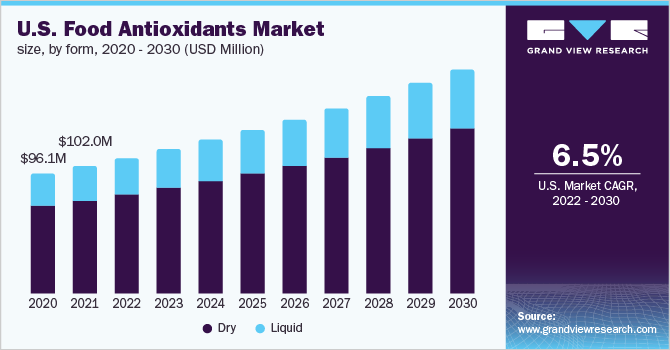
The global food antioxidants market size was valued at USD 502.2 million in 2021 and is expected to witness a compound annual growth rate (CAGR) of 6.1% from 2022 to 2030. The growing application of food antioxidants in a wide variety of prepared meals and packaged food has been the key driver for the growth of the market. The rising requirement for the long shelf life of packaged food is expected to be the major contributor to the escalating demand for food antioxidants during the forecast period.
 Source: Grand View Research, IR Documents, Primary Interviews, Paid DatabasesTo learn more about this report,
 Download Free Sample Report
Rising food consumption on the account of growing population has propelled the demand for a wide variety of prepared food globally. Such food comprises meat, poultry, bakery, sweets, confectionery, oil, fish, and many more. These food products are already prepared and kept at the store for a few days prior to selling to customers. Thus, a little portion of food antioxidants is mixed in the formulation of food to provide it with a long shelf life without losing its healthy properties. The rapid increase in the consumption of packaged food across the globe is anticipated to be the key factor for the rising demand for food antioxidants over the foreseeable future.
Increasing disposable income coupled with rapid growth in urbanization has been fostering the demand for prepared food globally. The time crunch to prepare their own food for working professionals has compelled them to rely on prepared food products which are easy to consume and contain healthy properties. The shift in consumers’ lifestyles is leading to a change in their preferences for food products. Consumers are highly aware of the variety of food products available in the market and the ingredients used in them as preservatives and nutrients. This factor is likely to contribute to the growth of the food antioxidants market globally over the projected years.
The government of different countries has imposed strict regulations pertaining to the consumption of food antioxidants as an additive in food products. The regulatory bodies have set some strict limitations on the use of antioxidants in food products. Especially, there are several stringent policies introduced by the government in the addition of synthetic antioxidants due to the involvement of chemicals in its formulation. They have defined a certain content level for antioxidants and other related additives and have also made it mandatory for manufacturers to clearly mention all ingredients that go into the production of prepared food products.
The outbreak of COVID-19 directly affected the meat & poultry market due to massive supply shortages of such food products on the account of the shutdown of many food facilities. In addition, consumers tended to avoid meat and livestock food products during the pandemic due to the risk of viruses being transmitted through the meat. However, the rising panic situation on the account of the shutdown of a maximum number of local food stores elevated the consumption of packaged food that could be stored for a longer period. Increasing dependencies on prepared food propelled the consumption of antioxidants in food products during the pandemic.
Market Dynamics
The food antioxidants market was driven by increasing demand for processed, packaged, and shelf-stable food products across global consumer markets. Food manufacturers increasingly incorporated antioxidants to improve product stability, prevent oxidation, and extend shelf life in bakery, meat, dairy, snacks, and beverage applications. Rising urbanization, changing dietary habits, and growth in convenience food consumption further support utilization of natural and synthetic antioxidant ingredients in food preservation systems.
Growing consumer preference for clean-label and naturally preserved products accelerated adoption of antioxidants derived from plant extracts, tocopherols, and rosemary ingredients. Food producers are increasingly focused on maintaining product freshness, flavor quality, and nutritional stability while meeting evolving regulatory and labeling requirements. Expansion of packaged food production and export-oriented food manufacturing continued to strengthen long-term market demand.
The market faced challenges due to stringent food safety regulations and varying approval standards for antioxidant ingredients across regions. Regulatory authorities imposed strict limitations on usage levels and permitted formulations for synthetic antioxidants, increasing compliance and reformulation costs for food manufacturers. Differences in regional food additive regulations also created operational complexity for multinational ingredient suppliers and processed food companies.
Fluctuations in prices of natural raw materials such as herbs, spices, and plant-based extracts further affected production economics for natural food antioxidants. Seasonal agricultural dependency and supply variability impacted pricing consistency and procurement planning, particularly for premium clean-label antioxidant formulations. Higher production costs for natural antioxidants compared to synthetic alternatives also limited adoption in cost-sensitive food applications.
Type Insights
The synthetic type segment dominated the market at a revenue share of over 55% in 2021. The growth is attributable to the rising consumption of butylated hydroxyanisole (BHA), butylated hydroxytoluene (BHT), Tert-butylhydroquinone (TBHQ), and Propyl Gallate (PG) in the production of a wide range of food products. Synthetic antioxidant is a mixture of numerous chemicals and involves a typical industrial process for their formulation. Thus, the government of many countries has imposed some strict regulations on its consumption as an additive. Synthetic antioxidants are widely utilized to increase the shelf life and provide a better texture, color, and fragrance to food products.
Natural antioxidants belong to natural sources such as plants, animals, fruits, herbs, and spices and do not involve a typical chemical operation. Natural antioxidants comprise carotenoids, rosemary extracts, vitamin C, vitamin E, ascorbic acid, alpha-tocopherol, and others. Rising inclination towards maintaining a healthy lifestyle has bolstered the consumption of naturally extracted antioxidants. Growing awareness of health and the side effects of chemicals is expected to fuel the demand for natural antioxidants over the projected years.
Form Insights
The dry form segment dominated the market with a revenue share of over 72% in 2021. The high share is attributable to the increasing consumption of powder based antioxidants in food products. Technical grade powders are highly consumable for numerous food products. The powder reduces the effects of free radicals and can significantly decrease the damage caused by them. Majority of food antioxidants are in dry form including powder, tablets, flakes, and granular. Dry antioxidants are widely preferred by consumers owing to the ease of their transport, storage, and usage. Growing prepared food market is expected to drive the demand for dry antioxidants globally over the forthcoming years.
Liquid antioxidants are also used in a wide range of food products, such as fats and oil, mayonnaise, and more. However, liquid antioxidants are complicated to transport, store, and usage. In addition, liquid antioxidants are not easily mixed with all types of food products, and thus, the market is expected to witness a limited demand for liquid antioxidants over the future years.
Application Insights
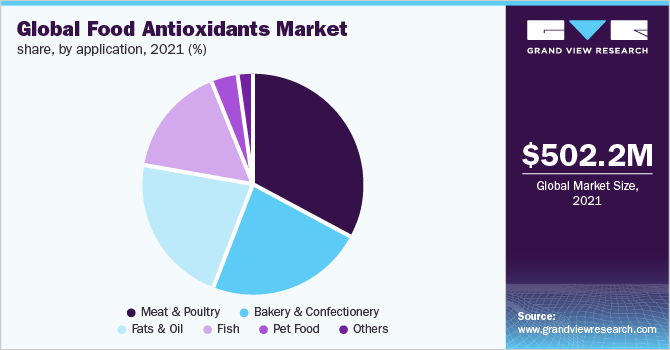
Meat & Poultry application dominated the market with a revenue share of over 32% in 2021. The growth is driven by the rising consumption of meat and its related food products across the globe. Meat & poultry are considered rich sources of protein that is required by humans to have a balanced diet. The consumption of meat & poultry products provides an adequate amount of protein to human bodies. The meat segment typically involves red meat including the meat of pork, lamb, and beef. The rising popularity of poultry meat on the account of its low price is expected to be the key driver for the growth of the poultry market. Meat & poultry products are also sold in the packaged form which is stored for a long time and consumed according to the need. Food antioxidants preserve the meat from bacteria and fungi and provide a longer shelf life to the meat & poultry products. Growing meat & poultry consumption on the account of its health benefits is anticipated to drive demand for food antioxidants in the coming years.
 To learn more about this report, Download Free Sample Report
Bakery and confectionery products are highly consumed by all age groups of people. Bakery products involve food products such as bread, toast, cookies, biscuits, and more. These food products are an essential part of people’s daily diet. Bakery & confectionery market is witnessing rapid innovation on the account of evolving habits and preferences of customers. In addition, the trend of gifting chocolates, sweets, and other confectionery products, especially at festivals is also a contributing factor to the growth of bakery & confectionery market. Increasing consumption of bakery and confectionery products is expected to stimulate the demand for food antioxidants over the forecast period.
Fats and oil are majorly consumable food products and are expected to record stable growth over the projected years. Fats & oil are sourced from plants such as palm, soybean, olive oil, sunflower, and rapeseed. Fatty acids and vegetable oil is consumed in a wide application of food products, and thus required to be preserved. Food antioxidants provide longer shelf life to fats & oil products and keep it safe from degrading. Growing utilization of fats and oil in food products is likely to escalate the demand for food antioxidants over the future years.
Regional Insights
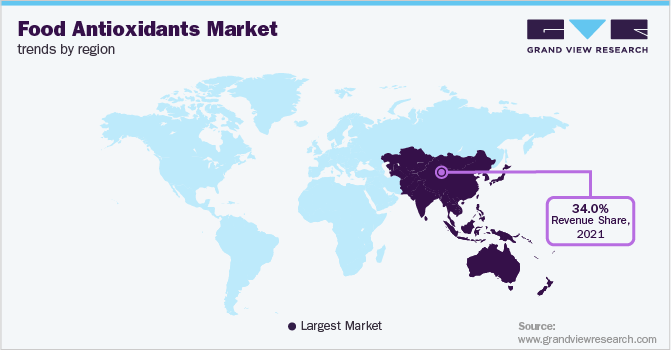
Asia Pacific dominated the market with a revenue share of over 34% in 2021. The high share is attributable to the rising population in the countries like China, India, and Japan. According to the Food and Agriculture Organization (FAO), China was the largest food producer with an output value of USD 1.56 trillion. The major factor driving the food market in China is the growing population of the country. India is the second most populous country in Asia, which also contributes to the increasing consumption of food. Asia Pacific is one of the majorly impacted regions by the strike of COVID-19. The health crisis has spread awareness for consuming healthy food products across the region. Rising population coupled with the growing consumption of food is expected to augment the demand for food antioxidants over the projected years.
 To learn more about this report, Download Free Sample Report
North America captures the second largest revenue share with a share of over 30% in 2021.The high share is attributable to the lifestyles of consumers in countries like the U.S. and Canada. Majority of people are working professionals in North America and thus, rely heavily on prepared food. In addition, the dire COVID-19 situation in the U.S. has compelled its population to have a healthy diet to immunize their body to fight against the virus. Food antioxidants preserve the food for a long time and prevent the formation of free radicals in human body. This factor is likely to fuel the demand for food antioxidants in North America over the next few years.
Europe holds a lucrative opportunity for the growth of food antioxidants market owing to the rising awareness of the health benefits of antioxidants. Rapid economic development and rising disposable income in Europe have propelled the consumption of prepared food across the region. Rising reliance on prepared food is anticipated to elevate the demand for food antioxidants across Europe in the near future.
Key Companies & Market Share Insights
Key players in the market are dedicated to new product design coupled with the rapid investment and mergers & acquisitions. Increasing innovation by the key players in the market is creating a competitive environment for the new entrants in the market. Some prominent players in the global food antioxidants market include:
-
BASF SE
-
Archer Daniels Midland Company (ADM)
-
DuPont
-
Kalsec Inc.
-
Kemin Industries
-
Camlin Fine Sciences
-
3A Antioixidants
-
Eastman Chemical Company
-
Frutarom Ltd
-
Barentz Group
-
Vitablend Nederland BV
-
Crystal Quinone Pvt Ltd
-
Sasol Limited
-
Naturex
Competitive Benchmarking
Operating Strategies
Competitive Edge
Weakness
Mature Players: BASF SE; Archer Daniels Midland Company (ADM); DuPont; Kemin Industries; Eastman Chemical Company; Sasol Limited; Naturex; Frutarom Ltd; Barentz Group
- Mature companies focused on expanding natural and clean-label antioxidant portfolios for food and beverage applications.
- Strategic investments were directed toward product innovation, regulatory compliance, and global distribution expansion.
- Companies strengthened partnerships with food manufacturers to support shelf-life extension and food stability requirements.
- Mature players benefited from strong global distribution networks and diversified food ingredient portfolios.
- Advanced R&D capabilities supported development of natural, plant-based, and application-specific antioxidant solutions.
- Established relationships with multinational food and beverage manufacturers strengthened long-term market presence.
- High dependence on agricultural raw materials created exposure to supply and pricing fluctuations.
- Large operational structures increased compliance and operational costs across global markets.
- Premium pricing for natural antioxidants limited penetration in cost-sensitive applications.
Emerging Players: Kalsec Inc.; Camlin Fine Sciences; 3A Antioxidants; Vitablend Nederland BV; Crystal Quinone Pvt Ltd.
- Emerging companies concentrated on cost-effective antioxidant formulations and regional market expansion.
- Focus remained on customized blends and specialty antioxidant solutions for processed food applications.
- Companies increasingly targeted clean-label and natural ingredient demand through flexible manufacturing strategies.
- Regional players benefited from flexible production capabilities and faster response to customer requirements.
- Competitive pricing supported penetration within small and mid-sized food processing companies.
- Strong focus on niche formulations enabled differentiation in specialized food applications.
- Limited global presence and lower brand recognition restricted international market penetration.
- Lower R&D investment capacity constrained development of advanced natural antioxidant technologies.
- Dependence on regional demand increased exposure to local market fluctuations.
Recent Development
-
In August 2022, Kalsec® partnered with Infinome™ Biosciences to provide naturally sourced and innovative ingredientswith superior quality.
-
In August 2022, Kemin launched ENTEROSURE™, a resilient intestinal health solution. The solution helps to enhance the control of enteric bacterial pathogens to reduce the use of antibiotics.
-
In December 2021, Barentz acquired Gangwal in India to become a major international distributor of specialty drugs and nutraceutical ingredients.
-
In April 2021, Eastman acquired 3F Feed & Food to strengthen its product portfolio and provide customized solutions to challenges faced by its customers.
Food Antioxidants Market Report Scope
Report Attribute
Details
Market size value in 2022
USD 531.69 million
Revenue forecast in 2030
USD 852.62 million
Growth Rate
CAGR of 6.1% from 2022 to 2030
Base year for estimation
2021
Historical data
2018 - 2020
Forecast period
2022 - 2030
Quantitative units
Volume in Tons, Revenue in USD Million, and CAGR from 2022 to 2030
Report coverage
Revenue forecast, company ranking, competitive landscape, growth factors, and trends
Segments covered
Type, form, application, region
Regional scope
North America, Europe, Asia Pacific, Central & South America, Middle East & Africa
Country scope
U.S., Canada, Mexico, Germany, UK, France, Italy, Spain, Russia, China, India, Japan, South Korea, Indonesia, Singapore, Malaysia, Vietnam, Brazil, Argentina, Colombia, Saudi Arabia, UAE, South Africa, Nigeria
Key companies profiled
BASF SE, Archer Daniels Midland Company (ADM), DuPont, Kalsec Inc., Kemin Industries, Camlin Fine Sciences, 3A Antioixidants, Eastman Chemical Company, Frutarom Ltd, Barentz Group, Vitablend Nederland BV, Crystal Quinone Pvt Ltd, Sasol Limited, Naturex
Customization scope
Free report customization (equivalent up to 8 analysts working days) with purchase. Addition or alteration to country, regional & segment scope.
Pricing and purchase options
Avail customized purchase options to meet your exact research needs. Explore purchase options
Global Food Antioxidants Market Segmentation
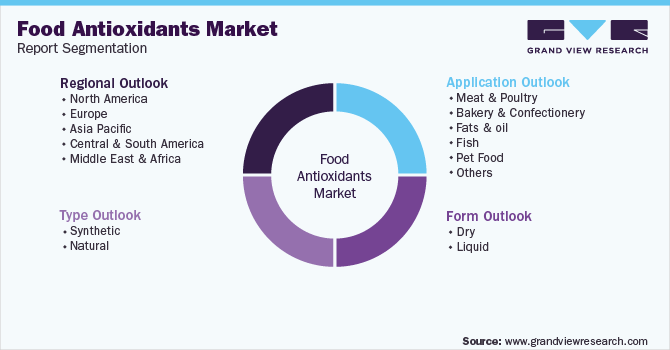
This report forecasts revenue growth at global, regional, and country levels and provides an analysis on the latest industry trends in each of the sub-segments from 2018 to 2030. For the purpose of this study, Grand View Research has segmented the global food antioxidants market report on the basis of type, form, application, and region:
 To learn more about this report, Download Free Sample Report
-
Type Outlook (Volume, Tons, Revenue, USD Million; 2018 - 2030)
-
Synthetic
-
Natural
-
-
Form Outlook (Volume, Tons, Revenue, USD Million; 2018 - 2030)
-
Dry
-
Liquid
-
-
Application Outlook (Volume, Tons, Revenue, USD Million; 2018 - 2030)
-
Meat & Poultry
-
Bakery & Confectionery
-
Fats & oil
-
Fish
-
Pet Food
-
Others
-
-
Regional Outlook (Volume, Tons, Revenue, USD Million; 2018 - 2030)
-
North America
-
U.S.
-
Canada
-
Mexico
-
-
Europe
-
Germany
-
U.K.
-
France
-
Italy
-
Spain
-
Russia
-
-
Asia Pacific
-
China
-
India
-
Japan
-
South Korea
-
Indonesia
-
Singapore
-
Malaysia
-
Vietnam
-
-
Central & South America
-
Brazil
-
Argentina
-
Colombia
-
-
Middle East & Africa
-
Saudi Arabia
-
UAE
-
South Africa
-
Nigeria
-
-
Delivered Customizations
This report has been delivered with the following In-depth customizations
Client Request
Customization Delivered
Value Adds
Regional Segmentation
A detailed regional evaluation of the food antioxidants market was conducted across North America, Europe, Asia Pacific, Latin America, and Middle East & Africa, with additional country-level analysis of antioxidant consumption across processed food, bakery, meat, pet food, and edible oil industries. The assessment examined regional regulatory frameworks, clean-label adoption trends, manufacturing presence, and demand shifts toward natural antioxidants.
Enabled identification of high-consumption markets and emerging regions with increasing demand for shelf-life enhancement and natural food preservation solutions. Supported regional expansion planning, localization strategies, and prioritization of high-growth food processing economies.
Competitive Benchmarking
Leading food antioxidant manufacturers were benchmarked based on product portfolio diversification, natural ingredient capabilities, raw material sourcing strategies, regulatory compliance, application expertise, global manufacturing footprint, and innovation activity in clean-label formulations. The analysis also reviewed strategic developments related to plant-based antioxidants and sustainable food preservation technologies.
Supported evaluation of competitive positioning, innovation strength, and operational differentiation among market participants. Helped identify partnership opportunities, product development priorities, and areas for long-term strategic expansion.
Opportunity Assessment
An opportunity-focused analysis was carried out covering growth areas such as natural antioxidants in clean-label foods, antioxidant fortification in pet food, plant-derived preservation systems, and functional ingredients for premium processed foods and beverages. Emerging consumer preference for minimally processed and additive-conscious food products was also examined.
Helped identify future growth opportunities and innovation priorities within natural food preservation and functional ingredient markets. Supported strategic investment planning and development of differentiated product portfolios aligned with evolving consumer preferences.
Frequently Asked Questions About This Report
The global food antioxidant market size was estimated at USD 502.2 million in 2021 and is expected to reach USD 531.69 million in 2022.
The global food antioxidant market is expected to grow at a compound annual growth rate of 6.1% from 2022 to 2030 to reach USD 852.62 million by 2030.
The meat & poultry segment emerged as the largest application segment in 2021 and accounted for a revenue share of around 32.7%.
key players operating in the food antioxidant market are BASF SE, Archer Daniels Midland Company (ADM), DuPont, Kalsec Inc., Kemin Industries, Camlin Fine Sciences, 3A Antioixidants, Eastman Chemical Company, Frutarom Ltd, Barentz Group, Vitablend Nederland BV, Crystal Quinone Pvt Ltd, Sasol Limited, Naturex
The growing application of food antioxidant in a wide variety of prepared meals and packaged food has been the key driver for the growth of the market. Rising requirement of long shelf life of packaged food is expected to be the major contributor for the escalating demand of food antioxidant during the forecast period.
About the Author(s)
Food Additives & Nutricosmetics Research Team
Specialty & Chemicals · Food Additives & NutricosmeticsThis report was authored by the food additives & nutricosmetics research team at Grand View Research - comprising two research analysts, one senior research analyst, and one industry expert - with specialized expertise in the food additives & nutricosmetics segment of the specialty & chemicals industry. All findings are based on proprietary specialty & chemicals databases, executive interviews, and regulatory analysis, subject to internal peer review prior to publication.
Last Updated:
Speak to Analyst -

Customize this report to your needs - add regions, segments, or data points, with 20% free customization.
Or view our licence options:


ISO 9001:2015 & 27001:2022 Certified
We are GDPR and CCPA compliant! Your transaction & personal information is safe and secure. For more details, please read our privacy policy.


