
- Home
- »
- Plastics, Polymers & Resins
- »
-
Food Contact Paper Market Size & Share Report, 2026-2033GVR Report cover

Food Contact Paper Market (2026 - 2033)
Size, Share & Trends Analysis Report By Product (Kraft Paper, Greaseproof Paper, Parchment Paper, Glassine Paper), By Coating Type, By Application, By Region, And Segment Forecasts
Market Size, 2025
$89.6BMarket Estimate, 2026
$93.1BMarket Forecast, 2033
$129.1BCAGR, 2026–2033
4.8%Food Contact Paper Market Summary
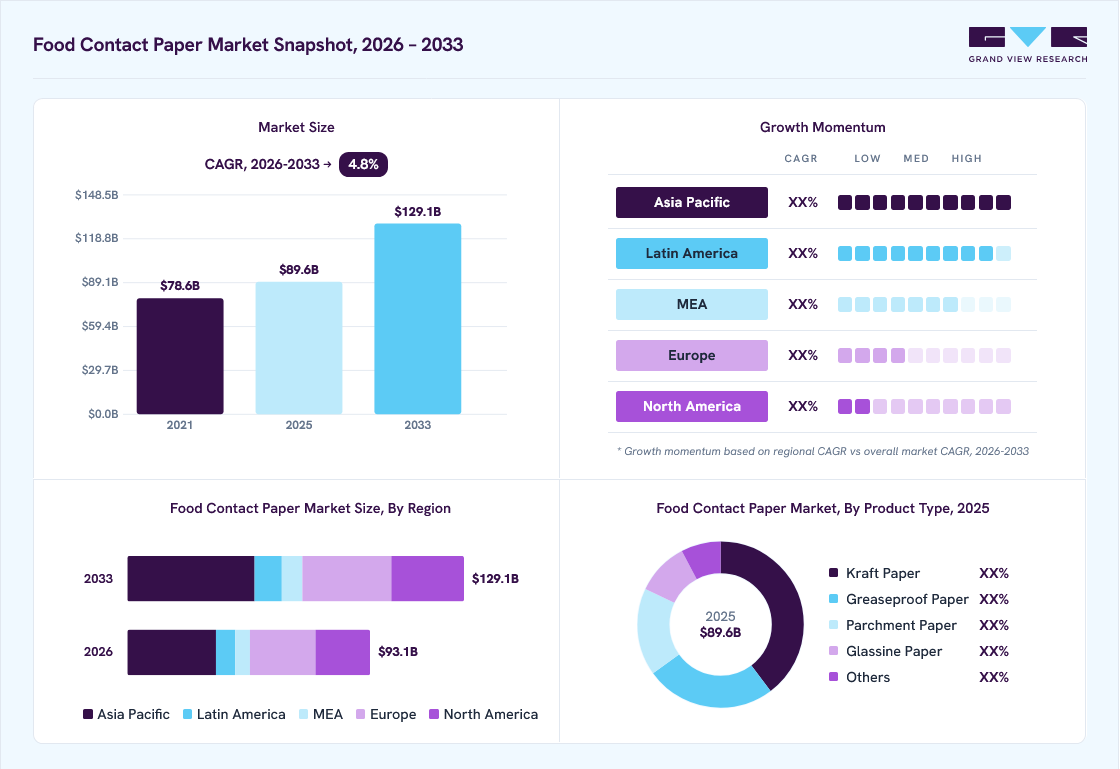
The global food contact paper market size was valued at USD 89.6 billion in 2025 and is projected to grow from USD 93.1 billion in 2026 to USD 129.1 billion in 2033, at a CAGR of 4.8% from 2026 to 2033. Asia Pacific dominated the market, accounting for the largest revenue share of 36.3% in 2025. The market is primarily driven by the growing demand for hygienic and sustainable food packaging, the expansion of foodservice and packaged food industries, and the increasing adoption of paper-based packaging as brands and consumers shift toward recyclable and fiber-based alternatives to conventional plastic packaging.
 Source: Grand View Research, IR Documents, Primary Interviews, Paid DatabasesTo learn more about this report,
 Download Free Sample Report
 Key Market Trends & Insights
- By product: Glassine paper segment is anticipated to expand at the fastest CAGR of 5.4% from 2026 to 2033.
- By coating type: Silicone-coated segment is projected to register the fastest CAGR of 5.5% from 2026 to 2033.
- By application: Takeaway & convenience foods segment is forecast to grow at the fastest CAGR of 5.5% from 2026 to 2033.
Regional Highlights
- Largest regional market: Asia Pacific (36.3% revenue share, 2025)
- By country: China held the largest market share in 2025
Market Size & Forecast
- Market size in 2025: USD 89.6 Billion
- Estimated market size in 2026: USD 93.1 Billion
- Projected market size by 2033: USD 129.1 Billion
- CAGR (2026-2033): 4.8%
Three ways to get this report
Buy it, customize it, or ask a question.Ask an Analyst
Analyst response in 1 business day
- AccessReport author, directly
- Reply timeWithin 1 working day
- No sales callDirect answer only
- FormatEmail reply
- CostFree, no cost
Get the Full Report
What the study covers
- FormatsPDF · Excel · Dashboard
- Timeline2026–2033 annual, 2025 base
- Coverage20+ countries, 5 regions
- Companies10+ key players profiled
Customize the Report
20% free customization
- IncludeCountries, segments, points
- TailorTo your product definition
- ExtendDeeper competitor detail
- OrA fully bespoke study
- Turnaround5–10 working days
The market is driven by the growing use of paper-based materials across packaged foods, bakery and confectionery, foodservice, takeaway, and fresh produce applications. Food manufacturers and converters are increasingly adopting kraft, greaseproof, parchment, and glassine papers to provide essential properties such as grease resistance, moisture control, strength, heat tolerance, and safe direct-food-contact performance. The shift toward convenient, lightweight, and functional food packaging is further supporting demand for specialty paper grades that can maintain product quality while offering compatibility with modern packaging formats.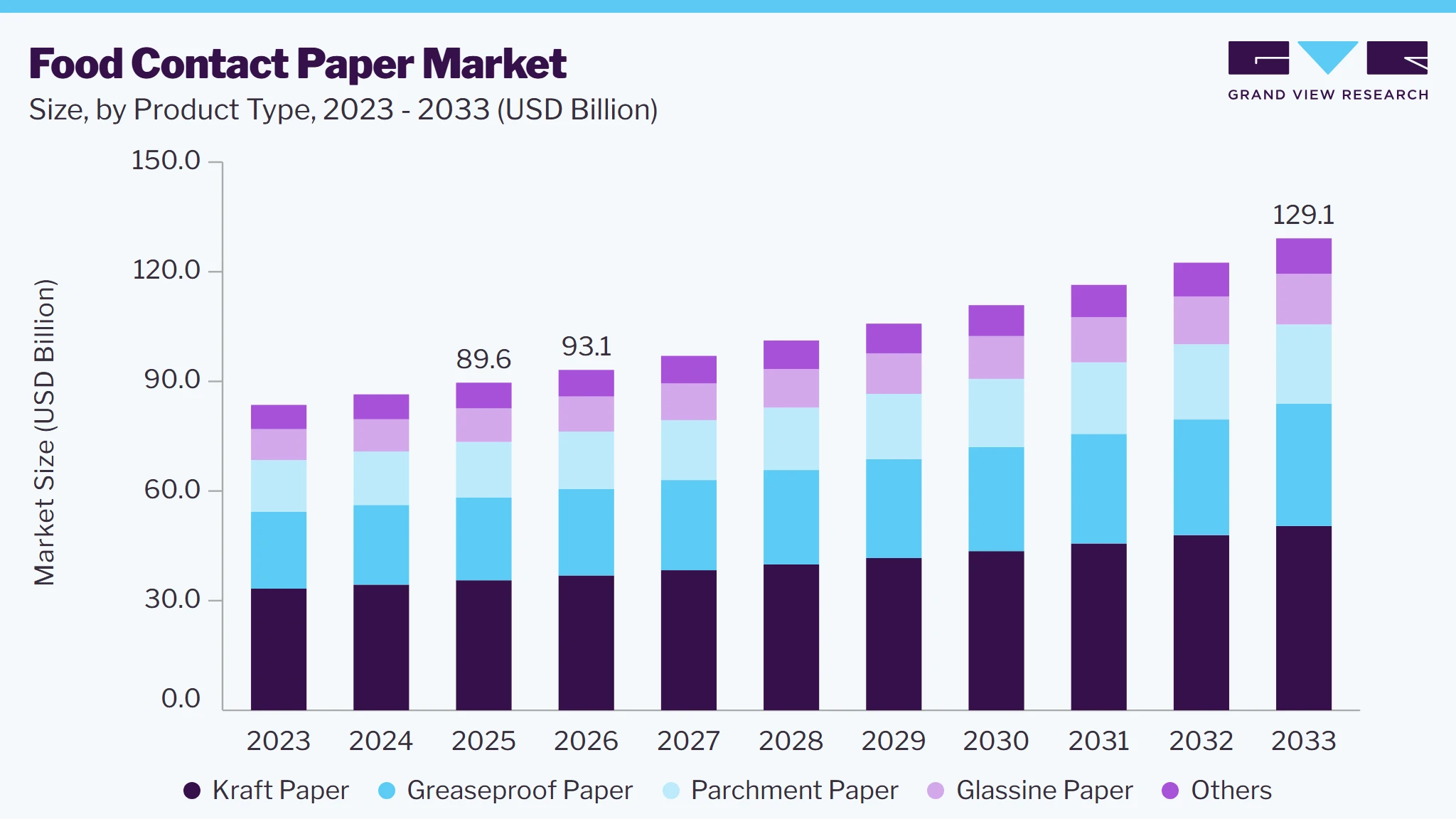 To learn more about this report, Download Free Sample Report
 An increasing focus on food safety, hygiene, and regulatory compliance is expected to support market growth in the coming years. Food-contact papers are being engineered with specialized coatings and barrier treatments to limit oil and moisture migration while maintaining the required performance during processing, storage, and consumption. Greaseproof and parchment papers are particularly suited to bakery, confectionery, and prepared-food applications, while coated and treated papers are expanding their use in applications requiring higher barrier performance. Manufacturers are also focusing on food-contact compliance, low-migration formulations, and improved coating technologies to meet increasingly stringent packaging requirements.
Sustainability initiatives and the transition toward fiber-based packaging systems are also significantly contributing to market growth. A defining trend in the food contact paper industry is the development of recyclable, renewable, and lower-plastic paper solutions that can replace conventional plastic-intensive formats without compromising packaging functionality. Increasing pressure from food brands, retailers, regulators, and consumers to reduce packaging waste is encouraging investment in water-based, bio-based, and recyclable barrier technologies. This transition is creating opportunities for higher-performance paper substrates, particularly in takeaway, convenience food, bakery, and fresh-food applications, while encouraging manufacturers to balance barrier performance, recyclability, and food-contact safety.
Market Dynamics
The market is witnessing steady growth, supported by the increasing use of paper-based materials in bakery, confectionery, takeaway, fresh produce, packaged food, and foodservice applications. Food manufacturers and converters are seeking paper substrates that combine food-contact safety with grease resistance, moisture control, heat tolerance, printability, and mechanical strength. At the same time, the shift toward fiber-based packaging, improvements in barrier coatings, and growing pressure to reduce plastic content are encouraging innovation across kraft, greaseproof, parchment, and glassine papers. However, performance requirements for high-barrier food applications and the need to comply with increasingly stringent food-contact regulations continue to influence material selection and production costs.
The increasing adoption of paper-based packaging across food and foodservice applications is a key market driver. Growing consumption of packaged foods, bakery products, convenience meals, and takeaway foods is creating demand for substrates that can provide protection against grease, moisture, and food contamination while maintaining handling and presentation requirements. Paper also offers advantages in printing, converting, and brand customization, making it suitable for a wide range of food-contact formats.
Food brands, retailers, and foodservice operators are increasingly incorporating paper-based materials into packaging portfolios as they seek to reduce reliance on conventional plastic formats. Advances in greaseproof, parchment, glassine, and coated paper technologies are expanding the range of applications where paper can be used without compromising functional performance. This combination of growing foodservice consumption and improvements in paper functionality is supporting broader adoption across both retail and food-to-go channels.
A key market restraint is the difficulty of achieving high grease, moisture, oxygen, and heat resistance while maintaining recyclability and food-contact safety. Many food applications require specialized coatings or barrier treatments, which can increase material complexity, production costs, and recycling challenges. Manufacturers must therefore balance functional performance with regulatory compliance and end-of-life requirements, particularly for packaging used with oily, wet, or liquid foods.
A major market opportunity lies in the development of recyclable, high-barrier paper solutions that can deliver strong grease, moisture, and heat resistance without compromising fiber recovery. Advances in water-based, bio-based, and dispersion coatings are enabling manufacturers to reduce reliance on conventional plastic barriers while maintaining packaging functionality. This creates opportunities across bakery, takeaway, convenience food, fresh produce, and foodservice applications as brands increasingly seek fiber-based packaging with improved environmental performance.
Market Concentration & Characteristics
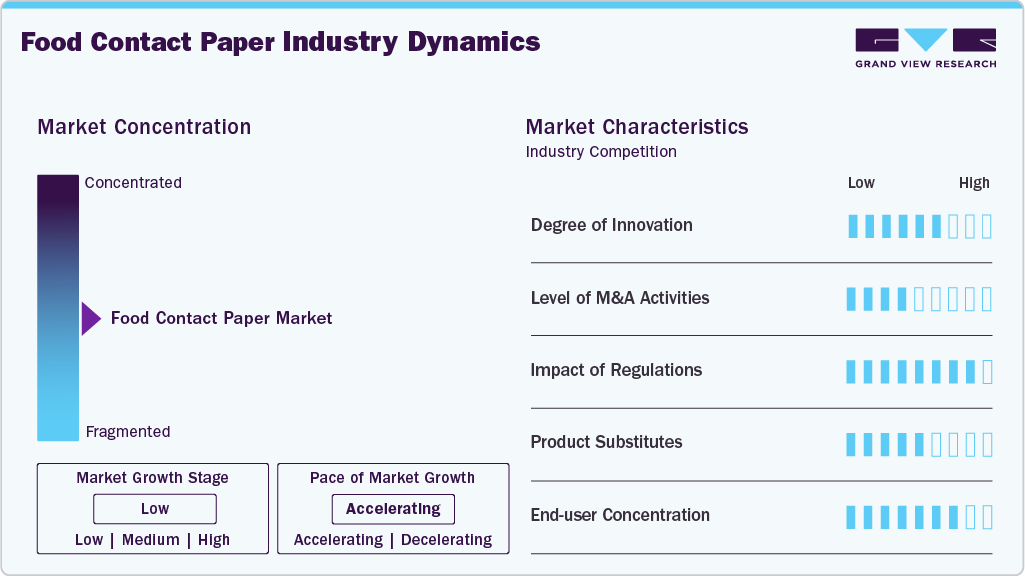
The food contact paper industry is characterized by its high-volume, application-driven nature, supported by steady demand from bakery and confectionery, fresh produce, packaged foods, takeaway, and foodservice applications. The industry depends on efficient paper manufacturing, converting, coating, and finishing processes, with manufacturers focusing on cost optimization, production consistency, barrier performance, and food-contact compliance. Economies of scale are important in the production of kraft paper, greaseproof paper, parchment, and glassine paper, while converters increasingly optimize coating application, printing, slitting, and forming operations to meet specific packaging requirements. Leading producers and paper converters prioritize fiber sourcing, lightweighting, coating efficiency, and scalable converting technologies to maintain competitiveness across high-volume food packaging applications.
 To learn more about this report, Download Free Sample Report
 A defining feature of the industry is the need to balance food-contact safety, functional barrier performance, and recyclability. Food contact papers must provide resistance to grease, moisture, heat, and, in selected applications, oxygen or aroma migration, while complying with food-contact regulations and migration limits. Conventional PE and other polymer coatings remain important for demanding applications, but the industry is increasingly shifting toward water-based, dispersion, bio-based, and recyclable barrier coatings to reduce plastic content and improve end-of-life performance. This transition is encouraging innovation in high-barrier paper, grease-resistant substrates, fiber-based packaging, and mono-material paper structures, particularly as food brands and foodservice operators seek packaging solutions that combine product protection with improved sustainability credentials.
Product Insights
The kraft paper segment led the market with the largest revenue share of 39.7% in 2025. Kraft paper is widely used in food-contact applications because of its high tensile strength, durability, printability, and versatility, making it suitable for bags, wraps, pouches, bakery packaging, and other food packaging formats. Its strong fiber structure supports efficient converting and handling, while compatibility with grease-resistant and moisture-barrier treatments expands its use across packaged foods and foodservice applications. Demand for kraft paper is further supported by the growing preference for fiber-based packaging, recyclable substrates, and plastic-reduction solutions, particularly among food brands and retailers seeking scalable paper-based alternatives.
The glassine paper segment is expected to grow at the fastest CAGR of 5.4% during the forecast period. Glassine paper is gaining traction in food-contact applications due to its smooth, dense, translucent structure, grease resistance, moisture protection, and strong printability. Its suitability for bakery products, confectionery, specialty foods, and wrapping applications supports broader adoption as manufacturers seek lightweight paper substrates with functional barrier properties. Growth is further supported by increasing interest in recyclable and fiber-based packaging solutions, along with advancements in surface treatment and barrier technologies that enhance the performance of glassine paper in demanding food-contact environments.
Coating Type Insights
The uncoated segment led the market with the largest revenue share of 30.9% in 2025. Uncoated food contact paper is widely used in applications where the paper substrate itself provides adequate handling, strength, printability, and food-contact performance. It is particularly relevant for dry foods, bakery products, wraps, bags, and other applications where extensive moisture or grease barriers are not required. Its relatively simple structure supports cost-efficient manufacturing, converting, and recyclability, while continued demand for fiber-based and low-complexity packaging sustains its broad application base.
The silicone-coated segment is expected to grow at the fastest CAGR of 5.5% during the forecast period. Silicone coatings provide non-stick, release, grease-resistant, and heat-resistant properties, making them particularly suitable for baking and food preparation applications where food must be released cleanly from the paper surface. Increasing demand for convenient baking formats, ready-to-use food preparation products, and high-performance food-contact substrates is supporting adoption. Advances in coating technology and growing interest in functional paper solutions are further expanding the use of silicone-coated papers across bakery, confectionery, food processing, and specialty food applications.
Application Insights
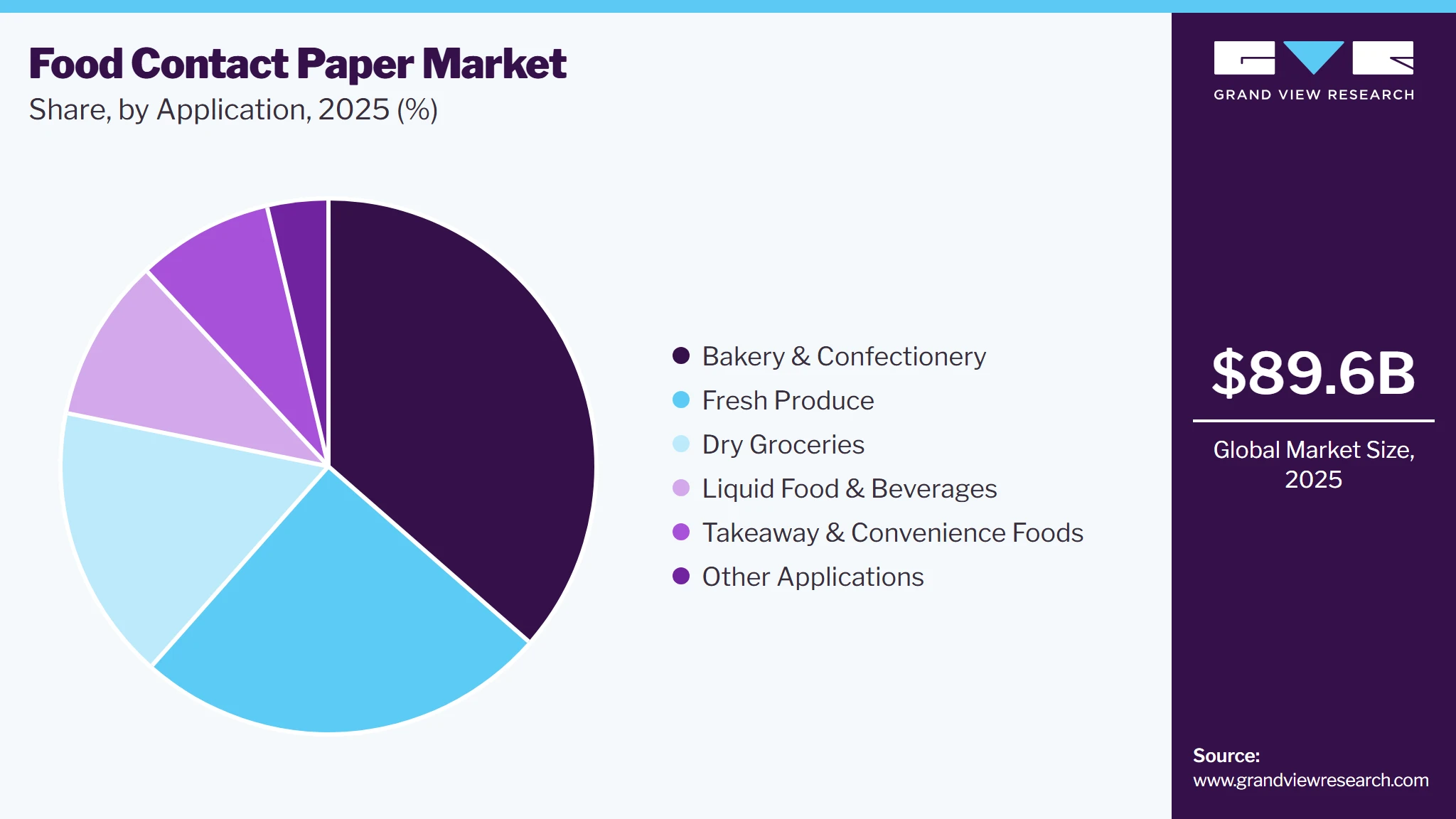
The bakery & confectionery segment led the market with the largest revenue share of 36.4% in 2025. Food contact paper is extensively used for baking sheets, wrappers, liners, bags, and confectionery packaging, where grease resistance, heat tolerance, food release, and product presentation are important. The segment benefits from the broad use of paper-based materials across baked goods and confectionery products, supported by the need for hygienic, lightweight, and easily convertible packaging formats. The versatility of kraft, greaseproof, parchment, and coated papers further strengthens their application across bakery and confectionery packaging.
 To learn more about this report, Download Free Sample Report
 The takeaway & convenience foods segment is expected to grow at the fastest CAGR of 5.5% during the forecast period. Rising demand for ready-to-eat meals, takeaway foods, food-to-go products, and convenience formats is increasing the need for paper substrates that can withstand grease, moisture, heat, and handling during transportation and consumption. Foodservice operators and packaging converters are also adopting functional paper solutions that support improved product presentation while reducing dependence on conventional plastic formats. This is creating opportunities for barrier-coated, grease-resistant, and lightweight food contact papers across takeaway boxes, wraps, liners, and other convenience-food packaging formats.
Regional Insights
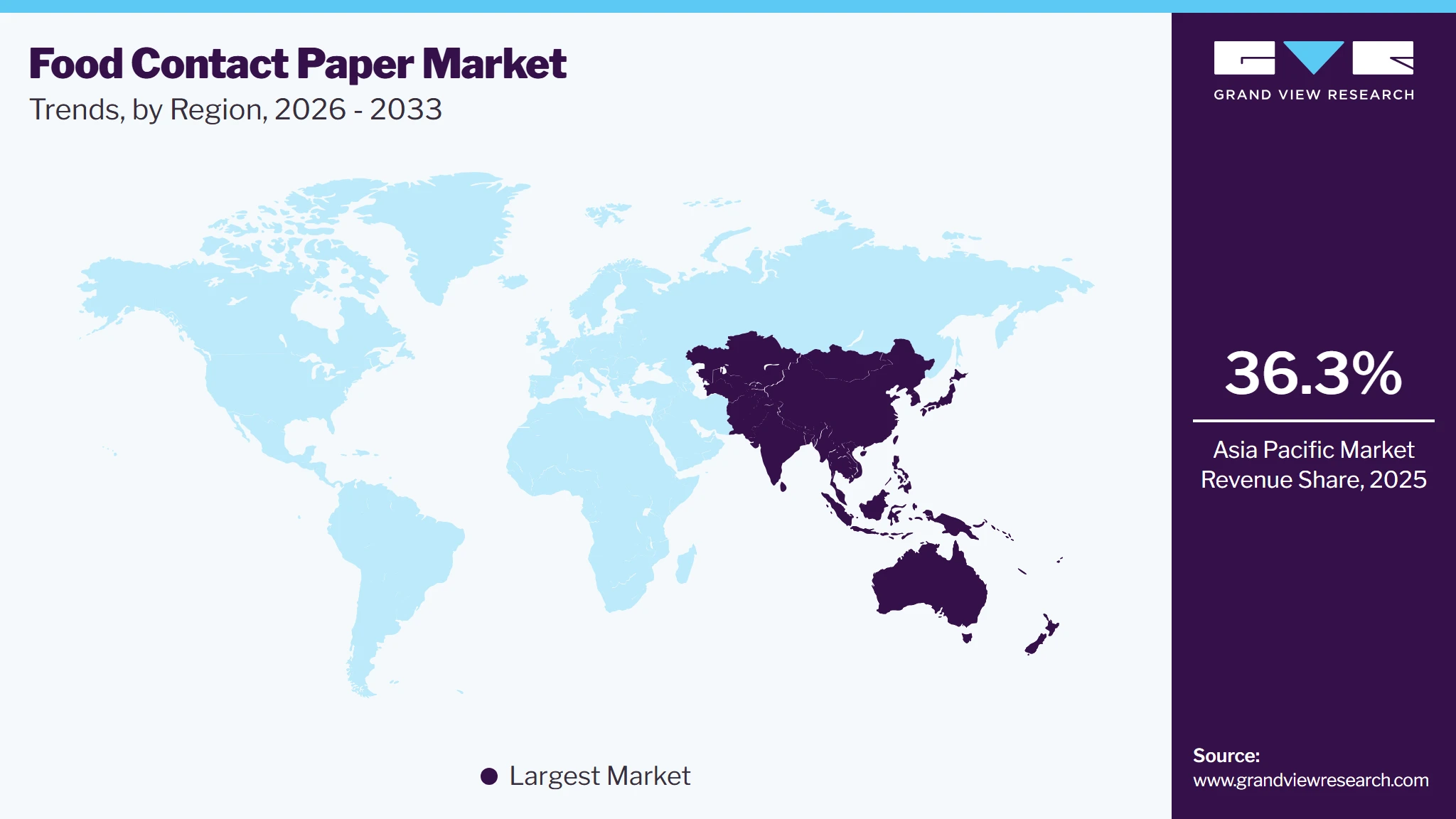
The Asia Pacific food contact paper market dominated the global market with a revenue share of 36.3% in 2025 and is also expected to register the fastest CAGR of 5.3% during the forecast period. Regional growth is supported by expanding packaged food production, rising foodservice consumption, urbanization, and the rapid development of modern retail and convenience-food channels. The region's large paper manufacturing base and growing conversion capacity further support the adoption of kraft, greaseproof, parchment, glassine, and coated food-contact papers.
 To learn more about this report, Download Free Sample Report
 China Food Contact Paper Market Trends
The food contact paper market in China represents a major market within Asia Pacific, supported by its large-scale food processing industry, extensive paper manufacturing capacity, and expanding foodservice and convenience-food sectors. Increasing demand for food wraps, bakery packaging, takeaway formats, and paper-based bags is supporting the consumption of food-contact papers. The country's broad manufacturing ecosystem also enables cost-efficient production and conversion of specialty paper substrates.
India food contact paper market is expected to witness strong growth, supported by expanding packaged food and bakery industries, urbanization, food delivery, and the development of organized foodservice channels. Rising adoption of paper-based takeaway packaging, greaseproof wraps, kraft bags, and food liners is creating additional demand. Increasing interest in alternatives to conventional plastic packaging is also encouraging domestic converters to expand paper-based packaging capabilities.
North America Food Contact Paper Market Trends
The food contact paper market in North America is expected to expand steadily during the forecast period, supported by established food processing, bakery, foodservice, and packaged food industries. Demand is increasingly centered on grease-resistant, moisture-barrier, recyclable, and food-contact-compliant paper for wraps, bags, liners, and convenience food packaging. Growing efforts by brands and converters to reduce plastic content are also encouraging the development of functional paper substrates and recyclable coating technologies.
The U.S. food contact paper market is supported by the extensive use of paper-based materials across bakery products, packaged foods, foodservice, and takeaway applications. Demand is shifting toward high-performance food-contact papers that combine barrier functionality with recyclability and efficient converting. Growth in food-to-go consumption and continued investment in sustainable packaging formats are creating opportunities for greaseproof, parchment, kraft, and coated paper solutions.
Europe Food Contact Paper Market Trends
The food contact paper market in Europe is projected to register moderate growth, supported by a mature packaged food industry and strong demand for recyclable and fiber-based packaging materials. The region has a well-developed ecosystem for specialty papers, barrier coatings, and food packaging conversion. Increasing emphasis on packaging recyclability, reduced plastic content, and food-contact compliance is encouraging innovation in water-based, dispersion, and other lower-plastic barrier technologies.
Germany food contact paper market accounts for a significant share of Europe, supported by its strong food manufacturing, bakery, packaging machinery, and paper-converting industries. Demand is particularly relevant for kraft, greaseproof, parchment, and specialty coated papers used in food packaging and foodservice. Investments in efficient converting and recyclable barrier solutions are supporting the transition toward more resource-efficient paper packaging.
The UK food contact paper market is expected to grow steadily, driven by demand from foodservice, bakery, takeaway, and convenience food applications. Packaging manufacturers are increasingly developing paper formats that deliver grease and moisture resistance while reducing dependence on plastic-based structures. The expansion of recyclable and fiber-based packaging solutions is creating opportunities for specialty food-contact papers and advanced barrier coatings.
Latin America Food Contact Paper Market Trends
The food contact paper market in Latin America is projected to grow at a healthy pace, supported by increasing consumption of packaged foods, bakery products, fresh produce, and convenience foods. The region offers opportunities for kraft and grease-resistant papers across retail and foodservice applications, while improving packaging infrastructure and growing interest in sustainable materials are encouraging wider adoption of fiber-based solutions.
Brazil food contact paper market represents a significant market in Latin America, supported by its large food and beverage industry, expanding foodservice sector, and established pulp and paper manufacturing base. Availability of domestic fiber resources strengthens the supply environment for kraft and other paper substrates, while demand for foodservice and packaged food formats is increasing the use of functional food-contact papers.
The food contact paper market in Argentina is expected to experience steady development alongside demand from food processing, bakery, retail, and foodservice applications. Opportunities are concentrated in kraft, greaseproof, and coated papers used for food wrapping, bags, liners, and takeaway formats. Increasing attention to packaging efficiency and fiber-based alternatives is expected to support gradual market expansion.
Middle East & Africa Food Contact Paper Market Trends
The food contact paper market in MEA is expected to maintain steady growth, supported by expanding food processing, retail, hospitality, and foodservice industries. Demand is gradually shifting toward hygienic, lightweight, and functional paper packaging, particularly for bakery, takeaway, and convenience foods. Investments in food manufacturing and modern retail infrastructure are creating additional opportunities for food-contact paper suppliers and converters.
Key Food Contact Paper Company Insights
Some key companies in the market include Mondi, Stora Enso, International Paper, WestRock, Sappi Ltd., UPM, Huhtamaki Ltd., Billerud, Ahlstrom, Delfortgroup AG, Gascogne, NIPPON PAPER INDUSTRIES CO., LTD., FELIX SCHOELLER, and Nordic Paper. The market is characterized by specialty paper development, functional barrier coatings, fiber-based packaging innovation, food-contact compliance, and sustainable material solutions. Key participants are focusing on developing grease-resistant, moisture-resistant, recyclable, lightweight, and high-performance paper substrates to meet the requirements of bakery, confectionery, fresh produce, foodservice, takeaway, and packaged food applications.
-
Mondi is a global packaging and paper company offering paper-based solutions across food packaging applications. Its portfolio includes functional papers, kraft papers, and barrier-coated paper solutions designed to provide properties such as grease and moisture resistance while supporting recyclable and fiber-based packaging structures.
-
Stora Enso develops renewable packaging materials and specialty paper solutions for food-contact applications. The company focuses on fiber-based packaging, barrier technologies, recyclable paper structures, and renewable materials, supporting the transition from conventional plastic packaging toward paper-based alternatives.
Key Food Contact Paper Companies
The following key companies have been profiled for this study on the food contact paper market:
-
Mondi
-
Stora Enso
-
International Paper
-
Westrock
-
Sappi, Ltd.
-
UPM
-
Huhtamaki, Ltd.
-
Billerud
-
Ahlstrom
-
delfortgroup AG
-
Gascogne
-
NIPPON PAPER INDUSTRIES CO., LTD.
-
FELIX SCHOELLER
-
Nordic Paper
Company Categorization
Category
Operating Strategies
Competitive Edge
Weakness
Established Players (Mondi; Stora Enso; International Paper; WestRock; Sappi Ltd.; UPM; Huhtamaki Ltd.; Billerud; Ahlstrom)
Expand food-contact papers, kraft, greaseproof, specialty papers, and barrier coatings through R&D, sustainable fibers, and advanced converting.
Global scale, strong paper manufacturing, coating, converting, food-contact compliance, and distribution capabilities.
High capital and pulp, energy, and fiber costs, plus rising investment in recyclable high-barrier solutions.
Emerging Players (delfortgroup AG; Gascogne; NIPPON PAPER INDUSTRIES CO., LTD.; FELIX SCHOELLER; Nordic Paper)
Target specialty food-contact, greaseproof, kraft, and functional papers through product specialization and barrier innovation.
Strong specialty-paper expertise, grease resistance, barrier performance, and customized solutions for food packaging.
Smaller scale, narrower distribution, and greater exposure to raw-material costs and niche-market demand.
Recent Development:
-
In April 2026, Stora Enso launched Performa Natura Aqua, a dispersion-coated folding boxboard developed for foodservice and bakery packaging. Its integrated grease barrier uses less plastic than conventional barrier alternatives and is designed to support faster repulping and improved fiber recovery in conventional recycling processes.
-
In April 2026, UPM and Felix Schoeller introduced a customizable recyclable barrier solution for flexible food packaging such as chocolate and snack bars. Based on UPM Solide Lucent paper, the solution allows barrier performance to be tailored for oxygen, moisture, grease, sealing, and mechanical requirements, supporting the shift toward fiber-based packaging.
-
In August 2026, Ahlstrom launched Grease-Gard PLUS and Grease-Gard PRO for the North American QSR and foodservice market. The new papers provide enhanced grease resistance, water holdout, heat retention, recyclability, and food-contact performance, targeting wraps, bags, burgers, sandwiches, and other takeaway formats.
Food Contact Paper Market Report Scope
Report Attribute
Details
Market size in 2025
USD 89.6 billion
Estimated market size in 2026
USD 93.1 billion
Projected market size by 2033
USD 129.1 billion
Growth rate
CAGR of 4.8% from 2026 to 2033
Historical data
2021 – 2025
Forecast period
2026 – 2033
Quantitative units
Revenue in USD billion and CAGR from 2026 to 2033
Report coverage
Revenue forecast, company ranking, competitive landscape, growth factors, and trends
Segments covered
Product, coating type, application, region
Regional scope
North America; Europe; Asia Pacific; Latin America; MEA
Country scope
U.S.; Canada; Mexico; Germany; France; UK; Italy; Spain; China; India; Japan; South Korea; Australia; Brazil; Argentina; Saudi Arabia; UAE; South Africa
Key companies profiled
Mondi; Stora Enso; International Paper; Westrock; Sappi, Ltd.; UPM; Huhtamaki, Ltd.; Billerud; Ahlstrom; delfortgroup AG; Gascogne; NIPPON PAPER INDUSTRIES CO., LTD.; FELIX SCHOELLER; Nordic Paper
Customization scope
Free report customization (equivalent up to 8 analysts working days) with purchase. Addition or alteration to country, regional & segment scope.
Pricing and purchase options
Avail of customized purchase options to meet your exact research needs. Explore purchase options
Global Food Contact Paper Market Report Segmentation
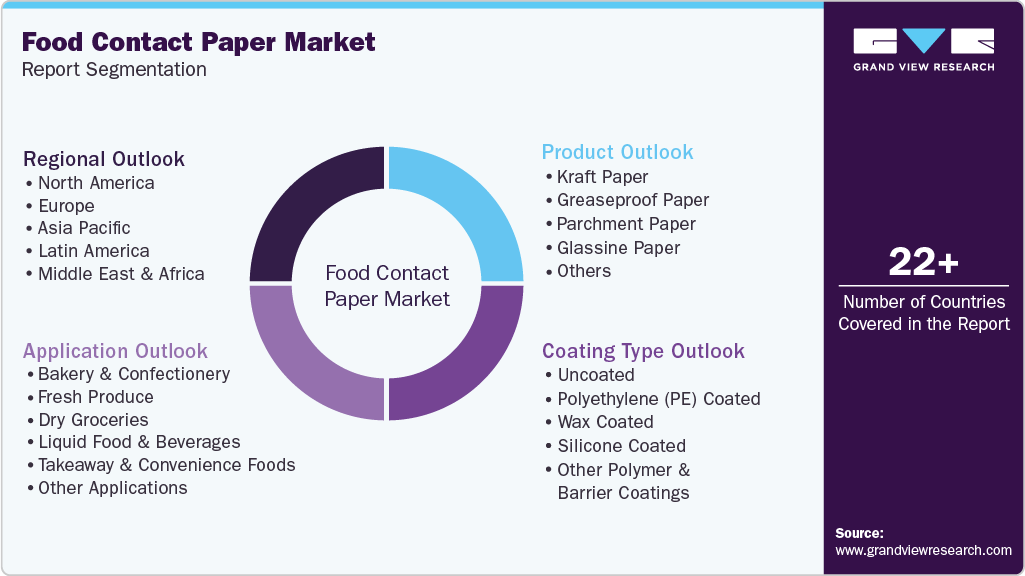
This report forecasts revenue growth at the regional and country levels and provides an analysis of the latest industry trends and opportunities in each of the sub-segments from 2021 to 2033. For this study, Grand View Research has segmented the global food contact paper market report based on product, coating type, application, and region:
 To learn more about this report, Download Free Sample Report
 -
Product Outlook (Revenue, USD Million, 2021 – 2033)
-
Kraft Paper
-
Greaseproof Paper
-
Parchment Paper
-
Glassine Paper
-
Others
-
-
Coating Type Outlook (Revenue, USD Million, 2021 – 2033)
-
Uncoated
-
Polyethylene (PE) Coated
-
Wax Coated
-
Silicone Coated
-
Other Polymer & Barrier Coatings
-
-
Application Outlook (Revenue, USD Million, 2021 - 2033)
-
Bakery & Confectionery
-
Fresh Produce
-
Dry Groceries
-
Liquid Food & Beverages
-
Takeaway & Convenience Foods
-
Other Applications
-
-
Regional Outlook (Revenue, USD Million, 2021 - 2033)
-
North America
-
U.S.
-
Canada
-
Mexico
-
-
Europe
-
Germany
-
France
-
UK
-
Italy
-
Spain
-
-
Asia Pacific
-
China
-
India
-
Japan
-
South Korea
-
Australia
-
-
Latin America
-
Brazil
-
Argentina
-
-
Middle East & Africa
-
Saudi Arabia
-
UAE
-
South Africa
-
-
Research Methodology
The food contact paper market figures in this report are based on a proven research process that combines executive interviews with secondary research from proprietary databases, company filings, and recognized regulatory and institutional sources. Market size is built through value-chain sizing—reconciling supply-side and demand-side estimates—and triangulated with bottom-up and top-down approaches. Every estimate passes multiple levels of expert validation before publication, with each food contact paper segment quantified using the revenue-capture definitions in the table below.
Segment Definition
Segment – Product
Revenue capture definition
Kraft Paper
Revenue generated from the sale of kraft paper used in food-contact applications, including food bags, wraps, pouches, liners, bakery packaging, and takeaway packaging. Includes kraft paper grades supplied with food-contact compliance and, where applicable, grease, moisture, or barrier treatments for food packaging applications.
Greaseproof Paper
Revenue generated from the sale of greaseproof paper designed to provide resistance to oils and fats in food-contact applications. Includes papers used for bakery products, confectionery, meat and dairy products, food wraps, liners, bags, and takeaway packaging where grease resistance and food-contact safety are required.
Parchment Paper
Revenue generated from the sale of parchment paper used in baking, cooking, food preparation, wrapping, and food packaging applications. Includes food-contact parchment grades offering non-stick, grease-resistant, heat-resistant, and moisture-resistant properties for bakery, confectionery, and foodservice applications.
Glassine Paper
Revenue generated from the sale of glassine paper used in food-contact packaging and wrapping applications requiring a smooth, dense, lightweight, and grease-resistant paper substrate. Includes glassine papers used for confectionery, bakery products, specialty foods, wrappers, liners, and other applications requiring enhanced surface and barrier properties.
Others
Revenue generated from the sale of other food-contact paper types not classified under kraft, greaseproof, parchment, or glassine paper. Includes specialty, coated, treated, and customized paper grades used for food wrapping, bakery, foodservice, fresh produce, takeaway, and other food packaging applications.
Segment – Coating Type
Revenue capture definition
Uncoated
Revenue generated from the sale of food-contact papers without an applied coating layer, where the paper substrate itself provides the required strength, handling, printability, and food-contact properties. Includes papers used for dry foods, bakery products, wraps, bags, liners, and other applications where additional barrier performance is not required.
Polyethylene (PE) Coated
Revenue generated from the sale of food-contact papers coated with polyethylene to provide enhanced moisture, grease, and liquid resistance. Includes PE-coated papers used in foodservice packaging, cups, wraps, bags, trays, and other applications requiring improved barrier protection and structural performance.
Wax Coated
Revenue generated from the sale of food-contact papers treated with wax coatings to provide resistance to moisture, grease, and surface penetration. Includes wax-coated papers used for food wrapping, bakery products, confectionery, meat, dairy, produce, and other food packaging applications.
Silicone Coated
Revenue generated from the sale of silicone-coated food-contact papers providing non-stick, release, grease-resistant, and heat-resistant properties. Includes papers used for baking sheets, liners, bakery and confectionery applications, food preparation, and specialty food packaging.
Other Polymer & Barrier Coatings
Revenue generated from the sale of food-contact papers incorporating polymer, dispersion, water-based, bio-based, or other functional barrier coatings not classified under PE, wax, or silicone coatings. Includes papers designed to provide enhanced oxygen, moisture, grease, heat, or aroma barrier performance for demanding food packaging applications.
Segment – Application
Revenue capture definition
Bakery & Confectionery
Revenue generated from food-contact paper used for bakery and confectionery products, including bread, cakes, pastries, cookies, chocolates, candies, and baked goods. Includes paper used for baking sheets, liners, wrappers, bags, trays, and product packaging requiring grease resistance, heat tolerance, and food-contact safety.
Fresh Produce
Revenue generated from food-contact paper used for packaging and handling fresh fruits, vegetables, herbs, and other perishable produce. Includes paper used in bags, wraps, trays, liners, and produce packaging formats requiring moisture management, breathability, strength, and food-contact compliance.
Dry Groceries
Revenue generated from food-contact paper used for dry and shelf-stable grocery products, including flour, grains, cereals, pulses, sugar, spices, snacks, and other dry foods. Includes paper used for bags, pouches, wraps, liners, and packaging formats requiring strength, printability, and product protection.
Liquid Food & Beverages
Revenue generated from food-contact paper used for liquid and semi-liquid foods and beverages, including dairy products, juices, sauces, soups, and other liquid food products. Includes coated and barrier-treated papers used in cups, cartons, wraps, and packaging structures requiring moisture, liquid, and grease resistance.
Takeaway & Convenience Foods
Revenue generated from food-contact paper used for takeaway, ready-to-eat, fast-food, and convenience food products. Includes paper used in food containers, wraps, bags, liners, trays, and other food-to-go formats requiring grease resistance, moisture protection, heat tolerance, and handling durability.
Other Applications
Revenue generated from food-contact paper used in other food packaging and food-handling applications not classified above. Includes specialty food packaging, meat and seafood packaging, dairy applications, food processing, catering, and other applications requiring food-contact compliance and functional paper properties.
Estimation Model
Layer No.
Layer Name
Key Question
Description
01
End-use Industry Layer
What drives demand?
Estimate demand from key food-related industries and channels, including bakery & confectionery, foodservice, packaged foods, fresh produce, dry groceries, and takeaway foods that utilize food-contact paper.
02
Application Adoption Layer
Where is food-contact paper used?
Assess adoption across major applications based on requirements such as grease resistance, moisture protection, heat tolerance, food-contact safety, printability, and recyclability.
03
Product Consumption Layer
Which products generate demand?
Evaluate consumption of kraft, greaseproof, parchment, glassine, and other food-contact papers, considering their use across food packaging and handling applications.
04
Coating & Performance Layer
What functional properties are required?
Assess demand for uncoated, PE-coated, wax-coated, silicone-coated, and other polymer/barrier-coated papers based on application-specific requirements for grease, moisture, liquid, heat, and release performance.
05
Revenue Layer
How is revenue generated?
Revenue is generated through the sale of food-contact paper products and coated paper solutions supplied for bakery & confectionery, fresh produce, dry groceries, liquid food & beverages, takeaway & convenience foods, and other food packaging applications.
Delivered Customizations
We have successfully delivered the following deep-dive customizations:
Client Request
Customization Delivered
Value Adds
Competitive Benchmarking
Comparative assessment of leading food-contact paper manufacturers based on product portfolio, kraft and specialty paper capabilities, grease and moisture resistance, barrier-coating technologies, food-contact compliance, production footprint, sustainability initiatives, and strategic developments.
Enables clients to benchmark competitive positioning, product differentiation, technology capabilities, and sustainability performance, while identifying gaps across specialty papers and food packaging applications.
Trade Assessment
Detailed assessment of food-contact paper trade flows, including major exporting and importing countries, product categories, regional supply patterns, trade dependencies, and factors influencing international movement, such as pulp and fiber availability, paper prices, tariffs, logistics costs, and food-contact regulations.
Helps clients identify key supply hubs, import dependencies, sourcing opportunities, trade risks, and regional supply-chain advantages to support procurement and market expansion decisions.
Opportunity Assessment
Evaluation of emerging opportunities across kraft, greaseproof, parchment, glassine, and barrier-coated papers, with focus on takeaway, bakery, foodservice, fresh produce, and convenience-food applications. Assessment also considers PFAS-free coatings, recyclability, lightweighting, plastic reduction, and high-barrier paper solutions.
Supports identification of high-potential products and application areas, technology opportunities, unmet packaging requirements, and sustainable-material opportunities for portfolio expansion and investment planning.
About the Author(s)
Plastics, Polymers & Resins Research Team
Bulk Chemicals · Plastics, Polymers & ResinsThis report was authored by the plastics, polymers & resins research team at Grand View Research - comprising two research analysts, one senior research analyst, and one industry expert - with specialized expertise in the plastics, polymers & resins segment of the bulk chemicals industry. All findings are based on proprietary bulk chemicals databases, executive interviews, and regulatory analysis, subject to internal peer review prior to publication.
Last Updated:
Speak to Analyst

Customize this report to your needs - add regions, segments, or data points, with 20% free customization.
Or view our licence options:


ISO 9001:2015 & 27001:2022 Certified
We are GDPR and CCPA compliant! Your transaction & personal information is safe and secure. For more details, please read our privacy policy.


