
- Home
- »
- Advanced Interior Materials
- »
-
Food Extrusion Machinery Market Size Report, 2026-2033GVR Report cover

Food Extrusion Machinery Market (2026 - 2033)
Size, Share & Trends Analysis Report By Process (Cold Extrusion, Hot Extrusion), By Extruder Type (Single Screw, Twin Screw, Multi-Screw), By Application (Snacks, Breakfast Cereals, Pet Food), By Region, And Segment Forecasts
Market Size, 2025
$3.7BMarket Estimate, 2026
$3.8BMarket Forecast, 2033
$5.2BCAGR, 2026–2033
4.5%Food Extrusion Machinery Market Summary
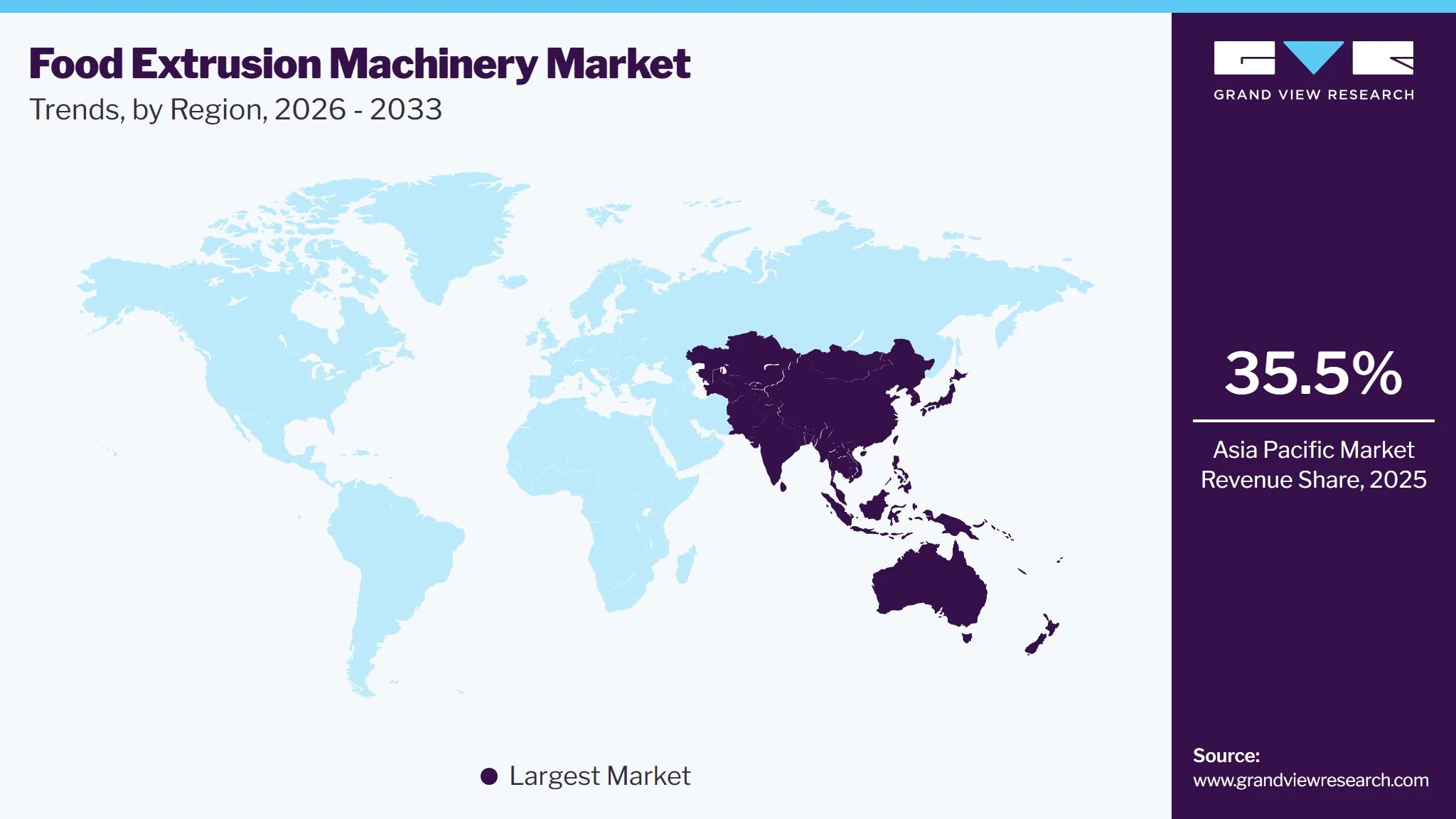
The global food extrusion machinery market size was valued at USD 3.7 billion in 2025 and is projected to grow from USD 3.8 billion in 2026 to USD 5.2 billion by 2033, at a CAGR of 4.5% from 2026 to 2033. Asia Pacific dominated the global market, accounting for the largest revenue share of 35.5% in 2025. The market is driven by the growing production of processed and convenience foods, including snacks, breakfast cereals, pasta, textured proteins, and pet food.
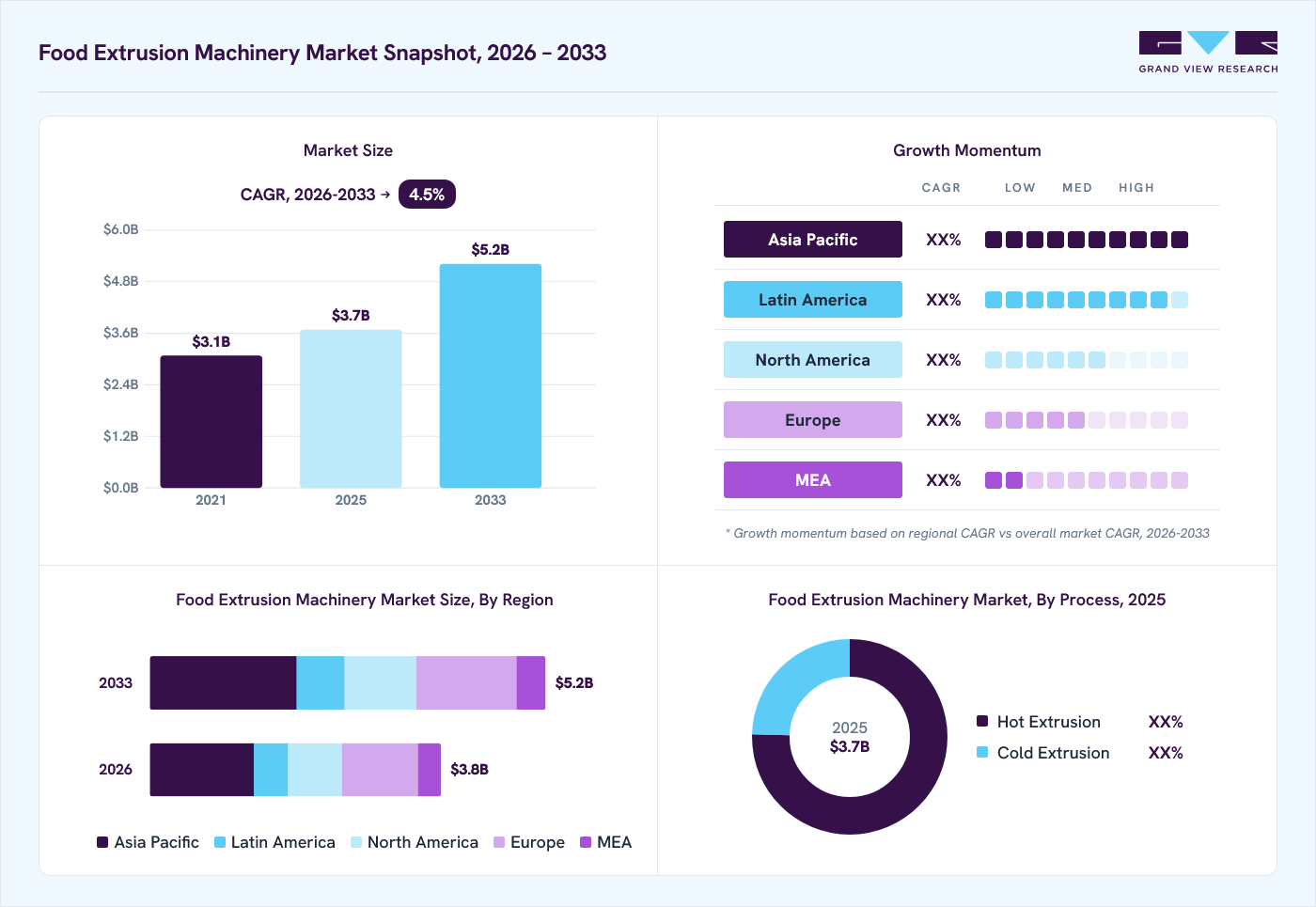 Source: Grand View Research, IR Documents, Primary Interviews, Paid DatabasesTo learn more about this report,
 Download Free Sample Report
Key Market Trends & Insights
- By process: The hot extrusion segment is projected to grow at 4.6% CAGR during the forecast period.
- By extruder type: The twin screw extruder segment dominated the market in 2025, accounting for 56.1% market share.
- By application: The textured protein segment is expected to grow at the fastest CAGR of 5.2% from 2026 to 2033.
Regional Highlights
- Largest regional market: Asia Pacific (35.5% revenue share, 2025)
- By country: China accounted for the largest share in 2025
Market Size & Forecast
- Market Size in 2025: USD 3.7 Billion
- Estimated Market Size in 2026: USD 3.8 Billion
- Projected Market Size by 2033: USD 5.2 Billion
- CAGR (2026-2033): 4.5%
Prism AI by Grand View Research Free to tryAsk a question about the food extrusion machinery market✓Every figure cited from GVR research Prefer the report? Download free sample →
Manufacturers are investing in extrusion machinery to improve production throughput, process consistency, product texturization, and operational flexibility across diverse formulations. The growing use of extrusion for plant-based proteins and specialized food products is further creating demand for advanced systems with improved processing control and product customization capabilities.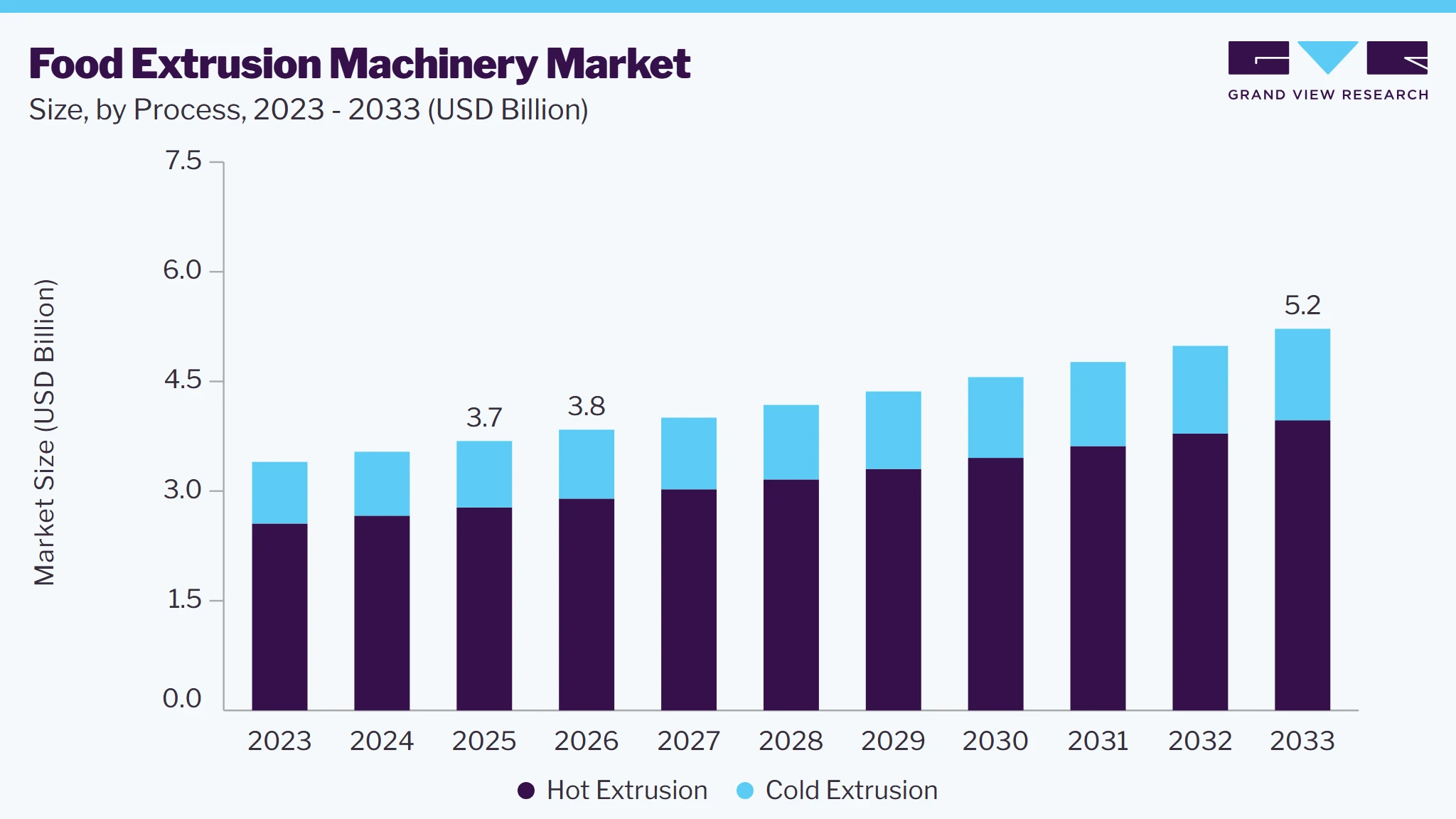 To learn more about this report, Download Free Sample Report
In addition, the expansion of food processing facilities and automation of production lines is encouraging manufacturers to invest in advanced extrusion equipment that offers higher throughput, improved process control, and reduced manual intervention. Technological developments in twin-screw extrusion, energy-efficient systems, and automated monitoring are also supporting equipment upgrades across established and emerging food manufacturing applications.
Market Dynamics
The market is shaped by increasing automation in food processing, modernization of production lines, and demand for high-throughput manufacturing solutions. Equipment adoption is influenced by the need for continuous processing, consistent product quality, efficient material utilization, and precise control of operating parameters. Advances in twin-screw technology, automated controls, thermal management, and process monitoring are enhancing machinery capabilities across diverse food applications.
The expansion of production of snacks, breakfast cereals, pasta, pet food, and ready-to-eat products is driving demand for extrusion-based processing equipment. Extrusion enables integrated cooking, mixing, shaping, and texturization within continuous production lines, supporting high-volume manufacturing and uniform product characteristics. The growing demand for efficient and scalable food processing solutions is prompting manufacturers to upgrade conventional production systems with advanced extrusion equipment.
High capital requirements for advanced extrusion machinery can constrain adoption, particularly among small and medium-sized food processors. Installation, commissioning, auxiliary equipment, and integration with existing production lines can further increase project costs and implementation complexity. Specialized maintenance requirements and the need for trained technical personnel may also influence purchasing decisions and extend equipment replacement cycles.
Growing production of plant-based proteins, functional foods, fortified products, and specialized snacks is creating opportunities for extrusion machinery manufacturers. These applications require precise control over moisture, temperature, shear, and residence time to achieve specific product structures and textures. Demand for advanced twin-screw systems, automated process controls, and application-specific configurations is creating opportunities for equipment suppliers to address evolving formulation and product development requirements.
Market Concentration & Characteristics
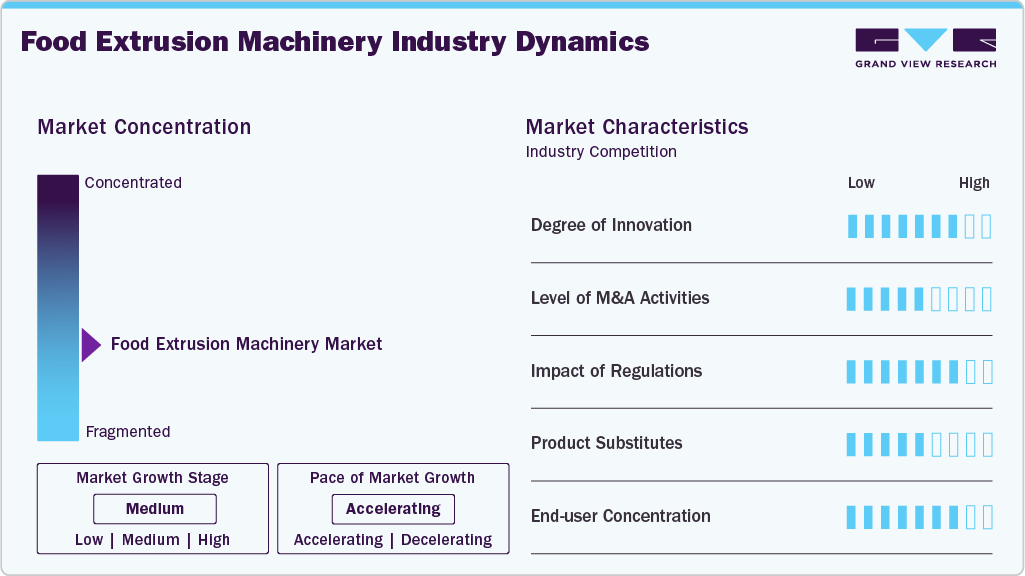
The global food extrusion machinery industry exhibits a moderately consolidated competitive landscape, with established machinery manufacturers holding significant positions alongside specialized and regional suppliers. Competition is driven by extrusion technology, engineering expertise, equipment reliability, processing capacity, and established relationships with food manufacturers. Companies are strengthening their market positions through mergers and acquisitions, strategic partnerships, product portfolio expansion, and geographic capacity development.
The market is characterized by high technological requirements and application-specific equipment design, with entry barriers associated with precision engineering, extrusion process expertise, manufacturing capabilities, and technical service infrastructure. Product differentiation focuses on throughput, energy efficiency, process consistency, automation, and flexibility in handling diverse formulations. Customized screw configurations, dies, feeders, and processing systems are increasingly important for meeting specific product requirements.
 To learn more about this report, Download Free Sample Report
The competitive environment is also influenced by food safety, hygiene, equipment performance, and energy-efficiency standards applicable to food processing machinery. Manufacturers are aligning equipment designs with regulatory and industry requirements while incorporating automated controls, process monitoring, and advanced safety features. Investments in research and development remain important for improving extrusion efficiency, product consistency, and equipment operating performance.
Market dynamics are further shaped by food processing capacity expansion, product diversification, and technological upgrades across developed and emerging markets. Manufacturers are expanding aftermarket service networks, regional distribution capabilities, and technical support to strengthen customer relationships. Strategic collaborations, acquisitions, and new product introductions continue to influence competitive positioning as companies seek to address evolving requirements across snacks, cereals, pet food, pasta, textured proteins, and other extruded food applications.
Analyst Perspective
The market is expected to grow steadily, driven by rising demand for processed foods, snacks, cereals, pasta, textured proteins, pet food, and other extruded products. The increasing adoption of plant-based and protein-enriched foods is driving demand for advanced extrusion systems that offer precise control over texture, moisture, shape, and product quality. Manufacturers are also investing in automated and energy-efficient machinery to improve production efficiency, reduce operating costs, and support flexible manufacturing. Equipment replacement, production capacity expansion, and modernization of food processing facilities are further supporting market growth. From an analyst perspective, manufacturers offering high-throughput, flexible, energy-efficient, and application-specific extrusion machinery are well positioned to benefit from increasing investments in advanced food processing technologies.
Process Insights
Cold extrusion accounted for a 24.6% revenue share, supported by its application in food processing operations where forming, shaping, and structural consistency are important. The process is suitable for products that require controlled mechanical processing without intensive thermal treatment, making it relevant across selected food formulations and product categories. Its established equipment base, operational simplicity, and ability to maintain specific product characteristics continue to support demand for cold extrusion machinery.
Hot extrusion is projected to register the fastest CAGR, driven by its ability to integrate cooking, mixing, forming, shaping, and texturization within a continuous processing operation. The process offers manufacturers greater control over temperature, moisture, shear, and product structure, supporting its use in snacks, breakfast cereals, textured proteins, and other processed food products. Increasing demand for high-throughput production, product innovation, and advanced processing capabilities is encouraging food manufacturers to adopt hot extrusion systems, particularly equipment incorporating automated controls and flexible processing configurations.
Extruder Type Insights
Twin-screw extruders accounted for the largest revenue share, reflecting their broad application across food processing operations requiring efficient mixing, controlled cooking, precise formulation handling, and consistent product texturization. Their ability to process diverse raw materials and accommodate complex formulations makes them suitable for snacks, breakfast cereals, pet food, textured proteins, and other processed food products. The flexibility to adjust screw configurations and operating parameters further supports their adoption in high-throughput and specialized production lines.
Single-screw extruders are projected to register a 4.3% CAGR, supported by their relatively straightforward design, lower operational complexity, and suitability for continuous processing applications. These systems provide consistent extrusion performance for established food products while offering food manufacturers a practical solution for applications with less complex mixing and formulation requirements. Their use across snacks, cereals, pasta, and other extruded products is contributing to continued demand for equipment, particularly where manufacturers prioritize reliable operation and cost-efficient processing.
Application Insights
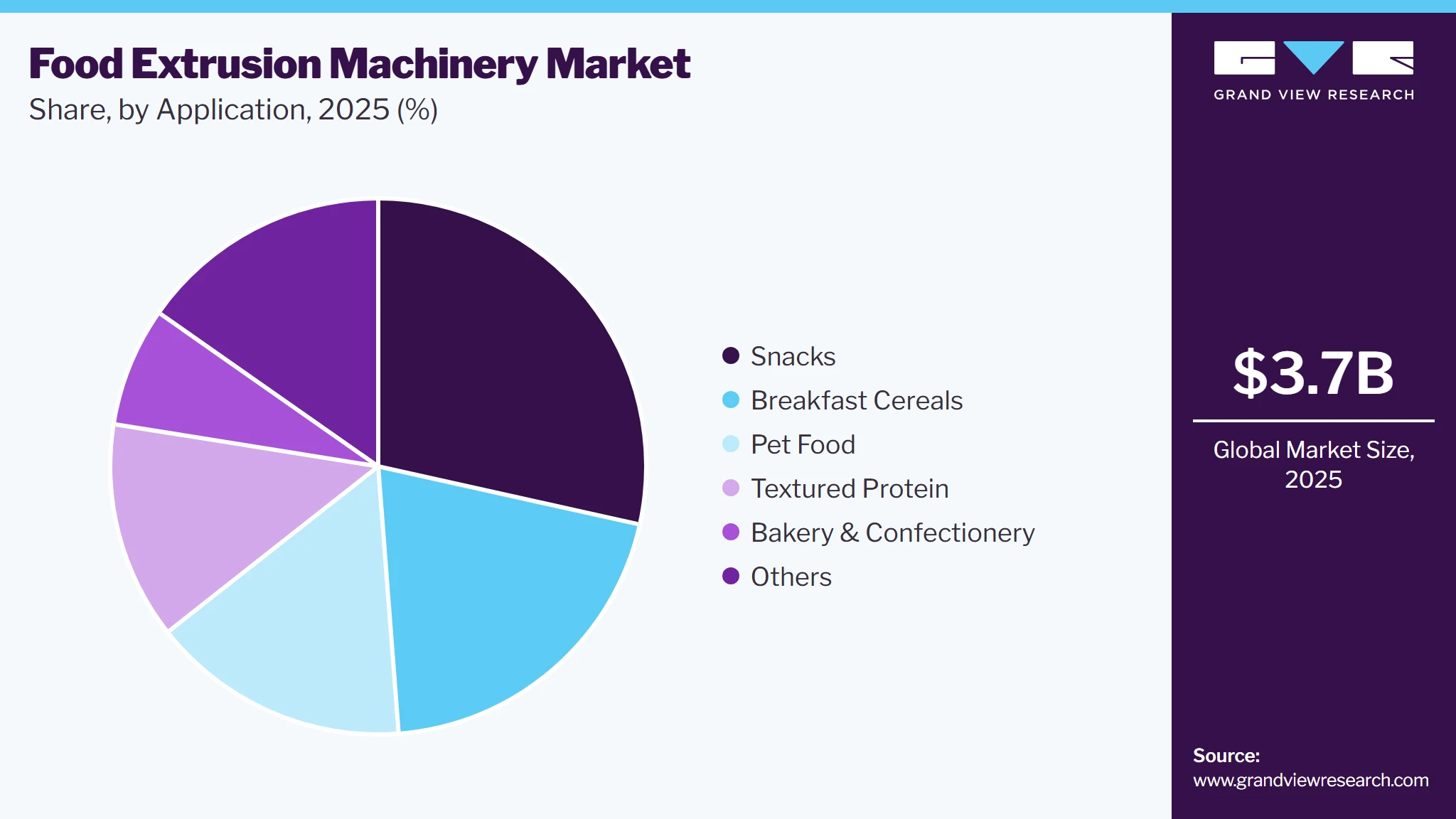
Snacks accounted for the largest revenue share at 28.5%, reflecting extensive use of extrusion technology in producing expanded snacks, savory products, and shaped snack formats. Extrusion machinery enables continuous processing, precise shaping, controlled expansion, and consistent product texture, making it well-suited to high-volume snack manufacturing. Demand for product variety and efficient production lines further supports the use of advanced extrusion equipment in this application.
 To learn more about this report, Download Free Sample Report
Textured protein is projected to register the fastest CAGR, driven by the expanding production of plant-based and alternative protein products. Extrusion technology is increasingly used to develop meat analogs with controlled fiber structure, texture, density, and moisture characteristics. Growing investments in plant-based food processing capacity and demand for products with improved sensory attributes are creating opportunities for high-moisture and twin-screw extrusion systems in textured protein manufacturing.
Regional Insights
Asia Pacific is a high-growth market for food extrusion machinery, supported by the region’s large food manufacturing base, expanding packaged food consumption, and increasing localization of food production. Demand is particularly strong for equipment used in snacks, cereals, noodles, pet food, and other high-volume categories. China and India represent the primary growth centers, while Southeast Asian economies are creating incremental demand through the expansion of regional food manufacturing capacity.
 To learn more about this report, Download Free Sample Report
China Food Extrusion Machinery Market Trends
The food extrusion machinery market in China remains the dominant market in the Asia-Pacific region, benefiting from its extensive processed-food industry and large-scale manufacturing infrastructure. The country has substantial production of extruded snacks, cereals, pet food, and convenience foods, creating a broad installed base for extrusion equipment. Investments in production-line efficiency and higher-capacity processing systems are supporting demand for replacement and new equipment.
India food extrusion machinery marketis progressing toward greater adoption of industrial food processing technologies as packaged food production expands across urban and semi-urban markets. Snack foods, breakfast cereals, instant foods, and pet food provide a growing base of applications for extrusion systems. Development of food processing clusters and investments in manufacturing infrastructure are improving the market potential for domestic and international machinery suppliers.
North America Food Extrusion Machinery Market Trends
The food extrusion machinery market in North America is a mature equipment market characterized by a high installed base, sophisticated food manufacturing operations, and established aftermarket requirements. Replacement of aging machinery, capacity upgrades, and demand for precise processing are important sources of equipment sales. Product innovation in alternative proteins, functional foods, and premium snack categories is also creating requirements for specialized extrusion capabilities.
The U.S. food extrusion machinery market accounts for the largest regional market, supported by its highly developed snack, cereal, pet food, and alternative protein industries. Large-scale manufacturers favor equipment offering high throughput, process repeatability, and integration with automated production lines. The country's strong machinery replacement cycle and continued development of new food formulations provide a stable demand base.
The food extrusion machinery market in Canada is smaller but established, with demand linked to processed food manufacturing, pet food, snacks, and cereal production. Investments in plant upgrades and production efficiency support market development. The country's proximity to the U.S. food manufacturing ecosystem also facilitates access to established extrusion technologies and equipment suppliers.
Europe Food Extrusion Machinery Market Trends
The food extrusion machinery market in Europe is technologically advanced, and equipment purchasing decisions are increasingly influenced by energy consumption, resource efficiency, food safety, and process precision. The region has a diversified food manufacturing base spanning snacks, cereals, pasta, pet food, and specialty products. Replacement demand and equipment modernization remain important, particularly where manufacturers seek improved production efficiency and tighter process control.
Germany food extrusion machinery marketis a prominent European market, supported by its sophisticated food manufacturing sector and strong domestic machinery engineering capabilities. Demand is concentrated among manufacturers operating large-scale and technically demanding production lines. The country's emphasis on industrial efficiency and equipment performance supports the adoption of advanced extrusion technologies.
France food extrusion machinery market maintains an established position in the European market, with demand driven by its diversified food industry and the production of processed and specialty foods. Extrusion equipment is used in selected snack, cereal, pet food, and other applications that require controlled forming and cooking. Growth in value-added food categories provides opportunities for machinery capable of accommodating differentiated product specifications.
Middle East & Africa Food Extrusion Machinery Market Trends
The food extrusion machinery market in MEA is emerging, with demand closely linked to the development of domestic processing capabilities. Governments and private manufacturers are investing in local food production, processing facilities, and supply-chain infrastructure, creating opportunities for industrial equipment suppliers. Adoption remains concentrated in established extrusion applications, with further potential as regional manufacturing capacity expands.
Saudi Arabia's food extrusion machinery market is significantin the region, supported by investments to expand domestic food manufacturing and strengthen food security. The development of packaged foods, snacks, cereals, and other processed foods is creating demand for industrial-scale processing equipment. New manufacturing facilities provide opportunities for suppliers offering complete extrusion lines and integrated processing solutions.
Latin America Food Extrusion Machinery Market Trends
The food extrusion machinery market in Latin America presents growth opportunities, supported by its substantial agricultural output, established food processing industry, and expanding demand for packaged products. Brazil, Argentina, and other large economies provide a broad customer base across snacks, cereals, pet food, and other processed food categories. Machinery demand is influenced by the expansion of value-added processing and the replacement of older production equipment.
Brazil food extrusion machinery market is the largest market in the region, benefiting from its extensive food-processing ecosystem and abundant agricultural raw materials. The country's sizeable snack, cereal, pet food, and processed food industries provide diverse applications for extrusion technology. Investment in higher-capacity production facilities and product diversification is supporting demand for modern extrusion equipment.
Key Food Extrusion Machinery Company Insights
Some of the key players operating in the market include Bühler Group and Coperion, among others.
-
Bühler Group is a Swiss family-owned tech company in the processing industry. The company develops processing technologies, equipment, and services for the food, feed, and advanced materials sectors. Its business activities span research and development, engineering, manufacturing, application solutions, and technical services. Within food processing, Bühler serves areas such as cereals, snacks, pet food, proteins, and food ingredients, with extrusion technology forming an important part of its broader processing portfolio.
-
Coperion is a Germany-based global process technology and equipment company headquartered in Stuttgart, specializing in extrusion, feeding, conveying, and material handling solutions. The company serves diverse industries, including food and pet food, plastics, chemicals, pharmaceuticals, and other process-oriented sectors. Its capabilities span equipment development, process engineering, system integration, plant solutions, and aftermarket services. Within the food processing sector, Coperion provides extrusion and related processing technologies for applications such as snacks, cereals, pet food, plant-based proteins, and specialty food ingredients.
Key Food Extrusion Machinery Companies
The following key companies have been profiled for this study on the food extrusion machinery market:
-
Bühler Group
-
Coperion
-
Baker Perkins
-
GEA Group
-
Wenger Manufacturing, Inc.
-
KAHL Group
-
Clextral
-
The Bonnot Company
-
American Extrusion International
-
Akron Tool & Die
-
Doering Systems, Inc.
-
Egan Food Technologies
-
Schaaf Technologie GmbH
-
Brabender GmbH & Co. KG
-
Triott Group
Competitive Benchmarking
Category
Operating Strategies
Competitive Edge
Weakness
Established Players (e.g., Bühler Group; Coperion; Baker Perkins; GEA Group; Wenger Manufacturing, Inc.; Clextral)
- Develop broad extrusion machinery portfolios covering snacks, breakfast cereals, pet food, textured proteins, and specialty foods.
- Strengthen capabilities through R&D, process automation, application engineering, global service networks, and strategic collaborations.
Strong extrusion technology expertise and integrated processing capabilities.
Established customer relationships, extensive application knowledge, and broad geographic coverage.- High costs associated with R&D, manufacturing infrastructure, and global service operations.
- Broader organizational structures can make highly customized solutions more resource-intensive to develop.
Emerging & Regional Players (e.g., KAHL Group; The Bonnot Company; American Extrusion International; Akron Tool & Die; Doering Systems, Inc.; Egan Food Technologies; Schaaf Technologie GmbH; Brabender GmbH & Co. KG; Triott Group)
- Concentrate on specialized extrusion equipment, customized configurations, and targeted food processing applications.
- Build market presence through technical expertise, customer-specific engineering, regional partnerships, and responsive aftermarket services.
High flexibility in equipment configuration and application-specific engineering.
Strong ability to address niche processing requirements and provide tailored technical solutions.- Smaller geographic footprint and comparatively limited manufacturing capacity.
- Narrower product portfolios and service infrastructure can limit participation in large-scale integrated food-processing projects.
Recent Developments:
-
In May 2026, Bühler Group launched the Nutrex 7 Series, a new generation of twin-screw extrusion systems designed to address food and feed manufacturers’ requirements for improved food safety, process efficiency, and ease of operation. The system incorporates a modular design, enhanced hygienic features, integrated automation, and digital monitoring capabilities to improve process stability and overall equipment efficiency. The extrusion platform is designed for applications including cereals, snacks, pet food, meat alternatives, and food ingredients, strengthening Bühler’s portfolio of advanced food extrusion machinery.
-
In June 2025, GEA Group launched its new GEA Bake Extruder at IBA in Düsseldorf, Germany, targeting medium- to large-scale biscuit manufacturers that require high-speed, flexible production. The system supports wirecut, co-extruded, filled, continuous extruded, and deposited products used in cookies, bars, and biscuits. Its modular configuration, interchangeable dies and cutting systems, servo-driven controls, hygienic design, and integrated process management improve production flexibility, product consistency, and cleaning efficiency. The launch strengthens GEA’s food extrusion machinery portfolio, particularly in high-volume bakery applications.
Food Extrusion Machinery Report Scope
Report Attribute
Details
Market size in 2025
USD 3.7 billion
Estimated market size in 2026
USD 3.8 billion
Projected market size by 2033
USD 5.2 billion
Growth rate
CAGR of 4.5% from 2026 to 2033
Historical data
2021-2025
Forecast period
2026 - 2033
Quantitative units
Revenue in USD billion and CAGR from 2026 to 2033
Report coverage
Revenue forecast, company market position analysis, competitive landscape, growth factors, and trends
Segments covered
Process, extruder type, application, region
Regional scope
North America; Europe; Asia Pacific; Latin America; MEA
Country scope
U.S.; Canada; Mexico; Germany; UK; Italy; Spain; France; China; Japan; India; Australia; South Korea; Brazil; Argentina; Saudi Arabia; UAE; South Africa
Key companies profiled
Bühler Group; Coperion; Baker Perkins; GEA Group; Wenger Manufacturing, Inc.; KAHL Group; Clextral; The Bonnot Company; American Extrusion International; Akron Tool & Die; Doering Systems, Inc.; Egan Food Technologies; Schaaf Technologie GmbH; Brabender GmbH & Co. KG; Triott Group
Customization scope
Free report customization (equivalent up to 8 analysts working days) with purchase. Addition or alteration to country, regional & segment scope.
Pricing and purchase options
Avail customized purchase options to meet your exact research needs. Explore purchase options
Global Food Extrusion Machinery Market Report Segmentation
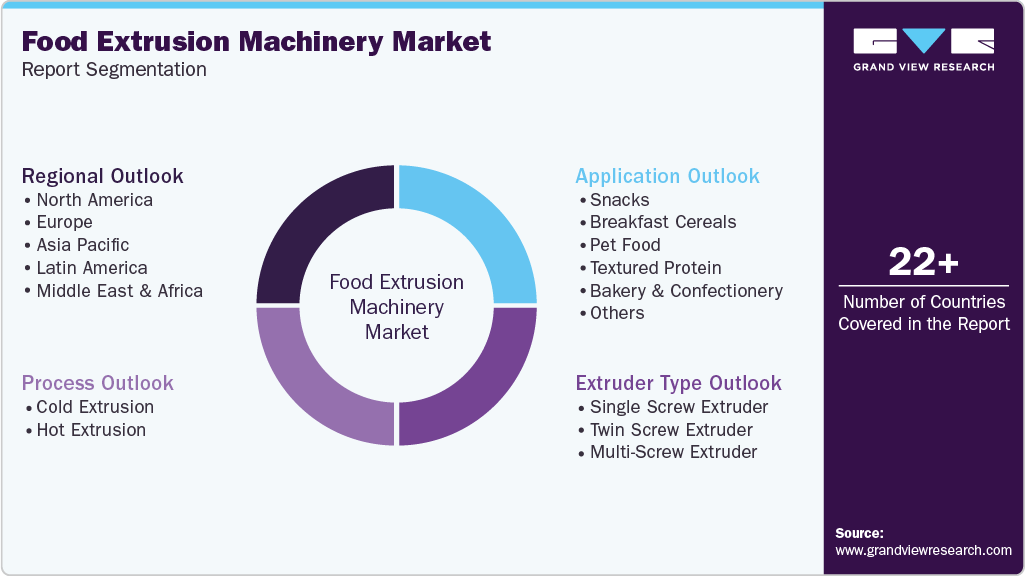
This report forecasts revenue growth at global, regional & country levels and provides an analysis of the industry trends in each of the sub-segments from 2021 to 2033. For this study, Grand View Research has segmented the global food extrusion machinery market based on process, extruder type, application, and region:
 To learn more about this report, Download Free Sample Report
-
Process Outlook (Revenue, USD Billion; 2021 - 2033)
-
Cold Extrusion
-
Hot Extrusion
-
-
Extruder Type Outlook (Revenue, USD Billion; 2021 - 2033)
-
Single Screw Extruder
-
Twin Screw Extruder
-
Multi-Screw Extruder
-
-
Application Outlook (Revenue, USD Billion; 2021 - 2033)
-
Snacks
-
Breakfast Cereals
-
Pet Food
-
Textured Protein
-
Bakery & Confectionery
-
Others
-
-
Regional Outlook (Revenue, USD Billion; 2021 - 2033)
-
North America
-
U.S.
-
Canada
-
Mexico
-
-
Europe
-
Germany
-
France
-
UK
-
Spain
-
Italy
-
-
Asia Pacific
-
China
-
India
-
Japan
-
South Korea
-
Australia
-
-
Latin America
-
Brazil
-
Argentina
-
-
Middle East & Africa
-
Saudi Arabia
-
UAE
-
South Africa
-
-
Research Methodology
The food extrusion machinery market figures in this report are based on a proven research process that combines executive interviews with secondary research from proprietary databases, company filings, and recognized regulatory and institutional sources. Market size is built through value-chain sizing—reconciling supply-side and demand-side estimates—and triangulated with bottom-up and top-down approaches. Every estimate passes multiple levels of expert validation before publication, with eachfood extrusion machinery segment quantified using the revenue-capture definitions in the table below.
Segment Definition
Process
Revenue Capture Definition
Cold Extrusion
Revenue is generated from the sale of food extrusion machinery designed to form, shape, and process food materials under controlled low-temperature conditions, primarily for applications where product structure and raw material characteristics must be maintained.
Hot Extrusion
Revenue is generated from the sale of food extrusion machinery designed to process food materials at elevated temperatures, integrating cooking, mixing, shaping, and texturizing to produce products such as snacks, cereals, pet food, and textured proteins.
Extruder Type
Revenue Capture Definition
Single Screw Extruder
Revenue is generated from the sale of food extrusion machinery equipped with a single rotating screw to convey, mix, cook, form, and shape food materials in continuous processing applications.
Twin Screw Extruder
Revenue is generated from the sale of food extrusion machinery equipped with two screws for enhanced mixing, conveying, cooking, and texturization, particularly for complex formulations and high-throughput applications.
Multi-Screw Extruder
Revenue is generated from the sale of food extrusion machinery with more than two screws, designed for specialized conveying, mixing, and processing requirements in demanding food applications.
Application
Revenue Capture Definition
Snacks
Revenue is generated from the sale of food extrusion machinery used to manufacture expanded, savory, and shaped snack products through continuous processes of cooking, forming, expansion, and texturization.
Breakfast Cereals
Revenue is generated from the sale of food extrusion machinery used to produce extruded cereal products, including shaped cereals, pellets, and other cereal-based formats requiring cooking, forming, and texturization.
Pet Food
Revenue is generated from the sale of food extrusion machinery used to manufacture dry and semi-moist pet food through controlled cooking, shaping, expansion, and moisture management.
Textured Protein
Revenue is generated from the sale of food extrusion machinery used to produce textured vegetable proteins, meat analogs, and other alternative protein products requiring controlled fibrous structure and texture development.
Bakery & Confectionery
Revenue is generated from the sale of food extrusion machinery used for specialized forming, shaping, filling, and texturization processes in bakery and confectionery production.
Others
Revenue is generated from the sale of food extrusion machinery used across other applications, including pasta and noodles, functional foods, specialty foods, and niche extrusion-based products not classified under the defined application segments.
Estimation Model
Layer No.
Layer Name
Key Question
Description
01
Food Processing Demand Layer
Where is food extrusion machinery required?
Analyze demand across savory snacks, breakfast cereals, pasta, textured proteins, pet food, aquafeed, flours & starches, and other processed food applications. Evaluate food production volumes, extrusion-based product output, processing capacity, and manufacturing requirements to establish the addressable demand for food extrusion machinery.
02
Food Manufacturing Capacity Layer
Where is new machinery demand being created?
Assess investments in new food processing plants, production line expansions, capacity additions, modernization projects, and replacement of aging extrusion machinery. Evaluate processed food production trends, expansion of snack and cereal manufacturing, growth of plant-based and texture production, and increasing industrialization of food processing.
03
Segment Adoption Layer
How is demand distributed across the market segments?
Analyze market demand across the three defined segmentation dimensions: process, extruder type, and application. For the process, assess hot and cold extrusion adoption based on cooking, shaping, moisture, temperature, and product requirements. For extruder type, evaluate single-screw, twin-screw, and other applicable configurations based on throughput, mixing, shearing, formulation flexibility, and processing complexity.
04
Revenue Generation Layer
How much market revenue is generated?
Estimate annual sales of new food extrusion machinery across process, extruder type, application, and region. Convert estimated equipment demand into revenue using equipment-specific average selling prices, machine capacity, configuration, and project values. Validate estimates using manufacturer revenues, product portfolios, equipment shipments, production capacity additions, and order activity.
Delivered Customizations
This report has been delivered with the following In-depth customizations
CLIENT REQUEST
CUSTOMIZATION DELIVERED
VALUE ADDS
Competitive Benchmarking
A competitive benchmarking analysis was conducted by evaluating leading food extrusion machinery manufacturers based on product portfolio, extrusion process offerings, extruder types, processing capacity, automation capabilities, application coverage, equipment configurations, manufacturing capabilities, aftermarket services, strategic initiatives, and market positioning.
The benchmarking provided a clear understanding of competitive strengths, technology differentiation, equipment capabilities, product innovation trends, and supplier positioning, enabling stakeholders to assess competitors and develop effective product and market strategies.
Regional Segmentation
A comprehensive regional assessment was provided across key markets, analyzing food extrusion machinery demand across snacks, breakfast cereals, pet food, textured proteins, bakery and confectionery, and other food applications. The analysis considered food processing capacity, packaged food production, manufacturing investments, technology adoption, automation levels, and regional market conditions influencing equipment demand.
The regional analysis helped stakeholders identify high-growth markets, evaluate equipment demand potential, prioritize geographic expansion, and align product portfolios with regional food processing requirements.
Opportunity Assessment
A detailed opportunity assessment was conducted by evaluating emerging food applications, extrusion technology developments, production-line automation, plant-based and textured protein manufacturing, equipment modernization, and demand for energy-efficient and flexible processing systems. The assessment identified growth opportunities across advanced twin-screw extrusion, automated process controls, high-moisture extrusion, and specialized food processing applications.
The assessment enabled stakeholders to prioritize attractive application areas, identify emerging equipment demand, support investment planning, and align product development and commercialization strategies with evolving food processing requirements.
Frequently Asked Questions About This Report
The global food extrusion machinery market size was valued at USD 3.7 billion in 2025 and is projected to reach USD 3.8 billion in 2026.
The global food extrusion machinery market is projected to grow at a CAGR of 4.5% from 2026 to 2033, reaching USD 5.2 billion by 2033.
Asia Pacific dominated the global food extrusion machinery market with the largest revenue share of 35.5% in 2025, supported by expanding food processing capacity, growing packaged food consumption, and increasing investments in food manufacturing equipment.
The hot extrusion segment is projected to grow at a CAGR of 4.6% during the forecast period, driven by its widespread use in cooking, shaping, texturization, and production of various processed food products.
The twin-screw extruder segment dominated the market with a revenue share of 56.1% in 2025.
The textured protein segment is projected to grow at the fastest CAGR of 5.2% from 2026 to 2033.
The snacks segment accounted for the largest revenue share of 28.5% in 2025, reflecting extensive use of extrusion machinery for producing expanded snacks, savory products, and shaped snack formats.
Market growth is driven by increasing demand for processed and convenience foods, expansion of snack and plant-based protein production, greater adoption of automated food processing technologies, and demand for extrusion systems offering improved production efficiency, product consistency, and formulation flexibility.
Key companies include Bühler Group, Coperion, Baker Perkins, GEA Group, Wenger Manufacturing, Inc., KAHL Group, Clextral, The Bonnot Company, American Extrusion International, Akron Tool & Die, Doering Systems, Inc., Egan Food Technologies, Schaaf Technologie GmbH, Brabender GmbH & Co. KG, and Triott Group.
About the Author(s)
Advanced Interior Materials Research Team
Advanced Materials · Advanced Interior MaterialsThis report was authored by the advanced interior materials research team at Grand View Research - comprising two research analysts, one senior research analyst, and one industry expert - with specialized expertise in the advanced interior materials segment of the advanced materials industry. All findings are based on proprietary advanced materials databases, executive interviews, and regulatory analysis, subject to internal peer review prior to publication.
Last Updated:
Speak to Analyst

Customize this report to your needs - add regions, segments, or data points, with 20% free customization.
Or view our licence options:


ISO 9001:2015 & 27001:2022 Certified
We are GDPR and CCPA compliant! Your transaction & personal information is safe and secure. For more details, please read our privacy policy.


