
- Home
- »
- Food Additives & Nutricosmetics
- »
-
Food Preservation Chemicals Market Size Report, 2026-2033GVR Report cover

Food Preservation Chemicals Market (2026 - 2033)
Size, Share & Trends Analysis Report By Product (Organic Preservatives, Inorganic Preservative), By Function (Antimicrobial, Antioxidant), By Application (Bakery & Confectionery, Dairy & Frozen Products), By Region, Forecasts
Market Size, 2025
$3.6BMarket Estimate, 2026
$3.7BMarket Forecast, 2033
$5.2BCAGR, 2026–2033
4.8%Food Preservation Chemicals Market Summary
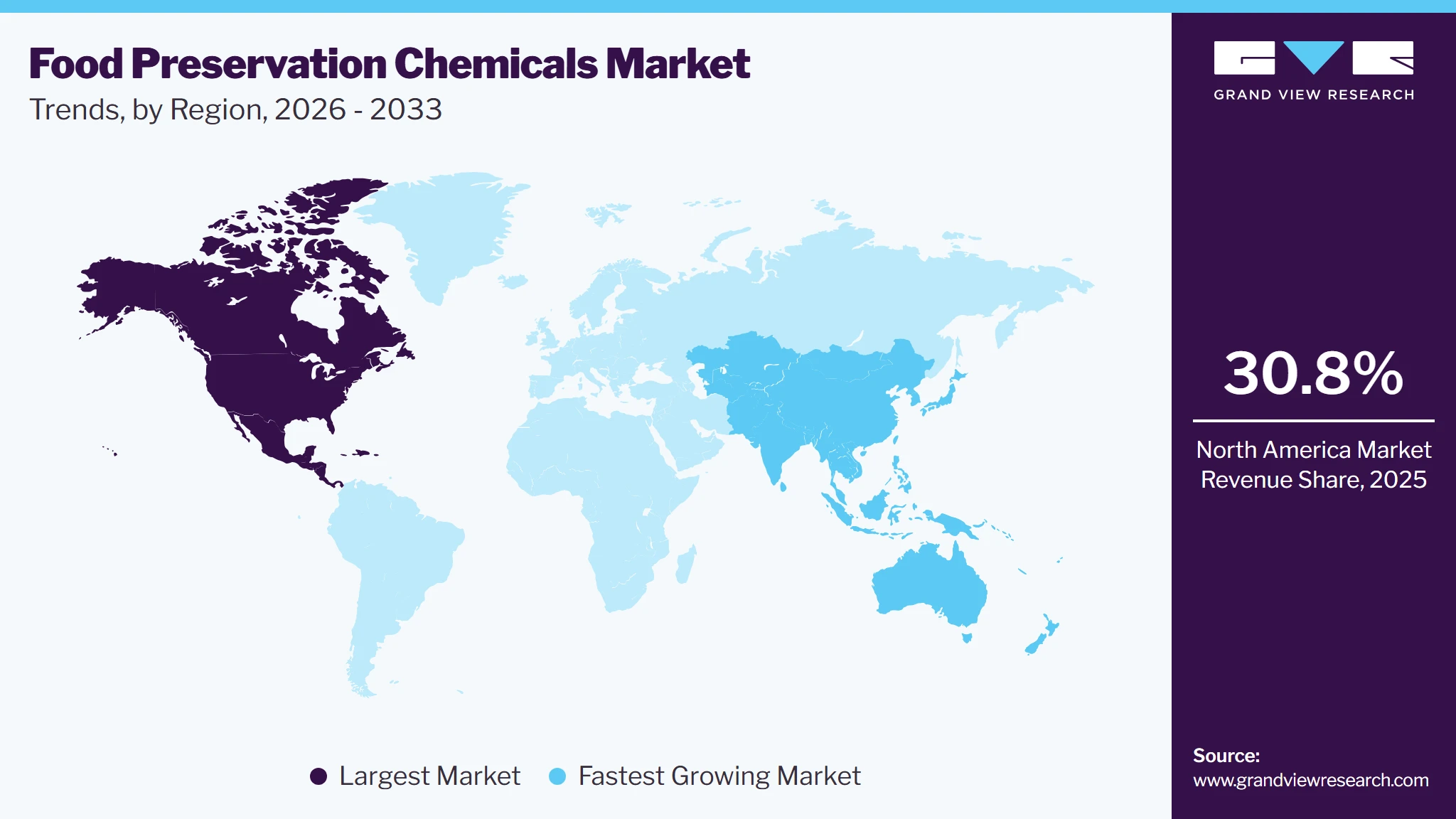
The global food preservation chemicals market size was valued at USD 3.6 billion in 2025 and is projected to grow from USD 3.7 billion in 2026 to USD 5.2 billion by 2033, at a CAGR of 4.8% from 2026 to 2033. North America dominated the market, accounting for the largest revenue share of 30.8% in 2025. Growth is primarily supported by increasing demand for extended shelf life, food safety, clean-label preservation solutions, and the rising consumption of processed and convenience foods worldwide.
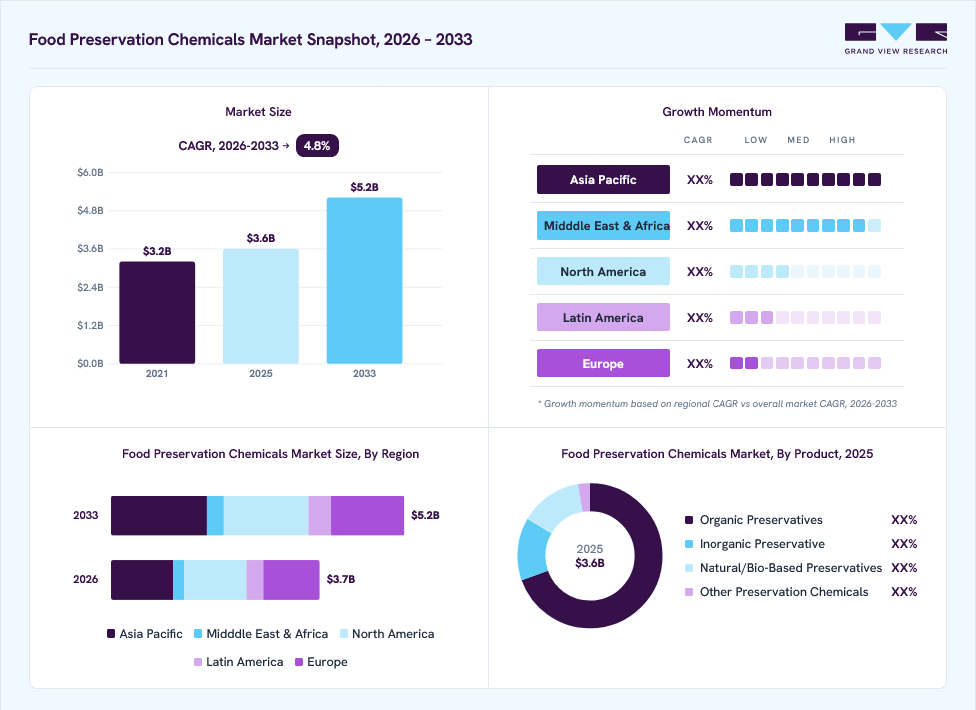 Source: Grand View Research, IR Documents, Primary Interviews, Paid DatabasesTo learn more about this report,
 Download Free Sample Report
Key Market Trends & Insights
- By product: Organic preservatives segment held the largest revenue share of 68.7% in 2025.
- By function: Antimicrobial segment dominated with a share of 72.9% in 2025.
- By application: Bakery & confectionery segment led with a revenue share of 23.7% in 2025.
Regional Highlights
- Largest regional market: North America (30.8% revenue share, 2025)
- Fastest-growing regional market: Asia Pacific (highest CAGR, 2026-2033)
- By country: The U.S. held the largest share in 2025
Market Size & Forecast
- Market size in 2025: USD 3.6 Billion
- Estimated market size in 2026: USD 3.7 Billion
- Projected market size in 2033: USD 5.2 Billion
- CAGR (2026-2033): 4.8%
Prism AI by Grand View Research Free to tryAsk a question about the food preservation chemicals market✓Every figure cited from GVR research Prefer the report? Download free sample →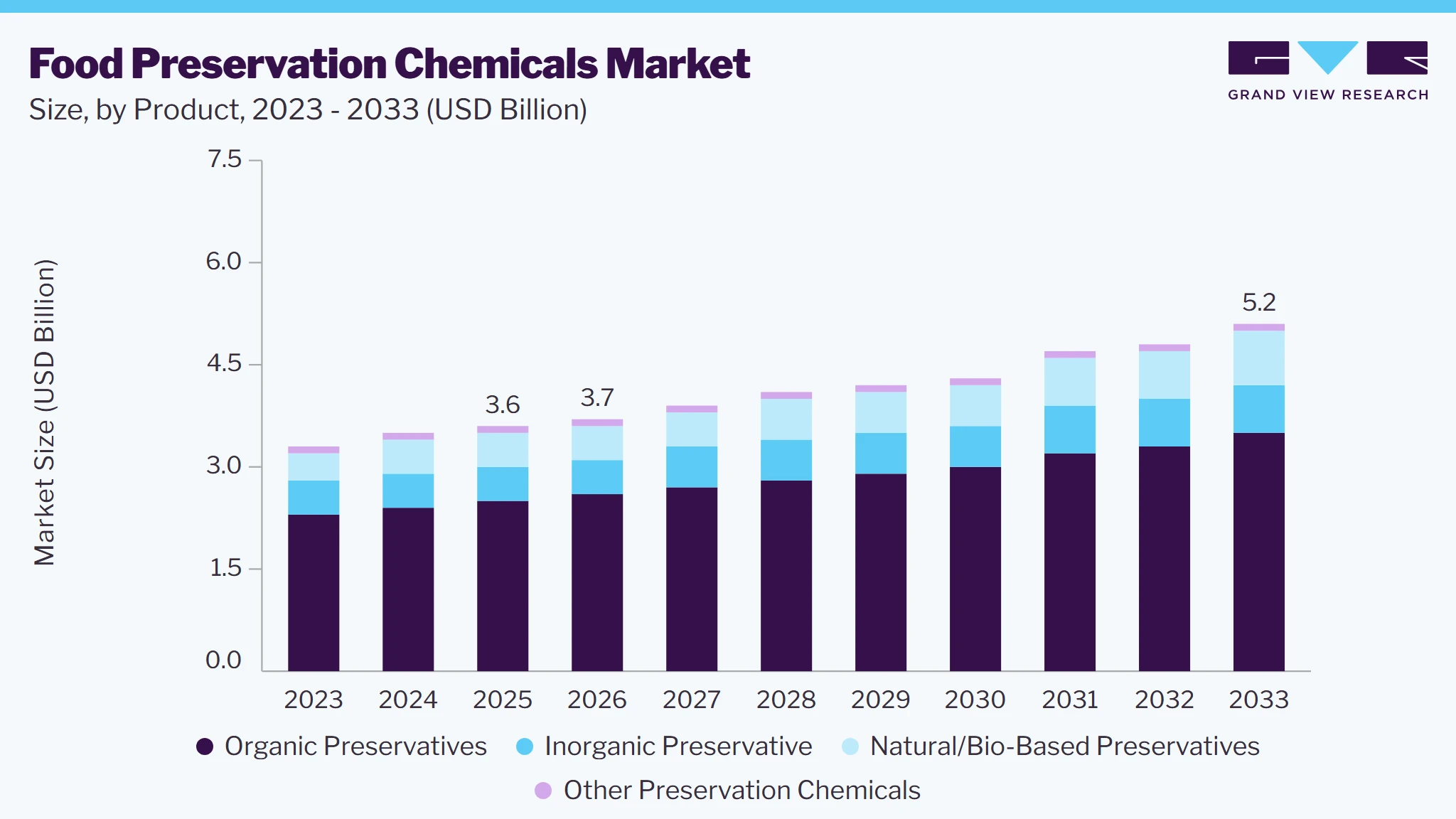 To learn more about this report, Download Free Sample Report
The industry is being shaped by rising demand for extended shelf life, improved food safety, clean-label formulations, and effective control of microbial and oxidative deterioration. Stricter food safety regulations and increasing consumption of processed, packaged, and convenience foods are encouraging manufacturers to develop more effective preservation solutions while maintaining product quality and sensory characteristics.
Market Dynamics
Growing consumer preference for natural and minimally processed foods is accelerating the development of bio-based preservatives, cultured systems, and plant-derived alternatives. Advances in fermentation, formulation technologies, and preservation systems are enabling producers to broaden their portfolios and address application-specific requirements. However, regulatory restrictions on certain preservatives, consumer concerns regarding synthetic ingredients, fluctuating raw material costs, and the technical challenges associated with replacing conventional preservatives remain key constraints.
Growing consumption of packaged, processed, convenience, and ready-to-eat foods is increasing the need for effective preservation systems that maintain product safety and quality throughout distribution and storage. This demand is reinforced by the scale of global food losses; the FAO estimates that 13.3% of food is lost between post-harvest and retail, while fruits and vegetables recorded losses of 25.4% in 2023, highlighting the commercial importance of technologies that can slow microbial spoilage and quality deterioration.
They help manufacturers extend shelf life, reduce spoilage-related losses, and maintain sensory characteristics over longer distribution cycles. The growing penetration of packaged foods and increasingly complex global supply chains is consequently encouraging manufacturers to optimize preservative systems across bakery, dairy, meat, beverage, and processed-food formulations. This creates sustained demand for organic acids, sorbates, benzoates, propionates, antimicrobial agents, antioxidants, and other preservation solutions capable of delivering consistent protection under different storage conditions.
Increasing regulatory scrutiny can constrain product adoption and raise compliance costs for manufacturers. Authorities are placing greater emphasis on the safety assessment, permitted concentrations, labeling, and usage conditions of these products, while manufacturers must continuously demonstrate that their products meet evolving food-safety requirements. For instance, in February 2026, the U.S. FDA initiated a review of BHA as part of a broader reassessment of chemicals used in the food supply, illustrating the heightened scrutiny facing established synthetic preservatives.
The shift toward clean-label is creating significant opportunities for natural and bio-based ingredients such as natamycin, nisin, lysozyme, cultured ingredients, fermented systems, and plant-derived compounds. Consumers are increasingly scrutinizing ingredient lists and perceived as more natural and minimally processed, encouraging food manufacturers to replace or reduce conventional synthetic additives where technically and economically feasible. Research has identified growing consumer interest in clean-label preservatives and highlighted bacteriocins, phytochemicals, and other natural compounds as promising preservation alternatives.
This transition provides manufacturers with opportunities to develop differentiated systems that combine microbial control with clean-label positioning while maintaining the required shelf-life performance. Advances in fermentation, biotechnology, extraction techniques, and formulation science are improving the functionality of natural ingredients and expanding their applicability across bakery, dairy, meat, beverages, and prepared foods. Companies that can overcome limitations related to stability, taste, dosage, and cost while providing reliable performance are well-positioned to capture demand from producers seeking alternatives to conventional synthetic additives.
Market Concentration & Characteristics
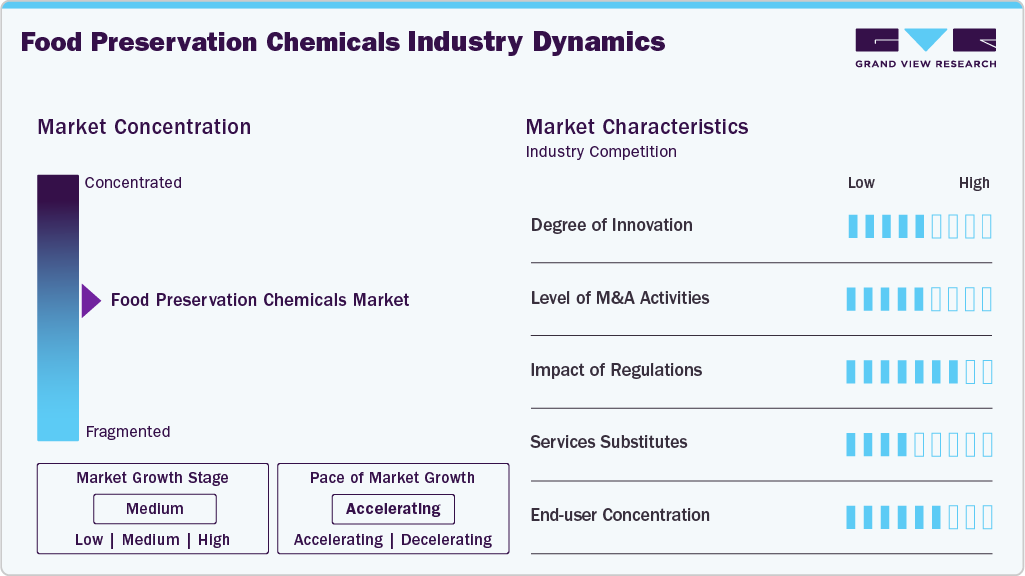
The industry is moderately competitive, with rivalry centered on preservative efficacy, formulation expertise, product quality, regulatory compliance, and reliable supply capabilities. Leading companies are broadening their portfolios across synthetic, natural, fermented, and bio-based preservation solutions to address rising demand for extended shelf life, food safety, clean-label formulations, and minimally processed foods. Investments in fermentation technologies, specialized antimicrobial systems, antioxidant solutions, and application-specific formulations are becoming important differentiators, particularly as food manufacturers seek effective preservation without compromising taste, texture, or product quality.
 To learn more about this report, Download Free Sample Report
Participants are also strengthening their positions through strategic collaborations, product development, capacity expansion, and geographic growth. Manufacturers are increasingly working with food producers to develop tailored preservation systems suited to specific processing conditions, ingredient compositions, shelf-life requirements, and regulatory standards. In addition, investments in sustainable sourcing, production efficiency, quality-control systems, and research are helping suppliers differentiate their offerings. The ability to deliver consistent performance, meet evolving food-safety requirements, maintain competitive pricing, and ensure dependable raw-material availability is becoming increasingly important for sustaining long-term competitive advantage.
Analyst Perspective
The industry is evolving as manufacturers prioritize longer shelf life, product safety, and quality retention across processed and packaged goods. Demand is supported by rising consumption of convenience products, stricter safety standards, and growing interest in clean-label and naturally derived preservation solutions. Advances in fermentation, biotechnology, and plant-based formulations are expanding the range of alternatives to conventional synthetic additives. However, regulatory restrictions on certain preservatives, changing consumer perceptions, and formulation challenges associated with natural alternatives can limit adoption. In our view, suppliers that can deliver effective preservation while maintaining taste, quality, regulatory compliance, and cost efficiency will be better positioned to strengthen their presence.
Product Insights
The organic preservatives segment held the largest revenue share of 68.7% in 2025, reflecting their widespread use across bakery products, beverages, dairy items, meat products, sauces, and processed foods. Sorbates, benzoates, propionates, acetates, and lactates are widely adopted because they provide reliable microbial control, formulation flexibility, and shelf-life extension across diverse food categories. Their established regulatory acceptance, cost effectiveness, and compatibility with large-scale food processing continue to support strong commercial demand.
The natural/bio-based preservatives segment is the fastest-growing segment, with a projected CAGR of 5.9% from 2026 to 2033. Growth is driven by increasing consumer preference for clean-label foods, minimally processed products, and recognizable ingredients. Manufacturers are increasingly incorporating natamycin, nisin, lysozyme, cultured ingredients, fermented preservation systems, and plant-derived compounds to reduce reliance on conventional synthetic additives. Improvements in fermentation technology and formulation performance are also helping overcome some of the effectiveness and stability limitations historically associated with natural preservation systems.
Application Insights
The bakery & confectionery segment held the largest revenue share of 23.7% in 2025, primarily due to the industry's strong requirement for mold control, freshness retention, and extended shelf life. Commercial bread, cakes, pastries, tortillas, fillings, and other baked products are particularly susceptible to microbial spoilage during storage, creating consistent demand for propionates, sorbates, acetates, cultured ingredients, and other preservation systems. The continued expansion of packaged bakery products and longer distribution networks is further supporting consumption.
The convenience & ready-to-eat food segment is expected to grow at a CAGR of 6.2% during the forecast period, supported by changing lifestyles, urbanization, rising demand for quick meal solutions, and expansion of packaged prepared foods. These products require effective preservation to maintain safety, flavor, texture, and freshness throughout extended distribution and storage periods. Increasing availability of chilled meals, prepared salads, packaged snacks, sauces, and other ready-to-consume products is expected to create additional opportunities for antimicrobial, antioxidant, and multifunctional preservation systems.
Function Insights
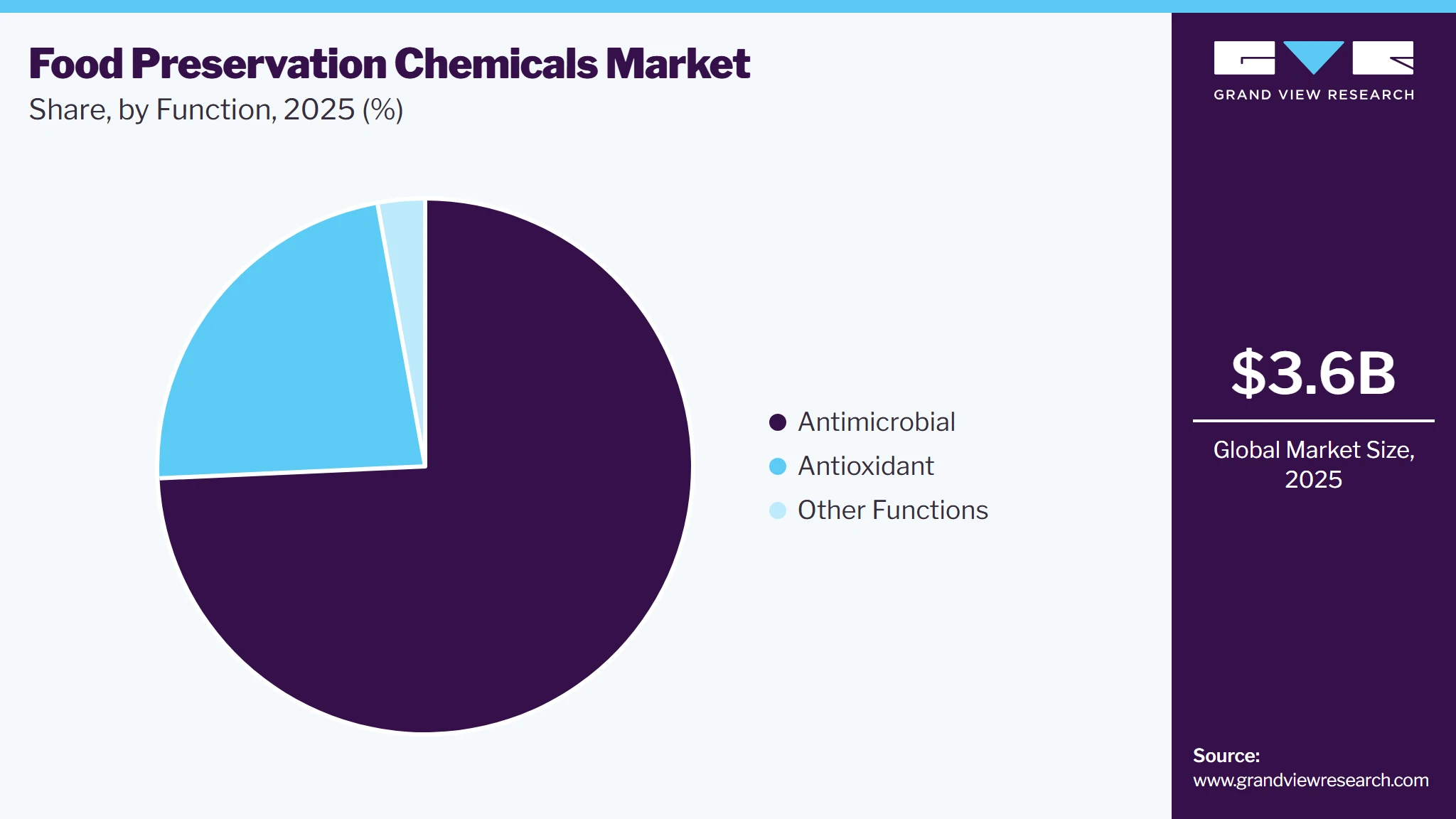
The antimicrobial segment held the largest revenue share of 72.9% in 2025, supported by the fundamental role of microbial control in maintaining food safety and extending product shelf life. Antimicrobial agents are extensively used to inhibit bacteria, yeasts, and molds across meat and seafood, dairy, bakery, beverages, sauces, and ready-to-eat products. Continued demand for packaged and processed foods, combined with stringent food safety requirements, is sustaining the need for effective microbial protection throughout processing, distribution, and storage.
 To learn more about this report, Download Free Sample Report
The antioxidant segment is the fastest-growing segment, with a projected CAGR of 6.2% from 2026 to 2033, making it the fastest-growing function segment. Increasing use of fats, oils, nuts, meat products, snacks, and other oxidation-sensitive ingredients is creating greater demand for solutions that prevent rancidity, discoloration, off-flavors, and nutritional deterioration. The segment is also benefiting from growing interest in natural antioxidant systems derived from botanical and other bio-based sources, as food producers seek preservation technologies that combine functional effectiveness with clean-label positioning.
Regional Insights
The North America food preservation chemicals market led with a revenue share of 30.8% in 2025, supported by its highly developed packaged-food industry, extensive cold-chain infrastructure, and strong demand for products with extended shelf life. The region's mature food-processing sector generates consistent requirements for sorbates, benzoates, propionates, nitrites, antioxidants, and other preservation agents across bakery, dairy, meat, beverages, and ready-to-eat categories. Regulatory oversight also plays an important role, with the U.S. FDA requiring food additives to meet established safety requirements for their intended uses.
 To learn more about this report, Download Free Sample Report
U.S. Food Preservation Chemicals Market Trends
The food preservation chemicals market in the U.S. is supported by its large-scale production of processed, packaged, frozen, and convenience foods. Preservatives are widely used to control microbial deterioration, oxidation, rancidity, and quality loss across baked goods, beverages, cured meats, oils, dressings, snacks, and other processed categories. The FDA specifically recognizes preservatives as ingredients used to prevent spoilage and maintain freshness, while manufacturers must establish the safety of chemicals used at their intended levels.
Asia Pacific Food Preservation Chemicals Market Trends
The food preservation chemicals market in Asia Pacific held a 29.6% revenue in 2025, reflecting the region's expanding processed-food manufacturing base, large consumer population, urbanization, and growing consumption of packaged and convenience products. Demand is particularly supported by the expansion of bakery, beverages, dairy, sauces, ready-to-eat meals, and processed-protein categories. The region also offers significant growth potential for natural and bio-based preservation systems as manufacturers respond to evolving consumer preferences and export-quality requirements. China is a particularly important contributor, with its food preservatives market supported by large-scale production of packaged foods, beverages, sauces, and edible oils.
The China food preservation chemicals market is supported by its extensive food-processing industry and large domestic consumption base. The country's production of packaged foods, beverages, sauces, edible oils, and processed products creates substantial requirements for antimicrobial and antioxidant preservation systems. At the same time, regulatory controls are significant: China's Food Safety Law requires food-additive production to be licensed and stipulates that additives must comply with applicable food-safety standards and undergo safety assessment before being permitted for use.
Europe Food Preservation Chemicals Market Trends
The food preservation chemicals market in Europe represents an established market characterized by sophisticated food-processing industries, stringent food-safety requirements, and strong demand for quality-preserving ingredients. Producers through bakery, dairy, processed meat, beverages, and prepared foods require preservation technologies that can maintain freshness while complying with increasingly rigorous regulatory and labeling expectations. The region is also an important market for naturally derived alternatives, as manufacturers seek preservation systems that can address consumer interest in cleaner ingredient lists while maintaining product stability.
The Germany food preservation chemicals market is one of Europe's important food-processing markets, supported by its large bakery, dairy, meat-processing, convenience-food, and beverage industries. The country's mature manufacturing infrastructure creates recurring requirements for antimicrobial and antioxidant systems that preserve product quality throughout processing, transportation, and retail distribution. Germany is also strategically significant for the competitive landscape; for example, German chemical producer LANXESS initiated the EU anti-dumping case concerning Chinese sodium benzoate imports, highlighting the importance of benzoates and international supply dynamics within the sector.
Middle East & Africa Food Preservation Chemicals Market Trends
The food preservation chemicals market in the Middle East & Africa presents an expanding opportunity as food-processing capacity, packaged-food consumption, urbanization, and modern retail networks continue to develop. Preservation chemicals are increasingly important for products that require longer distribution and storage periods, particularly bakery goods, dairy products, processed meats, beverages, sauces, and convenience foods. In markets where climatic conditions can increase spoilage risks and supply chains involve long transportation distances, effective antimicrobial and antioxidant systems can provide manufacturers with greater flexibility in maintaining product quality and extending commercial shelf life.
Latin America Food Preservation Chemicals Market Trends
The food preservation chemicals market in Latin America offers attractive growth potential due to its expanding processed-food and beverage industries, increasing urbanization, and rising consumption of packaged and convenience products. Brazil, Mexico, Argentina, and other major food-producing economies generate demand for preservation solutions across meat and poultry, bakery, beverages, dairy, sauces, and fruit-based products. The region's strong agricultural and food-processing base also creates opportunities for preservation technologies that help reduce post-processing losses and maintain quality during transportation and distribution.
Key Food Preservation Chemicals Company Insights
Companies are strengthening their position by expanding portfolios of synthetic, natural, and bio-based preservation solutions while investing in fermentation technologies, formulation development, and application-specific preservation systems. They are also pursuing strategic collaborations, capacity expansions, product innovation, and R&D initiatives to improve antimicrobial and antioxidant performance, address clean-label requirements, and meet evolving food-safety standards across bakery, dairy, meat, beverage, and convenience-food applications.
-
BASF SE is a major chemical manufacturer with a portfolio that includes food-grade preservatives and preservation-related chemicals, particularly organic acids and their derivatives used to support food quality and shelf-life extension. The company strengthens its position through product development, technical expertise, and global manufacturing capabilities, serving applications where effective microbial control and consistent product performance are required. Its broad chemical capabilities and established customer relationships enable it to serve food manufacturers seeking reliable preservation solutions while responding to changing regulatory and formulation requirements.
-
Corbion has a strong position in food preservation chemicals through its focus on fermentation-based and bio-based solutions, particularly lactic acid and its derivatives. The company produces lactic acid through carbohydrate fermentation and develops bio-based alternatives for applications including plastics, agrochemicals, coatings, adhesives, and other industrial uses. Corbion is also advancing circular manufacturing through its proprietary lactic acid technology, which recycles process chemicals, improves resource efficiency, and reduces cradle-to-gate greenhouse gas emissions compared with conventional production. Its combination of biotechnology, renewable feedstocks, application expertise, and circular production capabilities provides a differentiated platform for serving customers seeking lower-impact chemical alternatives.
Key Food Preservation Chemicals Companies
The following key companies have been profiled for the study on the food preservation chemicals market.
-
Corbion N.V.
-
Kerry Group plc
-
BASF SE
-
Kemin Industries, Inc.
-
Jungbunzlauer Suisse AG
-
Eastman Chemical Company
-
Celanese Corporation
-
Novonesis A/S
-
Handary S.A.
-
Shandong Freda Biotechnology Co., Ltd.
-
Galactic S.A.
-
Givaudan S.A.
Company Categorization
Operating Strategies
Competitive Edge
Weaknesses
Mature Players: Corbion N.V., Kerry Group plc, BASF SE, Kemin Industries, Inc., Jungbunzlauer Suisse AG, Eastman Chemical Company, Celanese Corporation, Novonesis A/S, Givaudan S.A.
- Expanding portfolios across organic, natural, bio-based, antimicrobial, and antioxidant preservation solutions to serve diverse food applications.
- Investing in R&D, fermentation technologies, formulation science, and application testing to improve preservation performance and shelf-life extension.
- Developing clean-label and naturally derived alternatives in response to changing consumer preferences and evolving food regulations.
- Strengthening relationships with food manufacturers through technical support, customized formulations, and broad global supply networks.
- Established manufacturing capabilities, extensive technical expertise, and strong relationships with food and ingredient manufacturers.
- Broad product portfolios enable participation across bakery, dairy, meat, beverages, and convenience-food applications.
- Strong R&D capabilities support the development of multifunctional, application-specific, and clean-label preservation systems.
- Global production and distribution networks provide a reliable supply and enable manufacturers to serve multinational food companies across regions.
- Large-scale operations can make rapid adaptation to niche preservation trends more challenging.
- Conventional preservation products may face pressure from changing consumer preferences toward naturally derived alternatives.
- Compliance with differing food-additive regulations across countries can increase product registration and commercialization costs.
- Broad portfolios can result in less specialization in certain niche preservation categories compared with dedicated specialists.
Emerging Players: Handary S.A., Shandong Freda Biotechnology Co., Ltd., Galactic S.A..
- Focusing on natural, fermentation-derived, and specialized preservation ingredients targeting clean-label and minimally processed food applications.
- Concentrating R&D efforts on targeted antimicrobial solutions such as natamycin, nisin, organic acids, and related preservation technologies.
- Establishing partnerships with food manufacturers and distributors to increase product validation and market penetration.
- Expanding manufacturing capabilities, certifications, and geographic reach to strengthen acceptance among international food producers.
- Specialized portfolios allow these companies to respond quickly to demand for natural and bio-based preservation alternatives.
- Focused technical expertise can support customized solutions for specific food matrices and shelf-life requirements.
- Greater organizational flexibility can facilitate faster product development and adaptation to emerging formulation trends.
- Strong positioning in niche preservation categories provides differentiation from diversified chemical manufacturers.
- Relatively smaller manufacturing capacity can restrict their ability to supply large multinational food producers on a large scale.
- Limited financial resources may constrain extensive R&D programs, international expansion, and production investments.
- Dependence on specific biological or fermentation-based raw materials can create supply and cost variability.
- Smaller international distribution networks may limit market access and customer reach compared with established global suppliers.
Recent Developments
-
In July 2026, Novonesis A/S entered into an agreement with TurtleTree to scale, manufacture, and commercialize precision-fermented lactoferrin, while also making a minority investment in the company, strengthening its biotechnology-based manufacturing capabilities.
-
In July 2026, Galactic S.A. launched Galimax Flavor V-100 Pearls, a low-dust granulated vinegar preservation solution designed to provide antimicrobial protection while improving handling and formulation performance. The launch strengthens Galactic’s portfolio of vinegar-based preservation solutions for food manufacturers.
Food Preservation Chemicals Market Report Scope
Report Attribute
Details
Market size value in 2025
USD 3.6 billion
Estimated market size in 2026
USD 3.7 billion
Revenue forecast in 2033
USD 5.2 billion
Growth rate
CAGR of 4.8% from 2026 to 2033
Base year for estimation
2025
Historical data
2021 - 2024
Forecast period
2026 - 2033
Quantitative units
Revenue in USD billion, and CAGR from 2026 to 2033
Report coverage
Revenue forecast, volume forecast, company ranking, competitive landscape, growth factors, and trends
Segments covered
Product, function, application, region
Regional scope
North America; Europe; Asia Pacific; Latin America; Middle East & Africa
Country scope
U.S.; Canada; Mexico; Germany; UK; France; Italy; Spain; China; India; Japan; South Korea; Brazil; Argentina; Saudi Arabia; South Africa.
Key companies profiled
Corbion N.V.; Kerry Group plc; BASF SE; Kemin Industries, Inc.; Jungbunzlauer Suisse AG; Eastman Chemical Company; Celanese Corporation; Novonesis A/S; Handary S.A.; Shandong Freda Biotechnology Co., Ltd.; Galactic S.A.; Givaudan S.A.
Customization scope
Free report customization (equivalent up to 8 analysts’ working days) with purchase. Addition or alteration to country, regional & segment scope.
Pricing and purchase options
Avail customized purchase options to meet your exact research needs. Explore purchase options
Food Preservation Chemicals Market Report Segmentation
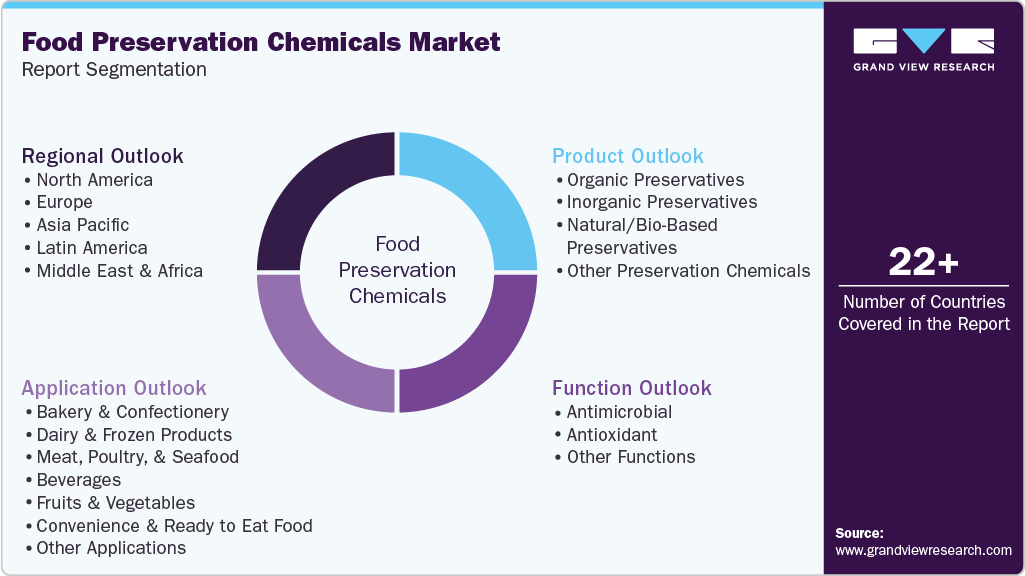
This report forecasts revenue growth at the global, regional, and country levels and provides an analysis of the latest industry trends in each of the sub-segments from 2021 to 2033. For this study, Grand View Research has segmented the global food preservation chemicals market report based on product, function, application, and region:
 To learn more about this report, Download Free Sample Report
-
Product Outlook (Revenue, USD Billion, 2021 - 2033)
-
Organic Preservatives
-
Sorbates
-
Benzoates
-
Propionates
-
Acetates
-
Lactates
-
Other Organic Preservatives
-
-
Inorganic Preservatives
-
Nitrites & Nitrates
-
Sulfites & Sulfur Dioxide
-
Other Inorganic Preservatives
-
-
Natural/Bio-Based Preservatives
-
Natamycin
-
Nisin
-
Lysozyme
-
Cultured/Fermented Preservatives
-
Plant Derived Preservatives
-
Other Natural Preservatives
-
-
Other Preservation Chemicals
-
-
Function Outlook (Revenue, USD Billion, 2021 - 2033)
-
Antimicrobial
-
Antioxidant
-
Other Functions
-
-
Application Outlook (Revenue, USD Billion, 2021 - 2033)
-
Bakery & Confectionery
-
Dairy & Frozen Products
-
Meat, Poultry, & Seafood
-
Beverages
-
Fruits & Vegetables
-
Convenience & Ready to Eat Food
-
Other Applications
-
-
Regional Outlook (Revenue, USD Billion, 2021 - 2033)
-
North America
-
U.S.
-
Canada
-
Mexico
-
-
Europe
-
UK
-
Germany
-
France
-
Italy
-
Spain
-
-
Asia Pacific
-
China
-
Japan
-
India
-
South Korea
-
-
Latin America
-
Brazil
-
Argentina
-
-
Middle East and Africa (MEA)
-
South Africa
-
Saudi Arabia
-
-
Research Methodology
The food preservation chemicals market figures in this report are based on a proven research process that combines executive interviews with secondary research from proprietary databases, company filings, and recognized regulatory and institutional sources. Market size is built through value-chain sizing—reconciling supply-side and demand-side estimates—and triangulated with bottom-up and top-down approaches. Every estimate passes multiple levels of expert validation before publication, with each food preservation chemicals segment quantified using the revenue-capture definitions in the table below.
Segment Definition
Segment - Product
Revenue capture definition
Organic Preservatives
Commercial demand is generated by the use of sorbates, benzoates, propionates, acetates, and lactates to inhibit microbial growth and extend the shelf life of bakery products, beverages, dairy items, processed foods, and other formulations.
Inorganic Preservatives
Revenue generation is supported by nitrites, nitrates, sulfites, sulfur dioxide, and related compounds used to control microbial activity, preserve color, and maintain product quality across meat, seafood, beverages, and processed food applications.
Natural/Bio-Based Preservatives
Value creation is driven by growing utilization of natamycin, nisin, lysozyme, cultured ingredients, fermented systems, and plant-derived compounds as alternatives to conventional synthetic preservation solutions, particularly in clean-label and minimally processed foods.
Other Preservation Chemicals
Market revenues are supported by specialized antimicrobial, antioxidant, and multifunctional preservation systems designed to control spoilage, oxidative degradation, and microbial contamination across diverse food formulations.
Segment - Function
Revenue capture definition
Antimicrobial
Industry demand is centered on preservation agents that inhibit or control bacteria, yeasts, molds, and other microorganisms, supporting extended shelf life and product safety across food and beverage formulations.
Antioxidant
Business expansion is supported by compounds that delay oxidation, protect fats and oils from rancidity, maintain flavor and appearance, and preserve nutritional quality during processing and storage.
Other Functions
Market momentum is driven by preservation ingredients providing complementary benefits such as acidity regulation, mold inhibition, freshness retention, stabilization, and quality maintenance across specialized food applications.
Segment - Application
Revenue capture definition
Bakery & Confectionery
Industry consumption is driven by preservatives that inhibit mold growth, maintain freshness, and extend the usable life of bread, cakes, pastries, fillings, and confectionery products.
Dairy & Frozen Products
Commercial adoption is supported by preservation systems that control microbial development and oxidation while maintaining quality, taste, texture, and stability throughout refrigerated and frozen storage.
Meat, Poultry, & Seafood
Business activity is fueled by preservation agents used to suppress microbial growth, maintain color, delay oxidation, and extend the storage life of fresh and processed protein products.
Beverages
Demand is generated by antimicrobial and antioxidant systems that protect beverages from spoilage, flavor deterioration, and oxidative changes while supporting longer shelf stability.
Fruits & Vegetables
Growth is encouraged by preservation solutions that reduce microbial deterioration, oxidative damage, discoloration, and quality loss during processing, transportation, and storage.
Convenience & Ready to Eat Food
Market adoption is strengthened by preservation technologies that extend shelf life and maintain sensory quality in prepared meals, sauces, snacks, salads, and other minimally processed or ready-to-consume products.
Other Applications
Industry utilization is supported by preservation chemicals used across specialized food categories, including sauces, condiments, pet food, processed ingredients, and other formulations requiring improved stability and shelf life.
Estimation Model
Layer No.
Layer Name
Key Question
Description
01
Raw Material & Production Layer
What forms the supply base?
Identify the feedstocks, renewable resources, recycled materials, bio-based inputs, and low-carbon energy sources used to manufacture sustainable chemicals. Assess biomass availability, waste and recycled feedstock streams, fermentation systems, chemical recycling technologies, carbon utilization, renewable energy integration, process efficiency, production capacities, sustainable sourcing infrastructure, and major manufacturing hubs supporting global supply.
02
Application Adoption Layer
Where is food preservation chemicals utilized?
Evaluate the adoption of sustainably produced chemicals across packaging, automotive, construction, agriculture, consumer goods, electronics, pharmaceuticals, textiles, coatings, adhesives, and other industrial sectors. Demand is influenced by decarbonization commitments, regulatory requirements, circular-economy targets, renewable-content preferences, and the growing need for lower-impact chemical inputs.
03
Consumption Intensity Layer
How extensively is food preservation chemicals consumed?
Analyze consumption patterns by examining the use of bio-based chemicals, recycled-content chemicals, renewable-feedstock derivatives, low-carbon intermediates, and other sustainable alternatives across major end-use industries. The assessment considers manufacturing output, substitution rates, sustainable-content requirements, production technologies, application intensity, customer procurement policies, and the availability of suitable alternatives to conventional fossil-based chemicals.
04
Revenue Layer
How is market revenue generated?
Market value is generated through the production, processing, formulation, commercialization, and supply of chemicals manufactured using renewable, recycled, bio-based, or lower-carbon production pathways. Revenue growth is supported by investments in sustainable production facilities, adoption of circular feedstocks, technological advancements in biotechnology and chemical recycling, expansion of low-carbon product portfolios, and increasing procurement of environmentally differentiated chemical solutions by downstream industries.
Delivered Customizations
This report has been delivered with the following In-depth customizations
Client Request
Customization Delivered
Value Adds
Regional segmentation
The assessment provides country-level market sizing and forecasts, along with demand analysis by product category, production pathway, and end-use industry. It evaluates the adoption of bio-based, renewable, recycled, and low-carbon chemicals across packaging, automotive, construction, agriculture, pharmaceuticals, electronics, textiles, coatings, adhesives, and other industrial sectors. The analysis also considers feedstock availability, domestic manufacturing capabilities, import-export dynamics, production capacity, sustainability regulations, infrastructure, competitive positioning, and investment activity across individual countries.
Supports geographic expansion, sourcing strategies, manufacturing footprint decisions, and investment prioritization by identifying regions with strong feedstock availability, favorable regulatory conditions, growing customer demand, and expanding sustainable production infrastructure.
Opportunity Assessment
Comprehensive evaluation of emerging opportunities across bio-based chemicals, circular feedstocks, chemical recycling, biomass conversion, fermentation technologies, carbon utilization, renewable energy integration, and low-carbon production processes. The assessment examines technological developments, corporate decarbonization targets, regulatory incentives, circular-economy initiatives, and increasing demand for sustainable chemical inputs across major downstream industries.
Helps identify high-potential technologies, applications, and investment areas by highlighting changes in feedstock availability, production economics, sustainability requirements, and customer preferences. The findings support portfolio development, technology investments, strategic partnerships, capacity planning, and market-entry decisions.
Competitive Benchmarking
Comparative assessment of leading manufacturers based on sustainable product portfolios, renewable and recycled feedstock capabilities, production technologies, manufacturing capacity, carbon-reduction initiatives, R&D capabilities, geographic footprint, sustainability credentials, strategic partnerships, and expansion activities. The benchmarking also examines supply-chain integration, operational efficiency, technology commercialization, customer relationships, and the ability to deliver cost-effective sustainable alternatives to conventional chemicals.
Enables companies to assess their competitive standing by identifying technological strengths, capability gaps, differentiation opportunities, and areas requiring further investment. The insights support decisions related to sustainable portfolio expansion, technology acquisition, production upgrades, strategic collaborations, and long-term competitive positioning.
Frequently Asked Questions About This Report
Some of the key players operating in the food preservation chemicals market include Corbion N.V.; Kerry Group plc; BASF SE; Kemin Industries, Inc.; Jungbunzlauer Suisse AG; Eastman Chemical Company; Celanese Corporation; Novonesis A/S; Handary S.A.; Shandong Freda Biotechnology Co., Ltd.; Galactic S.A.; Givaudan S.A.
Key factors driving the food preservation chemicals market include rising consumption of processed, packaged, and ready-to-eat foods, which increases the need for extended shelf life and product stability. Growing food-safety requirements and consumer demand for clean-label and naturally derived preservation solutions are further encouraging innovation and adoption across major food categories.
The food preservation chemicals market size was estimated at 3.6 billion in 2025 and is estimated to reach USD 3.7 billion in 2026.
The food preservation chemicals market is projected to grow at CAGR of 4.8% from 2026 to 2033 and is expected to reach USD 5.2 billion in 2033.
Antimicrobial accounted for the largest share of the food preservation chemicals market in 2025, representing 72.9% of total revenue, due to the widespread use of preservation agents to inhibit microbial growth, enhance food safety, and extend shelf life across major food categories
North America led with a revenue share of 30.8% in 2025 supported by its highly developed packaged-food industry, extensive cold-chain infrastructure, and strong demand for products with extended shelf life.
Organic preservatives held the largest revenue share of 68.7% in 2025, reflecting their widespread use across bakery products, beverages, dairy items, meat products, sauces, and processed foods.
Bakery & confectionery held the largest revenue share of 23.7% in 2025, primarily due to the industry's strong requirement for mold control, freshness retention, and extended shelf life.
Asia Pacific is the fastest growing region with a CAGR of 6.3% in the forecast period, reflecting the region's expanding processed-food manufacturing base, large consumer population, urbanization, and growing consumption of packaged and convenience products.
About the Author(s)
Food Additives & Nutricosmetics Research Team
Specialty & Chemicals · Food Additives & NutricosmeticsThis report was authored by the food additives & nutricosmetics research team at Grand View Research - comprising two research analysts, one senior research analyst, and one industry expert - with specialized expertise in the food additives & nutricosmetics segment of the specialty & chemicals industry. All findings are based on proprietary specialty & chemicals databases, executive interviews, and regulatory analysis, subject to internal peer review prior to publication.
Last Updated:
Speak to Analyst

Customize this report to your needs - add regions, segments, or data points, with 20% free customization.
Or view our licence options:


ISO 9001:2015 & 27001:2022 Certified
We are GDPR and CCPA compliant! Your transaction & personal information is safe and secure. For more details, please read our privacy policy.


