
- Home
- »
- Advanced Interior Materials
- »
-
Food Vacuum Machine Market Size & Share Report, 2033GVR Report cover

Food Vacuum Machine Market (2026 - 2033)
Size, Share & Trends Analysis Report By Machine Type (Chamber Vacuum Machine, External Vacuum Machine), By Automation (Automatic, Semi-automatic), By End-use (Food Processing, Food Retail), By Region, And Segment Forecasts
Market Size, 2025
$16.1BMarket Estimate, 2026
$16.9BMarket Forecast, 2033
$24.3BCAGR, 2026–2033
5.3%Food Vacuum Machine Market Summary
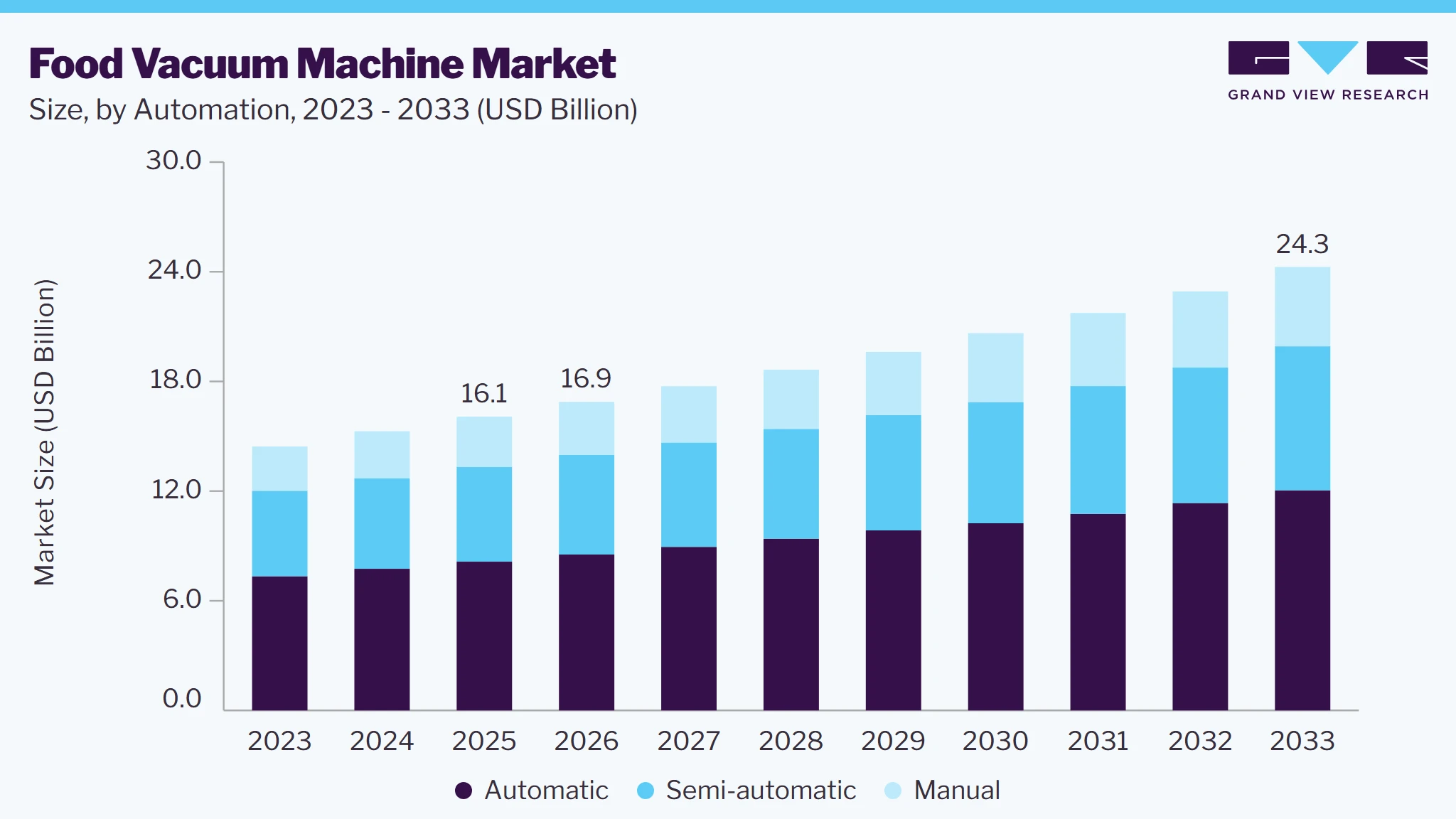
The global food vacuum machine market size was valued at USD 16.1 billion in 2025 and is projected to grow from USD 16.9 billion in 2026 to USD 24.3 billion by 2033, at a CAGR of 5.3% from 2026 to 2033. Asia Pacific dominated the market, accounting for a revenue share of 38.3% in 2025. The market growth is driven by the need to extend the shelf life of perishable food products and maintain quality during storage, handling, and distribution.
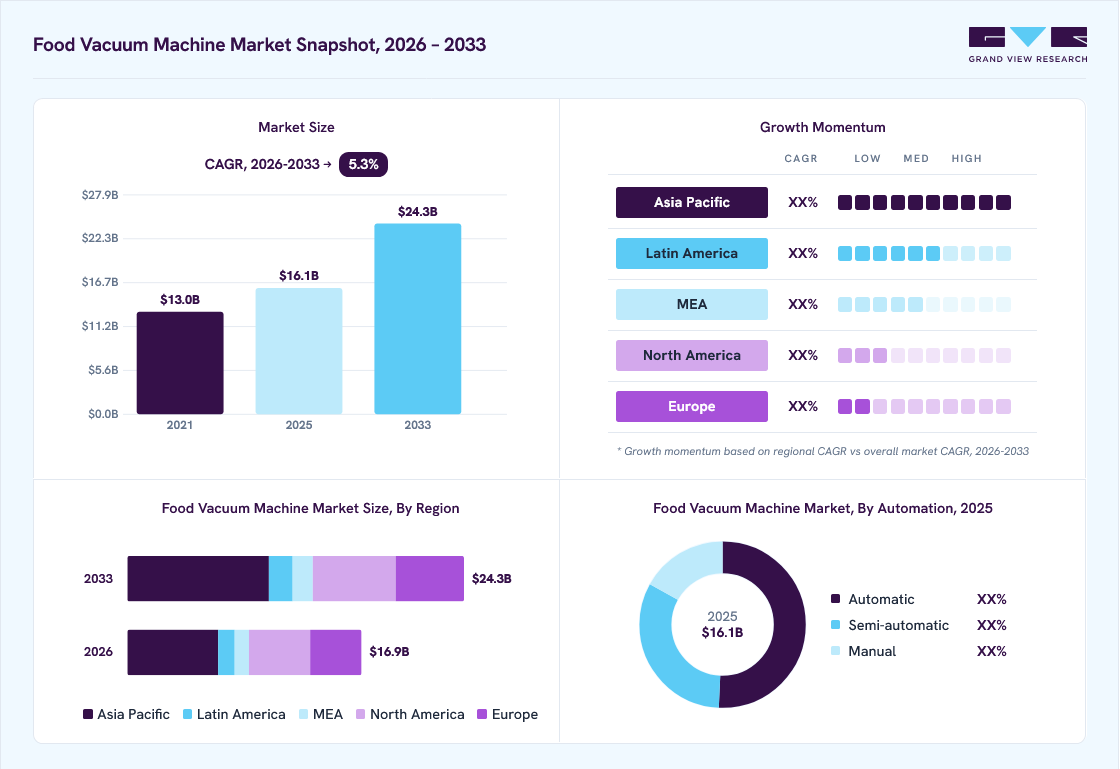 Source: Grand View Research, IR Documents, Primary Interviews, Paid DatabasesTo learn more about this report,
 Download Free Sample Report
 Key Market Trends & Insights
- By machine type: Chamber vacuum machine segment held the largest market share of 39.0% in 2025.
- By automation: Manual segment is expected to grow at the fastest CAGR of 5.9% from 2026 to 2033.
- By end-use: Food processing segment represented the largest share of the global food vacuum machine industry in 2025, accounting for 51.7% of revenue.
Regional Highlights
- Largest regional market: Asia Pacific (38.3% revenue share, 2025)
- By country: China held the largest market share in 2025.
Market Size & Forecast
- Market size in 2025: USD 16.1 Billion
- Estimated market size in 2026: USD 16.9 Billion
- Projected market size by 2033: USD 24.3 Billion
- CAGR (2026-2033): 5.3%
Three ways to get this report
Buy it, customize it, or ask a question.Ask an Analyst
Analyst response in 1 business day
- AccessReport author, directly
- Reply timeWithin 1 working day
- No sales callDirect answer only
- FormatEmail reply
- CostFree, no cost
Get the Full Report
What the study covers
- FormatsPDF · Excel · Dashboard
- Timeline2026–2033 annual, 2025 base
- Coverage20+ countries, 5 regions
- Companies10+ key players profiled
Customize the Report
20% free customization
- IncludeCountries, segments, points
- TailorTo your product definition
- ExtendDeeper competitor detail
- OrA fully bespoke study
- Turnaround5–10 working days
Meat, seafood, dairy, and processed food manufacturers rely on vacuum packaging to limit oxygen exposure, retard oxidation, and reduce packaging-related product deterioration. The expansion of packaged food production, organized retail, and cold-chain infrastructure is strengthening equipment demand across industrial food processing plants, commercial kitchens, and food packaging facilities.
 To learn more about this report, Download Free Sample Report
 Additionally, the increasing demand for packaged convenience foods and portion-controlled products is creating opportunities for vacuum machine manufacturers to address diverse processing requirements. Food processors are investing in automated systems to maintain uniform sealing quality, increase packaging throughput, and accommodate continuous production operations. Equipment selection is increasingly influenced by chamber capacity, sealing configuration, compatibility with packaging materials, and the characteristics of the food being processed.
Market Dynamics
The global food vacuum machine market is shaped by changes in food manufacturing practices, preservation requirements, packaging technology, and capital investment across processing facilities. Demand varies with food composition, production scale, packaging specifications, and the technical demands of individual processing environments. Market development also reflects differences in equipment affordability, automation readiness, maintenance capabilities, and the commercial priorities of food producers.
The expansion of ready-to-cook meals, portioned food products, processed meat, seafood, and specialty dairy is increasing the requirement for packaging systems capable of maintaining product integrity throughout commercial distribution. Vacuum packaging enables manufacturers to reduce air exposure within sealed packs, helping control oxidation and preserve product quality. Its adoption is particularly relevant to producers supplying supermarkets, institutional kitchens, foodservice operators, and export markets, where packaging consistency and inventory management influence commercial performance.
Vacuum packaging is not equally suitable for every food category, creating technical constraints on the application of equipment. Products with delicate structures may undergo compression, while foods containing liquids or releasing moisture can complicate air extraction and sealing operations. Certain fresh products also require packaging conditions that account for respiration, microbial behavior, and product-specific preservation requirements. These considerations necessitate appropriate machine configurations and process adjustments, increasing operational complexity for manufacturers handling varied product portfolios.
The integration of vacuum machines with digital process controls, automated loading systems, and production-line monitoring presents opportunities for equipment suppliers to address increasingly sophisticated manufacturing requirements. Sensors and programmable operating parameters can facilitate cycle monitoring, improve process repeatability, and help identify deviations in vacuum or sealing performance. Connectivity with broader packaging lines can also improve production coordination and reduce dependence on isolated manual operations.
Market Concentration & Characteristics
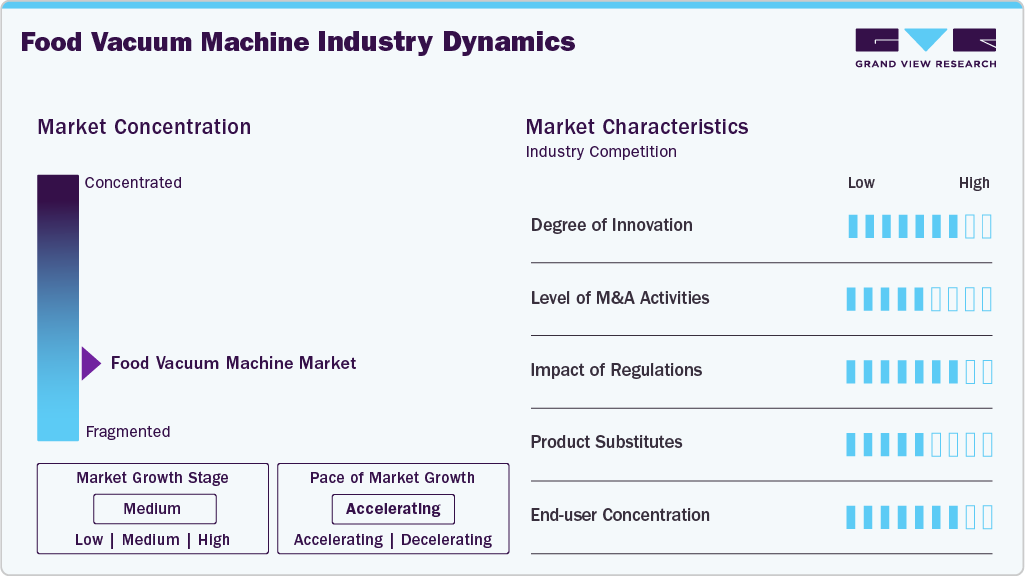
The global food vacuum machine market exhibits a heterogeneous competitive structure, comprising established packaging machinery manufacturers, specialized vacuum equipment suppliers, and regional producers serving differentiated customer requirements. Competitive intensity varies by equipment configuration, production capacity, and application complexity, with manufacturers competing on engineering capabilities, product reliability, customization, and service coverage. Established suppliers benefit from broad product portfolios and established distribution networks, whereas smaller manufacturers often focus on specific machine categories, regional demand, and cost-sensitive customer segments.
 To learn more about this report, Download Free Sample Report
 Product differentiation is concentrated around vacuum performance, chamber configuration, sealing precision, control-system functionality, and equipment throughput. Procurement decisions are influenced by compatibility with food characteristics and packaging formats, as well as by maintenance requirements, operational reliability, and integration with existing production lines. Industrial buyers generally evaluate equipment against production volumes and process specifications, while smaller food processors and commercial establishments prioritize machine footprint, ease of operation, and initial investment.
Regional market characteristics reflect differences in food processing capacity, manufacturing investment, supplier accessibility, and purchasing power. Established food manufacturing markets generally favor technologically advanced equipment and integrated packaging solutions, whereas price-sensitive markets still offer opportunities for standardized machinery and competitively priced configurations. Supplier selection also depends on the availability of installation support, spare parts, maintenance services, and distribution partners.
Analyst Perspective
The global food vacuum machine market is defined by demand for equipment that supports controlled vacuum extraction and sealing across food processing, retail, and foodservice operations. Machine selection is primarily influenced by throughput, packaging format, product characteristics, automation requirements, equipment capacity, and operating scale. Chamber vacuum machines remain suited to higher-volume commercial applications, while external and handheld vacuum machines address more flexible, lower-volume requirements; tray sealing machines serve tray-based vacuum packaging applications. Procurement increasingly emphasizes equipment reliability, sealing consistency, operating capacity, automation, machine flexibility, and after-sales support.
Machine Type Insights
The chamber vacuum machine segment dominated the market with revenue share of 39.0% in 2025, reflecting its established role in commercial and industrial food packaging. These machines extract air within an enclosed chamber before sealing the package, enabling controlled processing across different food types and packaging materials. Their suitability for products with varying dimensions, moisture content, and packaging requirements supports adoption across meat processing, seafood packaging, dairy production, and prepared food manufacturing.
The handheld vacuum sealers segment is projected to grow at a CAGR of 5.5% from 2026 to 2033. Growth is expected to reflect demand for accessible packaging solutions among small food enterprises, specialty food retailers, and household users. Their compact construction and portability make them suitable for intermittent packaging tasks, small batches, and operations with limited installation space. The segment also benefits from the growing availability of consumer-oriented vacuum storage products and compact sealing accessories.
Automation Insights
The automatic segment accounted for the largest share of the global food vacuum machine market in 2025, representing 50.6% of revenue. Its position reflects the requirements of large-scale food manufacturers for repeatable packaging cycles, controlled operating parameters, and integration with established production lines. Automated equipment can coordinate vacuum generation and sealing sequences with limited operator intervention, making it suitable for continuous processing environments and standardized packaging formats.
The manual segment is anticipated to grow at the fastest CAGR during the forecast period. Demand is expected to originate from smaller processors and foodservice businesses that require functional packaging equipment without the investment associated with automated installations. Manual systems provide greater flexibility for intermittent workloads, frequent product changes, and packaging operations that do not justify dedicated automated lines. Their relatively straightforward operating requirements can also reduce the need for specialized technical personnel.
End-use Insights
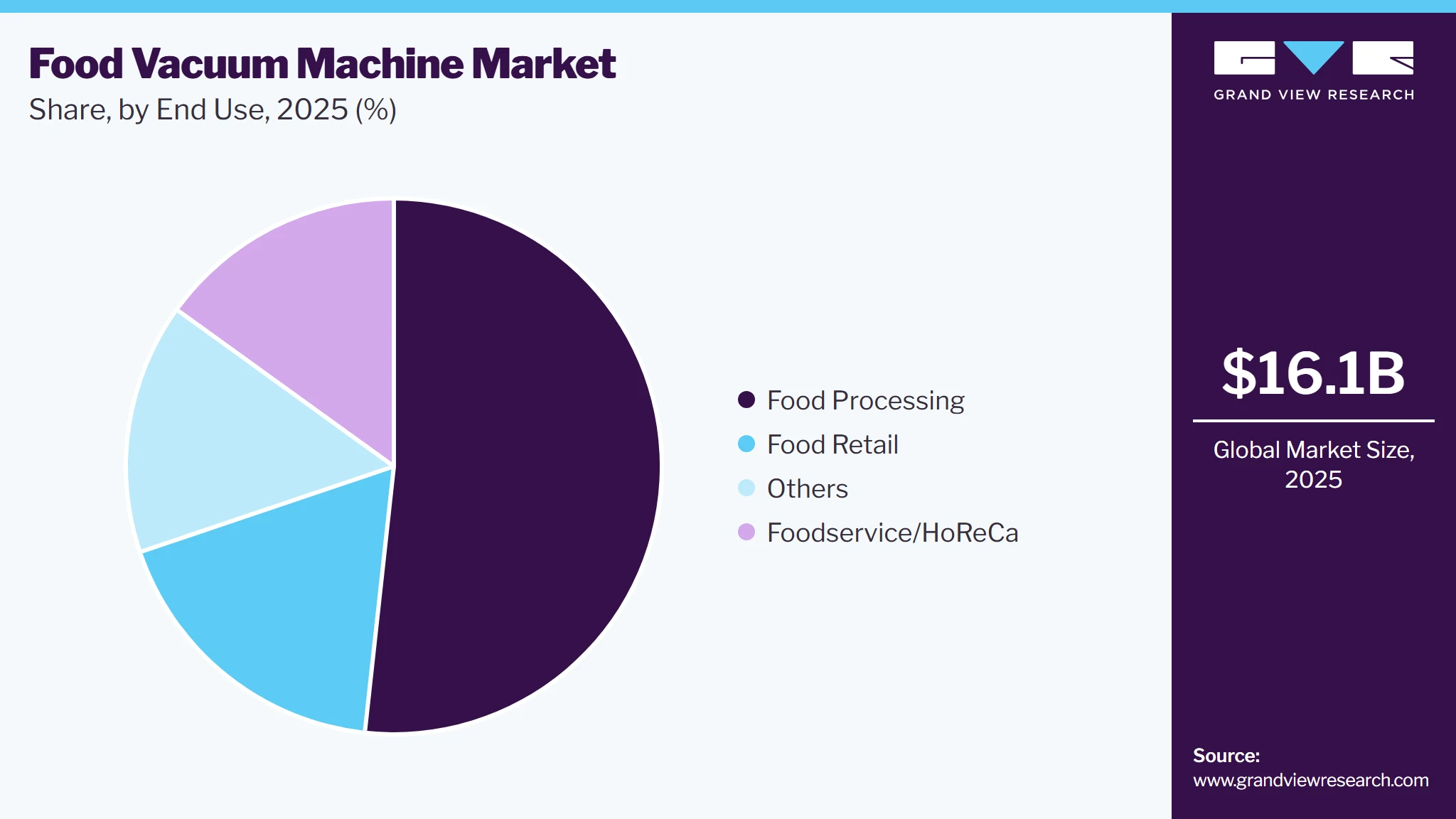
The food processing segment represented the largest share of the global food vacuum machine industry in 2025, accounting for 51.7% of revenue. The segment's position is attributable to the extensive incorporation of vacuum packaging into commercial food production, particularly in meat and poultry, seafood, dairy, and processed food categories. Manufacturers employ these systems to prepare products for subsequent storage, distribution, and retail presentation while limiting exposure to oxygen within sealed packs. The scale and regularity of packaging operations across processing facilities also generate demand for equipment with suitable chamber capacities, sealing specifications, and production-cycle characteristics.
 To learn more about this report, Download Free Sample Report
 The foodservice/HoReCa segment is expected to grow at the fastest CAGR from 2026 to 2033, reflecting the increasing relevance of structured food preparation and inventory management across hotels, restaurants, catering businesses, and institutional kitchens. Vacuum packaging supports portioning, advance ingredient preparation, and the organized storage of prepared components, aligning with kitchen workflows that require consistency across service periods. Adoption is likely to vary according to establishment size, menu complexity, storage practices, and daily preparation volumes.
Regional Insights
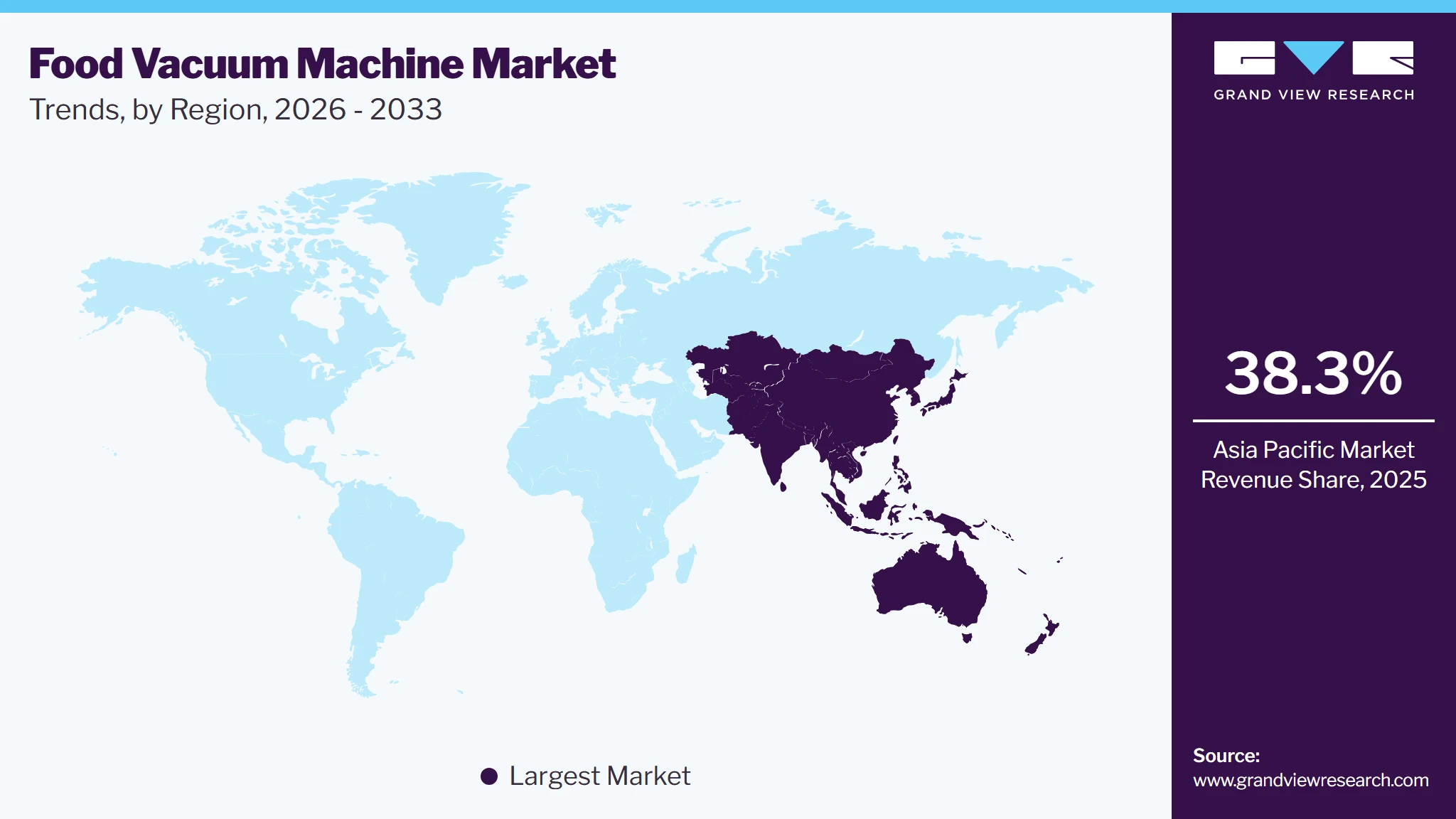
The Asia Pacific food vacuum machine market held the largest global revenue share of 38.3% in 2025, and is expected to grow at the fastest CAGR over the forecast period. This growth reflects the region's diverse food manufacturing structures, ranging from integrated industrial processing networks to fragmented domestic food production. Market development varies with the scale of packaged food manufacturing, the commercial organization of meat and seafood processing, and the penetration of modern preservation technologies. The coexistence of export-oriented producers and businesses serving domestic consumption creates distinct requirements for vacuum packaging equipment, particularly in processing capacity, packaging configuration, and production-line integration.
 To learn more about this report, Download Free Sample Report
 China Food Vacuum Machine Market Trends
China's food vacuum machine market is closely associated with its extensive packaged food industry and the scale of its meat, poultry, seafood, and convenience food production. The concentration of food manufacturing activity creates a substantial requirement for machinery capable of accommodating recurring production volumes and diverse packaging formats. Adoption is also influenced by the transition toward standardized processing operations, in which packaging equipment is part of broader manufacturing workflows.
The food vacuum machine market in India is projected to grow at the fastest CAGR of 7.4% from 2026 to 2033. The market's growth trajectory reflects the development of organized food processing, the commercialization of packaged convenience foods, and investment in infrastructure serving perishable food categories. Meat and poultry processing, seafood exports, dairy production, and ready-to-eat food manufacturing provide distinct avenues for equipment demand. The market also presents opportunities beyond large processing facilities, as smaller manufacturers increasingly require commercially viable packaging systems suited to their operating scale.
North America Food Vacuum Machine Market Trends
North America's food vacuum machine industry is characterized by an established processing base, mature packaging operations, and demand arising from both equipment replacement and production-line modernization. Purchasing decisions are shaped by the technical requirements of individual food categories, established manufacturing procedures, and the economic case for upgrading existing installations.
The United States represents the region's principal market, reflecting the scale and diversity of its industrial food production and packaged food supply chains. Large meat and poultry processors, prepared-food manufacturers, and dairy companies generate demand for equipment capable of meeting sustained production schedules and standardized packaging specifications. Beyond industrial applications, specialty food producers and commercial food businesses create demand for machinery configured for shorter production runs and differentiated product portfolios.
Canada's food vacuum machine market is influenced by the geography of its food supply chains and the requirements of processors serving both domestic consumption and export markets. Seafood processing, meat production, dairy manufacturing, and prepared-food operations create varied packaging requirements, particularly where products move through extended storage and distribution networks. The commercial case for equipment investment depends on processing scale, product characteristics, and the operating requirements of individual facilities.
Europe Food Vacuum Machine Market Trends
Europe's food vacuum machine industry is distinguished by its established food processing industries, specialized regional product categories, and demanding production and hygiene requirements. Vacuum packaging applications span meat products, fish, cheese, prepared meals, and other packaged foods, with machinery specifications varying by product composition and manufacturing processes. Market opportunities arise from the need to maintain established packaging standards, accommodate product-line changes, and replace or upgrade installed equipment.
Germany's food vacuum machine market is closely linked to its developed food manufacturing sector and the technical orientation of its industrial production base. Meat processing, dairy manufacturing, and packaged food production create requirements for equipment that can be incorporated into structured manufacturing operations. Procurement considerations extend to machine reliability, control precision, production-line compatibility, and the demands of medium-sized manufacturers operating specialized facilities.
The food vacuum machine market in the UK has a distinct demand profile shaped by prepared-meal production, chilled food manufacturing, specialty food businesses, and commercial catering. The diversity of these activities creates requirements across industrial packaging facilities and smaller batch-processing environments. Prepared ingredients and portion-controlled food products are relevant applications, particularly where packaging forms part of routine production and stock-preparation procedures.
Middle East & Africa Food Vacuum Machine Market Trends
The Middle East and Africa food vacuum machine market remains heterogeneous, with adoption patterns influenced by domestic processing capacity, dependence on imported food, and disparities in industrial infrastructure. In markets with limited local manufacturing, vacuum packaging demand is closely connected to food handling, commercial preparation, and distribution requirements. Elsewhere, investment in food production and processing facilities is creating a greater need for industrial packaging equipment.
Saudi Arabia's food vacuum machine market is shaped by investment in domestic food production and the development of processing capabilities across selected food categories. Meat and poultry, dairy products, and prepared foods form relevant areas of commercial activity, while hospitality and institutional catering generate additional requirements for food preparation and storage equipment. The expansion of domestic processing facilities creates scope for industrial installations, whereas foodservice operators represent a separate market for smaller commercial systems.
Latin America Food Vacuum Machine Market Trends
Latin America's food vacuum machine industry is closely connected to its agricultural production base, export-oriented food industries, and the varying levels of modernization across national processing sectors. Demand conditions vary with the structure of domestic food manufacturing, the concentration of large processors, and the investment capacity of smaller enterprises. Export-facing operations have distinct packaging requirements associated with product specifications and distribution arrangements, whereas businesses serving domestic markets may place greater weight on acquisition costs and production flexibility.
The Brazil food vacuum machine market occupies a central position in Latin America, driven by its extensive meat and poultry industries and broader packaged food manufacturing base. The scale of these industries creates demand for vacuum packaging machinery suited to high-volume operations and a range of product specifications. Export-oriented processors have equipment requirements shaped by their production processes and packaging standards, while manufacturers supplying domestic retail and foodservice channels operate under different volume and product-mix considerations.
Key Food Vacuum Machine Company Insights
Some of the key players operating in the market include MULTIVAC and ULMA Packaging.
-
MULTIVAC is a German manufacturer of packaging and food-processing machinery headquartered in Wolfertschwenden. Its product range includes chamber vacuum packaging machines, thermoforming equipment, tray-sealing systems, labeling technologies, inspection solutions, and automated packaging lines. The company serves multiple food segments, including meat, poultry, seafood, dairy, and convenience foods. Its position in the food vacuum machine industry is associated with its broad range of vacuum packaging technologies and the integration of packaging equipment into complete manufacturing workflows, enabling food producers to address varied product specifications and output requirements.
-
ULMA Packaging, headquartered in Spain, specializes in machinery for industrial packaging applications. Its portfolio covers thermoforming, tray sealing, flow wrapping, and vertical packaging technologies, with solutions tailored to food products such as meat, seafood, cheese, fresh produce, bakery goods, and prepared meals. The company participates in the food vacuum machine market through equipment designed to support vacuum and modified-atmosphere packaging, particularly within thermoforming and tray-sealing applications. Its product range caters to food manufacturers seeking packaging configurations aligned with specific product characteristics, package formats, and processing requirements.
Key Food Vacuum Machine Companies
The following key companies have been profiled for this study of the food vacuum machine market.
-
MULTIVAC
-
ULMA Packaging
-
Henkelman
-
VC999 Packaging Systems
-
WEBOMATIC
-
Turbovac
-
minipack-torre
-
Orved
-
Sammic
-
Reepack
-
Tecnovac
-
Sevana Electrical Appliances Pvt. Ltd.
-
Packmech Engineers (POWERVAC)
-
ICON Packtech (ICON Industries India)
-
Rema Engineers
Competitive Benchmarking
Category
Operating Strategies
Competitive Edge
Weakness
Established Players (e.g., MULTIVAC; ULMA Packaging; Henkelman; VC999 Packaging Systems; WEBOMATIC; Turbovac; minipack-torre; Orved; Sammic; Reepack; Tecnovac)
Expand vacuum packaging portfolios across single- and double-chamber machines, belt-fed systems, thermoforming equipment, and integrated packaging lines for diverse food-processing requirements.
Refine vacuum-cycle controls, sealing configurations, production throughput, and compatibility with different food products and packaging materials.
Broad machine portfolios spanning commercial food preparation and industrial packaging operations.
Established vacuum packaging expertise, application-specific configurations, and capabilities to accommodate varying throughput and package-format requirements.Advanced industrial systems can involve substantial equipment and integration expenditure, limiting accessibility for smaller food processors.
Specialized machine configurations and maintenance requirements may increase ownership complexity for facilities with limited technical resources.
Emerging & Regional Players (e.g., Packmech Engineers (POWERVAC); Sevana Electrical Appliances Pvt. Ltd.; ICON Packtech (ICON Industries India); Rema Engineers)
Concentrate on chamber vacuum packing, automatic packing configurations, and related equipment suited to domestic food processors and commercially oriented packaging operations.
Adapt machine specifications, chamber dimensions, and production capacities to regional customer requirements and investment constraints.
Availability of machine configurations suited to small and medium-sized food businesses with varying packaging volumes.
Regional customer access and the potential to provide application-specific equipment at comparatively accessible investment levels.
Narrower international distribution and lower global brand visibility may constrain access to multinational food manufacturers.
A more limited range of advanced automated systems may limit participation in large-scale packaging projects that require extensive production-line integration.
Recent Developments
-
In December 2025, Yorkshire Packaging Systems (YPS) introduced a semi-automatic vacuum packaging machine featuring a double-chamber design, programmable digital controls, and stainless-steel construction. The dual-chamber arrangement enables operators to prepare products in one chamber while the other performs the vacuum and sealing cycle, facilitating continuous packaging operations. The machine also supports modified-atmosphere packaging and addresses applications across meat, poultry, seafood, dairy, fresh produce, and prepared foods.
-
In November 2025, investment firm Clayton, Dubilier & Rice (CD&R) agreed to acquire Sealed Air Corporation in a transaction valued at approximately USD 10.3 billion, including debt. Sealed Air's food-packaging business includes the CRYOVAC brand, which offers rotary vacuum chamber packaging systems for food processing applications. The transaction is relevant to the food vacuum machine market through Sealed Air's existing vacuum packaging equipment portfolio, although its business encompasses a broader range of food and protective packaging solutions. Completion was expected in 2026, subject to customary closing conditions.
Food Vacuum Machine Market Report Scope
Report Attribute
Details
Market size in 2025
USD 16.1 billion
Estimated market size in 2026
USD 16.9 billion
Projected market size by 2033
USD 24.3 billion
Growth rate
CAGR of 5.3% from 2026 to 2033
Base year for estimation
2025
Historical data
2021-2024
Forecast period
2026 - 2033
Quantitative units
Revenue in USD billion and CAGR from 2026 to 2033
Report coverage
Revenue forecast, company market position analysis, competitive landscape, growth factors, and trends
Segments covered
Machine type, automation, end-use, region
Regional scope
North America; Europe; Asia Pacific; Latin America; Middle East & Africa
Country Scope
U.S.; Canada; Mexico; Germany; France; UK; Spain; Italy; China; India; Japan; South Korea; Australia; Brazil; Argentina; Saudi Arabia; UAE; South Africa
Key companies profiled
MULTIVAC; ULMA Packaging; Henkelman; VC999 Packaging Systems; WEBOMATIC; Turbovac; minipack-torre; Orved; Sammic; Reepack; Tecnovac; Sevana Electrical Appliances Pvt. Ltd.; Packmech Engineers (POWERVAC); ICON Packtech (ICON Industries India); Rema Engineers
Customization scope
Free report customization (equivalent up to 8 analysts working days) with purchase. Addition or alteration to country, regional & segment scope.
Pricing and purchase options
Avail customized purchase options to meet your exact research needs. Explore purchase options
Global Food Vacuum Machine Market Report Segmentation
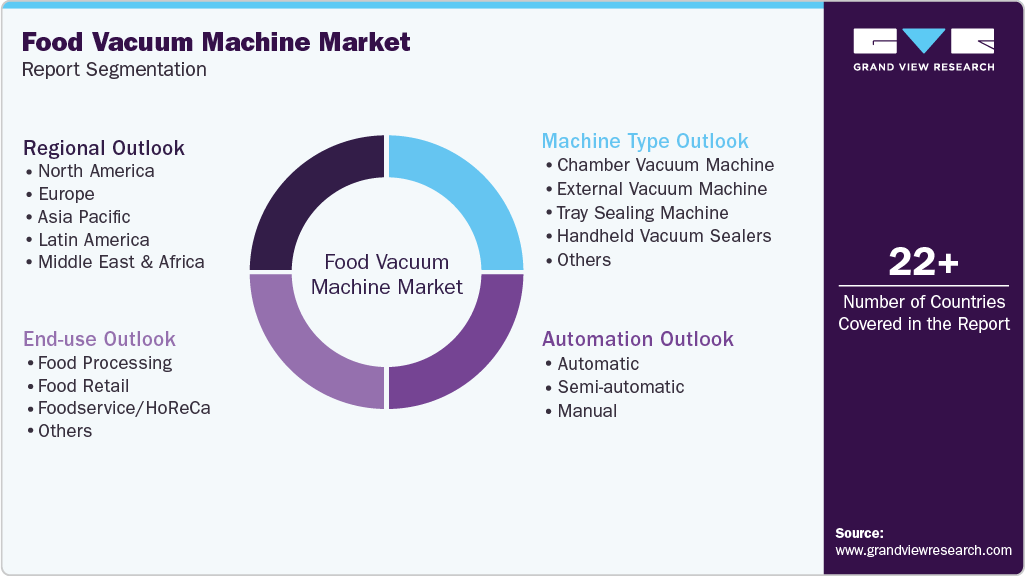
This report forecasts revenue growth at the global, regional & country levels and provides an analysis on the industry trends in each of the sub-segments from 2021 to 2033. For this study, Grand View Research has segmented the food vacuum machine market report based on machine type, automation, end-use, and region:
 To learn more about this report, Download Free Sample Report
 -
Machine Type Outlook (Revenue, USD Billion, 2021 - 2033)
-
Chamber Vacuum Machine
-
External Vacuum Machine
-
Tray Sealing Machine
-
Handheld Vacuum Sealers
-
Others
-
-
Automation Outlook (Revenue, USD Billion, 2021 - 2033)
-
Automatic
-
Semi-automatic
-
Manual
-
-
End-use Outlook (Revenue, USD Billion, 2021 - 2033)
-
Food Processing
-
Food Retail
-
Foodservice/HoReCa
-
Others
-
-
Regional Outlook (Revenue, USD Billion, 2021 - 2033)
-
North America
-
U.S.
-
Canada
-
Mexico
-
-
Europe
-
Germany
-
France
-
UK
-
Spain
-
Italy
-
-
Asia Pacific
-
China
-
India
-
Japan
-
South Korea
-
Australia
-
-
Latin America
-
Brazil
-
Argentina
-
-
Middle East & Africa
-
Saudi Arabia
-
UAE
-
South Africa
-
-
Research Methodology
The food vacuum machine market figures in this report are based on a proven research process that combines executive interviews with secondary research from proprietary databases, company filings, and recognized regulatory and institutional sources. Market size is built through value-chain sizing-reconciling supply-side and demand-side estimates-and triangulated with bottom-up and top-down approaches. Every estimate passes multiple levels of expert validation before publication, with each food vacuum machine segment quantified using the revenue-capture definitions in the table below.
Segment Definition
Machine Type
Revenue Capture Definition
Chamber Vacuum Machine
Revenue generated from the sale of chamber vacuum machines used for vacuumizing and sealing food products within a closed chamber.
External Vacuum Machine
Revenue generated from the sale of external vacuum machines used for extracting air from food packaging positioned outside the vacuum chamber and subsequently sealing the package.
Tray Sealing Machine
Revenue generated from the sale of tray sealing machines used for vacuumizing and sealing food products contained in trays with sealing films or lidding materials.
Handheld Vacuum Sealers
Revenue generated from the sale of handheld vacuum sealers used for air extraction and sealing of food packaging through portable, manually operated equipment.
Others
Revenue generated from the sale of food vacuum machines other than chamber vacuum machines, external vacuum machines, tray sealing machines, and handheld vacuum sealers.
Automation
Revenue Capture Definition
Automatic
Revenue generated from the sale of fully automatic food vacuum machines that execute vacuuming and sealing operations with limited operator intervention.
Semi-automatic
Revenue generated from the sale of semi-automatic food vacuum machines that combine automated vacuuming and sealing functions with operator-assisted handling or loading.
Manual
Revenue generated from the sale of manually operated food vacuum machines in which vacuuming, sealing, or product handling requires direct operator involvement.
End Use
Revenue Capture Definition
Food Processing
Revenue generated from the sale of food vacuum machines to food processing establishments for packaging food products across processing and preparation operations.
Food Retail
Revenue generated from the sale of food vacuum machines to supermarkets, grocery stores, butcher shops, specialty food retailers, and other food retail establishments.
Foodservice/HoReCa
Revenue generated from the sale of food vacuum machines to hotels, restaurants, cafés, catering companies, and other commercial foodservice establishments.
Others
Revenue generated from the sale of food vacuum machines to end-use establishments outside food processing, food retail, and foodservice/HoReCa.
Estimation Model
Layer Name
Key Question
Description
Food Vacuum Machine Demand Layer
Where is underlying demand for food vacuum machines generated?
Assess the addressable demand base across food processing, food retail, foodservice/HoReCa, and other relevant end-use establishments. Evaluate demand arising from vacuum packaging requirements for fresh, processed, prepared, frozen, and other food products, including new equipment installations, capacity additions, operational expansion, and replacement of existing machines.
Food Vacuum Machine Procurement Layer
What factors influence food vacuum machine purchasing decisions?
Assess procurement parameters including machine configuration, vacuum capability, sealing performance, throughput, chamber capacity, automation level, equipment dimensions, construction quality, operating requirements, product compatibility, maintenance requirements, equipment reliability, acquisition cost, warranty terms, supplier capabilities, and after-sales support. Evaluate procurement patterns across food manufacturers, retailers, restaurants, hotels, catering operators, distributors, and specialized equipment suppliers.
Machine & Channel Adoption Layer
Which machine configurations and automations capture market demand?
Analyze adoption across chamber vacuum machines, external vacuum machines, tray sealing machines, handheld vacuum sealers, and other food vacuum machines, segmented by automatic, semi-automatic, and manual configurations. Assess purchasing patterns across direct sales, distributors, dealers, specialty equipment suppliers, and online channels, considering production scale, packaging volumes, operating requirements, replacement cycles, and equipment accessibility.
Revenue Generation Layer
What constitutes revenue within the food vacuum machine market?
Quantify annual revenue generated from the sale of food vacuum machines across machine type, automation level, end use, and geographic markets. Account for revenues from new equipment installations, replacement purchases, capacity expansion, and machines sold through direct and indirect automation. Exclude revenues attributable to vacuum bags, films, trays, sealing materials, spare parts, repair and maintenance services, rentals, consulting, and other non-machine activities to preserve the defined market boundary.
Customization Table
Client Request
Customization Delivered
Value Adds
Competitive Benchmarking
Benchmarking of leading food vacuum machine manufacturers was performed across machine configurations, vacuum and sealing performance, automation capabilities, throughput, packaging-format compatibility, application scope, manufacturing footprint, distribution infrastructure, geographic presence, and product development initiatives.
Enables comparison of supplier positioning, technical capabilities, portfolio breadth, and market reach. The assessment highlights competitive differentiation, capability gaps, portfolio white spaces, and areas with potential for market positioning.
Regional Segmentation
Geographic assessment covered North America, Europe, Asia Pacific, Latin America, and the Middle East & Africa, with selected country-level analysis. Evaluation incorporated food-processing activity, packaged-food production, food retail development, foodservice infrastructure, packaging-equipment investment, automation penetration, distribution maturity, and replacement requirements.
Clarifies variations in regional demand intensity, equipment adoption, procurement conditions, and market maturity. This supports geographic prioritization, market entry assessment, channel development, and the allocation of commercial resources.
Opportunity Assessment
Opportunity mapping covered chamber vacuum machines, external vacuum machines, tray sealing machines, handheld vacuum sealers, and other machine types, further differentiated by automatic, semi-automatic, and manual configurations. Demand was assessed across food processing, food retail, foodservice/HoReCa, and other end uses, considering capacity additions, equipment replacement, automation requirements, and operating scale.
Identifies attractive revenue pools across machine, automation, and end-use segments. The assessment supports product portfolio refinement, segment prioritization, channel strategy, and targeted investment in areas offering stronger commercial potential.
About the Author(s)
Advanced Interior Materials Research Team
Advanced Materials · Advanced Interior MaterialsThis report was authored by the advanced interior materials research team at Grand View Research - comprising two research analysts, one senior research analyst, and one industry expert - with specialized expertise in the advanced interior materials segment of the advanced materials industry. All findings are based on proprietary advanced materials databases, executive interviews, and regulatory analysis, subject to internal peer review prior to publication.
Last Updated:
Speak to Analyst

Customize this report to your needs - add regions, segments, or data points, with 20% free customization.
Or view our licence options:


ISO 9001:2015 & 27001:2022 Certified
We are GDPR and CCPA compliant! Your transaction & personal information is safe and secure. For more details, please read our privacy policy.


