
- Home
- »
- Consumer F&B
- »
-
Frozen Bakery Market Size And Share Report, 2026-2033GVR Report cover

Frozen Bakery Market (2026 - 2033)
Size, Share & Trends Analysis Report By Product (Breads, Novelties, Doughnuts & Pies, Cakes & Pastries, Pizza), By Form Of Consumption, By Distribution Channel (Foodservice, Bakery Stores), By Region, And Segment Forecasts
Market Size, 2025
$74.2BMarket Estimate, 2026
$78.1BMarket Forecast, 2033
$113.0BCAGR, 2026–2033
5.4%Frozen Bakery Market Summary
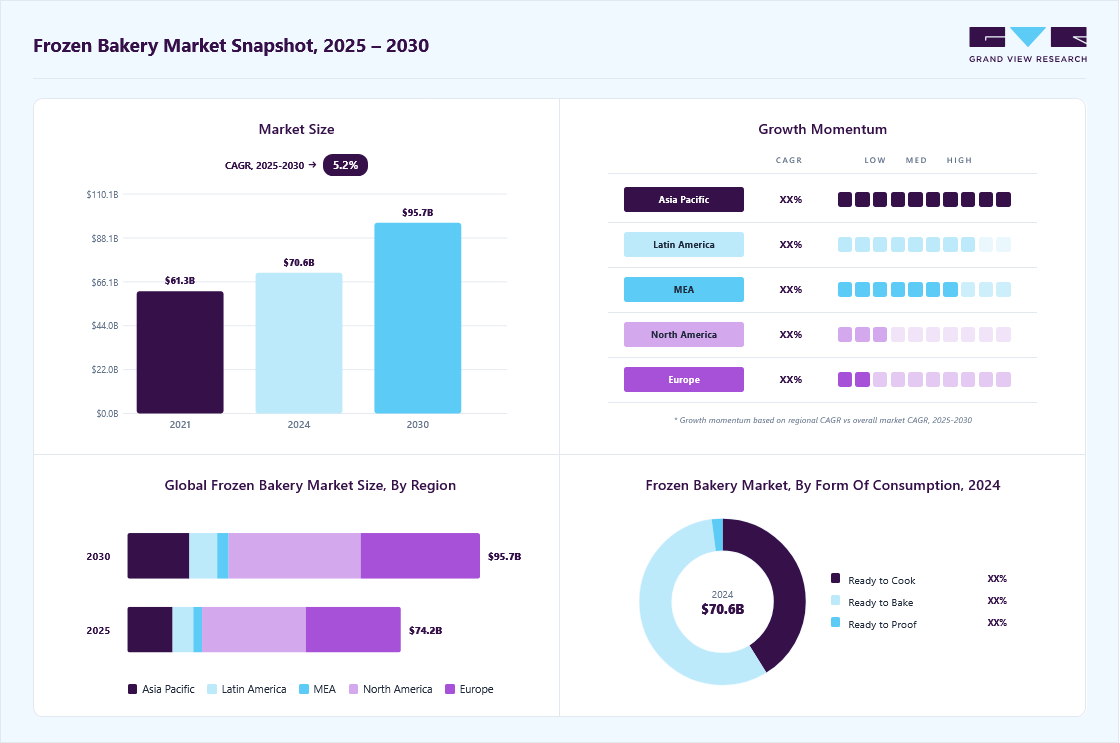
The global frozen bakery market size was valued at USD 74.2 billion in 2025 and is projected to grow from USD 78.1 billion in 2026 to USD 113.0 billion by 2033, at a CAGR of 5.4% from 2026 to 2033. North America dominated the market, accounting for a revenue share of 37.9% in 2025. The increasing demand for convenience foods has become a major catalyst driving the growth of the frozen food industry.
 Source: Grand View Research, IR Documents, Primary Interviews, Paid DatabasesTo learn more about this report,
 Download Free Sample Report
 Key Market Trends & Insights
- By product: Pizza led the market with the largest revenue share of 31.5% in 2025 and is expected to grow at the fastest CAGR over the forecast period.
- By form of consumption: Ready to bake segment led the market with the largest revenue share of 56.5% in 2025.
- By distribution channel: Food service led the market with the largest revenue share of 58.1% in 2025.
Regional Highlights
- Largest regional market: North America (37.9% revenue share, 2025)
- By country: The U.S. held the largest market share in 2025.
Market Size & Forecast
- Market size in 2025: USD 74.2 Billion
- Estimated market size in 2026: USD 78.1 Billion
- Projected market size by 2033: USD 113.0 Billion
- CAGR (2026-2033): 5.4%
Three ways to get this report
Buy it, customize it, or ask a question.Ask an Analyst
Analyst response in 1 business day
- AccessReport author, directly
- Reply timeWithin 1 working day
- No sales callDirect answer only
- FormatEmail reply
- CostFree, no cost
Get the Full Report
What the study covers
- FormatsPDF · Excel · Dashboard
- Timeline2026–2033 annual, 2025 base
- Coverage20+ countries, 5 regions
- Companies10+ key players profiled
Customize the Report
20% free customization
- IncludeCountries, segments, points
- TailorTo your product definition
- ExtendDeeper competitor detail
- OrA fully bespoke study
- Turnaround5–10 working days
Frozen bakery items, including bread, pastries, and cakes, present a convenient alternative that allows consumers to enjoy freshly baked goods without the time-consuming preparation process. This convenience factor resonates strongly with modern consumers, particularly those seeking quick and hassle-free meal solutions to accommodate their fast-paced lifestyles.The growing demand for convenience foods has become a major catalyst driving the growth of the frozen food industry, and within it, the frozen bakery sector has emerged as a key beneficiary of this trend. The modern lifestyle, characterized by hectic schedules and increased urbanization, has led consumers to seek convenient meal options that require minimal preparation time without compromising on taste or quality. In this context, frozen bakery products offer a compelling solution, as they provide convenience, longer shelf life, and the ability to be easily stored and prepared at the consumer's convenience.
 To learn more about this report, Download Free Sample Report
 One of the key drivers for the surge in demand for frozen bakery products is the convenience they offer. Busy consumers, juggling multiple responsibilities, often find it challenging to allocate time for baking from scratch or visiting bakeries frequently. Frozen bakery items, ranging from bread and pastries to cakes, present a convenient alternative that allows consumers to enjoy freshly baked goods without the time-consuming preparation process. This convenience factor resonates strongly with modern consumers, particularly those seeking quick and hassle-free meal solutions to accommodate their fast-paced lifestyles. In January 2022, research conducted by the American Frozen Food Institute (AFFI) revealed that frozen foods have gained prominence in American households, with 30% of shoppers expanding their freezer capacity since the beginning of the pandemic.
The frozen bakery industry has responded to the demand for convenience by introducing a wide range of frozen meals that require minimal preparation. From frozen pizzas to complete frozen dinners, these products offer a quick and hassle-free meal solution for consumers. Frozen breakfast items such as breakfast sandwiches, waffles, frozen bites, and pancakes cater to consumers looking for a convenient morning meal that can be prepared quickly. In August 2023, Loblaws, a Canadian supermarket chain, introduced a new line of frozen pizzas under its President's Choice private label brand. The PC Black Label Frozen Pizza line features three varieties - Margherita, Diavola, and Funghi - that are hand-tossed and made in Italy with high-quality ingredients.
Market Dynamics
The frozen bakery market is witnessing significant growth due to increasing consumer demand for convenient, high-quality, and ready-to-prepare bakery products. Frozen bakery offerings, including bread, pastries, cakes, croissants, and pizza bases, provide extended shelf life, reduced food waste, and operational efficiency for retailers and foodservice operators. The expansion of quick-service restaurants, cafés, and organized retail channels, coupled with rising preference for premium and artisanal bakery products, is accelerating market adoption. Additionally, advancements in freezing technologies and growing demand for clean-label, gluten-free, and health-oriented bakery products are expected to further support the growth of the frozen bakery market.
The growing preference for convenient and time-efficient food solutions is a primary factor driving the frozen bakery market. Consumers increasingly seek bakery products that offer freshness, quality, and ease of preparation without requiring extensive baking time. Frozen bakery products such as bread, croissants, pastries, pizza bases, and cakes provide extended shelf life while maintaining product consistency, making them highly attractive across both retail and foodservice channels. Simultaneously, cafés, quick-service restaurants (QSRs), hotels, and institutional foodservice operators are adopting frozen bakery products to reduce labor dependency, minimize food waste, and streamline operations. The ability to bake products on demand enables businesses to deliver freshly baked offerings while maintaining inventory flexibility and cost efficiency. The expansion of organized foodservice networks and coffee chains worldwide is further accelerating demand for frozen bakery solutions.
In October 2025, Hillshire Farm, a brand under Tyson Foods, expanded its frozen food portfolio by launching Stuffed Croissants and Ciabatta Deli Sandwiches in the frozen aisle. The products were introduced as convenient heat-and-eat bakery offerings designed to meet growing consumer demand for quick meal solutions while delivering premium taste and quality. The launch highlights how manufacturers are investing in frozen bakery innovation to capitalize on the increasing preference for convenience-oriented food products.
Frozen bakery products require continuous temperature-controlled storage and transportation throughout the supply chain to preserve product quality, texture, safety, and shelf life. Maintaining frozen conditions during manufacturing, warehousing, transportation, and retail display involves substantial investments in refrigeration equipment, cold-storage facilities, and energy-intensive logistics networks. Rising electricity costs and fuel expenses further increase operating expenditure for manufacturers and distributors. In addition, any disruption in the cold chain can result in product spoilage, inventory losses, and quality deterioration, creating operational risks for market participants. These challenges are particularly pronounced in developing regions where cold-storage infrastructure remains limited, thereby restricting market expansion and increasing overall supply chain complexity.
In April 2025, Upper Crust Bakery LP voluntarily recalled multiple frozen bread products distributed across several U.S. states following the discovery of glass fragments in the products. The incident highlighted the stringent quality-control requirements and operational challenges associated with frozen bakery production and distribution. Product recalls not only result in financial losses and inventory write-offs but also increase compliance costs and can negatively impact brand reputation, posing a significant challenge for manufacturers operating in the frozen bakery sector.
The growing need to reduce preparation time and dependence on skilled labor is creating opportunities for innovation in freezer-to-oven bakery products. Manufacturers are developing frozen bakery solutions that eliminate thawing and proofing stages while maintaining bakery-quality outcomes, enabling foodservice operators and retailers to improve efficiency and consistency.
In April 2026, Crown Bakeries introduced a new freezer-to-oven (FTO) frozen dough croissant line that allows operators to bake croissants directly from frozen state to finished product in approximately 25 minutes without additional proofing. The innovation was specifically developed to address labor shortages and simplify bakery operations while maintaining product quality. This development highlights how manufacturers are leveraging product innovation to improve operational efficiency and expand the adoption of frozen bakery products.
Market Concentration & Characteristics
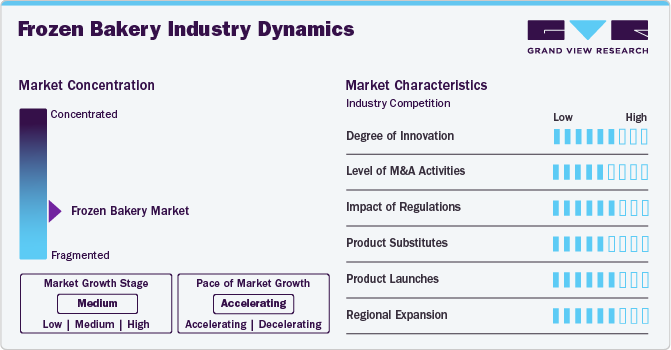
Manufacturers in the frozen bakery industry are actively engaged in various initiatives to meet evolving consumer demands and market trends.
Innovation in the frozen bakery market is primarily driven by the rising consumer demand for healthier, premium, and convenient products. Companies are focusing on new product development, including the introduction of gluten-free, organic, and high-protein frozen bakery items.
 To learn more about this report, Download Free Sample Report
 In addition, advancements in freezing technology are enhancing product quality, allowing for better taste and texture retention. The increasing use of natural and clean-label ingredients is also a significant innovation trend as consumers become more health-conscious. Many manufacturers are investing in R&D to cater to specific dietary preferences, such as vegan and low-sugar options, which are gaining traction in the market.
The market has seen considerable M&A activity as larger companies seek to expand their market presence and diversify their product portfolios. Major players like Aryzta AG and Grupo Bimbo have engaged in strategic acquisitions to enter new geographic markets and enhance their offerings in premium and specialty frozen bakery products.
These acquisitions are often aimed at gaining access to innovative product lines or expanding distribution networks. The M&A landscape is competitive, with both global and regional players actively participating to strengthen their market positions.
The market is subject to a range of food safety and labeling regulations that impact production and distribution. Regulations related to the use of preservatives, artificial additives, and allergens are particularly important, as consumers increasingly prefer clean-label products.
In addition, compliance with regional food safety standards, such as the U.S. FDA regulations or the European Union's food labeling laws, is essential for market entry and success. Stringent health and safety standards often drive companies to reformulate products, particularly when introducing new ingredients or entering international markets.
Frozen bakery products face competition from a variety of substitutes, including fresh bakery items, ready-to-bake products, and homemade goods. In addition, the growing popularity of healthier snacks, such as protein bars and granola, presents an alternative for consumers seeking convenient food options.
However, frozen bakery products remain competitive due to their longer shelf life and convenience compared to fresh alternatives. Companies are addressing the threat of substitutes by offering premium and innovative frozen products that emphasize convenience without compromising on taste or quality.
Analyst Perspective
The industry's long-term growth is likely to be driven by the convergence of automation, frozen technology, and foodservice outsourcing. As bakery production becomes increasingly centralized, frozen bakery products are evolving into a scalable manufacturing solution rather than a convenience product. This transition creates a competitive environment where production efficiency, shelf-life optimization, and distribution capabilities may become more valuable than brand recognition alone, potentially redefining market leadership over the next decade.
Product Insights
Based on product, pizza led the market with the largest revenue share of 31.5% in 2025 and is expected to grow at the fastest CAGR over the forecast period. Frozen pizzas are affordable and convenient and are available in a diverse range of bases and toppings, catering to various consumer preferences. In addition, frozen pizza options cater to a diverse array of dietary preferences, offering various bases such as traditional wheat crust, whole wheat crust, gluten-free crust, and even cauliflower crust, along with a diverse range of toppings for both vegetarian and non-vegetarian preferences, thus driving their demand among consumers.
The frozen breads segment is expected to grow at a CAGR of 4.9% from 2026 to 2033. Consumers are increasingly drawn to the convenience of frozen bread, as it allows them to stock up without concerns of quick spoilage, reducing food waste and shopping frequency, and resulting in its increased adoption. The longer shelf life of frozen bread appeals to those who do not consume bread regularly.
Form Of Consumption Insights
Based on form of consumption, ready to bake segment led the market with the largest revenue share of 56.5% in 2025, as these products are gaining traction due to their ability to provide freshly baked goods with minimal effort and time investment. With consumers increasingly prioritizing health and convenience, market players are developing new product variants, such as healthier ingredient options, gluten-free alternatives, and innovative flavor combinations, to cater to diverse dietary preferences and lifestyles.
Ready-to-cook frozen bakery products are expected to grow at a CAGR of 5.5% from 2026 to 2033, owing to the growing demand for convenient and time-saving meal solutions. Moreover, ready-to-cook frozen bakery items ensure consistent quality and taste, providing reassurance to consumers seeking reliability and thus driving their demand.
As consumers lead fast paced and busy lives, they are opting for frozen bakery items like croissants, rolls, and breads. Manufacturers are actively diversifying their product offerings within the frozen bakery category to cater to evolving consumer preferences. In addition, the market is witnessing the entry of new companies seeking to address the varied needs of consumers in this segment.
Distribution Channel Insights
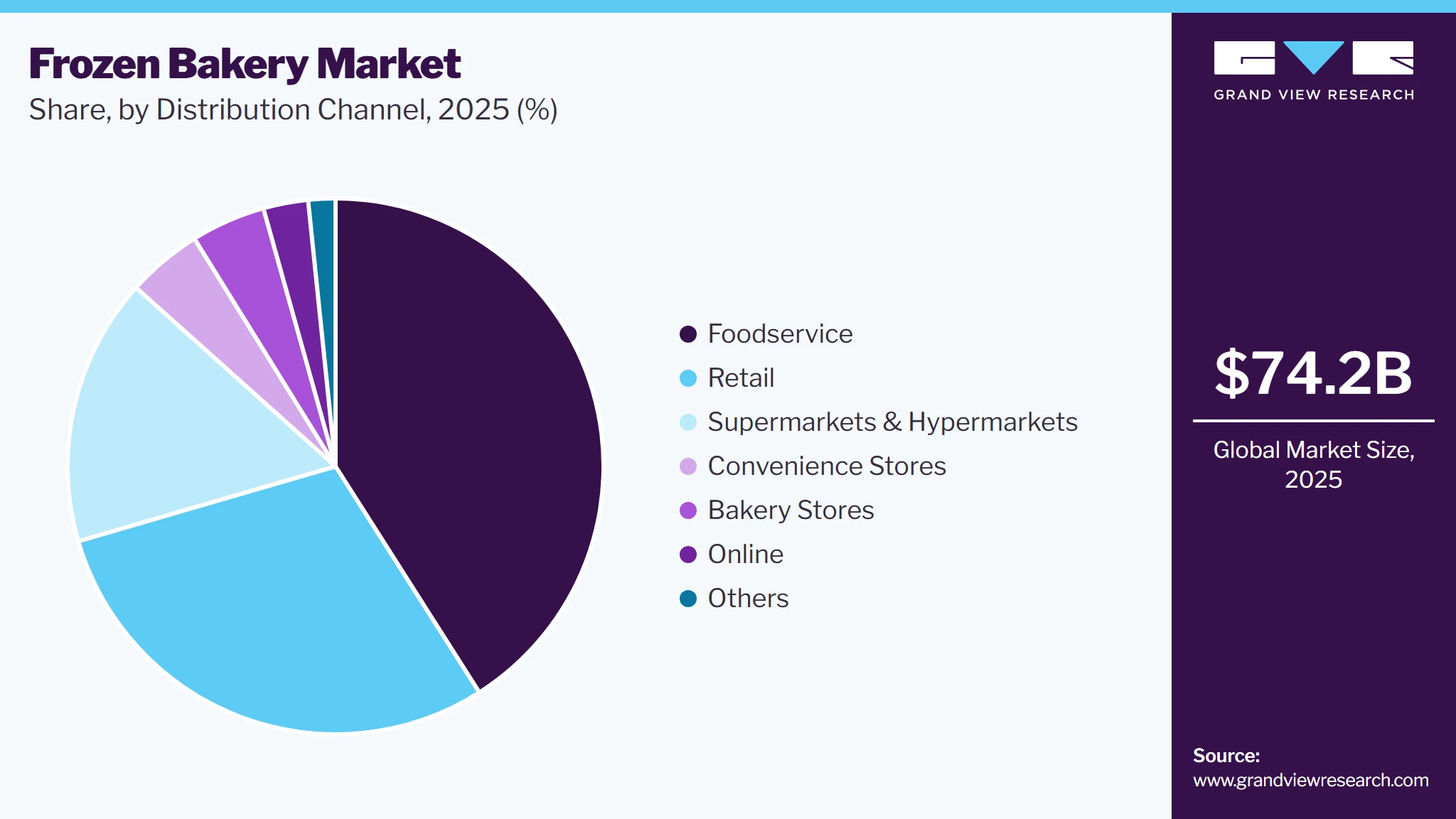
Based on distribution channel, food service led the market with the largest revenue share of 58.1% in 2025. Foodservice establishments offer a wide variety of frozen bakery items, ranging from breads and rolls to pastries and desserts, providing plenty of options to choose from. In addition, they are known for their consistency in taste and quality, ensuring that their frozen bakery products maintain the same delicious flavors as their freshly baked counterparts, thus driving the sales of frozen bakery products through foodservice establishments.
 To learn more about this report, Download Free Sample Report
 The sales through online channels are expected to grow at a CAGR of 6.4% from 2026 to 2033, owing to the convenience offered by these channels. In addition, online platforms provide access to a diverse range of frozen bakery items, including specialty products that may need to be more readily available locally. This variety allows consumers to explore unique options and cater to specific dietary preferences or restrictions, such as gluten-free or vegan choices.
Regional Insights
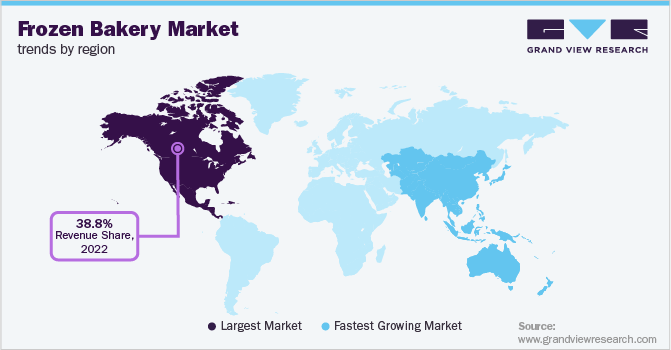
North America dominated the frozen bakery market with the largest revenue share of 37.9% in 2025. The growth of the market in North America can be attributed to several key factors influencing consumer behavior. Chief among these is the unparalleled convenience offered by frozen bakery products, which cater to the demands of modern, fast-paced lifestyles.
 To learn more about this report, Download Free Sample Report
 The rising number of professionals in the workforce, alongside the increasing preference for convenience foods, is anticipated to fuel the growth of the market. This sector benefits from an established presence in in-store bakeries, coffee chains, cafes, and quick-service restaurants, all of which are capitalizing on the advantages offered by frozen baked goods, including enhanced convenience, availability, and a wide range of product options. Consumers seeking convenient, indulgent, and on-the-go snacks are presented with a choice between fresh and frozen baked products, exerting significant influence on pricing dynamics within the market.
U.S. Frozen Bakery Market
The frozen bakery market in the U.S. held the largest share in the North America region in 2025. One of the main reasons for the popularity of frozen products is their unparalleled convenience. Ready-to-bake frozen bakery items offer a hassle-free solution for individuals and families with busy schedules, providing quick and easy access to freshly baked goods without the need for extensive preparation or baking skills.
In addition, the extended shelf life of frozen products allows consumers to stock up on items, reducing the frequency of grocery shopping trips and minimizing food waste. This, coupled with the versatility of frozen products in meal planning and the assurance of quality and nutrition, makes them an attractive option for households across the country. Furthermore, the cost-effectiveness of frozen products, along with their ease of preparation and the growing emphasis on conscious consumption and sustainability, further contribute to their widespread popularity among consumers in the U.S.
Europe Frozen Bakery Market
The Europe frozen bakery market is anticipated to grow at a lucrative CAGR over the forecast period. Growing consumer preferences for convenient and grab-and-go products for breakfast have significantly boosted the morning goods segment in Europe. This trend has fueled the demand for frozen bakery products, aligning with the fast-paced lifestyles in this region. The availability of gluten-free options has played a significant role in driving market growth, appealing to consumers with dietary restrictions or preferences. Moreover, the adoption of innovative freezing technologies has enabled manufacturers to preserve the freshness and quality of bakery products while extending their shelf life, contributing to the widespread acceptance and consumption of frozen bakery items.
Furthermore, the convenience factor associated with frozen bakery products has propelled their expansion across Europe. Consumers appreciate the ease of preparation and storage offered by these products, making them a convenient choice for households and food service establishments alike. As a result, the frozen bakery market continues to thrive, with increasing variety and innovation driving its sustained growth and popularity across Europe.
Asia Pacific Frozen Bakery Market
The frozen bakery market in Asia Pacific is expected to grow at 6.5% from 2026 to 2033. The Asia Pacific frozen bakery market is experiencing significant growth driven by rapid urbanization, the rise of convenience foods, and changing consumer lifestyles. As more consumers in urban areas seek quick and easy meal solutions, frozen bakery products such as bread, pastries, and pizzas are becoming increasingly popular. The growing number of working professionals, coupled with the rise of dual-income households, has led to a shift in preferences towards ready-to-eat and ready-to-bake products, particularly in countries like China, India, and Japan. Additionally, the expansion of modern retail infrastructure and e-commerce platforms across the region has made frozen bakery products more accessible to consumers.
Another key driver is the increasing Westernization of diets, particularly in countries like China and Southeast Asia, where Western-style baked goods are becoming more mainstream. Alongside this, there is rising consumer demand for premium and artisanal bakery products, which is encouraging manufacturers to innovate and introduce healthier frozen bakery options, such as those made with whole grains, organic ingredients, and fortified with nutrients. Furthermore, the growing influence of food service channels, including quick-service restaurants and cafes, is boosting the demand for frozen bakery products, as these establishments rely on frozen goods for consistent quality and longer shelf life.
Key Frozen Bakery Company Insights
The competitive landscape of the market is characterized by a mix of global and regional players striving to capture a share of the growing demand for convenient and high-quality frozen bakery products. The market is also witnessing increased competition from private-label brands, especially as supermarkets and hypermarkets expand their in-house frozen bakery offerings at competitive prices. Mergers and acquisitions are common strategies in this market as companies look to strengthen their market position and expand their geographical reach.
Key Frozen Bakery Companies
The following key companies have been profiled for this study on the frozen bakery market.
- Grupo Bimbo
- Conagra Brands, Inc.
- Vandemoortele NV
- Europastry
- Kellogg Company
- Flowers Foods
- General Mills Inc.
- Monbake
- Panamar Bakery Group
- Associated British Foods plc
- Cole’s Quality Foods, Inc.
- Bridgford Foods Corporation
- Custom Foods Inc.
Competitive Benchmarking
Category
Operating Strategies
Competitive Edge
Weakness
Established Players (Apple Inc., Google, Inc, Fitbit, Inc., Withings)
- Mature players focus on expanding frozen product portfolios across bread, pizza crusts, pastries, cakes, and ready-to-bake offerings while strengthening global distribution through acquisitions, partnerships, and capacity expansions.
- Established manufacturing infrastructure, strong retail and foodservice relationships, and advanced cold-chain networks enable consistent product quality and large-scale market reach.
- High energy, storage, and logistics costs associated with frozen distribution can pressure margins, while reliance on developed markets may limit growth potential.
Emerging Players (Flo Health, Inc., Clue, Glow, Inc., Wildflower Health)
- Emerging players emphasize premium, clean-label, gluten-free, artisanal, and convenience-oriented frozen bakery products to address evolving consumer preferences and niche demand segments.
- Greater agility in product innovation and faster response to health, sustainability, and premiumization trends help emerging brands differentiate from larger competitors.
- Limited production capacity, distribution reach, and cold-chain infrastructure can restrict market penetration and scalability compared to established players.
Recent Developments
-
In September 2026, General Mills Inc. announced the introduction of Pillsbury Frozen Grands! Butter Croissants and Chocolate Croissants. The pre-shaped products are designed to be baked directly from frozen without rolling, shaping, or thawing, expanding Pillsbury's frozen bakery portfolio for at-home consumption.
- In July 2026, Europastry agreed to acquire Highland Baking Company, a U.S. producer of premium breads for the foodservice channel. The proposed acquisition is intended to expand Europastry's North American bakery presence and strengthen its product offering for foodservice customers.
-
In January 2024, Conagra Brands, Inc. entered a strategic partnership with global entertainment icon Dolly Parton to develop a line of Dolly Parton-branded retail food items, including frozen, refrigerated, grocery, and snack items in the Duncan Hines mixes line. This strategy will help the company to expand its product portfolio and capture a higher share of the frozen bakery market.
Frozen Bakery Market Report Scope
Report Attribute
Details
Market size in 2025
USD 74.2 billion
Estimated market size in 2026
USD 78.1 billion
Projected market size by 2033
USD 113.0 billion
Growth rate
CAGR of 5.4% from 2026 to 2033
Base year for estimation
2025
Historical data
2021 - 2024
Forecast period
2026 - 2033
Quantitative units
Revenue in USD million/billion and CAGR from 2026 to 2033
Report coverage
Revenue forecast, company ranking, competitive landscape, growth factors, and trends
Segments covered
Product, form of consumption, distribution channel, region
Regional scope
North America; Europe; Asia Pacific; Latin America; MEA
Country scope
U.S.; Canada; Germany; Switzerland; Austria; Netherlands; China; Japan; India; Australia & New Zealand; Mexico; Chile; Peru; Colombia; Brazil
Key companies profiled
Grupo Bimbo; Conagra Brands, Inc.; Vandemoortele NV; Europastry; Kellogg Company; Flowers Foods; General Mills Inc.; Monbake; Panamar Bakery Group; Associated British Foods plc; Cole’s Quality Foods, Inc.; Bridgford Foods Corporation; and Custom Foods Inc.
Customization scope
Free report customization (equivalent up to 8 analysts' working days) with purchase. Addition or alteration to country, regional & segment scope.
Pricing and purchase options
Avail customized purchase options to meet your exact research needs. Explore purchase options
Global Frozen Bakery Market Report Segmentation
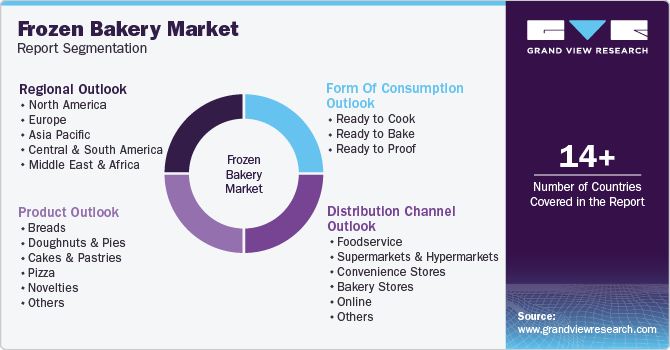
This report forecasts revenue growth at global, regional, and country levels and provides an analysis of the latest industry trends and opportunities in each of the segments from 2021 to 2033. For this study, Grand View Research has segmented the frozen bakery market report based on product, form of consumption, distribution channel, and region.
 To learn more about this report, Download Free Sample Report
 -
Product Outlook (Revenue, USD Million, 2021 - 2033)
-
Breads
-
Doughnuts & Pies
-
Cakes & Pastries
-
Pizza
-
Novelties
-
Others
-
-
Form Of Consumption Outlook (Revenue, USD Million; 2021 - 2033)
-
Ready to Cook
-
Ready to Bake
-
Ready to Proof
-
-
Distribution Channel Outlook (Revenue, USD Million, 2021 - 2033)
-
Foodservice
-
Supermarkets & Hypermarkets
-
Convenience Stores
-
Bakery Stores
-
Online
-
Others
-
-
Regional Outlook (Revenue, USD Million, 2021 - 2033)
-
North America
-
U.S.
-
Canada
-
-
Europe
-
Germany
-
UK
-
Switzerland
-
Austria
-
Netherlands
-
-
Asia Pacific
-
China
-
Japan
-
India
-
South Korea
-
Australia & New Zealand
-
-
Latin America
-
Chile
-
Peru
-
Colombia
-
Brazil
-
-
Middle East & Africa
-
South Africa
-
-
Research Methodology
The frozen bakery market figures in this report are based on a proven research process that combines executive interviews with secondary research from proprietary databases, company filings, and recognized regulatory and institutional sources. Market size is built through value-chain sizing - reconciling supply-side and demand-side estimates - and triangulated with bottom-up and top-down approaches. Every estimate passes multiple levels of expert validation before publication, with each frozen bakery segment quantified using the revenue-capture definitions in the table below.
Segment Definition
Segment - Product
Revenue capture definition
Breads
This segment includes the sales of frozen bread products such as artisan breads, sandwich breads, baguettes, rolls, buns, and specialty breads. Revenue is generated through retail sales, foodservice supply contracts, and bakery distribution channels that offer ready-to-bake, par-baked, or fully baked frozen bread products.
Doughnuts
This segment includes the sales of frozen doughnuts in various formats, including filled, glazed, iced, and specialty doughnuts. Revenue is generated through supermarkets, convenience stores, cafés, quick-service restaurants, and foodservice operators that ensure reduce preparation time, and support on-demand serving requirements.
Cakes & Pastries
This segment includes the sales of frozen cakes, croissants, muffins, Danish pastries, éclairs, tarts, and other sweet baked products. Revenue is generated through retail outlets, bakery chains, hotels, cafés, and catering services that rely on frozen bakery products to deliver premium-quality desserts and pastries.
Pizza
This segment includes the sales of frozen pizza bases, pizza dough, and ready-to-bake pizza products used across retail and foodservice channels. Revenue is generated through supermarkets, restaurants, quick-service chains, and institutional foodservice providers.
Novelties
This segment includes the sales of innovative and specialty frozen bakery products such as filled bakery snacks, seasonal baked goods, ethnic bakery offerings, gluten-free products, plant-based bakery items, and premium indulgent treats. Revenue is generated through product innovation, premiumization strategies.
Others
This segment includes the sales of frozen bakery products not classified under the primary categories, including cookies, biscuits, brownies, waffles, pancakes, savory pastries, and specialty dough products. Revenue is generated through diverse retail and foodservice applications where convenience, extended shelf life, and product consistency are critical purchasing factors.
Segment - Distribution Channel
Revenue capture definition
Foodservice
This segment includes the sales of frozen bakery products through cafés, restaurants, hotels, quick-service restaurants, bakeries, and catering services. Revenue is generated from bulk purchases of ready-to-bake, par-baked, and fully baked products for commercial consumption.
Retail
This segment includes the sales of frozen bakery products through supermarkets, hypermarkets, convenience stores, specialty stores, and online retail platforms. Revenue is generated from consumer purchases of frozen breads, pastries, cakes, pizzas, and other bakery products for at-home consumption.
Estimation Model
Production Layer
Distribution Layer
Consumption Layer
Revenue Layer
How many frozen bakery products are produced and supplied?
How much product reaches commercial and retail channels?
How much product is purchased and consumed?
How much revenue is generated?
Assess the production volumes of frozen breads, doughnuts, cakes & pastries, pizzas, and specialty bakery products across key manufacturing regions to establish the total addressable product base.
Apply distribution penetration across supermarkets, hypermarkets, convenience stores, foodservice operators, cafés, restaurants, and bakery chains to determine the market-reachable volume.
Evaluate consumption rates based on retail sales, foodservice demand, convenience food adoption, and bakery consumption patterns to convert distributed volumes into actual market demand.
Multiply consumed product volumes by average selling prices across product categories and channels, incorporating premium, artisan, and value-added frozen bakery offerings to derive total market revenue.
Delivered Customizations
This report has been delivered with the following In-depth customizations
Client Request
Customization Delivered
Value Adds
Technology Advancements Influencing Product Quality, Shelf Life, and Operational Efficiency
Conducted an in-depth assessment of emerging freezing technologies, freezer-to-oven innovations, automation systems, packaging advancements, and shelf-life enhancement solutions across the frozen bakery value chain. Evaluated their impact on product consistency, inventory management, and production efficiency.
Enables stakeholders to identify technology investment priorities, benchmark innovation strategies, and assess competitive advantages associated with advanced manufacturing and freezing capabilities.
Growth Potential of Convenience-Oriented Bakery Products in Retail Channels
Analyzed consumer purchasing behavior, demand trends for ready-to-bake and ready-to-heat bakery products, retail channel expansion, private-label penetration, and evolving at-home consumption patterns across key regions.
Supports product portfolio optimization, retail expansion strategies, and identification of high-growth convenience bakery categories aligned with changing consumer preferences.
Mergers, Acquisitions, Partnerships, and Capacity Expansion Activities
Evaluated recent strategic transactions, manufacturing facility expansions, distribution partnerships, and investment activities undertaken by leading frozen bakery manufacturers. Assessed their implications on market consolidation, production capacity, and competitive positioning.
Provides actionable intelligence on competitive movements, investment opportunities, market entry strategies, and potential partnership targets to support long-term growth initiatives.
Frequently Asked Questions About This Report
Pizza dominated the frozen bakery market with a share of 31.5% in 2025. This is attributed to the emergence of specialty pizza products such as dairy and gluten-free.
Some key players operating in the frozen bakery market include Kellogg Co.; Cargill, Incorporated; Conagra Brands Inc.; Custom Foods, Inc.; Vandemoortele nv; Bridgford Foods Corporation; Associated British Foods plc; General Mills, Inc.; Europastry; Cole’s Quality Foods Inc.; and Flowers Foods.
Key factors that are driving the market growth include noticeable increase in popularity for processed food and rising demand from coffee shops along with the small and large scale food chains.
Food service segment dominated the distribution channel with a revenue share of 58.1% in 2025.
Asia Pacific is the fastest growing region over the forecast period.
Ready to cook form of consumption is the fastest growing segment with a CAGR of 5.7% over the forecast period.
The global frozen bakery market size was valued at USD 74.2 billion in 2025 and is estimated at USD 78.1 billion for 2026.
The global frozen bakery market is expected to grow at a CAGR of 5.4% from 2026 to 2033, reaching USD 113.0 billion by 2033.
North America dominated with a 37.9% revenue share in 2025.
About the Author(s)
Consumer F&B Research Team
Consumer Goods · Consumer F&BThis report was authored by the consumer f&b research team at Grand View Research - comprising two research analysts, one senior research analyst, and one industry expert - with specialized expertise in the consumer f&b segment of the consumer goods industry. All findings are based on proprietary consumer goods databases, executive interviews, and regulatory analysis, subject to internal peer review prior to publication.
Last Updated:
Speak to Analyst

Customize this report to your needs - add regions, segments, or data points, with 20% free customization.
Or view our licence options:


ISO 9001:2015 & 27001:2022 Certified
We are GDPR and CCPA compliant! Your transaction & personal information is safe and secure. For more details, please read our privacy policy.


