
- Home
- »
- Consumer F&B
- »
-
Fruit Snacks Market Size, Share & Trends Report, 2026-2033GVR Report cover

Fruit Snacks Market (2026 - 2033)
Size, Share & Trends Analysis Report By Product (Fruit Roll-ups, Freeze Dried Fruits, Fruit Bars, Soft Chews), By Nature (Conventional, Organic), By Fruit Type (Apple, Mango, Banana), By Distribution Channel, By Region, And Segment Forecasts
Market Size, 2025
$17.7BMarket Estimate, 2026
$18.9BMarket Forecast, 2033
$33.5BCAGR, 2026–2033
8.5%Fruit Snacks Market Summary
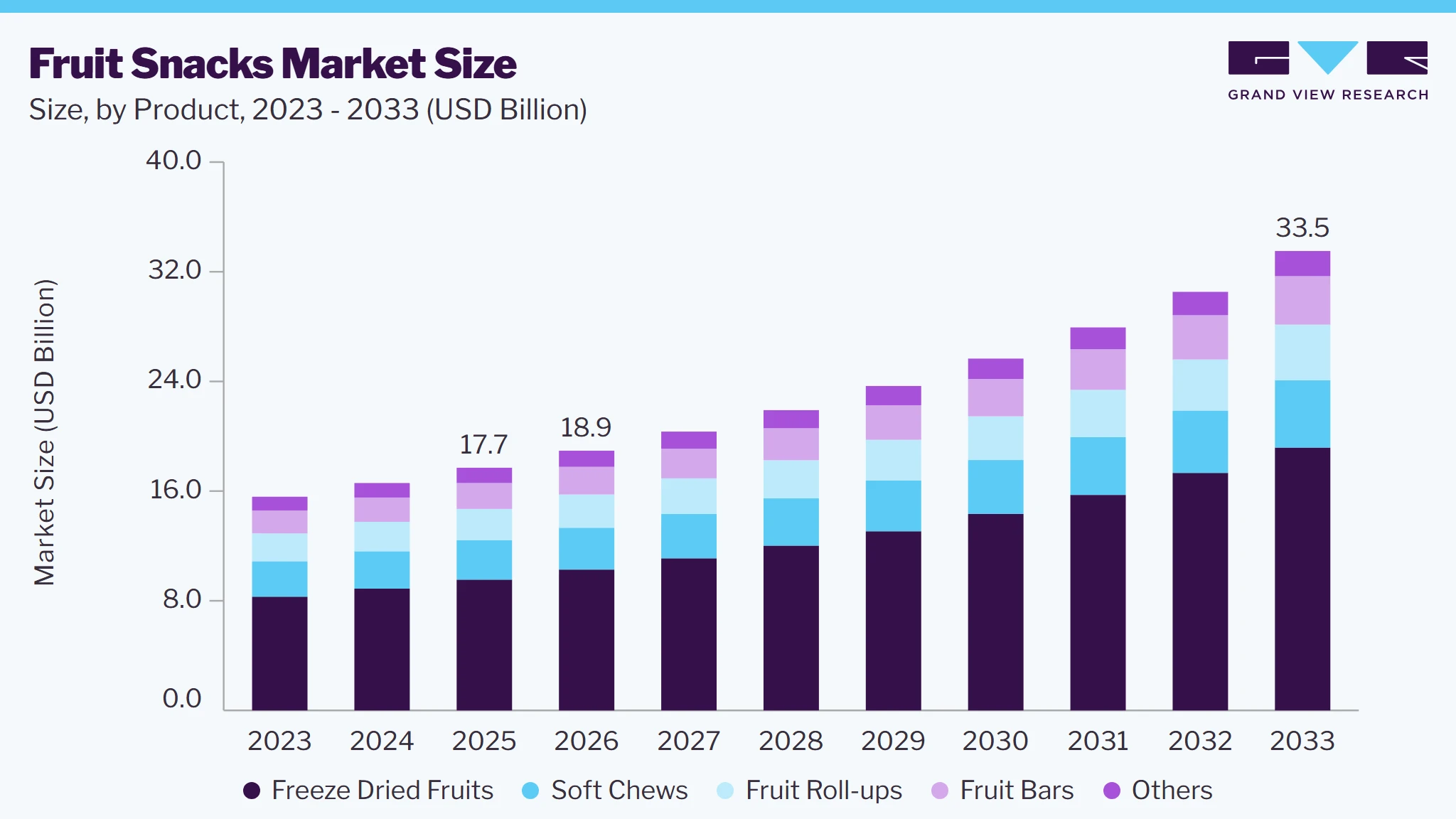
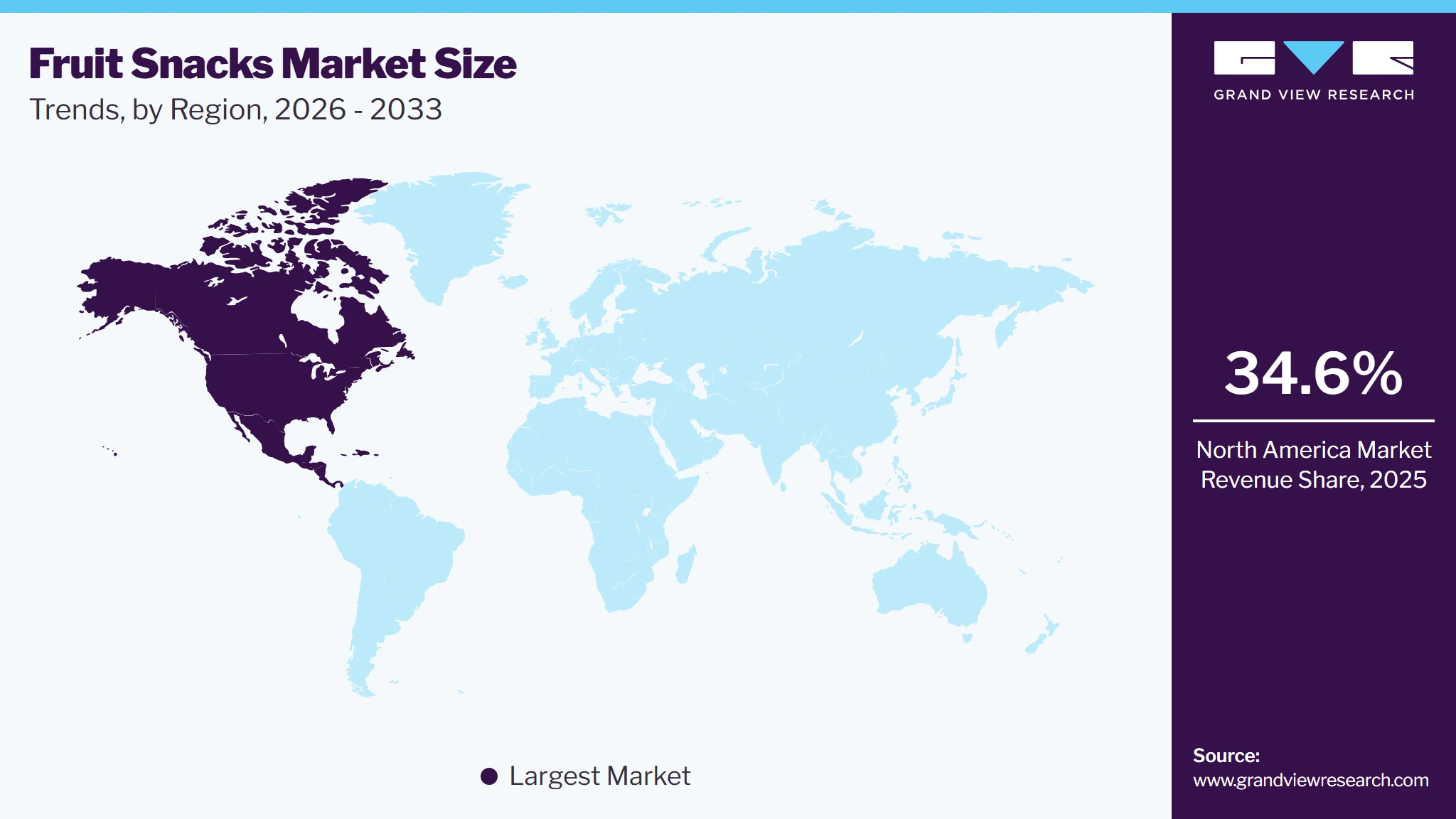
The global fruit snacks market size was valued at USD 17.7 billion in 2025 and is projected to grow from USD 18.9 billion in 2026 to USD 33.5 billion by 2033, at a CAGR of 8.5% from 2026 to 2033. North America dominated the fruit snacks market with the largest revenue share of 34.6% in 2025. The growth of the market is primarily driven by the prevalent health and wellness trend, with consumers looking for low-calorie snacks.
 Source: Grand View Research, IR Documents, Primary Interviews, Paid DatabasesTo learn more about this report,
 Download Free Sample Report
Key Market Trends & Insights
- By product: Freeze-dried fruits segment held the largest market share of 53.9% in 2025.
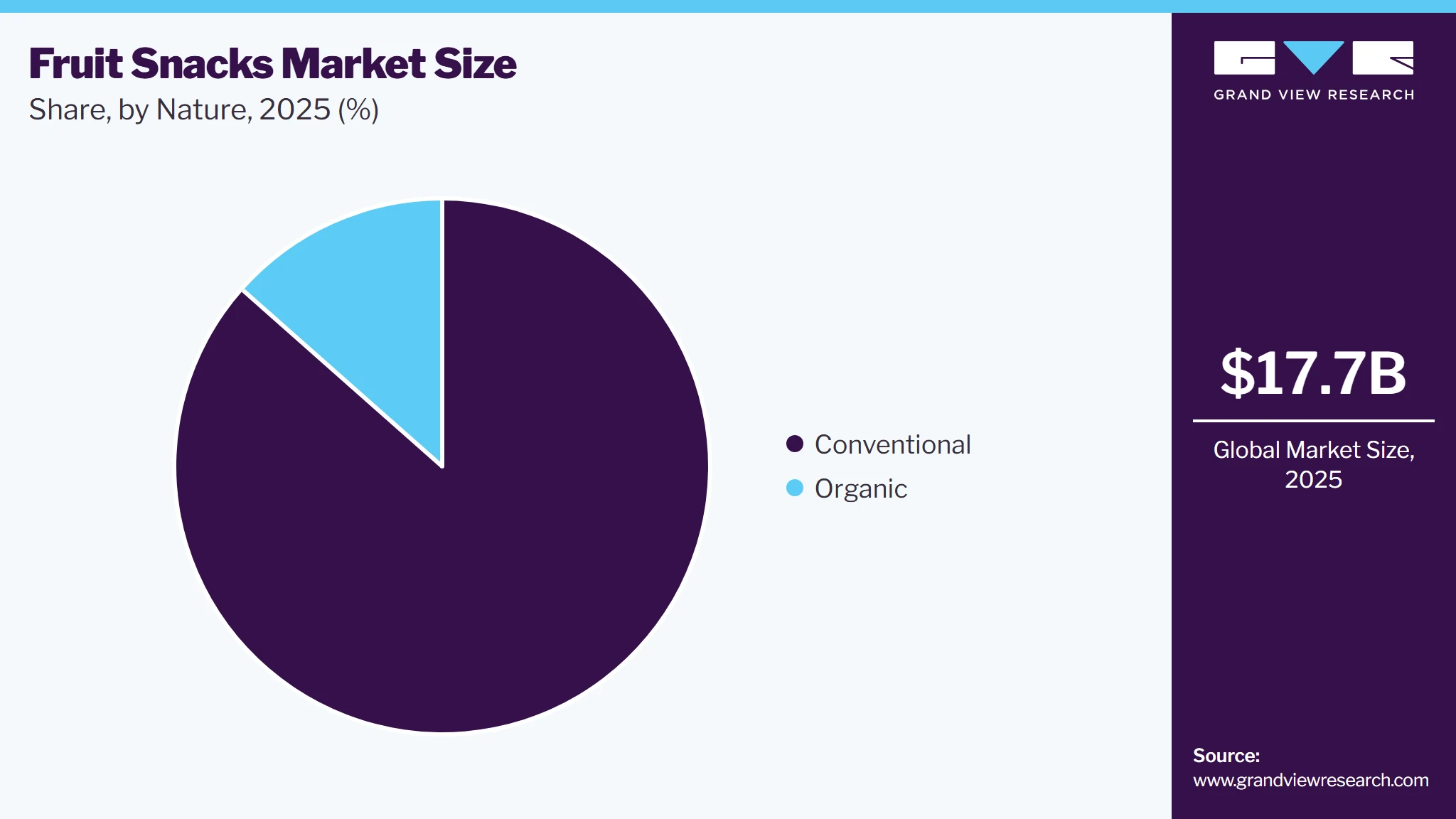
- By nature: Conventional segment held the largest market share of 86.5% in 2025.
- By fruit type: Berries segment led the market with the largest revenue share of 19.9% in 2025.
- By distribution channel: Supermarkets and hypermarkets led the market with the largest revenue share of 38.3% in 2025.
Regional Highlights
- Largest regional market: North America (34.6% revenue share, 2025)
- By country: The U.S. held the largest market share in 2025.
Market Size & Forecast
- Market size in 2025: USD 17.7 Billion
- Estimated market size in 2026: USD 18.9 Billion
- Projected market size by 2033: USD 33.5 Billion
- CAGR (2026-2033): 8.5%
Three ways to get this report
Buy it, customize it, or ask a question.Ask an Analyst
Analyst response in 1 business day
- AccessReport author, directly
- Reply timeWithin 1 working day
- No sales callDirect answer only
- FormatEmail reply
- CostFree, no cost
Get the Full Report
What the study covers
- FormatsPDF · Excel · Dashboard
- Timeline2026–2033 annual, 2025 base
- Coverage20+ countries, 5 regions
- Companies10+ key players profiled
Customize the Report
20% free customization
- IncludeCountries, segments, points
- TailorTo your product definition
- ExtendDeeper competitor detail
- OrA fully bespoke study
- Turnaround5–10 working days
<brAdditionally, the convenience of fruit snacks and their increased availability in grocery stores, convenience stores, and online retailers are also contributing to the market's growth. The market is being driven by the introduction of innovative flavors and products that cater to specific dietary requirements, such as gluten-free, low calories, and vegan options. As a result, the global snacks market is expected to continue advancing in the coming years. Various players operating in the market offer non-GMO, vegan, and allergen-free snacks. SunOpta, Inc.; The Hain Celestial Group, Inc.; and Primal Spirit Foods, Inc. are some of the major players offering such products to consumers across the globe.
With the introduction of newer healthy snacks, brands are targeting children as their primary customers. Many fruit snacks are marketed specifically to this demographic, with colorful packaging and fun shapes and flavors that appeal to younger consumers. More recently, many producers have started incorporating functional fruit snack ingredients, such as probiotics and vitamins, into fruit snacks to appeal to health-conscious consumers. Such factors will assist in market growth.
 To learn more about this report, Download Free Sample Report
In 2021, Ferrara re-launched Kellogg's fruit snacks as "Funables". The company's focus is on targeting families who are searching for healthy snack options that also provide a fun and enjoyable experience for kids. By introducing these snacks with healthy ingredients, Ferrara aims to meet the needs of health-conscious parents who want to encourage their children to eat nutritious snacks while also satisfying their taste buds.
The COVID-19 pandemic led to a significant shift in eating habits, with most consumers eating for comfort as much as nutrition. Fruit snack sales increased in many parts of the globe, as stay-at-home consumers were looking for indulgent treats. According to a poll published in a report on Processed Fruit Snacks by Action on Sugar in September 2020, families with kids snacked more frequently. 7 out of 10 families (70%) with children under five years of age reported snacking at home, which was more than twice as often as those with no children.
People are willing to spend more on quality fruit snacks with natural and authentic ingredients. Increased health consciousness, rising demand for organic and natural products, and the convenience of pre-packaged snacks are driving the demand for fruit snacks in countries such as the U.S. Many fruit snacks are marketed specifically to children, with colorful packaging and fun shapes and flavors that appeal to younger consumers.
Consumers are increasingly focusing on their health and wellness. As they become more health conscious, they prefer healthier snacks over traditional snacks such as candies and chips. Consumers seek nutritious and low-calorie snack options, such as fruit snacks, that are free from artificial additives and contain natural ingredients.
Fruit snacks and fruit juices use real fruits and are a good source of minerals and vitamins, making them a popular choice among health-conscious consumers. Additionally, they are a preferred choice among parents looking for healthier foods for their children to take to school or other activities. Moreover, the packaging of fruit snacks in various formats, such as bites, snack bars, and pouches, makes them portable and convenient. Some of the major players offering fruit snacks in forms such as bites and bars include KIND, Sun-Maid, and That’s it.
According to the 2022 Food and Health Survey report published by the International Food Information Council, 52% of participants followed a specific eating pattern or diet. Among these, the popular choices of eating were calorie-counting (13%), mindful eating (14%), and clean eating (16%).
Market Dynamics
The fruit snacks market is experiencing consistent growth as manufacturers expand product portfolios to address evolving dietary preferences and convenience-oriented consumption patterns. Product innovation has shifted beyond traditional fruit-flavored snacks toward offerings formulated with real fruit ingredients, reduced sugar content, functional ingredients, and clean-label claims. Demand is being supported by changing eating habits, expanding retail distribution, and increasing penetration of packaged snack products across both developed and emerging markets. Continuous investment in ingredient development and premium product positioning is expected to strengthen long-term market expansion.
The growing preference for healthier snack alternatives is a major factor supporting the fruit snacks market. Consumers are replacing conventional confectionery with products perceived to offer improved nutritional value, driving demand for snacks made with fruit puree, fruit juice concentrates, dried fruit, and natural ingredients. Busy lifestyles, rising urbanization, and increasing consumption of on-the-go foods have further accelerated sales across supermarkets, convenience stores, and online retail channels. Manufacturers are also introducing products with reduced added sugar, organic ingredients, plant-based formulations, and added vitamins or fiber to align with evolving dietary trends. These developments continue to broaden the consumer base and support category growth across multiple age groups.
Fluctuating prices of fruit-based ingredients and seasonal variations in agricultural production present challenges for the fruit snacks market. Production costs are influenced by the availability and pricing of fruits, natural sweeteners, packaging materials, and transportation, creating pressure on manufacturers' profit margins. Maintaining consistent product quality while reducing artificial ingredients and preservatives can further increase manufacturing complexity and costs. Additionally, premium fruit snacks often face pricing challenges in cost-sensitive markets, where consumers may opt for lower-priced conventional snack alternatives. These factors can limit market penetration, particularly in developing economies.
The increasing demand for functional nutrition and ingredient transparency is creating significant opportunities for the fruit snacks market. Manufacturers are expanding portfolios with products containing probiotics, prebiotic fiber, collagen, vitamins, antioxidants, and other functional ingredients while emphasizing natural colors, flavors, and preservative-free formulations. Innovation in freeze-drying, air-drying, and low-temperature processing technologies is also helping retain nutritional value and improve product quality. Furthermore, growing demand for organic, vegan, gluten-free, and allergen-free snacks, combined with expanding e-commerce distribution and premium branding strategies, is expected to create new revenue opportunities for industry participants throughout the forecast period.
Analyst Perspective
The fruit snacks industry is transitioning toward premium food positioning, supported by advancements in fruit processing, ingredient quality, and nutritional enhancement. Competitive differentiation will increasingly be determined by the ability to deliver products with authentic fruit content, minimal processing, extended shelf stability, and scalable manufacturing while adapting to evolving regulatory standards and retailer requirements. Businesses that optimize sourcing networks, diversify product formats, and strengthen omnichannel distribution are expected to secure stronger margins and sustained expansion over the forecast period.
Product Insights
largest revenue share of 53.9% in 2025 and is expected to grow at the fastest CAGR over the forecast period. Freeze-dried fruit snacks have a higher proportion of fruit exacts compared to roll-ups, bars, and soft chews. Trader Joe’s, Crispy Green, Ocean Spray, Augason Farms, and Mother Earth Products are some of the leading brands in the market.
An article published in MDPI titled ‘Sustainable Approach for Development Dried Snack Based on Actinidia deliciosa Kiwifruit’, published in 2023, compared hot air drying and freeze-drying for improving the shelf life of kiwi fruit. The freeze-dried snack was assessed to be better than its hot-air-dried counterpart. The hot-air-dried snacks were darker in appearance, and better preservation was observed in freeze-dried snacks.
Nature Insights
Based on nature, the conventional segment led the market with the largest revenue share of 86.5% in 2025. Conventional fruit snacks are made with ingredients that may have been treated with synthetic chemicals, pesticides, or fertilizers. They are often more affordable than organic fruit snacks and may be more widely available.
According to research published by the Oral Health Foundation in 2020, the pandemic has changed the eating habits of adults. Staying at home has led to an increase in snacking among 38% of British adults. Additionally, 61% of adults admitted to eating snacks between meals, while 70% of families with kids reported an increase in snacking compared to those without kids.
The organic segment is anticipated to expand at a CAGR of 10.5% during the forecast period. Organic fruit snacks are highly appealing to consumers concerned about the environmental impact of conventional agriculture. The organic fruit snacks market is growing at a faster pace than the conventional market for fruit snacks. Customers are increasingly demanding organic fruit snacks with low to no sugar.
Fruit Type Insights
Based on fruit type, the berries segment led the market with the largest revenue share of 19.9% in 2025 and is expected to grow at the fastest CAGR over the forecast period. Berries consist of flavors like cranberry, strawberry, blueberry, and mixed berries. Berries often have a sweet or sour taste and are often liked by kids. The demand for apple fruit snacks is projected to grow at a considerable rate of 7.5% during the forecast period. Apple fruit snacks have a longer shelf life than fresh apples.
Dried apple chips have zero water content, which typically lasts up to a year when stored properly in a cool, dry place. Apple fruit snacks are often flavored with cinnamon, honey, or other spices. These are low in calories and fat, an increasingly preferred choice of many consumers. A 1-ounce serving of dried apple fruit snacks contains approximately 100 calories, no fat, and 3 grams of fiber. Many fruit snack brands offer apple-flavored options because of the benefits and delicious taste of the fruit.
Distribution Channel Insights
Based on distribution channel, the supermarkets and hypermarkets led the market with the largest revenue share of 38.3% in 2025. The availability of an in-store associate/expert, assistance on product specifications, and the consumer being able to physically examine the product are some of the factors popularizing the sales of fruit snacks through the retail channel.
 To learn more about this report, Download Free Sample Report
Brick-and-mortar stores remain a preferred choice of customers to purchase food and beverage products. Product demand through this distribution channel is expected to remain stable over the forecast period. Research conducted by British Nutrition Foundation reflected that if supermarket trolleys advertise fruits and vegetables, healthy purchases by customers could increase by 12.4%.
The online distribution channel is expected to register the fastest growth rate of 9.3% during the forecast period. The penetration of online distribution channels significantly accelerated after the outbreak of COVID-19. The growth of online channels like Amazon, Target and Costco has significantly improved after the introduction of e-commerce in the market. The availability of a wide variety of options and quick delivery are shaping the online distribution channel.
The growth of the e-commerce industry has contributed to the growth of the fresh fruit market. Online platforms have made it easier for consumers to purchase fresh fruits from different parts of the world and have also enabled farmers to reach a wider customer base. Furthermore, the easy availability of fresh fruits through various chain stores and retail channels such as Walmart, Tesco.com, and others is another factor augmenting market growth.
Regional Insights
North America dominated the fruit snacks market with the largest revenue share of 34.6% in 2025. Fruit snacks are a popular choice among the younger generation in North America. These snacks are available in various shapes, sizes, and fruit flavors, making them a convenient option for kids. Some fruit snacks are even shaped like popular cartoon characters or animals, which adds to their appeal. These snacks are made with real fruit juices and purees and are often marketed as a healthier alternative to traditional candies.
 To learn more about this report, Download Free Sample Report
U.S. Fruit Snacks Market Trends
The fruit snacks market in the U.S. held the largest share in the North America region in 2025.
Europe Fruit Snacks Market Trends
The fruit snacks market in the U.K. held the largest share in the Europe region in 2025.
The UK is the largest market in Europe, holding a revenue share of 17.2% in 2022. The market for fruit snacks in the UK is steadily expanding due to the rising consumer demand for healthier snacking options. The growing consumer interest in health and wellness is one of the main drivers of the UK market for fruit snacks.
For instance, in April 2022, Soul Fruit, a tropical fruit snack brand, launched its new range at Planet Organic, a supermarket chain in the UK. Consumers in France prefer healthy and natural snacking options, which has increased the demand for organic and low-sugar fruit snacks. Germany is expected to expand at a CAGR of 7.7% during the forecast period.
Asia Pacific Fruit Snacks Market Trends
Asia Pacific is projected to expand at a CAGR of 8.3% over the forecast period, owing to the rising regional demand for healthy ingredients in fruit-based products. In China, gummy candy has been considered a snack for children, with Chinese companies focusing on exclusively marketing their fruit-flavored candies and snacks for kids. The country is expected to advance at a CAGR of 9.3% during the forest period.
Moreover, the country has a wide customer base for such products as the demand has risen among the female population. Moreover, Korean fruit-flavored candy has seen an increase in popularity among the Chinese, as consumers are increasingly focusing on the nutritional benefits of the ingredients that are used while processing fruit gummies or freeze-dried fruits. India is another promising economy and held a market share of 18.1% in 2022.
Key Fruit Snacks Company Insights
The fruit snacks market is characterized by the presence of several well-established players, such as General Mills Inc., Keurig Dr. Pepper Inc., Kellogg Company, Welch's, SunOpta Inc., and Sunkist Growers Inc, USA. These players account for considerable shares in the market for fruit snacks and have a strong presence across the globe. The market for fruit snacks also consists of various small- to mid-sized players who offer a selected range of products and mostly serve regional customers.
Key players operating in the market for fruit snacks are focusing on strategic initiatives such as product launches, acquisitions, sponsorships, collaborations, participation in events, and business expansions to drive revenue growth and reinforce their position in the global market. For example:
-
In February 2023, Fetch, the leading rewards app in the U.S. and a top platform for consumer engagement, partnered with PIM Brands, Inc., producer of Welch’s Fruit Snacks. The partnership will allow PIM Brands to connect with customers of its Welch’s Fruit Snacks, Welch’s Fruit Yogurt Snacks, and Welch’s Juicefuls brands, and gain insights into real-time customer buying behaviors by engaging shoppers through Fetch
-
In October 2022, under its Nutri-Grain brand, the Kellogg Company launched three new flavor mashups, including two new fruit and veggie breakfast bars and bites. The soft-baked breakfast bars are created with flavors of fruits and vegetables and have 8 grams of whole grains. They come in variants like apple & carrot, mixed berry, chocolatey banana, and strawberry & squash
-
In June 2022, General Mills introduced monster-inspired products with unique packaging designed by the American artist KAWS. The company also launched Monsters Mash Halloween Fruit Snacks, with a taste like Monsters cereals. They are made with real apple juice, making them a healthy option for traditional snack foods
-
In April 2022, Sunkist Growers, in partnership with Naturipe Farms and T&G Global's Envy Apples, debuted a ‘Fruitastic’ campaign for the Strawberry Shortcake animated series from WildBrain. Sunkist promoted Blood Oranges with Strawberry Shortcake's friend Orange Blossom
Key Fruit Snacks Companies
The following key companies have been profiled for this study on the fruit snacks market.
-
General Mills Inc.
-
Mount Franklin Foods
-
Keurig Dr Pepper Inc.
-
Kellogg Company
-
Welch's
-
Seneca Foods Corporation
-
SunOpta Inc.
-
Crispy Green Inc.
-
Sunkist Growers Inc.
-
Chaucer Foods Ltd
Competitive Benchmarking
Category
Operating Strategies
Competitive Edge
Weakness
Established Players (General Mills Inc.; Keurig Dr Pepper Inc.; Kellogg Company; Welch's; Seneca Foods Corporation)
- Expand product portfolios through clean-label, reduced-sugar, and functional fruit snacks while strengthening global retail distribution, strategic acquisitions, and investments in sustainable packaging and manufacturing efficiency.
- Extensive distribution networks, established brand recognition, large-scale production capabilities, diversified product portfolios, and strong relationships with retailers enable broad market penetration.
- High dependence on mature markets, increasing raw material and packaging costs, slower product development cycles, and operational complexity across multiple product categories.
Emerging Players (Mount Franklin Foods; SunOpta Inc.; Crispy Green Inc.; Sunkist Growers Inc.; Chaucer Foods Ltd.)
- Focus on premium fruit snacks, freeze-dried products, organic ingredients, private-label manufacturing, and innovative processing technologies while expanding through specialty retail and e-commerce channels.
- Strong innovation capabilities, expertise in natural and minimally processed products, faster response to changing consumer preferences, and flexibility in launching niche offerings.
- Limited global distribution, lower marketing budgets, dependence on selected product categories, and challenges in scaling production while maintaining competitive pricing.
Fruit Snacks Market Report Scope
Report Attribute
Details
Market size in 2025
USD 17.7 billion
Estimated market size in 2026
USD 18.9 billion
Projected market size by 2033
USD 33.5 billion
Growth rate
CAGR of 8.5% from 2026 to 2033
Base year for estimation
2025
Historical data
2021 - 2024
Forecast period
2026 - 2033
Quantitative units
Revenue in USD million/billion and CAGR from 2026 to 2033
Report coverage
Revenue forecast, company ranking, competitive landscape, growth factors, and trends
Segments covered
Product, nature, fruit type, distribution channel and region
Regional scope
North America; Europe; Asia Pacific; Latin America; MEA
Country scope
U.S.; Canada; Mexico; Germany; UK; France; China; Japan; India; Australia & New Zealand; Philippines; Brazil; Argentina; South Africa; Saudi Arabia
Key companies profiled
General Mills Inc.; Mount Franklin Foods; Keurig Dr Pepper Inc.; Kellogg Company; Welch's; Seneca Foods Corporation; SunOpta Inc.; Crispy Green Inc.; Sunkist Growers Inc.; Chaucer Foods Ltd
Customization scope
Free report customization (equivalent up to 8 analysts' working days) with purchase. Addition or alteration to country, regional & segment scope.
Pricing and purchase options
Avail customized purchase options to meet your exact research needs. Explore purchase options
Global Fruit Snacks Market Report Segmentation
This report forecasts revenue growth at global, regional & country levels and provides an analysis of the latest industry trends and opportunities in each of the sub-segments from 2021 to 2033. For the purpose of this study, Grand View Research has segmented the global fruit snacks market report based on product, nature, fruit type, distribution channel, and region.
-
Product Outlook (Revenue, USD Billion, 2021 - 2033)
-
Fruit Roll-ups
-
Freeze Dried Fruits
-
Fruit Bars
-
Soft Chews
-
Others
-
-
Nature Outlook (Revenue, USD Billion, 2021 - 2033)
-
Conventional
-
Organic
-
-
Fruit Type Outlook (Revenue, USD Billion, 2021 - 2033)
-
Apple
-
Mango
-
Banana
-
Pineapple
-
Berries
-
Mixed
-
Others
-
-
Distribution Channel Outlook (Revenue, USD Billion, 2021 - 2033)
-
Supermarkets & Hypermarkets
-
Convenience Stores
-
Online
-
Others
-
-
Regional Outlook (Revenue, USD Billion, 2021 - 2033)
-
North America
-
U.S.
-
Canada
-
Mexico
-
-
Europe
-
Germany
-
UK
-
France
-
-
Asia Pacific
-
China
-
Japan
-
India
-
Australia & New Zealand
-
Philippines
-
-
Central & South America
-
Brazil
-
Argentina
-
-
Middle East & Africa
-
South Africa
-
Saudi Arabia
-
-
Research Methodology
The Fruit Snacks market figures in this report are based on a proven research process that combines executive interviews with secondary research from proprietary databases, company filings, and recognized regulatory and institutional sources. Market size is built through value-chain sizing - reconciling supply-side and demand-side estimates - and triangulated with bottom-up and top-down approaches. Every estimate passes multiple levels of expert validation before publication, with each Fruit Snacks segment quantified using the revenue-capture definitions in the table below.
Segment Definition
Segment - Product
Revenue capture definition
Fruit Roll-ups
This segment includes the sales of fruit roll-ups made from fruit purée or concentrates, marketed as convenient packaged snacks through supermarkets, convenience stores, specialty retailers, and online platforms.
Freeze Dried Fruits
This segment includes the sales of freeze-dried fruits processed to retain flavor and nutrients, distributed through grocery retailers, health food stores, specialty outlets, and e-commerce channels.
Fruit Bars
This segment includes the sales of fruit bars containing fruit with cereals, nuts, or seeds, offered as convenient snack products through retail stores and online marketplaces.
Soft Chews
This segment includes the sales of soft fruit chews formulated with fruit-based ingredients, available in multiple flavors and pack sizes across supermarkets, convenience stores, and digital retail channels.
Others
This segment includes the sales of fruit gummies, dried fruit bites, fruit chips, fruit clusters, and other fruit snack formats distributed through retail and specialty channels.
Estimation Model
Consumer Base Layer
Retail Access Layer
Purchase Behaviour Layer
Monetisation Layer
Who consumes fruit snacks?
Who can purchase through available channels?
Who actively purchases fruit snacks?
How much revenue is generated?
Estimate the population purchasing packaged fruit snacks across children and adults based on snacking habits, health awareness, income levels, and retail accessibility.
Apply modern retail, convenience store, and e-commerce penetration to identify consumers with reliable access to packaged fruit snack products.
Apply purchase frequency and category adoption rates to estimate active fruit snack buyers, considering health preferences, convenience, and premium product acceptance.
Multiply active consumers by average annual spending per buyer, incorporating product mix, pricing, retail channels, and premium category contributions to estimate market revenue.
Delivered Customizations
This report has been delivered with the following In-depth customizations
Client Request
Customization Delivered
Value Adds
Product Innovation & Health-Oriented Snack Assessment
Examined the fruit snacks industry across fruit bars, freeze-dried fruits, fruit roll-ups, soft chews, natural ingredient formulations, sugar-reduction initiatives, and evolving product development strategies.
Enables stakeholders to identify fast-growing product segments, monitor formulation trends, and evaluate opportunities within premium and health-focused snack categories.
Consumer Demand & Distribution Channel Evaluation
Analyzed purchasing patterns across supermarkets, hypermarkets, convenience stores, specialty retailers, and e-commerce platforms, considering packaging preferences, product accessibility, and consumption trends.
Delivers actionable insights into channel effectiveness, shopper preferences, and distribution priorities to support market penetration and commercial planning.
Market Positioning & Expansion Opportunity Analysis
Investigated competitive developments, premium product launches, sustainable packaging adoption, regional demand shifts, and category diversification influencing the future fruit snacks landscape.
Assists strategic decision-making by identifying expansion opportunities, competitive differentiation, and investment priorities across established and emerging fruit snacks markets.
Frequently Asked Questions About This Report
The global fruit snacks market size was valued at USD 17.7 billion in 2025 and is estimated at USD 18.9 billion in 2026.
The global fruit snacks market is expected to grow at a CAGR of 8.5% from 2026 to 2033, reaching USD 33.5 billion by 2033.
North America dominated with a 34.6% revenue share in 2025.
Asia Pacific is the fastest-growing region over the forecast period.
The freeze-dried fruits led with a 53.9% revenue share in 2025 and is the fastest-growing segment.
The berries segment held the largest revenue share in 2025 and is the fastest-growing segment.
Supermarkets and Hypermarkets held the largest revenue share in 2025.
Key factors include increasing demand for convenient on-the-go snacks, rising preference for healthier snack options, growing interest in fruit-based products, and continuous product innovation.
The conventional segment held the largest revenue share in 2025, while organic is the fastest-growing segment.
About the Author(s)
Consumer F&B Research Team
Consumer Goods · Consumer F&BThis report was authored by the consumer f&b research team at Grand View Research - comprising two research analysts, one senior research analyst, and one industry expert - with specialized expertise in the consumer f&b segment of the consumer goods industry. All findings are based on proprietary consumer goods databases, executive interviews, and regulatory analysis, subject to internal peer review prior to publication.
Last Updated:
Speak to Analyst

Customize this report to your needs - add regions, segments, or data points, with 20% free customization.
Or view our licence options:


ISO 9001:2015 & 27001:2022 Certified
We are GDPR and CCPA compliant! Your transaction & personal information is safe and secure. For more details, please read our privacy policy.


