
- Home
- »
- Smart Textiles
- »
-
Garment Active Insulation Market Size, Share Report, 2033GVR Report cover

Garment Active Insulation Market (2026 - 2033)
Size, Share & Trend Analysis Report By Product (Polyester, Wool, Cotton, Nylon), By Sourcing (Branded Insulation, Non-Branded Insulation), By Application (Outerwear, Footwear), By Region, And Segment Forecasts
Market Size, 2025
$250.1MMarket Estimate, 2026
$271.3MMarket Forecast, 2033
$499.5MCAGR, 2026–2033
9.1%Garment Active Insulation Market Trends
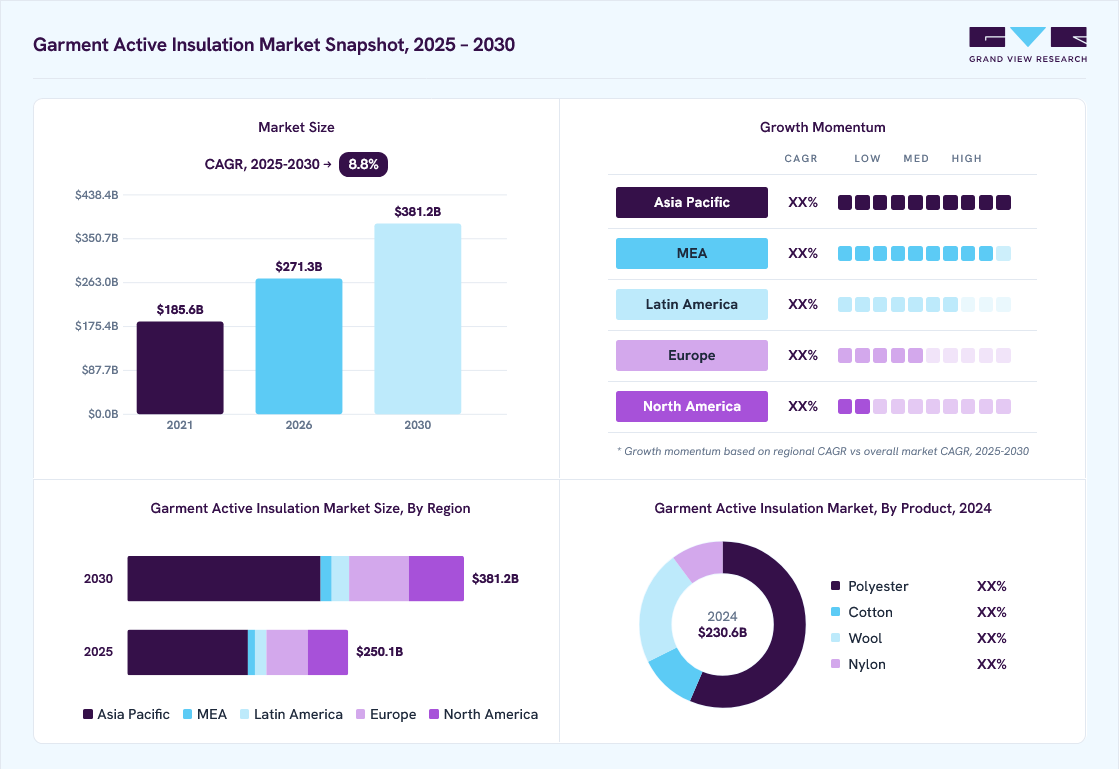
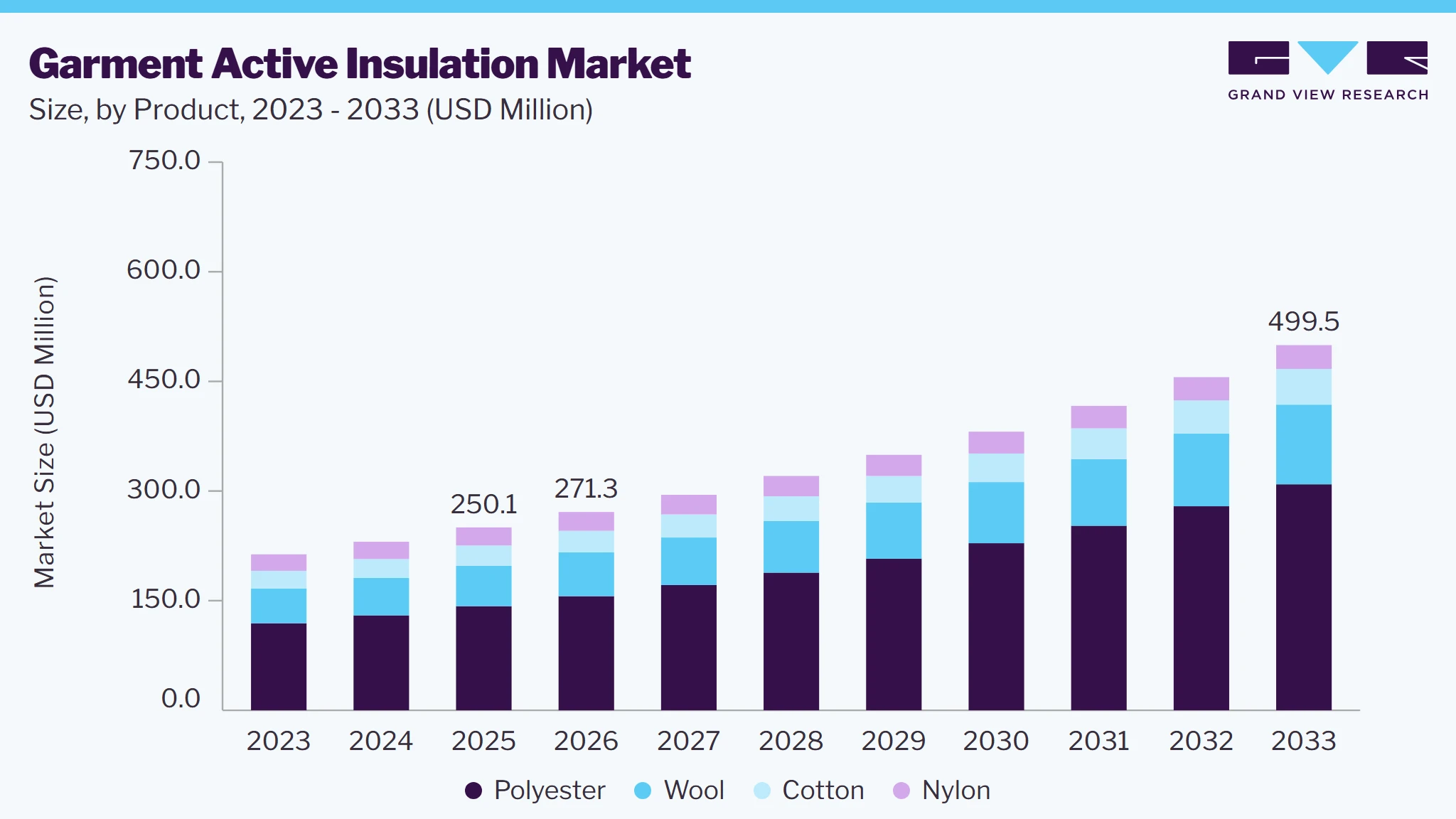
The global garment active insulation market size was valued at USD 250.1 million in 2025 and is projected to grow from USD 271.3 million in 2026 to USD 499.5 million by 2033, at a CAGR of 9.1% from 2026 to 2033. Asia Pacific dominated the market, accounting for a revenue share of 54.6% in 2025. The market growth can be attributed to the increasing consumer demand for high-performance, multifunctional apparel suitable for various activities and climatic conditions.
 Source: Grand View Research, IR Documents, Primary Interviews, Paid DatabasesTo learn more about this report,
 Download Free Sample Report
Key Market Trends & Insights
- By product: Polyester segment led the market with the largest revenue share of 56.9% in 2025
- By application: Outerwear segment led the market with the largest revenue share of 61.6% in 2025
- By sourcing: Branded insulation segment led the market with the largest revenue share of 74.3% in 2025
Regional Highlights
- Largest regional market: Asia Pacific (54.6% revenue share, 2025)
- By country: China held the largest market share in 2025.
Market Size & Forecast
- Market size in 2025: USD 250.1 Million
- Estimated market size in 2026: USD 271.3 Million
- Projected market size by 2033: USD 499.5 Million
- CAGR (2026-2033): 9.1%
Prism AI by Grand View Research Free to tryAsk a question about the garment active insulation marketTry asking✓Every figure cited from GVR research Prefer the report? Download free sample →In addition, sustainability trends push for innovations in biodegradable and recycled materials. Furthermore, rising disposable incomes and the popularity of outdoor sports further contribute to market expansion, making garment active insulation a sought-after choice for performance clothing. Garment active insulation refers to specialized clothing layers designed to provide warmth while allowing moisture to escape, making them ideal for various physical activities. The garment active insulation market is experiencing growth due to several factors. A significant increase in demand for high-performance outdoor and sports apparel is evident, driven by a heightened focus on fitness and healthy lifestyles. In addition, the rising popularity of outdoor activities, including hiking and military operations in extreme weather, further fuels this demand.
 To learn more about this report, Download Free Sample Report
Furthermore, the growing emphasis on environmental safety is influencing market dynamics. Governments are increasingly promoting green building initiatives, leading to a rise in the use of thermal insulation materials that help reduce carbon emissions. These materials support sustainability efforts and contribute to energy savings and noise reduction, aligning with strict energy efficiency standards.
Moreover, substantial investments in research and development by established companies are paving the way for advancements in technology and materials used in garment active insulation. Innovations such as finishing treatments and layered fabrics are expected to enhance product quality and performance. These developments present lucrative opportunities for market players as they strive to meet evolving consumer demands for high-quality, functional apparel. As the market continues to expand, the integration of cutting-edge technologies will likely play a crucial role in shaping its future trajectory.
Market Dynamics
The garment active insulation market is expanding steadily due to rising consumer demand for lightweight, breathable, and thermally efficient apparel designed for outdoor activities, sports, and everyday wear. Growing participation in hiking, trekking, skiing, cycling, and fitness activities has increased the adoption of advanced insulated garments that provide warmth without compromising mobility. Continuous innovation in synthetic insulation, recycled fibers, and moisture-management technologies, along with the growing emphasis on sustainable performance apparel, is further supporting market growth.
The growing popularity of outdoor recreation, adventure tourism, and fitness activities is a major factor driving the garment active insulation market. Consumers increasingly seek apparel that delivers an optimal balance of warmth, breathability, moisture control, and lightweight comfort, making active insulation materials a preferred choice for jackets, vests, pants, and footwear. Expanding participation in winter sports, trekking, mountaineering, and running has encouraged apparel manufacturers to integrate advanced insulation technologies into their product portfolios.
Additionally, increasing disposable incomes and greater awareness of technical apparel have boosted demand for premium performance clothing across both developed and emerging economies. Leading brands are investing in innovative insulation materials that offer improved thermal regulation while reducing garment weight and bulk. The shift toward multifunctional clothing suitable for changing weather conditions continues to strengthen demand across consumer and professional applications.
Despite favorable growth prospects, the market faces challenges due to the relatively high cost of advanced insulation materials and specialized garment manufacturing processes. Premium synthetic insulation technologies, branded insulation systems, and sustainable recycled fibers often increase production expenses, resulting in higher retail prices. These cost factors can limit adoption in price-sensitive markets where consumers continue to prefer conventional insulated apparel.
The growing focus on sustainability presents significant opportunities for manufacturers to develop eco-friendly garment active insulation solutions. Increasing use of recycled polyester, bio-based insulation fibers, PFAS-free finishes, and circular textile manufacturing is helping brands meet evolving environmental regulations and consumer expectations. Sustainable insulation technologies are becoming an important differentiator in premium outdoor and sports apparel markets.
Analyst Perspective
The garment active insulation market is expected to witness steady growth, driven by increasing demand for lightweight, breathable, and thermally efficient apparel across outdoor recreation, sportswear, workwear, and lifestyle applications. Manufacturers are focusing on developing insulation materials that provide warmth while enhancing moisture management, flexibility, and wearer comfort. Sustainability is becoming a key competitive factor, with growing investments in recycled polyester, bio-based fibers, and low-impact manufacturing processes to meet evolving consumer preferences and environmental regulations. Continued innovation in insulation technologies, coupled with expanding collaborations between material suppliers and apparel brands, is expected to strengthen product differentiation and create long-term growth opportunities for the market.
Product Insights
Based on product, the polyester segment led the market with the largest revenue share of 56.9% in 2025 and is expected to grow at a CAGR of 10.3% over the forecast period. This growth can be attributed to its high performance and versatility. Polyester offers excellent moisture-wicking properties, quick-drying capabilities, and resistance to shrinking and stretching, making it ideal for active wear. In addition, its lightweight nature and durability further enhance its appeal, particularly in outdoor and sports clothing. Furthermore, the rising demand for high-performance apparel among consumers engaged in fitness and outdoor activities is expected to significantly boost polyester's market share.
The wool segment is expected to grow at a CAGR of 8.6% over the forecast period, driven by its natural moisture-absorbing properties and temperature-regulation capabilities. In addition, wool fibers effectively wick sweat away from the skin while allowing for evaporation, which helps maintain comfort during physical activities. This inherent ability to manage temperature and moisture makes wool an attractive option for active insulation in sportswear. Furthermore, the growing interest in sustainable and eco-friendly materials is likely to drive demand for wool-based garments, as consumers increasingly seek environmentally responsible choices in their apparel.
Sourcing Insights
Based on sourcing, the branded insulation segment led the market with the largest revenue share of 74.3% in 2025 and is expected to grow at a CAGR of 9.7% over the forecast period, owing to consumer trust and brand loyalty. In addition, established brands often invest heavily in marketing and product innovation, which enhances their reputation for quality and performance. This reputation drives demand among consumers seeking reliable, high-performance apparel for outdoor and athletic activities. Furthermore, branded products typically offer advanced features and technologies, appealing to consumers who prioritize functionality and style in their activewear choices.
The non-branded segment is expected to grow at a CAGR of 7.2% from 2025 to 2030, primarily due to its affordability and accessibility. Many consumers are increasingly price-sensitive, opting for non-branded options that provide similar performance at a lower cost. This trend is particularly evident among budget-conscious shoppers and those new to outdoor activities who may be hesitant to invest in premium brands initially. Furthermore, the availability of non-branded products in various retail channels also contributes to their popularity, making them an attractive option for a broader audience seeking functional garment active insulation without the premium price tag.
Application Insights
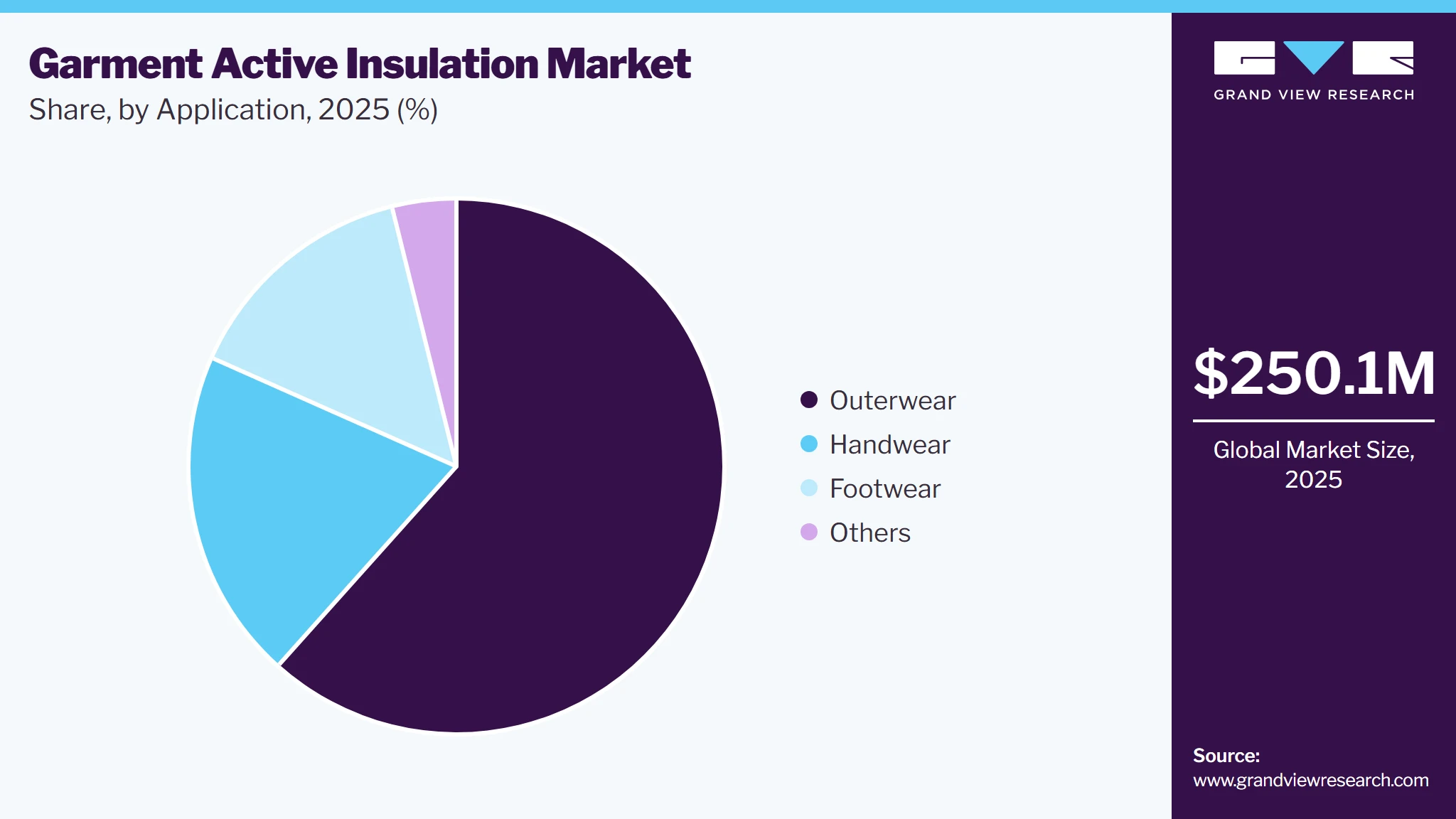
Based on application, the outerwear segment led the market with the largest revenue share of 61.6% in 2025 and is expected to grow at a CAGR of 8.7% over the forecast period, driven by increasing consumer interest in high-performance clothing that offers warmth and breathability. In addition, as outdoor activities gain popularity, there is a rising demand for jackets and coats that can adapt to varying weather conditions while ensuring comfort during physical exertion. Furthermore, insulation technology advancements enhance outerwear's functionality, making it more appealing to consumers seeking durable and versatile options for their active lifestyles.
 To learn more about this report, Download Free Sample Report
The footwear segment is expected to grow at a CAGR of 9.5% over the forecast period, owing to the need for specialized shoes that provide both insulation and comfort during outdoor activities. Consumers are increasingly looking for footwear that can maintain warmth while allowing for breathability, particularly in colder climates. In addition, the integration of active insulation materials into footwear enhances performance, catering to athletes and outdoor enthusiasts. Furthermore, the trend towards multifunctional products encourages manufacturers to innovate, resulting in footwear that meets diverse consumer needs while promoting an active lifestyle.
Regional Insights
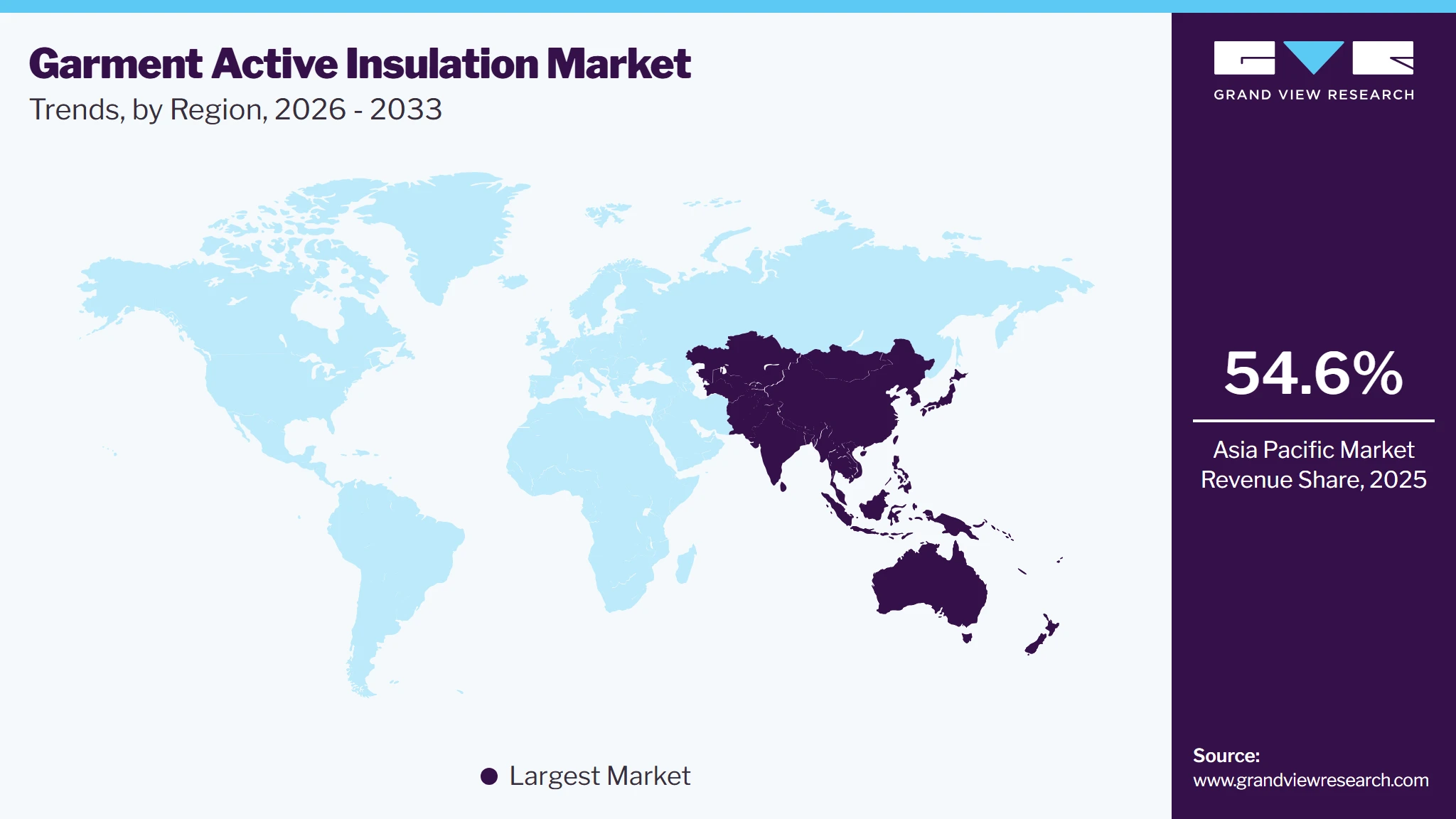
Asia Pacific dominated the garment active insulation market with the largest revenue share of 54.6% in 2025. This growth can be attributed to the booming fashion and sports apparel industries. Increasing consumer spending and the rising popularity of outdoor activities like hiking and sports have heightened demand for high-performance clothing. Furthermore, the penetration of multinational brands and a growing retail sector contribute to market expansion. Moreover, the region's focus on innovative textile technologies further enhances the appeal of garment active insulation products among consumers seeking comfort and functionality.
 To learn more about this report, Download Free Sample Report
China Garment Active Insulation Market Trends
The garment active insulation market in China held the largest share in the Asia Pacific region in 2025, driven by the rapid expansion of its sportswear and outdoor apparel sectors. In addition, as fitness and outdoor activities gain popularity, there is a growing demand for high-quality insulation materials that provide warmth and breathability. Furthermore, the increasing disposable income among consumers allows for greater spending on premium activewear. Moreover, government initiatives promoting healthy lifestyles and outdoor activities are expected to further stimulate market growth in the coming years.
Middle East & Africa Garment Active Insulation Market Trends
The Middle East and Africa garment active insulation market is expected to grow at a CAGR of 9.6% over the forecast period, owing to an increasing interest in outdoor sports and activities. In addition, the region's diverse climate conditions necessitate versatile clothing options that offer both insulation and moisture management. Furthermore, rising disposable incomes among consumers are fostering demand for high-performance apparel. Moreover, the ongoing development of retail infrastructure and increased availability of international brands are also contributing to the expansion of the market in this region.
Europe Garment Active Insulation Market Trends
The garment active insulation market in Europe is expected to grow significantly over the forecast period, primarily driven by a strong emphasis on sustainability and eco-friendly materials. Consumers are increasingly seeking products that provide performance benefits and align with their environmental values, leading to a rise in demand for innovative insulation technologies that utilize recycled or natural materials. Furthermore, the popularity of outdoor activities, coupled with a growing awareness of health and fitness, continues to drive market growth across various European countries.
Germany garment active insulation market dominated the European market and accounted for the largest revenue share in 2024, owing to its robust outdoor culture and strong consumer interest in high-quality sportswear. In addition, the country’s focus on innovation in textile manufacturing has led to advancements in garment active insulation technologies, appealing to both athletes and casual consumers alike. Furthermore, Germany's commitment to sustainability resonates with consumers who prioritize environmentally friendly products, further propelling the demand for advanced insulation solutions in activewear.
North America Garment Active Insulation Market Trends
The growth of the garment active insulation market in North America is expected to be driven by high consumer spending power and a strong outdoor recreation culture. In addition, the increasing popularity of skiing, hiking, and fitness training activities has created a substantial demand for performance-oriented apparel that provides warmth without compromising mobility. Furthermore, major brands are investing in research and development to enhance product offerings, which is expected to drive continued growth in this segment as consumers seek innovative solutions for their active lifestyles.
Key Garment Active Insulation Company Insights
Key players in the global garment active insulation industry include Owens Corning, Rockwool A/S, Saint-Gobain, and others. These companies adopt several strategies to enhance their competitive edge. These include investing in research and development to innovate and improve insulation technologies, ensuring product quality and performance. In addition, collaborations with outdoor brands and retailers are also common, allowing for expanded market reach. Furthermore, a focus on sustainability by utilizing eco-friendly materials and practices is increasingly prioritized to meet consumer demand for environmentally responsible products.
-
Rockwool A/S manufactures stone wool insulation products designed to provide superior thermal, acoustic, and fire-resistant properties. The company operates primarily in the building and construction segment, supplying insulation solutions for various applications, including residential, commercial, and industrial projects. The company’s expertise in advanced insulation materials positions it to contribute to the development of high-performance textiles that enhance thermal regulation and comfort in outdoor and activewear clothing.
-
Knauf Insulation produces a wide range of insulation materials, including glass wool, mineral wool, and other advanced insulation solutions. The company operates within the building and construction sector, catering to both residential and commercial markets. In relation to garment active insulation, the company’s innovative insulation technologies can be adapted for use in performance apparel, offering effective thermal management and moisture control.
Key Garment Active Insulation Companies:
The following key companies have been profiled for this study on the garment active insulation market.
- Covestro AG
- Owens Corning
- Rockwool A/S
- Saint-Gobain
- Knauf Insulation
- Huntsman International LLC
- Dupont
- Armacell
- Johns Manville
- Kingspan Group
- China Jushi Co. Ltd.
- Freudenberg SE
- 3M
- KUIU
- Polartec
- PrimaLoft, Inc.
Competitive Benchmarking
Category
Operating Strategies
Competitive Edge
Weakness
Established Players (Covestro AG; Owens Corning; Rockwool A/S; Saint-Gobain; Knauf Insulation; Huntsman International LLC; DuPont; Armacell; Johns Manville; Kingspan Group; 3M)
- Invest in advanced insulation materials with enhanced thermal regulation, breathability, and lightweight performance.
- Expand sustainable product portfolios using recycled and bio-based fibers while strengthening partnerships with apparel brands.
- Increase global manufacturing capacity and R&D to support high-performance outdoor and sportswear applications.
- Strong global manufacturing footprint and established relationships with leading apparel brands.
- Extensive R&D capabilities with patented insulation technologies and sustainable material expertise.
- Diversified product portfolios serving multiple industrial and textile markets.
- High R&D and manufacturing costs for advanced insulation materials.
- Dependence on volatile raw material prices and complex global supply chains.
- Increasing pressure to comply with evolving environmental and sustainability regulations.
Emerging Players (KUIU; Polartec; PrimaLoft, Inc.)
- Focus on premium, performance-driven insulation solutions for outdoor and technical apparel.
- Collaborate with apparel brands to develop specialized and sustainable insulation technologies.
- Differentiate through lightweight, breathable, and eco-friendly insulation products.
- Strong brand recognition in the outdoor and performance apparel segment.
- High product innovation and rapid adoption of sustainable insulation materials.
- Ability to quickly respond to changing consumer preferences and market trends.
- Smaller production scale than diversified multinational competitors.
- Limited geographic reach and dependence on premium apparel markets.
- Higher product pricing may restrict adoption in price-sensitive regions.
Recent Developments
-
In July 2023, PrimaLoft announced enhancements to its garment active insulation line, specifically the PrimaLoft Active Evolve, which adapts to various activities and intensities. Launched in 2018, this innovative fabric combines warmth, breathability, and moisture management, making it suitable for year-round use. The latest expansion includes four new styles crafted from up to 100% recycled materials. Brands like Sitka and LÖFFLER are already integrating this technology into their apparel, emphasizing its versatility and performance across diverse outdoor activities.
Garment Active Insulation Market Report Scope
Report Attribute
Details
Market size in 2025
USD 250.1 million
Market size value in 2026
USD 271.3 million
Revenue forecast in 2033
USD 499.5 million
Growth rate
CAGR of 9.1% from 2026 to 2033
Base year for estimation
2025
Historical data
2021 - 2024
Forecast period
2026 - 2033
Quantitative units
Volume in Tons, Revenue in USD million/billion, and CAGR from 2026 to 2033
Report coverage
Revenue forecast, company ranking, competitive landscape, growth factors, and trends
Segments covered
Product, sourcing, application, region
Regional scope
North America; Europe; Asia Pacific; Central & South America; Middle East & Africa
Country scope
U.S., Canada, Mexico, China, India, Japan, South Korea, Germany, UK, France, Italy, Brazil, Argentina, Saudi Arabia
Key companies profiled
Covestro AG; Owens Corning; Rockwool A/S; Saint-Gobain; Knauf Insulation; Huntsman International LLC; Dupont; Armacell; Johns Manville; Kingspan Group; China Jushi Co. Ltd.; Freudenberg SE; 3M; KUIU; Polartec; and PrimaLoft, Inc.
Customization scope
Free report customization (equivalent up to 8 analysts' working days) with purchase. Addition or alteration to country, regional & segment scope.
Pricing and purchase options
Avail customized purchase options to meet your exact research needs. Explore purchase options
Global Garment Active Insulation Market Report Segmentation
This report forecasts revenue growth at global, regional, and country levels and analyzes the latest industry trends in each sub-segment from 2021 to 2033. For this study, Grand View Research has segmented the global garment active insulation market report based on product, sourcing, application, and region.
 To learn more about this report, Download Free Sample Report
-
Product Outlook (Volume, Tons; Revenue, USD Million, 2021 - 2033)
-
Polyester
-
Cotton
-
Wool
-
Nylon
-
-
Sourcing Outlook (Volume, Tons; Revenue, USD Million, 2021 - 2033)
-
Branded Insulation
-
Non-Branded Insulation
-
-
Application Outlook (Volume, Tons; Revenue, USD Million, 2021 - 2033)
-
Outerwear
-
Footwear
-
Handwear
-
Others
-
-
Regional Outlook (Volume, Tons; Revenue, USD Million, 2021 - 2033)
-
North America
-
U.S.
-
Canada
-
Mexico
-
-
Europe
-
Germany
-
UK
-
France
-
Italy
-
-
Asia Pacific
-
China
-
India
-
Japan
-
South Korea
-
-
Latin America
-
Brazil
-
Argentina
-
-
Middle East and Africa
-
Saudi Arabia
-
-
Research Methodology
The garment active insulation Market figures in this report are based on a proven research process that combines executive interviews with secondary research from proprietary databases, company filings, and recognized regulatory and institutional sources. Market size is built through value-chain sizing - reconciling supply-side and demand-side estimates - and triangulated with bottom-up and top-down approaches. Every estimate passes multiple levels of expert validation before publication, with each Garment Active Insulation segment quantified using the revenue-capture definitions in the table below.
Segment Definition
Segment - Product
Revenue capture definition
Polyester
Revenue generated from the sale of polyester-based active insulation materials used in garments requiring lightweight warmth, moisture management, and breathability. This includes virgin and recycled polyester insulation utilized in outdoor apparel, sportswear, and performance clothing.
Cotton
Revenue generated from the sale of cotton-based active insulation materials used in garments designed for comfort, thermal regulation, and natural breathability. This includes insulated apparel incorporating cotton fibers or cotton blends for casual wear, workwear, and outdoor applications.
Wool
Revenue generated from the sale of wool-based active insulation materials used in garments requiring natural thermal insulation, moisture-wicking, and odor resistance. This includes merino wool and other wool fiber insulation used in outdoor apparel, base layers, and cold-weather clothing.
Nylon
Revenue generated from the sale of nylon-based active insulation materials used in high-performance garments requiring durability, abrasion resistance, and lightweight thermal protection. This includes insulated apparel for sportswear, mountaineering, and technical outdoor applications.
Segment - Sourcing
Revenue capture definition
Branded Insulation
Revenue generated from the sale of proprietary active insulation materials developed and marketed under established brands. This includes premium insulation technologies supplied by recognized manufacturers for use in high-performance outdoor, sports, and lifestyle apparel.
Non-Branded Insulation
Revenue generated from the sale of generic or private-label active insulation materials supplied by manufacturers without proprietary branding. This includes cost-effective insulation solutions used across value, mid-range, and private-label garment collections.
Segment End Use
Revenue capture definition
Outerwear
Revenue generated from the sale of garment active insulation incorporated into jackets, coats, vests, parkas, and other outerwear designed to provide lightweight warmth, breathability, and thermal comfort in varying weather conditions.
Footwear
Revenue generated from the sale of garment active insulation used in boots, hiking shoes, winter footwear, and other insulated footwear products. This includes insulation materials that enhance warmth while maintaining comfort and moisture control.
Handwear
Revenue generated from the sale of garment active insulation used in gloves, mittens, and other hand protection products requiring thermal insulation, flexibility, and moisture management for outdoor, industrial, and sports applications.
Others
Revenue generated from the sale of garment active insulation used in apparel accessories and specialized clothing products, including hats, socks, gaiters, protective wear, and performance gear designed for enhanced thermal regulation and wearer comfort.
Estimation Model
Layer Name
Key Question
Description
Raw Material & Insulation Production
What is the production capacity and supply of active insulation materials by product type?
Estimates the supply of polyester, cotton, wool, nylon, and other insulation materials by evaluating raw material availability, manufacturing capacity, technology adoption, and supplier output across key regions.
Garment Manufacturing Integration
How much active insulation is incorporated into finished garments?
Evaluates the consumption of insulation materials by apparel manufacturers across branded and non-branded sourcing channels, considering production volumes, insulation loading per garment, and adoption across different apparel categories.
End-Use Application Demand
Which applications generate the highest demand for garment active insulation?
Measures demand across outerwear, footwear, handwear, and other insulated apparel by analyzing consumer purchasing trends, outdoor participation, sportswear demand, workwear requirements, and seasonal consumption patterns.
Regional Revenue Validation
What is the final market value by region and segment?
Validates market estimates through regional apparel sales, pricing trends, brand revenues, distribution channels, import-export analysis, and demand from outdoor, sports, military, and lifestyle apparel markets to derive the final market size.
Delivered Customizations
This report has been delivered with the following In-depth customizations
Client Request
Customization Delivered
Value Adds
Regional Market Analysis
Comprehensive analysis of the garment active insulation market across all major regions, covering market size, growth trends, demand drivers, consumer preferences, regulatory landscape, manufacturing hubs, and country-level opportunities.
Enables stakeholders to identify high-growth regions, evaluate regional demand patterns, optimize expansion strategies, and prioritize investments based on market maturity and future growth potential.
Competitive Benchmarking
Detailed benchmarking of leading manufacturers based on product portfolio, insulation technologies, material innovation, sustainability initiatives, production capabilities, pricing strategies, strategic partnerships, mergers & acquisitions, geographic presence, and recent product launches.
Helps companies assess their competitive position, identify market gaps, benchmark best practices, and formulate effective product development, pricing, and market entry strategies.
Supply Chain & Sustainability Analysis
In-depth assessment of the complete value chain, including raw material sourcing, insulation manufacturing, garment integration, distribution channels, supply chain risks, recycling initiatives, circular economy practices, and the adoption of recycled and bio-based insulation materials.
Provides actionable insights for improving supply chain resilience, reducing procurement risks, meeting sustainability and regulatory requirements, optimizing sourcing strategies, and supporting long-term business growth through environmentally responsible operations.
Frequently Asked Questions About This Report
Asia Pacific held the highest revenue market share of 54.6% in 2025, owing to its strong textile and apparel manufacturing base, growing production of performance clothing, and increasing demand for outdoor, sports, and athleisure apparel across the region.
Polyester segment led the market with the largest revenue share of 56.9% in 2025
Outerwear segment led the market with the largest revenue share of 61.6% in 2025
Branded insulation segment led the market with the largest revenue share of 74.3% in 2025
Some of the key players operating in the garment active insulation market include Covestro AG, Owens Corning, Rockwool A/S, Saint-Gobain, Knauf Insulation, Huntsman International LLC; Dupont; Armacell, Johns Manville, Kingspan Group; China Jushi Co. Ltd., Freudenberg SE, 3M, KUIU, Polartec, and PrimaLoft, Inc.
Key factors driving the garment active insulation market include the growing demand for lightweight performance apparel, increasing participation in outdoor and sports activities, and continuous advancements in sustainable, breathable insulation technologies.
The garment active insulation market size was estimated at USD 250.1 million in 2025 and is expected to reach USD 271.3 million in 2026.
The garment active insulation market is expected to grow at a compound annual growth rate of 9.1% from 2026 to 2033 to reach USD 499.5 million by 2033.
About the Author(s)
Smart Textiles Research Team
Advanced Materials · Smart TextilesThis report was authored by the smart textiles research team at Grand View Research - comprising two research analysts, one senior research analyst, and one industry expert - with specialized expertise in the smart textiles segment of the advanced materials industry. All findings are based on proprietary advanced materials databases, executive interviews, and regulatory analysis, subject to internal peer review prior to publication.
Last Updated:
Speak to Analyst

Customize this report to your needs - add regions, segments, or data points, with 20% free customization.
Or view our licence options:


ISO 9001:2015 & 27001:2022 Certified
We are GDPR and CCPA compliant! Your transaction & personal information is safe and secure. For more details, please read our privacy policy.


