
- Home
- »
- Advanced Interior Materials
- »
-
Gas Separation Membrane Market Size Report, 2026-2033GVR Report cover

Gas Separation Membrane Market (2026 - 2033)
Size, Share & Trends Analysis Report By Product (Polymeric Membranes, Inorganic Membranes, Metallic Membranes), By Application (Nitrogen Separation, Oxygen Separation), By End Use, By Region, And Segment Forecasts
Market Size, 2025
$1.5BMarket Estimate, 2026
$1.6BMarket Forecast, 2033
$2.8BCAGR, 2026–2033
7.9%Gas Separation Membrane Market Summary
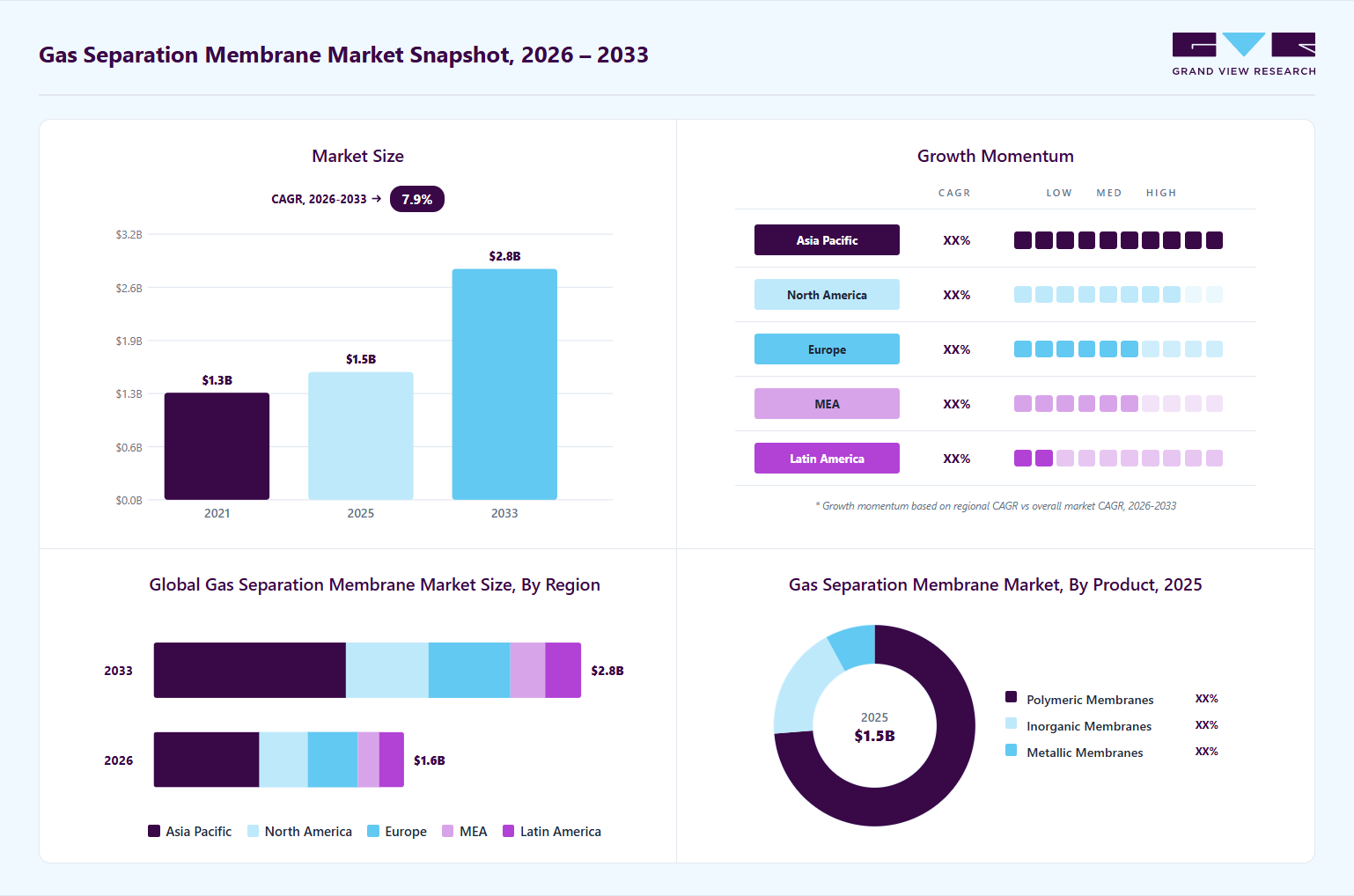
The global gas separation membrane market size was valued at USD 1.5 billion in 2025 and is projected to grow from USD 1.6 billion in 2026 to USD 2.8 billion by 2033, at a CAGR of 7.9% from 2026 to 2033. The gas separation membrane market in Asia Pacific accounted for the largest revenue share of 41.7% in 2025. The gas separation membrane market is anticipated to expand due to the growth of the petrochemical and chemical industries.
 Source: Grand View Research, IR Documents, Primary Interviews, Paid DatabasesTo learn more about this report,
 Download Free Sample Report
 Key Market Trends & Insights
- By product: Polymeric membranes segment dominated in 2025, accounting for 73.7% of the market share during the forecast period.
- By application: Nitrogen gas separation segment dominated the market in 2025.
- By end use: Petrochemicals and oil & gas segment accounted for the largest revenue share in 2025.
Regional Highlights
- Largest regional market: Asia Pacific (41.7% revenue share, 2025)
- By country: The China held the largest market share in 2025.
Market Size & Forecast
- Market size in 2025: USD 1.5 Billion
- Estimated market size in 2026: USD 1.6 Billion
- Projected market size by 2033: USD 2.8 Billion
- CAGR (2026-2033): 7.9%
Three ways to get this report
Buy it, customize it, or ask a question.Ask an Analyst
Analyst response in 1 business day
- AccessReport author, directly
- Reply timeWithin 1 working day
- No sales callDirect answer only
- FormatEmail reply
- CostFree, no cost
Get the Full Report
What the study covers
- FormatsPDF · Excel · Dashboard
- Timeline2026–2033 annual, 2025 base
- Coverage20+ countries, 5 regions
- Companies10+ key players profiled
Customize the Report
20% free customization
- IncludeCountries, segments, points
- TailorTo your product definition
- ExtendDeeper competitor detail
- OrA fully bespoke study
- Turnaround5–10 working days
Furthermore, strict government regulations and policies focused on lowering greenhouse gas (GHG) emissions are propelling market growth, as membrane technologies provide an energy-efficient method for gas separation. Growing environmental concerns related to climate change are motivating sectors such as chemicals, food & beverage, petrochemicals, and power generation to adopt more sustainable gas separation approaches.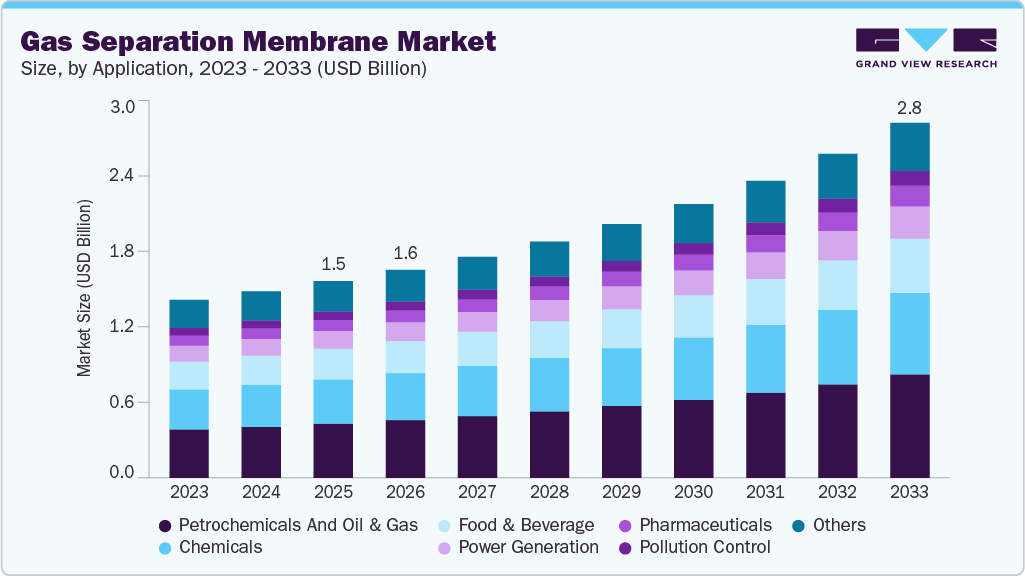 To learn more about this report, Download Free Sample Report
 Polymers are essential raw materials in the production of gas separation membranes. Polyethersulfone (PES), polyvinylidene fluoride (PVDF), and polypropylene (PP) are the most commonly used polymers for manufacturing membrane modules. For instance, in January 2022, Toray Industries, Inc., a diversified chemical company, announced the development of a new polymeric separation membrane module designed for the selective and efficient separation of hydrogen from mixed gas streams. This development is poised to invigorate the polymer segment within the gas membrane separation market by offering an advanced material solution for enhanced hydrogen recovery.
 To learn more about this report, Download Free Sample Report
 The gas separation membrane market is dynamic and highly competitive. Companies are employing strategies such as investments, divestments, and regional expansion to strengthen their market position. However, volatility in raw material prices is expected to be a significant concern for market participants.
Market Dynamics
The growing demand for energy-efficient and cost-effective gas separation technologies across industries such as oil & gas, chemicals, power generation, and healthcare is significantly driving the growth of the gas separation membrane market. Gas separation membranes offer advantages such as lower energy consumption, compact system design, operational flexibility, and reduced maintenance requirements compared to conventional separation technologies including cryogenic distillation and absorption systems. Increasing focus on carbon capture, hydrogen recovery, nitrogen generation, and natural gas processing is further supporting market demand globally.
In addition, stringent environmental regulations related to greenhouse gas emissions and industrial air pollution are accelerating the adoption of advanced gas separation membrane systems. Rising investments in hydrogen production, biogas upgrading, carbon dioxide removal, and clean energy infrastructure are creating substantial growth opportunities for membrane technologies. Technological advancements in polymeric, ceramic, and hollow fiber membranes are also improving separation efficiency, durability, and operational performance, further expanding their industrial application scope.
The gas separation membrane market faces challenges related to membrane fouling, limited selectivity under extreme operating conditions, and performance degradation over long-term industrial usage. Exposure to contaminants, high temperatures, and harsh chemicals may reduce membrane efficiency and operational lifespan, particularly in complex gas processing applications. In addition, the relatively high initial installation costs and requirement for specialized system integration may limit adoption among small and medium-scale industrial users.
Market Concentration & Characteristics
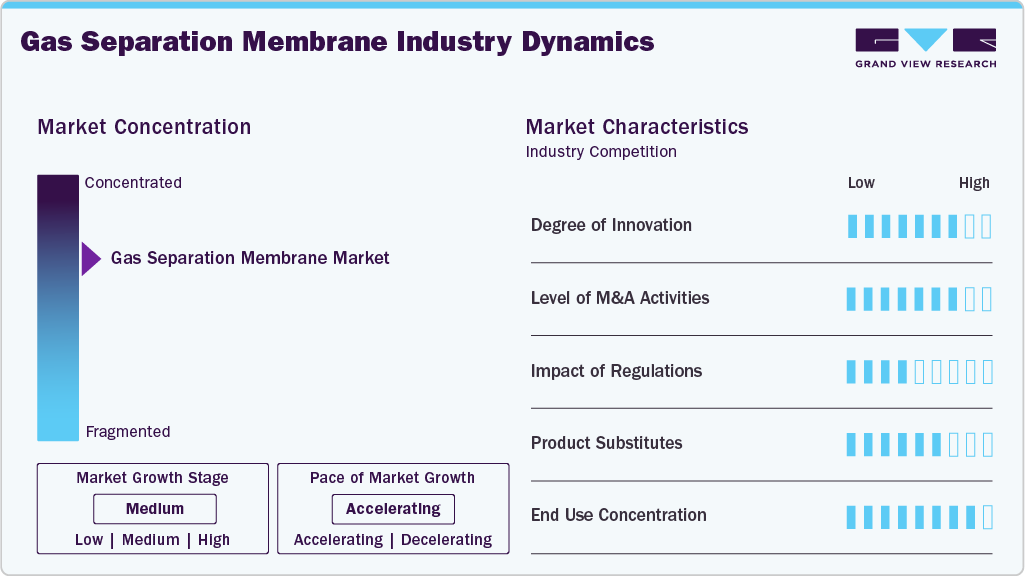
The growth stage of the market is medium, and the growth rate is increasing. The gas separation membrane industry is characterized by a high degree of innovation owing to the potential use of 3D printing techniques to enable the production of membranes in different shapes & designs and in a more precise manner compared to other fabrication methods currently available in the industry. In November 2023, an article published on IOP Science highlights 3D printing as a novel and innovative method for manufacturing reverse osmosis membranes. These membranes are intended for use in water desalination and treatment processes, representing an advancement in the development of 3D-printed membranes for these applications.
The gas separation membrane market features numerous companies actively pursuing capacity expansions and mergers & acquisitions to gain a larger market share. International companies are strategically acquiring small- and medium-sized enterprises to broaden their product offerings and reinforce their market presence.
 To learn more about this report, Download Free Sample Report
 The gas separation membrane industry is subject to the low impact of regulations owing to the presence of fewer standards, regulations, and guidelines. Few regulations control the market, such as the U.S. Food & Drug Administration 21CFR 177.2910 defines the labeling, usage, and development of ultra-filtration membranes.
The market caters to a wide array of end users across sectors including chemicals, food & beverage, power generation, and petrochemicals, indicating a high concentration of end use applications. Manufacturers should prioritize understanding the specific requirements of these end users and providing effective client services as key factors for success.
Product Insights
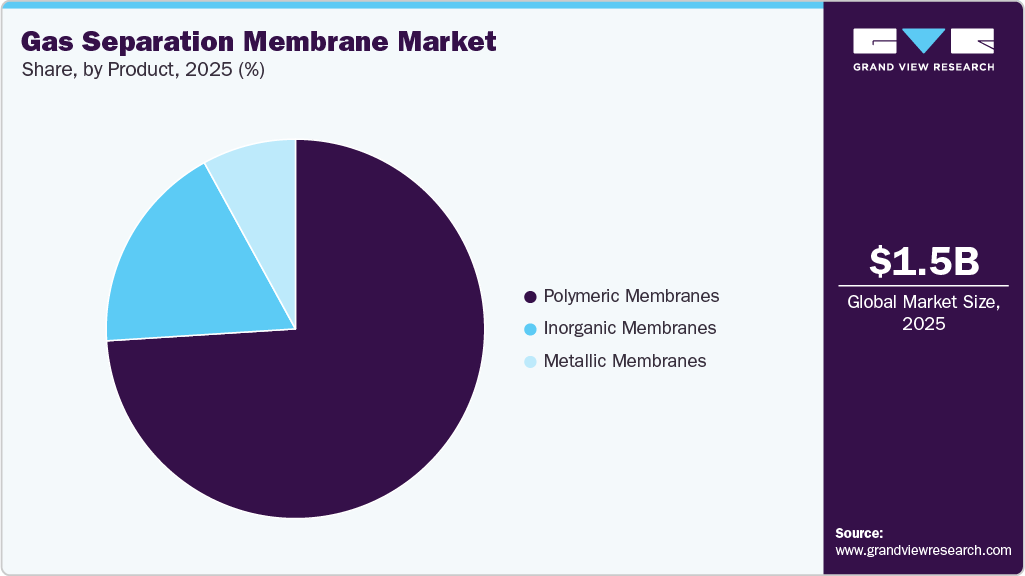
The polymeric membranes segment dominated in 2025, accounting for 73.7% of the market share during the forecast period. Polymeric separation membranes are composed of polymeric materials, such as polysulfone, polyimide, polyethylene, or polyvinylidene fluoride (PVDF). The separation process takes place when gas mixtures pass through a membrane under pressure, allowing for the separation of particular gases from a mixture. For instance, in September 2023, Membrane Technology and Research, Inc. (MTR) scaled its carbon capture operations with the establishment of the largest membrane-based plant in Wyoming. This facility will utilize MTR's Polaris polymeric membrane technology to capture over 150 metric tons of CO2 daily. This expansion proves their viability and effectiveness for significant CO2 removal, boosting confidence in the polymeric membrane segment.
 To learn more about this report, Download Free Sample Report
 The inorganic membrane segment is projected to grow at a CAGR of 8.1% from 2026 to 2033. Inorganic separation membranes are composed of inorganic materials, such as ceramics, metals, and metal oxides. Inorganic gas separation membrane offers high selectivity of gases, thermal and chemical stability, and resistance to fouling, which are driving factors of the segment growth.
Application Insights
The nitrogen gas separation segment dominated the market in 2025. Gas separation membranes are used to separate nitrogen from the air, producing high-purity nitrogen. This nitrogen is used in various industries, including electronics, food and beverage packaging, pharmaceuticals, and chemical processing. Furthermore, the membranes are integrated into nitrogen generation systems to produce nitrogen on-site from compressed air. In February 2023, Evonik, a specialty chemical company, started a new production plant of gas separation membranes in Austria, specifically for hollow-fiber membranes. These membranes are designed for the separation of gases such as methane, nitrogen, and hydrogen. This development by Evonik signifies an increase in the production capacity for nitrogen separation membranes, potentially leading to greater availability and potentially more competitive pricing within the nitrogen separation segment.
The acid gas separation segment is projected to grow at a significant CAGR growth from 2026 to 2033. Gas separation membranes are extensively used in acid separation processes across various industries, including oil and gas production, natural gas processing, chemical manufacturing, and environmental protection. The membranes selectively remove acid gases, such as carbon dioxide (CO2), hydrogen sulfide (H2S), and sulfur dioxide (SO2), from gas streams. These factors are expected to boost the segment growth over the forecast period.
End Use Insights
The petrochemicals and oil & gas segment accounted for the largest revenue share in 2025 and is further expected to grow at a fastest CAGR of 8.7% over the forecast period. The growing use of gas separation membranes for natural gas processing, hydrogen purification, carbon capture & storage, vapor recovery, and natural gas liquefaction is expected to drive segment growth. In May 2024, Air Products, a manufacturer specializing in gas separation and purification membranes, introduced its new PRISM GreenSep liquefied natural gas (LNG) membrane separator. This product is specifically designed for the production of bio-LNG. In the food & beverage industry, gas separation membranes are primarily used for modified atmosphere packaging (MAP) and controlled atmosphere storage (CAS) applications. This helps extend the shelf life and maintain the quality of perishable products.
The power generation segment is expected to grow at a CAGR of 8.1% growth from 2026 to 2033 owing to its improved performance efficiency, reduced emissions, and cleaner energy production methods. The product is used for carbon capture & storage, pre-combustion carbon capture, hydrogen purification, oxygen enrichment, and selectively removing impurities, such as carbon dioxide (CO2) and water vapor from natural gas streams. These factors are projected to propel the market growth.
Regional Insights
The gas separation membrane market in Asia Pacific accounted for the largest revenue share of 41.7% in 2025 owing to rising demand, rapid industrialization coupled with stringent regulations set by various governments to maintain environmental quality. Moreover, as pollution levels continue to rise and concerns about the environment grow, the demand for wastewater treatment technologies is expected to increase in the region over the next few years.
 To learn more about this report, Download Free Sample Report
 The China gas separation membrane market is projected to grow at a significant CAGR from 2026 to 2033. Rapid industrialization and economic development have led to increased product demand in various industries, including oil and gas, petrochemicals, chemicals, and steel production. In addition, the presence of environmental NGOs in China including China Biodiversity Conservation, Friends of Nature, and Green Development Foundation that implement various measures to curb pollution is driving the product growth.
North America Gas Separation Membrane Market Trends
The North America gas separation membrane market is driven by increasing investments in petrochemical processing, natural gas treatment, and carbon capture initiatives, coupled with the growing adoption of energy-efficient gas purification technologies across the oil & gas and power generation sectors.
The gas separation membrane industry in the U.S. accounted for the largest share in 2025 in the North America. This growth is attributed to the U.S. government initiatives to encourage sustainable manufacturing processes in industries such as food & beverage and power generation, which are expected to play a pivotal role in the growth of gas membrane separation.
Europe Gas Separation Membrane Market Trends
The gas separation membrane market in Europe is expected to grow at a CAGR of 7.3% from 2026 to 2033 owing to stringent environmental regulations and government initiatives aimed at reducing air and water pollution, as well as mitigating greenhouse gas (GHG) emissions. Furthermore, the pharmaceutical industry is one of the significant contributors to the demand for gas membrane separation.
Middle East & Africa Gas Separation Membrane Market Trends
The gas separation membrane industry is projected to grow at a significant CAGR from 2026 to 2033, driven by significant product demand in Saudi Arabia, Qatar, and the UAE. These countries face increasing environmental challenges stemming from extensive exploration, drilling, and extraction activities. The escalating oil and gas production in the region has resulted in considerable air and water pollution, which is expected to increase the demand for gas separation membranes in wastewater treatment applications. As a result, strict government regulations focused on limiting pollutant emissions are anticipated to further stimulate the expansion of the gas separation membrane industry in this market.
Key Gas Separation Membrane Company Insights
Some of the key players operating in the gas separation membrane market include UBE Corporation, Air Liquide Advanced Separations, Air Products and Chemicals, Inc., DIC CORPORATION, and FUJIFILM Corporation. These organizations are focusing on increasing the customer base to gain a competitive edge in the industry. Therefore, key players are taking several strategic initiatives, such as mergers & acquisition, capacity expansion, and product enhancement to align with changing regulations.
-
GMT Membrantechnik GmbH is a German-based company specializing in the development, manufacturing, and distribution of membrane filtration systems and components. The company focuses on membrane technology solutions for various industries, including water and wastewater treatment, food and beverage, pharmaceuticals, biotechnology, and chemical processing.
-
UBE Corp. is engaged in the production of machinery, industry chemicals, battery materials, and fine chemicals. The company offers a CO2 separation, H2 separation, organic vapor dehydration, N2 separation, and dehumidification membrane module.
Key Gas Separation Membrane Companies:
The following key companies have been profiled for this study on the gas separation membrane market.
-
Air Liquide Advanced Separations
-
Air Products and Chemicals, Inc.
-
Atlas Copco AB
-
DIC CORPORATION
-
Evonik Industries AG
-
FUJIFILM Corporation
-
GENERON
-
GMT Membrantechnik GmbH
-
JSC Grasys.
-
Honeywell International Inc.
-
Mahler AGS GmbH
-
Parker Hannifin Corp
-
SLB
-
UBE Corporation
Competitive Benchmarking
Operating Strategies
Competitive Edge
Weakness
Mature Players: Honeywell International Inc.; Parker Hannifin Corp; UBE Corporation; Evonik Industries AG
- Focus on large-scale production and long-term industrial contracts.
- Continuous investment in membrane technology development and global expansion.
- Strong global presence and established industrial customer base.
- Advanced technological expertise and diversified application portfolio.
- High operational and capital investment costs.
- Slower flexibility in adopting niche or emerging applications.
Emerging Players: Membrane Technology and Research, Inc. (MTR); GENERON; Compact Membrane Systems; Inc.
- Focus on niche gas separation and carbon capture applications.
- Emphasis on innovation, customized solutions, and flexible manufacturing.
- Faster innovation cycles and strong focus on advanced membrane technologies.
- High adaptability toward clean energy and sustainable applications.
- Limited production scale and lower brand recognition.
- Challenges in expanding global distribution and commercial operations.
Recent Developments
-
In January 2025, Arkema, a specialty materials manufacturer, and OOYOO LTD., a gas separation membrane manufacturer, announced a collaboration focused on developing gas separation membranes for carbon capture applications. This partnership will drive gas separation membrane market growth through innovation and wider availability for carbon capture.
-
In December 2024, Toray Industries announced the establishment of a pilot production line for its all-carbon CO2 separation membrane at their Shiga Plant, marking progress towards large-scale manufacturing of this technology. This development signals a promising advancement for the gas membrane separation market, potentially offering a more efficient and robust solution for carbon capture.
-
In November 2023, Air Products has announced that over 2,000 seagoing vessels globally now use their membrane-based nitrogen generation systems. This widespread adoption highlights Air Products' significant market share and strong competitive position in the maritime sector. This news underscores the effectiveness and reliability of gas separation membrane technology for critical onboard applications, further validating its potential and driving growth within the broader gas separation membrane market.
Gas Separation Membrane Market Report Scope
Report Attribute
Details
Market size in 2025
USD 1.5 billion
Estimated Market size in 2026
USD 1.6 billion
Projected Market size by 2033
USD 2.8 billion
Growth rate
CAGR of 7.9% from 2026 to 2033
Base year for estimation
2025
Historical data
2021 - 2024
Forecast period
2026 - 2033
Quantitative units
Revenue in USD million and CAGR from 2026 to 2033
Report coverage
Volume & revenue forecast, company ranking, competitive landscape, growth factors, and trends
Segments covered
Product, application, end use, and region
Regional scope
North America; Europe; Asia Pacific; Central & South America; Middle East & Africa
Country scope
U.S.; Canada; Mexico; Germany; UK; France; Italy; Spain; China; India; Japan; Australia; Brazil; Saudi Arabia
Key companies profiled
Air Liquide Advanced Separations; Air Products and Chemicals, Inc.; Atlas Copco AB; DIC CORPORATION; Evonik Industries AG; FUJIFILM Corporation; GENERON; GMT Membrantechnik GmbH; JSC Grasys.; Honeywell International Inc.; Mahler AGS GmbH; Parker Hannifin Corp; SLB; UBE Corporation
Customization scope
Free report customization (equivalent up to 8 analysts working days) with purchase. Addition or alteration to country, regional & segment scope.
Pricing and purchase options
Avail customized purchase options to meet your exact research needs. Explore purchase options
Global Gas Separation Membrane Market Report Segmentation
This report forecasts revenue growth at global, regional, and country levels and provides an analysis of the latest industry trends in each of the sub-segments from 2021 to 2033. For this study, Grand View Research has segmented the global gas separation membrane market report based on product, application, end use and region.
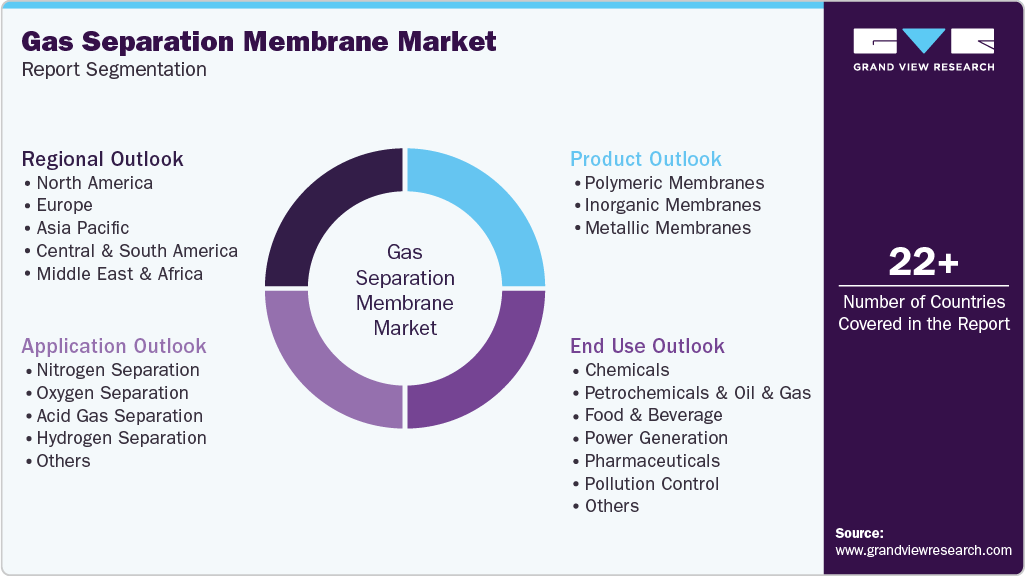 To learn more about this report, Download Free Sample Report
 -
Product Outlook (Revenue, USD Billion, 2021 - 2033)
-
Polymeric Membranes
-
Inorganic Membranes
-
Metallic Membranes
-
-
Application Outlook (Revenue, USD Billion, 2021 - 2033)
-
Nitrogen Separation
-
Oxygen Separation
-
Acid gas Separation
-
Hydrogen Separation
-
Others
-
-
End Use Outlook (Revenue, USD Billion, 2021 - 2033)
-
Chemicals
-
Petrochemicals and Oil & Gas
-
Food & Beverage
-
Power Generation
-
Pharmaceuticals
-
Pollution Control
-
Others
-
-
Regional Outlook (Revenue, USD Billion, 2021 - 2033)
-
North America
-
U.S.
-
Canada
-
Mexico
-
-
Europe
-
Germany
-
UK
-
France
-
Italy
-
Spain
-
-
Asia Pacific
-
China
-
India
-
Japan
-
Australia
-
-
Central & South America
-
Brazil
-
-
Middle East and Africa
-
Saudi Arabia
-
-
Delivered Customizations
This report has been delivered with the following In-depth customizations
Client Request
Customization Delivered
Value Adds
Country Extension
Expanded country-level analysis of the gas separation membrane market covering industrial gas demand, hydrogen and carbon capture activities, regulatory landscape, and adoption trends across key economies.
Enable identification of high-growth countries and industrial demand hubs. Support regional expansion and country-specific market strategies.
Competitive Benchmarking
Benchmarking of key gas separation membrane manufacturers based on product portfolio, technology capabilities, production capacity, geographic presence, pricing strategy, and strategic developments.
Enable comparison of competitive positioning and identification of technology leadership and differentiation opportunities.
Opportunity Assessment
Evaluation of growth opportunities across membrane types, applications, and end-use industries including hydrogen recovery, nitrogen generation, carbon capture, oil & gas, chemicals, and power generation.
Identify high-growth applications and emerging demand areas. Support market entry, product development, and expansion strategies.
Frequently Asked Questions About This Report
Some of the key players operating in the gas separation membrane market include Air Liquide Advanced Separations, Air Products and Chemicals, Inc., DIC CORPORATION, and FUJIFILM Corporation.
The key factors that are driving the global gas separation membrane market include utilizing Membrane for nitrogen separation, oxygen separation, acid gas separation, and hydrogen separation in industries such as petrochemicals, chemicals, pharmaceuticals, and oil & gas.
The global gas separation membrane market size was estimated at USD 1.5 billion in 2025 and is expected to reach USD 1.6 billion in 2026.
The global gas separation membrane market is expected to grow at a compound annual growth rate of 7.9% from 2026 to 2033 to reach USD 2.8 billion by 2033.
Polymeric gas separation membrane led the market and accounted for 73.7% of the revenue in 2025 owing to its scalability, ease of fabrication, cost-effectiveness, and flexibility in design.
The nitrogen gas separation segment dominated the market in 2025.
The Asia Pacific gas separation membrane market dominated with a share of 41.7% in 2025.
The petrochemicals and oil & gas segment accounted for the largest revenue share in 2025.
About the Author(s)
Advanced Interior Materials Research Team
Advanced Materials · Advanced Interior MaterialsThis report was authored by the advanced interior materials research team at Grand View Research - comprising two research analysts, one senior research analyst, and one industry expert - with specialized expertise in the advanced interior materials segment of the advanced materials industry. All findings are based on proprietary advanced materials databases, executive interviews, and regulatory analysis, subject to internal peer review prior to publication.
Last Updated:
Speak to Analyst

Customize this report to your needs - add regions, segments, or data points, with 20% free customization.
Or view our licence options:


ISO 9001:2015 & 27001:2022 Certified
We are GDPR and CCPA compliant! Your transaction & personal information is safe and secure. For more details, please read our privacy policy.


