
- Home
- »
- Advanced Interior Materials
- »
-
Gemstones Market Size, Share & Trends Report, 2026-2033GVR Report cover

Gemstones Market (2026 - 2033)
Size, Share & Trends Analysis Report By Type (Ruby, Sapphire, Diamond, Emerald), By Sales Channel (Online, Offline), By Region (North America, Europe, Asia Pacific, Latin America, Middle East & Africa), And Segment Forecasts
Market Size, 2025
$106.8BMarket Estimate, 2026
$112.7BMarket Forecast, 2033
$183.2BCAGR, 2026–2033
7.2%Gemstones Market Summary
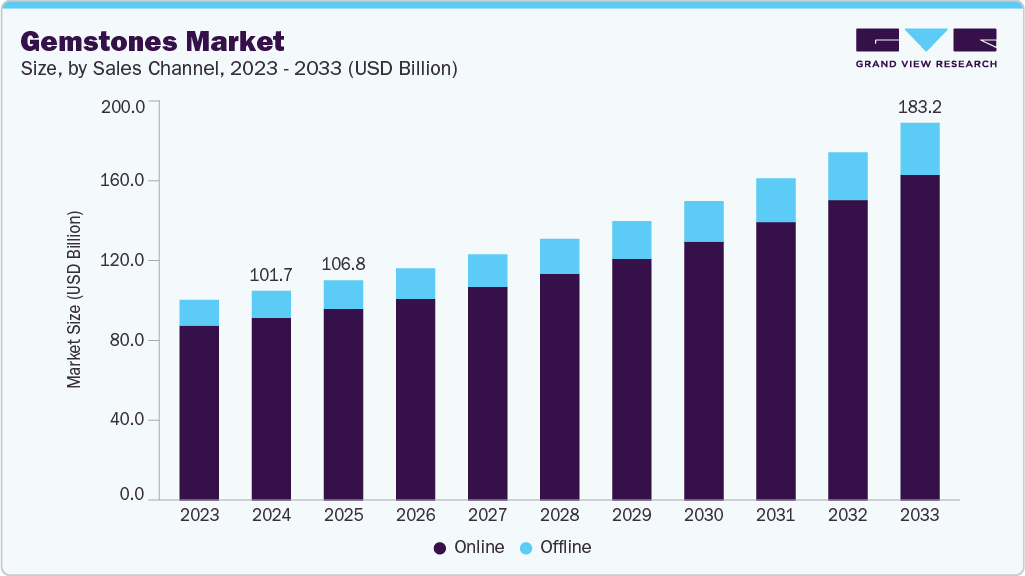
The global gemstones market size was valued at USD 106.8 billion in 2025 and is projected to grow from USD 112.7 billion in 2026 to USD 183.2 billion by 2033, at a CAGR of 7.2% from 2026 to 2033. Asia Pacific dominated the market, accounting for a revenue share of 46.4% in 2025. The gemstones industry is experiencing growth driven by rising consumer demand for luxury goods and personal adornment.
 Source: Grand View Research, IR Documents, Primary Interviews, Paid DatabasesTo learn more about this report,
 Download Free Sample Report
Key Market Trends & Insights
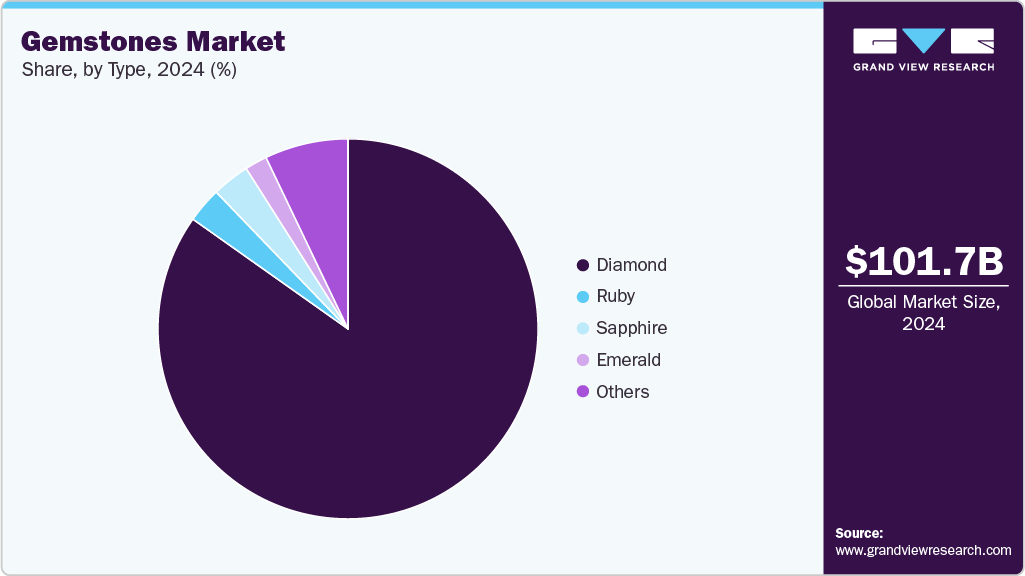
- By type: Diamond segment led the market with the largest revenue share of 84.9% in 2025.
- By sales channel: Online segment led the market with the largest revenue share of 87.0% in 2025.
Regional Highlights
- Largest regional market: Asia Pacific (46.4% revenue share, 2025)
- By country: China held the largest market share in 2025.
Market Size & Forecast
- Market size in 2025: USD 106.8 Billion
- Estimated market size in 2026: USD 112.7 Billion
- Projected market size by 2033: USD 183.2 Billion
- CAGR (2026-2033): 7.2%
Three ways to get this report
Buy it, customize it, or ask a question.Ask an Analyst
Analyst response in 1 business day
- AccessReport author, directly
- Reply timeWithin 1 working day
- No sales callDirect answer only
- FormatEmail reply
- CostFree, no cost
Get the Full Report
What the study covers
- FormatsPDF · Excel · Dashboard
- Timeline2026–2033 annual, 2025 base
- Coverage20+ countries, 5 regions
- Companies10+ key players profiled
Customize the Report
20% free customization
- IncludeCountries, segments, points
- TailorTo your product definition
- ExtendDeeper competitor detail
- OrA fully bespoke study
- Turnaround5–10 working days
Increasing disposable incomes in developing countries have expanded the customer base for premium jewelry. As more consumers view gemstones as symbols of wealth, elegance, and individuality, retailers invest in innovative designs and marketing campaigns to capture demand. The growing middle-class population in regions such as the Asia Pacific has also created strong momentum in sales. For instance, in India and China, sales of high-value jewelry collections during festive seasons and weddings have surged, boosting demand for diamonds and other precious stones. Global jewelry brands such as Tiffany & Co. and Chow Tai Fook are expanding their retail presence in Asia Pacific to tap into this rising demand, reflecting the growing appeal of gemstones as symbols of wealth, elegance, and individuality.
 To learn more about this report, Download Free Sample Report
Gemstones are no longer confined to high-end jewellery but are also used in watches, accessories, and clothing lines. For example, luxury watchmakers like Rolex and Cartier use sapphires and rubies in limited-edition models, while fashion brands such as Gucci and Louis Vuitton incorporate gemstone embellishments into handbags and couture lines. These applications broaden the consumer base and allow gemstones to reach new lifestyle-driven markets, fuelling overall growth.
The rising popularity of colored gemstones is also a major growth factor. While diamonds have traditionally dominated the market, colored stones such as emeralds, sapphires, and rubies are gaining traction due to their rarity and unique visual appeal. For example, Gemfields Group has promoted ethically sourced emeralds from Zambia and rubies from Mozambique, which younger consumers increasingly seek after. Millennials and Gen Z are particularly drawn to colored gemstones that express individuality, as seen in the growing demand for alternative engagement rings featuring sapphires or morganites instead of traditional diamonds.
Technological advancements in gemstone mining and processing are supporting market expansion. Improved extraction methods and authenticity verification tools are helping ensure better quality and transparency. Companies such as ALROSA and Rio Tinto have introduced blockchain-based certification systems to guarantee the authenticity of diamonds. At the same time, online platforms like Blue Nile provide digital certificates and purchase options. This technology adoption builds consumer trust and enhances accessibility, with e-commerce driving significant gemstone sales in regions such as North America and Europe.
Sustainability and ethical sourcing are becoming significant growth drivers in the gemstones industry. Consumers are increasingly conscious of environmental and social issues related to gemstone mining. For instance, De Beers launched its Tracr blockchain platform to improve transparency and ethical sourcing practices. Similarly, initiatives by companies like Kiran Gems to adopt fair trade standards have gained recognition in global markets. These practices align with consumer expectations and help brands differentiate themselves, ensuring long-term demand and growth opportunities for ethically sourced gemstones.
Market Dynamics
The global gemstones market is experiencing steady growth, driven by rising consumer demand for luxury jewelry and increasing disposable incomes, particularly across emerging economies. As middle-class populations expand in countries such as India, China, and Southeast Asian nations, spending on premium jewelry featuring diamonds, rubies, sapphires, emeralds, and other precious and semi-precious gemstones continues to rise. Cultural traditions, weddings, festivals, and gifting occasions further strengthen gemstone purchases in these regions. In developed markets, consumers are increasingly seeking unique, high-quality, and customized jewelry pieces, encouraging jewelers to incorporate rare and colored gemstones into their collections. The rapid expansion of organized jewelry retail and ecommerce platforms has further improved product accessibility, enabling consumers to explore a wider variety of certified gemstones with greater transparency and convenience.
The rising demand for luxury and premium jewelry is one of the primary factors driving the growth of the global gemstones market. Increasing disposable incomes, rapid urbanization, and the expansion of affluent and upper middle income consumer groups have significantly boosted spending on high value jewelry featuring diamonds, emeralds, rubies, sapphires, and other precious gemstones. Consumers are increasingly seeking exclusive jewelry pieces that reflect personal style, social status, and long term value, leading jewelry manufacturers to introduce premium collections with rare and high quality gemstones. This trend is particularly strong in emerging economies, where economic growth and changing lifestyles are encouraging greater expenditure on luxury goods.
In addition, the growing influence of fashion trends, celebrity endorsements, and social media has strengthened consumer interest in gemstone jewelry across a wider demographic. Luxury brands are expanding their product portfolios with innovative designs, limited edition collections, and customized gemstone jewelry to cater to evolving consumer preferences. Wedding ceremonies, anniversaries, festivals, and gifting occasions continue to generate consistent demand for premium gemstone jewelry, especially in markets such as India, China, the Middle East, and North America. As consumers increasingly value craftsmanship, exclusivity, and certified quality, the demand for luxury gemstone jewelry is expected to remain a key contributor to the long term growth of the global gemstones market.
Rising concerns over illegal mining and ethical sourcing present a significant restraint to the growth of the global gemstones market. Unregulated mining activities are often associated with environmental degradation, unsafe working conditions, child labor, and the trade of conflict gemstones, leading to increased scrutiny from governments, industry organizations, and consumers. As awareness of responsible sourcing grows, jewelry manufacturers and retailers face greater pressure to ensure complete traceability and compliance with international ethical standards. Implementing transparent supply chains, certification processes, and responsible mining practices increases operational costs and can limit the availability of natural gemstones from certain regions. These challenges may affect consumer confidence, disrupt supply chains, and create additional compliance burdens for market participants, ultimately restraining overall market growth.
The growing demand for ethically sourced and traceable gemstones presents a significant opportunity for the global gemstones market as consumers increasingly prioritize sustainability, transparency, and responsible business practices. Buyers are becoming more conscious of the environmental and social impacts associated with gemstone mining, prompting greater demand for products that can demonstrate responsible sourcing and compliance with international ethical standards. This shift has encouraged gemstone producers, traders, and jewelry manufacturers to invest in traceability systems, third party certifications, and sustainable mining initiatives that verify the origin and authenticity of gemstones. Companies that establish transparent supply chains are better positioned to strengthen consumer trust, enhance brand reputation, and differentiate themselves in a highly competitive market.
Analyst Perspective
The gemstones market is witnessing healthy long-term growth, supported by rising consumer spending on luxury jewelry, increasing disposable incomes, and growing demand for personalized and premium accessories across both developed and emerging economies. Diamonds continue to dominate the market, while colored gemstones such as rubies, sapphires, and emeralds are gaining popularity as consumers seek distinctive, high-value jewelry. The rapid growth of online retail, digital certification, and transparent sourcing practices is improving consumer confidence and expanding market reach, particularly among younger buyers.
Type Insights
Based on type, the diamond segment led the market with the largest revenue share of 84.9% in 2025, due to their enduring appeal in luxury jewellery and their symbolic association with wealth, prestige, and commitment. Rising disposable incomes across emerging economies such as China and India have significantly boosted demand for diamond jewellery, particularly for weddings and festive occasions. Global players also invest in advanced cutting and polishing technologies to enhance brilliance and design, further increasing consumer interest. Marketing campaigns by leading brands continue to shape consumer perceptions, reinforcing diamonds as a status symbol and a preferred choice for high-value purchases.
 To learn more about this report, Download Free Sample Report
The ruby segment is anticipated to register at the fastest CAGR over the forecast period, as consumers increasingly associate the stone with passion, prosperity, and protection. Its vibrant red color and rarity make it a sought-after choice in high-end jewellery, particularly in engagement rings, luxury ornaments, and heirloom pieces. Growing demand in Asian countries, where rubies hold cultural and astrological importance, is adding to the segment’s expansion. Rising disposable incomes and a preference for colored gemstones as a unique alternative to traditional diamonds are further supporting market growth.
Sales Channel Insights
Based on sales channel, the online segment led the market with the largest revenue share of 87.0% in 2025. Consumers are increasingly turning to e-commerce to purchase gemstones and jewelry due to wider product choices, transparent pricing, and the ability to compare across brands. Integrating advanced technologies such as augmented reality try-on tools and 360-degree product views enhances consumer confidence in online purchases. Attractive discounts, secure payment options, and doorstep delivery further fuel the shift toward digital platforms for gemstone sales.
The offline segment is anticipated to grow at the fastest CAGR during the forecast period, due to consumers’ preference for physically examining gemstones before purchase. Traditional jewelry stores, specialty gemstone outlets, and luxury boutiques offer tactile experiences, expert guidance, and personalized services that enhance buyer confidence. High-value purchases, particularly of diamonds, rubies, and emeralds, often favor offline channels where consumers can assess gemstone quality, color, and cut in person. Cultural factors and the trust associated with established local jewelers also play a significant role in sustaining offline sales.
Regional Insights
Asia Pacific dominated the gemstones market with the largest revenue share of 46.4% in 2025. The gemstones market in the China held the largest share in the Asia Pacific region in 2025. The gemstones market in North America is experiencing robust growth, driven by several key factors. As consumers become more conscious of environmental and social issues, there is a growing preference for responsibly mined or lab-grown gemstones. This shift is particularly evident in the U.S. and Canada, with rising interest in sustainable and transparent sourcing practices. Additionally, advancements in e-commerce platforms have made gemstone jewelry more accessible, allowing consumers to explore various options and make informed purchasing decisions from the comfort of their homes.
U.S. Gemstones Market Trends
The gemstones market in the U.S. is experiencing significant growth, driven by several key factors. Notably, colored gemstones have gained substantial popularity, with imports increasing by 136% from 2020 to 2024. This surge reflects a shift in consumer preferences towards vibrant, unique stones over traditional diamonds. In addition, the rising demand for sustainable and ethically sourced gemstones aligns with broader consumer trends favoring transparency and environmental responsibility. Technological advancements have also played a role, with innovations in gemstone cutting and polishing techniques enhancing the appeal and accessibility of these stones.
Asia Pacific Gemstones Market Trends
Asia Pacific dominated the gemstones market with the largest revenue share of 46.3% in 2024, driven by several key factors. Rising disposable incomes and urbanization in countries like India and China have significantly increased consumer purchasing power, leading to higher demand for luxury and ornamental items, including gemstones. This surge in affluence is further complemented by a deep-rooted cultural affinity for gemstones, where they hold significant astrological and ceremonial value. In addition, the region's rich heritage in jewellery craftsmanship and the expansion of organized retail sectors have enhanced accessibility and consumer awareness, further propelling market growth.
 To learn more about this report, Download Free Sample Report
Europe Gemstones Market Trends
The gemstones market in Europe is witnessing strong growth due to several key factors. Consumer demand for colored gemstones has risen, driven by a shift toward vibrant and unique stones over traditional diamonds. Countries such as the UK, Germany, and France are at the forefront of this trend, reflecting a widespread appreciation for colored gemstones in fine jewelry. The region’s long-standing tradition in jewelry craftsmanship continues to enhance consumer confidence and sustain demand for high-quality gemstones.
Latin America Gemstones Market Trends
The gemstones market in Latin America is experiencing notable growth, driven by several key factors. The region's rich natural resources, particularly in countries like Brazil and Colombia, contribute significantly to the global supply of gemstones such as emeralds and tourmalines. Brazil, for instance, is renowned for its diverse range of gemstones, including the highly prized Paraíba tourmaline, which has garnered international attention for its vibrant colors and rarity. Conversely, Colombia is a leading emerald producer, with the Muzo region being particularly famous for its high-quality stones. These abundant natural resources support local economies and position Latin America as a key player in the global market.
Middle East & Africa Gemstones Market Trends
The gemstones market in the Middle East and Africa is experiencing strong growth, driven by several key factors. Rising disposable incomes and a young, affluent population are boosting demand for luxury jewelry, which remains an important symbol of status and tradition in the region. Countries such as Saudi Arabia, South Africa, and the UAE are at the forefront of this trend, reflecting a cultural affinity for gemstone jewelry and a preference for high-quality, visually striking stones.
Key Gemstones Company Insights
Some of the key players operating in the market include Blue Nile, Inc., Anglo American plc, and others
-
Anglo American plc is a global mining company headquartered in the United Kingdom, with a diverse portfolio that spans various commodities, including diamonds. The company owns an 85% stake in De Beers Group, a leading entity in the diamond industry. De Beers operates diamond mines in Botswana, Canada, Namibia, and South Africa, and is renowned for producing approximately one-third of the world's rough diamonds by value.
-
Blue Nile, Inc. offers a wide selection of certified loose diamonds, engagement rings, and gemstone jewelry, allowing customers to customize their pieces to suit personal preferences. Blue Nile's offerings include various gemstone types in different shapes and sizes, such as sapphires, emeralds, and rubies. The company emphasizes quality and value, offering GIA-graded natural diamonds and its exclusive Astor by Blue Nile diamonds, known for their exceptional brilliance.
Key Gemstones Companies:
The following key companies have been profiled for this study on the gemstones market.
-
Anglo American plc
-
Blue Nile, Inc.
-
Chow Tai Fook Jewellery Group Limited
-
Debswana Diamond Company (Pty) Limited
-
Gem Diamonds Limited
-
Gemfields Group Limited
-
Kiran Gems Private Limited
-
PJSC ALROSA
-
Rio Tinto Group
-
Tiffany & Co.
Competitive Benchmarking
Category
Operating Strategies
Competitive Edge
Weakness
Established Players (e.g. Gem Diamonds Limited, Kiran Gems Private Limited)
- Mature participants in the gemstones market primarily focus on vertically integrated operations encompassing mining, cutting, polishing, certification, branding, and global retail distribution.
- These companies emphasize securing long term access to gemstone resources through mining ownership, strategic sourcing partnerships, and exclusive procurement agreements.
- Established players possess significant competitive advantages through their control over mining assets, extensive global sourcing networks, and well established distribution channels.
- Their ability to consistently supply high quality natural gemstones supported by internationally recognized certifications enables them to maintain strong customer trust and premium pricing.
- Despite their strong market positions, mature players face challenges related to the limited availability of high quality natural gemstone deposits and increasing mining costs.
- Exploration, extraction, and regulatory compliance require substantial capital investment, while declining ore grades and resource depletion can affect long term production.
Emerging & Regional Players (e.g., Blue Nile, Inc..)
- Emerging participants in the gemstones market generally focus on ethical sourcing, digital commerce, and specialized gemstone offerings.
- Rather than competing directly with established luxury brands on scale, these companies emphasize transparency, sustainability, and customized customer experiences.
- Emerging companies benefit from operational flexibility and the ability to rapidly adapt to changing consumer preferences.
- Their digital first business models enable direct customer engagement, faster product launches, and personalized purchasing experiences.
- Emerging participants face significant challenges related to limited access to premium gemstone sources, lower inventory availability, and restricted financial resources.
- Without ownership of mining assets or established procurement networks, many depend on third party suppliers, making them more vulnerable to supply constraints and price volatility.
Recent Development
-
In September 2025, Malabar Gold & Diamonds unveiled the ‘Vyana’ Gemstone Collection at a major launch event in Mysore, featuring prominent guests and company executives. The new line, crafted in both 18kt and 22kt gold, blends diamond-like brilliance with a spectrum of vibrant gemstones, offering lightweight, fluid designs for modern Indian women who balance tradition and contemporary lifestyles.
-
In August 2025, Columbia Gem House launched a new collection of untreated, traceable rubies and sapphires sourced from the Winza region and surrounding mining areas in central Tanzania. This launch introduced an array of vibrant gemstones, including vivid pinks, saturated purples, fuchsia, padparadscha, and authentic rubies, with many stones featuring distinctive two-tone zoning and bicolor effects.
Gemstones Market Report Scope
Report Attribute
Details
Market definition
The market size represents the annual value of the apparent consumption of gemstones across various applications during a particular year.
Market size in 2025
USD 106.8 billion
Estimated market size in 2026
USD 112.7 billion
Projected market size by 2033
USD 183.2 billion
Growth rate
CAGR of 7.2% from 2026 to 2033
Base year for estimation
2025
Historical data
2021 - 2024
Forecast period
2026 - 2033
Quantitative units
Revenue in USD million, volume in kilotons and CAGR from 2026 to 2033
Report coverage
Revenue forecast, volume forecast, company ranking, competitive landscape, growth factors, and trends
Segments covered
Type, sales channel, region
Regional scope
North America; Europe; Asia Pacific; Latin America; Middle East & Africa
Country scope
U.S., Canada, Mexico, Germany, UK, France, India, China, Japan, Brazil, Saudi Arabia, UAE
Key companies profiled
Gem Diamonds Limited; Kiran Gems Private Limited; Gemfields Group Limited; PJSC ALROSA; Anglo American plc; Rio Tinto Group; Debswana Diamond Company (Pty) Limited; Blue Nile, Inc.; Chow Tai Fook Jewellery Group Limited; Tiffany & Co.
Customization scope
Free report customization (equivalent up to 8 analysts' working days) with purchase. Addition or alteration to country, regional & segment scope.
Pricing and purchase options
Avail customized purchase options to meet your exact research needs. Explore purchase options
Global Gemstones Market Report Segmentation
This report forecasts revenue and volume growth at global, regional, and country levels and provides an analysis of the latest industry trends in each of the sub-segments from 2021 to 2033. For this study, Grand View Research has segmented the global gemstones market report based on the type, sales channel, and region:
 To learn more about this report, Download Free Sample Report
-
Type Outlook (Revenue, USD Billion, 2021 - 2033)
-
Diamond
-
Ruby
-
Sapphire
-
Emerald
-
Others
-
-
Sales Channel Outlook (Revenue, USD Billion, 2021 - 2033)
-
Online
-
Offline
-
-
Regional Outlook (Revenue, USD Billion, 2021 - 2033)
-
North America
-
U.S.
-
Canada
-
Mexico
-
-
Europe
-
Germany
-
UK
-
France
-
-
Asia Pacific
-
China
-
India
-
Japan
-
-
Latin America
-
Brazil
-
-
Middle East & Africa
-
Saudi Arabia
-
UAE
-
-
Research Methodology
The gemstones market figures in this report are based on a proven research process that combines executive interviews with secondary research from proprietary databases, company filings, and recognized regulatory and institutional sources. Market size is built through value-chain sizing-reconciling supply-side and demand-side estimates-and triangulated with bottom-up and top-down approaches. Every estimate passes multiple levels of expert validation before publication, with each gemstones segment quantified using the revenue-capture definitions in the table below.
Segment Definition
Type
Revenue Capture Definition
Diamond
Revenue for the diamond segment is generated from the sale of natural diamonds used in fine jewelry, luxury accessories, and investment grade gemstones. The segment includes polished diamonds sold through wholesalers, jewelry manufacturers, retailers, and auction houses.
Ruby
The ruby segment captures revenue from the commercialization of natural rubies used in rings, necklaces, earrings, bracelets, and premium jewelry collections. Revenue also includes certified rubies traded through gemstone dealers and luxury jewelry brands.
Sapphire
Revenue in the sapphire segment is derived from the sale of natural sapphires across fine jewelry, bespoke designs, and high value ornaments. The segment includes blue sapphires as well as fancy colored sapphires marketed through retail and wholesale channels.
Emerald
The emerald segment generates revenue from the supply of natural emeralds used in luxury jewelry, designer collections, and high end gemstone investments. Sales from certified emeralds distributed through gemstone traders and branded jewelers are included within this segment.
Others
The others segment includes revenue generated from gemstones such as amethyst, opal, topaz, garnet, aquamarine, tourmaline, tanzanite, jade, and pearls when classified within the gemstone market. Revenue is captured from their use in jewelry, decorative accessories, collectibles, and specialty gemstone applications.
Application
Revenue Capture Definition
Online
The online segment generates revenue through the sale of gemstones and gemstone jewelry via ecommerce platforms, brand owned websites, online marketplaces, and digital auctions. Growth is supported by wider product availability, certified gemstone listings, and convenient global purchasing options.
Offline
The offline segment generates revenue from gemstones sold through jewelry stores, specialty gemstone retailers, department stores, luxury boutiques, exhibitions, and auctions. This channel remains significant due to personalized customer service, physical product inspection, and immediate purchase confidence.
Estimation Model
Layer Name
Key Question
Description
Jewelry & Luxury Goods Demand Base Layer
What forms the demand base?
Identify global demand from the jewelry, luxury goods, fashion accessories, investment, and industrial sectors. Assess jewelry production, consumer spending on luxury products, disposable income growth, and gifting trends to establish the total addressable demand for gemstones worldwide.
Gemstone Application Penetration Layer
Where are gemstones utilized?
Estimate the penetration of gemstones across key applications including rings, necklaces, earrings, bracelets, watches, decorative ornaments, investment grade gemstones, and industrial uses. Analyze the adoption of diamonds, rubies, sapphires, emeralds, and other precious and semi precious gemstones across retail, luxury, and industrial markets in different regions.
Gemstone Consumption Intensity Layer
How much gemstone is consumed?
Analyze gemstone consumption intensity based on jewelry manufacturing volumes, gemstone content per jewelry piece, consumer purchasing behavior, luxury spending patterns, and regional preferences. Evaluate demand across bridal jewelry, fashion jewelry, premium collections, and investment grade gemstones. Consumption intensity varies according to cultural traditions, income levels, fashion trends, and gemstone availability.
Revenue Layer
How is market revenue generated?
Market revenue is quantified through sales of gemstones including diamonds, rubies, sapphires, emeralds, and other precious and semi precious stones. Revenue generation is driven by demand from jewelry manufacturers, luxury brands, retailers, collectors, and industrial applications. Market value is influenced by gemstone type, quality, rarity, carat weight, certification, processing value addition, and regional demand dynamics.
Delivered Customizations
This report has been delivered with the following In-depth customizations
Client Request
Customization Delivered
Value Adds
Regional Segmentation
Detailed regional analysis of the gemstones market across North America, Europe, Asia Pacific, Latin America, and Middle East & Africa. Included evaluation of gemstone mining activities, cutting and polishing hubs, jewelry manufacturing, luxury goods consumption, retail demand, export competitiveness, and government regulations governing gemstone trade and ethical sourcing.
Identified high growth consumption markets, processing hubs, and mining regions. Enabled strategic expansion planning based on luxury spending, jewelry manufacturing growth, and international trade dynamics. Supported regional demand forecasting and market entry strategies.
Cross Segmentation
Comprehensive cross segmentation analysis by gemstone type, distribution channel, application, and region, including diamonds, rubies, sapphires, emeralds, and other gemstones across online and offline sales channels. Evaluated regional demand trends, consumer preferences, pricing variations, certification requirements, and purchasing behavior across jewelry, investment, fashion, and luxury applications.
Enabled identification of the most profitable gemstone distribution channel combinations and emerging market opportunities. Supported product portfolio optimization, customer targeting, and sales strategy development.
Opportunity Assessment
Identification of high growth opportunities across certified gemstones, lab grown and natural gemstone differentiation, luxury jewelry, personalized jewelry, online retail platforms, bridal jewelry, sustainable sourcing initiatives, premium gifting, and emerging luxury consumer markets.
Enabled prioritization of high return growth segments and emerging regional opportunities. Supported long term investment planning, product innovation, channel expansion, and strategic business development initiatives aligned with evolving consumer preferences and luxury market trends.
Frequently Asked Questions About This Report
Asia Pacific dominated the market, accounting for a revenue share of 46.4% in 2025.
The key factor driving the growth of the global gemstones market is the rising consumer preference for premium jewelry and luxury fashion accessories.
The gemstones market is expected to grow at a CAGR of 7.2% from 2026 to 2033 to reach USD 183.2 billion by 2033.
Diamond segment led the market with the largest revenue share of 84.9% in 2025.
Online segment led the market with the largest revenue share of 87.0% in 2025.
Key players include Gem Diamonds Limited; Kiran Gems Private Limited; Gemfields Group Limited; PJSC ALROSA; Anglo American plc; Rio Tinto Group; Debswana Diamond Company (Pty) Limited; Blue Nile, Inc.; Chow Tai Fook Jewellery Group Limited; Tiffany & Co.
The gemstones market size was valued at USD 106.8 billion in 2025 and is estimated at USD 112.7 billion in 2026.
About the Author(s)
Advanced Interior Materials Research Team
Advanced Materials · Advanced Interior MaterialsThis report was authored by the advanced interior materials research team at Grand View Research - comprising two research analysts, one senior research analyst, and one industry expert - with specialized expertise in the advanced interior materials segment of the advanced materials industry. All findings are based on proprietary advanced materials databases, executive interviews, and regulatory analysis, subject to internal peer review prior to publication.
Last Updated:
Speak to Analyst

Customize this report to your needs - add regions, segments, or data points, with 20% free customization.
Or view our licence options:


ISO 9001:2015 & 27001:2022 Certified
We are GDPR and CCPA compliant! Your transaction & personal information is safe and secure. For more details, please read our privacy policy.


